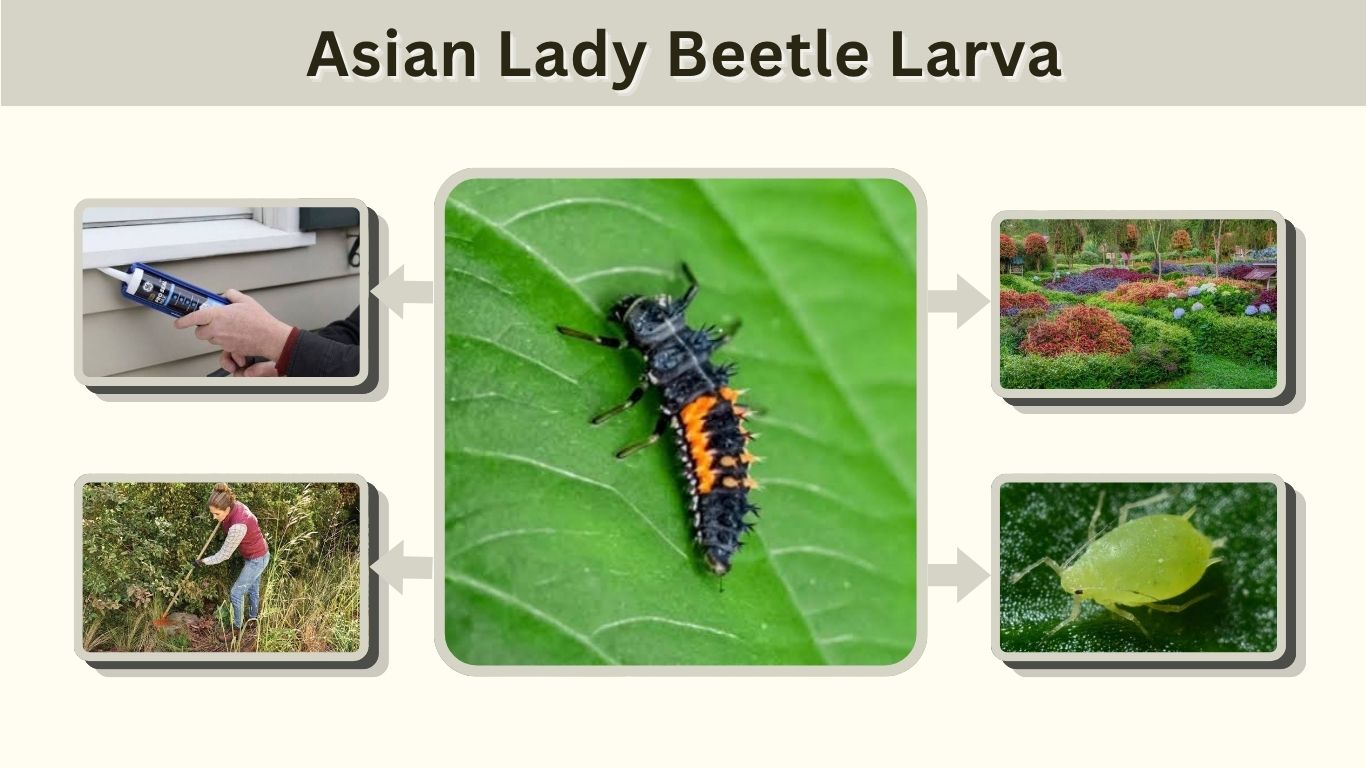
An Asian lady beetle larva looks surprisingly different from the familiar round adult beetle. Instead of a smooth red or orange body, the larva is elongated, dark, spiny, and often marked with bright orange patches. Although its appearance can seem intimidating, it is primarily a beneficial predator that hunts aphids and other small, soft-bodied insects on plants. Understanding the larval stage of the multicolored Asian lady beetle can help you distinguish it from caterpillars, native lady beetle larvae, and potentially harmful garden pests.
What Does an Asian Lady Beetle Larva Look Like?
The multicolored Asian lady beetle, Harmonia axyridis, goes through a larval stage before becoming the recognizable adult lady beetle. Larvae can look almost alligator-like because of their elongated bodies, prominent segments, and small projections. Mature larvae develop especially noticeable orange markings against a dark gray, blue-black, or nearly black body.
Asian Lady Beetle Larva Identification
Look for these common characteristics:
- Elongated, alligator-like body
- Dark blue-gray to black coloration
- Bright orange or yellow-orange markings
- Rows of small branched spines
- Six visible legs near the front of the body
- Segmented abdomen
- Length up to roughly 1/3–1/2 inch
- Usually found walking on leaves and stems
University of Minnesota Extension describes the larvae as black with orange markings and rows of small spines. UC IPM notes that the bright orange markings become particularly prominent during the fourth and final larval stage.
Why Does the Larva Look So Different From the Adult?
Lady beetles undergo complete metamorphosis, meaning their larval and adult stages have very different body forms.
The spiny, elongated larva is adapted for actively crawling across plants and hunting prey. Once it completes its larval development, it becomes a pupa and undergoes a major transformation.
The resulting adult has the rounded, dome-shaped body most people recognize as a ladybug or lady beetle.
Asian Lady Beetle Larva Life Cycle
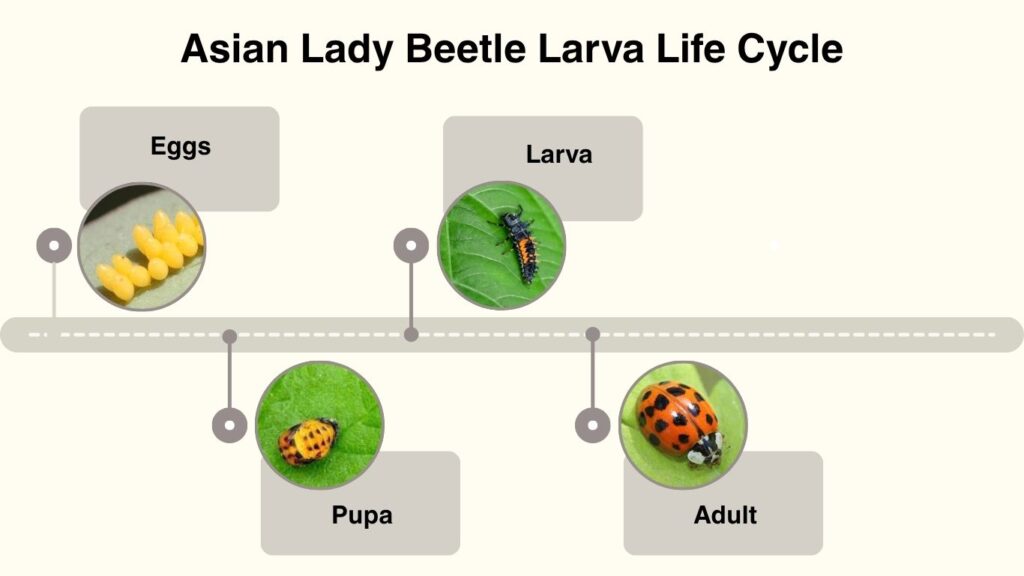
The Asian lady beetle has four major life stages: egg, larva, pupa, and adult. Warm temperatures and abundant prey can accelerate development, while cooler weather may slow it. The larval period is particularly important because this is when the insect actively consumes large quantities of aphids and grows through several stages before pupation.
From Egg to Larva
Female Asian lady beetles lay clusters of small yellow, elongated eggs, commonly on the undersides of leaves near potential prey.
Penn State Extension reports that eggs generally hatch after about three to five days. Newly hatched larvae are small and relatively dark.
They immediately begin searching for food and continue growing through four larval instars. Each time a larva becomes too large for its outer covering, it molts and enters the next developmental stage.
How Long Does the Larval Stage Last?
The four larval instars generally take about 12–14 days under favorable conditions.
Afterward, the mature larva attaches itself to vegetation or another surface and becomes a pupa. The pupal stage typically lasts another four to five days before the adult emerges.
The entire egg-to-adult process can take roughly three to six weeks, depending on temperature and food availability. Multiple generations can occur during a single growing season.
What Do Asian Lady Beetle Larvae Eat?
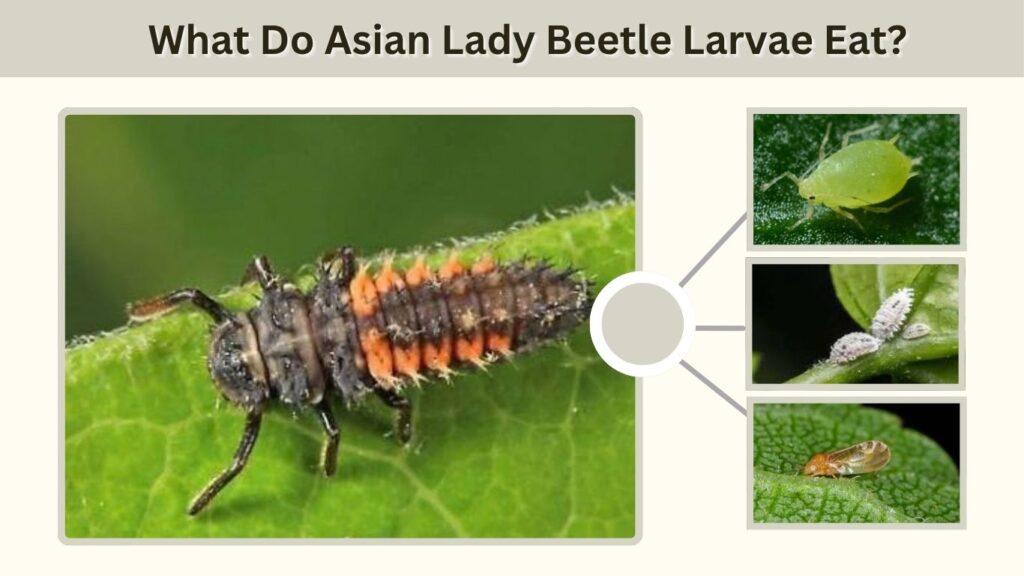
Asian lady beetle larvae are active predators rather than plant-eating caterpillars. They spend much of their time searching leaves and stems for small insects. This predatory behavior is one reason Asian lady beetles were historically valued as biological-control organisms, even though the species can create ecological and household problems in areas where it has become established.
Common Prey
Asian lady beetle larvae may feed on:
- Aphids
- Scale insects
- Psyllids
- Insect eggs
- Other small soft-bodied arthropods
- Occasionally other lady beetle eggs or larvae
Aphids are particularly important prey. University of Minnesota Extension describes Asian lady beetle larvae as beneficial predators commonly found where aphids are abundant. UC IPM likewise lists aphids, scales, adelgids, and psyllids among their prey.
Are They Good for Gardens?
From a short-term pest-control perspective, they can be beneficial because both larvae and adults consume plant-feeding insects.
However, Harmonia axyridis is a non-native species in North America and many other regions. Penn State Extension notes that it can compete with and displace native lady beetle species.
Therefore, its role is complicated: an individual larva may help remove aphids from a plant while the species as a whole may affect native insect communities.
Asian Lady Beetle Larva vs Ladybug Larva
The phrase “ladybug larva” can cause confusion because Asian lady beetles themselves belong to the lady beetle family Coccinellidae. In other words, an Asian lady beetle is a type of ladybug. What people usually mean by this comparison is an Asian lady be
Appearance Can Be Similar
Many lady beetle larvae share the same basic elongated, alligator-like shape.
Asian lady beetle larvae are typically dark with strong orange markings and conspicuous branched spines. However, several native lady beetle larvae also have dark bodies with orange or yellow areas.
That means color alone may not provide a certain identification. Geographic location, markings, size, host plant, and close-up photographs can all help.
Adult identification is often easier because the multicolored Asian lady beetle commonly develops a pale pronotum behind the head with a dark M- or W-shaped marking.
Can an Asian Lady Beetle Larva Bite?
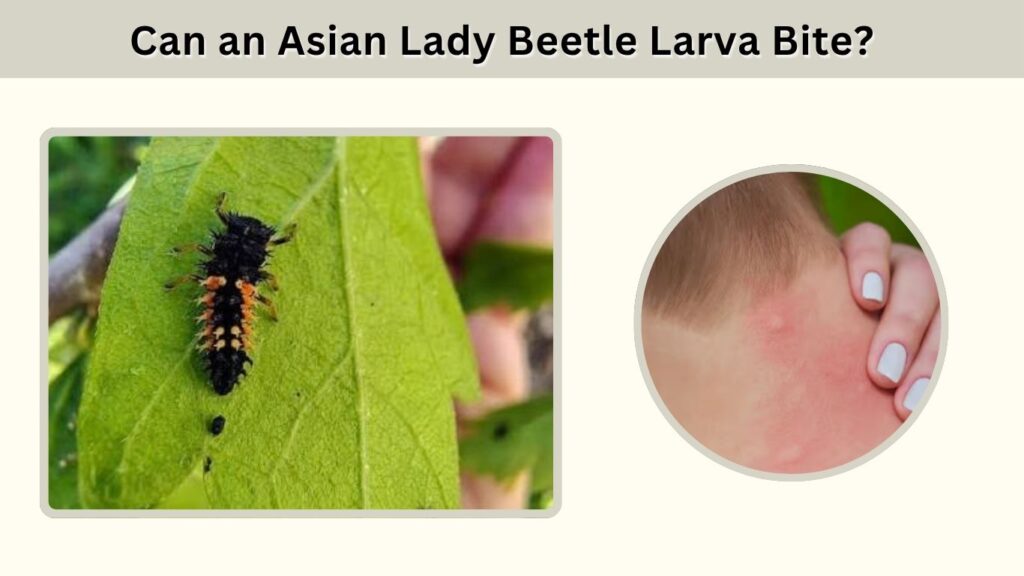
Asian lady beetle adults are known to occasionally nip human skin, but this behavior should not automatically be applied to the larvae. University of Minnesota Extension specifically describes multicolored Asian lady beetle larvae as harmless to people and plants.
Larvae Are Not a Significant Bite Risk
The spines covering an Asian lady beetle larva can make it look dangerous, but they are not stingers.
Larvae are built primarily to hunt tiny prey such as aphids rather than attack people. If one is crawling on your skin, gently brush or allow it to walk onto a leaf instead of crushing it.
Adults are different. University of Minnesota Extension notes that adult Asian lady beetles can occasionally bite hard enough to cause brief discomfort, particularly when they are searching for moisture or food.
Is an Asian Lady Beetle Larva Poisonous?
Asian lady beetle larvae should not be considered poisonous to humans in normal garden contact. Their spiny appearance is easy to mistake for a venomous caterpillar, but they do not possess venomous stingers or the irritating hairs associated with some caterpillars.
Their Spines Are Not Venomous
The projections on the larva are part of its external body structure.
University of Minnesota Extension classifies these larvae as harmless to people and plants. That makes accidental contact very different from touching a genuinely stinging or venomous insect larva.
Asian lady beetles do possess chemical defenses, particularly as adults, and may release yellowish defensive fluid when disturbed. However, this should not be confused with a venom-delivering larval spine.
Where Do Asian Lady Beetle Larvae Live?
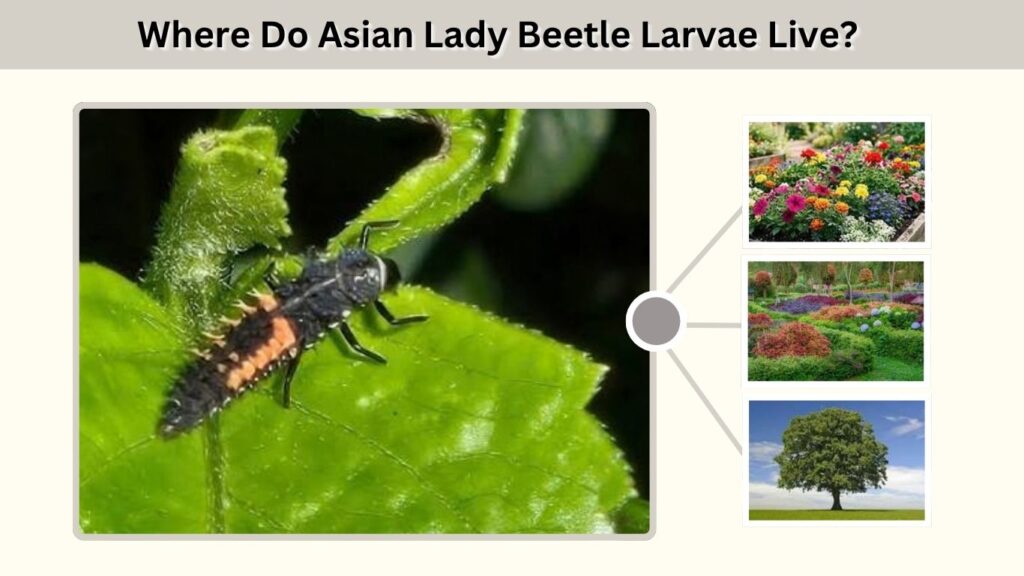
Larvae are generally outdoor insects. They develop where food is available rather than gathering inside buildings like overwintering adults. Gardens, agricultural crops, shrubs, and trees containing aphids are particularly suitable hunting grounds.
When and Where to Look
Asian lady beetle larvae are commonly found on:
- Garden plants
- Shrubs
- Trees
- Agricultural crops
- Leaves containing aphid colonies
- Stems containing soft-bodied insects
University of Minnesota Extension reports that larvae are especially common during late spring and summer, while another Extension resource notes that they occur on many plants wherever aphids and similar prey are available.
Adults, rather than larvae, are responsible for the large autumn gatherings around houses as they search for sheltered overwintering locations.
How to Get Rid of Asian Lady Beetle Larvae
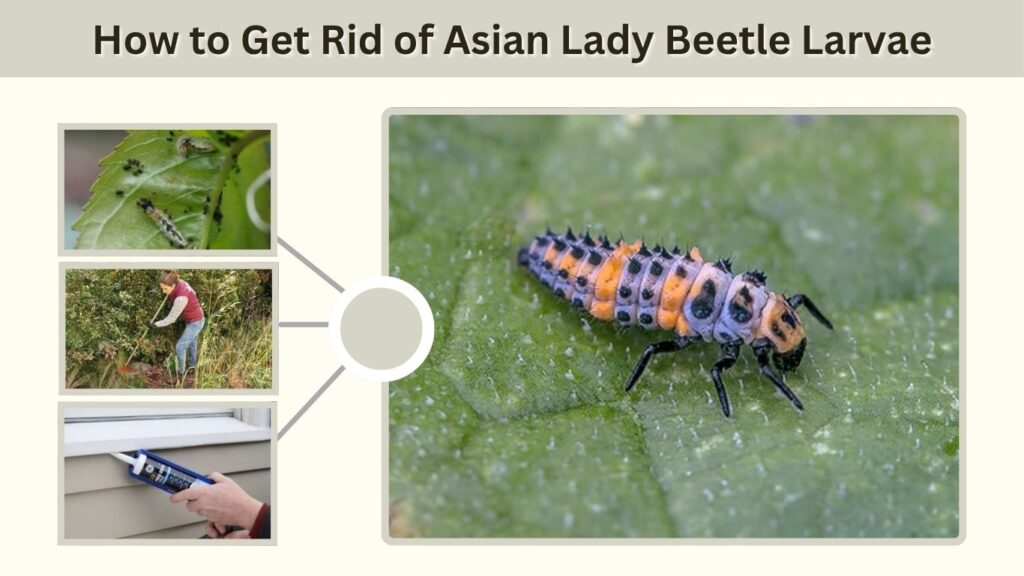
Finding a few larvae outdoors generally does not require treatment. Because they consume aphids, killing them may remove a useful predator from your plants. Management becomes more relevant when large populations of Asian lady beetles repeatedly create nuisance problems or when conservation of native lady beetles is a priority.
What You Can Do
Consider these approaches:
- Leave isolated larvae outdoors when they are feeding on aphids.
- Avoid broad-spectrum insecticides when possible.
- Remove unwanted individuals manually if necessary.
- Monitor plants for both aphids and lady beetles.
- Avoid crushing beetles on light-colored surfaces.
- Seal building gaps before adults begin entering in fall.
- Vacuum adults that accidentally enter buildings rather than spraying indoor populations.
University of Minnesota Extension recommends focusing control on preventing adult Asian lady beetles from entering buildings rather than treating beneficial outdoor populations.
FAQs
What does an Asian lady beetle larva look like?
An Asian lady beetle larva has an elongated, alligator-like body that is usually dark gray, blue-black, or black. Mature larvae develop bright orange markings along the abdomen and have rows of small branched spines. They can grow to roughly 1/3–1/2 inch long.
Do Asian lady beetle larvae bite humans?
Asian lady beetle larvae are not considered a significant bite threat. University of Minnesota Extension describes them as harmless to people and plants. Adult Asian lady beetles can occasionally nip human skin, but this behavior should not be confused with the appearance or behavior of their larval stage.
Are Asian lady beetle larvae poisonous?
Asian lady beetle larvae are not regarded as poisonous or venomous to humans during normal contact. Their dark, spiny bodies may resemble dangerous caterpillars, but the projections are not venomous stingers. If you find one outdoors, there is usually no need to handle or destroy it.
What do Asian lady beetle larvae eat?
They mainly prey on aphids and other small, soft-bodied insects. Their diet may also include scales, psyllids, adelgids, and insect eggs. This predatory appetite makes larvae useful for reducing certain plant pests, although the Asian lady beetle itself is non-native in many regions.
How long does an Asian lady beetle stay a larva?
The larval period generally lasts about 12–14 days under favorable conditions. During that time, the insect passes through four larval instars and grows rapidly while feeding. It then becomes a pupa for several more days before emerging as an adult Asian lady beetle.