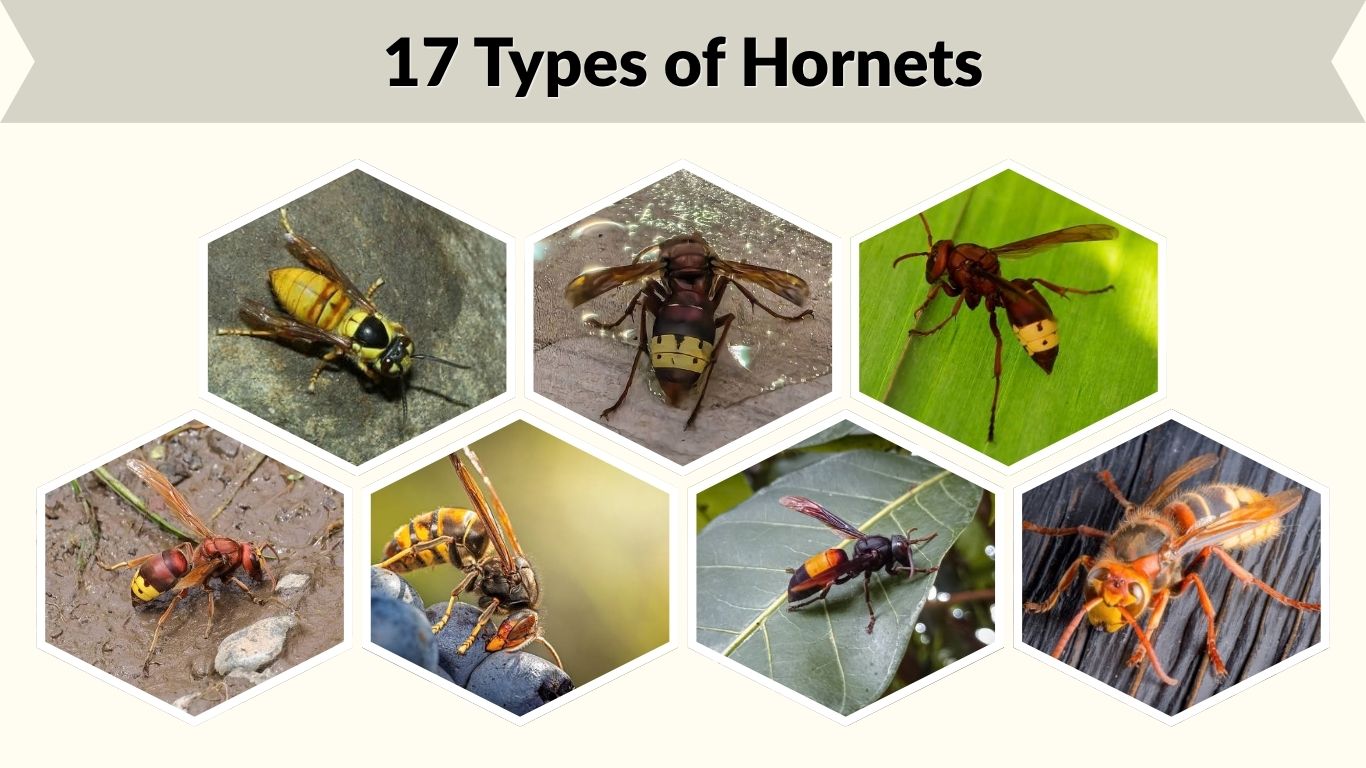
Hornets are large social wasps known for their powerful bodies, organized colonies, and impressive hunting abilities. Although many hornet species may look similar at first, they differ greatly in size, coloration, nesting habits, geographic range, and behavior. Some build nests underground or inside tree cavities, while others create aerial paper nests. In this guide, you’ll discover 17 types of hornets, including giant, European, Oriental, banded, and yellow-legged hornets, along with their identification features, habitat, diet, behavior, lifespan, and life cycle.
1. Northern Giant Hornet
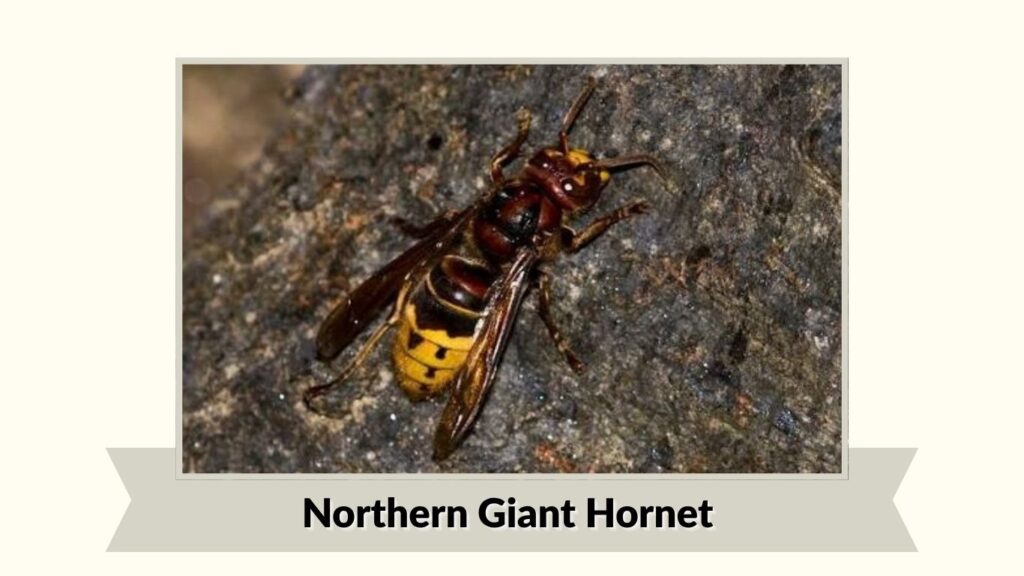
The Northern Giant Hornet (Vespa mandarinia) is the largest hornet species in the world, with adults reaching up to about 2 inches in length. Native to parts of Asia, this powerful social wasp is recognizable by its large orange head, dark thorax, and banded abdomen. It mainly nests underground and preys on various insects, including honey bees. Despite its intimidating appearance, it generally does not attack people unless threatened or its nest is disturbed.
Identification
Northern Giant Hornets are considerably larger than most common wasps and hornets. Their large head and strongly contrasting abdominal bands are particularly useful identification features.
- Adults are about 1.5–2 inches long
- Large yellow-orange to orange head
- Prominent black or dark brown eyes
- Mostly dark brown or black thorax
- Abdomen has alternating dark and yellow-orange bands
- Broad, powerful body compared with typical yellowjackets
- Brownish-gray transparent wings
- Queens are larger and heavier-bodied than workers
Habitat and Distribution
Northern Giant Hornets are native to eastern and parts of southern Asia. They favor forested and mountainous landscapes where suitable underground cavities and abundant insect prey are available. Queens usually establish nests in preexisting underground spaces, particularly abandoned rodent burrows with relatively narrow entrances.
The species was detected in Washington State and British Columbia beginning in 2019. However, after several years without confirmed detections, authorities declared it eradicated from the United States in December 2024.
Behavior and Diet
Northern Giant Hornets are social predators. Workers hunt various insects and carry protein-rich food back to the nest for developing larvae. Queens also feed on tree sap during the early stages of colony development.
Later in summer and early fall, colonies may attack honey bee hives. Groups of workers can kill adult bees and then remove bee larvae and pupae to feed their own brood. This behavior makes the species a significant threat to honey bee colonies in areas where it occurs.
Lifespan and Life Cycle
The colony follows an annual life cycle. A fertilized queen emerges from overwintering in spring and searches for an underground nesting site. Initially, she builds the nest, lays eggs, gathers food, and cares for her first brood alone.
Once roughly 40 workers are present, they take over foraging and other outside duties while the queen remains inside producing eggs. Colonies grow through summer and begin producing males and new queens toward late summer and fall.
After mating, new queens overwinter in protected soil, decaying wood, or similar sheltered locations. Workers, males, and the old queen die as winter arrives, and surviving fertilized queens begin new colonies the following spring.
2. Southern Giant Hornet
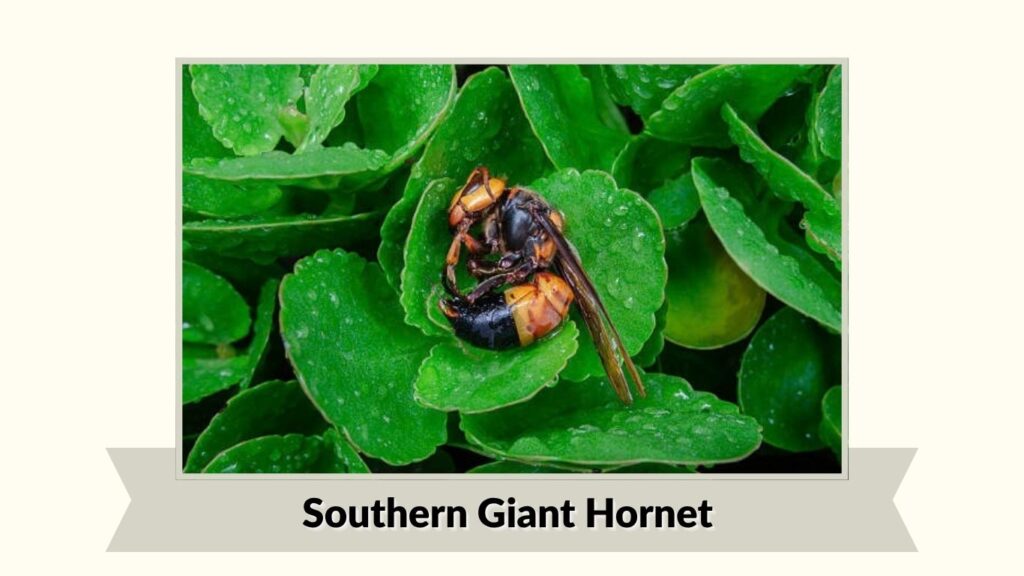
The Southern Giant Hornet (Vespa soror) is one of the largest true hornets in the world and a close relative of the Northern Giant Hornet. Native to parts of South and Southeast Asia, it is a powerful social predator known for large underground colonies and coordinated attacks on other social insects. Mature colonies can contain hundreds or even more than a thousand adults.
Identification
Southern Giant Hornets have a massive body, broad head, and striking orange, yellow, and black coloration. Workers average around 3.2 cm long, although their size can vary considerably.
- Workers generally about 27–37 mm long
- Queens noticeably larger than workers
- Large yellow to orange head
- Broad head extending behind the eyes
- Mostly dark thorax
- Orange-brown and yellow markings near the front of the abdomen
- Rear portion of abdomen mostly dark
- Large, powerful mandibles
Habitat and Distribution
Southern Giant Hornets are native to parts of northeastern India, southern China, northern Thailand, Laos, and Vietnam. They generally inhabit forested or partly forested landscapes where suitable underground nesting cavities and abundant insect prey are available.
Their nests are primarily subterranean. Colonies construct multiple horizontal combs inside underground cavities, producing extensive nests as populations increase through the season. Research in northern Vietnam has documented exceptionally large mature colonies.
Behavior and Diet
Southern Giant Hornets are formidable predators. Workers hunt many kinds of insects, including mantises, grasshoppers, butterflies, dragonflies, wasps, other hornets, and honey bees. They have even been observed attacking small vertebrates such as geckos.
One of their most remarkable behaviors is coordinated attack on social-insect colonies. Groups of workers can overwhelm honey bee nests and carry protein-rich broods back to feed hornet larvae.
Lifespan and Life Cycle
Southern Giant Hornets live in organized social colonies. A queen establishes or heads the colony, while workers construct combs, forage, defend the nest, and care for developing broods.
Research indicates that colonies in subtropical regions may have relatively long nesting seasons. Mature colonies can become extremely populous, with one studied colony containing roughly 1,200 adults and more than 1,100 pupae. Colonies eventually produce reproductive males and new queens. New queens mate and become the individuals responsible for starting the next generation.
3. European Hornet
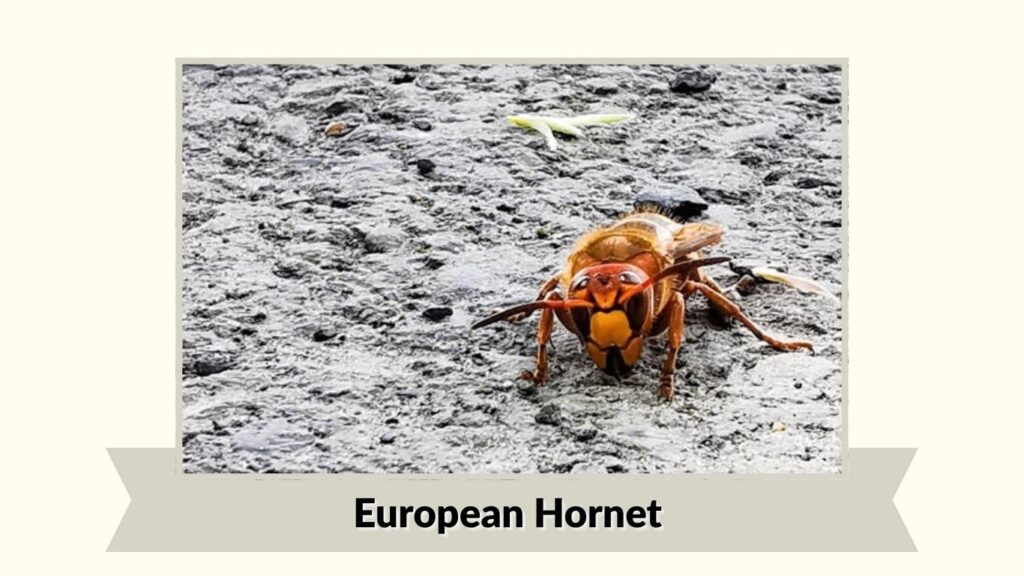
The European Hornet (Vespa crabro) is a large social hornet native to Europe and Asia. It is also well established in eastern North America after being introduced during the nineteenth century. Despite its intimidating size, it is an important predator of other insects and normally becomes defensive primarily when its nest is threatened.
Identification
European Hornets are much larger than ordinary yellowjackets and have a distinctive combination of reddish-brown, black, and yellow coloration.
- Workers can reach approximately 25 mm
- Queens may reach around 35 mm
- Head largely reddish brown and yellow
- Thorax dark with reddish-brown areas
- Abdomen predominantly yellow with dark markings
- Thick, powerful body
- Brownish transparent wings
- Queens larger and heavier than workers
Habitat and Distribution
The European Hornet is native across much of Europe and parts of Asia. It was introduced into North America and first recorded in the United States during the 1840s. It is now widely established across much of the eastern United States.
Woodlands are an especially important habitat. Colonies commonly occupy hollow trees but may also establish themselves inside wall cavities, attics, barns, and other sheltered structures. Unlike many aerial hornets, they prefer an enclosed cavity around the nest.
Behavior and Diet
European Hornets are active predators of many insects. Workers capture prey and chew it into protein-rich material that is carried back to developing larvae.
Adult hornets obtain much of their own energy from sugary liquids such as nectar and tree sap. They are known to strip or girdle small twigs and branches to reach flowing sap. European Hornets are also unusual among many large wasps because workers may remain active after dark and are sometimes attracted to artificial lights.
Lifespan and Life Cycle
In spring, an overwintered queen finds a suitable cavity and constructs the first paper cells. She lays eggs and personally raises the first workers.
After several workers mature, they assume nest construction, hunting, and brood-care duties. The queen then concentrates mainly on laying eggs. The colony reaches its greatest size toward late summer.
Males and new queens are eventually produced. After mating, new queens seek sheltered places for winter. The workers, males, and old queen die as the season ends, and the abandoned nest is generally not reused.
4. Oriental Hornet
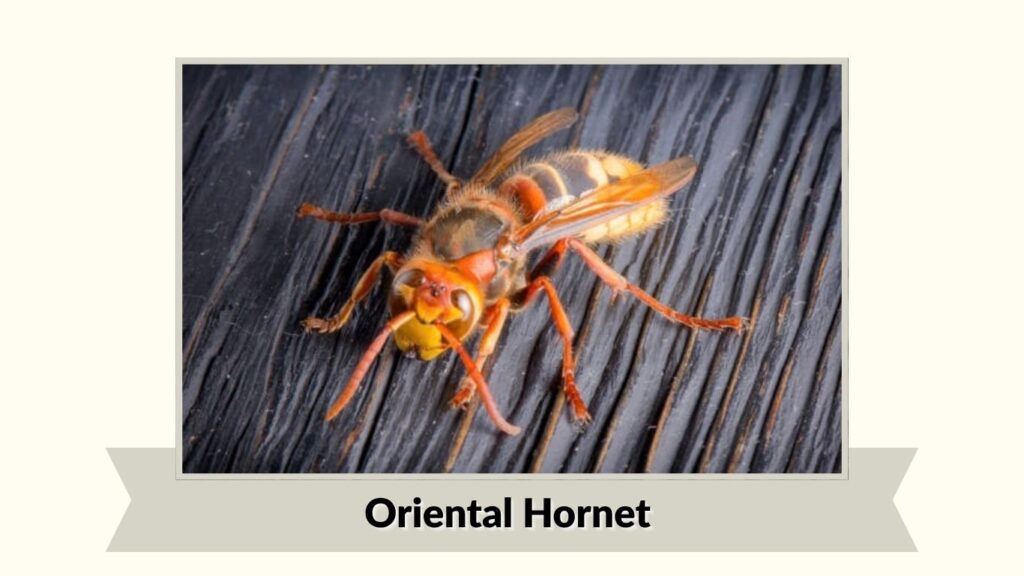
The Oriental Hornet (Vespa orientalis) is a strongly built social hornet adapted especially well to warm, dry environments. It is recognized by its reddish-brown body and contrasting yellow abdominal markings. This hornet is an important predator but can also become a serious problem around apiaries because workers frequently hunt honey bees.
Identification
Oriental Hornets have a distinctive coloration that separates them from most yellow-and-black hornets. Their reddish-brown body combined with broad yellow abdominal areas is particularly characteristic.
- Predominantly reddish-brown body
- Broad yellow markings on the abdomen
- Yellow facial markings
- Strong, robust body
- Dark reddish-brown antennae
- Brownish transparent wings
- Large jaws adapted for capturing prey
- Queens larger than workers
Habitat and Distribution
The Oriental Hornet occurs naturally across portions of southeastern Europe, North Africa, the Middle East, and western and southern Asia. It is particularly successful in warm Mediterranean, semi-arid, and dry environments. It has also appeared beyond parts of its historical range through natural expansion and human-assisted transport.
Colonies frequently establish nests underground or inside protected cavities. Suitable sites can include soil banks, abandoned animal burrows, walls, buildings, and other sheltered spaces.
Behavior and Diet
Adult Oriental Hornets rely heavily on carbohydrate-rich foods. Nectar, honeydew, ripe fruit, and other sugary materials provide energy for their demanding flight activity.
Their larvae, however, require protein. Workers therefore hunt large insects such as flies, grasshoppers, and especially honey bees. They can also scavenge meat and fish. Heavy predation around apiaries can weaken honey bee colonies and make the hornet an economically significant pest in some regions.
Lifespan and Life Cycle
Oriental Hornet colonies normally follow a seasonal cycle. A fertilized queen begins a colony when favorable temperatures return. She establishes the first cells and produces workers that later handle nest expansion, hunting, and brood care.
Colonies expand throughout the warmer months. Toward the end of summer and beginning of autumn, new queens and males are produced. They leave the nest and mate.
Fertilized young queens then seek protected cavities or crevices in which to overwinter. Most workers, males, and the old queen die as the colony declines, while surviving queens begin the next generation when suitable conditions return.
5. Yellow-Legged Hornet
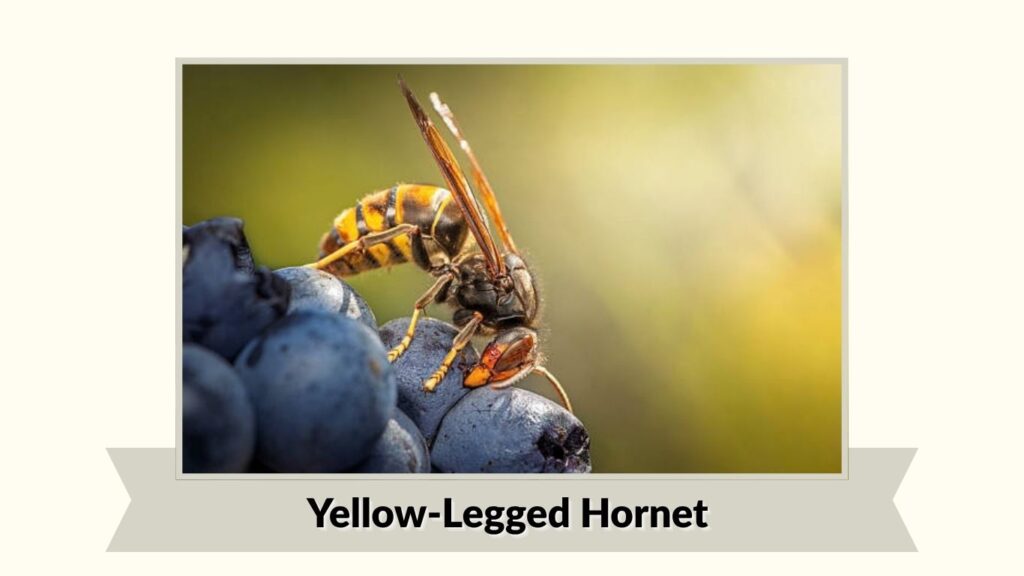
The Yellow-Legged Hornet (Vespa velutina) is an Asian hornet named for the conspicuous yellow ends of its legs. It is a highly adaptable social predator and has become invasive in several regions outside its native range. Honey bees form an important part of its prey, making this hornet a major concern for beekeeping and pollinator protection where it becomes established.
Identification
Yellow-Legged Hornets are generally darker than European Hornets. Their yellow lower legs and contrasting orange-yellow abdominal band provide useful field identification features.
- Approximately ¾–1 inch long
- Body predominantly dark brown or black
- Distinct yellow lower legs
- Abdomen mostly dark
- Noticeable yellow-orange abdominal band
- Dark head with orange-yellow face
- Brownish wings
- Queens larger than typical workers
Habitat and Distribution
The species is native to Asia but has spread into several other regions. Colonies are especially successful in areas offering abundant insect prey, flowering vegetation, trees, and nearby water.
Nests are made from chewed plant fibers and usually become large as summer progresses. Mature secondary nests are frequently positioned high in trees but can also occur on barns, sheds, rooflines, and other structures. Some may contain thousands of workers.
In the United States, detections have occurred in Georgia, South Carolina, and North Carolina, where authorities continue surveillance and nest-removal efforts.
Behavior and Diet
Yellow-Legged Hornets are skilled insect predators. Workers capture flies, bees, wasps, and other insects to provide protein for growing larvae.
Honey bees can become especially important prey later in the colony season. Workers may hover near hive entrances and intercept returning bees, making heavily affected apiaries vulnerable to continued predation. Adults themselves depend largely on sugary liquids for energy.
Lifespan and Life Cycle
The yearly cycle begins when fertilized queens emerge from winter shelter in spring and start small nests. The first workers mature during spring or early summer and begin foraging and expanding the colony.
Large secondary nests develop as worker numbers increase. By late summer and early fall, colonies begin producing males and future queens.
Mating occurs during autumn. Newly fertilized queens find protected overwintering sites, while workers, males, and the old queen die. Surviving queens establish new colonies the following spring.
6. Lesser-Banded Hornet
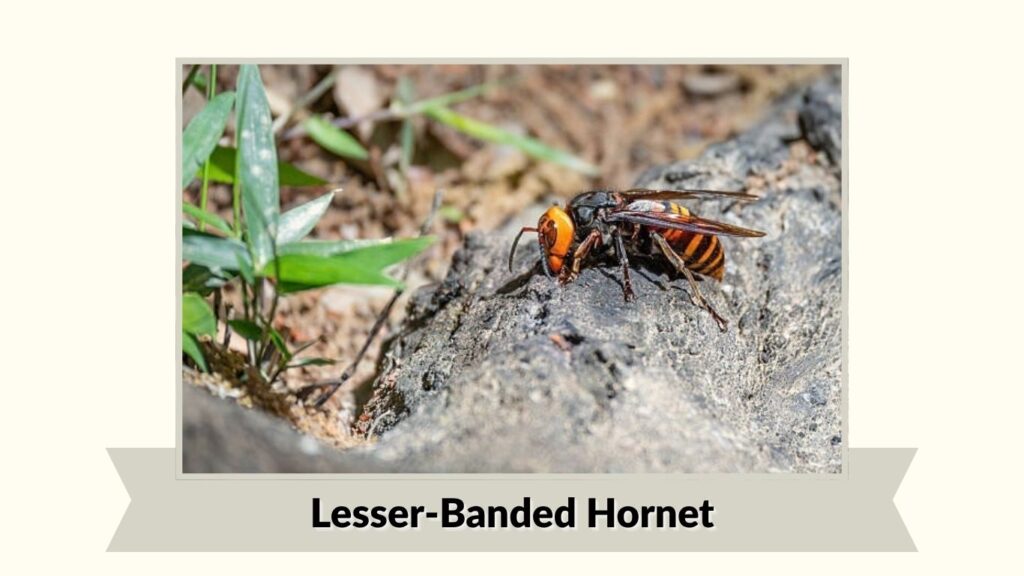
The Lesser-Banded Hornet (Vespa affinis) is a common social hornet of tropical and subtropical Asia. Its name refers to the relatively limited yellow or orange banding on its otherwise dark abdomen. This adaptable species inhabits forests, grasslands, agricultural areas, and cities and can build impressive paper nests on trees, shrubs, or human structures.
Identification
Lesser-Banded Hornets usually have a dark body with one conspicuous orange-yellow abdominal region. Their exact coloration varies geographically, so different populations may look somewhat different.
- Workers usually around 22–25 mm long
- Queens may reach about 30 mm
- Head reddish brown to dark
- Thorax predominantly black
- Abdomen mostly dark brown or black
- Distinct yellow-orange band near the front of the abdomen
- Dark brown legs
- Smoky brown wings
Habitat and Distribution
The Lesser-Banded Hornet occurs widely throughout tropical and subtropical Asia. Its range includes areas such as Sri Lanka, Myanmar, Thailand, Laos, Vietnam, Cambodia, Malaysia, Singapore, Indonesia, Taiwan, Hong Kong, and parts of the Philippines.
It adapts well to both natural and human-modified environments. Hornets may forage in forests, grasslands, wastelands, gardens, and urban parks.
Nests are generally above ground. They may be suspended high in trees, attached to low shrubs, or constructed on buildings. Mature tropical nests can become large and elongated.
Behavior and Diet
Lesser-Banded Hornets have a broad diet. Adults consume carbohydrate-rich substances such as nectar, fruit juices, tree sap, and sweet secretions from larvae.
Workers also collect animal protein for developing brood. Their prey includes bees, paper wasps, flies, insect larvae, and other insects. They may additionally collect material from recently dead animals or insects.
Lifespan and Life Cycle
Like other hornets, the Lesser-Banded Hornet undergoes complete metamorphosis through egg, larva, pupa, and adult stages. Workers can begin emerging roughly a month after nest initiation, although development varies with environmental conditions.
Its colony cycle varies across its broad geographic range. In subtropical regions, queens emerge after winter and colonies develop through the warmer months before declining late in the year.
In tropical climates, activity can occur over a much longer period. Colonies may also show unusual founding strategies involving more than one queen or groups of workers participating in the establishment of a new nest.
7. Greater-Banded Hornet
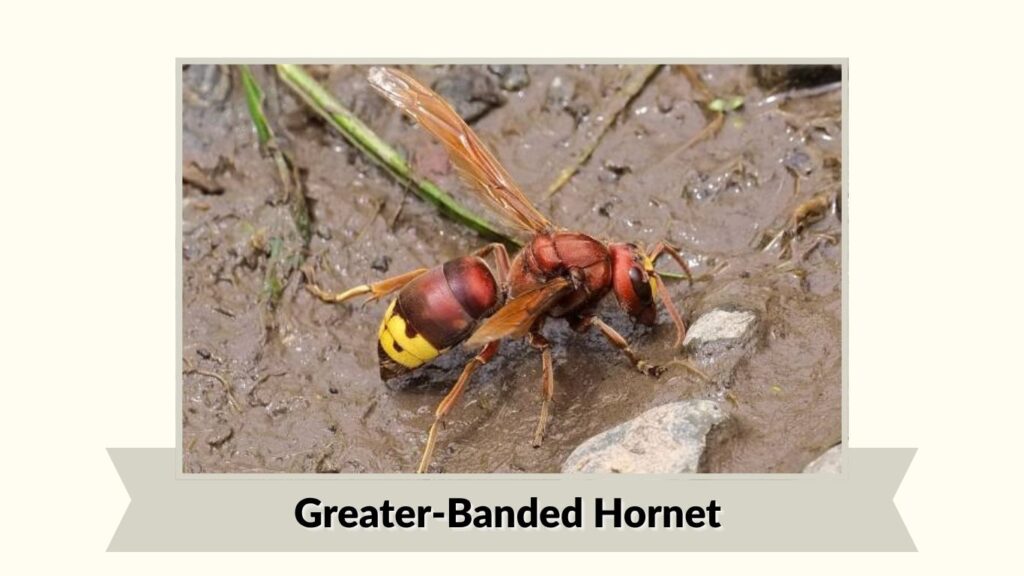
The Greater-Banded Hornet (Vespa tropica) is a large social hornet native to tropical and subtropical Asia. It is easily recognized by its mostly dark body and broad yellow or orange abdominal band. This species is a powerful predator, particularly of paper wasps, and may raid their nests to collect larvae and pupae as food for its own developing brood.
Identification
Greater-Banded Hornets have a heavy, muscular appearance and one conspicuous abdominal band. Color varies geographically, so individuals from different regions may look somewhat different.
- Workers generally about 24–26 mm long
- Queens may reach around 30 mm
- Head dark brown, reddish brown, or nearly black
- Thorax predominantly black
- Abdomen mostly black
- Broad yellow to orange band across the second abdominal segment
- Dark legs and antennae
- Smoky brown wings
Habitat and Distribution
The Greater-Banded Hornet has a broad Asian distribution extending from Afghanistan, Pakistan, India, Sri Lanka, Nepal, and Bhutan through southern China and Southeast Asia to Indonesia, the Philippines, and Papua New Guinea. It has also become established on Guam.
Nests may be constructed underground, inside tree cavities, beneath buildings, under eaves, or in sheltered structural spaces. Recent research on Guam found most nests inside cavities or other protected locations, although exposed aerial nests also occur.
Behavior and Diet
Greater-Banded Hornets are especially well known as predators of social wasps. Workers raid paper-wasp nests and remove larvae and pupae, which provide protein for hornet larvae. They may also hunt honey bees and other insects.
Adult hornets obtain energy from carbohydrate-rich plant resources. Because solid prey is primarily used for the brood, workers spend considerable time locating both insect prey and sugary foods.
Lifespan and Life Cycle
In seasonal parts of their range, overwintered queens establish new colonies and initially raise the first workers themselves. Japanese studies found V. tropica queens emerging relatively late compared with several other local hornet species. Once workers appear, they assume hunting, nest construction, defense, and brood care.
The colony eventually shifts toward producing males and new queens. After mating, reproductive queens become responsible for beginning the next generation. In tropical climates, timing can vary considerably because warm conditions may permit a longer period of colony activity.
8. Yellow-Vented Hornet
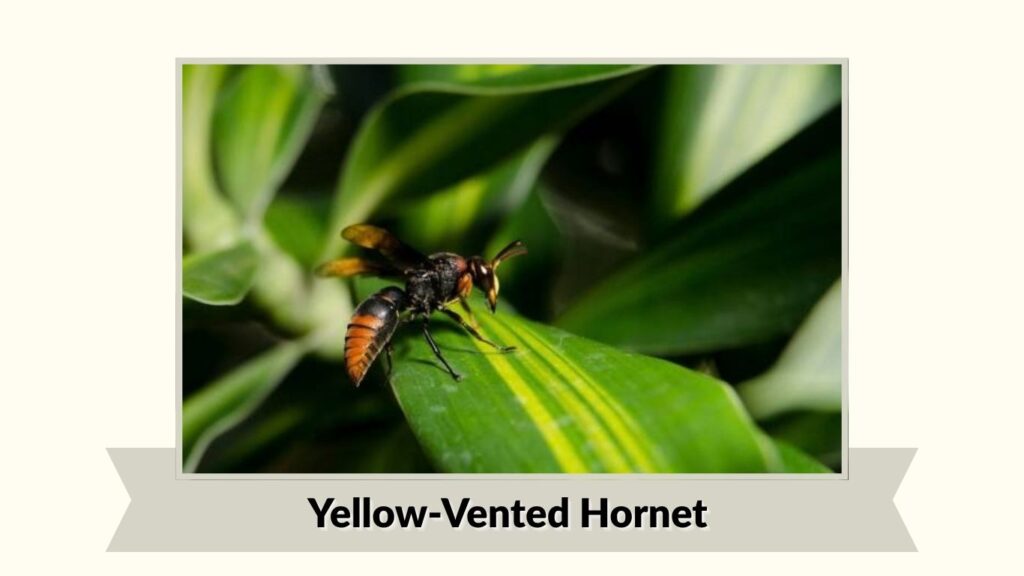
The Yellow-Vented Hornet (Vespa analis) is a widely distributed Asian hornet notable for the yellow or pale coloration near the tip of its abdomen. Its appearance varies considerably across its range, with some populations having reddish or yellow heads while others appear predominantly black. It occupies forests as well as landscapes near people and typically constructs enclosed paper nests above ground.
Identification
Color variation is unusually strong in this species. Southeast Asian individuals are commonly dark with a bright yellow abdominal tip, while northern populations can display much more yellow coloration.
- Workers commonly about 20–30 mm long
- Predominantly dark brown or black body in tropical populations
- Yellow terminal abdominal segment
- Head may be reddish brown, black, or yellow depending on region
- Strong mandibles
- Robust thorax
- Long antennae
- Brownish transparent wings
Habitat and Distribution
The Yellow-Vented Hornet is among the most widely distributed true hornets in Asia. Its range includes India, Nepal, China, Hong Kong, Taiwan, Korea, Japan, Russia, Myanmar, Thailand, Laos, Vietnam, Malaysia, Singapore, and Indonesia.
Nests are generally aerial. Taxonomic accounts report that colonies commonly construct nests in trees about two to three meters above the ground, although nesting height and placement can vary with climate and available shelter.
Behavior and Diet
Yellow-Vented Hornets are versatile insect hunters. Studies in Japan describe them as generalist predators capable of capturing a broad range of insects and spiders. Recorded prey includes butterflies, bees, and other flying insects.
Adults obtain carbohydrates from resources such as tree sap, nectar, and other sugary plant liquids. Compared with certain scavenging hornets, they are more strongly associated with hunting live prey.
Lifespan and Life Cycle
In temperate regions, the Yellow-Vented Hornet follows an annual colony cycle. An overwintered queen emerges in spring, constructs the first cells, and independently raises approximately the first generation of workers.
Workers emerge during early summer and gradually assume foraging and colony-maintenance duties. The population expands through summer before reproductive males and new queens appear later in the season. After mating, young queens enter overwintering sites while the original colony declines.
The exact timing varies geographically, particularly because the species occurs from tropical Southeast Asia to cooler areas of Japan and Russia.
9. Black-Bellied Hornet
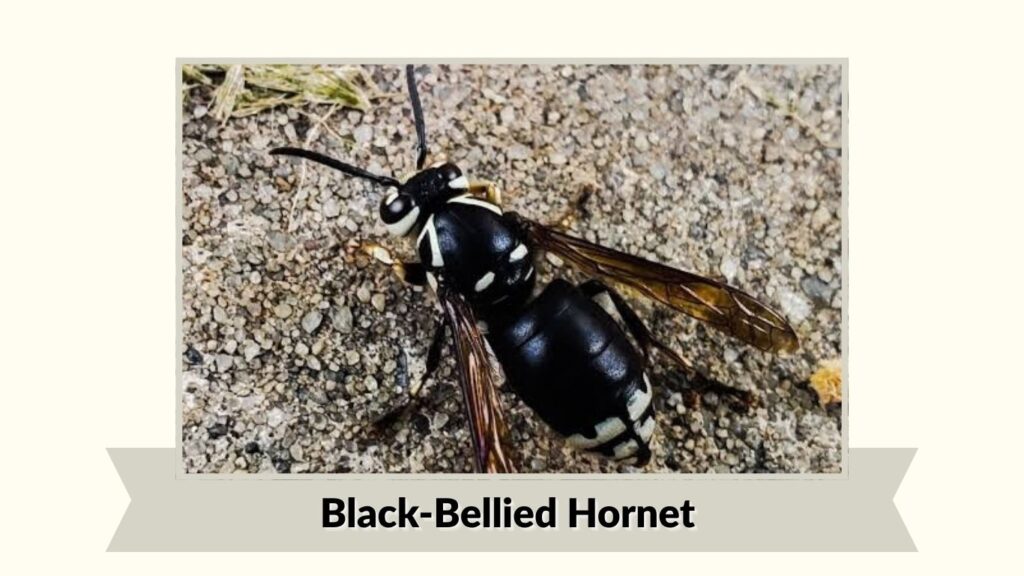
The Black-Bellied Hornet (Vespa basalis) is an Asian true hornet recognized by its unusually dark abdomen. While many hornet species have obvious yellow or orange bands across the abdomen, V. basalis is largely dark brown to black, giving it a distinctive appearance. It is particularly associated with forested landscapes at moderate elevations and can construct nests in a surprisingly wide range of locations.
Identification
The almost entirely dark abdomen provides one of the clearest field clues for recognizing this hornet.
- Medium-to-large, strongly built hornet
- Abdomen mostly dark brown or black
- Head may show reddish or brown coloration
- Thorax predominantly dark
- Minimal yellow abdominal banding
- Strong mandibles
- Long dark antennae
- Smoky transparent wings
Habitat and Distribution
The Black-Bellied Hornet occurs from Pakistan and India through Nepal, China, Taiwan, Myanmar, Thailand, Laos, Vietnam, and Sumatra. Research summaries associate it particularly with forested regions at elevations of roughly 500–1,500 meters.
Its nesting behavior is flexible. Colonies have been recorded on tree branches, in shrubs, on buildings, inside rock crevices, and even underground. This versatility allows the species to exploit both natural and human-modified habitats.
Behavior and Diet
Like other hornets, Black-Bellied Hornets are predators whose workers collect animal protein for developing larvae. Recent dietary research found that beetles represented an especially important part of the sampled V. basalis diet, with leaf beetles strongly represented.
Adults also depend on plant-derived carbohydrate sources. The same research detected strong associations with plants in the order Fagales, particularly Castanopsis, suggesting that forest vegetation supplies important food resources alongside insect prey.
Lifespan and Life Cycle
Black-Bellied Hornets live in organized social colonies consisting of a reproductive queen and workers. A queen establishes a nest and raises the first brood before workers take responsibility for hunting, nest maintenance, defense, and larval care.
As the colony grows, worker numbers increase and additional paper comb is produced. Later in the reproductive phase, males and new queens develop.
After mating, future queens become responsible for carrying the population into the next reproductive cycle. In cooler parts of the range, this normally involves overwintering before colony foundation, while seasonal timing can be different in warmer tropical environments.
10. Black-Tailed Hornet
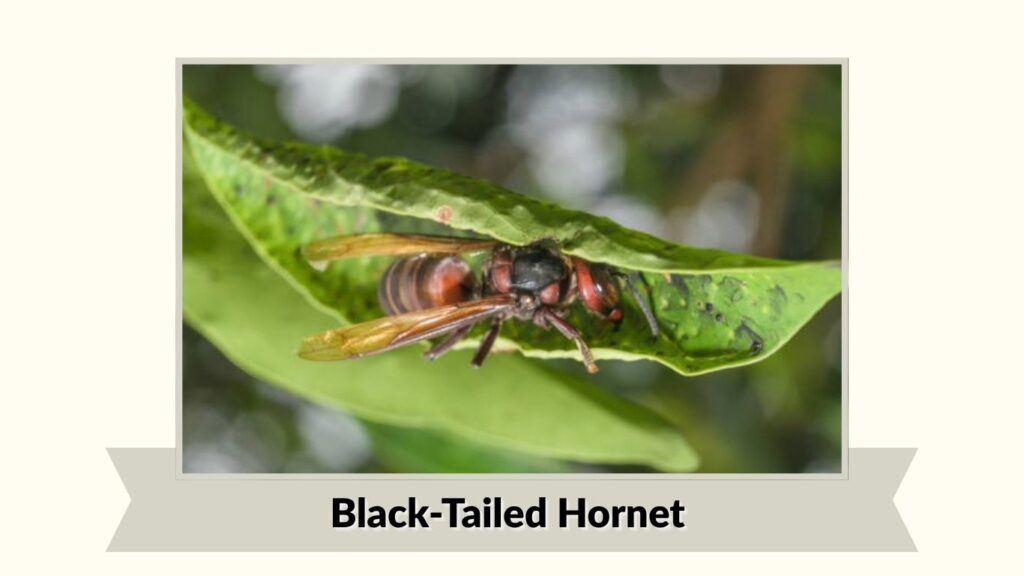
The Black-Tailed Hornet (Vespa ducalis) is a large Asian hornet recognized by the striking black coloration at the end of its abdomen. Despite its impressive size, its colonies are remarkably small compared with those of many other true hornets. It is also a highly specialized predator whose workers frequently raid paper-wasp colonies specifically to obtain larvae and pupae.
Identification
The contrasting orange-yellow front portion of the body and dark abdominal tip are particularly helpful identification features.
- Workers about 24–32 mm long
- Queens may reach approximately 37 mm
- Large orange or yellow head
- Dark thorax
- Orange-yellow markings on the front abdominal segments
- Distinctly black terminal abdomen or “tail”
- Strong jaws
- Brownish transparent wings
Habitat and Distribution
Black-Tailed Hornets occur widely across Asia. Their range includes northeastern India, Nepal, Myanmar, Thailand, Laos, Vietnam, China, Hong Kong, Taiwan, Korea, eastern Russia, and Japan, including the Ryukyu Islands.
Nesting sites are varied but generally protected. Colonies have been found underground, inside tree hollows, and even within attics. Their nests are considerably smaller than those of many other Vespa species.
Behavior and Diet
The Black-Tailed Hornet is especially adapted for raiding paper-wasp nests. Workers attack colonies and collect the pupae and larvae rather than focusing primarily on killing adult paper wasps. The captured brood is carried back as protein-rich food for hornet larvae.
Adults themselves rely more strongly on sugary liquids for energy, including plant-derived carbohydrate sources.
Lifespan and Life Cycle
The Black-Tailed Hornet has one of the smallest typical colonies among true hornets. Research summaries report colonies averaging only around 50 individuals.
A founding queen initially establishes the nest and produces workers. Once workers appear, they conduct most hunting and nest-maintenance activities. Their specialized paper-wasp predation helps provide the protein required for developing brood.
The colony eventually produces males and new queens. New reproductive females mate and become responsible for founding the next generation, while the old seasonal colony declines as environmental conditions become unfavorable.
11. Dybowski’s Hornet
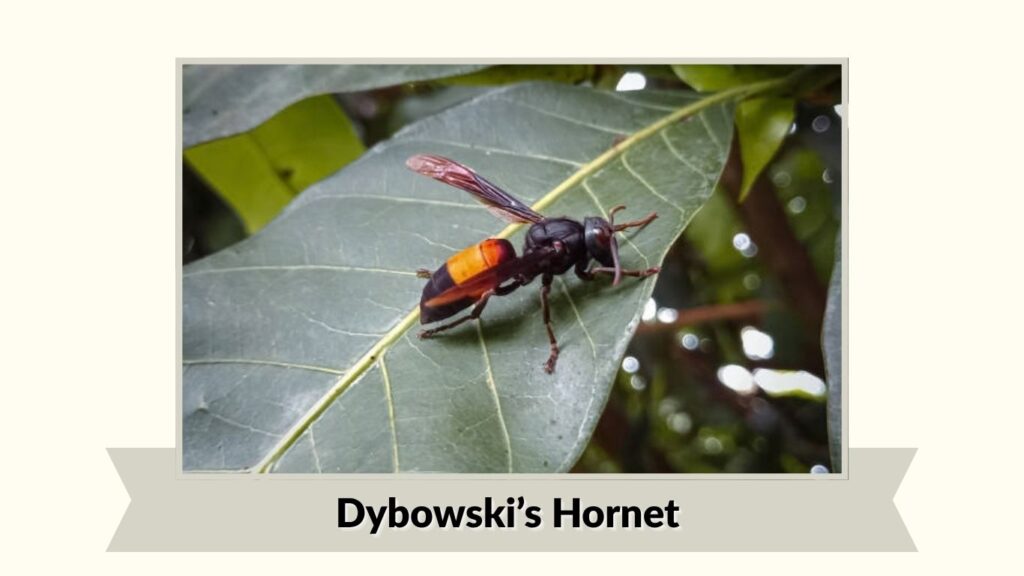
Dybowski’s Hornet (Vespa dybowskii) is one of the most unusual true hornets because it can reproduce through social parasitism. Rather than always creating a colony entirely on its own, a queen may invade the nest of another hornet, kill or replace its queen, and use the resident workers to raise her offspring. Known hosts include the European Hornet and Yellow Hornet.
Identification
Dybowski’s Hornet has a much darker appearance than the strongly yellow-banded hornets commonly encountered in Asia.
- Workers generally around 17–24 mm long
- Queens may approach 30 mm
- Head reddish brown
- Thorax reddish brown with darker upper markings
- Abdomen predominantly or completely black
- Very little yellow coloration
- Strong mandibles
- Amber to brownish transparent wings
Habitat and Distribution
Dybowski’s Hornet occurs mainly in eastern Asia. Recorded populations include Myanmar, China, eastern Russia, Korea, and Japan. The species is relatively uncommon in scientific collections compared with several widespread hornets.
It is associated particularly with woodland habitats where suitable tree cavities and host hornet colonies are available. Independent nests can occur in protected cavities, although colony takeover is one of the species’ best-known behaviors.
Behavior and Diet
Dybowski’s Hornet is particularly fascinating because of its social-parasitic strategy. A queen may invade a well-established colony of Vespa simillima or Vespa crabro, eliminate the host queen, and begin producing her own eggs.
The existing host workers continue normal colony activities and raise the invading queen’s brood. Research suggests that the parasite’s eggs have unusual chemical properties that may help prevent host workers from recognizing and rejecting them.
Lifespan and Life Cycle
Dybowski’s Hornet can establish colonies independently, but social parasitism is considered an important colony-founding strategy. When parasitism occurs, a queen finds an established host colony rather than raising an entire first generation of workers by herself.
After takeover, host workers care for the invading queen’s eggs and developing brood. Unlike obligate cuckoo yellowjackets that lack workers entirely, V. dybowskii produces its own worker offspring, which gradually become part of the colony.
Later in the season, the colony produces reproductive males and queens. After mating, young queens survive the unfavorable season and can either establish their own colonies or attempt to usurp suitable host nests the following year.
12. Yellow Hornet
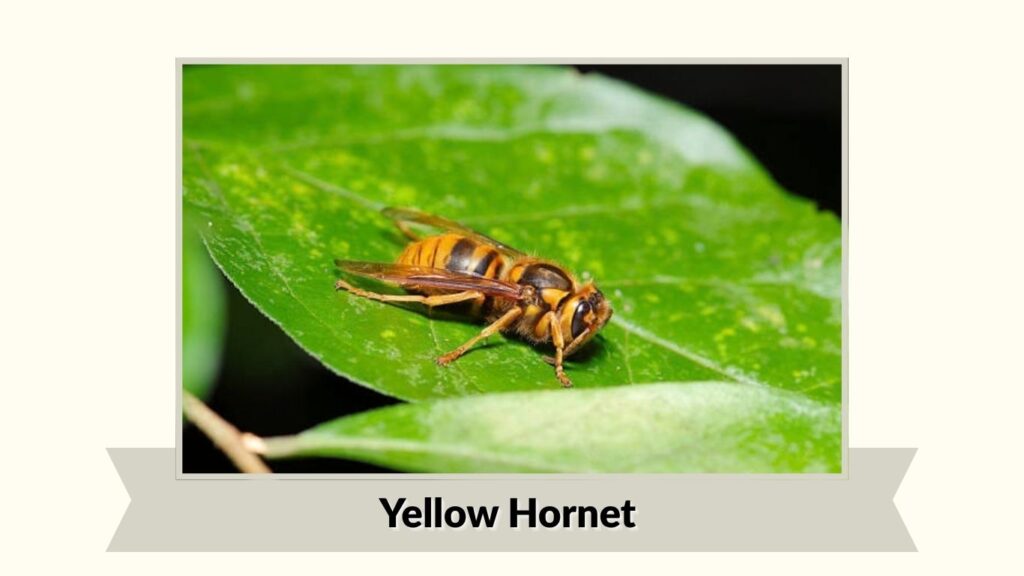
The Yellow Hornet (Vespa simillima) is an East Asian true hornet recognized for its strong yellow-and-dark coloration and highly organized social colonies. It occurs in parts of Russia, China, Korea, and Japan. A yellow Japanese color form has historically been called the Japanese Yellow Hornet. Modern taxonomic treatments generally regard these regional forms as belonging to the single species Vespa simillima.
Identification
Yellow Hornets are medium-sized compared with giant hornets and usually show much more extensive yellow coloration. Appearance can vary geographically.
- Predominantly yellow and dark brown to black body
- Yellow face with dark compound eyes
- Multiple yellow abdominal bands
- Relatively hairy body compared with some hornets
- Strong mandibles for capturing prey
- Brownish transparent wings
- Workers smaller than reproductive queens
- Regional populations may differ noticeably in coloration
Habitat and Distribution
The Yellow Hornet occurs across eastern Asia, including Japan, the Korean Peninsula, eastern Russia, and China. Some forms are darker and hairier, particularly in northern portions of the range, while heavily yellow-colored individuals are widespread in Japan.
It occupies forests, woodland edges, agricultural areas, suburbs, and cities. The species is particularly adaptable around people. Studies in Japan have recorded colonies inside wall cavities and attics, showing that buildings can provide highly suitable protected nesting spaces.
Behavior and Diet
Yellow Hornets are active predators. Workers capture insects and process the prey into protein-rich food for developing larvae. Adults themselves obtain energy largely from sugary liquids, including nectar, tree sap, and other plant secretions.
The species can become a nuisance in urban environments when colonies are established inside homes or other structures. Most defensive behavior occurs near the nest, where workers respond rapidly to perceived threats.
Lifespan and Life Cycle
Colonies generally follow a seasonal cycle. An overwintered queen begins a nest during spring and raises the first workers. Once workers emerge, they take over food collection, construction, and brood care.
Research from Hokkaido found colonies lasting about four and a half months, from late May until early October, although warmer populations may remain active longer. Mature colonies in that study averaged several hundred adults.
Late in the season, males and new queens develop. After mating, fertilized queens overwinter while the old queen, workers, and males die.
13. Bingham’s Hornet
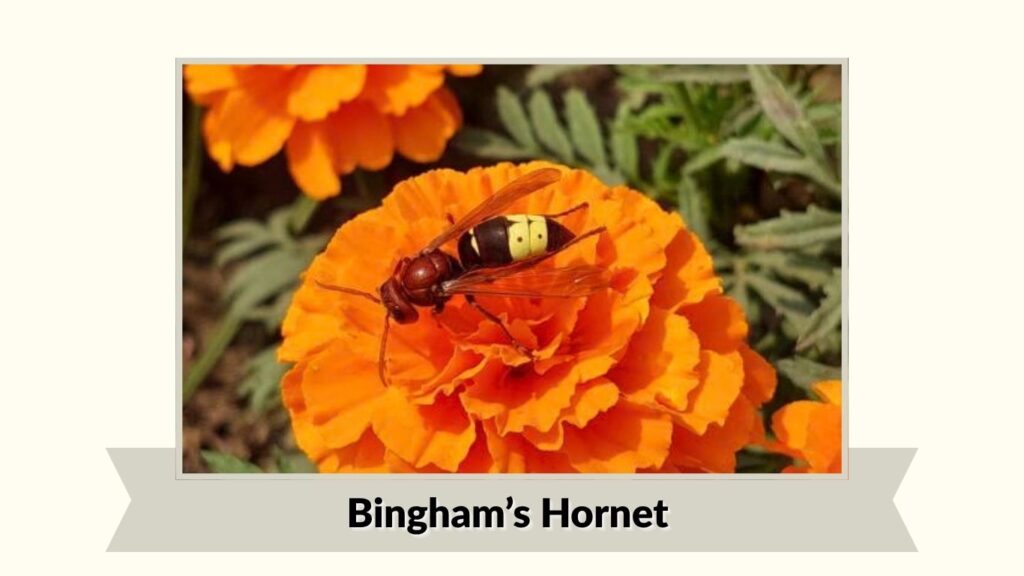
Bingham’s Hornet (Vespa binghami) is one of the most fascinating true hornets because it is primarily nocturnal. While most Vespa species conduct much of their foraging during daylight, Bingham’s Hornet becomes particularly active after sunset. Its unusually large simple eyes, or ocelli, are associated with its ability to operate under low-light conditions. Recent research has revealed a strong dietary association with nocturnal moths.
Identification
Bingham’s Hornet is a medium-to-large hornet with coloration that differs somewhat across its geographic range.
- Workers average around 30 mm long
- Large and conspicuous ocelli on top of the head
- Southeast Asian individuals may have a brown body and yellow head
- Northern populations can appear predominantly brown
- Some populations show yellow abdominal markings
- Strong, broad mandibles
- Long dark antennae
- Brownish translucent wings
Habitat and Distribution
Bingham’s Hornet has a broad Asian range extending from the Himalayan foothills through portions of India, Myanmar, Laos, China, Korea, and the Russian Far East.
Research in South Korea found individuals from elevations of roughly 10 to more than 1,000 meters, although many were recorded between 100 and 400 meters. The species appears particularly associated with wooded habitats.
Studied colonies showed a preference for cavities inside dead or living trees. The documented nests contained three to five layers of comb and roughly 30–150 hornets when adults and immature individuals were considered.
Behavior and Diet
Bingham’s Hornet is remarkable for its nighttime lifestyle. A recent South Korean study found substantial activity beginning around sunset, with peak movement occurring around 11 p.m. to midnight. Very little activity occurred during most daylight hours.
Dietary analysis found Lepidoptera to dominate sampled prey, particularly noctuid moths. Beetles, true bugs, and several other arthropod groups were also detected. Researchers caution that the dietary findings came from limited samples, but they strongly support nocturnal moth hunting as an important behavior.
Lifespan and Life Cycle
Species-specific life-cycle information remains limited because Bingham’s Hornet is rarely observed. Like other social Vespa, colonies contain a reproductive queen, workers, developing larvae, and pupae.
A queen establishes the colony, after which workers assume nest construction, hunting, cleaning, and brood care. South Korean observations found activity peaking in late summer.
As the reproductive phase approaches, colonies produce males and new queens. Fertilized females ultimately carry the species into the next colony cycle.
14. Philippine Hornet
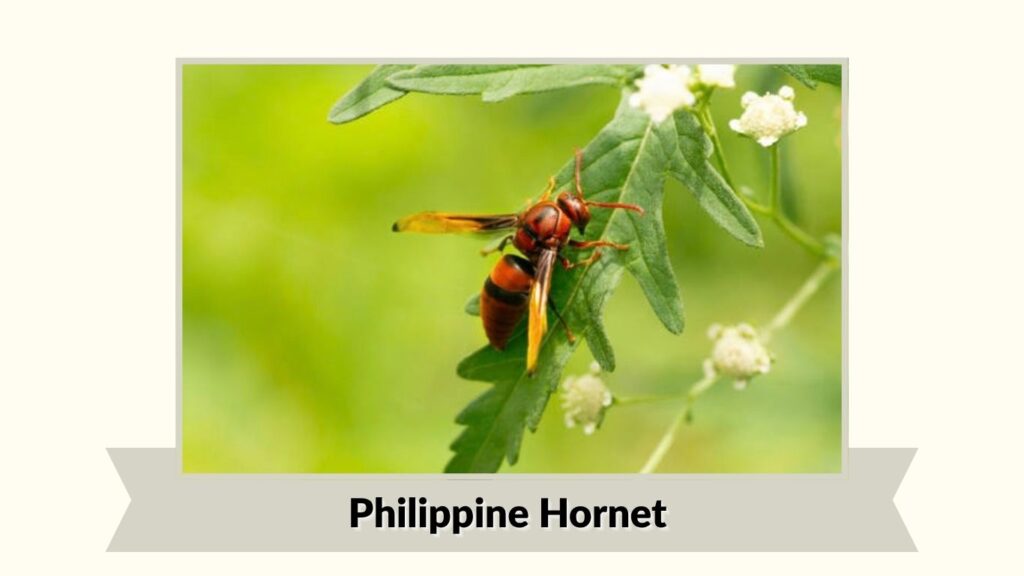
The Philippine Hornet (Vespa philippinensis) is a rare true hornet endemic to the Philippines. Compared with well-studied species such as the European or Yellow-Legged Hornet, remarkably little is known about its natural history. Available records indicate that it is a ground-nesting species and is structurally similar to the Greater-Banded Hornet, Vespa tropica.
Identification
Because Philippine Hornets are rarely encountered, identification usually requires examination of specimens by specialists.
- Medium-to-large true hornet
- Strong, compact body
- Dark head and thorax
- Yellow markings contrasting with darker abdominal areas
- Powerful mandibles
- Narrow waist characteristic of Vespa
- Brownish translucent wings
- Queens expected to be larger than workers
Habitat and Distribution
The Philippine Hornet is restricted to the Philippine archipelago. Scientific records include Leyte, Luzon, Negros, and Samar. This limited distribution makes it one of the more geographically restricted members of the genus Vespa.
Published information about nesting is extremely sparse. One described colony from Leyte was located inside a cavity in the ground, supporting classification of the species as a ground-nesting hornet.
Its rarity and association with tropical island habitats mean that much of its ecology remains undocumented.
Behavior and Diet
Detailed prey studies have not been published for this species, so its exact dietary preferences should not be assumed from appearance alone. Like other true hornets, it is a social predatory wasp, and workers are expected to supply developing larvae with animal protein while adults obtain much of their own energy from liquid carbohydrates.
The Philippine Hornet’s rarity is one reason information about hunting patterns, daily activity, colony defense, and interaction with other insects remains limited.
Lifespan and Life Cycle
Very little species-specific information is available about the Philippine Hornet’s colony duration or reproductive timing. Its basic development follows the complete metamorphosis characteristic of hornets: egg, larva, pupa, and adult.
A colony contains reproductive and worker castes, with workers handling activities such as foraging and brood care as the nest develops. Later, reproductive males and future queens are produced.
Because only a very small number of nests have been documented scientifically, details such as typical colony population, nest longevity, and seasonal timing require further field research. Modern reviews specifically categorize V. philippinensis among uncommon or rare hornet species.
15. Many-Banded Hornet
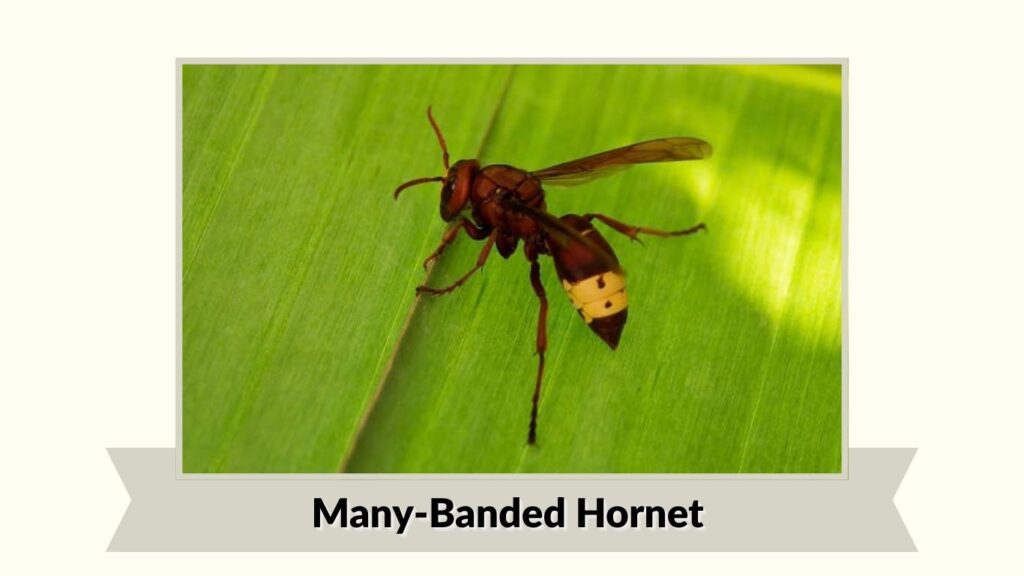
The Many-Banded Hornet (Vespa multimaculata) is a relatively small true hornet native to Southeast Asia. Its common name comes from the numerous pale yellow bands extending across its abdomen. Compared with many familiar hornets, this species is diminutive, with workers around 16 mm long. It primarily inhabits tropical forests and has been recorded from both lowland and mountainous environments.
Identification
The multiple abdominal bands and relatively small size are particularly useful clues for distinguishing this species from larger Southeast Asian hornets.
- Workers around 16 mm long
- Among the smaller species of true hornet
- Head largely black with yellow markings
- Clypeus mostly yellow with darker central coloration
- Thorax predominantly black with yellow markings
- Yellow markings on portions of the legs
- Multiple narrow yellow abdominal bands
- Transparent amber-colored wings
Habitat and Distribution
The Many-Banded Hornet occurs in Southeast Asia, including Thailand, Peninsular Malaysia and Borneo, Singapore, Brunei, Sumatra, and Kalimantan. Singapore’s National Parks Board recognizes Vespa multimaculata as the Many-Banded Hornet.
It inhabits both lowland and montane forests and has been recorded at elevations exceeding 2,000 meters. Nests are typically located underground, particularly beneath tree roots. Documented nests may be roughly spherical and around 20–30 cm in diameter.
Behavior and Diet
Many-Banded Hornets have been described as extremely fast and agile flyers. They forage close to the forest floor, where their small body size and maneuverability may help them pursue prey through dense vegetation.
Detailed species-specific dietary studies remain limited. As social hornets, workers collect animal protein to support larval development, while adults require carbohydrate-rich liquids for energy.
The species is considered relatively uncommon compared with several widespread Asian hornets, which partly explains why its behavior remains less thoroughly documented.
Lifespan and Life Cycle
Many-Banded Hornets develop through egg, larval, pupal, and adult stages inside an organized social colony. The queen functions as the primary reproductive individual, while workers perform most foraging and colony-maintenance activities once the worker population develops.
The subterranean nest expands as new brood is produced. Toward the reproductive stage of colony development, males and future queens are produced.
Specific data on typical colony longevity, maximum worker population, and reproductive timing remain limited for V. multimaculata. Its broad tropical and montane distribution also means colony timing may vary according to local rainfall, temperature, and food availability.
16. Mocsarian Hornet
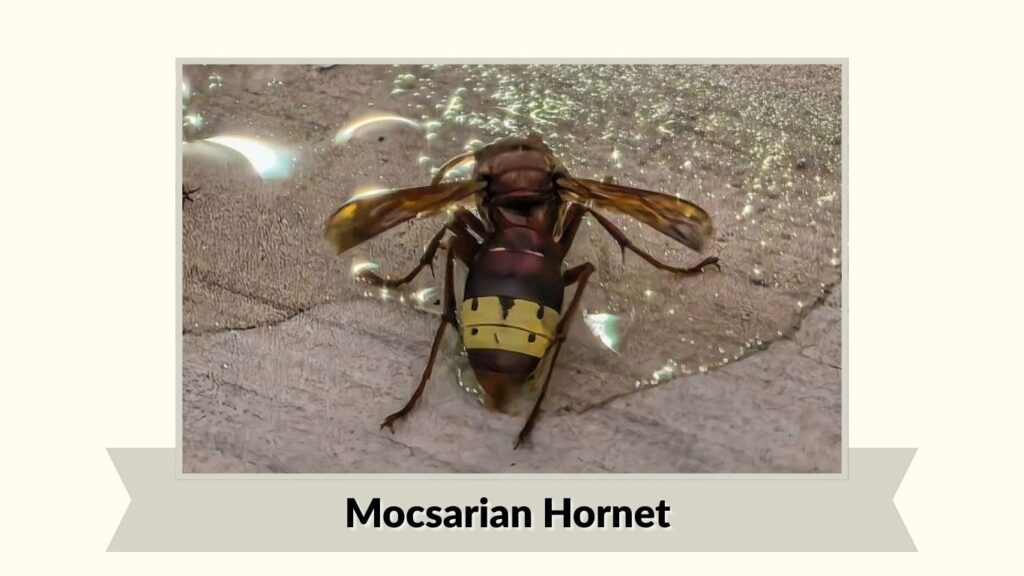
The Mocsarian Hornet (Vespa mocsaryana) is an uncommon Asian hornet associated mainly with montane forest habitats. It occurs across portions of northeastern India, China, mainland Southeast Asia, Malaysia, and Sumatra. Compared with widely studied species such as Vespa velutina, relatively little is known about its biology, colony size, diet, or seasonal activity.
Identification
Mocsarian Hornets combine reddish-brown, black, and yellow coloration. Their exact pattern can vary between individuals.
- Reddish-brown head
- Yellow clypeus or facial plate
- Brown to rusty-brown antennae
- Thorax mostly dark with reddish-brown areas
- Brown legs
- Yellow bands on several abdominal segments
- Fine hairs covering portions of the body
- Strong hornet-like body structure
Habitat and Distribution
The species is recorded from northeastern India, including Assam, Meghalaya, and Sikkim, as well as parts of China, Laos, Vietnam, Myanmar, Thailand, Malaysia, and Sumatra.
Mocsarian Hornets are particularly associated with montane forests. Published reviews describe nests found in shrubs and on sheltered ceilings, indicating that the species can use both natural vegetation and protected structures.
One documented nest was positioned in shrub vegetation about 1.5 meters above ground, but the scarcity of observations makes it difficult to define a single typical nesting location.
Behavior and Diet
Very little detailed ecological research has been conducted on this hornet. It is presumably an insect predator like other members of Vespa, with workers supplying developing larvae with protein-rich prey and adults relying more heavily on carbohydrate-rich liquids.
Because direct dietary observations are scarce, specific statements about preferred prey should be treated cautiously. Forest insects probably form an important portion of the available prey community, but more field research is required to determine whether V. mocsaryana specializes on particular groups.
Lifespan and Life Cycle
The complete life history of the Mocsarian Hornet remains poorly documented. Like other social hornets, colonies develop through repeated production of eggs, larvae, pupae, and adults, with a queen responsible for most reproduction.
Workers maintain the nest, gather food, protect developing brood, and support colony expansion. At a later reproductive stage, males and future queens are produced.
Modern reviews identify V. mocsaryana as a relatively uncommon high-elevation or forest-associated species, which has contributed to the lack of detailed colony studies.
17. Black Shield Wasp
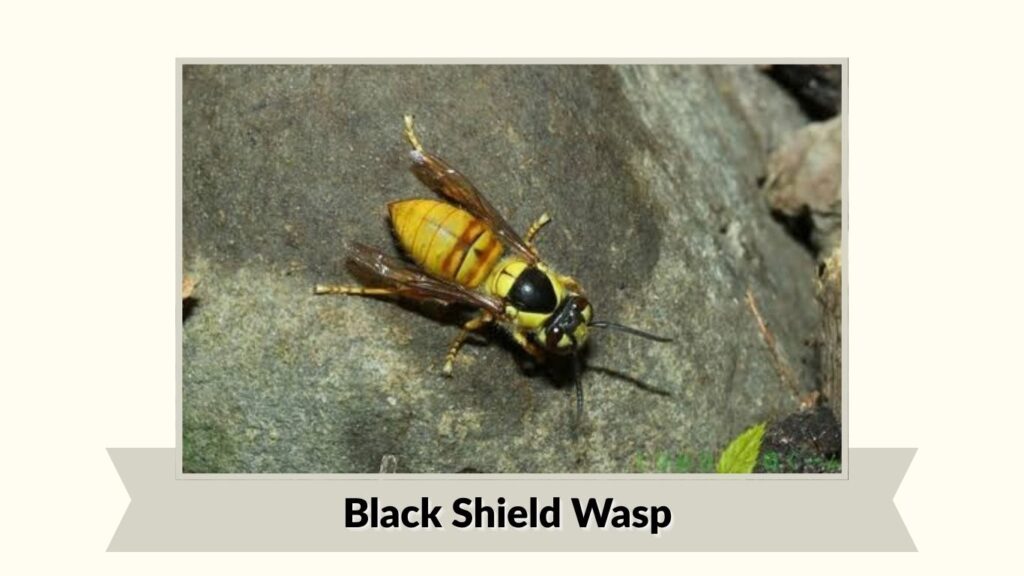
The Black Shield Wasp (Vespa bicolor), also called the Black Shield Hornet, is a true hornet native to parts of southern China, Southeast Asia, and the Himalayan foothills. Despite its common name containing “wasp,” it belongs to the true hornet genus Vespa. It is particularly interesting because it both hunts honey bees and serves as a pollinator for an orchid that chemically mimics honey bee signals.
Identification
Black Shield Wasps are relatively small for true hornets and are dominated by bright yellow coloration contrasted with a dark thoracic “shield.”
- Adults approximately 15–19 mm long in studied Taiwanese populations
- Head largely yellow
- Thorax marked prominently with black
- Abdomen predominantly yellow with dark bands
- Yellow legs with darker areas
- Dark antennae
- Relatively small compared with many Vespa species
- Fast and agile flight
Habitat and Distribution
The native distribution covers much of southern China, parts of Southeast Asia, and the Himalayan foothills. The species has also established outside parts of its native range, including Taiwan, and has been documented as an introduced hornet in southern Spain.
It occupies forests, hilly landscapes, agricultural areas, and environments close to human settlements. Research in Taiwan has found populations primarily in hilly and lower-mountain environments.
Behavior and Diet
Black Shield Wasps are active predators of honey bees. Workers may hover near hive entrances, capture returning bees, and carry prey back as food for larvae. Adults themselves have been observed feeding on floral nectar and honeydew.
The species also has a remarkable relationship with the orchid Dendrobium sinense. The flower releases chemicals resembling honey bee alarm pheromones, attracting the predatory hornet and using it as a pollinator.
Lifespan and Life Cycle
Black Shield Wasps form social colonies centered around a reproductive queen. After a colony is founded, workers eventually take responsibility for gathering food, enlarging the nest, defending it, and caring for developing broods.
The immature stages progress from egg to larva and then pupa before becoming adults. As colonies mature, reproductive males and young queens are produced.
In climates with pronounced seasons, fertilized queens provide the primary means of surviving between annual colony cycles. This overwintering-queen strategy is typical of invasive Vespa species as well and helps explain how fertilized females transported accidentally can sometimes establish populations in new regions.
FAQs
1. What is the difference between a hornet and a yellowjacket?
True hornets belong to the genus Vespa, whereas most yellowjackets belong to Vespula or Dolichovespula. Hornets are generally larger and heavier-bodied, although size alone is not always reliable for identification.
2. What is the largest hornet in the world?
The Northern Giant Hornet (Vespa mandarinia) is generally recognized as the world’s largest living hornet. Queens can approach about 5 cm in body length, making them considerably larger than most other social wasps.
3. Do all hornets build hanging nests in trees?
No. Nest location varies greatly among species. European Hornets often nest inside hollow trees, Philippine Hornets have been recorded nesting underground, Greater-Banded Hornets may use subterranean cavities, and several other species construct exposed or sheltered aerial nests.
4. What do hornets eat?
Adult hornets mainly obtain energy from carbohydrate-rich foods such as nectar, sap, honeydew, and ripe fruit. Workers hunt insects and other arthropods primarily to provide protein for developing larvae. Some species specialize strongly on particular prey, while others are generalist hunters.
5. Are all hornets aggressive toward humans?
No. Hornets generally do not spend their time actively seeking people to sting. The greatest risk occurs when a colony is disturbed or someone approaches a nest closely. Defensive intensity varies among species, colony stage, and circumstances. Because true hornets can sting repeatedly, active nests should be given plenty of space.