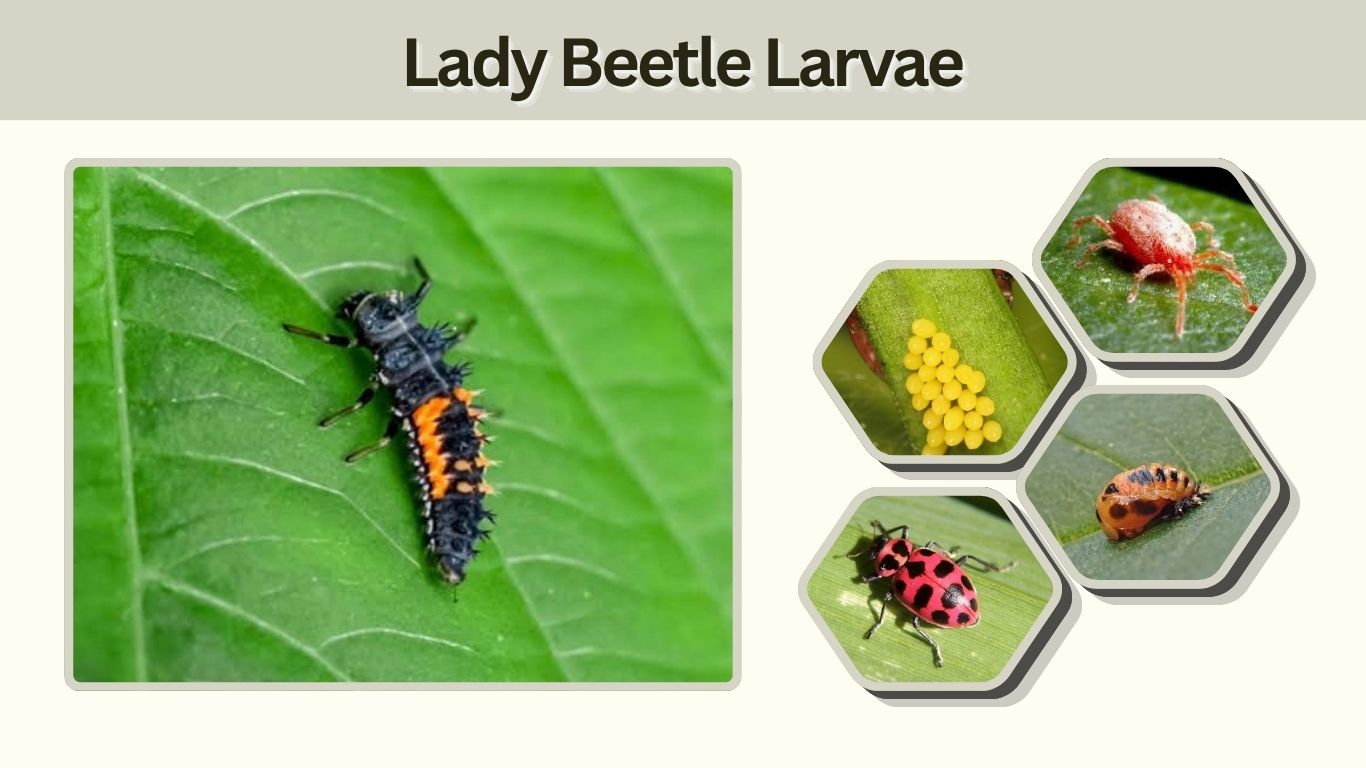
Lady beetle larvae look surprisingly different from the familiar round, colorful adults. Instead of having a smooth red shell with black spots, most larvae are elongated, dark-colored, somewhat spiny, and often described as looking like tiny alligators. They are commonly found crawling across leaves where aphids and other small insects are abundant. Most lady beetle larvae are beneficial garden predators, although a few species feed on plants. Learning their appearance, diet, life cycle, and behavior makes identification much easier.
What Do Lady Beetle Larvae Look Like?
Lady beetle larvae bear little resemblance to adult ladybugs, which is why gardeners sometimes mistake them for harmful insects. Their appearance varies among species, but most share an elongated segmented body, six well-developed legs, and conspicuous bumps or spines. Colors can range from nearly black to gray, with orange, yellow, white, or reddish markings.
Lady Beetle Larvae Identification
Look for several characteristics when trying to identify lady beetle larvae:
- Elongated, alligator-like body
- Dark gray, blue-gray, brown, or black coloration
- Orange, yellow, white, or reddish markings
- Six true legs near the front half of the body
- Segmented abdomen
- Small bumps, tubercles, or flexible spines
- Active movement across leaves and stems
- Frequent presence near aphid colonies
- Usually about 1/3 to 1/2 inch long when mature, depending on species
Unlike caterpillars, lady beetle larvae do not have fleshy abdominal prolegs. They possess three pairs of true legs, a useful feature for separating beetle larvae from many caterpillar-like insects.
Why They Look Nothing Like Ladybugs
Lady beetles undergo complete metamorphosis. Consequently, the larval stage is designed for feeding and growth rather than looking like the adult.
During this period, the larva repeatedly molts and becomes larger. Only after pupation does the familiar rounded lady beetle body appear. Seeing a black-and-orange larva beside adult ladybugs therefore does not necessarily mean two unrelated insects are present.
What Do Lady Beetle Larvae Eat?
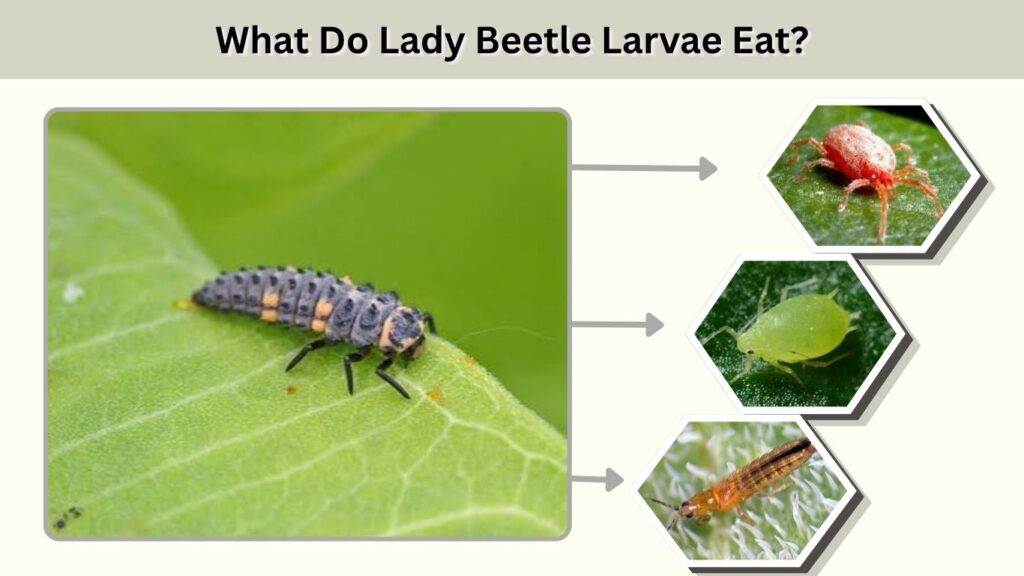
Most familiar lady beetle larvae are predators. They actively patrol leaves, stems, flowers, and growing shoots for small prey. Aphids are particularly important, but different lady beetle species specialize on different foods. Larvae can be valuable biological-control insects because they begin hunting pests long before becoming adults.
Common Foods
Depending on the species, lady beetle larvae may eat:
- Aphids
- Scale insects
- Mealybugs
- Mites
- Psyllids
- Whiteflies
- Small insect larvae
- Insect eggs
- Other soft-bodied arthropods
Some species have relatively narrow diets, while others consume several types of prey.
Lady beetle larvae can be surprisingly active hunters. They search plants rather than waiting in one location for food to arrive.
Why Larvae Are Beneficial
Lady beetle larvae are especially useful because they require substantial food while growing. The University of Minnesota notes that larvae can consume more pest insects than adults. Their presence near aphids is therefore generally a positive sign rather than evidence of an additional infestation.
When gardeners unknowingly spray these unfamiliar black-and-orange larvae, they can remove insects that were already helping suppress the original pest problem.
Lady Beetle Larvae Life Cycle
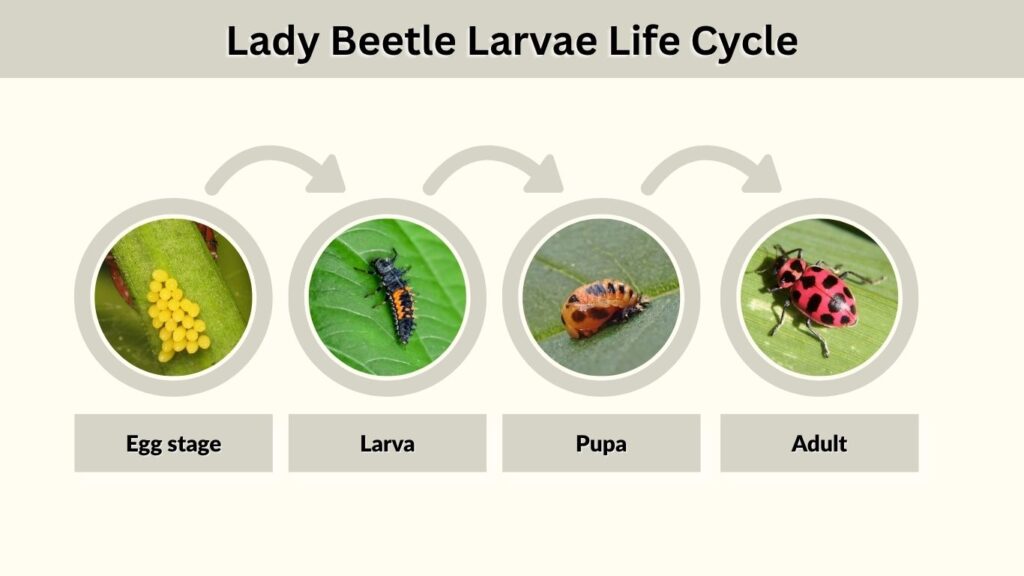
Lady beetles have four major developmental stages: egg, larva, pupa, and adult. The larva itself passes through several growth stages called instars. Lady beetles generally have four larval instars, becoming progressively larger after each molt. Environmental temperature, food availability, and species influence how quickly development occurs.
Four Main Stages
The lady beetle life cycle includes:
- Egg: Females usually lay small yellow or orange eggs near suitable food.
- Larva: Newly hatched larvae begin searching for prey and pass through four instars.
- Pupa: A mature larva attaches itself to a surface and transforms inside the pupal stage.
- Adult: The fully developed lady beetle emerges, initially soft before its outer covering hardens.
The larval stage is primarily devoted to eating and growing.
Lady Beetle Larvae and Pupae
A mature larva eventually stops roaming and attaches its rear end to a leaf, stem, bark, wall, or another suitable surface.
It then becomes a pupa. A lady beetle pupa may appear motionless and damaged, but it should usually be left undisturbed. Major changes are taking place internally as the insect develops its adult wings, legs, coloring, and characteristic beetle shape.
Asian Lady Beetle Larvae
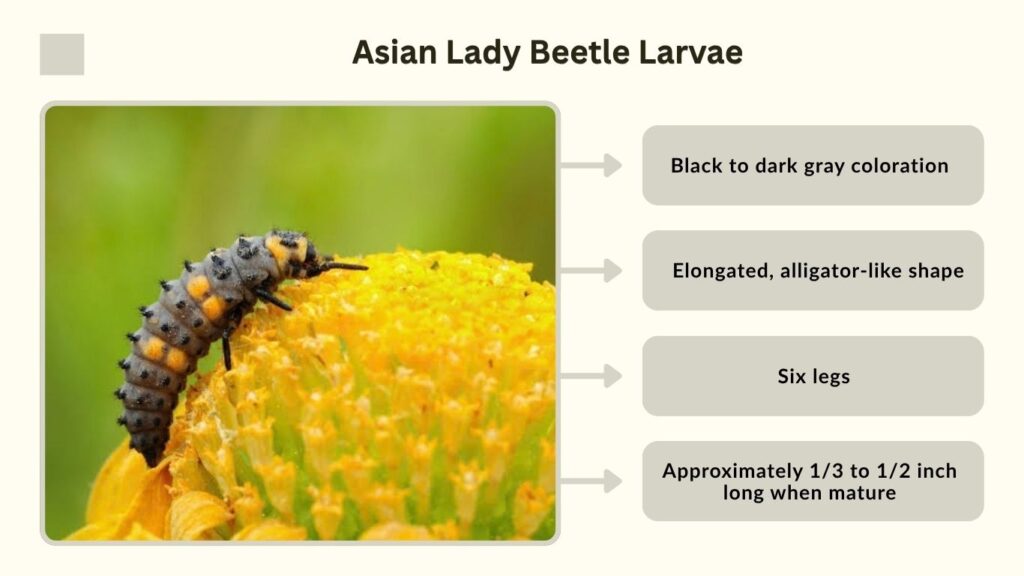
The Asian lady beetle, or multicolored Asian lady beetle (Harmonia axyridis), is one of the species people commonly search for when encountering unusual larvae. Its larvae are dark, heavily textured, and conspicuously marked with orange. They commonly occur outdoors on plants containing aphids during spring and summer.
Asian Lady Beetle Larvae Identification
Typical characteristics include:
- Black to dark gray coloration
- Bright orange markings along portions of the abdomen
- Rows of conspicuous branched spines
- Elongated, alligator-like shape
- Six legs
- Approximately 1/3 to 1/2 inch long when mature
- Frequently found around aphid-infested vegetation
Despite their somewhat intimidating appearance, the spines do not function like stingers.
Asian Lady Beetle Larvae vs Ladybug Larvae
“Ladybug” and “lady beetle” are common names for insects belonging to the family Coccinellidae. Therefore, an Asian lady beetle larva is a type of ladybug larva.
There is no single appearance that separates “ladybug larvae” from Asian lady beetle larvae because many different lady beetle species have larvae with their own patterns.
Asian lady beetle larvae are especially recognizable by their combination of dark coloration, prominent orange patches, and branched spines.
Common Types of Lady Beetle Larvae
Many lady beetle species occur worldwide, and their larvae can differ substantially in color and texture. Identifying the exact species often requires looking at body patterns, geographic range, host plants, preferred prey, and sometimes the adult beetles nearby.
Examples You May Encounter
Commonly searched lady beetle larvae include:
- Asian lady beetle larvae – dark with prominent orange markings
- Convergent lady beetle larvae – active predators frequently associated with aphids
- Pink spotted lady beetle larvae – blackish with yellow or orange markings
- Seven-spotted lady beetle larvae
- Ashy gray lady beetle larvae
- Twice-stabbed lady beetle larvae
- Hyperaspis lady beetle larvae
- Squash lady beetle larvae
Pink spotted lady beetle larvae, for example, begin at about 1 mm and can reach around 6 mm by their fourth instar.
Not Every Lady Beetle Larva Is Beneficial
Most commonly encountered lady beetles are predators, but gardeners should not assume every member of the family eats pests.
Some plant-feeding lady beetles can damage crops. The squash beetle is one example. Its larvae feed on cucurbit leaves, scraping tissue between veins and producing characteristic leaf injury. Squash, cucumber, and pumpkin can serve as host plants.
Correct identification is therefore important before deciding whether a larva should be protected or controlled.
Do Lady Beetle Larvae Bite?
The unusual spines and dark coloration of lady beetle larvae can make them appear dangerous. However, typical predatory lady beetle larvae are not considered harmful to people. Their mouthparts are primarily adapted for capturing and consuming small insect prey rather than attacking humans.
Can Lady Beetle Larvae Bite Humans?
Lady beetle larvae should generally be considered harmless to people. The University of Minnesota specifically describes lady beetle larvae, including multicolored Asian lady beetle larvae, as harmless to humans and plants.
Avoid unnecessarily handling them, however. Small insects can be injured easily when squeezed or picked up.
Are Lady Beetle Larvae Poisonous?
Lady beetle larvae are not considered poisonous to humans simply because they have unusual colors or spines.
Their threatening appearance is misleading. In most gardens, black-and-orange lady beetle larvae crawling around aphid colonies are predators working through the vegetation rather than insects that pose a danger to people.
Lady Beetle Larvae in the Garden
Finding several lady beetle larvae on a plant can initially resemble an infestation. Before reaching for an insecticide, check what they are doing. If they are moving among aphids, scales, or other small pests without chewing the plant itself, they are likely helping protect the vegetation.
Should You Remove Them?
Predatory lady beetle larvae should generally be left in place. Broad-spectrum pesticides can kill beneficial larvae along with the pests they are hunting.
Maintaining flowering plants, minimizing unnecessary pesticide applications, and tolerating small populations of prey insects can help lady beetle populations remain established in a garden.
When Control May Be Necessary
Control becomes relevant when identification confirms a plant-feeding species, such as squash beetles, rather than a predatory species.
Squash beetle adults and larvae can damage cucurbit leaves. For small infestations, removing adults, larvae, and egg masses by hand can help reduce their numbers.
FAQs
1. Are lady beetle larvae good or bad?
Most lady beetle larvae found around aphids are beneficial predators. They eat aphids, scales, mites, mealybugs, and other pests. However, a small number of lady beetle species are plant feeders, so identification matters.
2. Do lady beetle larvae turn into ladybugs?
Yes. A lady beetle larva eventually develops into a pupa and then emerges as an adult ladybug or lady beetle. Larvae look completely different from the adults because lady beetles undergo complete metamorphosis.
3. Do Asian lady beetle larvae bite?
Asian lady beetle larvae are considered harmless to people. They are predators primarily interested in aphids and other small, soft-bodied insects rather than humans.
4. Why are lady beetle larvae black and orange?
Black and orange are common larval colors among several lady beetle species. The exact amount and arrangement of the markings vary by species and developmental stage, so color patterns can also help with identification.
5. What should I do if I find lady beetle larvae on my plants?
First check whether they are eating the plant or hunting pests. Predatory lady beetle larvae should usually be left alone because they provide natural pest control. If the larvae are confirmed squash beetles or another plant-feeding species and visible plant damage is occurring, targeted control may be appropriate.