
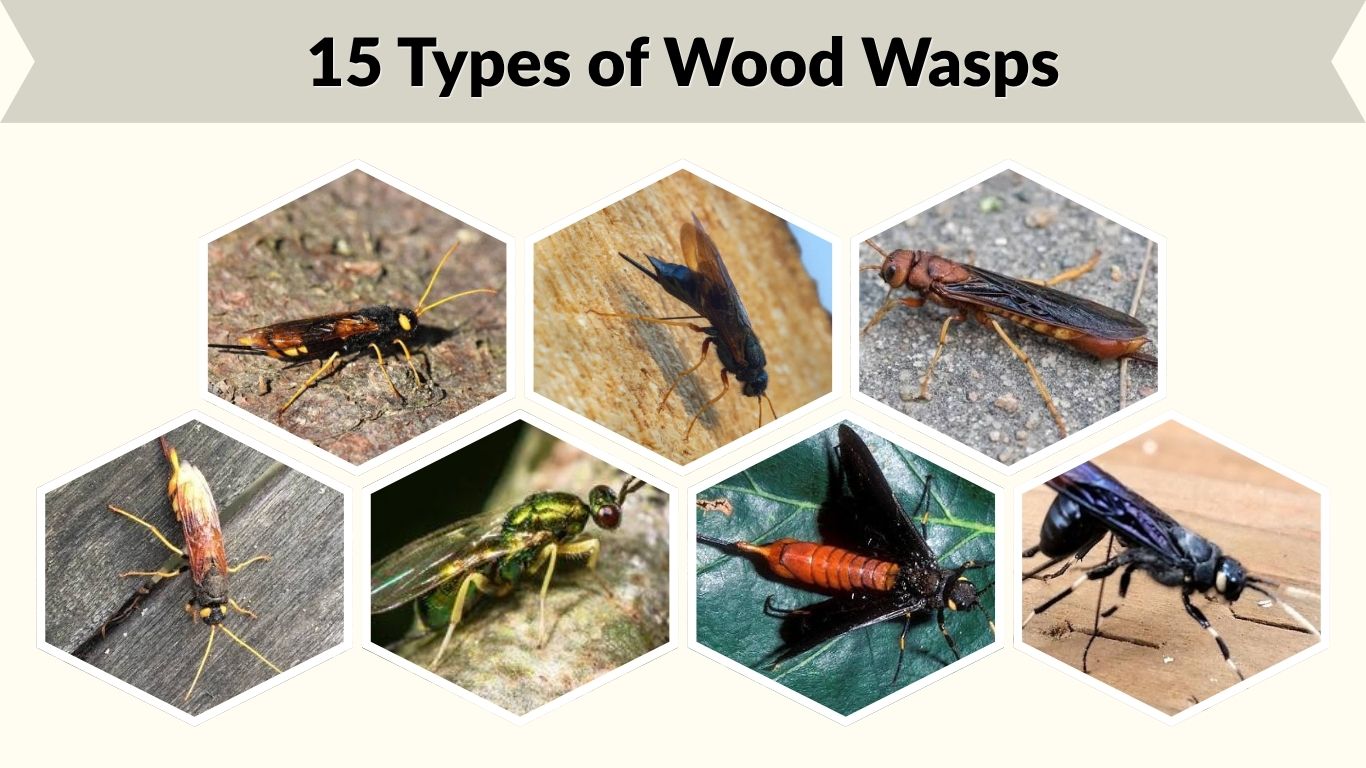
Wood wasps are fascinating insects known for their long, cylindrical bodies, distinctive colors, and wood-boring behavior. Found in forests worldwide, these insects play important roles in breaking down dead and weakened trees. Although some species can damage timber, most are harmless to humans. In this guide, explore 15 types of wood wasps, including their identification, habitats, behaviors, life cycles, and ecological importance.
1. Giant Woodwasp (Urocerus gigas)
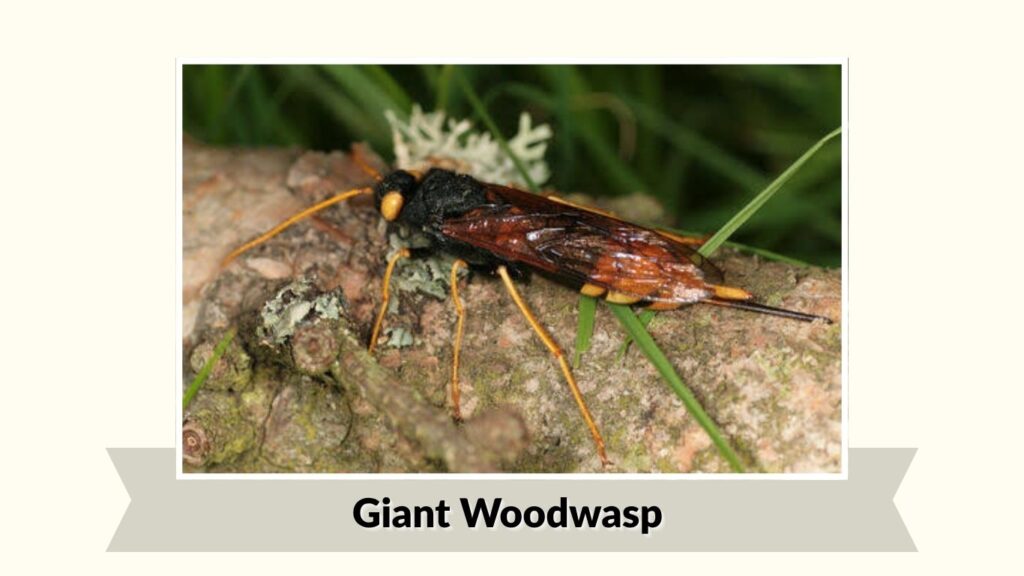
The Giant Woodwasp (Urocerus gigas), also known as the Greater Horntail or Banded Horntail, is one of the largest wood wasps in the family Siricidae. This impressive insect has a distinctive black-and-yellow body and long, transparent wings. Despite its intimidating appearance, it is harmless to humans and plays an important role in forest ecosystems by helping break down weakened and dead wood.
Identification
- Scientific Name: Urocerus gigas
- Common Name: Giant Woodwasp
- Family: Siricidae
- Size: Approximately 12–40 mm long
- Color: Black and yellow body with yellowish-orange legs
- Body Shape: Large, cylindrical body with a pointed abdomen
- Wings: Two pairs of transparent, amber-tinted wings
- Antennae: Long, slender, and yellowish-orange
- Distinctive Feature: Females possess a long, needle-like ovipositor for laying eggs in wood
- Host Trees: Pine, spruce, fir, larch, and other conifers
Habitat and Distribution
Giant Woodwasps are widely distributed throughout Europe and parts of Asia, with records also occurring in North America. They primarily inhabit coniferous forests, woodland areas, and locations containing weakened or recently fallen trees.
These insects prefer spruce, pine, and other softwood trees for reproduction. Adult wasps are commonly observed during the warmer months, particularly between June and October in Britain.
Behavior and Life Cycle
Female Giant Woodwasps use their long ovipositors to insert eggs into weakened, dying, or freshly cut coniferous wood. They also introduce a wood-decaying fungus that helps their larvae obtain nutrients.
The larvae develop inside the wood, creating tunnels while feeding on fungus and fungus-altered wood. Development commonly takes two to three years before the adults emerge through circular exit holes.
Unlike many familiar wasps, Giant Woodwasps do not build social nests and cannot sting humans.
Ecological Importance
Giant Woodwasps contribute to forest decomposition by supporting the breakdown of dead and weakened timber. Their association with wood-decaying fungi helps recycle organic materials and return nutrients to forest ecosystems.
Although their larvae can damage harvested timber, they generally prefer trees that are already weakened or dying rather than healthy, actively growing trees.
2. Pigeon Horntail (Tremex columba)
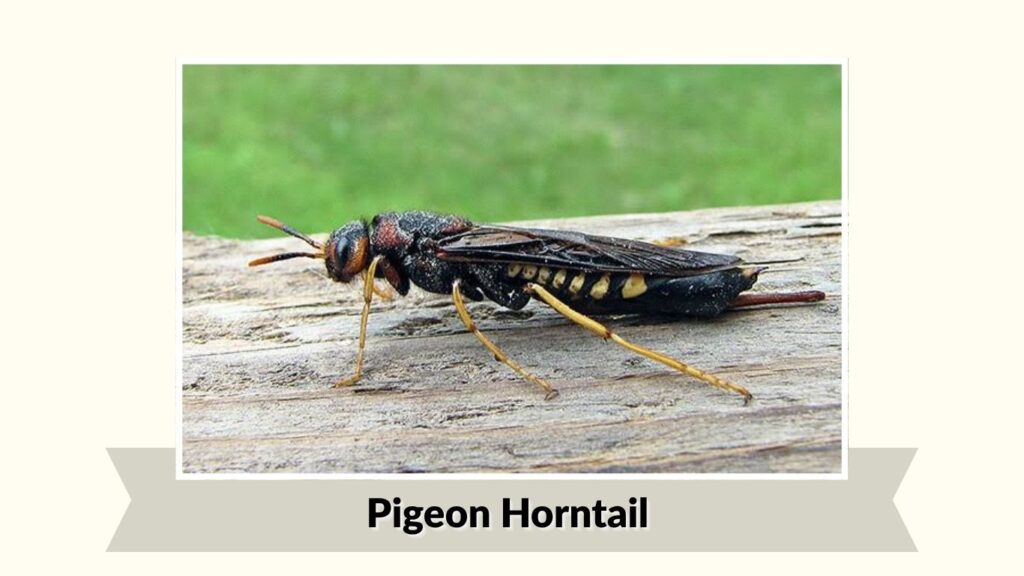
The Pigeon Horntail (Tremex columba) is a large wood-boring wasp belonging to the family Siricidae. This fascinating insect is native to North America and is easily recognized by its reddish-brown body, yellow abdominal markings, and long wings. Despite its intimidating appearance, it cannot sting humans and primarily inhabits weakened, dying, or recently dead hardwood trees.
Identification
- Scientific Name: Tremex columba
- Common Name: Pigeon Horntail
- Family: Siricidae
- Size: Approximately 25–50 mm long
- Color: Reddish-brown body with black and yellow abdominal bands
- Body Shape: Long, cylindrical body without a narrow waist
- Wings: Transparent to amber-brown wings
- Antennae: Long and slender
- Distinctive Feature: Females possess a long ovipositor extending from the abdomen
- Host Trees: Maple, elm, beech, oak, and other hardwoods
Habitat and Distribution
Pigeon Horntails are widely distributed across North America, including the United States and Canada. They typically inhabit deciduous forests, wooded landscapes, parks, and residential areas containing mature hardwood trees.
These insects prefer weakened, dying, or recently dead trees because the wood provides suitable conditions for larval development. Adults are frequently observed during late summer and early autumn, especially around declining trees.
Behavior and Life Cycle
Female Pigeon Horntails use their sharp ovipositors to deposit eggs beneath the bark of weakened hardwood trees. They are also associated with wood-decaying fungi that help soften the surrounding wood.
After hatching, the larvae tunnel through the wood and feed on fungus-affected material. Larval development may take one to two years, depending on environmental conditions. Mature larvae pupate inside the wood, and adults emerge through round exit holes.
Ecological Importance
Pigeon Horntails contribute to the breakdown of weakened and dead hardwood trees. Their wood-boring activities and fungal associations support natural decomposition processes.
They also serve as hosts for large parasitoid wasps, including giant ichneumon wasps, making them important participants in woodland food webs.
3. Sirex Woodwasp (Sirex noctilio)
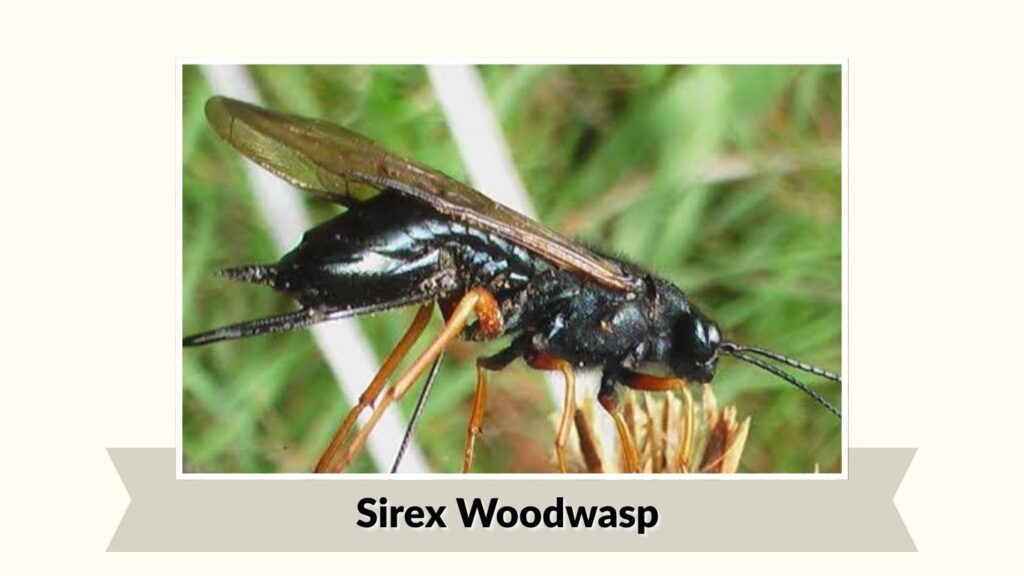
The Sirex Woodwasp (Sirex noctilio), also called the European Woodwasp, is a wood-boring insect belonging to the family Siricidae. Unlike many other wood wasps, this species can attack and kill living pine trees. Its relationship with a wood-decaying fungus makes it a significant forestry pest in several countries where it has been introduced.
Identification
- Scientific Name: Sirex noctilio
- Common Name: Sirex Woodwasp
- Family: Siricidae
- Size: Approximately 10–40 mm long
- Color: Females are metallic blue-black; males have orange abdominal segments
- Body Shape: Long, cylindrical body with a broad waist
- Wings: Transparent wings with a smoky appearance
- Antennae: Dark, slender antennae
- Distinctive Feature: Females possess a prominent ovipositor and pointed abdominal horn
- Host Trees: Primarily pine trees, including Scots pine and Monterey pine
Habitat and Distribution
Sirex Woodwasps are native to Europe, parts of Asia, and North Africa. However, they have been introduced into several regions, including Australia, New Zealand, South Africa, South America, and North America.
They commonly inhabit pine forests and commercial plantations. Stressed, crowded, or weakened pine trees are particularly vulnerable to infestation. Their ability to establish pine plantations has made them an important concern for forest management.
Behavior and Life Cycle
Female Sirex Woodwasps drill into pine wood using their ovipositors. During egg-laying, they introduce a symbiotic fungus called Amylostereum areolatum and a toxic mucus.
These substances weaken the tree and create favorable conditions for fungal growth. The developing larvae feed on fungal material and altered wood while tunneling through the trunk.
Development typically takes about one year, although environmental conditions can extend the life cycle.
Ecological Importance
In their native range, Sirex Woodwasps participate in the breakdown of stressed coniferous trees. However, in introduced environments, they can cause significant damage to pine forests.
Large infestations may result in tree mortality, reduced timber quality, and substantial economic losses for forestry industries.
4. Japanese Horntail (Urocerus japonicus)
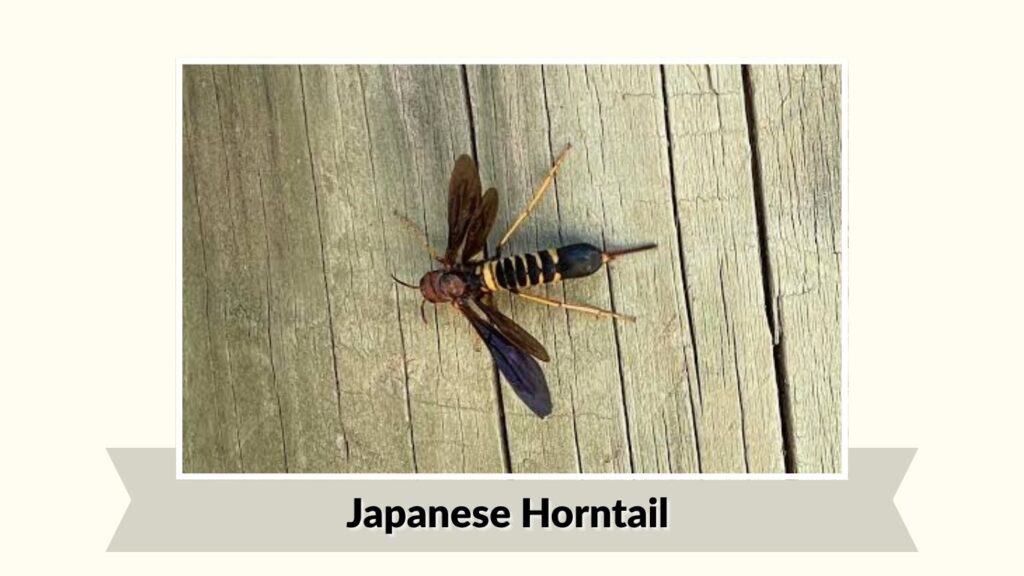
The Japanese Horntail (Urocerus japonicus), previously listed here as the Asian Horntail, is a wood-boring wasp belonging to the family Siricidae. Native to East Asia, this species primarily develops inside weakened coniferous trees. Its close relationship with wood-decaying fungi helps the larvae obtain nutrients, although infestations can reduce timber quality and cause economic damage.
Identification
- Scientific Name: Urocerus japonicus
- Common Name: Japanese Horntail
- Family: Siricidae
- Size: Approximately 15–35 mm long
- Color: Predominantly dark with contrasting yellowish markings
- Body Shape: Elongated, cylindrical body without a narrow waist
- Wings: Two pairs of transparent or slightly smoky wings
- Antennae: Long, slender antennae
- Distinctive Feature: Females have a pointed abdominal projection and a wood-penetrating ovipositor
- Host Trees: Japanese cedar, Japanese cypress, pine, spruce, and fir
Habitat and Distribution
Japanese Horntails are primarily distributed throughout Japan and the Korean Peninsula. They inhabit coniferous forests, forest plantations, and other environments containing suitable host trees.
The species particularly favors Japanese cedar (Cryptomeria japonica) and Japanese cypress (Chamaecyparis obtusa). It generally colonizes fallen, recently cut, or weakened trees rather than healthy, vigorous trees.
Behavior and Life Cycle
Female Japanese Horntails deposit their eggs deep inside coniferous wood. During this process, they introduce a symbiotic fungus called Amylostereum laevigatum.
The fungus colonizes the wood, creating conditions that support larval development. After hatching, larvae tunnel through the sapwood and obtain nourishment from fungus-affected wood.
Development usually takes one year but sometimes extends to two years. Adults generally emerge between June and October.
Ecological Importance
Japanese Horntails contribute to natural wood decomposition by introducing fungi into weakened coniferous trees.
However, larval tunnels and fungal discoloration can reduce the commercial value of timber, particularly in cedar and cypress plantations.
5. Blue Horntail (Sirex cyaneus)
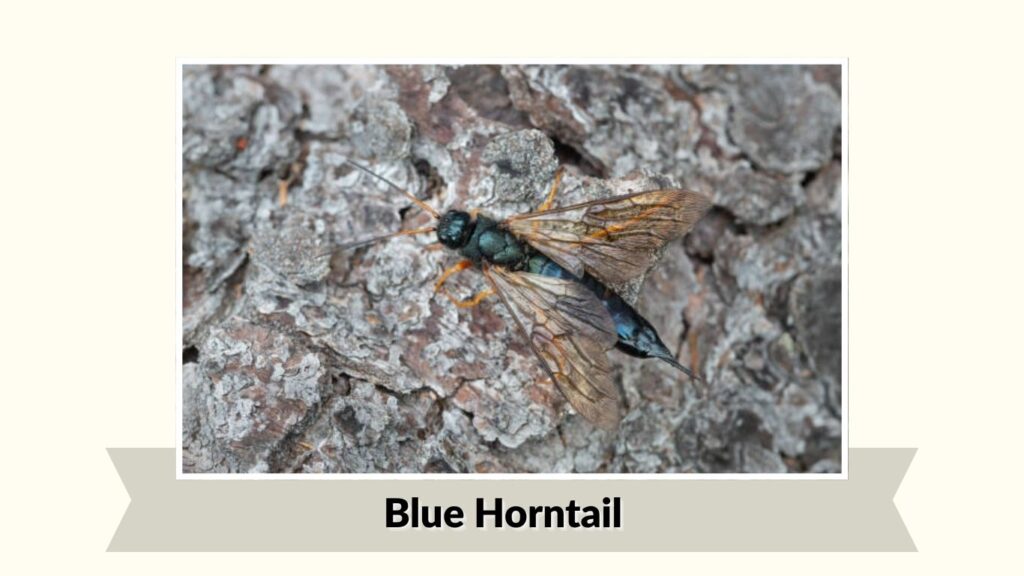
The Blue Horntail (Sirex cyaneus) is a distinctive wood-boring wasp belonging to the family Siricidae. It is recognized by its metallic blue body, reddish-yellow legs, and cylindrical shape. Found mainly in North American coniferous forests, this species develops within weakened or dead trees and contributes to natural wood decomposition.
Identification
- Scientific Name: Sirex cyaneus
- Common Name: Blue Horntail
- Family: Siricidae
- Size: Approximately 15–30 mm long
- Color: Metallic blue to bluish-black
- Body Shape: Cylindrical body with a broad waist
- Wings: Transparent to smoky wings
- Legs: Reddish-yellow
- Antennae: Slender and dark-colored
- Distinctive Feature: Females possess a relatively short ovipositor
- Host Trees: Primarily fir, especially balsam fir; also spruce, larch, and some pines
Habitat and Distribution
Blue Horntails occur in coniferous forests across much of Canada and parts of the United States. Their range extends from western Canada to Newfoundland and southward into portions of the eastern United States.
They are particularly associated with fir trees, although other conifers can serve as hosts. Adults are generally active during summer and early autumn, when they search for suitable trees for reproduction.
Behavior and Life Cycle
Female Blue Horntails insert their eggs beneath the bark of weakened or recently dead coniferous trees. Like other members of the genus Sirex, they maintain relationships with fungi that help their larvae develop inside wood.
After hatching, larvae create tunnels through the wood while feeding on fungus-affected material. They remain concealed during development before pupating and emerging as adults.
Adult wood wasps generally do not feed extensively, and their main purpose is reproduction.
Ecological Importance
Blue Horntails contribute to nutrient recycling by assisting in the decomposition of weakened and dead coniferous trees.
Their larvae also provide food for parasitoid insects and other natural enemies. Although their tunnels can affect timber quality, they are generally less destructive than invasive Sirex Woodwasps.
6. Steely-Blue Woodwasp (Sirex juvencus)
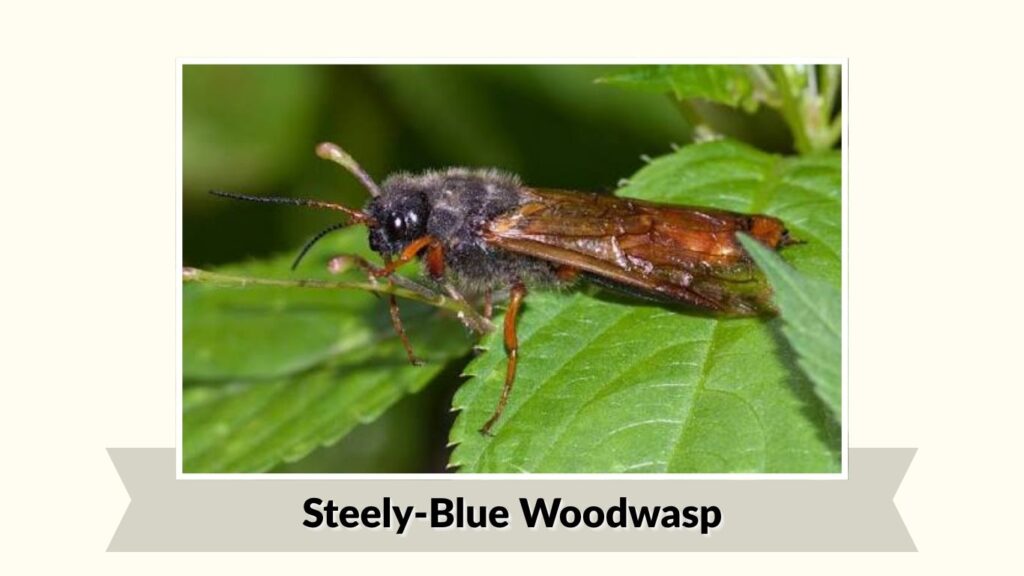
The Steely-Blue Woodwasp (Sirex juvencus) is a striking wood-boring insect belonging to the family Siricidae. Its metallic bluish-black coloration and elongated body make it recognizable among conifer-associated wasps. This species occurs across parts of Europe, Asia, and North America and is associated with pine, spruce, fir, and other coniferous trees.
Identification
- Scientific Name: Sirex juvencus
- Common Name: Steely-Blue Woodwasp
- Other Common Names: Polished Horntail, Blue Horntail
- Family: Siricidae
- Size: Females approximately 15–32 mm long; males 8–28 mm
- Color: Metallic bluish-black body
- Body Shape: Long, cylindrical body with a pointed abdomen
- Wings: Transparent to smoky wings
- Legs: Reddish or yellowish in females
- Distinctive Feature: Females have a long, prominent ovipositor
- Host Trees: Pine, spruce, fir, and larch
Habitat and Distribution
Steely-Blue Woodwasps inhabit coniferous forests throughout large areas of Europe and Asia, with records also occurring in North America.
They are found in temperate and boreal forests where suitable coniferous trees grow. Weakened, damaged, and declining trees provide favorable environments for reproduction and larval development.
The species can occur alongside other wood-boring wasps, particularly in forests experiencing environmental stress.
Behavior and Life Cycle
Female Steely-Blue Woodwasps use their ovipositors to lay eggs inside coniferous wood. During egg-laying, they introduce fungal associates that help make wood suitable for developing larvae.
After hatching, the larvae tunnel through the wood, obtaining nutrients from fungus-affected tissues. Their concealed development protects them from many external threats.
Depending on environmental conditions, development may extend beyond one year before adults emerge through circular holes in the wood.
Ecological Importance
Steely-Blue Woodwasps participate in the breakdown of weakened and dying coniferous trees, contributing to the natural recycling of forest nutrients.
However, their larval tunnels and fungal associations can damage timber and reduce wood quality. Large populations may create additional stress in already declining forest stands.
7. White-Horned Horntail (Urocerus albicornis)
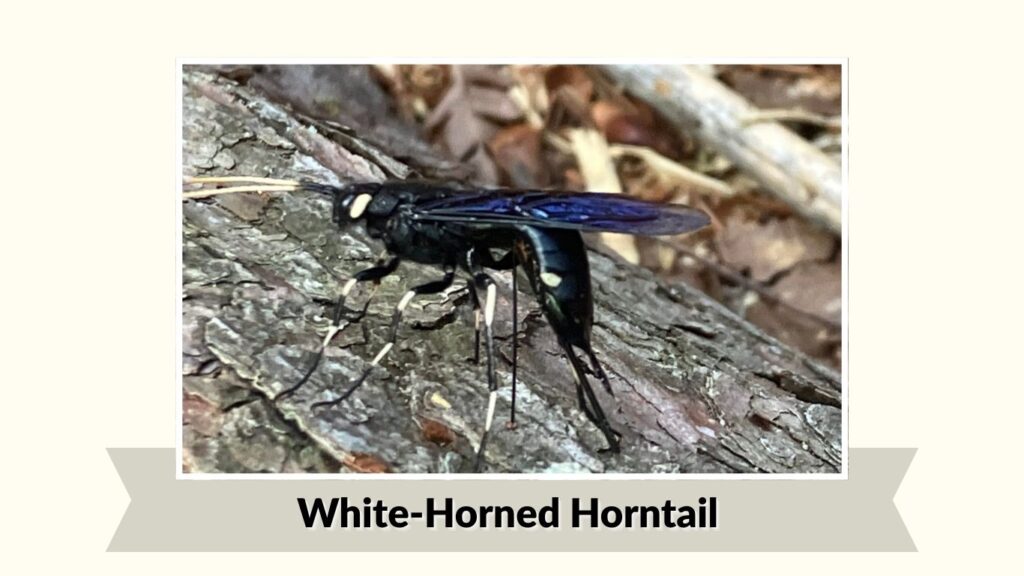
The White-Horned Horntail (Urocerus albicornis) is a large wood-boring wasp belonging to the family Siricidae. This species is easily recognized by its dark body, distinctive whitish antennae, and pale markings on its legs. Native to North America, it primarily develops inside weakened or recently dead coniferous trees and contributes to natural wood decomposition.
Identification
- Scientific Name: Urocerus albicornis
- Common Name: White-Horned Horntail
- Family: Siricidae
- Size: Approximately 25–30 mm long
- Color: Predominantly black with whitish markings
- Body Shape: Long, cylindrical body without a narrow waist
- Wings: Transparent to slightly smoky wings
- Antennae: Dark near the base with distinctive white middle segments
- Distinctive Feature: White markings on the antennae, face, and legs
- Host Trees: Pine, spruce, fir, larch, Douglas-fir, and hemlock
Habitat and Distribution
White-Horned Horntails are native to North America and occur throughout forested regions of Canada and the United States. Their range extends from southern boreal forests into various temperate coniferous woodlands.
They prefer weakened, fallen, or recently dead coniferous trees, particularly those containing suitable moisture for fungal development. The species has also been introduced into parts of Europe and Japan, sometimes through transported timber.
Behavior and Life Cycle
Female White-Horned Horntails use their ovipositors to deposit eggs inside suitable wood. During egg-laying, they also introduce symbiotic fungi that help create favorable conditions for larval development.
The larvae tunnel through fungus-colonized wood while growing and feeding. Their development can take more than one year, depending on temperature and wood conditions.
Once mature, adult wasps emerge through circular holes and search for mates.
Ecological Importance
White-Horned Horntails contribute to the natural decomposition of weakened and dead coniferous trees. Their activities help accelerate wood breakdown and nutrient recycling in forest ecosystems.
Although they occasionally emerge from processed timber, they generally do not infest dry structural wood or pose a danger to humans.
8. Black-and-Red Horntail (Urocerus cressoni)
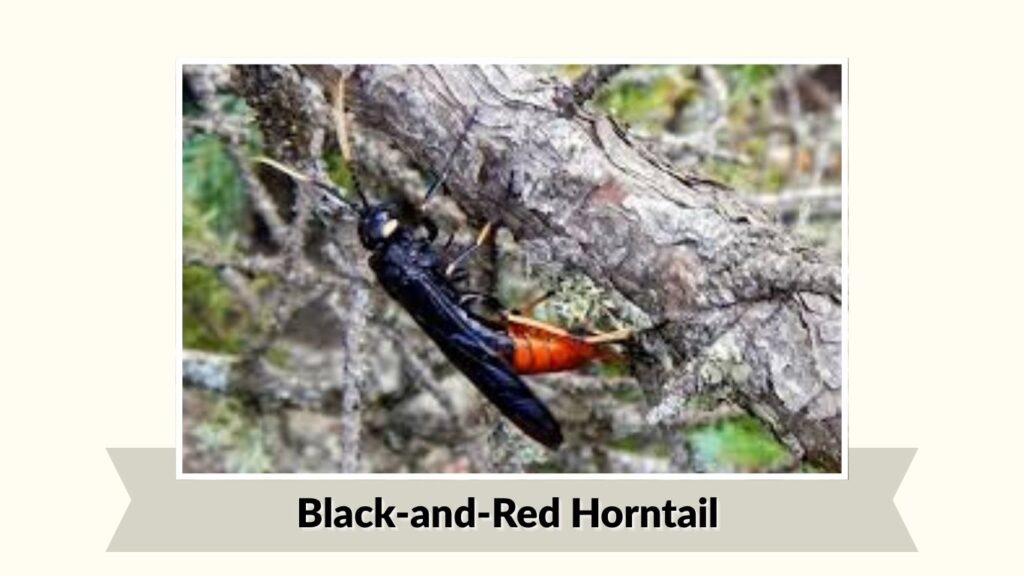
The Black-and-Red Horntail (Urocerus cressoni) is a distinctive wood wasp belonging to the family Siricidae. Its striking combination of a black head, dark wings, and reddish abdomen makes it relatively easy to recognize. Native to eastern North America, this species is associated with coniferous trees and participates in the decomposition of weakened and dead wood.
Identification
- Scientific Name: Urocerus cressoni
- Common Name: Black-and-Red Horntail
- Family: Siricidae
- Size: Medium to large wood wasp
- Color: Black head and thorax with a reddish abdomen
- Body Shape: Long, cylindrical body
- Wings: Dark, smoky-black wings
- Antennae: Black with distinctive white tips
- Distinctive Feature: Two pale spots behind the eyes
- Host Trees: Fir, spruce, and pine
- Distribution: Eastern North America
Habitat and Distribution
Black-and-Red Horntails occur across eastern North America, including parts of Canada and the United States. Their recorded range extends from Nova Scotia and Ontario southward into portions of the southeastern United States.
They typically inhabit coniferous forests and mixed woodlands containing fir, spruce, and pine trees. Adults are most frequently observed during summer, particularly in July and August.
Behavior and Life Cycle
Female Black-and-Red Horntails deposit eggs inside suitable coniferous wood using a specialized ovipositor. Like other members of the genus Urocerus, they are associated with wood-decaying fungi that support larval development.
The larvae tunnel through the wood while feeding on fungus-affected material. They remain hidden throughout most of their development before pupating.
When adults emerge, they leave circular exit holes in the wood. These insects are solitary and do not form colonies like social wasps.
Ecological Importance
Black-and-Red Horntails help break down dead and declining coniferous timber. Their larval tunnels and associated fungi contribute to the natural recycling of nutrients in forest ecosystems.
They also provide food for specialized parasitoid insects, supporting ecological interactions within North American forests.
9. Western Horntail (Sirex areolatus)
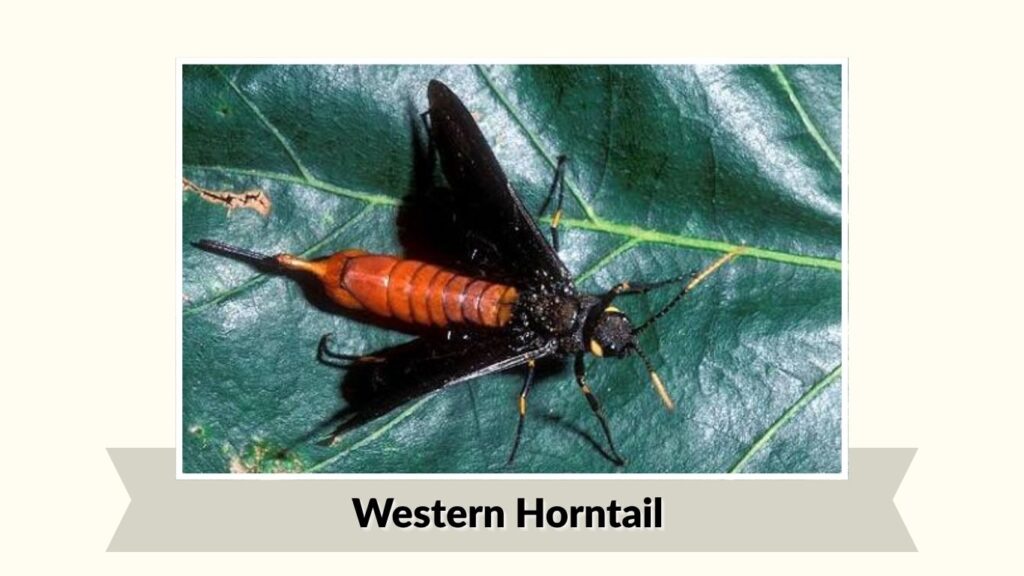
The Western Horntail (Sirex areolatus) is a wood-boring wasp native primarily to western North America. It belongs to the family Siricidae and is recognized by its metallic blue-black coloration and elongated body. Unlike many wood wasps that mainly develop in pine and spruce, this species frequently uses cypress, juniper, and other trees in the cypress family.
Identification
- Scientific Name: Sirex areolatus
- Common Name: Western Horntail
- Family: Siricidae
- Size: Medium to large wood wasp
- Color: Metallic blue-black body
- Body Shape: Long, cylindrical body without a narrow waist
- Wings: Clear to lightly brown-tinted wings
- Legs: Predominantly metallic blue-black
- Antennae: Long and dark-colored
- Distinctive Feature: Females have a relatively long ovipositor
- Host Trees: Cypress, juniper, incense cedar, redwood, pine, and Douglas-fir
Habitat and Distribution
Western Horntails inhabit forested regions of western North America, including California, Oregon, Washington, Arizona, New Mexico, and British Columbia.
They commonly occur in coniferous woodlands containing cypress, juniper, and other suitable host trees. Their larvae often develop inside weakened, recently dead, or fire-damaged wood.
Adult activity generally increases during late summer and early autumn, with the main flight period occurring from September to early October.
Behavior and Life Cycle
Female Western Horntails insert their eggs into weakened or dead wood using a specialized ovipositor. They also introduce symbiotic fungi that colonize the surrounding wood and support larval growth.
After hatching, the larvae tunnel through fungus-affected wood, obtaining nutrients during development. They remain concealed until they pupate and eventually emerge as adults.
Western Horntails are solitary insects and do not build nests or defend colonies.
Ecological Importance
Western Horntails contribute to the decomposition of damaged and dead coniferous trees. Their activities help break down woody material and recycle nutrients.
They can occasionally damage harvested timber by creating tunnels, although they generally do not pose a serious threat to healthy forests.
10. Behrens’s Horntail (Sirex behrensii)
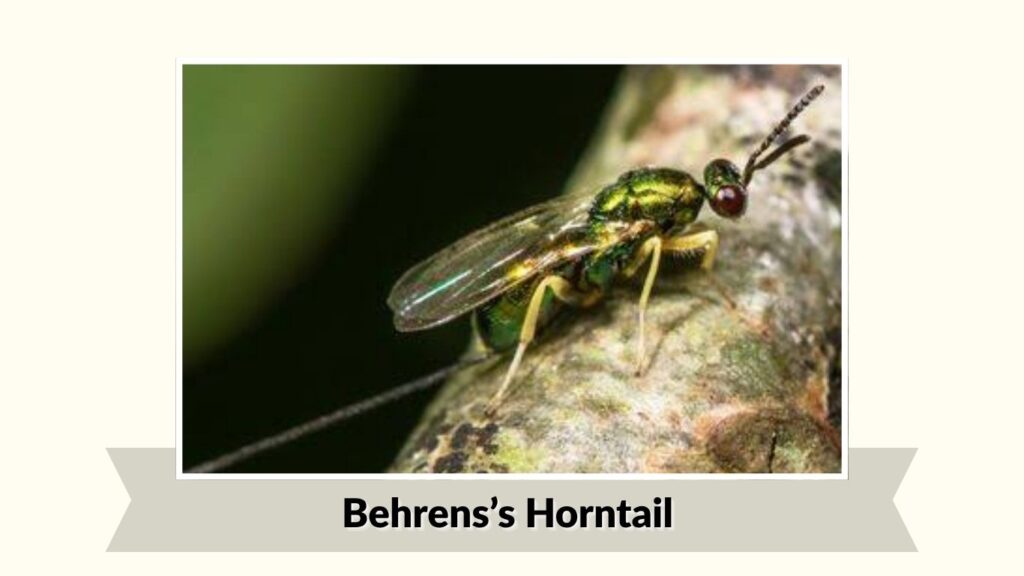
Behrens’s Horntail (Sirex behrensii) is a distinctive North American wood wasp belonging to the family Siricidae. This species is particularly recognized for its dark head, reddish-brown abdomen, and uniquely banded wings. It primarily inhabits coniferous forests in western North America, where its larvae develop inside weakened pine trees and contribute to the natural decomposition of wood.
Identification
- Scientific Name: Sirex behrensii
- Common Name: Behrens’s Horntail
- Family: Siricidae
- Size: Medium to large wood wasp
- Color: Dark bluish-black head and thorax with a reddish-brown abdomen
- Body Shape: Elongated, cylindrical body
- Wings: Transparent wings with two distinctive dark bands
- Antennae: Primarily black in females
- Legs: Dark legs with reddish-brown sections
- Distinctive Feature: Reddish abdomen combined with banded wings
- Host Trees: Ponderosa pine, Jeffrey pine, sugar pine, Monterey pine, and Douglas-fir
Habitat and Distribution
Behrens’s Horntails are native to western North America. They occur primarily in California, Oregon, Washington, Idaho, Nevada, and parts of British Columbia.
They inhabit coniferous forests, especially areas containing ponderosa pine and other suitable pine species. Their reproductive activities are closely associated with recently dead, declining, or damaged trees.
The wasps may also occur in commercially managed forests where suitable host material is available.
Behavior and Life Cycle
Female Behrens’s Horntails deposit eggs inside coniferous wood using their ovipositors. During this process, they introduce symbiotic fungi that begin colonizing the surrounding wood.
The developing larvae feed on fungi and fungus-affected wood while creating tunnels. They remain inside the tree throughout their immature stages.
After completing development, the larvae pupate and emerge as adults. The resulting exit holes are usually circular.
Ecological Importance
Behrens’s Horntails help decompose weakened coniferous trees by supporting fungal colonization and wood breakdown.
Although larval tunneling can affect timber quality, the species generally plays a natural role in forest nutrient cycling rather than acting as a major pest of healthy trees.
11. California Horntail (Urocerus californicus)
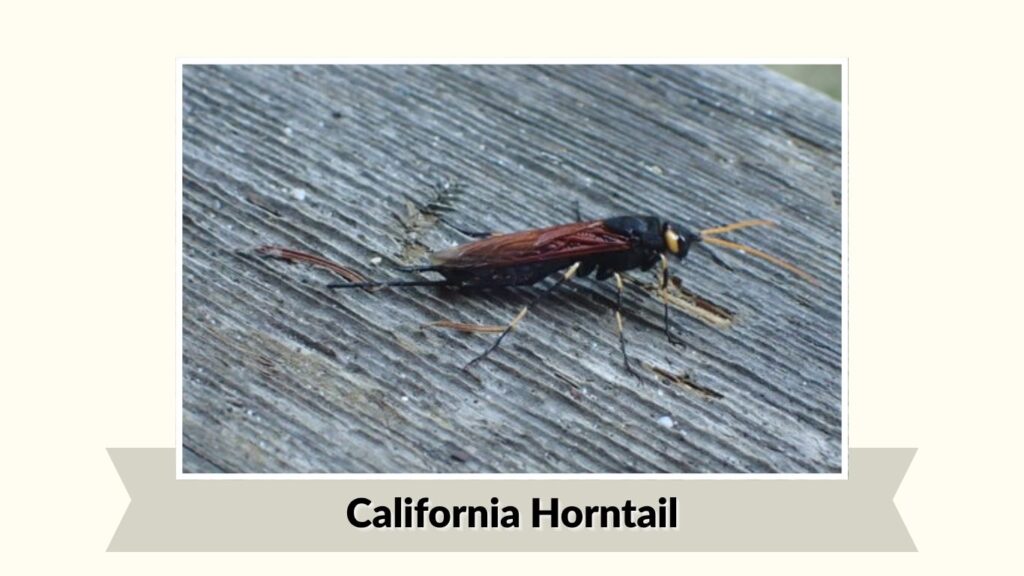
The California Horntail (Urocerus californicus) is a large wood-boring wasp belonging to the family Siricidae. It is among the largest native horntails found in western North America, with females sometimes approaching 40 mm in length. Its dark body, golden-yellow wings, and striking antennae make it a recognizable forest insect commonly associated with weakened or dead coniferous trees.
Identification
- Scientific Name: Urocerus californicus
- Common Name: California Horntail
- Family: Siricidae
- Size: Large; females may reach approximately 40 mm
- Color: Predominantly black body with golden-yellow wings
- Body Shape: Long, robust, cylindrical body
- Wings: Distinctive golden-yellow to amber-colored wings
- Antennae: Yellow to golden-yellow
- Legs: Dark with lighter-colored sections
- Distinctive Feature: Black abdomen combined with yellow wings and antennae
- Host Trees: Fir, larch, incense cedar, spruce, Douglas-fir, and hemlock
Habitat and Distribution
California Horntails occur throughout forested regions of western North America. Their documented range extends from British Columbia through parts of the western United States, including California, Montana, and New Mexico.
They are especially associated with coniferous forests containing mature fir, spruce, Douglas-fir, and other suitable host trees.
These wasps generally select weakened, recently dead, or damaged timber for reproduction rather than healthy living trees.
Behavior and Life Cycle
Female California Horntails use their long ovipositors to insert eggs into suitable coniferous wood. As with other members of the genus Urocerus, fungal associations play an important role in supporting larval development.
After hatching, the larvae tunnel through the wood while obtaining nutrients from fungus-affected material. They remain concealed during their immature stages and eventually pupate inside the tree.
Adults emerge through circular exit holes and disperse to locate mates and suitable reproductive sites.
Ecological Importance
California Horntails contribute to the breakdown of weakened and dead coniferous trees. Their larval feeding activities and fungal associations help accelerate decomposition and nutrient recycling.
Although they may reduce the appearance and quality of harvested timber, they are generally harmless to humans and do not normally infest dry building materials.
12. Tremex Woodwasp (Tremex fuscicornis)
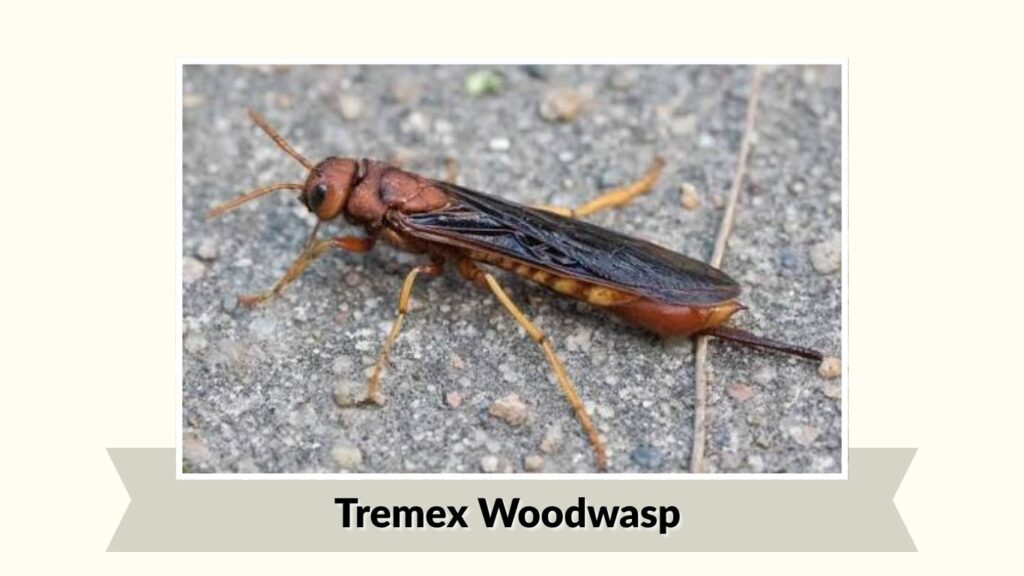
The Tremex Woodwasp (Tremex fuscicornis) is a large wood-boring wasp belonging to the family Siricidae. Native to Europe and Asia, this species is recognized by its black-and-yellow body, amber-colored wings, and prominent ovipositor. It primarily develops inside weakened or dying hardwood trees, although introduced populations have caused damage to healthy poplar trees in some regions.
Identification
- Scientific Name: Tremex fuscicornis
- Common Name: Tremex Woodwasp
- Other Common Name: Dark-Horned Trembling Woodwasp
- Family: Siricidae
- Size: Approximately 15–40 mm long
- Color: Dark body with yellow or orange abdominal markings
- Body Shape: Large, cylindrical body without a narrow waist
- Wings: Transparent to amber-brown wings
- Antennae: Relatively short and dark-colored
- Distinctive Feature: Females possess a long ovipositor for depositing eggs inside wood
- Host Trees: Poplar, willow, birch, beech, maple, and elm
Habitat and Distribution
Tremex Woodwasps naturally occur throughout much of Europe and temperate Asia, including Japan, China, Korea, and Russia. They primarily inhabit deciduous forests, woodland edges, and environments containing weakened hardwood trees.
The species has also been introduced into Chile, where it has caused damage to poplar plantations. Its distribution depends on suitable host trees and the availability of wood for larval development.
Behavior and Life Cycle
Female Tremex Woodwasps use their ovipositors to insert eggs into hardwood trees. During this process, they introduce a wood-decaying fungus called Cerrena unicolor, which helps break down the wood and supports larval feeding.
The larvae develop inside tunnels, feeding on fungus-affected wood. Their development often takes one to two years, depending on environmental conditions.
After pupation, adults emerge through circular exit holes and search for mates.
Ecological Importance
Tremex Woodwasps contribute to the decomposition of weakened and dead hardwood trees. Their association with fungi helps recycle woody materials and return nutrients to forest ecosystems.
However, introduced populations can cause significant damage to poplar trees, particularly when infestations become established in managed plantations.
13. Yellow-Winged Horntail (Urocerus californicus)
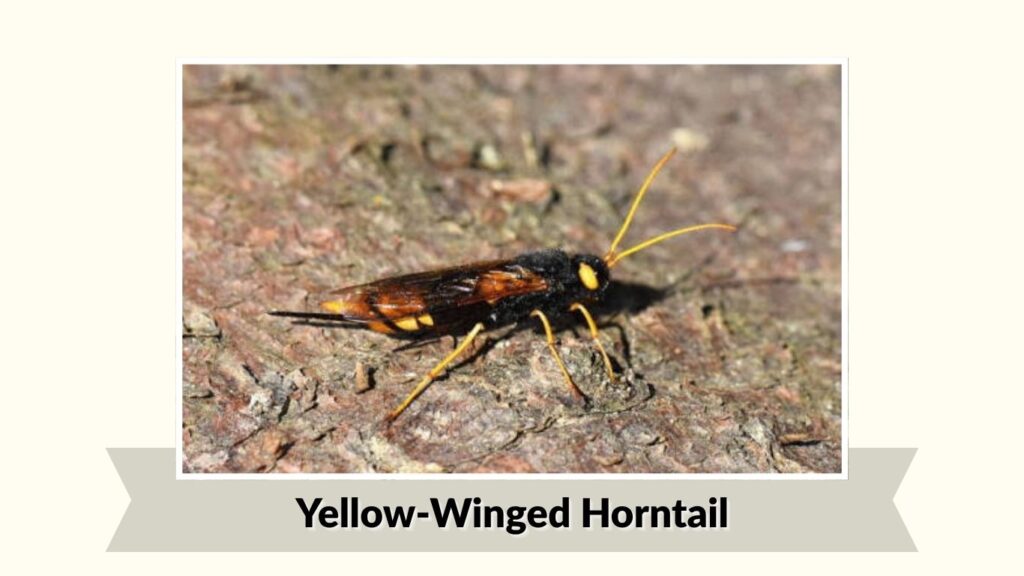
The Yellow-Winged Horntail is a large wood-boring wasp historically identified as Urocerus flavipennis. Modern taxonomy treats that name as a synonym of Urocerus californicus, the California Horntail described earlier in this article. This insect is recognized by its yellow-tinted wings, dark body, and pale antennae. It inhabits western North American coniferous forests, where its larvae develop inside weakened or dead trees.
Identification
- Accepted Scientific Name: Urocerus californicus
- Historical Scientific Name: Urocerus flavipennis
- Common Name: Yellow-Winged Horntail
- Family: Siricidae
- Size: Large wood wasp, with females reaching several centimeters
- Color: Predominantly black in females
- Body Shape: Long, cylindrical body without a narrow waist
- Wings: Distinctively yellow-tinted
- Antennae: Pale white or yellowish in females
- Distinctive Feature: Yellow wings combined with pale antennae
- Host Trees: Fir, spruce, pine, Douglas-fir, and hemlock
Habitat and Distribution
Yellow-Winged Horntails occur in western North America, including California, Oregon, Washington, Idaho, Montana, and British Columbia. Their range extends southward into parts of Mexico.
They inhabit coniferous forests containing fir, spruce, and other suitable trees. Adult activity is most common between July and September, with peak observations often occurring in August.
Behavior and Life Cycle
Female horntails use their specialized ovipositors to deposit eggs inside weakened or recently dead coniferous wood. They introduce fungal associates that help prepare the wood for larval development.
After hatching, larvae tunnel through the wood and obtain nutrients from fungus-affected material. They remain concealed until completing development and emerging as adults.
Ecological Importance
These horntails contribute to wood decomposition and nutrient recycling in coniferous forests. Their fungal associations help break down woody tissues, while their larvae provide food for parasitoid insects.
Although larval tunnels can reduce timber quality, these insects generally prefer weakened or dead trees.
14. Black-Pine Horntail (Sirex nigricornis)
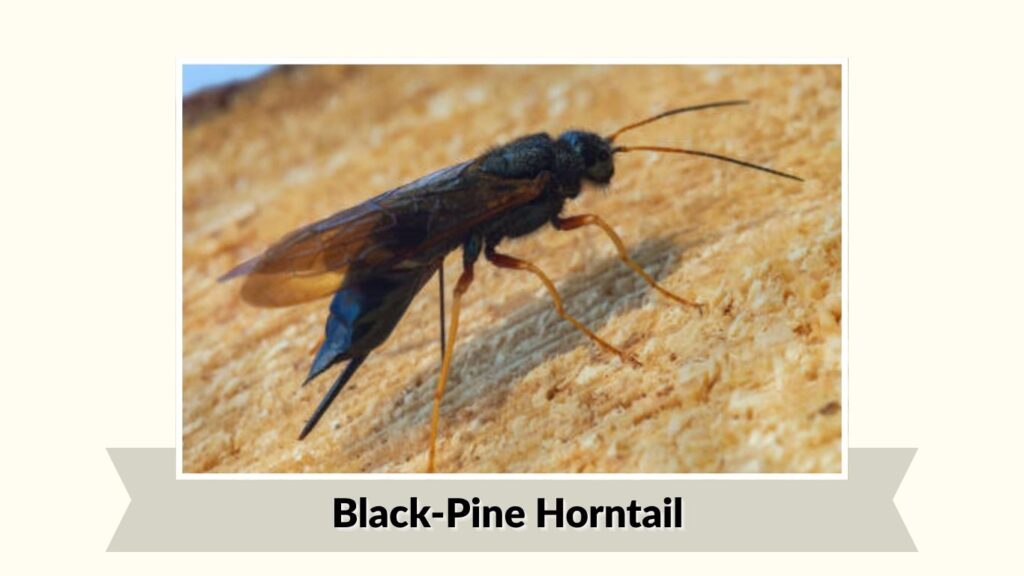
The Black-Pine Horntail is a native North American wood wasp historically described under the name Paururus hopkinsi. That name is now considered a synonym of Sirex nigricornis. This species has a dark, robust body and is primarily associated with pine trees. Unlike the invasive Sirex Woodwasp, it generally colonizes severely weakened or dying trees rather than healthy ones.
Identification
- Accepted Scientific Name: Sirex nigricornis
- Historical Scientific Name: Paururus hopkinsi
- Common Name: Black-Pine Horntail
- Family: Siricidae
- Size: Approximately 25–40 mm long
- Color: Dark blue-black head and thorax; abdomen varies from black to orange
- Body Shape: Robust, cylindrical body
- Wings: Dark, smoky wings
- Antennae: Dark-colored and slender
- Distinctive Feature: Dark abdominal horn and prominent female ovipositor
- Host Trees: Shortleaf pine, eastern white pine, pitch pine, jack pine, and other pines
Habitat and Distribution
Black-Pine Horntails occur across eastern North America, extending through much of the eastern United States and parts of Canada.
They inhabit pine forests, mixed woodlands, and areas containing recently dead or declining pine trees. Their larvae require suitable wood moisture and fungal development to survive.
Historical specimens identified as Paururus hopkinsi were collected from dead pine trees in North Carolina and West Virginia.
Behavior and Life Cycle
Female Black-Pine Horntails deposit eggs inside weakened pine wood using their ovipositors. They also introduce symbiotic fungi that support larval development.
The larvae develop inside the wood, tunneling through fungus-colonized tissues. Development commonly takes approximately one year, although conditions may affect its duration.
Adults eventually emerge through circular holes and search for suitable mates and host trees.
Ecological Importance
Black-Pine Horntails help decompose weakened and dead pine trees. Their activities contribute to forest nutrient recycling and support organisms that depend on decaying wood.
They also serve as hosts for parasitoid wasps and nematodes. Unlike invasive Sirex noctilio, this native species is not generally considered a major economic pest of healthy pine forests.
15. Pale Tremex (Tremex columba)
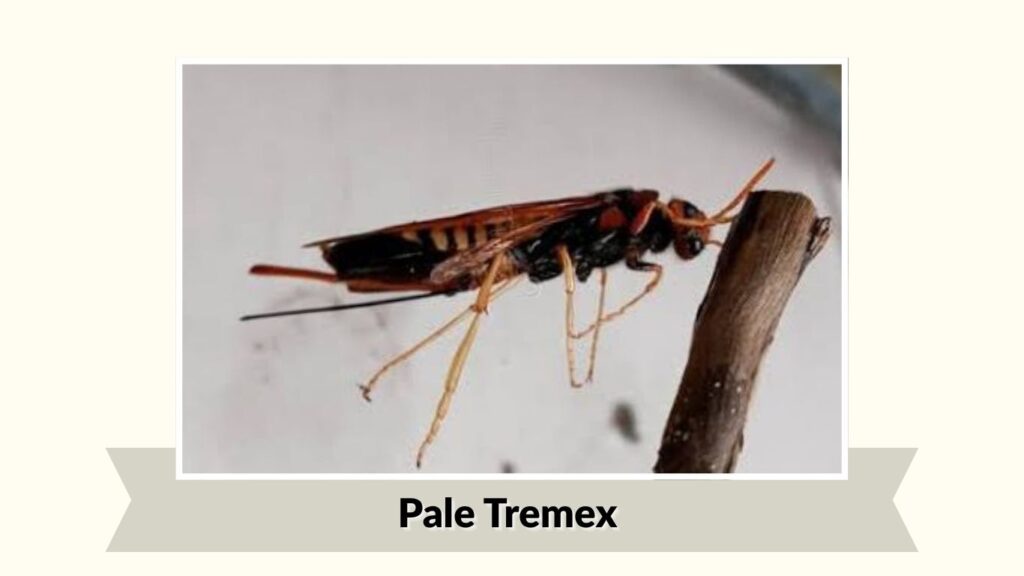
The Pale Tremex is a historical name associated with a lighter-colored form of the Pigeon Horntail (Tremex columba). Previously described as Tremex sericeus, it is now considered part of the same species discussed in entry two. This wood-boring wasp is recognized by its reddish-brown coloration, elongated body, and association with weakened hardwood trees throughout North America.
Identification
- Accepted Scientific Name: Tremex columba
- Historical Scientific Name: Tremex sericeus
- Common Name: Pale Tremex
- Family: Siricidae
- Size: Approximately 25–50 mm long
- Color: Predominantly reddish-brown with darker markings
- Body Shape: Large, elongated, cylindrical body
- Wings: Brownish to smoky-colored wings
- Antennae: Relatively short and reddish-brown
- Distinctive Feature: Pale reddish-brown abdomen and prominent female ovipositor
- Host Trees: Maple, elm, oak, hickory, poplar, and other hardwoods
Habitat and Distribution
Pale Tremex wasps are associated with deciduous forests throughout eastern North America. The pale-colored form is particularly known from southeastern states, extending northward into southern New York and Illinois.
These insects typically inhabit forests, woodland edges, and locations containing weakened or recently dead hardwood trees. Their occurrence depends on suitable host wood for egg-laying and larval development.
Behavior and Life Cycle
Female Pale Tremex wasps deposit eggs inside suitable hardwood trees using their long ovipositors. They are associated with wood-decaying fungi that help support larval development.
After hatching, larvae create tunnels within the wood and feed on fungus-affected materials. They remain concealed during development before eventually emerging as adults.
Although the ovipositor resembles a stinger, it is used for laying eggs rather than attacking humans.
Ecological Importance
Pale Tremex wasps contribute to the breakdown of weakened and dead hardwood trees. Their activities support nutrient recycling and the natural decomposition of forest materials.
They also provide hosts for parasitoid wasps, including giant ichneumon wasps, which develop by feeding on woodwasp larvae.
FAQs
1. Are Wood Wasps Dangerous to Humans?
Wood wasps are generally harmless to humans because they do not possess a functional defensive stinger. Their long, needle-like structures are used by females to deposit eggs inside wood. Although some species resemble large hornets, they are solitary insects and do not aggressively defend colonies or nests.
2. Do Wood Wasps Damage Healthy Trees?
Most wood wasps prefer weakened, dying, recently cut, or dead trees. However, certain species, particularly the invasive Sirex Woodwasp (Sirex noctilio), can attack living pine trees and cause significant damage. Their larvae and associated fungi may weaken trees, affect timber quality, and contribute to tree mortality.
3. How Long Do Wood Wasps Live?
Adult wood wasps generally live for a relatively short period, often only several days to a few weeks. However, their complete life cycle can take one to three years, depending on the species and environmental conditions. Most of their lives are spent developing as larvae inside wood before emerging as adults.
4. What Do Wood Wasps Eat?
Adult wood wasps generally consume little or no food, relying on energy reserves accumulated during larval development. Their larvae develop inside wood, obtaining nutrients from fungus-colonized plant tissues. Many wood wasp species maintain specialized relationships with fungi that help break down wood and make nutrients available.
5. How Can You Identify a Wood Wasp?
Wood wasps typically have elongated, cylindrical bodies without the narrow waists seen in many familiar wasps. They possess two pairs of wings, long antennae, and a pointed abdominal projection. Females often have a noticeable ovipositor extending from the abdomen. Depending on the species, their bodies may be black, metallic blue, reddish-brown, or yellow-banded.
