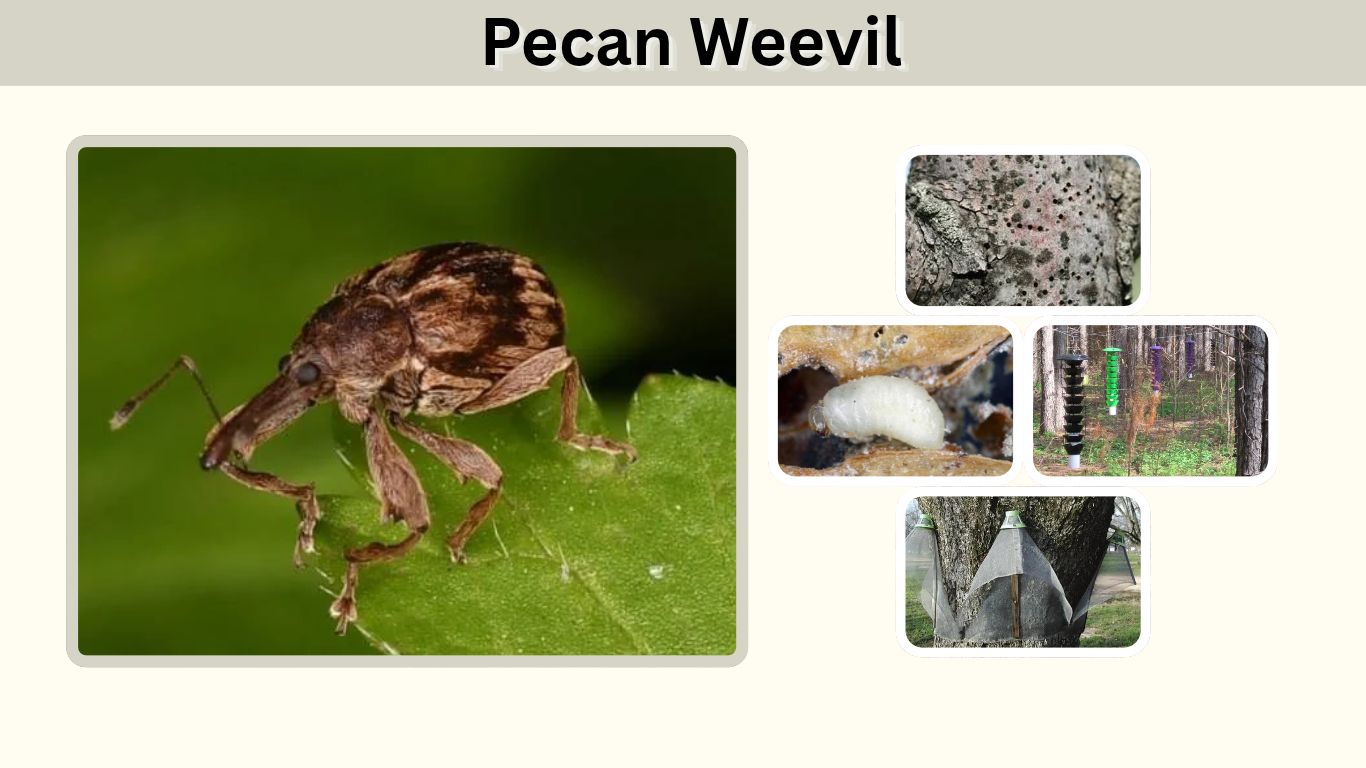
Pecan weevils are destructive insects that can cause serious damage to pecan trees and reduce nut production. These small, brown beetles have long snouts and spend much of their life cycle underground. Adult pecan weevils feed on developing nuts, while their larvae consume the kernels from inside. Infestations are particularly concerning for home gardeners and commercial pecan growers. Understanding pecan weevil identification, damage symptoms, emergence patterns, and effective control methods can help protect pecan harvests. This guide explains their life cycle, trapping techniques, treatment options, and prevention strategies.
What Is a Pecan Weevil?
The pecan weevil (Curculio caryae) is a beetle belonging to the family Curculionidae. It is one of the most significant insect pests affecting pecan production in the United States. Unlike weevils that attack stored grains, pecan weevils infest developing nuts directly on trees.
These insects primarily attack pecans but can also reproduce in certain hickory nuts. Adults emerge from underground during late summer, while larvae develop inside nuts before entering the soil.
Pecan Weevil Identification
Pecan weevils have distinctive physical characteristics that help distinguish them from other beetles. Their unusually long snouts are the most recognizable feature. Both adults and larvae look different, making identification important throughout the growing season.
What Does an Adult Pecan Weevil Look Like?
- Size: Approximately 10–13 millimeters long, excluding the snout.
- Color: Reddish-brown, grayish-brown, or dark brown.
- Body: Oval, hard-shelled, and covered with fine scales.
- Snout: Long, narrow, and slightly curved downward.
- Antennae: Elbowed antennae attached to the snout.
- Legs: Six relatively thin legs adapted for walking and climbing.
- Wings: Adults possess functional wings and can fly.
Female pecan weevils usually have longer snouts than males. Their extended mouthparts allow them to bore into developing pecans and prepare openings for egg deposition.
Pecan Weevil Larvae Identification
Pecan weevil larvae are creamy-white, legless grubs with reddish-brown heads. Their bodies are soft, curved, and segmented.
They develop inside pecan shells, consuming the edible kernels. Fully developed larvae may reach approximately 15 millimeters in length before leaving the nuts and entering the soil.
Pecan Weevil Life Cycle
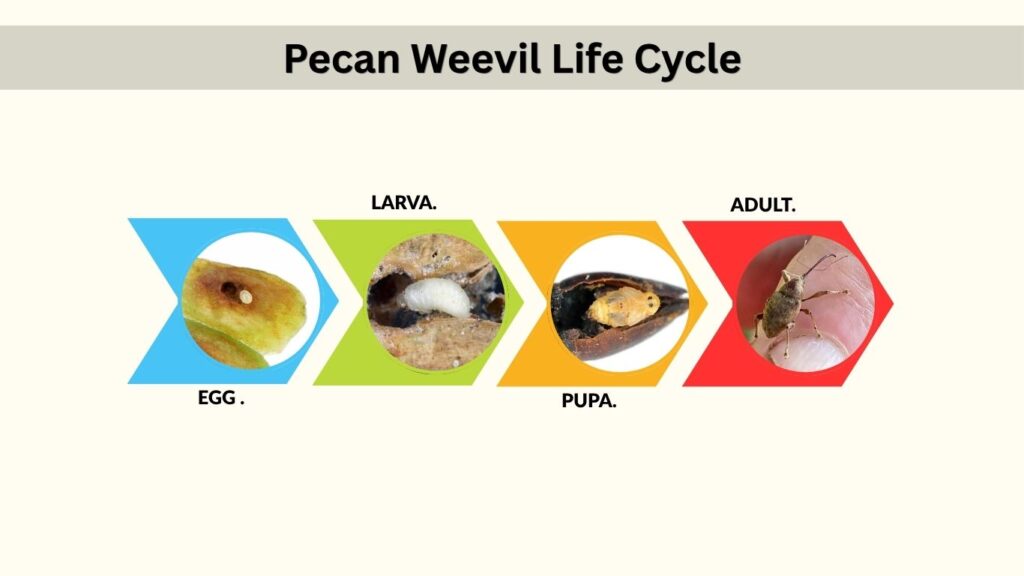
The pecan weevil undergoes complete metamorphosis through four stages: egg, larva, pupa, and adult. Unlike many other beetles, its development usually takes two to three years.
The extended underground period makes pecan weevil management particularly challenging.
Egg and Larval Development
Female weevils drill openings through developing pecans and deposit eggs inside once the nuts reach a suitable developmental stage.
Eggs hatch into larvae that feed on the kernels for approximately four to six weeks.
After completing development, mature larvae chew circular exit holes through the shells. They then drop to the ground and burrow into the soil.
Pupal and Adult Stages
Larvae remain underground for an extended period, usually within protective soil chambers.
Some develop into pupae the following year, while others remain underground longer. Adults eventually form inside these chambers and emerge during a subsequent growing season.
This extended life cycle allows populations to persist even when control measures are applied during a single season.
Pecan Weevil Damage to Pecan Trees
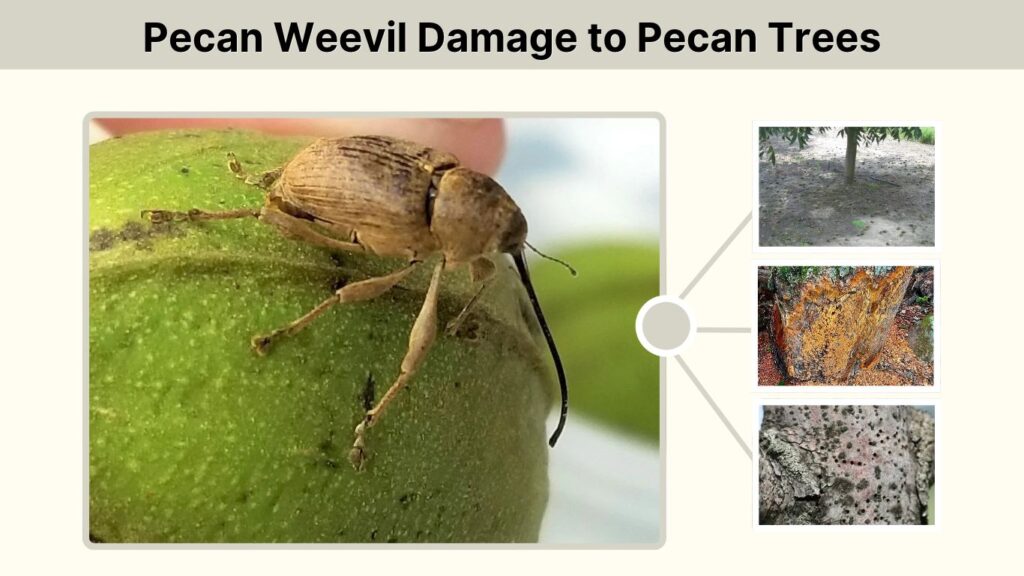
Pecan weevils damage nuts during both adult feeding and larval development. The severity depends on nut maturity, infestation levels, and seasonal conditions.
Early adult feeding can cause immature nuts to drop. Later infestations allow larvae to develop inside nuts, destroying the kernels and reducing harvest quality.
Common Signs of Pecan Weevil Damage
- Premature nut drop: Young pecans fall after feeding punctures.
- Dark feeding marks: Small punctures or discoloration appear on shucks.
- Circular exit holes: Mature larvae leave openings in damaged shells.
- Destroyed kernels: Larvae consume developing nut tissue.
- White grubs: Cream-colored larvae appear inside cracked pecans.
- Poor nut quality: Infested nuts may contain darkened or shriveled kernels.
Severely affected orchards may experience significant reductions in marketable pecan production.
When Do Pecan Weevils Emerge?
Adult pecan weevils generally emerge from the soil between late July and October, depending on location and environmental conditions.
Peak emergence often occurs from August through September across major pecan-growing areas.
Rainfall strongly influences their activity because moist soil makes it easier for adults to reach the surface. Extended drought can delay emergence.
Pecan Weevil Emergence After Rain
Adult emergence often increases several days after substantial rainfall, especially when soil temperatures remain favorable.
Growers should monitor activity after late-summer storms. Early-maturing pecan varieties may become vulnerable before later varieties, making local monitoring essential.
How to Get Rid of Pecan Weevils
Successful pecan weevil control requires monitoring adult emergence and protecting nuts before females deposit eggs. Once larvae enter pecan kernels, ordinary foliar insecticides cannot reliably reach them.
Combining trapping, sanitation, and properly timed treatments provides the strongest approach.
Natural and Organic Pecan Weevil Control
Natural management focuses on reducing insect populations and limiting successful reproduction.
Collecting and destroying infested nuts before larvae escape can reduce future populations. Early harvesting may also help remove developing larvae from affected orchards.
Beneficial nematodes have been studied for controlling soil-dwelling pecan weevils, but their field performance varies. They should not be considered a guaranteed replacement for established control programs.
Pecan Weevil Insecticides
Registered insecticides can control adult pecan weevils before egg deposition. Treatment decisions should depend on adult captures and pecan development rather than a fixed spraying schedule.
Carbaryl-based products, including certain Sevin formulations, have historically been used for pecan weevil control. However, registrations and permitted uses vary by product and location.
Always check current labels, preharvest intervals, and local agricultural extension recommendations before application.
Pecan Weevil Traps and Monitoring Methods
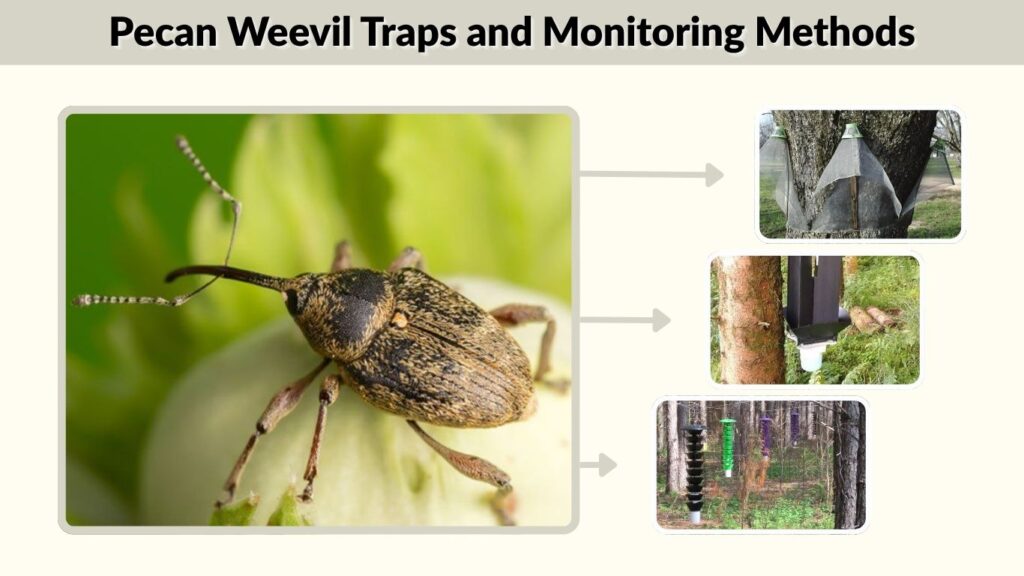
Traps help growers determine when adults emerge and whether treatments are necessary. Monitoring is especially important because adult activity can vary considerably between years.
Different traps intercept beetles as they move from the soil into pecan trees.
Common Types of Pecan Weevil Traps
- Circle traps: Attach to tree trunks and capture adults crawling upward.
- Pyramid traps: Resemble small tree trunks and intercept emerging adults.
- Wire cone traps: Capture beetles climbing through funnel-shaped structures.
- Burlap traps: Provide a simple way to intercept climbing insects.
- Beating sheets: Collect adults dislodged from tree branches.
Traps should be inspected every two to three days during the emergence period. Their catches help identify when control treatments may be necessary.
How to Prevent Pecan Weevil Infestations
Preventing pecan weevils requires consistent orchard monitoring and sanitation. Because many larvae survive underground for more than one year, management must continue across multiple growing seasons.
Removing infested nuts and monitoring trees with a history of damage can gradually reduce infestation pressure.
Effective Pecan Weevil Prevention Tips
- Collect fallen pecans frequently during harvest.
- Destroy infested nuts before larvae escape into the soil.
- Install monitoring traps before expected adult emergence.
- Inspect pecan shells for punctures and circular exit holes.
- Avoid transporting infested nuts into pest-free areas.
- Maintain records of affected trees and seasonal activity.
Maintaining healthy trees supports production, but good tree care alone does not prevent pecan weevil attacks.
FAQs
1. Do Pecan Weevils Bite Humans?
Pecan weevils do not normally bite humans or pets. Their mouthparts are designed for feeding on developing nuts and boring into pecan shells. They are agricultural pests rather than insects that pose a direct threat to human health.
2. Can Pecan Weevils Fly?
Yes, adult pecan weevils can fly. However, they also crawl from the soil onto tree trunks to reach developing nuts. Their movement depends on environmental conditions, and trunk-mounted traps can capture adults moving upward into the canopy.
3. What Is the Best Time to Spray for Pecan Weevils?
The best time depends on adult emergence and nut development. Treatments generally target adults before egg laying. Monitoring traps helps growers identify the appropriate application window and determine whether additional treatment is necessary.
4. How Long Do Pecan Weevils Stay Underground?
Pecan weevils spend much of their two- to three-year life cycle underground. Mature larvae enter the soil, where they eventually pupate and become adults. Some remain underground longer than others before emerging.
5. Are Pecan Weevil Traps Effective?
Pecan weevil traps are effective monitoring tools, especially circle and pyramid traps. They help identify adult emergence and guide treatment decisions. However, trapping alone may not provide sufficient control for heavy infestations in commercial orchards.