
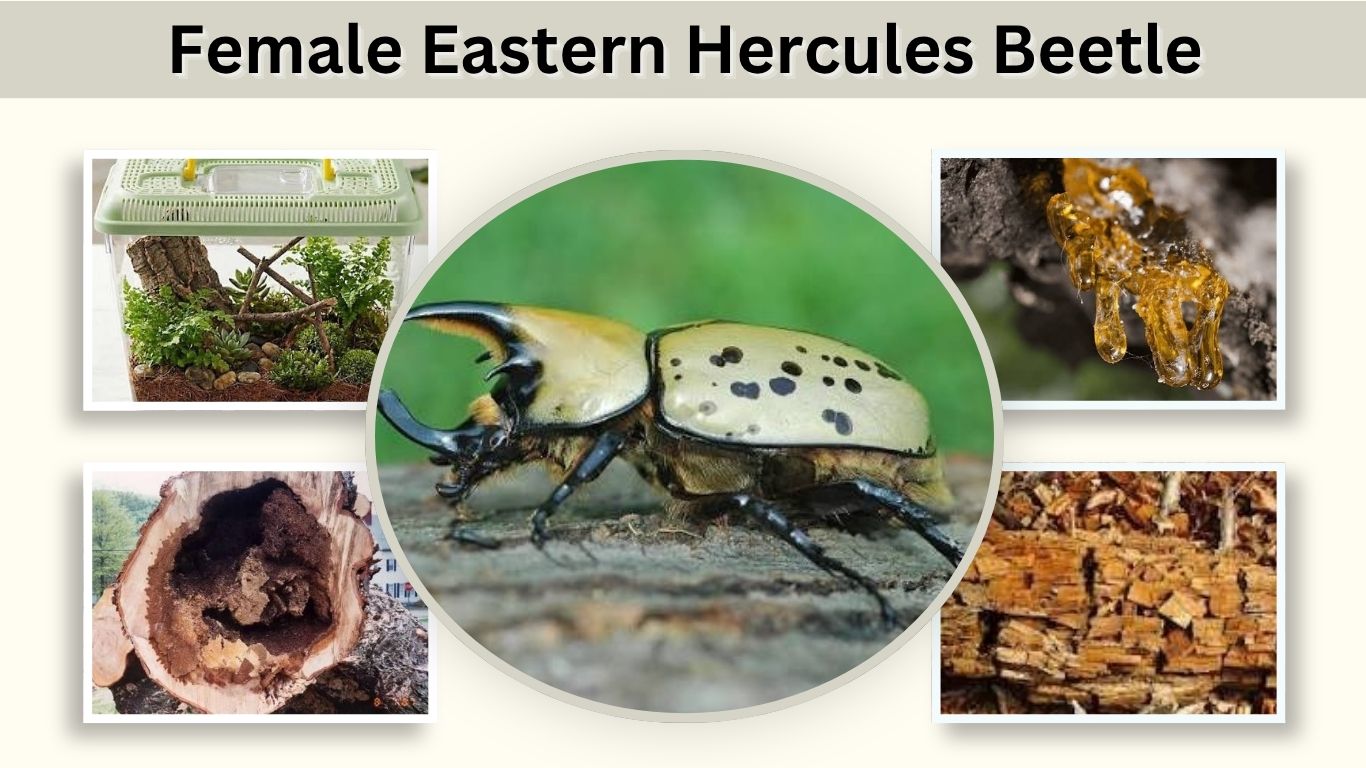
The female Eastern Hercules beetle (Dynastes tityus) is a large, fascinating insect found throughout much of the eastern United States. Unlike males, which have impressive horns, females have rounded bodies, smooth-looking heads, and distinctive spotted wing covers. Their colors range from pale greenish-gray to dark brown or almost black. Although they lack the dramatic horns of males, female beetles play an essential role in reproduction and forest ecosystems. Understanding their appearance, size, habitat, diet, behavior, and life cycle makes it easier to identify these remarkable insects in the wild.
What Is a Female Eastern Hercules Beetle?
The female Eastern Hercules beetle belongs to the family Scarabaeidae and the rhinoceros beetle subfamily Dynastinae. Its scientific name is Dynastes tityus, the same as the male because both belong to one species. Females are particularly recognizable by their lack of large horns, rounded body structure, and distinctive dark markings.
Female Eastern Hercules Beetle Identification
Female Eastern Hercules beetles have several physical features that distinguish them from males and other large scarab beetles.
- Scientific name: Dynastes tityus
- Family: Scarabaeidae
- Body length: Commonly around 1.5–2 inches
- Color: Yellowish-tan, greenish-gray, or dark brown
- Markings: Irregular black spots on the wing covers
- Head: Rounded, without prominent horns
- Body shape: Broad, oval, and heavily built
- Legs: Strong, dark legs with gripping claws
- Activity: Primarily nocturnal
Females possess hardened wing covers called elytra, which protect the delicate wings underneath.
What Does a Female Eastern Hercules Beetle Look Like?
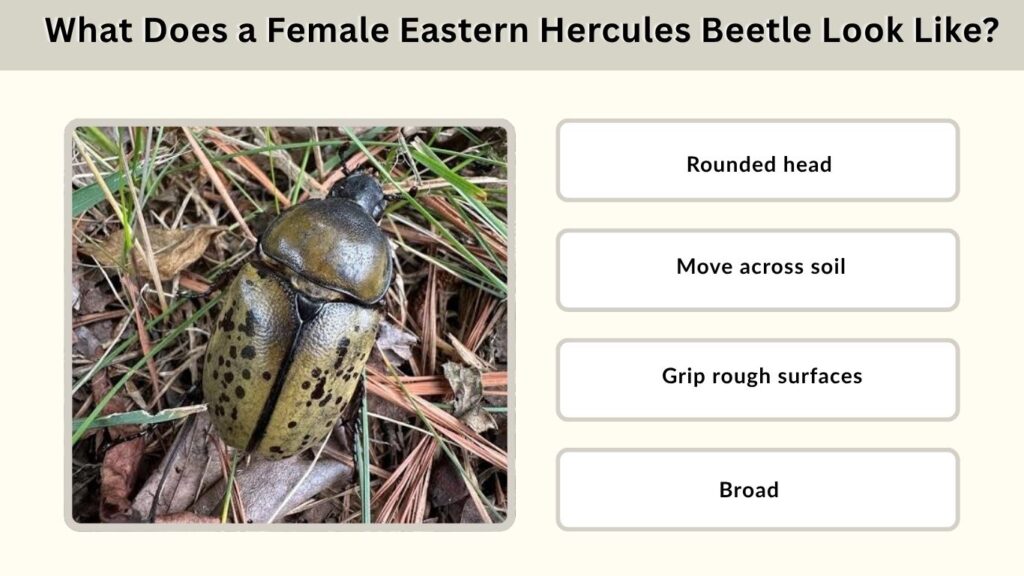
Female Eastern Hercules beetles have a robust, rounded appearance. Their bodies are noticeably broader than those of many common beetles, while their shiny outer shells feature unusual spotting patterns. Unlike males, they lack the large projections that make Hercules beetles famous. However, their size and markings still make them relatively easy to recognize.
Body Shape and Physical Features
A female Eastern Hercules beetle has a broad thorax, rounded head, and thick abdomen protected by hardened wing covers. Small raised bumps may appear on the head or thorax where males develop prominent horns.
Her legs are muscular and equipped with small claws that help her climb tree bark, move across soil, and grip rough surfaces. Short, clubbed antennae allow her to detect environmental signals.
Female Eastern Hercules Beetle Color
Most females display greenish-gray or yellowish-tan wing covers decorated with irregular black spots. These markings vary between individuals, so two females may look noticeably different.
Some females appear dark brown or almost black. Both natural variation and environmental conditions influence their appearance, making color alone an unreliable identification feature.
Why Is a Female Eastern Hercules Beetle Black?
A black female Eastern Hercules beetle is not necessarily a different species. Eastern Hercules beetles can undergo noticeable color changes in response to environmental humidity. Their wing covers become darker under moist conditions, sometimes changing from pale greenish-yellow to deep brown.
How Humidity Affects Shell Color
The wing covers of Eastern Hercules beetles contain microscopic structures that influence how light interacts with their surfaces.
When moisture enters these structures, their optical properties change, making the shell appear darker. This effect is reversible, although naturally dark individuals can also occur.
A female beetle found after heavy rain may therefore appear much darker than one observed under dry conditions.
Eastern Hercules Beetle Male vs. Female
Male and female Eastern Hercules beetles share many characteristics, including body coloration, powerful legs, and large size. Their most obvious difference is the presence or absence of horns. This distinction makes sex identification relatively straightforward, especially when comparing mature adults of the same species.
Key Differences Between Male and Female
| Feature | Female Eastern Hercules Beetle | Male Eastern Hercules Beetle |
| Horns | No prominent horns | Two prominent horns |
| Body shape | Broad and rounded | More elongated with horns |
| Size | Generally smaller | Often larger |
| Head | Rounded with small bumps | Large horn-bearing structure |
| Color | Greenish, tan, or dark brown | Greenish, tan, or dark brown |
| Reproductive role | Produces and lays eggs | Competes for mating opportunities |
| Flight ability | Can fly | Can fly |
Why Do Female Eastern Hercules Beetles Have No Horns?
Male Eastern Hercules beetles use their horns during competition with other males. These structures help them push, lift, or displace rivals when competing for reproductive opportunities.
Females do not participate in these horn-based contests, so they have not developed similarly prominent structures. Instead, their reproductive activities involve mating and locating suitable places to lay eggs.
How Big Is a Female Eastern Hercules Beetle?
Female Eastern Hercules beetles are among the largest beetles commonly encountered in eastern North America. Although males may appear significantly longer because of their horns, females still possess exceptionally heavy and robust bodies compared with ordinary garden beetles.
Female Eastern Hercules Beetle Size
Adult females commonly measure approximately 1.5–2 inches (38–51 mm) long, although individual measurements vary.
Their bodies are relatively wide, with a substantial abdomen and protective wing covers. Nutrition during larval development strongly influences adult body size.
A well-developed female may be noticeably larger than a poorly nourished male with short horns.
Where Do Female Eastern Hercules Beetles Live?
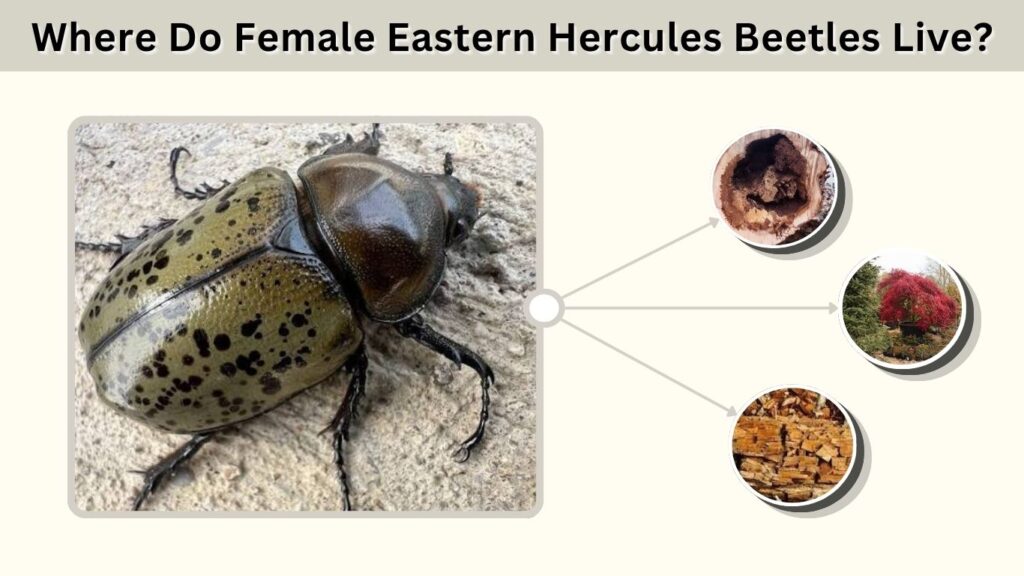
Female Eastern Hercules beetles inhabit forest environments throughout much of the eastern and southeastern United States. They depend on wooded habitats containing mature trees, decaying hardwood, and suitable conditions for reproduction. Unlike larvae, which remain hidden in decomposing wood, adult females may occasionally be encountered in gardens or near buildings.
Native Range and Habitat
Female Eastern Hercules beetles occur in states including:
- Florida: Woodlands and suitable forest habitats.
- North Carolina: Deciduous forests and wooded areas.
- Virginia: Forests containing mature trees.
- Maryland: Wooded habitats with decomposing hardwood.
- Missouri: Forest environments and wooded landscapes.
- Arkansas: Areas with abundant decaying wood.
- Tennessee: Suitable wooded habitats.
Their natural environments provide food, shelter, and breeding sites essential for reproduction.
When Are Female Eastern Hercules Beetles Active?
Adult females are mainly active during summer, particularly from June through August in many areas.
They are primarily nocturnal and may fly toward artificial lights during warm evenings. Females also spend time searching for appropriate locations to deposit their eggs.
What Do Female Eastern Hercules Beetles Eat?
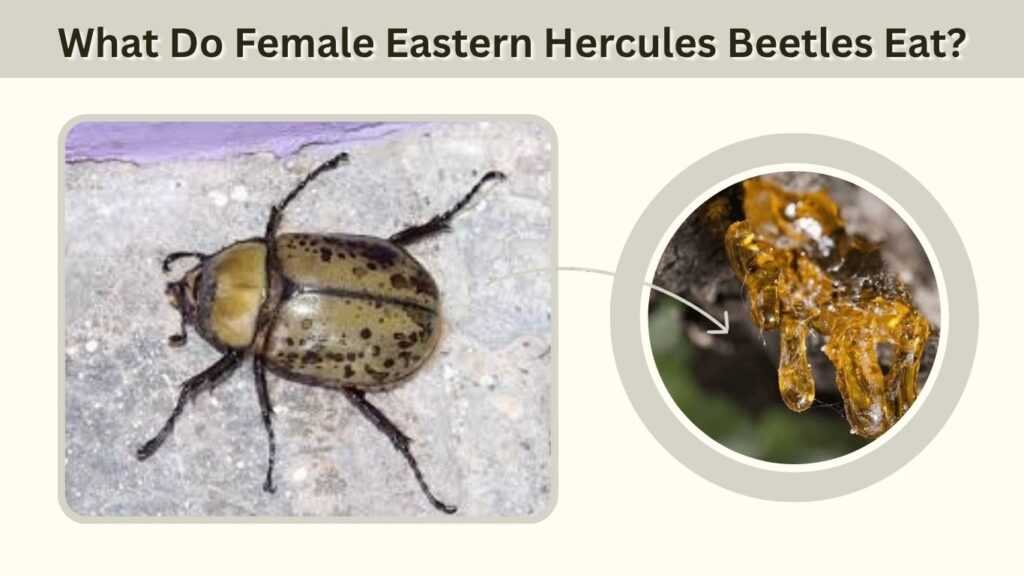
Female Eastern Hercules beetles obtain energy from sugary plant materials. Their feeding habits are similar to those of males, although females also require sufficient energy for reproduction. Unlike their developing larvae, which consume decaying wood, adult females primarily use accessible plant-based food sources.
Natural Food Sources
Adult female Eastern Hercules beetles may consume tree sap and decaying fruit. They have been observed feeding around damaged tree bark where sugary sap is available.
In captivity, females may accept ripe bananas, apples, and commercially prepared beetle jelly. Fresh food should be provided carefully to prevent mold growth.
Their larvae have different feeding requirements and depend on decomposed hardwood material.
Female Eastern Hercules Beetle Reproduction and Life Cycle
Female Eastern Hercules beetles play a central role in maintaining the species population. After mating, they search for suitable egg-laying locations containing decomposing organic matter. Their offspring undergo complete metamorphosis, developing through egg, larval, pupal, and adult stages before eventually becoming reproductive adults themselves.
Egg Laying and Breeding
Female Eastern Hercules beetles lay eggs in cavities associated with decaying hardwood, often near the bases of dead or dying trees.
A female may produce dozens of eggs, potentially up to around 100 under favorable conditions. The eggs are pale and generally hatch after approximately one month.
Larval Development
After hatching, larvae begin feeding on decomposing hardwood and accumulated organic material.
They develop through three larval stages known as instars. This period may continue for a year or longer, depending on environmental conditions.
The complete life cycle often requires around two to three years, although developmental timing varies.
Can You Keep a Female Eastern Hercules Beetle as a Pet?
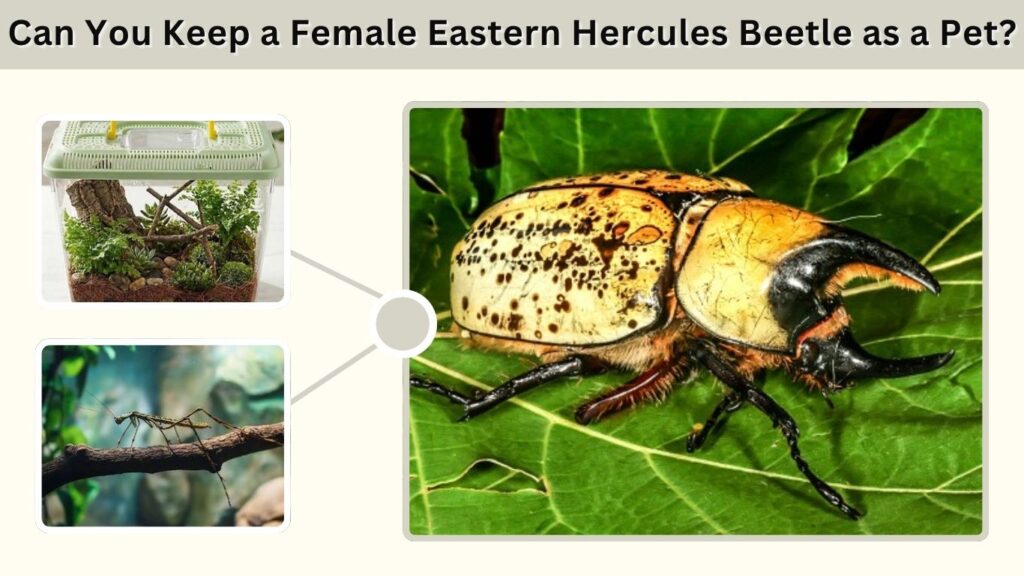
Female Eastern Hercules beetles are sometimes kept by insect enthusiasts because of their interesting appearance and generally manageable behavior. Their lack of large horns makes them less visually intimidating than males. However, they still require careful handling, appropriate housing, and a suitable diet to remain healthy.
Basic Care Requirements
A female Eastern Hercules beetle should have a secure, ventilated enclosure with enough space for walking and climbing.
Provide natural hiding places, a suitable slightly moist substrate, and protection from direct sunlight. Room temperatures around 68–77°F (20–25°C) are a reasonable starting point for adult husbandry.
Offer fresh fruit or beetle jelly and remove spoiled food regularly. Breeding females require specialized egg-laying substrate containing appropriately decomposed hardwood material.
Are Female Eastern Hercules Beetles Dangerous?
Female Eastern Hercules beetles are not venomous and do not possess stingers. They are generally harmless to humans despite their large size and strong-looking bodies.
Although they have chewing mouthparts, dangerous bites are not characteristic of this species. Their legs can grip skin firmly, which may feel uncomfortable during handling.
These beetles are beneficial forest insects because their larvae help break down decaying hardwood, returning nutrients to the surrounding environment.
FAQs
1. Can Female Eastern Hercules Beetles Fly?
Yes, female Eastern Hercules beetles can fly. Their functional hindwings are folded beneath protective wing covers when not in use. Females are primarily active at night and may be attracted to outdoor lights during warm summer evenings.
2. Do Female Eastern Hercules Beetles Have Horns?
No, female Eastern Hercules beetles do not have the prominent horns seen on males. They may possess small raised bumps on their heads or thoraxes, but these structures are not comparable to the large horns males use during competition.
3. How Long Do Female Eastern Hercules Beetles Live?
The entire Eastern Hercules beetle life cycle may take approximately two to three years. Most of this period involves immature development. Adult females can survive for several months or longer, depending on seasonal conditions, nutrition, and whether the individual is living in captivity.
4. Are Female Eastern Hercules Beetles Rare?
Female Eastern Hercules beetles are not necessarily rare throughout their native range. However, they are encountered relatively infrequently because adults are mostly active at night, and larvae remain hidden in decomposing wood. Local populations depend on suitable forest habitats.
5. Can Female Eastern Hercules Beetles Bite Humans?
Female Eastern Hercules beetles possess chewing mouthparts but are not known for dangerous bites. They are generally harmless when handled carefully. Their strong claws may grip human skin, so it is best to allow them to walk naturally rather than pulling them away forcefully.
