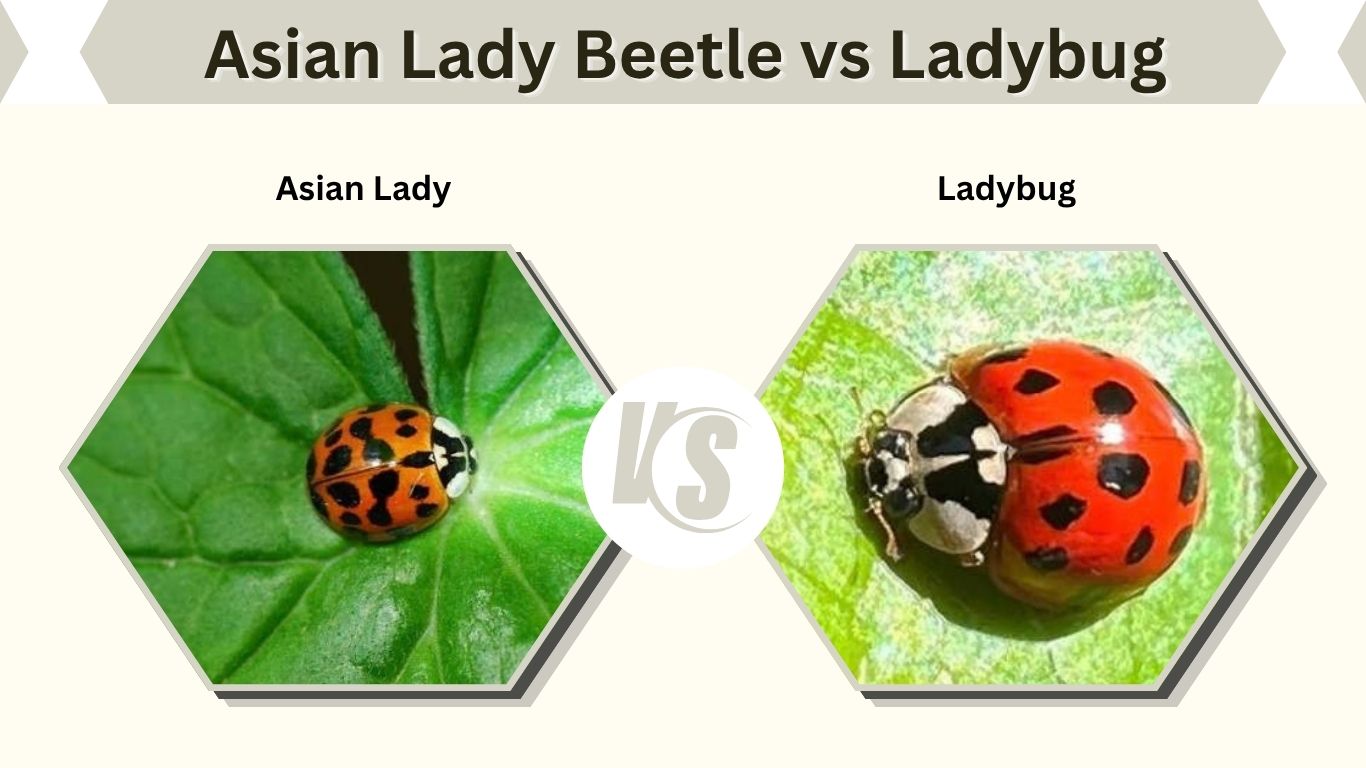
The Asian lady beetle vs ladybug comparison can be confusing because Asian lady beetles are technically ladybugs too. The multicolored Asian lady beetle (Harmonia axyridis) belongs to the same lady beetle family as the familiar red-and-black species, but it differs in appearance and behavior. Asian lady beetles vary from yellow to red, often have an M-shaped marking behind the head, and commonly enter homes in large groups. This guide explains identification, size, larvae, bites, behavior, and differences from other lady beetles.
Asian Lady Beetle vs Ladybug: Quick Differences
“Ladybug” is a broad common name for beetles in the family Coccinellidae rather than one single species. Therefore, an Asian lady beetle is scientifically a type of ladybug. When people compare the two, they usually mean the multicolored Asian lady beetle versus familiar native or other common lady beetle species. Their markings and overwintering behavior provide useful identification clues.
Main Differences
Typical differences include:
- Asian lady beetle: Often yellow, orange, or red
- Other ladybugs: Color depends on species, commonly red, orange, or black
- Asian lady beetle: Often has a pale pronotum with a dark M or W
- Other species: Usually lack that characteristic M-shaped pattern
- Asian lady beetle: May have zero to about 19 spots
- Other species: Spot patterns are often more consistent within a species
- Asian lady beetle: Frequently gathers on buildings in fall
- Many other species: Less likely to become major household invaders
- Asian lady beetle: Can occasionally pinch or bite exposed skin
- Lady beetles generally: Do not sting
The University of Minnesota identifies the dark M-shaped marking behind the head as one of the most reliable field characteristics of Harmonia axyridis.
What Does an Asian Lady Beetle Look Like?
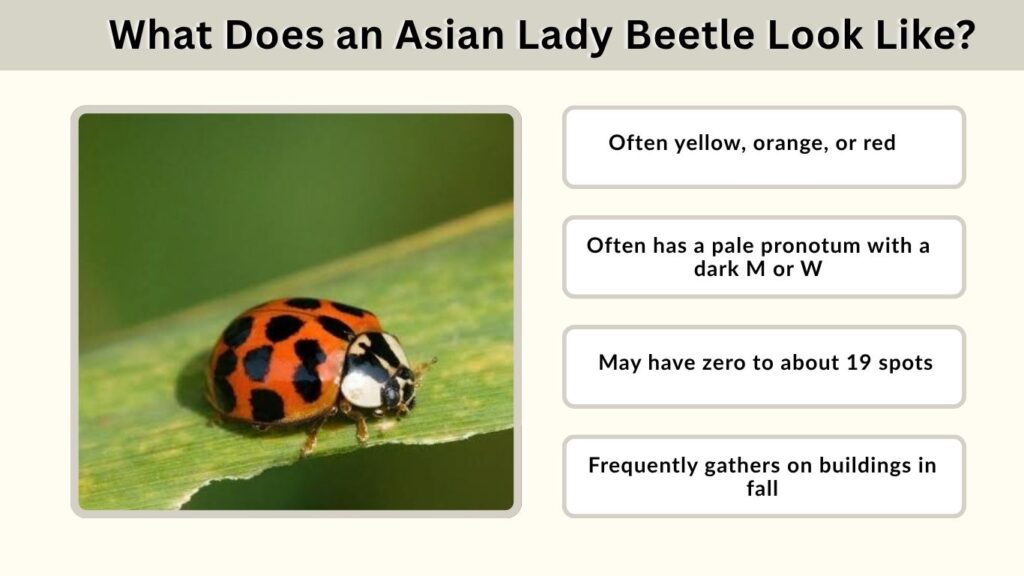
Multicolored Asian lady beetles earned their name because their appearance is extremely variable. One individual may be bright orange with many spots, while another may be red with only a few. Some have no obvious spots at all. Adults are approximately one-third of an inch long and have the rounded, dome-shaped body typical of lady beetles.
Asian Lady Beetle Identification
Look for:
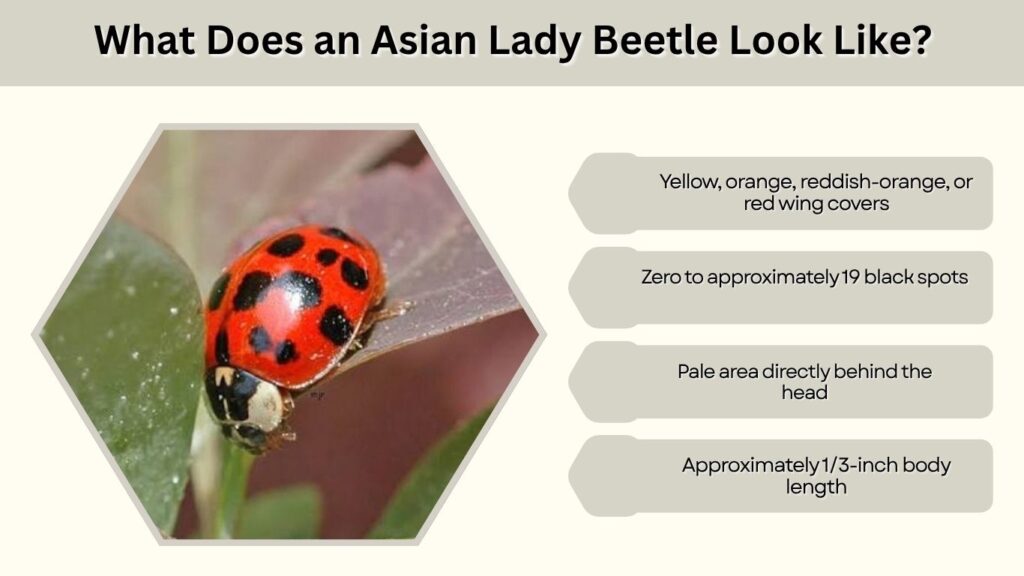
- Yellow, orange, reddish-orange, or red wing covers
- Zero to approximately 19 black spots
- Rounded, dome-shaped body
- Pale area directly behind the head
- Dark M- or W-shaped marking on the pale area
- Approximately 1/3-inch body length
- Strong tendency to gather in large groups during fall
The M can be thick, thin, broken, or somewhat irregular, so identification should use several characteristics rather than one mark alone.
Does Spot Number Identify Them?
Not reliably.
Although 19 spots are often associated with the multicolored Asian lady beetle, the spots can be faint, reduced, or completely absent. Color also varies significantly.
A beetle should therefore not be identified simply because it is orange or because it has a particular number of spots.
What Does a Regular Ladybug Look Like?
There is no single species scientifically called the “regular ladybug.” North America contains numerous lady beetle species with different colors and markings. Some are red with black spots, while others are orange, black, gray, or patterned. Comparing an unknown beetle with a specific species is therefore more accurate than comparing it with a generic “real ladybug.”
Native Ladybug Identification
Depending on species, native lady beetles may show:
- Red, orange, black, or gray coloration
- Species-specific spot patterns
- Different pronotum markings
- Rounded or oval bodies
- No characteristic Asian lady beetle M in many species
- Considerable variation between species
For example, the convergent lady beetle has characteristic pale lines on the pronotum, while other species have entirely different markings.
Is the Seven-Spotted Ladybug Native?
The seven-spotted lady beetle (Coccinella septempunctata) is a familiar red ladybug with seven dark spots, but it is not native to North America.
This illustrates why “Asian beetle vs native ladybug” cannot simply be reduced to orange versus red or many spots versus seven. Lady beetle identification depends on the particular species being compared.
Asian Lady Beetle vs Ladybug Size
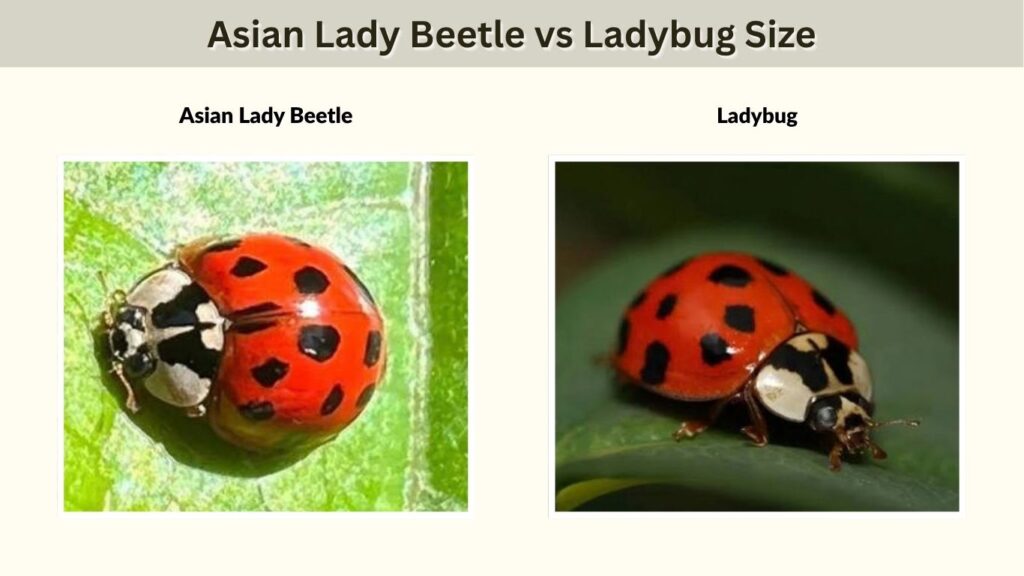
Size can provide another clue, although it is not enough for certain identification. Multicolored Asian lady beetles are relatively large for lady beetles, reaching around one-third of an inch in length. Other lady beetle species may be smaller, similar-sized, or occasionally comparable depending on species.
Is the Asian Lady Beetle Bigger?
Often, yes, compared with some commonly encountered lady beetles.
However, natural size variation means that two individuals can overlap considerably. An unusually small Asian lady beetle could be similar in size to another species.
The pronotum pattern, color variation, spot arrangement, geographic location, and behavior provide stronger evidence when used together.
Asian Lady Beetle Larvae vs Ladybug Larvae
All lady beetles undergo complete metamorphosis through egg, larva, pupa, and adult stages. Their larvae look dramatically different from the rounded adults. Asian lady beetle larvae are elongated and somewhat alligator-like, with dark bodies, small projections, and orange markings. Other lady beetle larvae can look surprisingly similar.
Asian Lady Beetle Larvae Identification
Asian lady beetle larvae typically have:
- Elongated alligator-like bodies
- Blue-black to dark coloration
- Rows of small projections or spines
- Prominent orange markings
- Six visible legs near the front
- Active hunting behavior
- A tendency to feed on aphids
University of Minnesota Extension describes the larvae as blue to black with two orange stripes and rows of small spines.
Are Ladybug Larvae Harmful?
Lady beetle larvae often look intimidating, but they are valuable predators.
Both larvae and adults of many species consume aphids and other soft-bodied plant pests. Asian lady beetles can therefore be beneficial in agricultural fields, gardens, trees, and landscapes even though adults may later become household nuisances.
Asian Lady Beetle vs Ladybug Behavior
Behavior is one of the clearest differences homeowners notice. Multicolored Asian lady beetles have a strong tendency to gather on sunny buildings during autumn and move into protected cracks for winter. They may then appear around windows and ceilings on warm winter or spring days.
Why Asian Lady Beetles Enter Houses
Asian lady beetles search for protected overwintering sites as colder weather approaches.
They often gather on sunny walls before crawling through gaps around windows, doors, roofs, siding, fascia, and utility openings. Some spend winter in wall voids or attics.
They do not normally reproduce inside homes.
Do Regular Ladybugs Invade Houses?
Other lady beetles also overwinter, but the multicolored Asian lady beetle is especially well known for entering buildings in very large numbers.
This behavior is one reason homeowners distinguish it from the ladybugs they normally see outdoors.
Finding dozens or hundreds clustered around windows in fall strongly suggests an overwintering species such as Harmonia axyridis.
Asian Lady Beetle Bite vs Ladybug
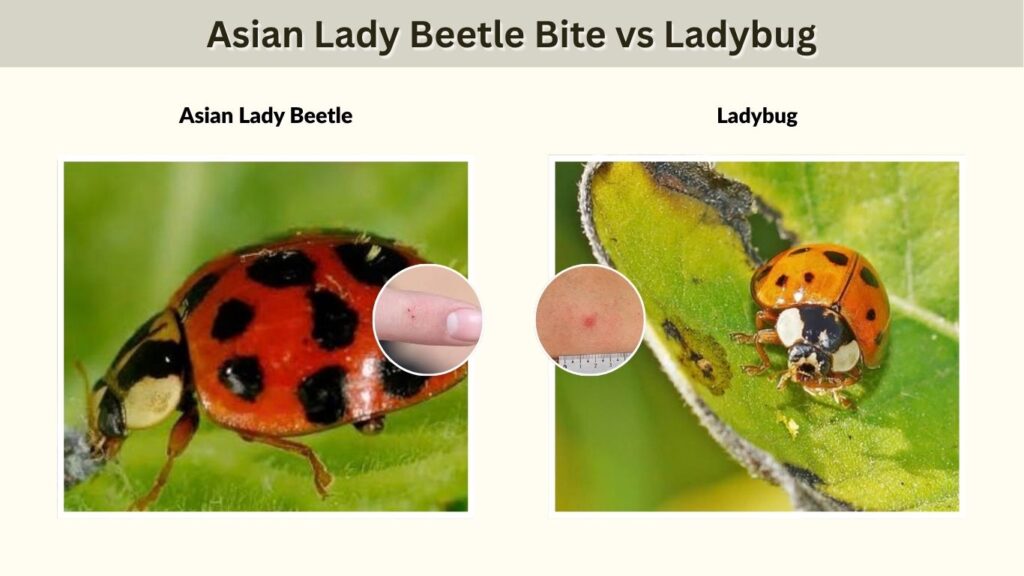
Neither Asian lady beetles nor other ladybugs have stingers. However, Asian lady beetles can occasionally pinch exposed skin with their mouthparts. University of Minnesota Extension notes that some bites can be strong enough to break the skin, although the resulting discomfort is usually minor and short-lived.
Do Asian Lady Beetles Bite?
Yes, occasionally.
They are not blood-feeding insects and are not seeking humans as prey. A beetle may pinch skin while looking for moisture or food.
They can also release yellowish defensive fluid from their leg joints when disturbed. This secretion has a noticeable odor and can stain light-colored surfaces.
Do Ladybugs Sting?
Lady beetles do not have stingers.
Some species may use their mouthparts defensively, but the Asian lady beetle is particularly associated with occasional reports of skin pinching.
Avoid crushing Asian lady beetles indoors because their defensive secretion can produce both odor and staining.
Asian Lady Beetle Eggs vs Ladybug Eggs
Asian lady beetle eggs resemble those of many other lady beetles, making identification by eggs alone difficult. Females lay clusters of yellowish eggs on plants, usually where aphids or other suitable prey are available nearby.
From Egg to Adult
The general stages are egg, larva, pupa, and adult.
After hatching, larvae actively hunt soft-bodied insects. They grow through several larval stages before attaching themselves to vegetation and pupating.
Adults eventually emerge and continue feeding on aphids and similar prey.
Exact development time depends on temperature, food, species, and environmental conditions.
Are Asian Lady Beetles Invasive?
Harmonia axyridis is native to Asia and has become established across much of North America and many other regions. It is an effective predator of aphids, but its abundance and interactions with other lady beetles have also attracted ecological concern. In homes, its major impact is usually as a seasonal nuisance rather than a structural pest.
Are They Bad for Gardens?
Not necessarily.
Asian lady beetles consume large numbers of aphids and other soft-bodied insects, making them useful biological predators.
The main conflict occurs when adults enter buildings in fall. They do not normally damage wood, clothing, furniture, or stored household food while overwintering indoors.
How to Handle Asian Lady Beetles Indoors
If beetles have already entered, physical removal is generally more practical than indoor insecticide treatment. Prevention before autumn is particularly important because beetles hidden inside wall cavities can be difficult to reach.
Indoor Control and Prevention
Use these methods:
- Vacuum visible beetles.
- Avoid crushing them.
- Seal cracks around windows.
- Repair damaged screens.
- Replace worn weather stripping.
- Seal utility openings.
- Inspect roof and fascia gaps.
- Close siding gaps where practical.
- Complete exclusion work before fall migration.
University of Minnesota Extension recommends preventing entry as the most effective approach and notes that indoor pesticide spraying is generally ineffective once beetles have moved into wall voids.
FAQs
1. Are Asian lady beetles actually ladybugs?
Yes. Asian lady beetles are members of the lady beetle family Coccinellidae, so scientifically they are a type of ladybug.
2. How can I tell an Asian lady beetle from another ladybug?
Look for a pale area behind the head with a dark M- or W-shaped marking, variable yellow-to-red coloration, and anywhere from no visible spots to numerous black spots.
3. Do Asian lady beetles bite?
They can occasionally pinch human skin, but they do not feed on blood and generally cause only temporary local discomfort.
4. Do Asian lady beetles have more spots than ladybugs?
Not necessarily. Asian lady beetles can have many spots, only a few, or none. Spot count alone is therefore unreliable for identification.
5. Why do Asian lady beetles come inside houses?
They enter cracks and gaps in buildings during fall while searching for protected places to overwinter. Warm conditions can later cause them to emerge inside during winter or spring.