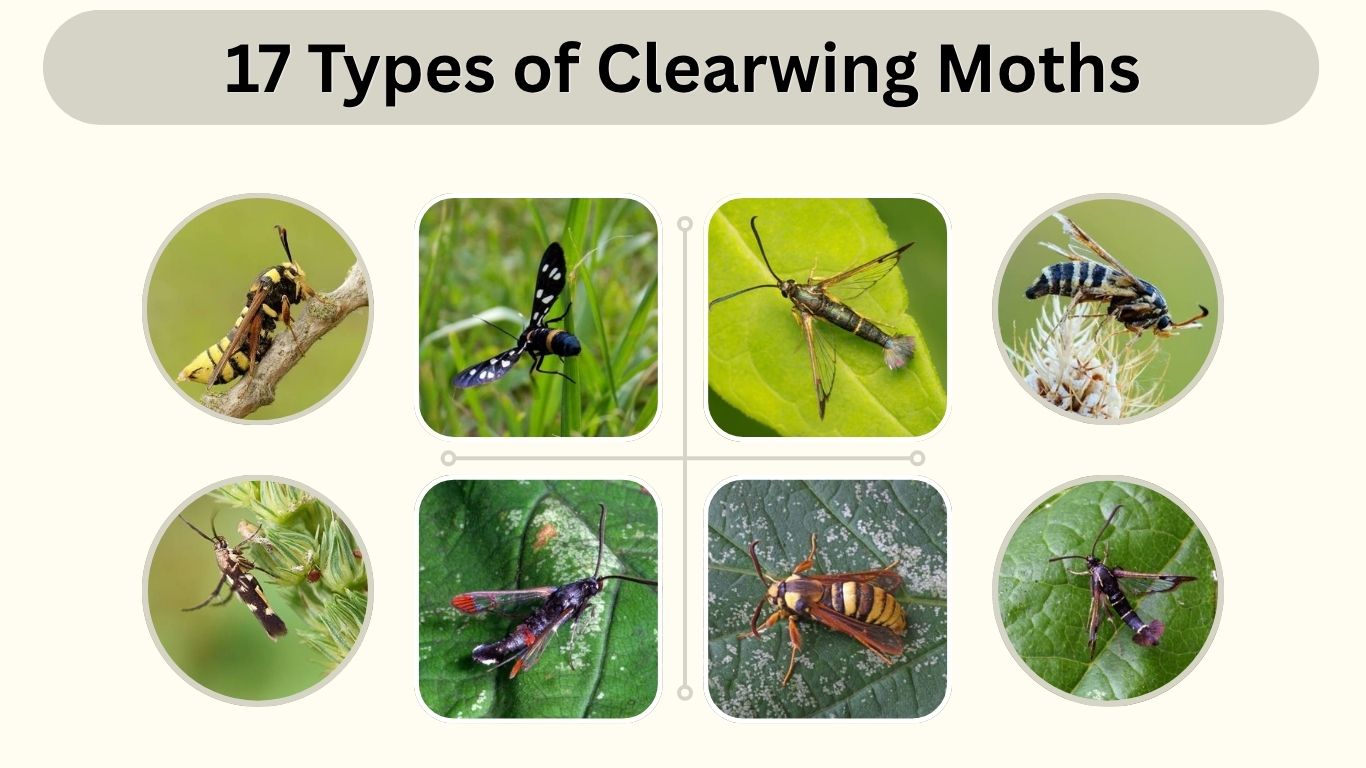
Clearwing moths are fascinating insects known for their transparent wings and remarkable resemblance to wasps, bees, and hornets. Belonging mainly to the family Sesiidae, these day-flying moths can be found in woodlands, gardens, wetlands, orchards, and grasslands around the world. Different species rely on specific host plants for larval development, including oak, willow, birch, poplar, apple, and currant. In this guide, you will discover 17 types of clearwing moths, along with their identification features, habitat, behavior, diet, lifespan, and life cycle.
1. Apple Clearwing
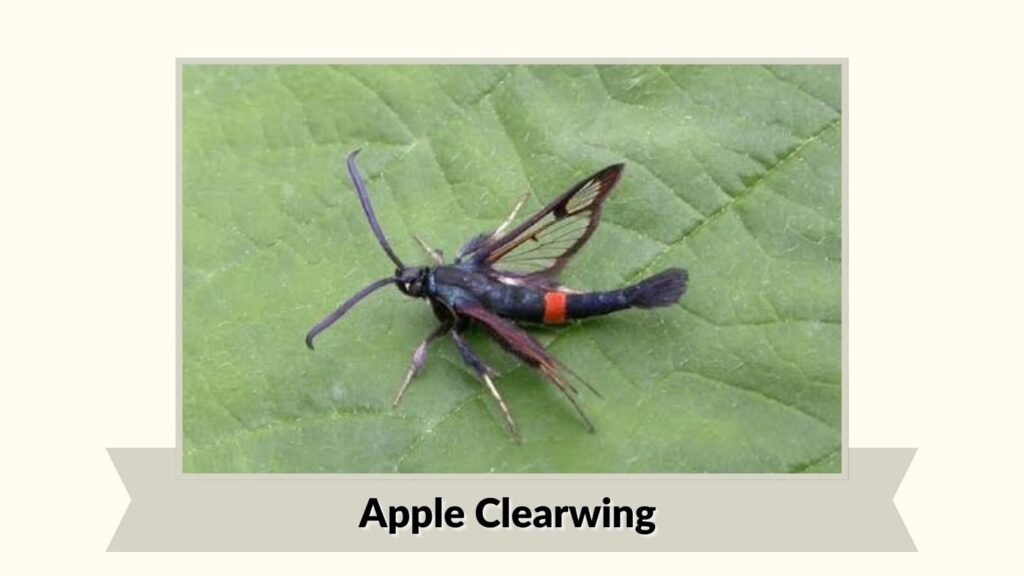
The Apple Clearwing (Synanthedon myopaeformis) is a distinctive clearwing moth known for its transparent wings and wasp-like appearance. Unlike many moths, adults are active during daylight. The species is closely associated with fruit trees, especially apple trees, where its larvae develop beneath the bark and feed on living plant tissue.
Identification
Apple Clearwing moths can be recognized by their slender body, transparent wings, and brightly colored abdominal markings. Their resemblance to wasps may help discourage predators.
- Adult size: About 20–25 mm wingspan
- Body color: Dark blue-black or metallic-looking
- Abdominal marking: Noticeable orange-red band
- Wings: Mostly transparent, with narrow darker forewings
- Larvae: Creamy or dirty white with a reddish-brown head
- Larval size: Approximately 15–20 mm long
- Pupae: Pale yellowish-brown and around 15 mm long
Habitat and Distribution
Apple Clearwings are associated mainly with orchards, gardens, and other places where suitable fruit trees grow. The species occurs naturally across parts of Europe and has been introduced into North America. It was first confirmed in North America in British Columbia in 2005 and subsequently spread into several fruit-growing areas. Apple is an important host, although European records also include pear, crabapple, quince, plum, apricot, cherry, hawthorn, and mountain ash.
Behavior and Diet
Adults are daytime-active moths and may be seen resting on leaves during warm, sunny weather. The damaging stage is the caterpillar. Larvae tunnel beneath tree bark and feed within cambial tissues. Their feeding can produce tunnels, frass, loose bark, and weakened areas around trunks or branches.
Lifespan and Life Cycle
Females usually place eggs around bark wounds, pruning scars, grafting points, or other damaged areas. After hatching, the larvae enter beneath the bark and continue feeding as they develop. Development can be prolonged, with reports indicating that larvae may spend about two years within the tree before completing pupation and emerging as adult moths.
2. Currant Clearwing
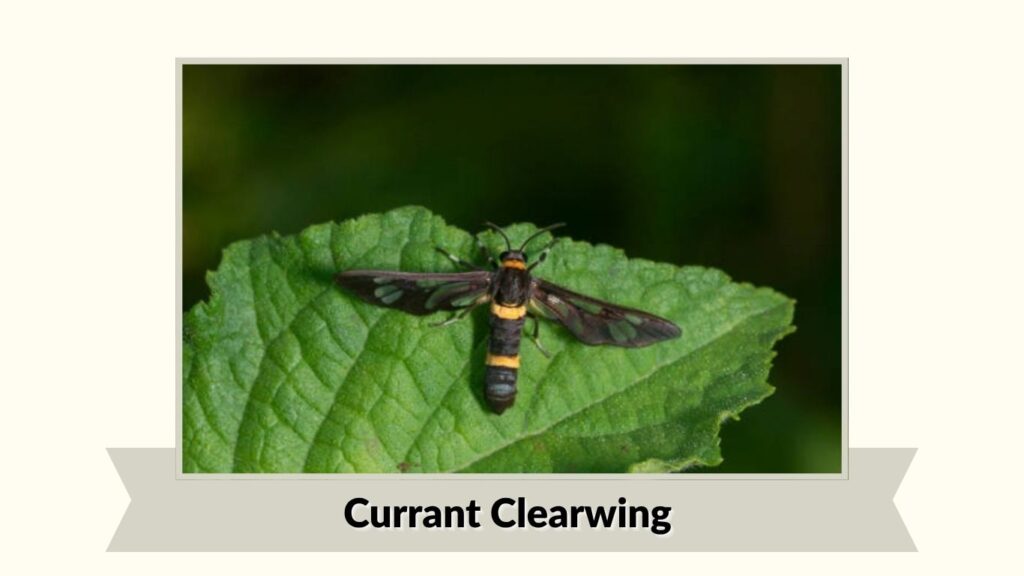
The Currant Clearwing (Synanthedon tipuliformis) is a small, day-flying clearwing moth closely associated with currant bushes. Its transparent wings and yellow-banded body make it resemble a small wasp. The larvae live hidden inside currant stems, making the species much easier to detect by signs of larval activity than by seeing the adults themselves.
Identification
- Wingspan: About 17–20 mm
- Body: Slender and dark with a metallic appearance
- Markings: Several narrow yellow bands across the abdomen
- Wings: Mostly transparent with dark margins and veins
- Appearance: Strongly resembles a small wasp
- Larvae: Pale caterpillars that develop inside plant stems
Habitat and Distribution
Currant Clearwings are commonly associated with gardens, allotments, fruit-growing areas, and other locations containing currant bushes. In Britain, they are widely distributed through England and Wales and extend into parts of Scotland, although they are not particularly abundant. Their main larval host plants are red currant and black currant, making cultivated berry-growing areas especially suitable.
Behavior and Diet
Adults are active during daylight and generally fly from late May through July. They can be difficult to notice because of their small size and wasp-like appearance. The caterpillars are the important feeding stage. They tunnel internally through shoots and stems of Ribes plants, particularly black and red currants. Their concealed lifestyle gives them protection from many predators.
Lifespan and Life Cycle
Females lay eggs on or near suitable currant stems. After hatching, the young larvae bore into the plant and feed internally while growing. They remain protected inside the stem for much of their development and eventually pupate before the adult emerges. The annual cycle is closely connected with current growth, with most adults appearing during early summer.
3. Dale’s Oak Clearwing
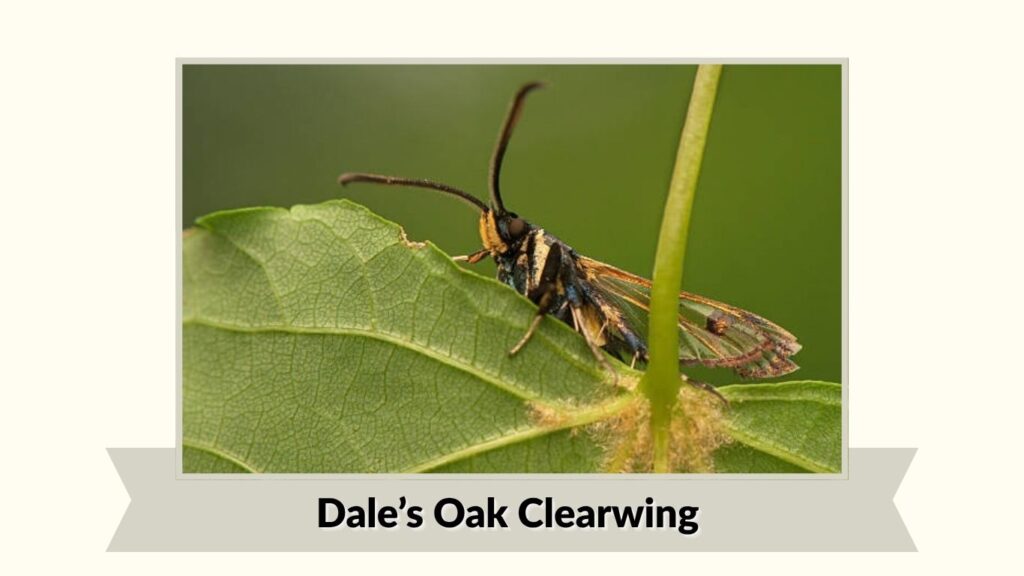
The Dale’s Oak Clearwing (Synanthedon conopiformis) is an attractive European clearwing moth associated mainly with oak trees. Like other members of the clearwing family, it uses its narrow body, transparent wings, and bright markings to create a convincing wasp-like appearance. Its larvae spend most of their development concealed within the stems or bark of oak hosts.
Identification
- Wingspan: Commonly about 16–19 mm, though size can vary
- Body: Dark and slender
- Thorax: Distinctive yellow marking on the metathorax
- Forewings: Transparent areas with dark veins and orange scaling toward the tips
- Abdomen: Yellow bands contrast with the dark body
- Overall appearance: Similar to a small wasp or hoverfly
Habitat and Distribution
This species occurs across much of Europe but is largely absent from the far north. It favors oak woodland, forest margins, mature parkland, and other habitats containing established oak trees. Pedunculate oak, sessile oak, and red oak are among its documented larval hosts.
Behavior and Diet
Adults are day-flying and are generally encountered during warm weather from summer into late summer. They may spend much of their brief adult stage searching for mates around suitable oak habitat. The caterpillars are wood-borers and obtain their food by feeding within the tissues of oak stems and trunks rather than eating exposed foliage.
Lifespan and Life Cycle
Females select suitable oak bark or stems for egg laying. Once the eggs hatch, larvae penetrate the plant and establish internal feeding galleries. The hidden larval period forms the longest part of the life cycle. After completing growth, the caterpillar pupates near an emergence point, allowing the adult clearing to escape and begin its short reproductive stage.
4. Dusky Clearwing
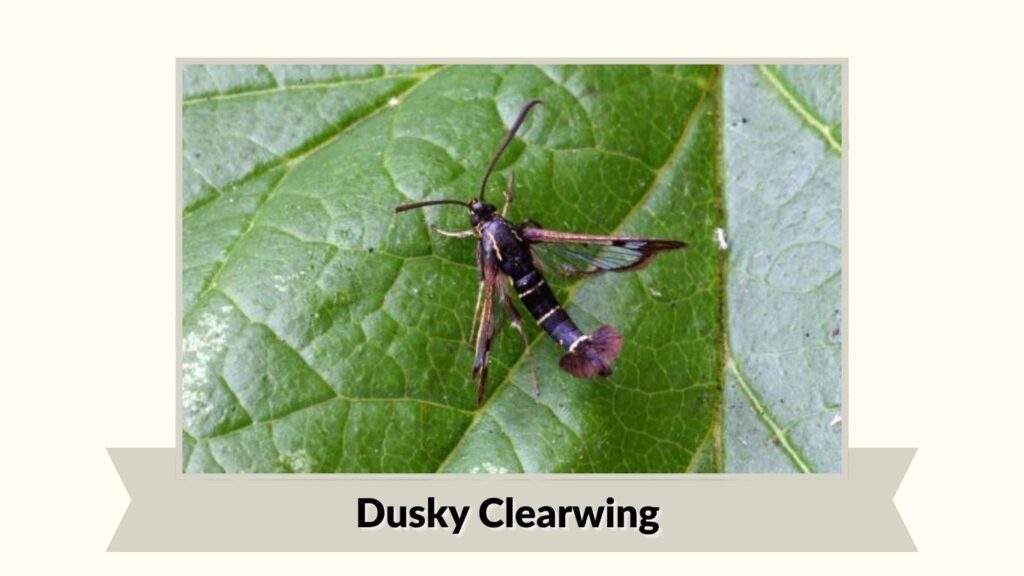
The Dusky Clearwing (Paranthrene tabaniformis) is a comparatively robust clearwing moth found across parts of the Palearctic and Nearctic regions. It is strongly associated with poplars and willows. Although it belongs to the moth order, its dark wings, yellow abdominal bands, and active daytime behavior can make it look remarkably similar to a wasp.
Identification
- Wingspan: Around 30 mm in many adults
- Body: Dark with conspicuous yellow abdominal rings
- Forewings: Dusky brown with relatively small transparent areas
- Hindwings: More extensively transparent
- Legs: Often show yellow or orange coloration
- Shape: Stocky, wasp-like body with elongated antennae
Habitat and Distribution
Dusky Clearwings inhabit places where poplars and willows grow, including woodland edges, riverbanks, parks, roadside plantings, gardens, and poplar plantations. The species has a broad distribution and has also become established in parts of North America.
Behavior and Diet
Adults are active mainly in daylight and can be strong fliers. Larvae feed inside poplar and willow wood. Young caterpillars may enter twigs near buds or damaged portions of trunks and branches. Their feeding sometimes creates characteristic swellings in young shoots, while larvae in larger trunks form galleries between bark and wood.
Lifespan and Life Cycle
Females deposit eggs on suitable twigs, wounds, or bark. The caterpillar then bores inward and feeds securely within the plant. Many larvae overwinter twice, meaning development commonly extends across roughly two years, although faster development may occur under favorable conditions. Pupation takes place inside the feeding gallery before adults emerge from late spring through summer.
5. Fiery Clearwing
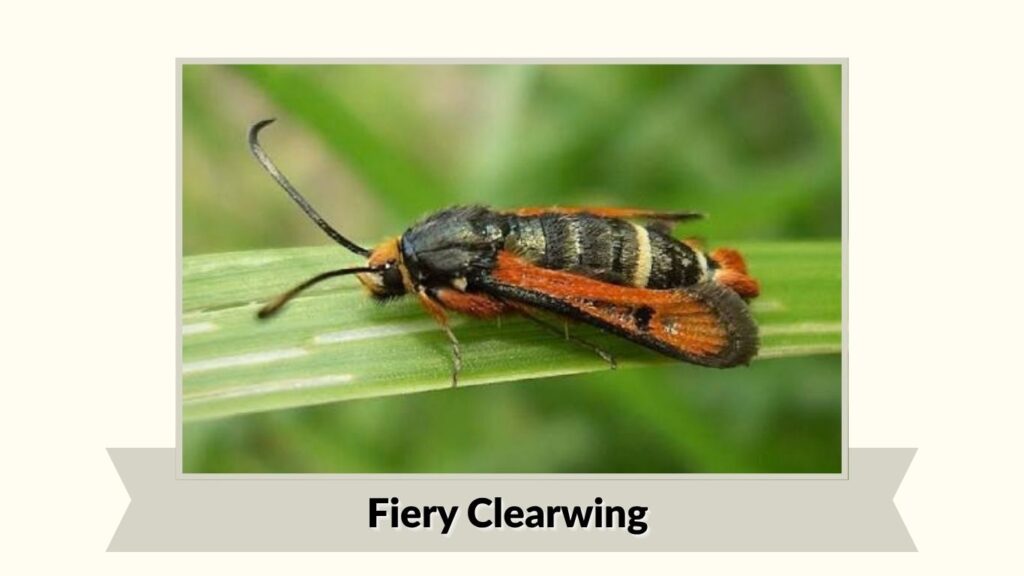
The Fiery Clearwing (Pyropteron chrysidiformis) is one of the most colorful clearwing moths, recognized by the flame-like orange-red coloring around its otherwise transparent wings. This day-flying species is closely connected with dock and sorrel plants because its larvae develop underground inside their roots. In Britain, it is particularly rare and has a highly restricted distribution.
Identification
- Wingspan: Approximately 15–23 mm
- Body: Dark, often with a metallic blue-black appearance
- Wings: Clear central sections surrounded by bright orange-red margins
- Abdomen: Mostly dark with lighter markings
- Tail: Often displays noticeable orange scales
- Appearance: One of the easiest clearwings to recognize because of its fiery wing coloration
Habitat and Distribution
In Britain, the species is strongly associated with a small number of coastal locations in Kent. Suitable habitat includes sheltered areas below sea cliffs, disturbed coastal ground, and vegetated shingle where dock plants grow in warm, sunny conditions. Elsewhere in its European range, it occurs wherever suitable host plants and microhabitats are present.
Behavior and Diet
Adults are day-flying and can be observed moving around their host plants during sunny weather. Dock species such as curled dock and common sorrel serve as important larval food plants. Unlike many tree-boring clearwings, Fiery Clearwing caterpillars move into the roots and feed underground.
Lifespan and Life Cycle
Eggs are generally laid during late spring and summer on host-plant leaves or stems. The larvae hatch later and enter the roots, where they normally spend about a year, although development can occasionally take two years. Pupation occurs in spring, and the adult moths usually appear from late May through July.
6. Large Red-belted Clearwing
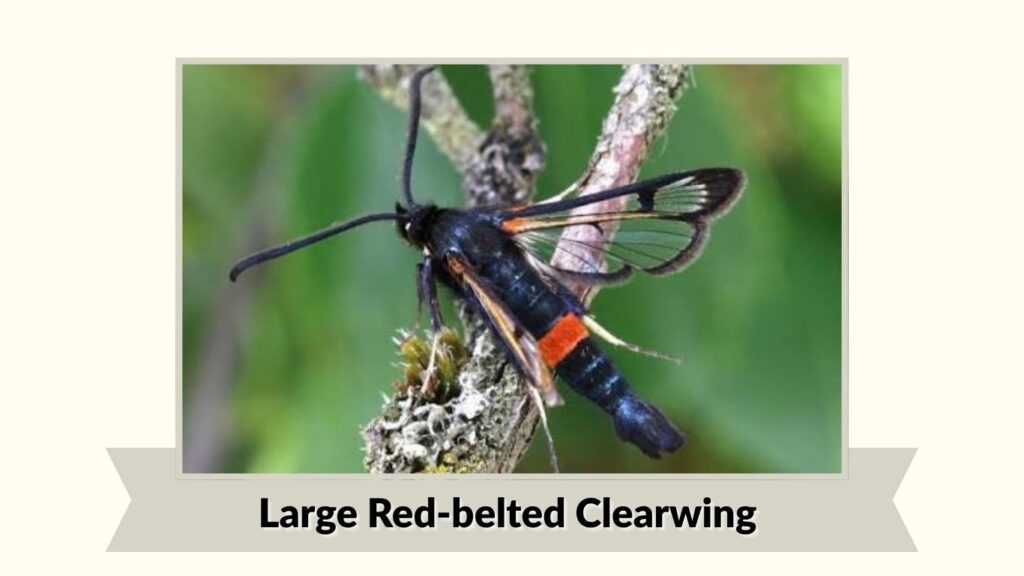
The Large Red-belted Clearwing (Synanthedon culiciformis) is a striking moth named for the broad orange-red band crossing its dark abdomen. It is primarily associated with birch habitat and is among the earlier clearing species to appear each year. Adults may be overlooked because their transparent wings and slender bodies allow them to pass easily for wasps.
Identification
- Wingspan: About 23–27 mm
- Body: Metallic dark blue-black
- Abdomen: Prominent orange-red belt
- Forewings: Orange-red coloration near the base
- Wings: Large transparent sections bordered with dark scales
- Similar species: Resembles the Red-belted Clearwing but is usually larger and shows stronger reddish coloring near the wing base
Habitat and Distribution
The moth occurs in heathland, open woodland, birch woodland, and other habitats where birch is common. In Britain it occurs through much of the mainland in suitable areas. Cut birch stumps are especially important because they provide favorable larval development sites.
Behavior and Diet
Adults fly mainly during daylight in May and June. The larvae feed underneath the bark of birch and may also use alder. They often occupy recently cut or damaged stumps, producing galleries and small amounts of woody debris as they feed. Adults may occasionally visit flowers, while males can be strongly attracted to species-specific pheromones.
Lifespan and Life Cycle
Females place their eggs in cracks and crevices on suitable birch material. The larvae enter beneath the bark and feed between bark and wood. Their larval stage can last about two years. Once mature, they pupate close to the bark surface, allowing the adult to emerge relatively easily during spring or early summer.
7. Lunar Hornet Clearwing
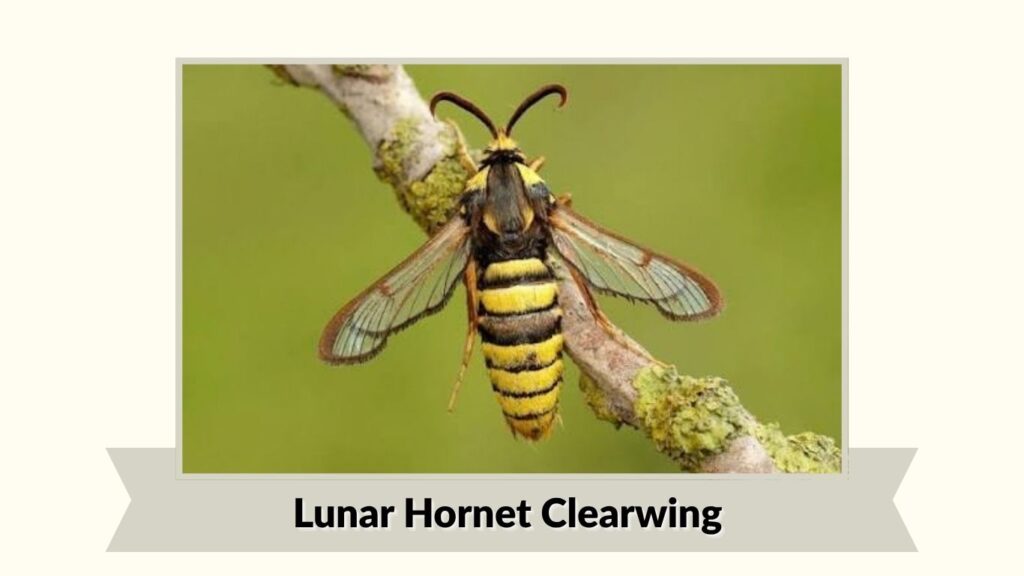
The Lunar Hornet Clearwing, better known as the Lunar Hornet Moth (Sesia bembeciformis), is one of the largest clearwing moths. Its powerful hornet-like appearance includes a thick yellow-and-black abdomen, transparent wings, and a robust body. Despite looking capable of stinging, it is a harmless moth whose larvae develop inside willow and sallow trees.
Identification
- Wingspan: Around 32–42 mm
- Body: Large and strongly built for a clearwing moth
- Abdomen: Bold yellow and black bands
- Wings: Transparent with dark to reddish-brown borders
- Antennae: Long and noticeably curved
- Appearance: Very similar to a large wasp or hornet
Habitat and Distribution
The Lunar Hornet Moth is associated with willow-rich habitats. It may occur beside wetlands, rivers, lakes, woodland edges, carr woodland, and other places where sallow and willow grow. Adults are often found around the lower trunks of their larval host trees.
Behavior and Diet
Adults fly during the day, with activity particularly noticeable during warm summer weather. Females use pheromones to attract males for mating. After reproduction, eggs are placed on willow bark. The larvae are wood-borers rather than foliage feeders, tunneling deep inside willow or sallow tissue.
Lifespan and Life Cycle
After hatching, young caterpillars chew through the bark and remain hidden inside the host tree. Larval development commonly lasts around two years. Mature larvae eventually pupate within the tree. Adults generally emerge during summer, especially around July, sometimes leaving visible pupal remains near their emergence holes.
8. Orange-tailed Clearwing
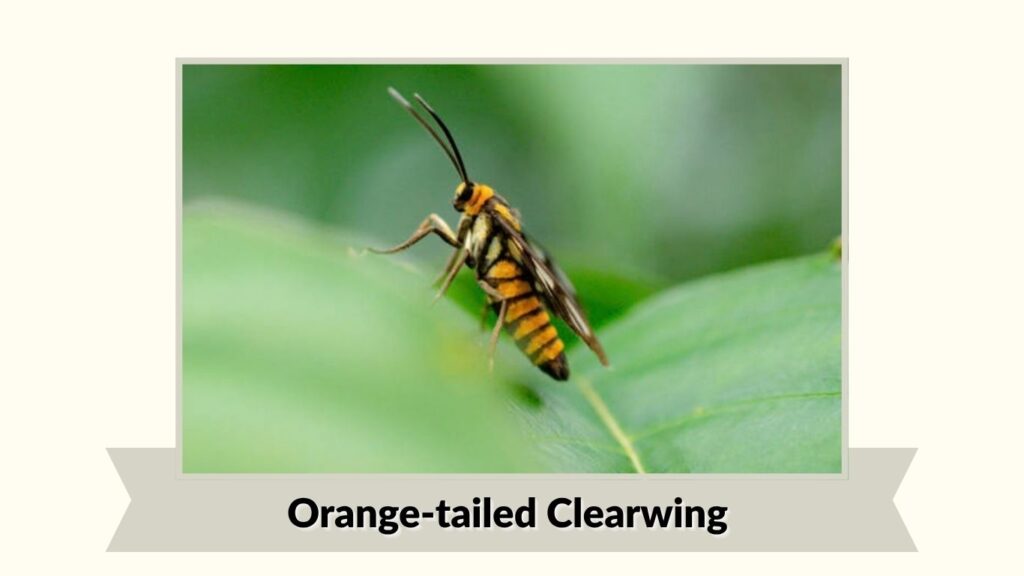
The Orange-tailed Clearwing (Synanthedon andrenaeformis) is a small, highly specialized clearwing moth distinguished by orange coloration near the end of its abdomen. Its larvae develop primarily in wayfaring tree and guelder roses. Adults can be remarkably difficult to locate even in areas where the species is present because they are active for only a relatively short period.
Identification
- Wingspan: About 18–22 mm
- Body: Dark, narrow, and wasp-like
- Tail: Distinctive orange coloration toward the abdominal tip
- Wings: Mostly transparent with dark edges and veins
- Antennae: Long and slender
- Flight appearance: Easily mistaken for a small wasp
Habitat and Distribution
The species occurs across much of Europe and also reaches parts of the Near East. In Britain, it has a restricted distribution, with populations concentrated particularly in central southern England. Chalk downland, calcareous scrub, and sunny woodland edges containing wayfaring tree provide particularly favorable habitat.
Behavior and Diet
Orange-tailed Clearwings are active during daylight. Adults are most often encountered during late spring and early summer. The larvae feed within the stems of wayfaring tree and, less commonly, guelder rose. They begin feeding beneath the bark before developing longer galleries inside the central portions of the stem.
Lifespan and Life Cycle
The larval period is unusually long. Caterpillars normally pass through two winters while living inside the host plant. Before their final winter, they prepare an emergence opening in the bark. Pupation occurs during spring, and adults usually emerge from May through July. The complete development from egg to adult therefore generally takes more than two years.
9. Poplar Hornet Clearwing
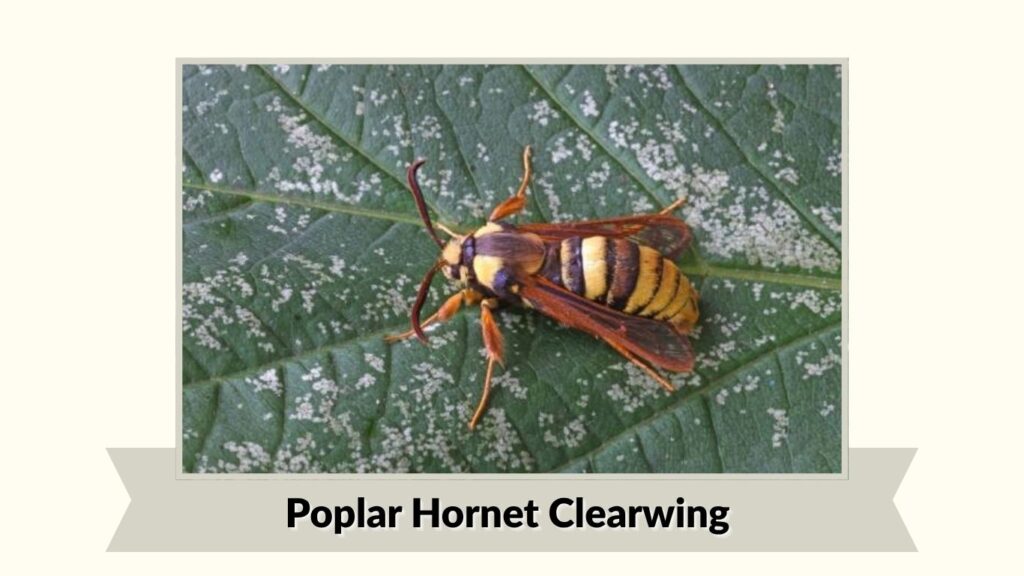
The Poplar Hornet Clearwing, more commonly called the Hornet Moth (Sesia apiformis), is a large clearwing whose yellow-and-black markings produce an exceptionally convincing resemblance to a hornet. Poplar trees are its principal larval hosts, and the caterpillars can remain concealed in the lower trunk and roots for years before emerging as adults.
Identification
- Wingspan: About 33–48 mm
- Body: Large, thick, and hornet-like
- Head and shoulders: Bright yellow markings
- Abdomen: Alternating black and yellow bands
- Wings: Transparent with reddish-brown edges and veins
- Larvae: Yellowish-white with a brown to reddish-brown head
Habitat and Distribution
Hornet Moths are closely associated with poplars and therefore occur around poplar plantations, river valleys, wetlands, parks, roadsides, and mature urban landscapes. In Britain, the species has a predominantly southern distribution. Black poplar and other Populus species are important hosts.
Behavior and Diet
Adults fly during daylight, particularly in June and July. Newly emerged individuals may be found resting low on poplar trunks during the morning. Their hornet mimicry provides a powerful visual defense against predators. Larvae feed internally on bark, roots, and the lower portions of poplar trunks rather than exposed leaves.
Lifespan and Life Cycle
Eggs are deposited around suitable areas of bark or near the base of host trees. After hatching, larvae burrow into the cambium and wood, where they create galleries and overwinter. Development commonly requires about two years and may take longer under unfavorable conditions. Mature larvae prepare an exit route before pupating, and the adult later emerges through this opening, sometimes leaving the empty pupal case projecting from the trunk.
10. Red-tipped Clearwing
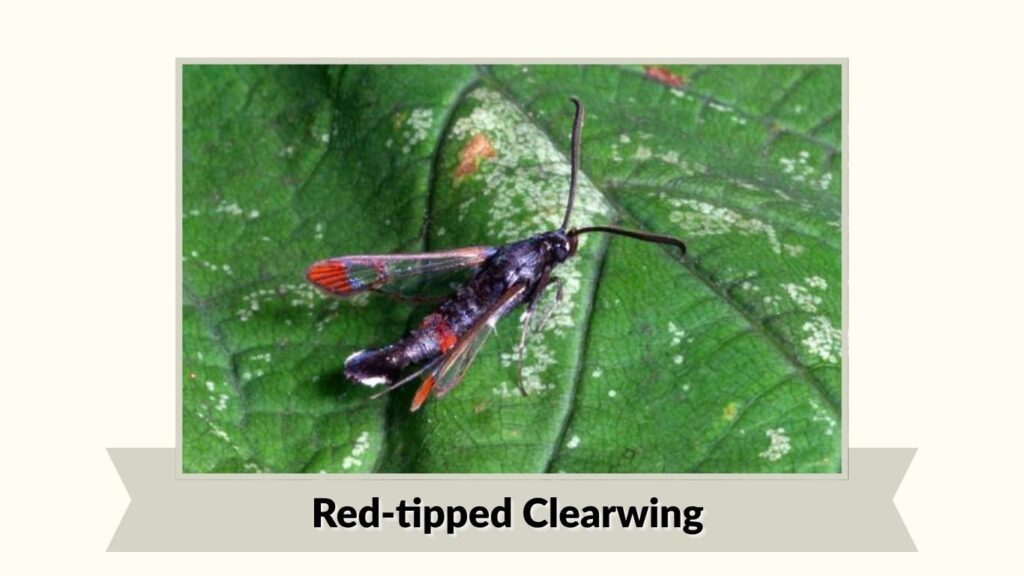
The Red-tipped Clearwing (Synanthedon formicaeformis) is a small day-flying moth named for the reddish-orange coloring near the ends of its forewings. Like many clearwing moths, its slender body and transparent wings create a convincing wasp-like appearance. The species is strongly associated with willows and is most often encountered around wetlands and other damp habitats.
Identification
- Wingspan: About 17–19 mm
- Body: Slender and mainly dark
- Wings: Mostly transparent with dark margins
- Forewing tips: Distinctive reddish patches
- Abdomen: Dark with narrow contrasting bands
- Appearance: Resembles a small wasp
- Larvae: Pale caterpillars that live inside willow stems
Habitat and Distribution
Red-tipped Clearwings favor fens, marshes, wet woodland edges, riverbanks, and other damp places where willows grow. They occur across much of Europe and extend eastward into parts of the Palearctic and Near East. In Britain, populations are local but occur across much of England, southern Scotland, and parts of Wales and Ireland.
Behavior and Diet
Adults are active during daylight, particularly on warm, sunny days from late spring through midsummer. Their rapid flight and wasp-like shape can make them easy to overlook. The caterpillars feed internally rather than eating leaves. They bore into stems of willow species, particularly osier, where they remain protected while feeding and growing.
Lifespan and Life Cycle
Females deposit eggs on suitable willow stems. Once hatched, the larvae bore beneath the bark and establish feeding tunnels within the plant. Larval feeding can sometimes produce noticeable swellings or pear-shaped galls. The immature stages occupy most of the species’ life, while the adult stage is comparatively brief and mainly devoted to mating and egg laying. Adults are most often seen between May and July.
11. Sallow Clearwing
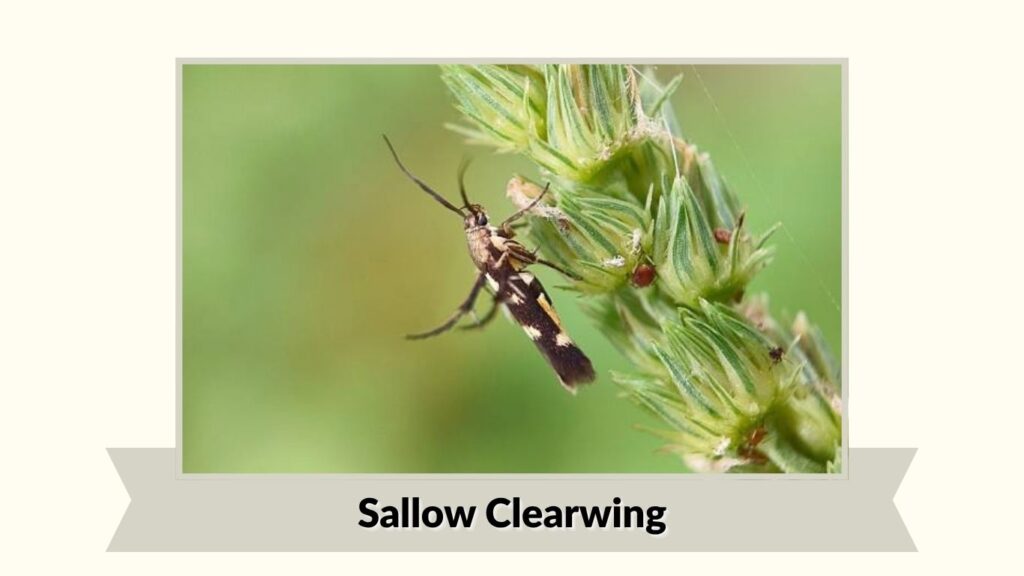
The Sallow Clearwing (Synanthedon flaviventris) is an elusive clearwing moth whose larvae develop inside the stems of sallow. Its transparent wings, narrow body, and contrasting markings give it the familiar wasp-like appearance typical of the family Sesiidae. Because most of its development occurs hidden within its host plant, adults may be difficult to find even where established populations occur.
Identification
- Wingspan: Approximately 17–20 mm
- Body: Slender and predominantly dark
- Wings: Transparent with dark borders and veins
- Abdomen: Shows contrasting yellowish markings
- Shape: Narrow-bodied and wasp-like
- Larvae: Pale and concealed inside sallow stems
- Larval sign: Characteristic swelling or gall may develop on the stem
Habitat and Distribution
The species prefers woodland, wet woodland margins, scrub, marshy ground, and other damp habitats supporting sallow and related willows. In Britain it is particularly localized, with populations occurring mainly in parts of central southern England. Its dependence on suitable sallow growth means it can be absent from apparently similar habitats where appropriate host stems are scarce.
Behavior and Diet
Adults fly during daylight in June and July. Their short flight season and resemblance to wasps help explain why they are not often noticed. Larvae are specialist internal feeders. After entering a young sallow shoot, they gradually construct a tunnel within the woody tissue while consuming plant material.
Lifespan and Life Cycle
The Sallow Clearwing generally has a two-year life cycle. Eggs are placed around slender, sallow shoots, and newly hatched caterpillars burrow into the stem. During their first year, there may be few obvious external signs. As the caterpillar grows during its second year, feeding produces a distinctive pear-shaped gall. The mature larva eventually prepares for pupation close to the stem surface, allowing the adult moth to emerge during early summer.
12. Six-belted Clearwing
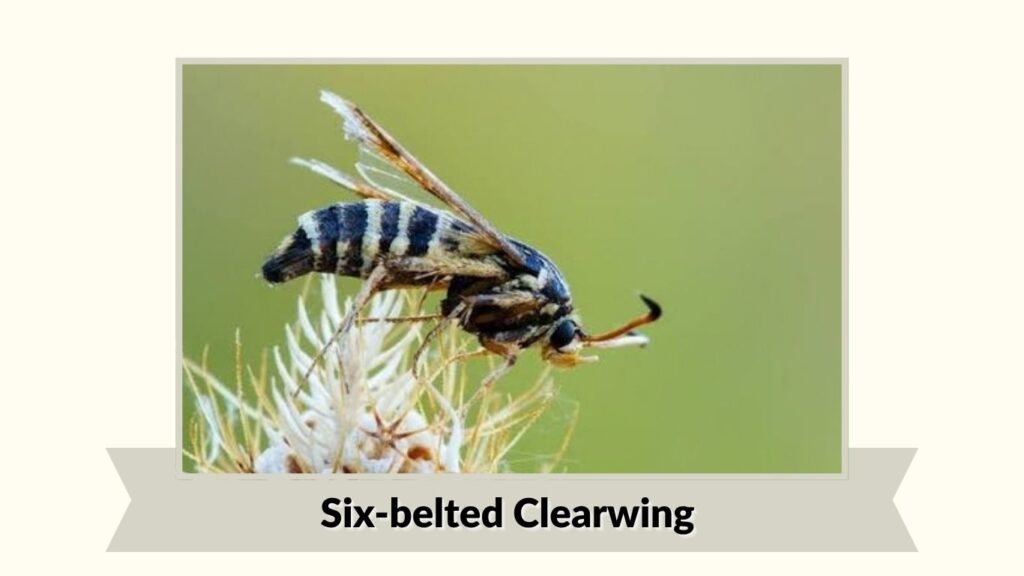
The Six-belted Clearwing (Bembecia ichneumoniformis) is an attractive wasp-mimicking moth named for the narrow yellow bands crossing its dark abdomen. It is frequently associated with warm, open habitats containing low-growing members of the pea family. Unlike many clearwings whose larvae develop in trees, this species spends its immature stages feeding around the roots of herbaceous plants.
Identification
- Wingspan: Usually around 15–25 mm
- Body: Black or very dark brown
- Abdomen: Up to six narrow yellow bands in males
- Wings: Largely transparent with brownish or dark margins
- Antennae: Relatively thick
- Legs: Often show yellow markings
- Appearance: Similar to a small solitary wasp
Habitat and Distribution
Six-belted Clearwings occur across much of Europe and extend through Asia Minor, the Caucasus, northern Iran, and parts of the Near East. They favor sunny, dry environments such as limestone grassland, calcareous slopes, quarries, railway embankments, coastal cliffs, and flower-rich grasslands. These habitats typically support the larval host plants required for reproduction.
Behavior and Diet
Adults fly during daylight and are most active in warm sunshine. They may visit flowers for nectar and can move quickly through low vegetation. Larvae feed underground within the roots of plants belonging largely to the pea family, including bird’s-foot trefoil and related species.
Lifespan and Life Cycle
Females lay eggs close to suitable host plants. The newly hatched larvae move into the lower stems or roots, where they remain concealed while feeding. Larval development is far longer than the adult stage and includes overwintering underground. Once fully developed, the larva constructs a pupation site near the root crown or soil surface. Adults generally emerge during summer, reproduce, and survive only long enough to complete mating and egg laying.
13. Thrift Clearwing
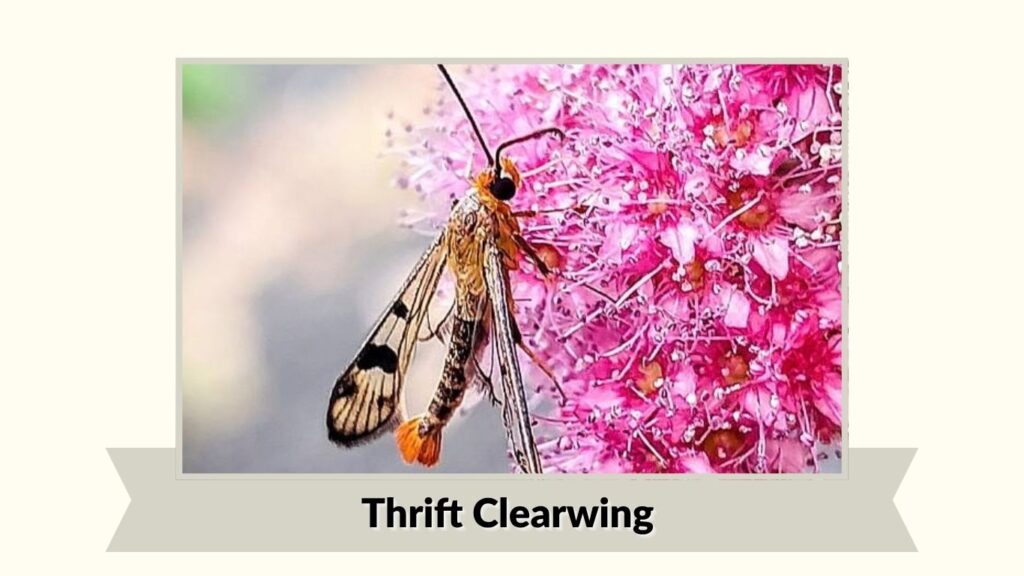
The Thrift Clearwing (Pyropteron muscaeformis) is a small clearwing moth strongly associated with coastal thrift. Its restricted host preference means that it is usually found around rocky coastlines and sea cliffs rather than inland woodland. Adults have dark bronzy wings containing narrow transparent areas and a banded body that gives them a subtle wasp-like appearance.
Identification
- Wingspan: About 15–18 mm
- Body: Small and dark
- Forewings: Blackish or bronze with narrow transparent areas
- Abdomen: Usually displays three pale or whitish bands
- Wings: Narrow compared with many larger clearwings
- Antennae: Slender and curved
- Overall appearance: Dark, compact, and slightly wasp-like
Habitat and Distribution
Thrift Clearwings inhabit exposed rocky shorelines, sea cliffs, coastal grasslands, and other locations where thrift (Armeria maritima) grows abundantly. In Britain, the species has a mainly western distribution, including suitable sites in western England, Wales, and Scotland. It also occurs in southern Ireland and across parts of continental Europe.
Behavior and Diet
Adults are day-flying but are seldom noticed. They are most active in sunny conditions during June and July. Adults may visit the flowers of thrift and thyme for nectar. The caterpillars depend much more closely on thrift, feeding internally in the plant’s roots and crown rather than consuming its leaves.
Lifespan and Life Cycle
Females deposit tiny eggs on thrift plants. Caterpillars hatch during summer and tunnel into the stems, crowns, and roots. They remain there through autumn and overwinter as partly grown larvae. Feeding resumes as conditions improve in spring. Once development is complete, pupation occurs within or close to the host plant, and the new adults emerge in late spring or summer. The species normally produces one generation each year.
14. Welsh Clearwing
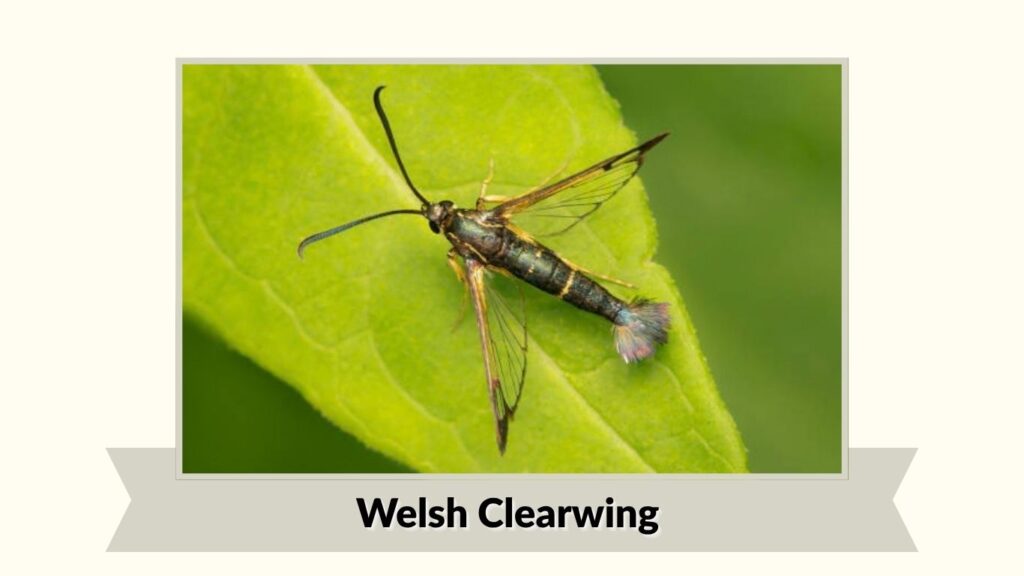
The Welsh Clearwing (Synanthedon scoliaeformis) is one of the larger European clearwing moths and is closely associated with mature birch trees. Despite its common name, the species is not limited to Wales and occurs across a much wider European and Asian range. Adults combine transparent wings, dark coloration, yellow abdominal rings, and an often conspicuous tail fan.
Identification
- Wingspan: Approximately 30–36 mm
- Body: Long, dark, and robust
- Abdomen: Two narrow yellow rings
- Female tail: Usually bright orange
- Male tail: Generally darker brown
- Wings: Broad transparent areas with dark margins
- Appearance: Large wasp-like moth with a conspicuous tail fan
Habitat and Distribution
The species is associated primarily with mature birch woodland, wooded hillsides, parks, and other habitats containing established birch trees. In Britain it is very local, being particularly associated with parts of Wales, while populations also occur elsewhere. Globally, its distribution stretches across much of Europe and eastward through Russia toward Japan.
Behavior and Diet
Adults are day-flying and usually appear during June and July. They often remain close to mature birches where larval development occurs. Their wasp-like shape helps them blend among other flying insects, while males can be detected using pheromone lures. Larvae feed hidden within mature birch, consuming tissues beneath the bark.
Lifespan and Life Cycle
Females lay eggs in suitable cracks or damaged areas of birch bark. After hatching, larvae enter the tree and create internal feeding galleries. This concealed wood-boring stage lasts much longer than the adult period and may extend across multiple seasons. Once mature, the caterpillar prepares an exit area, pupates beneath the bark, and later emerges as an adult. Old emergence holes can sometimes reveal that Welsh Clearwings are present even when no adult moths are visible.
15. White-barred Clearwing
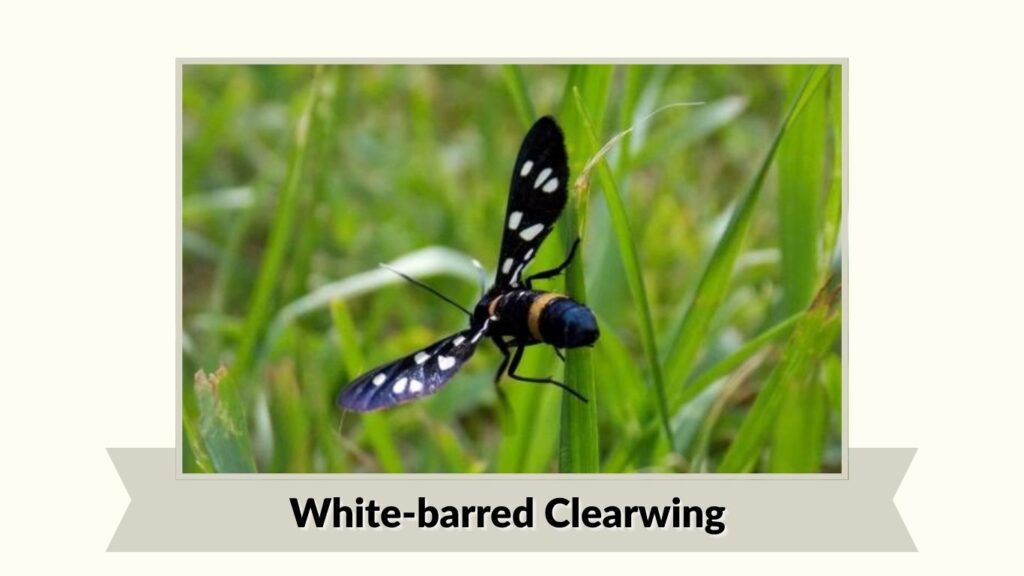
The White-barred Clearwing (Synanthedon spheciformis) is a distinctive medium-sized clearwing characterized by creamy-white markings against a dark body. Like several related species, its caterpillars are wood borers, spending years hidden inside living trees. Birch and alder are its primary host plants, so adults are generally found in wooded or damp habitats supporting these trees.
Identification
- Wingspan: About 26–31 mm
- Body: Dark and slender
- Antennae: Creamy markings near their tips
- Thorax: Pale or creamy bands on the tegulae
- Abdomen: Prominent pale band on the second segment
- Wings: Mostly transparent with dark margins
- Overall appearance: Contrasting dark body and creamy-white markings
Habitat and Distribution
White-barred Clearwings inhabit birch woods, alder woodland, woodland edges, damp forests, and areas containing mature host trees. The species is distributed across Europe and extends into Siberia. In Britain it is local, occurring particularly in parts of southern, northwestern, and Welsh regions where suitable birch and alder habitat survives.
Behavior and Diet
Adults are daytime fliers and have a relatively short flight period, particularly around May and June. They may be overlooked because of their resemblance to wasps and their localized populations. The larvae do most of the feeding, boring into birch and alder wood and remaining almost completely concealed during development.
Lifespan and Life Cycle
The White-barred Clearwing has a prolonged developmental cycle. Females place eggs on suitable host trees, after which the caterpillars penetrate the woody tissue. Larvae can remain inside their host for two or possibly three years, feeding and enlarging their galleries as they mature. Pupation eventually occurs near an exit point. The adult emerges during late spring or early summer, leaving behind a hole or empty pupal case that may help reveal the species’ presence.
16. Yellow-legged Clearwing
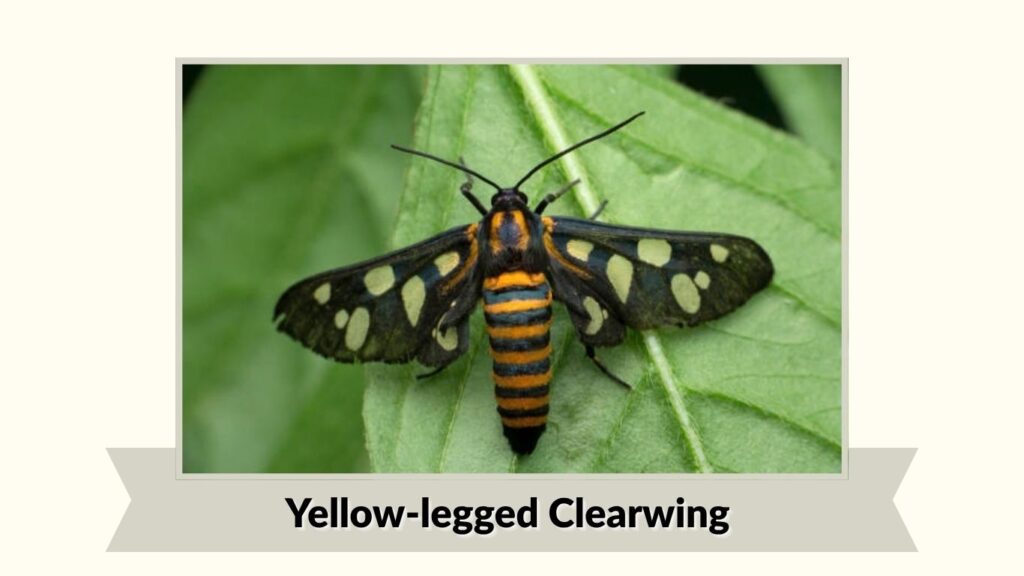
The Yellow-legged Clearwing (Synanthedon vespiformis) is a small clearwing moth whose yellowish legs and transparent wings strengthen its resemblance to a wasp. It is mainly associated with oak trees, particularly damaged, cut, or recently felled wood that provides suitable larval habitat. Adults fly in sunshine and can easily be mistaken for small wasps moving through woodland.
Identification
- Wingspan: Usually about 18–20 mm
- Body: Dark and narrow
- Legs: Noticeably yellow or yellowish
- Wings: Transparent with dark and reddish-brown margins
- Abdomen: Narrow pale bands contrast with the dark body
- Antennae: Long and slightly thickened
- Appearance: Particularly convincing wasp mimic
Habitat and Distribution
Yellow-legged Clearwings are associated with deciduous woodland, parks, hedgerows, gardens, and similar places containing oaks. In Britain, populations are concentrated mainly across southern and central England and can be highly localized. More broadly, the species occurs across the Palearctic region. Recently cut oak stumps and damaged trees can provide especially favorable breeding sites.
Behavior and Diet
Adults fly during the daytime, usually from May to July in Britain, although the broader flight season varies by region. Warm sunshine encourages activity. Larvae feed internally in woody tissue, with oak serving as the principal host. Elsewhere, poplar, horse chestnut, and willow have also been recorded as hosts.
Lifespan and Life Cycle
Females place their eggs on suitable bark, often around damaged areas or cut wood. Young larvae penetrate beneath the bark and establish galleries where they can feed safely for an extended period. After completing growth, the caterpillar forms a pupal chamber close to the outer surface. The emerging adult pushes through the prepared exit and begins its relatively short reproductive phase. Because most of the life cycle occurs hidden inside wood, the species can be more common at a site than adult sightings suggest.
17. American Hornet Clearwing
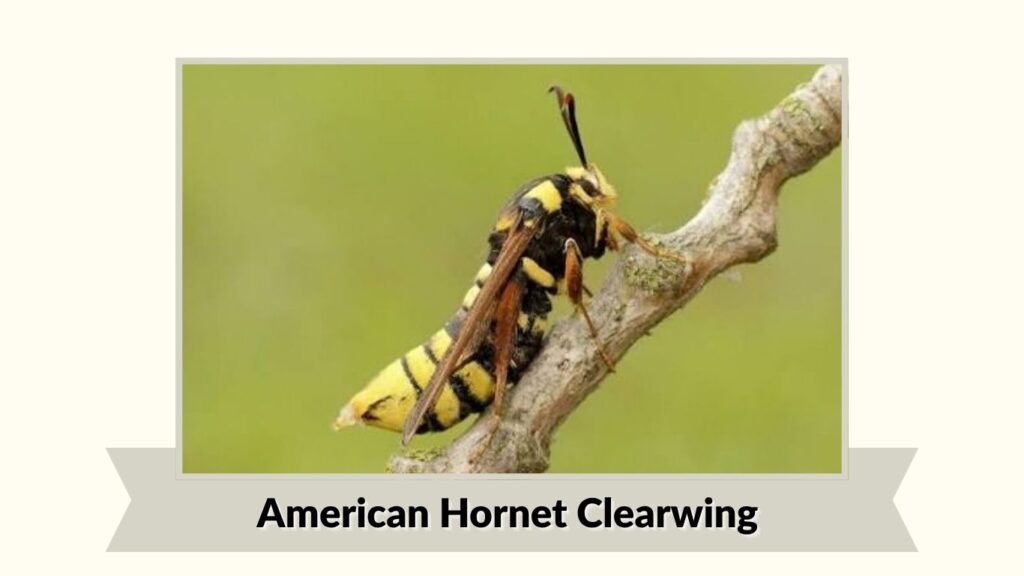
The American Hornet Clearwing, more commonly known as the American Hornet Moth (Sesia tibialis), is a North American clearwing moth famous for its remarkable hornet mimicry. It is also called the poplar clearwing borer or cottonwood crown borer, reflecting its association with poplars and cottonwoods. Although its appearance can be intimidating, it is a moth and does not possess a hornet’s sting.
Identification
- Body: Large and strongly hornet-like
- Color: Dark body with contrasting yellow markings
- Wings: Partly transparent with strongly defined veins and margins
- Legs: Often conspicuously marked
- Antennae: Long and prominent
- Flight: Fast and wasp-like during daylight
- Key feature: Overall shape and coloration strongly resemble a hornet
Habitat and Distribution
This species is native to North America and has been recorded in western and northern regions including British Columbia, Washington, California, Utah, Colorado, Montana, Michigan, and Arizona. It is associated mainly with areas supporting poplar and cottonwood trees, including river valleys, woodland margins, shelterbelts, parks, and other habitats where these host trees occur.
Behavior and Diet
Adults fly in daylight and use both appearance and movement to reinforce their hornet-like mimicry. This resemblance likely discourages predators that have learned to avoid stinging insects. Adult moths do not damage trees. Instead, the caterpillars are the feeding stage and live concealed within the lower portions, crowns, or woody tissues of suitable poplars and cottonwoods.
Lifespan and Life Cycle
After mating, females place eggs on or near suitable host trees. Newly hatched larvae bore into woody tissue and remain hidden during development. The internal feeding stage can extend across seasons, giving the larvae time to grow while protected from weather and many predators. Mature larvae eventually create a pupation site near the bark surface. Adults emerge through prepared openings and spend their comparatively short adult lives searching for mates and reproducing, completing the clearing’s transformation from concealed wood-boring caterpillar to convincing hornet mimic.
FAQs
1. What is a clearwing moth?
A clearwing moth is a moth belonging mainly to the family Sesiidae. Most species have transparent or partly transparent wings and slender bodies that make them look similar to wasps, bees, or hornets.
2. Are clearwing moths dangerous to humans?
No. Adult clearwing moths do not sting or bite people. Their wasp-like appearance is mainly a form of mimicry that can help protect them from predators.
3. Why do clearwing moths look like wasps?
Clearwing moths use Batesian mimicry, meaning harmless species resemble insects that predators consider dangerous. Their narrow bodies, transparent wings, bright abdominal bands, and daytime activity help create a convincing wasp-like appearance.
4. What do clearwing moth larvae eat?
Most clearwing moth larvae feed inside stems, trunks, roots, or bark of host plants. Depending on the species, they may use trees such as willow, birch, oak, poplar, and apple, while others develop in smaller plants such as thrift or bird’s-foot trefoil.
5. How long is the clearwing moth life cycle?
The life cycle varies by species. Many clearwing moths spend one to three years as larvae hidden inside their host plants. After pupation, the adult stage is much shorter and is mainly devoted to mating and laying eggs.