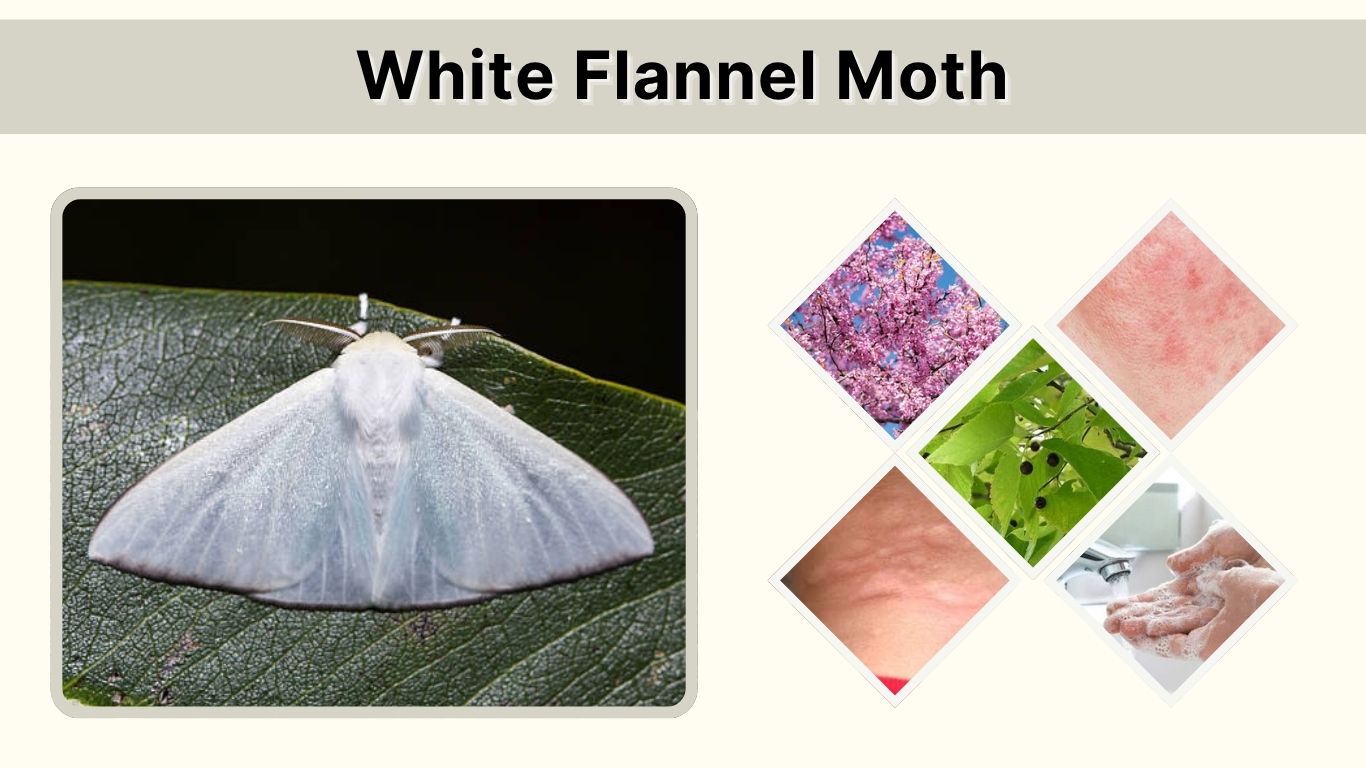
The white flannel moth is a small, fuzzy-looking moth whose caterpillar is far more memorable than the adult. The eastern U.S. species widely called the white flannel moth is currently classified as Norape cretata, although many older references identify it as Norape ovina. Its caterpillar is brightly patterned with yellow, black, and reddish markings and carries clusters of venomous stinging hairs. Contact can cause immediate burning, pain, redness, and an itchy or raised rash. Adults, however, are harmless and do not sting.
What Is a White Flannel Moth?
The white flannel moth belongs to the family Megalopygidae, a group well known for caterpillars with defensive stinging hairs.
Adult white flannel moths look soft and almost completely white. Their bodies are stout and densely covered with hairlike scales. The wings are rounded, giving the moth a fluffy appearance when it rests.
Recent taxonomic work recognizes the eastern U.S. white flannel moth as Norape cretata. Older sources frequently used Norape ovina, which explains why both scientific names still appear in articles and identification searches. Current references consider N. ovina to occur south of the United States, while N. cretata represents the familiar eastern U.S. species.
White Flannel Moth Identification
Look for these adult characteristics:
- Scientific name: Norape cretata in the eastern United States
- Older name: Frequently listed as Norape ovina
- Family: Megalopygidae
- Wingspan: approximately 27–33 mm
- Body: short, thick, and very hairy
- Wings: mostly pure or creamy white
- Hindwings: rounded
- Male antennae: may appear orange or yellowish
- Activity: primarily nocturnal
The adult’s almost entirely white coloration separates it from many darker flannel moth species.
White Flannel Moth Caterpillar
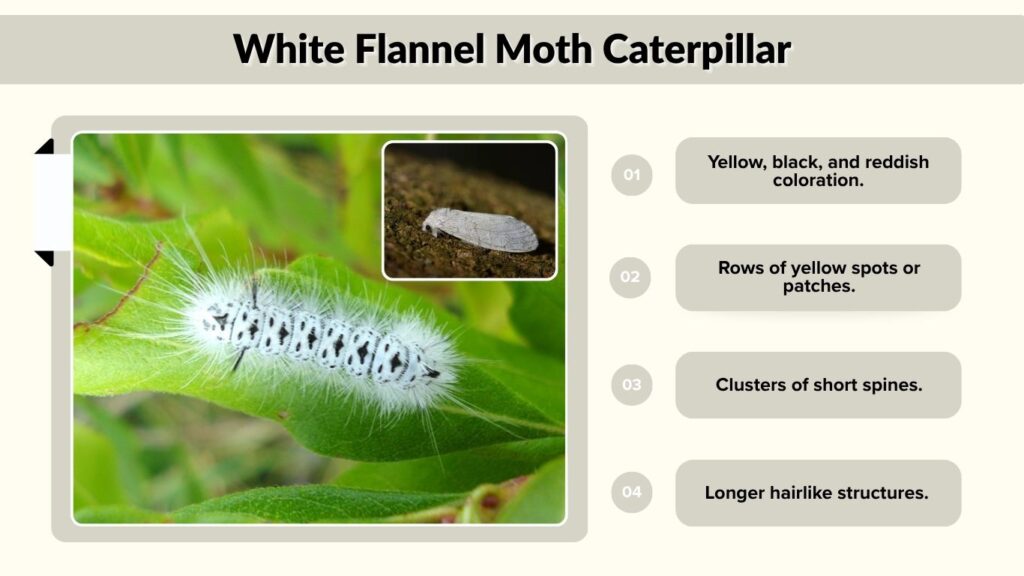
The white flannel moth caterpillar looks dramatically different from the adult.
Mature larvae have a dark body decorated with bright yellow patches and reddish areas. Rows of yellow spots or raised patches occur along the body, with clusters of short, needlelike stinging hairs projecting from them.
Longer hairs may also be visible, but the shorter spines are especially important because they can penetrate human skin.
The caterpillar should never be picked up with bare hands.
How to Identify the Caterpillar
Typical features include:
- Yellow, black, and reddish coloration
- Rows of yellow spots or patches
- Clusters of short spines
- Longer hairlike structures
- Flattened or sluglike appearance
- Bright contrasting pattern
- Usually found on leaves of trees and shrubs
Its colorful appearance may be attractive, but the hairs serve as an effective defense against predators.
Does a White Flannel Moth Caterpillar Sting?
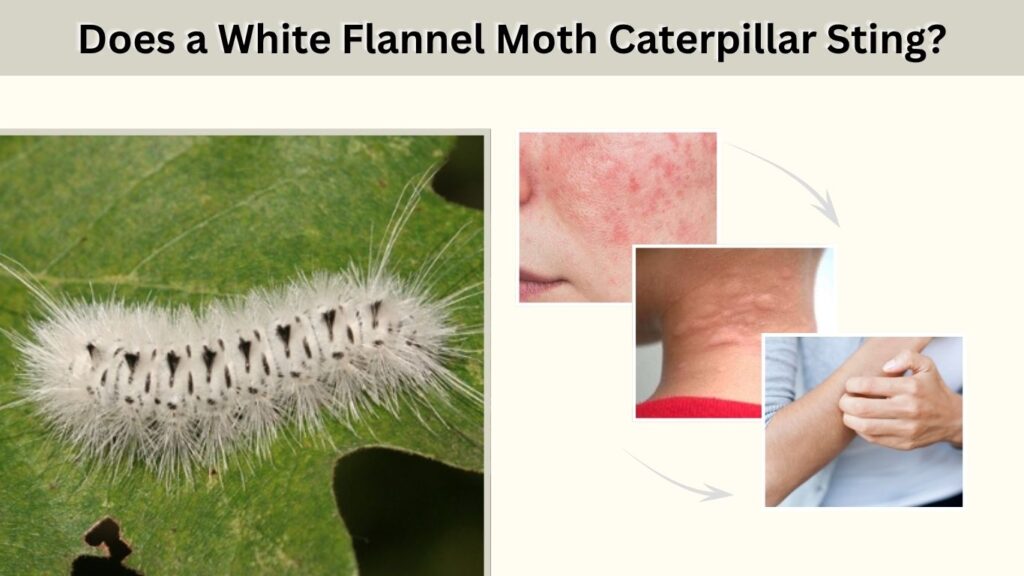
Yes. White flannel moth caterpillars can sting.
The caterpillar has specialized hairs or spines capable of delivering irritating venom when they become embedded in skin. This type of caterpillar-induced skin reaction is known as erucism.
A published medical case involving a white flannel moth caterpillar documented immediate pain followed by a raised, red rash. Pain persisted for about a day, while the skin reaction gradually improved afterward.
White Flannel Moth Caterpillar Sting Symptoms
Possible symptoms include:
- Immediate burning or stinging
- Sharp localized pain
- Redness
- Raised welts
- Itching
- Swelling
- Tenderness
- Persistent skin irritation
Reactions can vary considerably between individuals. The exact severity depends on the amount of contact, number of hairs embedded in the skin, and individual sensitivity.
Is the White Flannel Moth Caterpillar Poisonous?
It is more accurate to describe the caterpillar as venomous rather than poisonous.
A poisonous animal causes harm when eaten or otherwise absorbed, whereas a venomous animal actively delivers a toxin through structures such as spines.
White flannel moth caterpillars have venom-associated stinging hairs capable of penetrating the skin. Their defensive mechanism is similar in principle to that of other flannel moth caterpillars.
The adult white flannel moth is not dangerous and cannot sting.
White Flannel Moth Caterpillar Sting Treatment
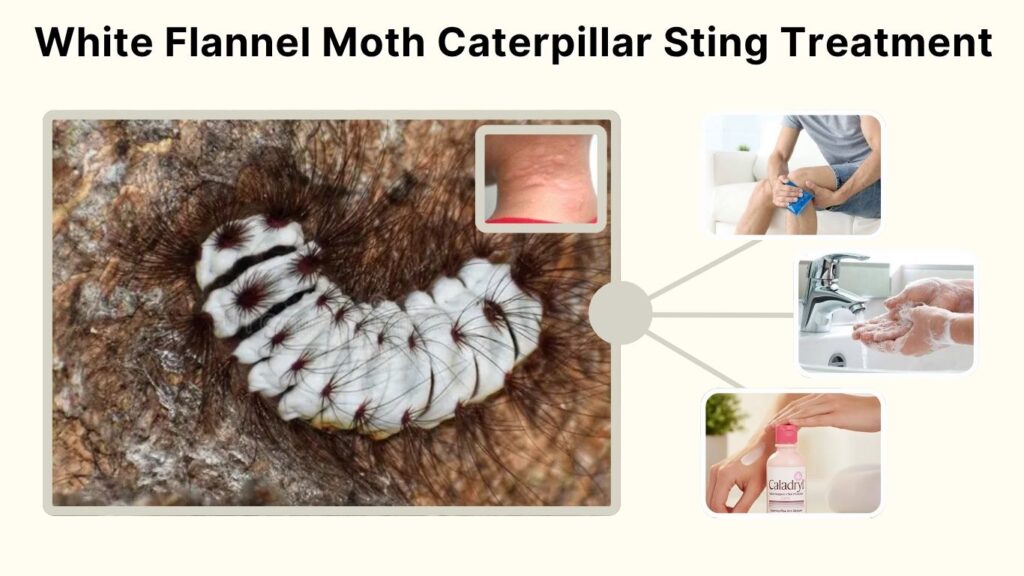
If you accidentally touch a white flannel moth caterpillar, avoid rubbing or scratching the area because this can push remaining hairs farther into the skin.
For a localized reaction:
- Move away from the caterpillar and avoid additional contact.
- Use adhesive tape gently on the affected area to help lift out embedded hairs or spines.
- Wash or irrigate the skin after removing visible hairs.
- Apply a cold compress to reduce discomfort and swelling.
- Monitor the reaction for worsening symptoms.
Medical literature discussing white flannel moth stings specifically recommends irrigation and removal of urticating hairs with adhesive tape as useful first-aid measures.
Seek medical care promptly if pain is severe, swelling spreads substantially, symptoms involve the eyes or mouth, or breathing difficulty or another severe reaction develops.
Where Do White Flannel Moth Caterpillars Live?
The white flannel moth associated with Norape cretata is found primarily in the eastern United States. Records extend through many southeastern and central areas where its host trees grow.
Caterpillars can occur in:
- Gardens
- Parks
- Woodland edges
- Residential landscapes
- Shrubby areas
- Areas containing redbud or hackberry trees
- Urban and suburban plantings
They may sometimes occur in noticeable groups on a single tree or branch.
White Flannel Moth in Texas, Florida, Georgia and Virginia
Flannel moth caterpillars are particularly relevant in warmer portions of the United States.
The white flannel moth and related stinging caterpillars can occur across the Southeast. Historical records of the species commonly called Norape ovina extended from the Washington, D.C. region south toward Florida and Texas, while modern taxonomy separates the eastern U.S. form as N. cretata.
White flannel moth caterpillar encounters have also been documented medically in Virginia, demonstrating that they are not limited to the Deep South.
What Do White Flannel Moth Caterpillars Eat?
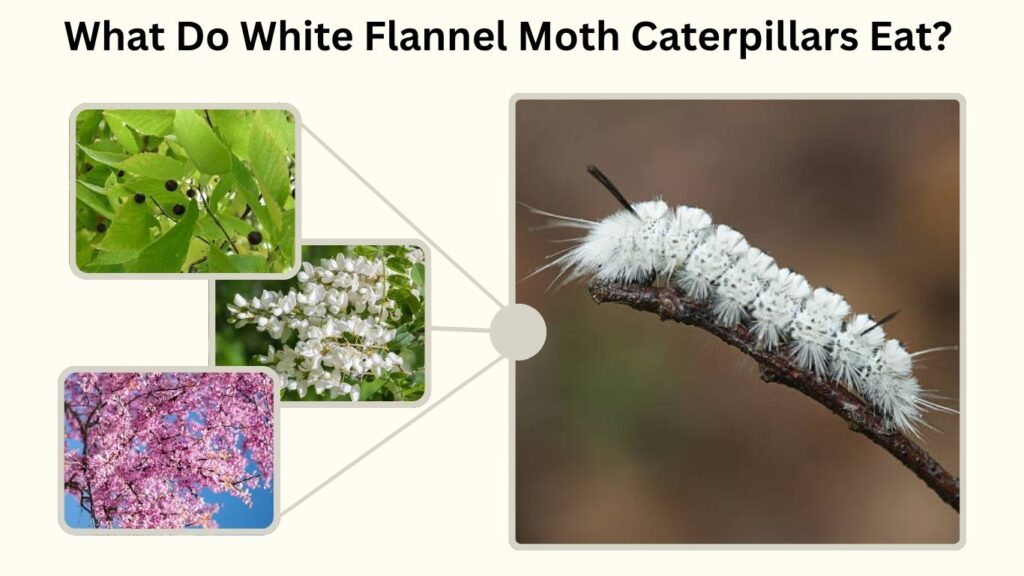
White flannel moth larvae feed on leaves of several broadleaf trees and shrubs.
Known host plants include:
- Redbud
- Hackberry
- Black locust
- Beech
- Mimosa
- Other suitable woody plants
Redbud is particularly associated with the species in some eastern U.S. landscapes.
A small number of caterpillars typically causes limited damage, although occasional outbreaks can lead to more noticeable defoliation.
White Flannel Moth Life Cycle
Like other moths, the white flannel moth undergoes complete metamorphosis:
Egg → Caterpillar → Pupa → Adult
Eggs
Adult females deposit eggs on suitable host plants.
Some observations describe the eggs being placed in linear groups on leaves. After hatching, the small larvae begin feeding on plant tissue.
Caterpillar
The caterpillar grows through several developmental stages called instars.
As it matures, its defensive hairs and bright markings become increasingly obvious. This is the stage capable of stinging people.
Pupa
Once fully grown, the caterpillar leaves its feeding location and prepares for pupation.
White flannel moth caterpillars may form a cocoon near or slightly beneath the soil surface. The transformation into the adult occurs inside this protected structure.
Adult Moth
Adults emerge, mate, and produce the next generation.
In North Carolina, extension observations report two generations per year, although generation numbers can vary with climate and latitude.
White Flannel Moth vs Megalopyge crispata
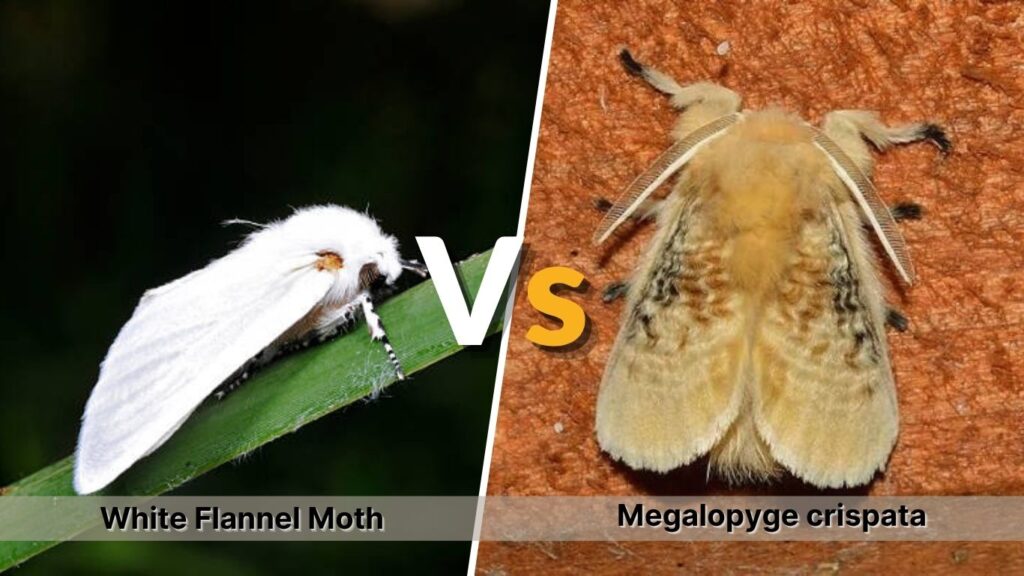
Another source of confusion involves Megalopyge crispata.
This species is commonly called the black-waved flannel moth or crinkled flannel moth, although “white flannel moth” has also occasionally been used for it.
It is not the same species as Norape cretata.
| Feature | Norape cretata | Megalopyge crispata |
| Common name | White flannel moth | Black-waved/crinkled flannel moth |
| Family | Megalopygidae | Megalopygidae |
| Adult appearance | Mostly white | White/cream with darker markings |
| Caterpillar | Yellow, black and red pattern | Dense hairy covering |
| Can larva sting? | Yes | Yes |
Both should be treated cautiously during the caterpillar stage.
How to Get Rid of White Flannel Moth Larvae
Control may be appropriate when numerous stinging caterpillars occur around homes, playgrounds, walkways, or frequently used garden areas.
White Flannel Moth Caterpillar Control
Start with these precautions:
- Do not touch caterpillars with bare hands.
- Keep children and pets away from infested plants.
- Wear gloves, long sleeves, and protective clothing when working nearby.
- Avoid brushing directly against infested foliage.
- Carefully remove isolated caterpillars with tools rather than your hands.
- Check redbud, hackberry, and similar host plants regularly.
Because caterpillar hairs may remain irritating even after the insect dies, avoid crushing or casually handling dead larvae. General guidance for flannel moths recommends avoiding contact with unidentified hairy or spiny caterpillars altogether.
Large infestations near heavily used areas may justify advice from a local extension service or licensed pest professional.
FAQs
Can a white flannel moth caterpillar sting you?
Yes. Its specialized hairs can penetrate the skin and cause immediate pain, burning, redness, and a raised rash.
Is the adult white flannel moth dangerous?
No. The dangerous defensive structures occur on the caterpillar. Adult moths do not sting people.
Where are white flannel moths found?
The white flannel moth currently identified as Norape cretata occurs in the eastern United States.
What do white flannel moth caterpillars eat?
Their host plants include redbud, hackberry, black locust, beech, mimosa, and other broadleaf trees and shrubs.
What should I do after a white flannel moth caterpillar sting?
Avoid rubbing the skin, remove remaining hairs carefully with adhesive tape, wash the area, and use a cold compress. Seek medical care for severe or worsening reactions.