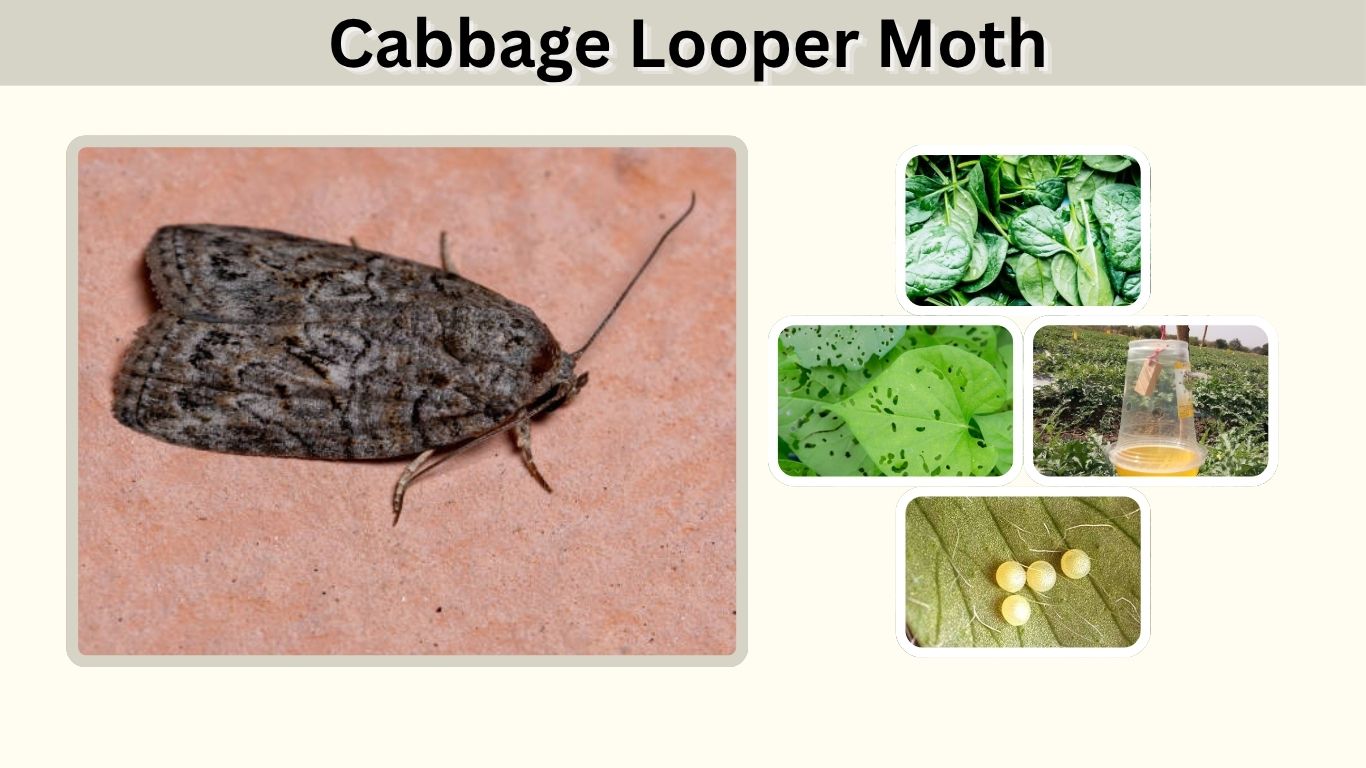
The cabbage looper moth (Trichoplusia ni) is a widespread agricultural moth best known for its green caterpillars, which feed on cabbage, broccoli, cauliflower, lettuce, tomatoes, and many other crops. The caterpillar gets its name from the distinctive looping motion it makes while crawling. Adult moths are brownish gray with small silvery markings on the forewings and are mainly active at night. While the adult moth is harmless to people, the larvae can become serious garden and farm pests because they chew large, irregular holes in leaves.
What Is a Cabbage Looper Moth?
The cabbage looper moth is the adult stage of Trichoplusia ni, a species in the family Noctuidae. It occurs across much of North America and in many other warm or temperate regions.
The adult itself causes little direct plant damage because the destructive stage is the caterpillar. Female moths fly at night and lay eggs on suitable host plants. Once the eggs hatch, the young larvae immediately begin feeding.
Cabbage loopers are especially important pests of vegetables in the cabbage family, although their diet includes dozens of unrelated plants.
Cabbage Looper Moth Identification
Look for these features:
- Scientific name: Trichoplusia ni
- Family: Noctuidae
- Adult color: gray-brown to mottled brown
- Wingspan: usually about 30–40 mm
- Forewings: patterned with brown and gray shades
- Distinctive marking: small silvery-white figure-eight or loop-shaped marking
- Activity: mainly nocturnal
- Caterpillar: bright green with pale lines
- Movement: characteristic looping or arching crawl
The pale silver mark on each forewing is one of the easiest ways to recognize an adult cabbage looper moth.
Cabbage Looper Moth Caterpillar
The cabbage looper caterpillar is the stage most gardeners encounter.
Young larvae are small and light green, while mature caterpillars may grow to around 30–40 mm long. Their bodies are smooth and usually have thin white lines along the sides and back.
One unusual feature is that cabbage loopers have fewer abdominal prolegs than many other caterpillars.
Why Does the Caterpillar “Loop”?
Cabbage loopers lack some of the middle abdominal prolegs found in typical caterpillars.
When moving, they pull the rear part of their body toward the front, causing the middle section to rise into an arch. They then extend forward again.
This creates the familiar looping movement that gives the species its common name.
What Do Cabbage Looper Caterpillars Eat?
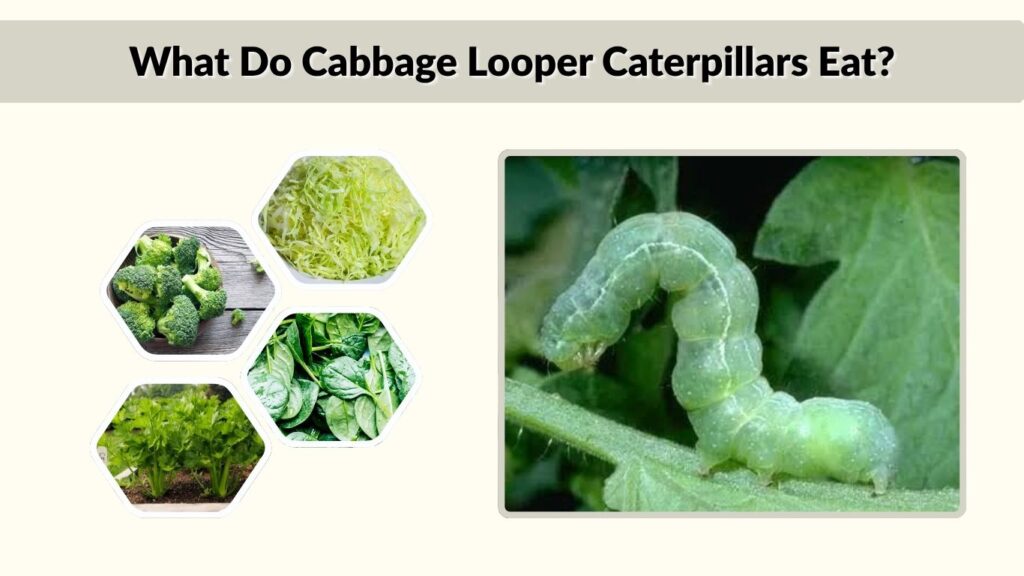
Cabbage loopers feed on a wide range of plants, but vegetables are particularly vulnerable.
Common host plants include:
- Cabbage
- Broccoli
- Cauliflower
- Kale
- Brussels sprouts
- Lettuce
- Spinach
- Celery
- Peas
- Beans
- Tomatoes
- Potatoes
- Peppers
- Cucumbers
They may also feed on weeds and ornamental plants.
Do Cabbage Loopers Eat Nightshades?
Yes. Although cabbage-family vegetables are famous hosts, cabbage loopers can also feed on nightshade plants such as tomatoes, peppers, potatoes, and eggplants.
This broad diet is one reason the species can survive in many agricultural environments.
What Do Adult Cabbage Looper Moths Eat?
Adult cabbage looper moths do not chew vegetable leaves.
Instead, adults primarily obtain energy by drinking nectar from flowers.
At night, moths visit flowering plants before females search for suitable locations to lay their eggs.
Adult feeding generally causes no meaningful damage to garden plants.
Cabbage Looper Moth Life Cycle
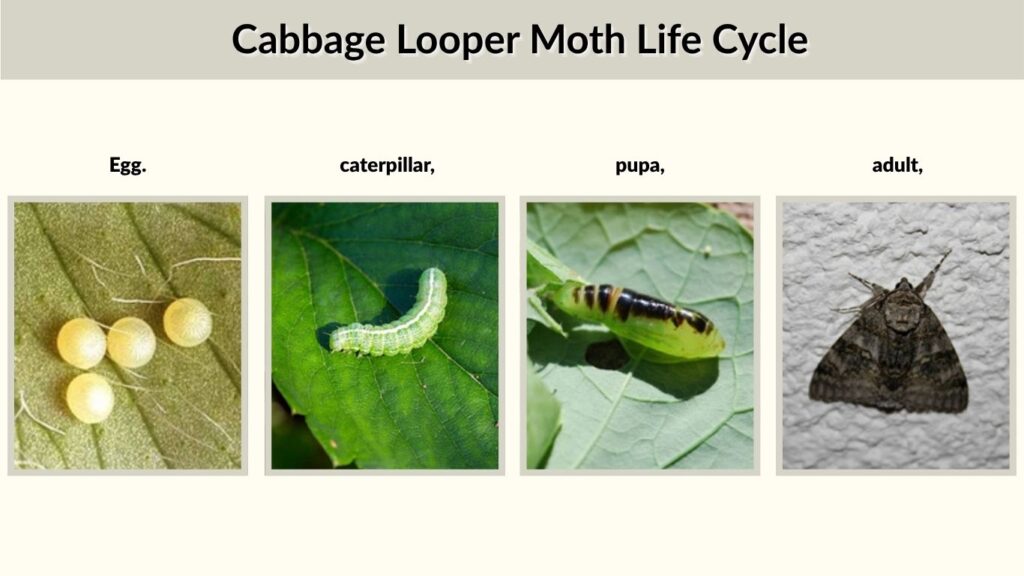
The cabbage looper moth life cycle consists of four stages:
Egg → Caterpillar → Pupa → Adult
Warm weather allows the entire cycle to proceed quickly, so several generations may occur during one growing season.
1. Eggs
Female moths lay small, pale eggs individually or occasionally in small groups on host plants.
Eggs are often deposited on the undersides of leaves, although other plant surfaces may also be used.
Under warm conditions, eggs can hatch within only a few days.
2. Caterpillar
The larvae begin feeding shortly after hatching.
They progress through several growth stages called instars. Younger larvae scrape or chew small areas of leaf tissue, while larger caterpillars can create substantial irregular holes.
Mature larvae are much easier to recognize because of their green color and looping movement.
3. Pupa
When fully grown, the caterpillar stops feeding and creates a thin, loose silk cocoon.
The pupa is commonly attached to the underside of a leaf or another protected part of the plant.
Inside the cocoon, the caterpillar transforms into an adult moth.
4. Adult Moth
The brownish adult emerges from the pupa and becomes active mainly after sunset.
Adults mate, females lay eggs, and another generation begins.
In warm climates, cabbage looper populations can continue developing for much of the year.
How Long Does a Cabbage Looper Moth Live?
Development speed varies greatly with temperature.
Under favorable warm conditions, cabbage loopers may complete development from egg to adult in roughly one month, although cooler weather slows the process.
Adult moths generally live for a much shorter period than the complete life cycle, often only long enough to feed, mate, and reproduce.
Because several generations can overlap, gardeners may see eggs, caterpillars, pupae, and adults during the same growing season.
Cabbage Looper Moth Eggs
Cabbage looper eggs are very small, usually pale white, cream, or greenish.
They are somewhat rounded and have fine ridges that may be difficult to see without magnification.
Female moths usually place eggs directly on plants that newly hatched caterpillars can eat.
Checking the undersides of cabbage, kale, broccoli, and similar vegetables can help detect an infestation before large caterpillars develop.
Signs of Cabbage Looper Damage
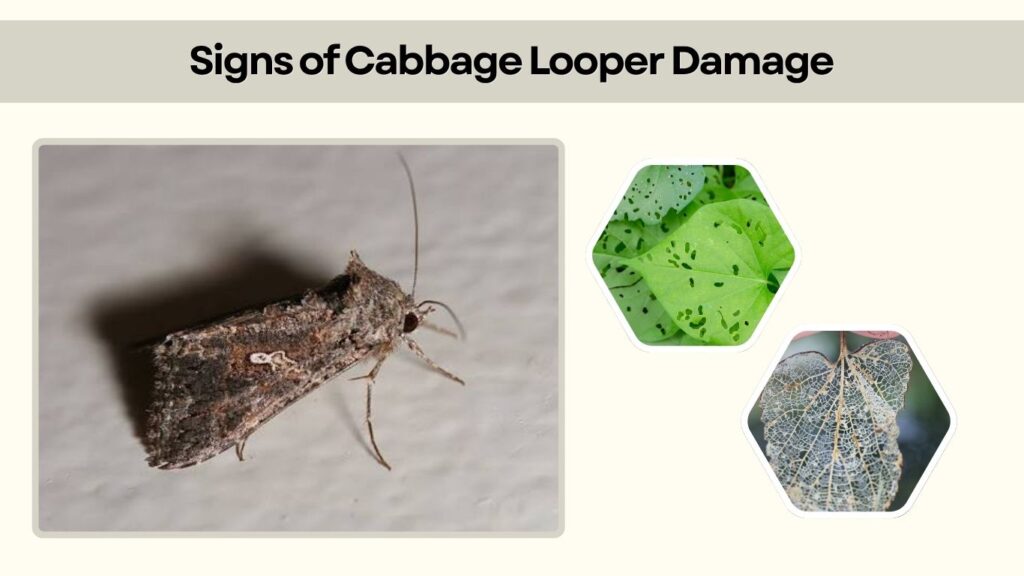
The caterpillars have chewing mouthparts and remove sections of leaf tissue.
Common symptoms include:
- Irregular holes in leaves
- Ragged leaf edges
- Skeletonized areas on leaves
- Green caterpillars on leaf undersides
- Dark caterpillar droppings
- Damage to cabbage heads
- Feeding on broccoli and cauliflower
- Young seedlings losing large amounts of foliage
Small populations may cause only cosmetic damage, while larger infestations can substantially reduce crop quality.
Cabbage Looper Moth Control
Controlling cabbage loopers is usually easiest when caterpillars are still young.
Hand Removal
In small gardens, inspect plants regularly and remove visible caterpillars by hand.
Pay particular attention to the undersides of leaves.
Bacillus thuringiensis
Products containing Bacillus thuringiensis var. kurstaki, commonly called Bt, are frequently used against young caterpillars.
Larvae must eat treated plant material for Bt to work effectively.
Encourage Natural Enemies
Cabbage loopers have numerous natural predators and parasitoids.
Helpful organisms may include:
- Parasitic wasps
- Predatory bugs
- Spiders
- Birds
- Other insect predators
Avoiding unnecessary broad-spectrum insecticides can help preserve these beneficial species.
Use Row Covers
Lightweight floating row covers can prevent adult moths from reaching vegetable plants and laying eggs.
Covers work best when installed before moth activity becomes significant.
Cabbage Looper Moth Traps and Pheromones
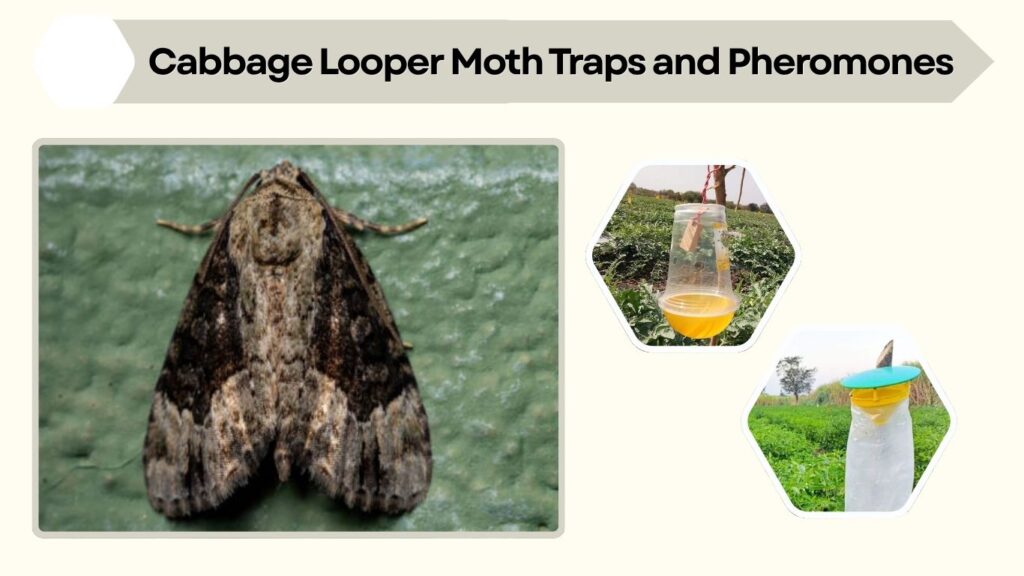
Pheromone traps can attract male cabbage looper moths.
These traps are especially useful for monitoring adult activity and determining when moth populations are increasing.
However, trapping males alone usually does not eliminate a major infestation. Pheromone traps are therefore generally more valuable as monitoring tools than as the only control method.
Gardeners should combine monitoring with regular plant inspections and caterpillar management.
Cabbage Looper Moth Prevention
Preventing egg laying and identifying caterpillars early can significantly reduce damage.
Useful prevention measures include:
- Inspect new plants before adding them to the garden.
- Check leaf undersides regularly for eggs and larvae.
- Remove weeds that may provide alternative host plants.
- Use floating row covers on susceptible vegetables.
- Remove heavily infested plant material.
- Rotate vegetable crops when practical.
- Encourage beneficial insects.
- Treat young caterpillars before extensive damage occurs.
Plants should be checked frequently during warm weather because populations can increase quickly.
Cabbage Looper Moth Migration
Cabbage loopers thrive in warm conditions and cannot successfully survive severe winters in many northern regions.
Populations can expand northward during warmer months as adults move from warmer regions into areas where seasonal crops are available.
This movement explains why cabbage loopers may become common during summer even in regions where year-round survival is difficult.
Cabbage Looper Moth in California
Cabbage loopers are important vegetable pests in California, where the relatively mild climate and extensive crop production provide suitable conditions.
They can attack cole crops such as broccoli, cabbage, and cauliflower as well as lettuce, tomatoes, and other vegetables.
A brown moth seen around vegetable crops at night may be an adult cabbage looper, particularly if green looping caterpillars are also found on the plants.
Cabbage Looper Moth in the UK and Australia
The geographic importance of Trichoplusia ni varies considerably.
The species is best known as a widespread pest in North America and other warm regions. It can also occur outside this core range, including through migration or introductions.
Because several similar noctuid and looper moth species occur in the UK and Australia, identification based only on a green caterpillar or brown adult moth can be unreliable.
Wing markings, caterpillar structure, host plant, and location should all be considered.
Are Cabbage Looper Moths Dangerous?
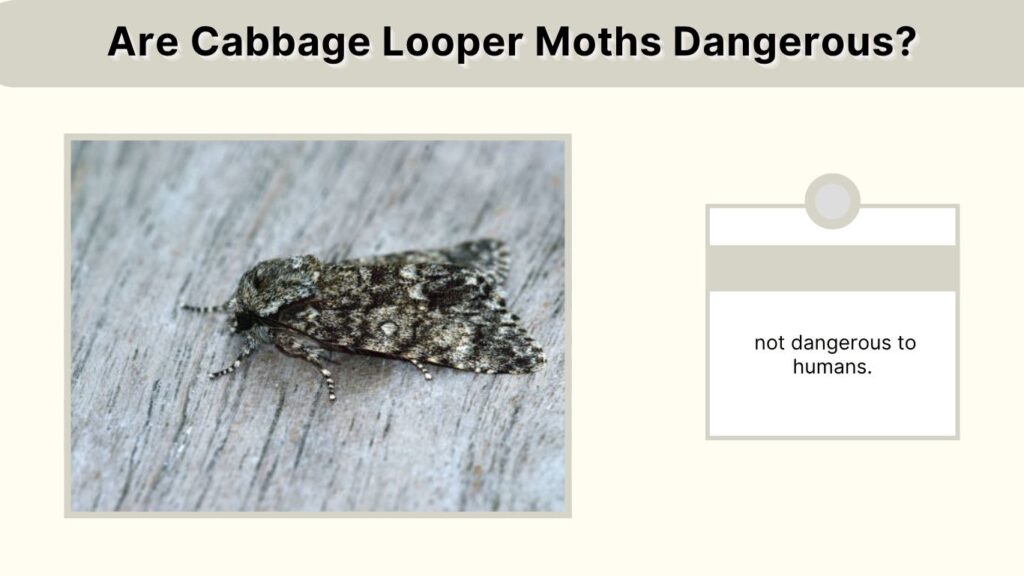
Cabbage looper moths are not dangerous to humans.
Adult moths do not bite or sting. Their caterpillars are also not venomous or known for medically important stinging hairs.
Their main significance is agriculture.
Heavy caterpillar populations can damage vegetable crops, reduce market quality, and contaminate harvested produce with larvae or droppings.
FAQs
What is a cabbage looper moth?
The cabbage looper moth is the adult form of Trichoplusia ni, a noctuid moth whose green caterpillars are common pests of cabbage and many other vegetables.
How big is a cabbage looper moth?
Adults generally have a wingspan of roughly 30–40 mm, while mature caterpillars can reach approximately 30–40 mm in length.
What does a cabbage looper moth caterpillar eat?
Caterpillars eat cabbage, broccoli, cauliflower, kale, lettuce, tomatoes, peppers, potatoes, beans, and numerous other plants.
How can I identify cabbage looper damage?
Look for irregular holes, damaged leaf edges, caterpillar droppings, and green looping caterpillars on the undersides of leaves.
How do I get rid of cabbage loopers?
Hand-picking, row covers, natural predators, regular plant inspection, and appropriately labeled Bt products are commonly used to control cabbage looper caterpillars.