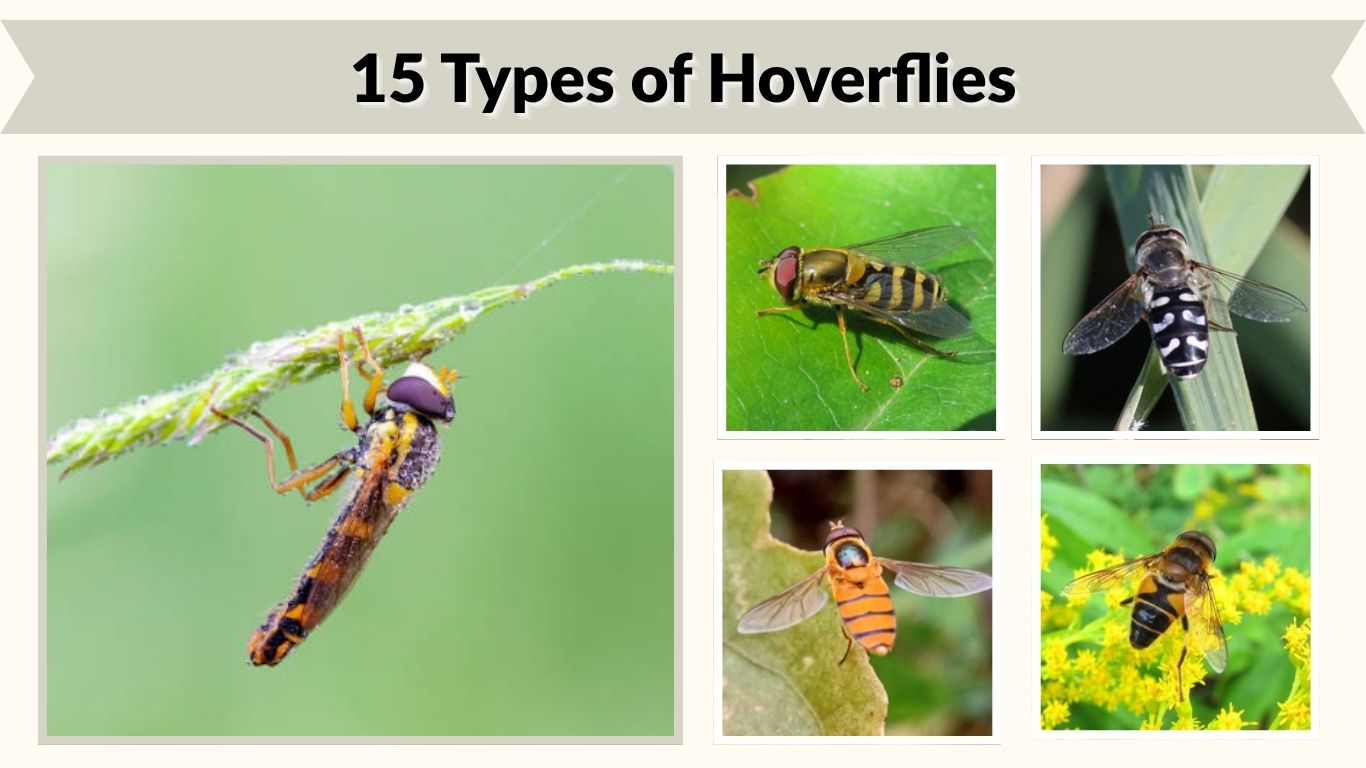
Hoverflies are harmless flower-visiting insects known for their ability to remain almost motionless in the air. Many species resemble bees, wasps or hornets, but they cannot sting. Adult hoverflies feed on nectar and pollen, making them valuable pollinators, while the larvae of many species help control aphids and other garden pests. This guide covers 15 types of hoverflies, including the marmalade hoverfly, drone fly, hornet mimic hoverfly and pellucid hoverfly, with details about their identification, habitat, diet and life cycle.
1. Marmalade Hoverfly (Episyrphus balteatus)
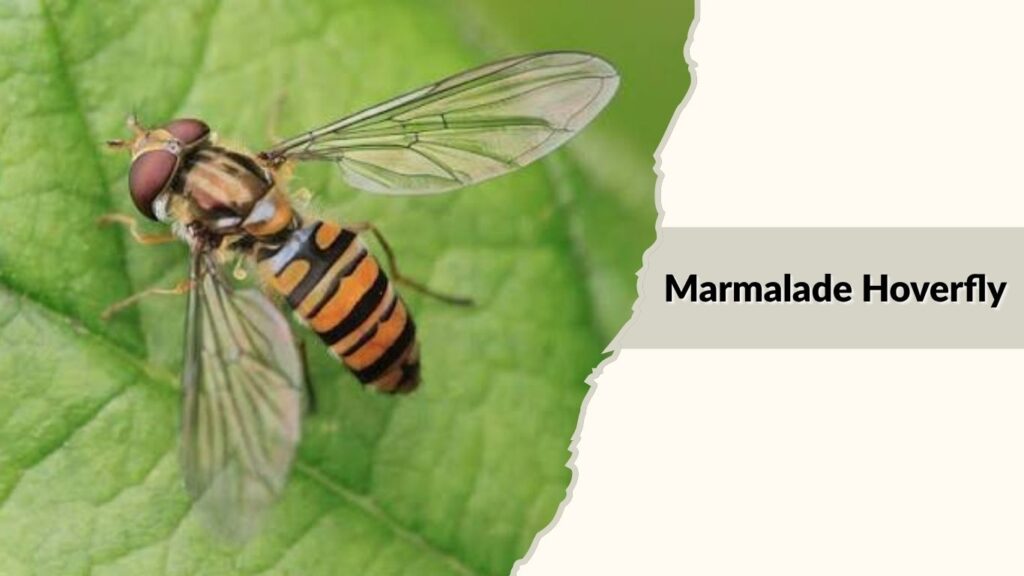
The marmalade hoverfly is a small orange-and-black fly commonly seen hovering over flowers in gardens, parks, hedgerows and sunny woodland. Its wasp-like markings discourage predators, but it cannot sting or bite people. Adults support pollination, while their larvae help gardeners by feeding on aphids.
Identification
- Adult length: approximately 9–12 mm
- Abdomen: orange with alternating thick and thin black bands
- Thorax: dark bronze or brown with a glossy appearance
- Eyes: large and reddish-brown
- Wings: one clear pair, unlike bees and wasps
- Antennae: short and inconspicuous
- Flight: capable of hovering almost motionless
- Larvae: pale, legless maggots without an obvious head
The different widths of the abdominal bands resemble thick-cut and thin-cut marmalade, which explains the common name.
Habitat and Distribution
Marmalade hoverflies occupy gardens, farmland, grasslands, wetlands, woodland edges, parks and coastal habitats. They can be seen throughout the year in mild areas, although their numbers are usually highest during summer. Large migrations from continental Europe can substantially increase local populations.
Diet and Garden Benefits
Adults drink nectar and consume pollen from accessible flowers such as tansy, ragwort and cow parsley. While moving between blooms, they transfer pollen and support plant reproduction. Their larvae are valuable natural predators that locate aphid colonies and consume the soft-bodied pests.
Life Cycle
Females deposit eggs close to aphid colonies so newly hatched larvae can immediately find food. The legless larvae pass through three growth stages before forming pear-shaped pupae. Adults later emerge and continue feeding on flowers, reproducing and sometimes migrating over considerable distances.
2. Common Drone Fly (Eristalis tenax)
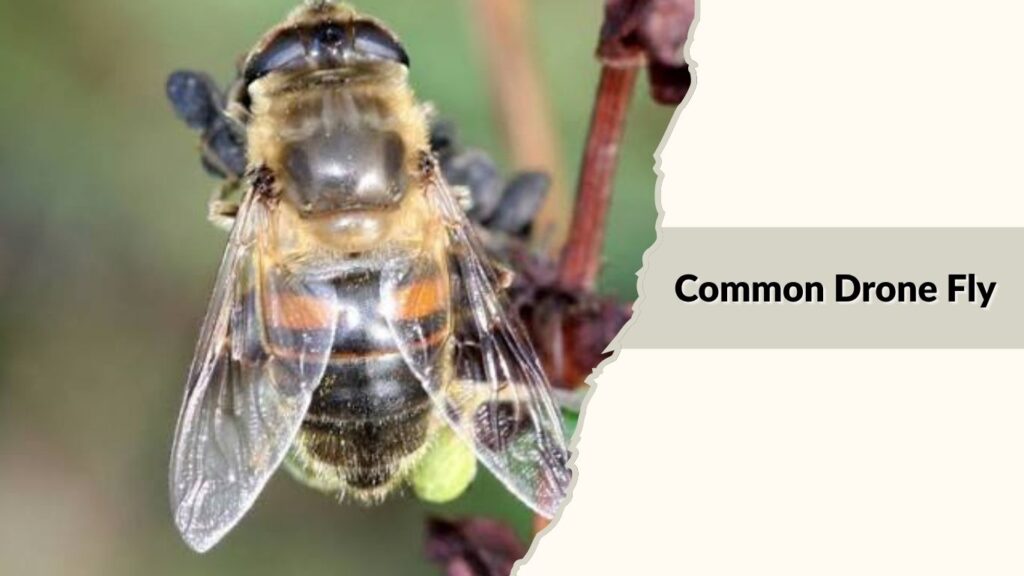
The common drone fly is a widespread hoverfly named for its close resemblance to a male honeybee, or drone. Its fuzzy body and yellow-orange abdominal markings help discourage predators, but it has no sting and is harmless to people. Adults are valuable flower visitors, while the aquatic larvae recycle decaying organic material.
Identification
- Adult length: usually around 10–15 mm
- Body color: dark brown to black
- Thorax: covered with short brownish-yellow hairs
- Abdomen: yellow-orange side markings and bands
- Wings: one clear pair with a false or spurious vein
- Waist: broad rather than narrowly constricted
- Male eyes: large and nearly touching
- Larvae: aquatic “rat-tailed maggots” with a long breathing tube
Unlike a honeybee, the drone fly has only one pair of wings and lacks a narrow waist.
Habitat and Distribution
Common drone flies occupy gardens, farmland, wetlands, woodland edges, parks and urban areas. They are among the most widely distributed hoverflies and can be seen during much of the year in mild climates. Adults frequently rest in sunny places or hover above flower beds.
Diet and Pollination
Adults consume nectar for energy and pollen for protein. They frequently visit daisies, asters, chrysanthemums and other open flowers, carrying pollen between blooms as they feed. Females require pollen to support egg development, while males may defend productive flower patches from competing insects.
Life Cycle
Females lay clusters of eggs close to stagnant water or wet material rich in decaying organic matter. The larvae breathe through a long tube extending to the water’s surface. After three larval stages, they leave the wet habitat and pupate in a drier place. Two or three generations may develop annually under favorable conditions.
3. Hornet Mimic Hoverfly (Volucella zonaria)
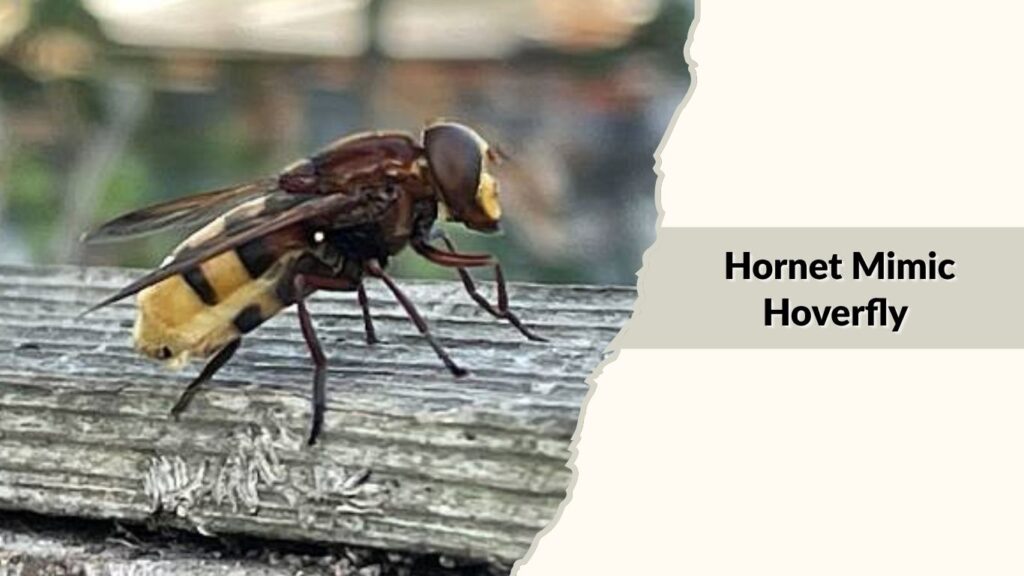
The hornet mimic hoverfly is a large orange-and-brown species that closely resembles a stinging hornet. Despite its intimidating appearance and loud flight, it cannot sting and is not aggressive. Its coloration provides protection from predators, while adults help pollinate garden and woodland flowers.
Identification
- Adult length: up to approximately 20 mm
- Abdomen: orange-yellow with broad dark bands
- Thorax: glossy dark brown or reddish-brown
- Eyes: extremely large and clearly visible from above
- Antennae: short and stubby
- Body shape: broad without a narrow wasp-like waist
- Wings: one transparent pair
- Sting: completely absent
Its broad body, enormous eyes and single pair of wings separate it from a true hornet.
Habitat and Distribution
Hornet mimic hoverflies favor parks, gardens, woodland edges and other flower-rich urban habitats. They are widely distributed in parts of continental Europe and have become increasingly common in southern England, with records continuing farther north. Adults are generally observed between May and October.
Diet and Pollination
Adults drink nectar and feed on pollen from accessible flowers. They are especially noticeable on flowering shrubs, ivy, scabious and members of the carrot family. Their hornet-like appearance protects them while they spend extended periods feeding openly on blossoms.
Life Cycle
Females enter active nests of social wasps or hornets to deposit their eggs. The larvae survive within the nest and feed mainly on discarded material, dead insects and debris accumulating beneath the colony. After completing development, they leave or pupate in protected material before emerging as adults.
4. Pied Hoverfly (Scaeva pyrastri)
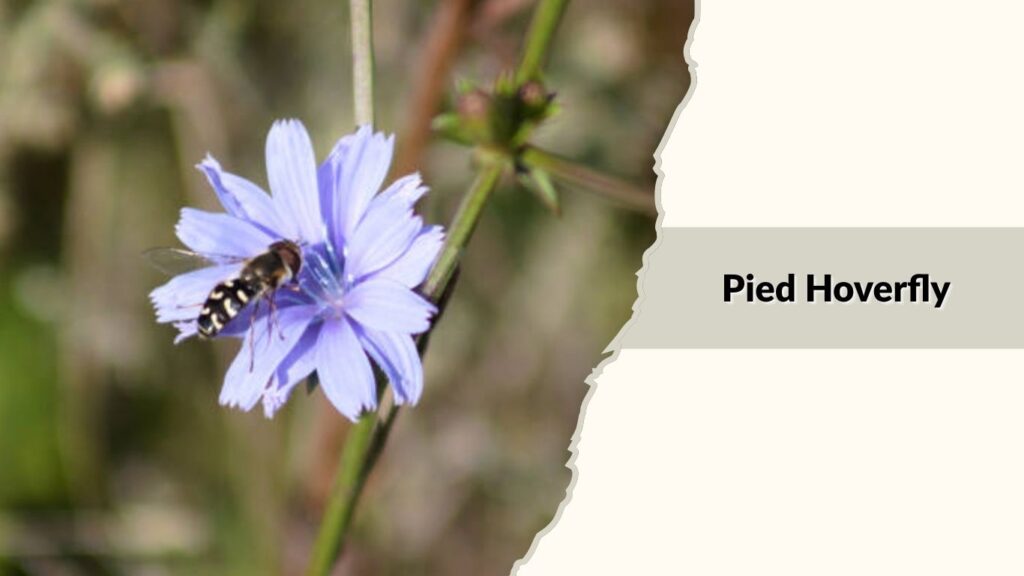
The pied hoverfly is a distinctive black-and-white species recognized by curved, comma-shaped markings across its abdomen. It is a strong migrant that may arrive in large numbers during favorable summers. Adults support pollination, while the larvae prey on aphids found on garden and agricultural plants.
Identification
- Adult length: approximately 10–15 mm
- Body color: glossy black
- Abdomen: three pairs of creamy-white curved markings
- Marking shape: commas or upward-curving crescents
- Face: pale yellow
- Eyes: covered with fine hairs
- Legs: reddish with darker sections
- Wings: clear with typical hoverfly venation
The creamy-white abdominal marks distinguish it from the similar Scaeva selenitica, whose markings are usually yellow.
Habitat and Distribution
Pied hoverflies occur in gardens, meadows, hedgerows, wasteland and other open flower-rich environments. They are found across Europe and parts of neighboring regions. In Britain, most are seen between May and November, with numbers often highest during August.
Diet and Garden Benefits
Adults consume nectar and pollen from daisies, umbellifers, honeysuckle and other open flowers. Females place their eggs close to aphid colonies. The larvae crawl among infested foliage and consume large numbers of aphids, making them useful natural garden predators.
Life Cycle
The female lays small eggs individually on plants near suitable prey. After hatching, the legless larvae feed through three growth stages before attaching themselves to vegetation and forming pupae. Many northern populations are strengthened by seasonal migrants because relatively few individuals survive cold winters.
5. Footballer Hoverfly (Helophilus pendulus)
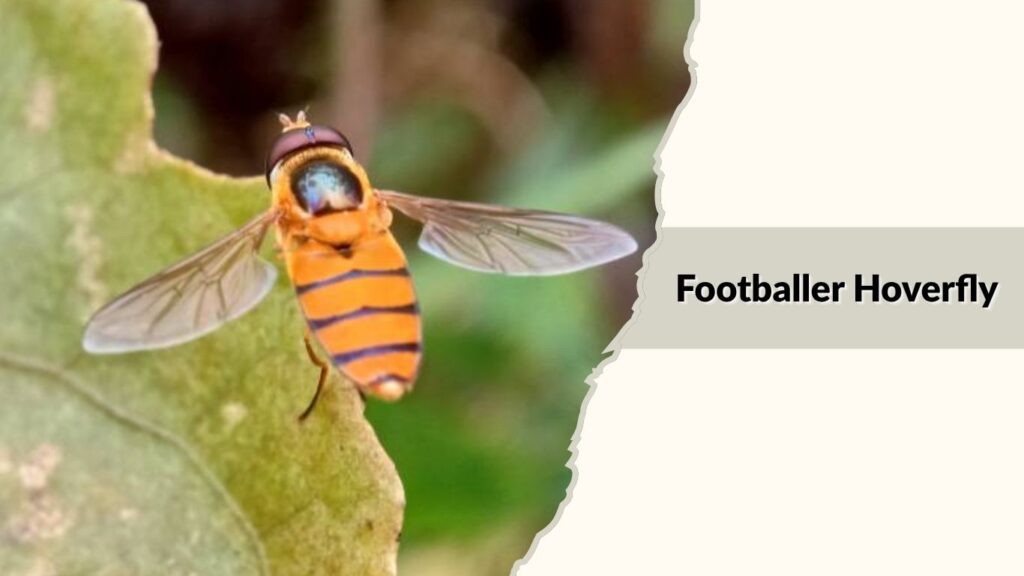
The footballer hoverfly is a common black-and-yellow species named for the bold stripes running along its thorax, which resemble a striped football shirt. It is also called the common tiger hoverfly or sun fly. Adults frequently visit flowers, while the larvae develop in wet organic material.
Identification
- Wing length: approximately 8.5–11.25 mm
- Thorax: four strong yellow and black longitudinal stripes
- Abdomen: yellow-orange with dark markings
- Face: yellow with a central black stripe
- Hind tibia: upper two-thirds orange and lower third black
- Wings: transparent with visible veins
- Female abdomen: ends in a pointed cone
- Male abdomen: ends in a rounded dome
Several related hoverflies have striped thoraxes, so leg color and facial markings help confirm identification.
Habitat and Distribution
Footballer hoverflies live in gardens, woodland, wetlands, roadsides and farmland. They are particularly common near ponds, drainage channels and muddy areas. Adults are widespread across Britain and are usually visible from April through November.
Diet and Pollination
Adults feed on nectar and pollen from numerous garden and wild flowers. They may hover above plants before landing and can remain almost stationary in flight. Their regular movement between blossoms helps transfer pollen and supports seed and fruit production.
Life Cycle
Females lay eggs near shallow water, wet manure or decomposing vegetation. The larvae are rat-tailed maggots equipped with long breathing tubes that allow them to remain underwater while obtaining air from the surface. They consume microorganisms and decaying material before moving to a drier location to pupate.
6. Long Hoverfly (Sphaerophoria scripta)
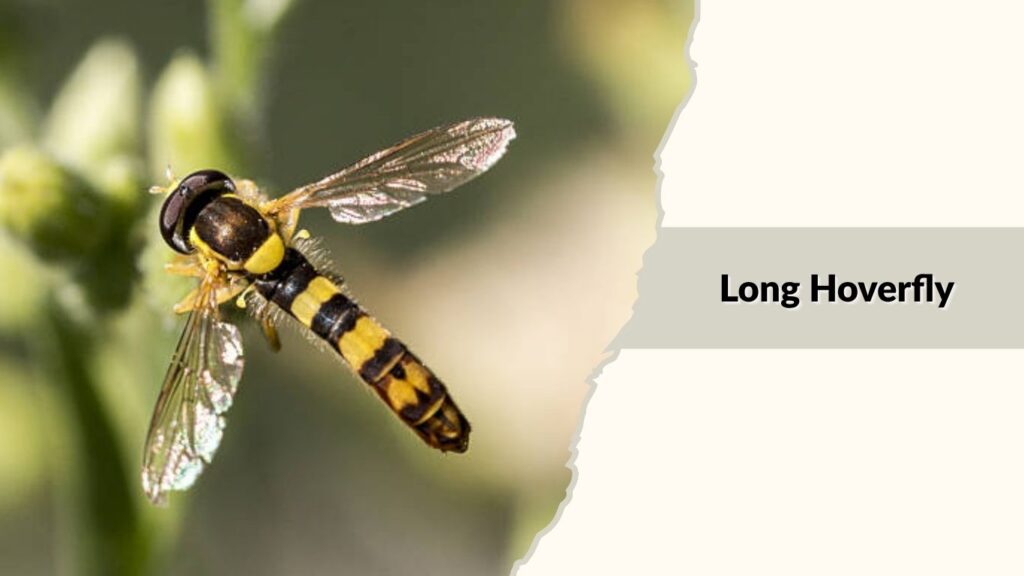
The long hoverfly is a slender black-and-yellow species commonly found in grasslands, gardens and other open areas. Males are especially recognizable because their abdomens extend noticeably beyond the ends of their folded wings. Adults pollinate flowers, and their aphid-eating larvae provide natural pest control.
Identification
- Adult length: approximately 7–10 mm
- Body shape: extremely narrow and elongated
- Abdomen: alternating yellow and black bands
- Thorax: dark with yellow side markings
- Scutellum: yellow
- Antennae: short
- Male body: extends beyond the wing tips
- Female: difficult to separate from related species visually
The body extending beyond the folded wings is the most useful identification feature for males.
Habitat and Distribution
Long hoverflies favor open grassland, gardens, parks, farmland and urban wasteland. They are common across much of Britain but become less frequent farther north. Adults can be seen between April and November, with activity usually peaking in July and August.
Diet and Garden Benefits
Adults visit flowers for nectar and pollen, particularly low-growing plants with exposed floral centers. The larvae search vegetation close to the ground and prey on aphids. This makes the species beneficial in gardens and crop fields affected by sap-feeding pests.
Life Cycle
Females lay their eggs on plants carrying aphid colonies. The larvae feed and grow through three stages before forming pupae attached to vegetation. Adults emerge to reproduce and continue visiting flowers. Seasonal migrants may supplement local populations during favorable years.
7. Batman Hoverfly (Myathropa florea)
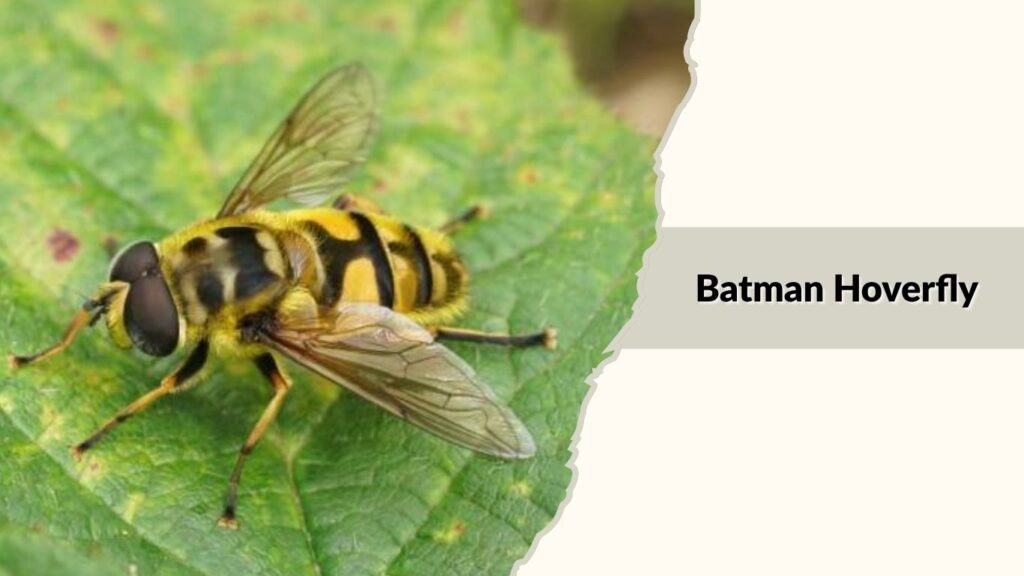
The Batman hoverfly is a large yellow-and-black species named after the unusual dark marking on its thorax, which often resembles the Batman logo. It is harmless to humans and cannot sting. Adults are frequently seen hovering in sunny woodland openings or feeding on flowers in gardens.
Identification
- Wing length: approximately 7–12 mm
- Body: broad and strongly built
- Abdomen: yellow with irregular black bands
- Thorax: dark marking resembling a bat or skull
- Eyes: large and dark reddish-brown
- Wings: one transparent pair
- Antennae: short and dark
- Larvae: rat-tailed maggots with long breathing tubes
The thoracic pattern is its most recognizable feature, although its exact shape varies between individuals.
Habitat and Distribution
Batman hoverflies are widespread in woodland, parks, gardens and other places containing mature trees. Adults may be seen from April through November and often bask on leaves or hover inside shafts of sunlight.
Diet and Pollination
Adults feed on nectar and pollen from blackthorn, ivy, umbellifers and many other flowers. Their movement between blossoms makes them useful pollinators in both natural habitats and gardens.
Life Cycle
Females lay eggs in water-filled tree holes, rotting stumps, damp compost and other wet places containing decaying organic material. The larvae use long breathing tubes to reach the surface while feeding on microorganisms and organic debris.
8. Tapered Drone Fly (Eristalis pertinax)
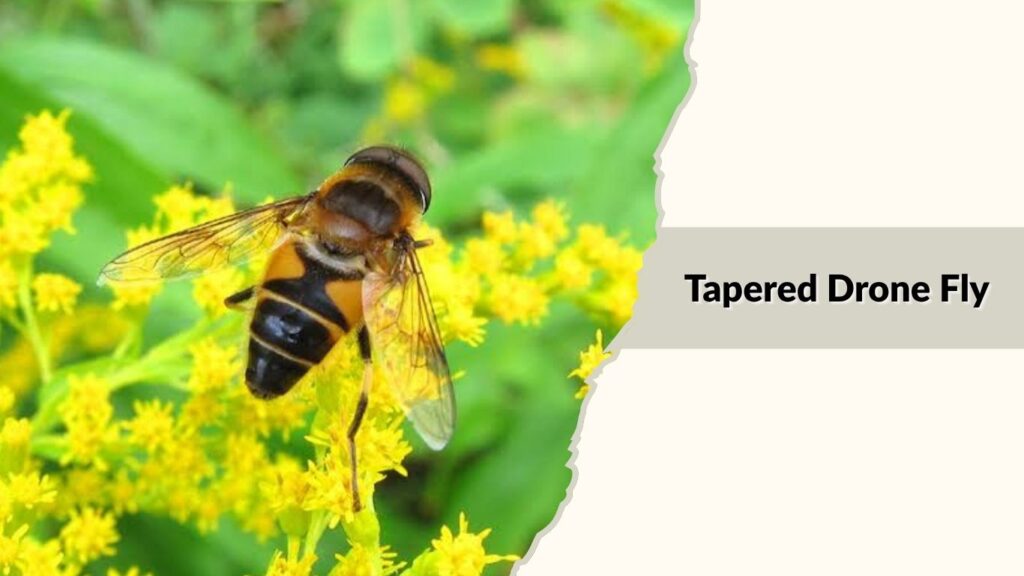
The tapered drone fly is a common honeybee mimic found around flowers, woodland paths and hedgerows. Its fuzzy body and orange abdominal patches can make it look like a bee, but it has only one pair of wings and lacks a sting.
Identification
- Adult size: medium to large hoverfly
- Body color: dark brown or black
- Abdomen: two orange side patches
- Male abdomen: noticeably tapered toward the end
- Front feet: pale or yellowish
- Wings: clear with a false vein typical of hoverflies
- Eyes: large and dark
- Larvae: aquatic rat-tailed maggots
The pale front legs and narrowing male abdomen help separate it from the common drone fly, Eristalis tenax.
Habitat and Distribution
Tapered drone flies favor woodland rides, hedgerows, gardens and flower-rich countryside. They are common and widespread across Britain and can generally be seen from March through November, with stronger activity during spring and late summer.
Diet and Pollination
Adults feed on pollen and nectar from dandelions, daisies, hawthorn and other open flowers. Their bee-like appearance offers protection from predators, while their flower visits contribute to pollination.
Life Cycle
Females deposit eggs near stagnant water or damp organic matter. The larvae develop as rat-tailed maggots, using extendable breathing tubes while feeding in wet environments. The species is thought to produce several generations during a favorable year.
9. Migrant Hoverfly (Eupeodes corollae)
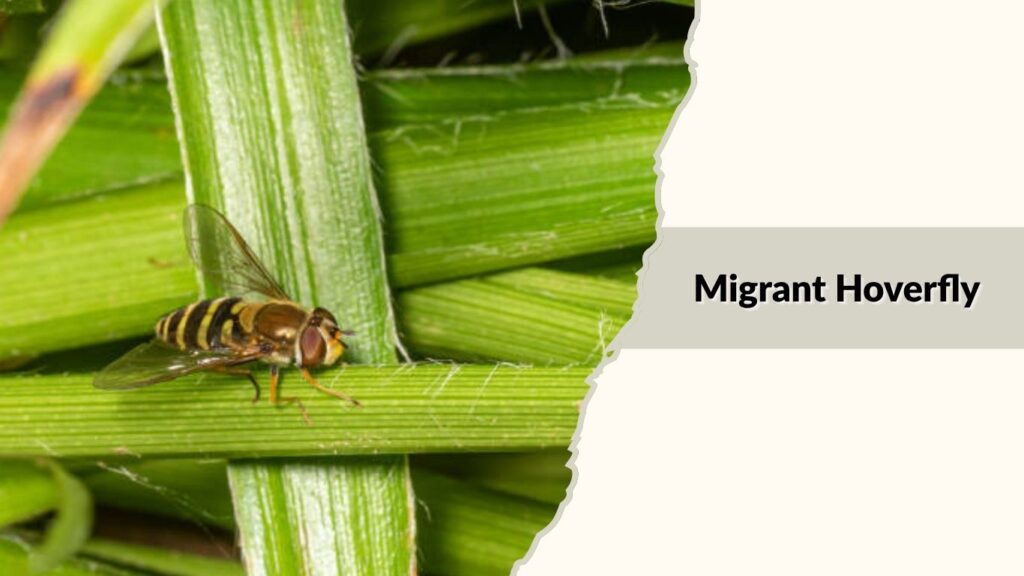
The migrant hoverfly is a mobile black-and-yellow species that travels considerable distances and may appear in large numbers during favorable years. Adults pollinate many flowers, while the larvae prey on aphids living on crops, garden plants and low-growing vegetation.
Identification
- Body: relatively small and oval
- Abdomen: black with yellow or cream-colored markings
- Yellow markings: usually reach the abdomen’s side edges
- Male: enlarged reproductive segment at the abdomen’s tip
- Female: markings usually clearly separated
- Face: pale yellow
- Wings: one clear pair
- Antennae: short and dark
Color and abdominal patterns vary between males, females and individual flies, so close examination may be needed to separate it from similar Eupeodes species.
Habitat and Distribution
Migrant hoverflies occur in farmland, urban gardens, parks, woodland clearings and other open habitats. They are among the commonest flower-visiting hoverflies in Britain, and seasonal migration from continental Europe may increase their numbers.
Diet and Garden Benefits
Adults drink nectar and consume pollen from many flower types. Their larvae actively hunt aphids, particularly on legumes and other low-growing plants, making them valuable natural pest-control insects.
Life Cycle
Females lay eggs beside aphid colonies. The larvae feed until fully developed, then form puparia attached to plants or nearby surfaces. The species overwinters as a puparium and has a long adult flight season.
10. Marsh Tiger Hoverfly (Helophilus hybridus)
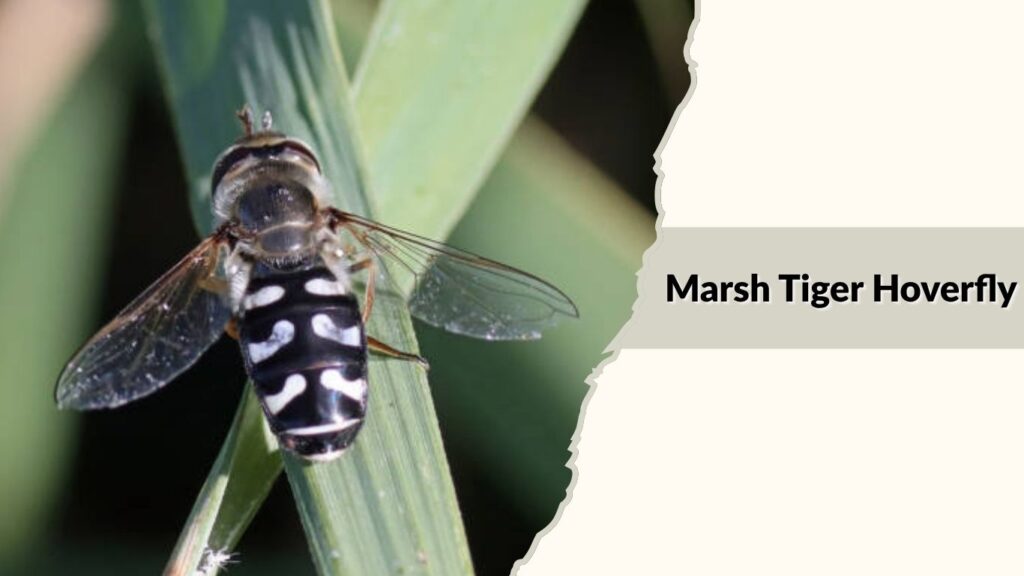
The marsh tiger hoverfly is a bold black-and-yellow species associated with ponds, ditches, fens and coastal marshes. It resembles the footballer hoverfly but usually remains closer to wet breeding habitats. Its larvae develop in decaying vegetation around shallow water.
Identification
- Wing length: approximately 8.5–11.25 mm
- Thorax: strong black and yellow longitudinal stripes
- Abdomen: yellow side markings on a dark background
- Male: broad yellow sides on abdominal segments two and three
- Female: black bar near the rear of the second segment
- Hind tibia: lower two-thirds usually black
- Wings: transparent
- Body: broad and bee-like
The hind-leg color and abdominal markings are useful for distinguishing it from Helophilus pendulus and Helophilus trivittatus.
Habitat and Distribution
This hoverfly lives around ponds, ditches, fens, coastal marshes and wet woodland. Adults usually remain near water and are commonly found resting on tall vegetation or visiting flowers along wetland margins.
Diet and Pollination
Adults consume nectar and pollen from wetland and garden flowers. They help pollinate plants growing around marshes and ponds but may occasionally visit gardens near suitable aquatic habitat.
Life Cycle
The long-tailed aquatic larvae inhabit wet, decaying organic matter, especially vegetation accumulating beside ponds and ditches. Larvae have also been recorded developing within decaying bulrush rhizomes.
11. Glass-Winged Syrphus (Syrphus vitripennis)
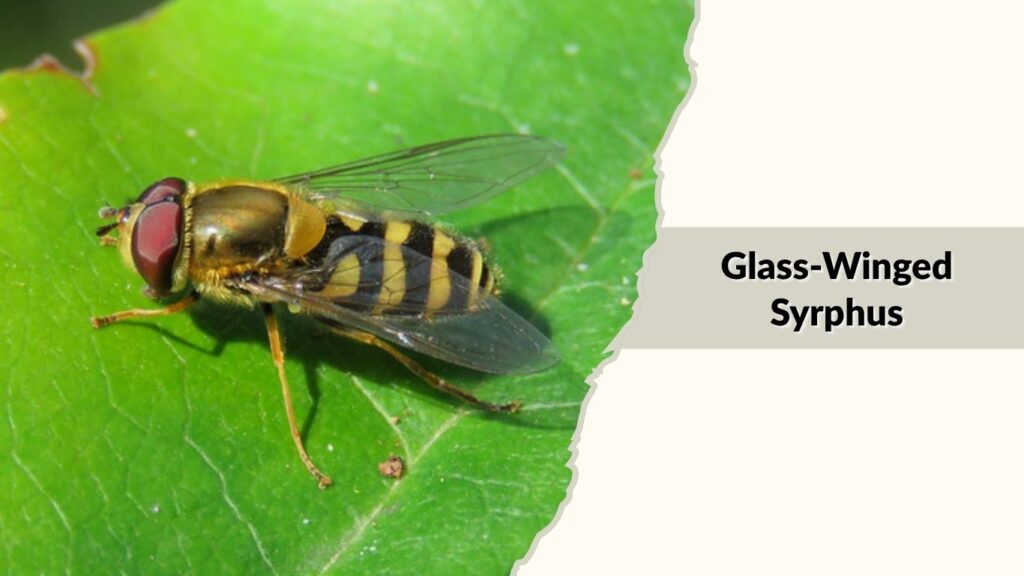
The glass-winged Syrphus is a yellow-and-black hoverfly found across gardens, parks, farmland and woodland. It closely resembles several related Syrphus species, making accurate identification difficult without a clear view of the legs. Its larvae are beneficial aphid predators.
Identification
- Body length: approximately 8–11 mm
- Wing length: approximately 7–10 mm
- Abdomen: black with broad yellow bands
- Face: yellow
- Eyes: large and without obvious hairs
- Female hind thigh: mostly black
- Wings: clear or glass-like
- Larvae: flattened, legless aphid predators
The female’s black hind femur is an important distinction from the very similar Syrphus ribesii, whose female hind femur is yellow. Males can be considerably harder to identify confidently.
Habitat and Distribution
Glass-winged Syrphus hoverflies occupy gardens, meadows, hedgerows, woodland rides, parks and many other habitats containing aphids and flowering plants. They are common and widespread across Britain and may be seen between March and November.
Diet and Garden Benefits
Adults feed on pollen and nectar from many different flowers. The larvae consume several aphid species, helping reduce populations of these sap-feeding garden and agricultural pests.
Life Cycle
Females place their eggs close to aphid colonies. The larvae hunt and consume aphids before becoming pupae on vegetation. The species is also a noted migrant, allowing populations to move between regions when weather and food conditions are favorable.
12. Large Tiger Hoverfly (Helophilus trivittatus)
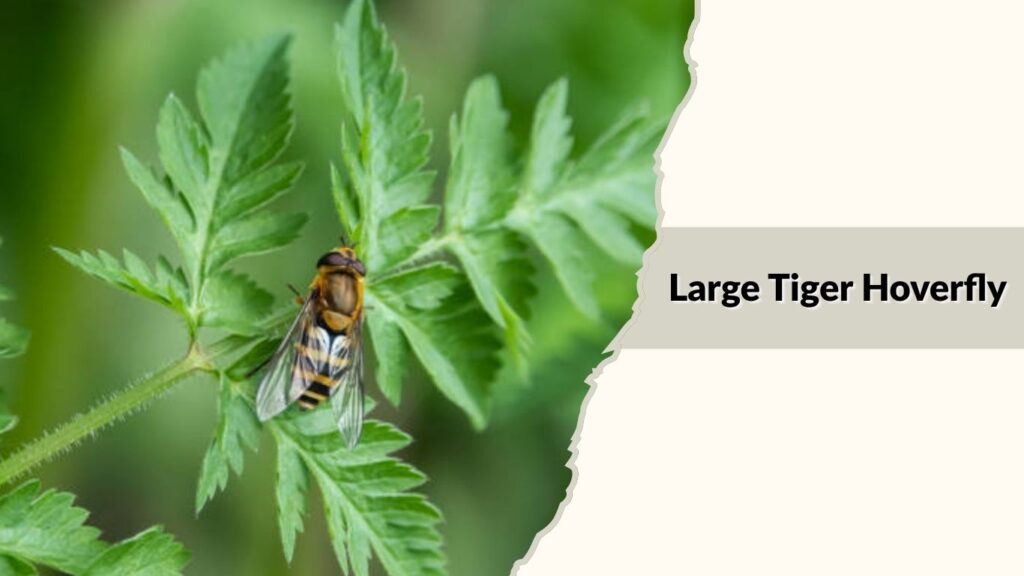
The large tiger hoverfly is a striking black-and-yellow fly identified by the bold stripes running lengthwise across its thorax. It resembles the smaller footballer hoverfly but has a longer body and larger lemon-yellow abdominal markings. Adults are harmless flower visitors that contribute to pollination.
Identification
- Adult length: approximately 12–18 mm
- Body shape: long and relatively broad
- Thorax: three bold black longitudinal stripes
- Abdomen: large lemon-yellow side patches
- Face: pale yellow with a central yellow stripe
- Hind tibia: lower two-thirds usually dark
- Wings: one clear pair
- Sting: completely absent
Its larger size, pale facial stripe and extensive yellow abdominal markings help distinguish it from other Helophilus hoverflies.
Habitat and Distribution
Large tiger hoverflies occur across the Palearctic region and are found in meadows, coastal areas, grasslands, wetlands and gardens. In Britain, they are widespread in England and Wales but less commonly recorded farther north. Adults are generally active from May through October, with sightings often peaking in late summer.
Diet and Pollination
Adults drink nectar and consume pollen from thistles, hogweed, ragwort and other accessible flowers. Their large bodies can carry pollen between blooms, making them useful pollinators in grasslands and gardens.
Life Cycle
Females lay eggs near shallow water or wet organic matter. The aquatic larvae possess long breathing tubes and feed on bacteria, microorganisms and decaying material. After completing development, they move to a drier location and form pupae before emerging as adults.
13. Spotted Meliscaeva Hoverfly (Meliscaeva auricollis)
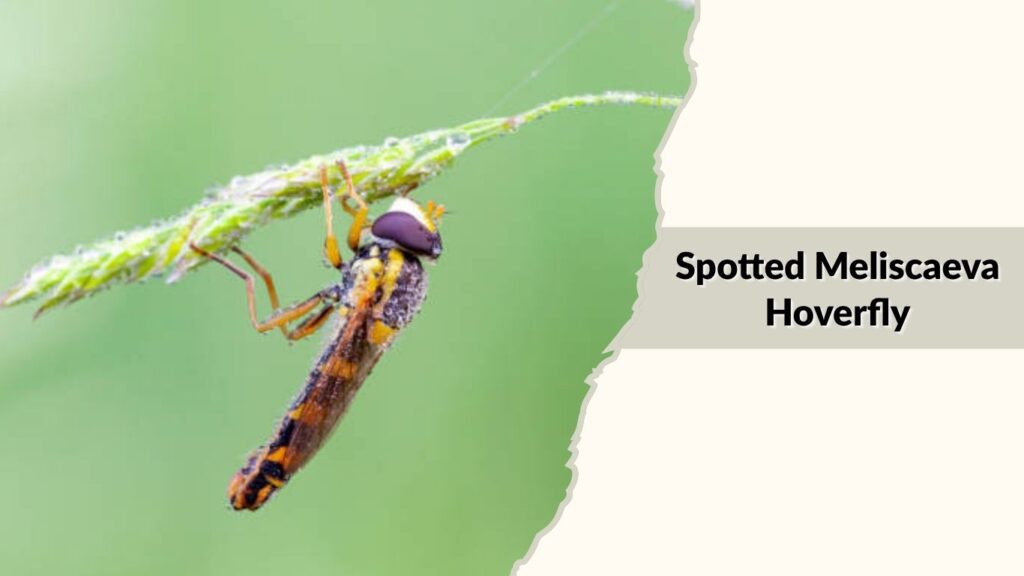
The spotted Meliscaeva is a small, slender hoverfly with highly variable yellow markings on its dark abdomen. It is among the earliest hoverflies to appear each year and may become active during warm winter days. Its larvae are beneficial predators of aphids.
Identification
- Body size: small and slender
- Body color: mainly black
- Abdomen: yellow spots or crescent-shaped markings
- Second abdominal segment: angled yellow crescents
- Spring generation: often darker than summer individuals
- Face: pale yellow
- Antennae: short and dark
- Wings: one clear pair
The markings vary considerably, but the sloping rear edges of the yellow crescents on the second abdominal segment are useful identification clues.
Habitat and Distribution
Spotted Meliscaeva hoverflies prefer wooded places and are commonly encountered around trees, shrubs, woodland edges and sheltered gardens. They are relatively frequent in southern and central England but become scarcer toward Scotland and Ireland. Adults may be observed from February through December.
Diet and Garden Benefits
Adults feed on flower nectar and pollen. Their larvae prey on aphids found on barberry, broom, umbellifers and other plants. This predatory behavior helps suppress populations of plant-damaging aphids without pesticides.
Life Cycle
Females place eggs close to aphid colonies. The larvae consume aphids before forming small puparia on plants. Adults commonly overwinter, allowing them to emerge on mild days during late winter or early spring.
14. Pellucid Hoverfly (Volucella pellucens)
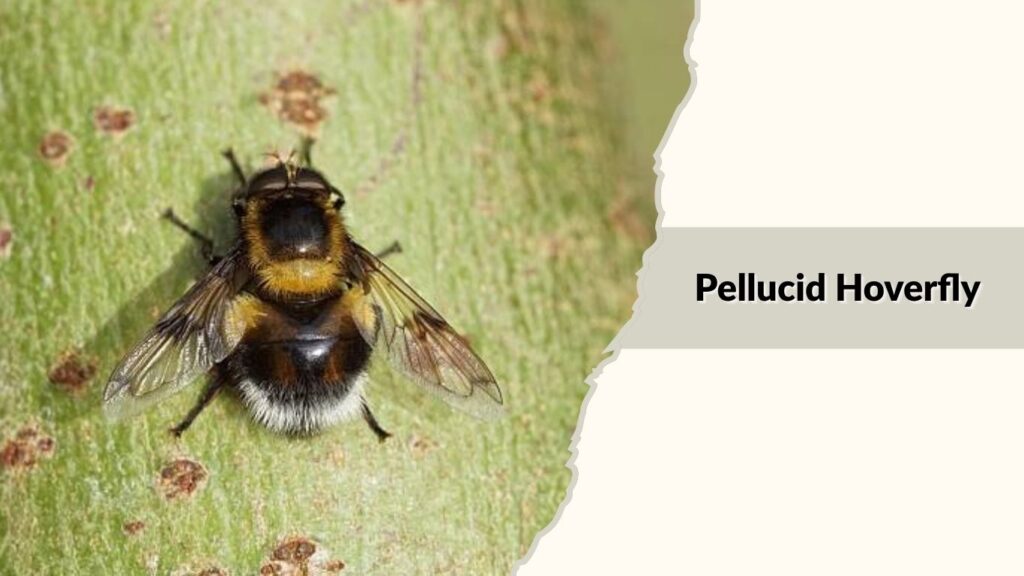
The pellucid hoverfly is one of Britain’s largest and most distinctive hoverflies. It has a mostly black body interrupted by a broad ivory-white abdominal band. Despite its imposing size and association with wasp nests, it cannot sting and is harmless to humans.
Identification
- Adult size: large and strongly built
- Body color: mainly glossy black
- Abdomen: broad ivory-white band across the middle
- Wings: dark patches near their centers
- Scutellum: brown rather than yellow
- Eyes: large and dark
- Antennae: short and branched
- Flight: fast, powerful and often noisy
It resembles the blotch-winged hoverfly, but the pellucid hoverfly is larger and has a brown scutellum instead of a yellow one.
Habitat and Distribution
Pellucid hoverflies are closely associated with woodland, wooded hedgerows and gardens near mature trees. Adults are usually seen from May through October, often resting on sunny leaves or feeding on brambles and umbellifer flowers.
Diet and Pollination
Adults consume nectar and pollen from bramble, hogweed, thistles and other flowers. Their large bodies collect and transport pollen as they move between blooms.
Life Cycle
Females enter the underground or concealed nests of social wasps and bumblebees to lay eggs. The larvae live within the nest, consuming waste, dead insects and sometimes bee or wasp larvae. They eventually pupate in protected material before emerging as adults.
15. Common Banded Hoverfly (Syrphus ribesii)
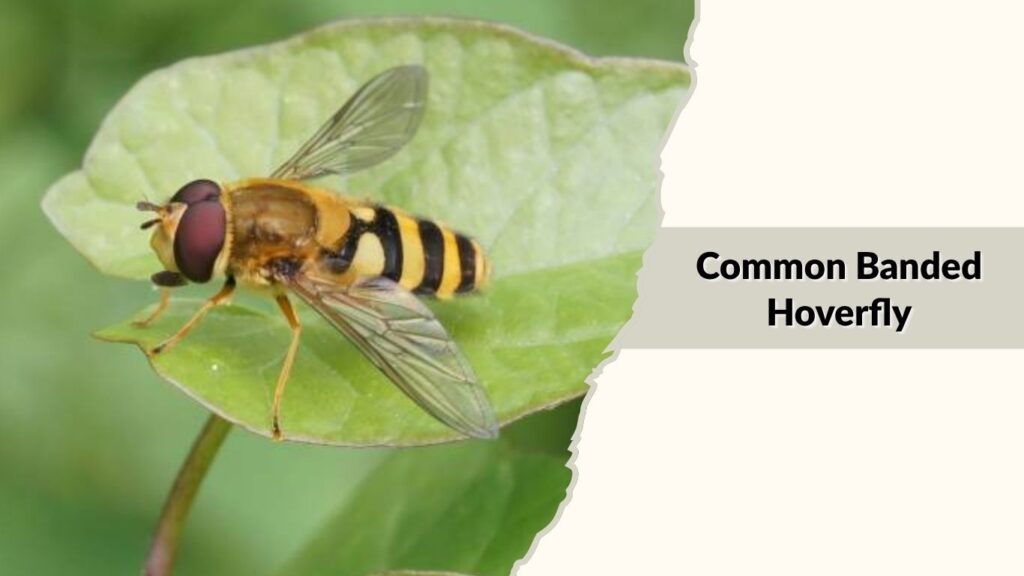
The earlier name “broad-bordered bee hoverfly” is not a recognized standard name for a hoverfly; it is easily confused with the broad-bordered bee hawk-moth. The common banded hoverfly is included here as the corrected fifteenth species. It is a widespread black-and-yellow garden hoverfly whose larvae feed on aphids.
Identification
- Adult length: approximately 10 mm
- Body color: glossy black
- Abdomen: three broad yellow bands
- Face: yellow with no strong central black stripe
- Scutellum: yellow
- Female hind thighs: predominantly yellow
- Eyes: generally without visible hairs
- Wings: one transparent pair
The yellow hind thighs of females help distinguish this species from the similar glass-winged Syrphus, whose female hind thighs are primarily black.
Habitat and Distribution
Common banded hoverflies occur in gardens, woodland, parks, hedgerows, meadows and farmland. They are common and widespread across Britain and can generally be observed between March and November.
Diet and Garden Benefits
Adults visit flowers to consume nectar and pollen, contributing to pollination. Their flattened, legless larvae hunt aphids on trees, shrubs and herbaceous plants. They are therefore beneficial visitors in gardens affected by aphid infestations.
Life Cycle
Females lay eggs on plants close to aphid colonies. After hatching, the larvae search foliage at night and capture soft-bodied aphids. Fully grown larvae attach themselves to vegetation and form puparia, from which the winged adults later emerge.
FAQs
Are hoverflies dangerous to humans?
No. Hoverflies cannot sting and do not normally bite people. Their black-and-yellow markings mimic bees or wasps and help protect them from predators. They may hover nearby or land on skin, but they are harmless and usually move away when disturbed.
Why do hoverflies hover in one place?
Hoverflies use rapid wing movements to remain almost motionless in the air. Males may hover while defending territory or watching for females, while others hover before landing on flowers. Their precise flight control also helps them escape predators and move quickly between plants.
What do adult hoverflies eat?
Adult hoverflies mainly feed on nectar and pollen. Nectar provides energy for flight, while pollen supplies protein and other nutrients needed for reproduction. They frequently visit daisies, umbellifers, ivy, dandelions and many garden flowers, making them valuable pollinators.
Do hoverfly larvae eat aphids?
The larvae of many hoverfly species feed on aphids and other soft-bodied pests. A single larva may consume numerous aphids during development. However, not all hoverfly larvae are predators; some live in water, decaying wood, wet organic matter or social-insect nests.
How can I attract hoverflies to my garden?
Grow a variety of open, nectar-rich flowers that bloom from spring through autumn. Plants such as dill, fennel, alyssum, daisies, yarrow and marigolds provide accessible food. Avoid unnecessary pesticides and leave some natural shelter or shallow wet habitats for developing larvae.