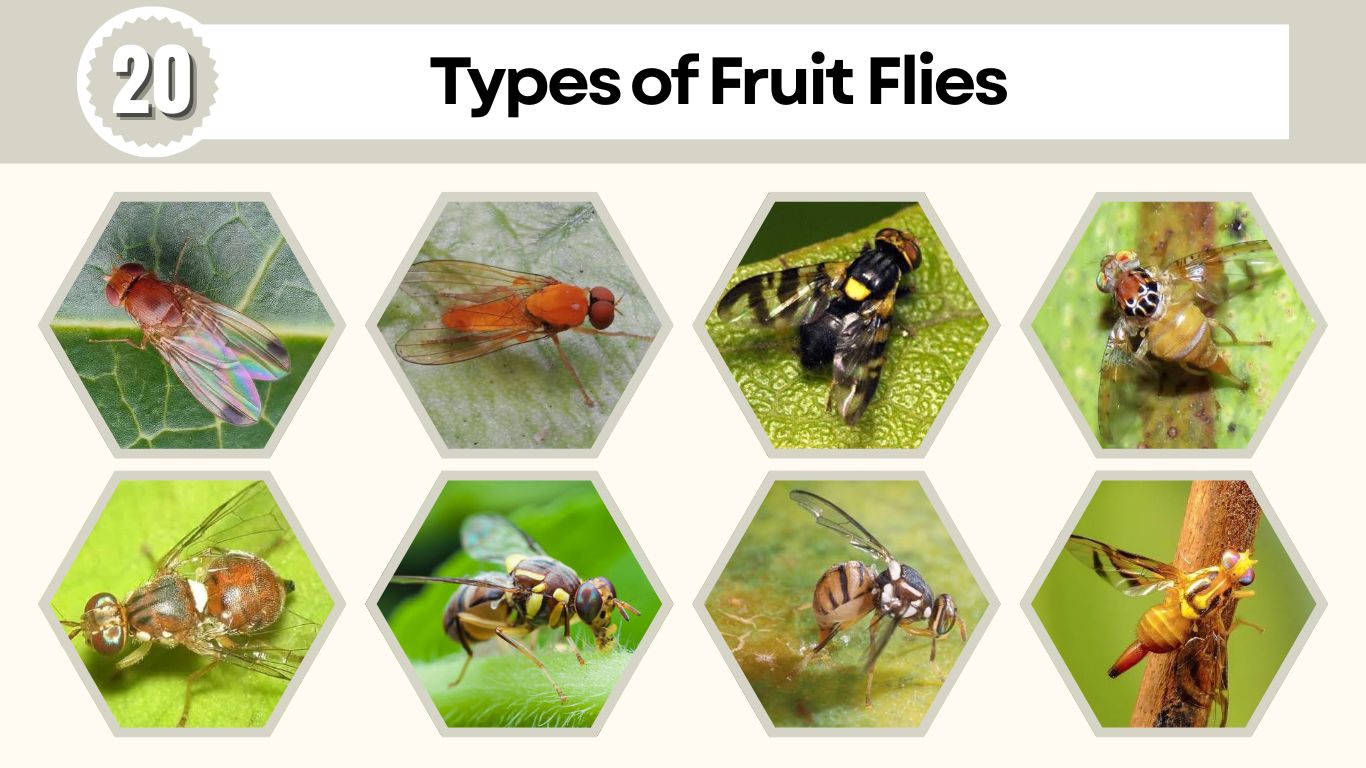
Fruit flies include a diverse group of insects that feed and reproduce in fruits, vegetables and other plant materials. Some species attack healthy crops by laying eggs beneath fruit skin, while others prefer damaged or fermenting produce. Their larvae can cause internal decay, premature fruit drop and serious agricultural losses. This guide explores 20 types of fruit flies, including the Mediterranean fruit fly, oriental fruit fly, apple maggot fly and spotted-wing drosophila, with details about their identification, habitat, diet, damage and life cycle.
1. Mediterranean Fruit Fly (Ceratitis capitata)
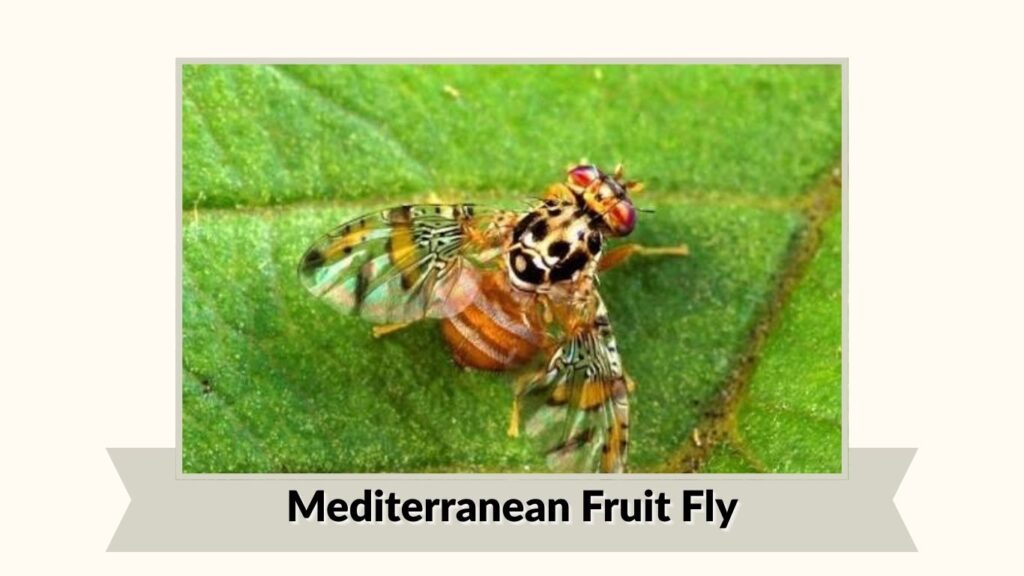
The Mediterranean fruit fly, commonly called the Medfly, is a destructive fruit-infesting species in the family Tephritidae. Despite its name, it originated in sub-Saharan Africa before spreading to many tropical and subtropical regions. Females lay eggs beneath fruit skin, allowing the larvae to feed unseen inside the pulp.
Identification
- Adult body length: approximately 3.5–5 mm
- Body color: yellowish or tan with brown markings
- Thorax: creamy yellow with distinctive black patches
- Abdomen: oval with two lighter horizontal bands
- Eyes: reddish-purple
- Wings: transparent with yellow-brown bands and dark markings
- Larvae: white, legless maggots measuring up to 7–9 mm
- Male: has unusual paddle-shaped bristles near the eyes
Adults are slightly smaller than ordinary house flies and have noticeably patterned wings.
Habitat and Distribution
Mediterranean fruit flies thrive in warm regions containing orchards, farms, gardens and abundant fruiting plants. Established populations occur across Africa, southern Europe, the Mediterranean region, Central and South America, Western Australia and Hawaii. The species is not considered permanently established across the continental United States, although temporary outbreaks have occurred.
Diet and Fruit Damage
Adult Medflies consume fruit juices, nectar and other sugary liquids. The larvae feed inside apples, peaches, citrus fruits, melons, tomatoes, peppers and many other crops. Infested fruit may soften, decay prematurely or fall before harvest, making it unsuitable for sale or consumption.
Life Cycle
The life cycle includes egg, larva, pupa and adult stages. Females insert eggs beneath the skin of ripening fruit. After hatching, the larvae consume the pulp before leaving the fruit and pupating in soil. Under warm conditions, the complete cycle may take approximately 21–30 days.
2. Oriental Fruit Fly (Bactrocera dorsalis)
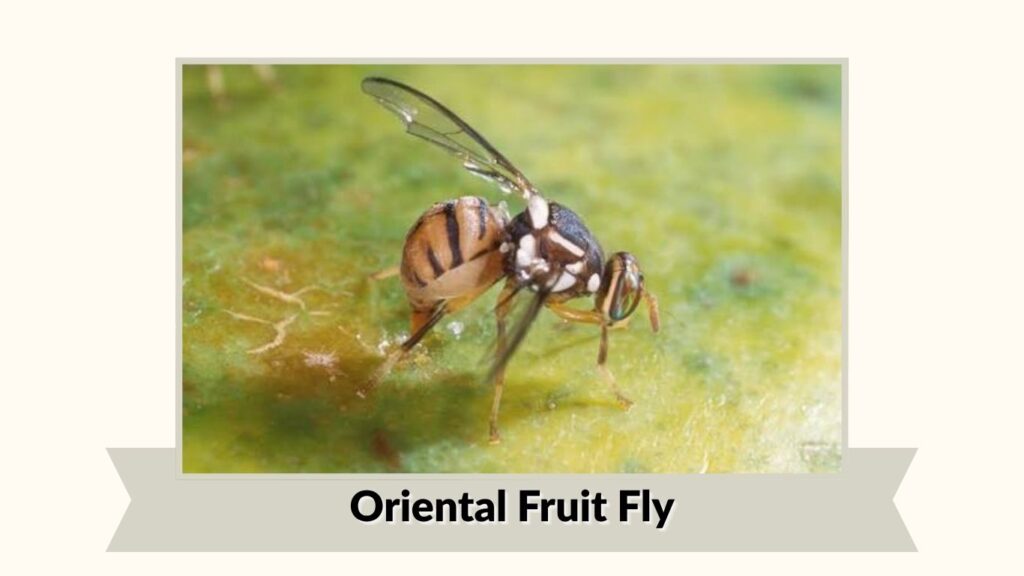
The oriental fruit fly is a highly destructive agricultural pest that attacks hundreds of fruits and vegetables. Females puncture fruit skin and deposit eggs beneath the surface, where the developing larvae remain protected while feeding on the pulp.
Identification
- Adult length: approximately 8 mm
- Body color: yellow with dark brown or black markings
- Abdomen: often has a dark T-shaped pattern
- Thorax: prominent yellow and black patches
- Wings: mostly clear and approximately 7.3 mm long
- Female: slender, sharply pointed ovipositor
- Larvae: creamy-white maggots reaching about 7–11 mm
- Pupae: tan to dark brown and formed in soil
The abdominal pattern varies, so professional identification may require examination of several features.
Habitat and Distribution
This species is native to tropical Asia and occurs in countries including Bangladesh, India, Thailand, Malaysia, China and the Philippines. It has also become established across much of sub-Saharan Africa and several Pacific islands, including Hawaii. Adults thrive in warm orchards, farms and gardens containing fruiting plants.
Diet and Fruit Damage
Larvae attack mangoes, papayas, avocados, citrus, peaches, pears, figs and many other crops. Feeding causes internal tunnels, soft tissue, premature fruit drop and decay. Egg-laying punctures may also allow microorganisms to enter.
Life Cycle
Females place eggs beneath the fruit skin. The maggots feed internally before leaving the fruit and pupating underground. Under warm summer conditions, development from egg to adult may take about 16 days, although cooler weather slows the process.
3. Mexican Fruit Fly (Anastrepha ludens)
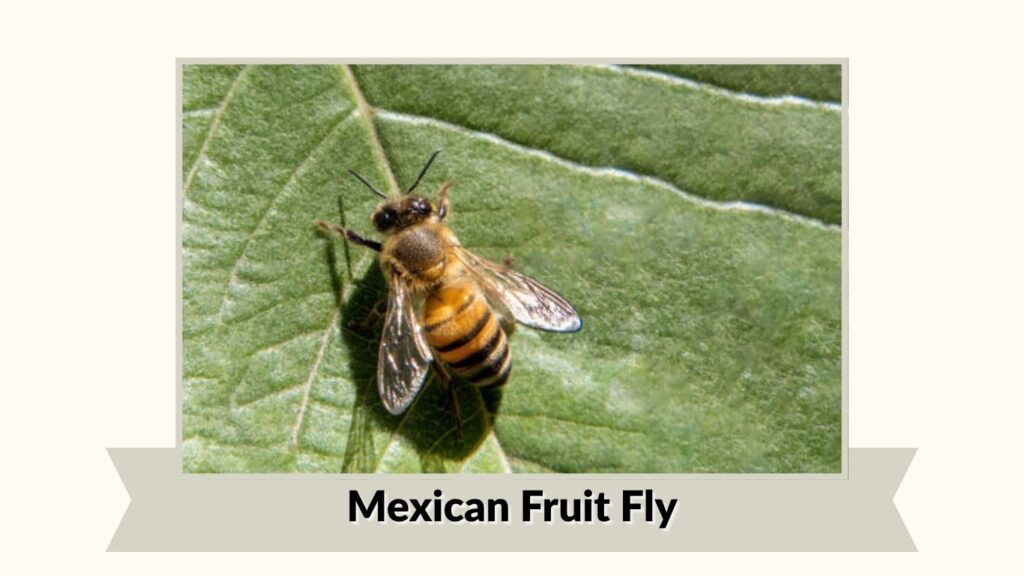
The Mexican fruit fly is a serious pest of citrus, mangoes and several deciduous fruits. It is particularly associated with grapefruit and can be transported to new areas inside apparently healthy fruit containing hidden eggs or larvae.
Identification
- Adult length: approximately 7–11 mm
- Body color: mostly yellowish-brown
- Wings: clear with pale yellow C-, S- and V-shaped bands
- Female: exceptionally long ovipositor
- Ovipositor length: approximately 3.35–4.7 mm
- Eyes: large and often greenish or reddish
- Larvae: pale, legless maggots
- Adult size: slightly larger than an ordinary house fly
The female’s unusually long ovipositor and pale wing bands help distinguish it from the Caribbean fruit fly.
Habitat and Distribution
Mexican fruit flies are native to Mexico and much of Central America, extending as far south as Costa Rica. They are associated with citrus-growing areas and warm orchards. Outbreaks and detections may also occur near the southern borders of Texas, Arizona and California.
Diet and Fruit Damage
Grapefruit is a preferred host, followed by oranges. The larvae can also develop in mangoes, apples, peaches, pears, pomegranates, sapotes and other fruits. Infested fruit may contain several larvae, become soft and eventually develop large exit holes.
Life Cycle
Females commonly lay groups of around 10 eggs as fruit begins changing color. Eggs hatch in approximately 6–12 days. Larvae feed inside the pulp for about three to four weeks, then leave the fruit and pupate in soil. Adults may survive for many months under suitable conditions.
4. Caribbean Fruit Fly (Anastrepha suspensa)
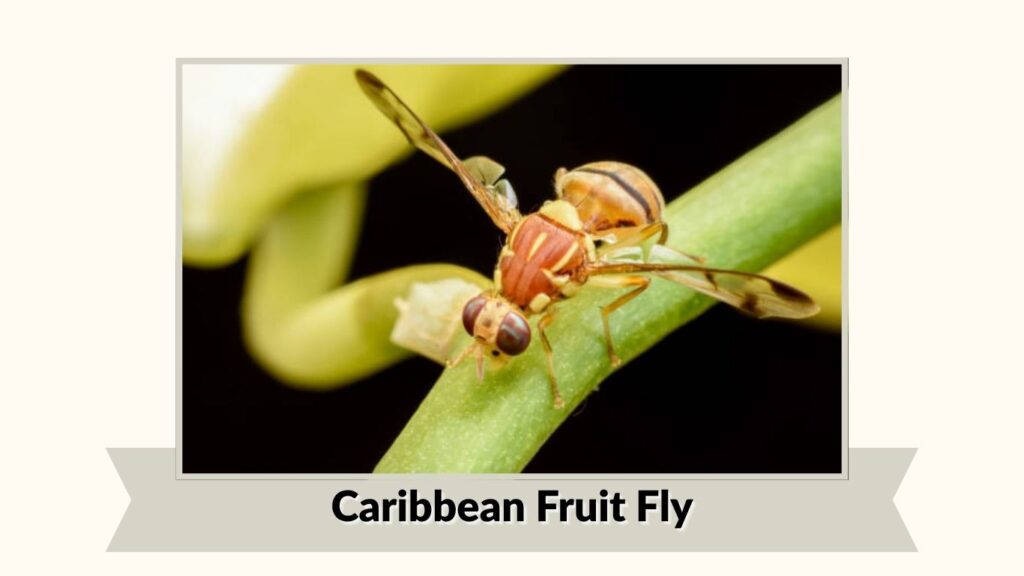
The Caribbean fruit fly, also called the Caribfly, attacks mature and overripe tropical fruits. It is closely related to the Mexican and West Indian fruit flies but has darker wing markings and a much shorter female ovipositor.
Identification
- Adult length: may reach approximately 12–14 mm
- Body color: yellow-brown
- Wings: long with yellow-brown or dark-brown bands
- Wing pattern: connected C-, S- and inverted V-shaped markings
- Female ovipositor: short and relatively stout
- Thorax: may have a distinct dark spot near the rear
- Larvae: white, cylindrical and legless
- Mature larval length: approximately 8–10 mm
Wing markings and the female reproductive structure are important for separating this species from similar Anastrepha flies.
Habitat and Distribution
The Caribbean fruit fly occurs in Cuba, Jamaica, Hispaniola, Puerto Rico and Florida. It lives in warm subtropical and tropical areas containing orchards, backyard fruit trees, woodland edges and unmanaged host plants.
Diet and Fruit Damage
Preferred hosts include guava, Surinam cherry, peach, rose apple and tropical almond. It can also attack citrus and numerous other fruits. Larvae tunnel through the pulp, causing internal breakdown, premature decay and reduced fruit quality.
Life Cycle
Females normally place individual eggs in mature or overripe fruit. Eggs hatch after about two to three days. The larvae feed for approximately 10–14 days before leaving the fruit and pupating, usually in soil. The pupal period commonly lasts another 10–14 days but becomes longer during cooler weather.
5. South American Fruit Fly (Anastrepha fraterculus)
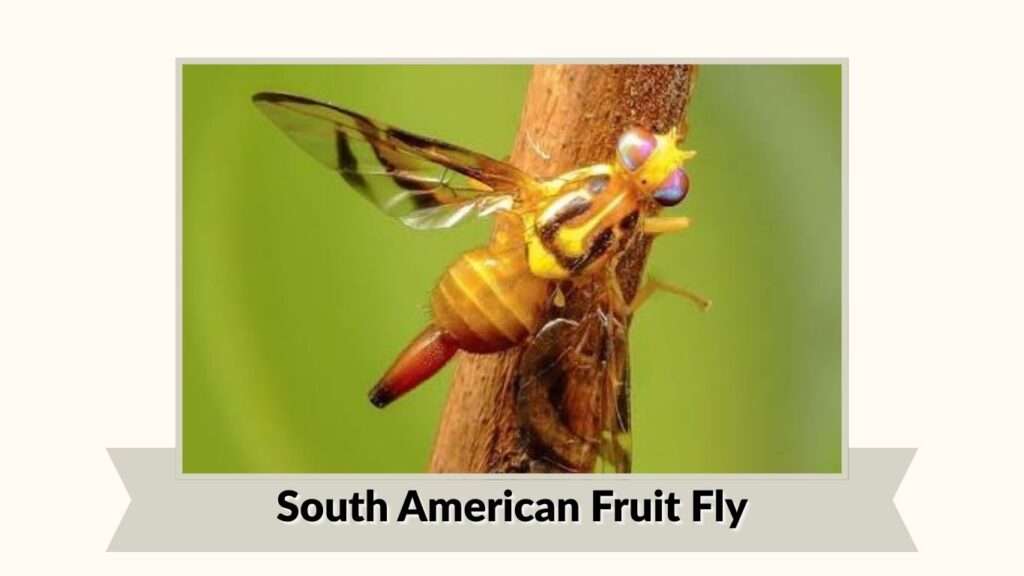
The South American fruit fly is an important pest of guava, citrus, apples, peaches and many other fruits. The name represents a complex of several closely related forms that look similar but may have different distributions, behaviors and preferred host plants.
Identification
- Adult length: commonly approximately 12–14 mm
- Body color: yellowish-brown
- Wings: patterned with yellow and brown bands
- Females: usually larger than males
- Female ovipositor: approximately 2 mm long
- Eggs: creamy-white and elongated
- Larvae: pale maggots reaching about 9–10 mm
- Pupae: cylindrical, brown and found underground
Reliable identification may require examination of the wings, thorax and female ovipositor because the group contains multiple cryptic forms.
Habitat and Distribution
Members of the complex occur primarily in South America, including Argentina, Brazil, Colombia, Ecuador, Peru and Venezuela. They are also recorded in parts of Central America, Mexico and the southern United States. They inhabit orchards, farms, tropical forests and areas containing wild fruit trees.
Diet and Fruit Damage
The group can infest more than 100 host plants. Common hosts include guava, mango, apples, citrus, peaches, papayas, passion fruit, plums and coffee fruit. Larval feeding creates internal tunnels, encourages rotting and may cause fruit to fall early.
Life Cycle
Females insert eggs beneath the fruit skin, and the eggs may hatch within about two days. Larvae develop through three feeding stages over approximately 12 days. Mature larvae leave the fruit and pupate underground, with adults generally emerging after another two to three weeks.
6. West Indian Fruit Fly (Anastrepha obliqua)
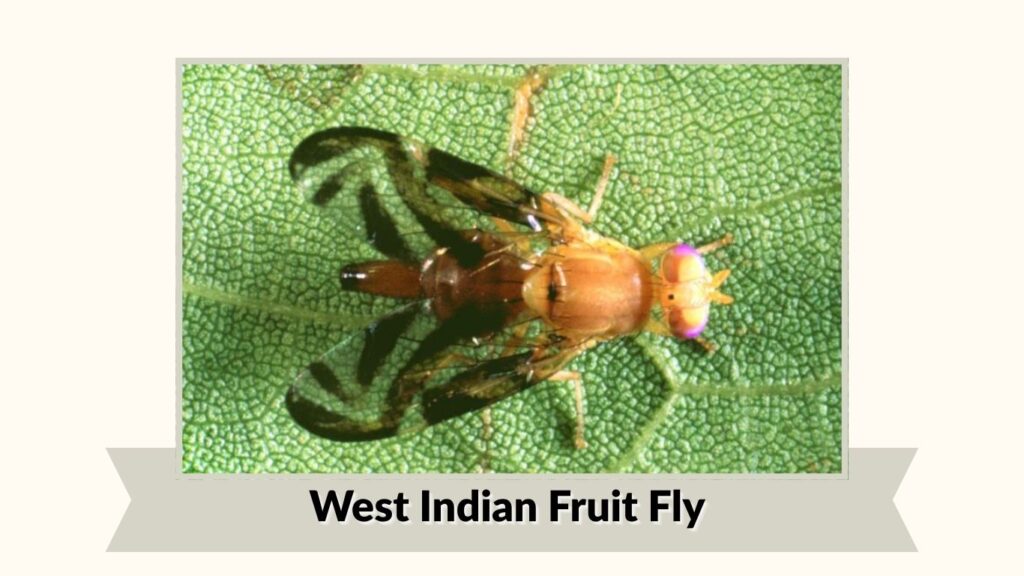
The West Indian fruit fly is a major tropical pest best known for attacking mangoes, guavas and hog plums. It is also called the Antillean fruit fly and is considered one of the most abundant Anastrepha species in parts of the Caribbean.
Identification
- Adult appearance: medium-sized and yellowish-brown
- Thorax: yellow-orange with paler side markings
- Wings: approximately 5.85–7.5 mm long
- Wing bands: yellow-brown and strongly connected
- Body hairs: mainly dark brown
- Female ovipositor: approximately 1.3–1.6 mm long
- Larvae: pale, cylindrical and legless
- Pupae: brown and usually found in soil
It closely resembles the South American fruit fly, so detailed examination of the wing pattern and female ovipositor may be necessary.
Habitat and Distribution
This fruit fly is widely distributed through the Greater and Lesser Antilles, Mexico, Central America and northern South America. Its range extends into parts of Brazil. It is commonly associated with tropical orchards, mango-growing regions and areas containing wild Spondias trees.
Diet and Fruit Damage
Hog plums, mangoes, guavas and rose apples are among its most important hosts. Females puncture fruit to deposit eggs, and larvae feed inside the pulp. The injured tissue may soften, rot or become unsuitable for consumption.
Life Cycle
Females generally lay single eggs inside mature green fruit. In summer, the larval period lasts approximately 10–13 days, followed by a pupal stage of similar length. The species may complete six or seven generations annually in warm climates.
7. Queensland Fruit Fly (Bactrocera tryoni)
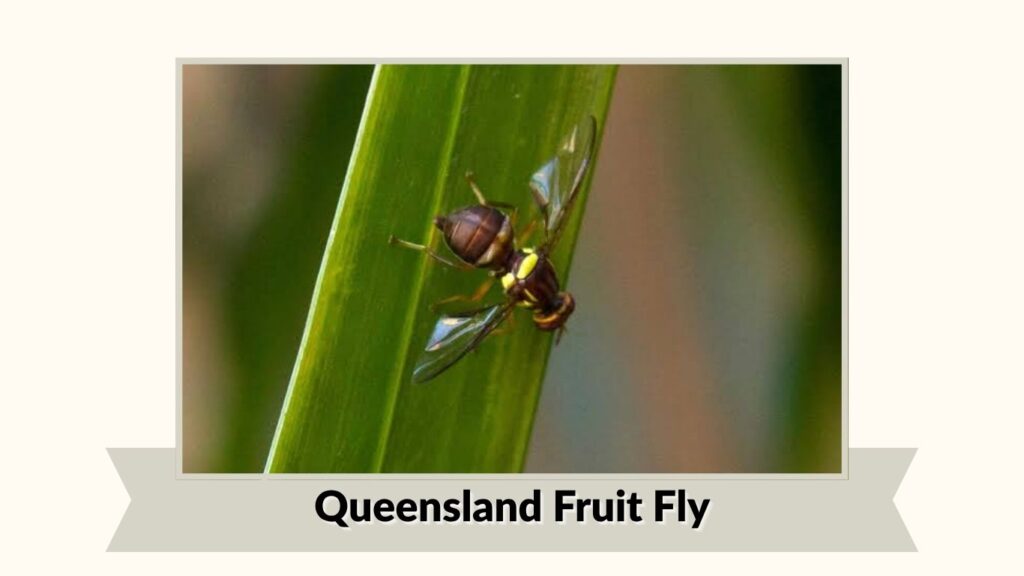
The Queensland fruit fly is one of Australia’s most damaging fruit pests. Females lay their eggs beneath the skin of ripening produce, where the larvae feed secretly within the flesh. It attacks many commercial crops and backyard fruits, including peaches, citrus, mangoes, tomatoes and guavas.
Identification
- Adult length: approximately 7–8 mm
- Body color: reddish-brown
- Markings: distinct yellow patches on the thorax
- Appearance: somewhat similar to a small wasp
- Wings: clear and usually held horizontally while walking
- Eggs: white, curved and banana-shaped
- Larvae: creamy-white maggots measuring about 5–10 mm
- Pupae: hard, oval and brown
Adults frequently flick their wings while walking. Their reddish-brown bodies and prominent yellow markings help separate them from smaller vinegar flies commonly found around overripe fruit.
Habitat and Distribution
Queensland fruit flies are native to eastern Australia. They occur in orchards, vegetable gardens, suburban yards and areas containing wild fruiting plants. Populations are especially active during warm, humid periods when suitable fruit is abundant.
Diet and Fruit Damage
Adults obtain nutrients from plant surfaces, nectar, fruit juices and bacterial colonies. Larvae attack apples, avocados, cherries, citrus, grapes, guavas, mangoes, papayas, peaches, pears, tomatoes and numerous other hosts. Infested fruit may show small puncture marks, internal decay, softening and premature fruit drop.
Life Cycle
Females insert groups of eggs just below the fruit skin. Eggs hatch after approximately two to three days, and the larvae feed inside for about seven to ten days during summer. Mature maggots leave the fruit and pupate underground. The complete cycle may take around two and a half weeks in favorable summer conditions, although cooler temperatures slow development.
8. Melon Fruit Fly (Zeugodacus cucurbitae)
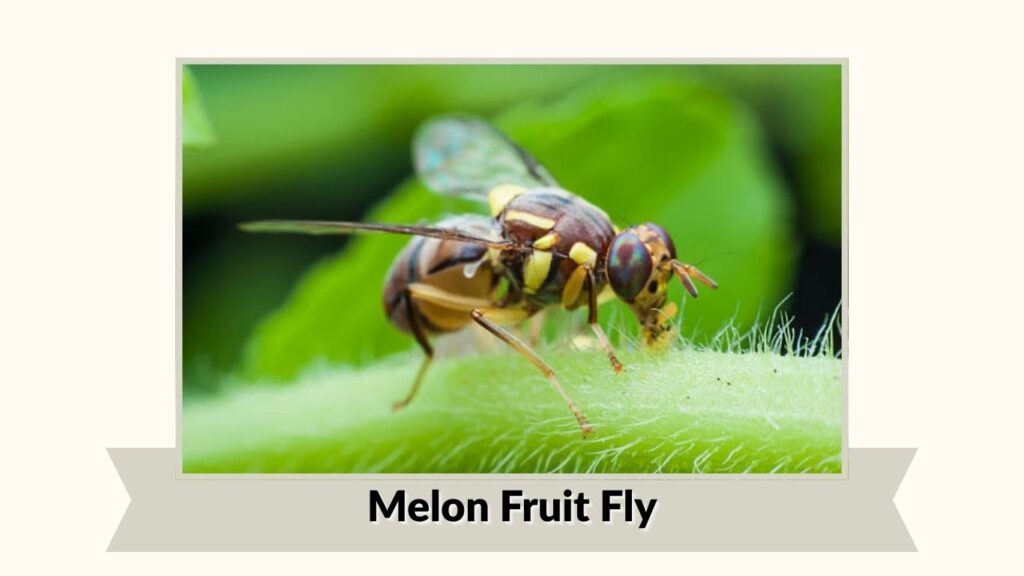
The melon fruit fly, formerly classified as Bactrocera cucurbitae, is a serious pest of cucumbers, melons, pumpkins, squash and other vegetables. Its larvae develop inside fruits, stems and flowers, causing decay and reducing crop quality.
Identification
- Adult length: approximately 6–8 mm
- Body color: reddish-yellow or golden-brown
- Head: yellowish with dark facial spots
- Thorax: reddish-yellow with pale yellow markings
- Wings: clear with distinctive dark spots and bands
- Antennae: elongated third segment
- Eggs: white, curved and approximately 2 mm long
- Larvae: white maggots reaching approximately 7.5–11.8 mm
The patterned wings and reddish-yellow thorax are valuable identification features. However, separating melon flies from closely related species may require expert examination.
Habitat and Distribution
The species is native to Asia and is widespread across India, Bangladesh, China, Southeast Asia and several Pacific islands. It has also spread to parts of Africa and Hawaii. It thrives in warm farms, gardens and areas where cucurbit crops grow throughout much of the year.
Diet and Fruit Damage
Preferred hosts include cucumbers, watermelons, cantaloupes, gourds, pumpkins, squash, tomatoes, cowpeas and string beans. Larval feeding creates internal tunnels and wet, decaying areas. Young fruits may become misshapen, rot or fall before reaching maturity.
Life Cycle
Females puncture fruits, flowers or tender plant tissue and deposit eggs below the surface. After hatching, the larvae pass through three feeding stages. Mature larvae leave the host and enter the soil, where they form brown pupae. Adults later emerge and begin another generation, with development progressing fastest in warm conditions.
9. Papaya Fruit Fly (Anastrepha curvicauda)
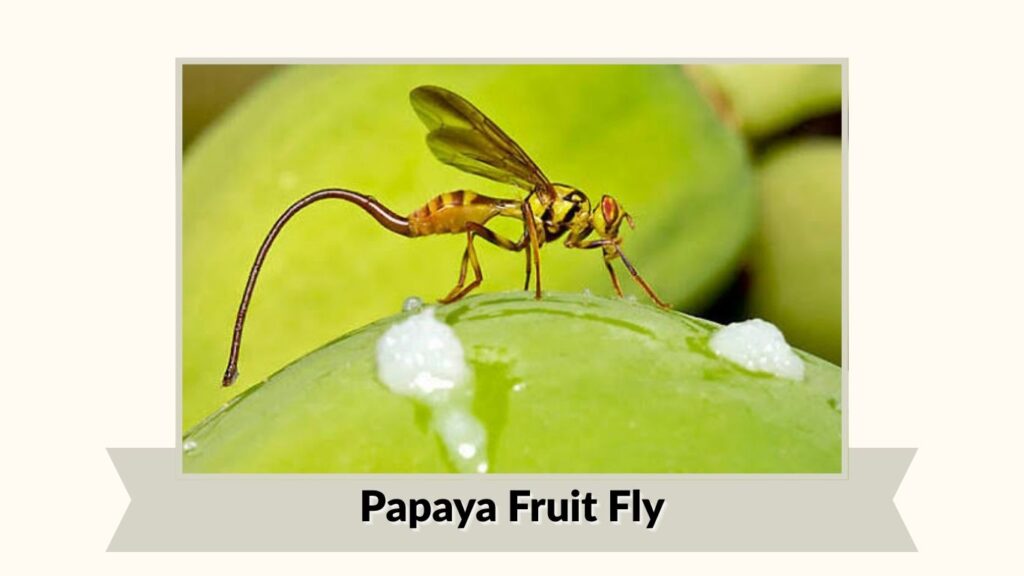
The papaya fruit fly is a large, wasp-like species and one of the most important pests of papaya in tropical parts of the Americas. It was formerly placed in the genus Toxotrypana and is still widely listed under the name Toxotrypana curvicauda.
Identification
- Female body length: approximately 8.5–12.5 mm
- Male body length: approximately 11–13.5 mm
- Body color: yellow with black markings
- Body shape: slender and wasp-like
- Female ovipositor: curved and approximately 9–14 mm long
- Wings: clear with dark patterning
- Eggs: long, narrow and yellowish
- Larvae: white maggots reaching approximately 13–15 mm
The female’s extremely long, curved ovipositor is the most recognizable feature. It can exceed the length of her body and allows her to reach the central cavity of young papayas.
Habitat and Distribution
Papaya fruit flies occur throughout the Caribbean, Mexico, Central America, Colombia and Venezuela. In the United States, they are established in southern Florida and southern Texas. They live wherever papayas are cultivated in warm tropical or subtropical conditions.
Diet and Fruit Damage
Papaya is the primary host, although occasional records involve mangoes and several other plants. Larvae feed on developing seeds and internal fruit tissue. Infested papayas may turn yellow, soften and fall prematurely, even when the entry puncture is difficult to see.
Life Cycle
A female may produce more than 100 eggs. She places groups of eggs in the central cavity of immature papayas. Eggs hatch after approximately 12 days, and larvae develop inside the fruit for about 15–16 days. Mature larvae exit, fall to the ground and pupate just below the soil surface. Adult emergence may require two to six weeks, depending on soil temperature and moisture.
10. Olive Fruit Fly (Bactrocera oleae)
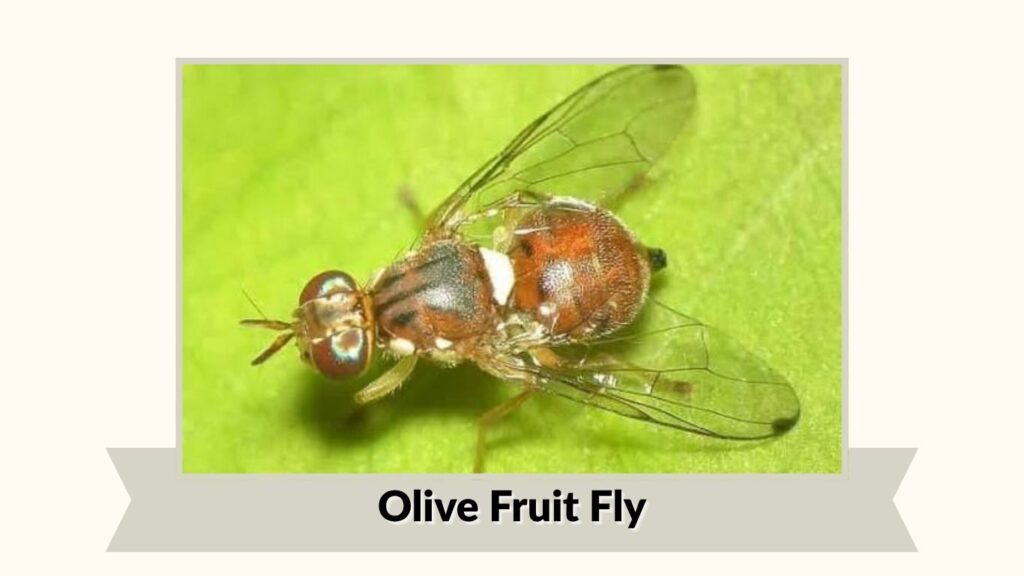
The olive fruit fly is a highly specialized pest that develops almost exclusively in wild and cultivated olives. It can reduce table-olive quality and damage oil production by tunneling through the fruit and encouraging microbial decay.
Identification
- Adult length: approximately 5 mm
- Wingspan: approximately 10 mm
- Body color: dark brown to black
- Markings: yellow-brown patches and short silvery hairs
- Wings: mostly clear with a dark spot near each tip
- Female: possesses a serrated ovipositor
- Eggs: creamy-white and approximately 0.74 mm long
- Larvae: white maggots measuring approximately 5–6 mm
The small dark spot at the tip of each wing is an especially helpful feature. The adult is considerably smaller than many other economically important fruit flies.
Habitat and Distribution
Olive fruit flies occur across major olive-growing regions in Africa, southern Europe, the Middle East, western Asia, California and Mexico. Their distribution is closely connected to cultivated olives and related wild plants.
Diet and Fruit Damage
The larvae feed only within fruits belonging to olive trees. Their tunnels cause olives to dry, rot or drop prematurely. Egg-laying wounds also make the fruit more vulnerable to bacterial and fungal infection, reducing its suitability for table consumption and oil production.
Life Cycle
Females generally deposit one egg beneath the skin of a developing olive. Eggs hatch after two to three days, and larvae feed on the flesh for approximately 20 days. Pupation may occur inside the olive or in the soil. Pupae inside fruit may develop in around eight to ten days, while overwintering soil pupae can remain inactive for several months.
11. Mango Fruit Fly (Bactrocera frauenfeldi)
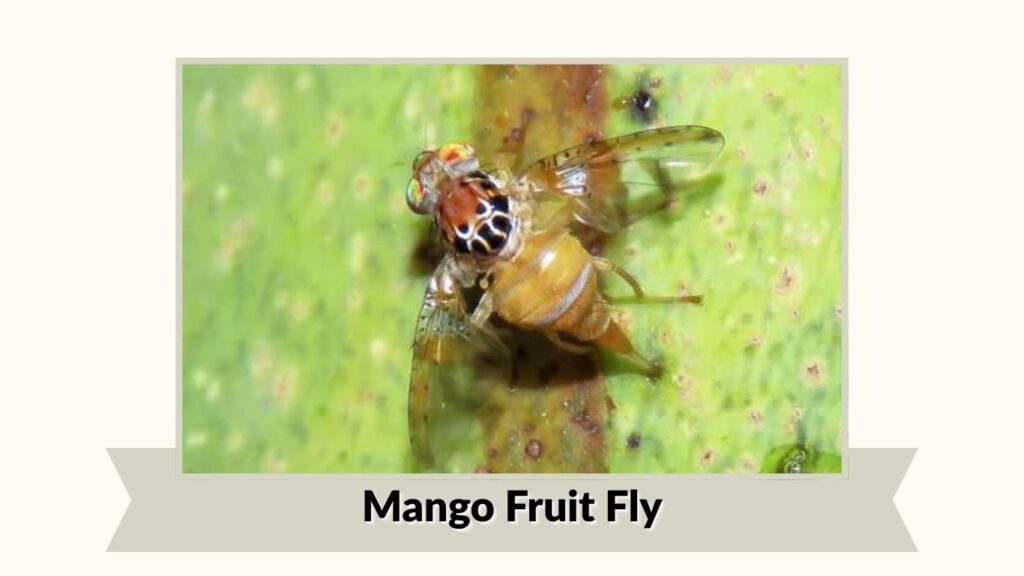
The mango fruit fly is an economically important pest originating from the Papua New Guinea region. Despite its common name, it does not feed exclusively on mangoes. Its larvae can develop in guavas, citrus, papayas and numerous other tropical fruits.
Identification
- Adult size: medium-sized fruit fly
- Face: two large black spots
- Thorax: glossy black with yellow side markings
- Scutellum: yellow with a black triangular mark
- Wings: pale bands with a darker transverse stripe
- Abdomen: orange-brown with broad black longitudinal bands
- Female ovipositor: narrow with a needle-shaped tip
- Larvae: pale, legless maggots developing inside fruit
The dark thorax, black facial spots, wing band and striped abdomen help identify this species. However, it belongs to a complex of closely related fruit flies, and expert or molecular examination may be needed for confirmation.
Habitat and Distribution
Mango fruit flies are widespread in Papua New Guinea, the Bismarck Archipelago, the Solomon Islands, the Torres Strait and northern Queensland. Warm, humid tropical areas with continuous fruit production provide favorable conditions for the species.
Diet and Fruit Damage
Major hosts include mangoes, guavas, citrus fruits, Malay apples, carambolas and papayas. Females puncture fruit to lay eggs, and the larvae consume the pulp. Feeding can cause internal breakdown, soft patches, premature fruit drop and secondary decay.
Life Cycle
Females place their eggs beneath the skin of suitable fruit. The larvae hatch and pass through several feeding stages within the pulp. Once mature, they leave the fruit and burrow into the soil to pupate. Adults emerge from the pupae and search for food, mates and new host fruits. Temperature and host quality influence how quickly each generation develops.
12. Apple Maggot Fly (Rhagoletis pomonella)
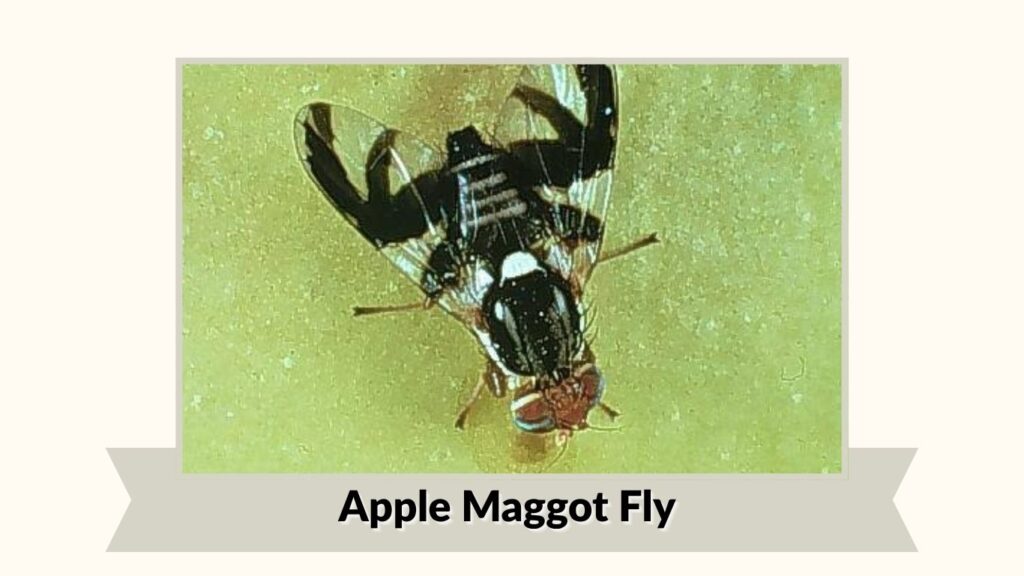
The apple maggot fly, sometimes called the railroad worm, is a North American fruit pest whose larvae tunnel through apple flesh. It originally developed in native hawthorn fruits before adapting to cultivated apples. Infested fruit may appear normal outside while containing winding brown trails and soft internal tissue.
Identification
- Adult length: approximately 5–6 mm
- Body color: shiny black
- Abdomen: marked with white bands
- Thorax: noticeable white spot on the back
- Eyes: usually greenish
- Wings: clear with bold black bands forming an M- or F-like pattern
- Larvae: creamy-white, tapered and legless
- Pupae: oval, brown and located in soil
The distinctive wing pattern and white thoracic spot are useful identification features, although related Rhagoletis species can look similar.
Habitat and Distribution
Apple maggot flies are native to eastern North America but have spread into several western regions. They occur in orchards, backyard gardens, abandoned apple stands and areas containing wild hawthorns. Adults usually begin appearing during summer as host fruits become suitable for egg laying.
Diet and Fruit Damage
Larvae feed inside apples, crabapples, hawthorns, pears and several related fruits. Their winding tunnels cause browning, softening and premature decay. Heavily infested apples may become misshapen or drop before harvest.
Life Cycle
Females insert individual eggs beneath fruit skin. Eggs generally hatch within 2–10 days, and the larvae tunnel through the flesh for about three to four weeks. Mature maggots leave fallen fruit, enter the soil and form pupae. Most remain underground through winter before adults emerge the following summer.
13. European Cherry Fruit Fly (Rhagoletis cerasi)
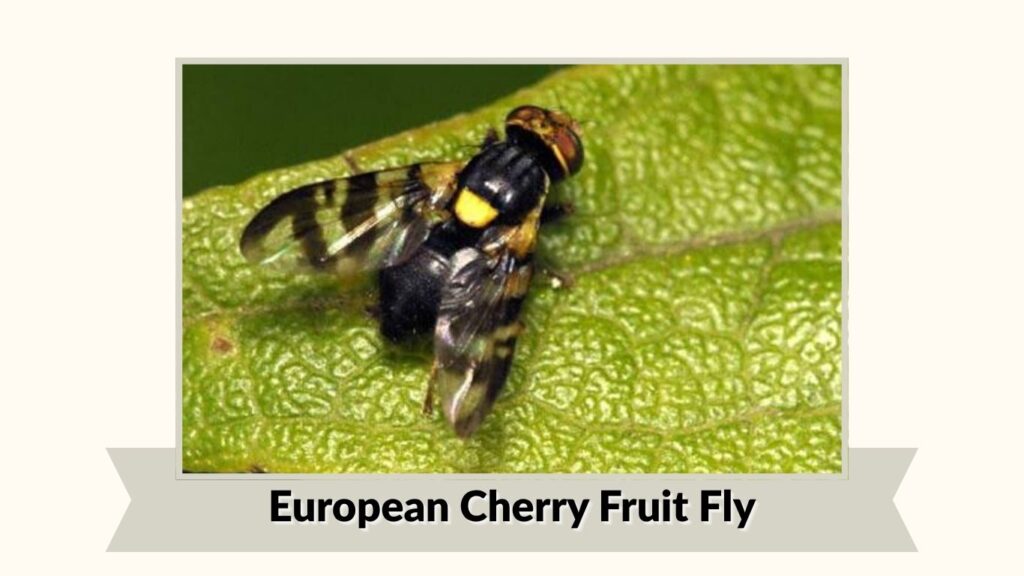
The European cherry fruit fly is a major pest of sweet and sour cherries across Europe and parts of Asia. Its larvae develop inside ripening cherries, where they feed near the pit and make fruit unsuitable for fresh sale or processing.
Identification
- Adult length: approximately 3–5 mm
- Body color: mostly black
- Head and thorax: yellow markings
- Scutellum: bright yellow
- Eyes: greenish
- Wings: transparent with four bluish-black bands
- Eggs: white and oval
- Larvae: creamy-white, legless and up to about 6 mm long
The four dark wing bands distinguish it from the western cherry fruit fly, which has a different wing pattern and white abdominal bands.
Habitat and Distribution
The species occurs across much of Europe and extends into temperate parts of Asia. It is associated with cherry orchards, home gardens and areas containing wild cherries or honeysuckle. Adults favor warm, sunny fruiting areas.
Diet and Fruit Damage
Larvae mainly feed inside sweet, sour and wild cherries. Infested cherries may soften, brown around the pit or develop small exit holes. Feeding damage can also encourage decay, while severely affected fruit may fall prematurely.
Life Cycle
Females normally place one egg beneath the skin of a ripening cherry. Eggs hatch within one to two weeks, and the larvae feed for approximately four to six weeks. Mature larvae leave the cherries, burrow into the soil and pupate. The species normally produces one generation annually and survives winter underground.
14. Blueberry Maggot Fly (Rhagoletis mendax)
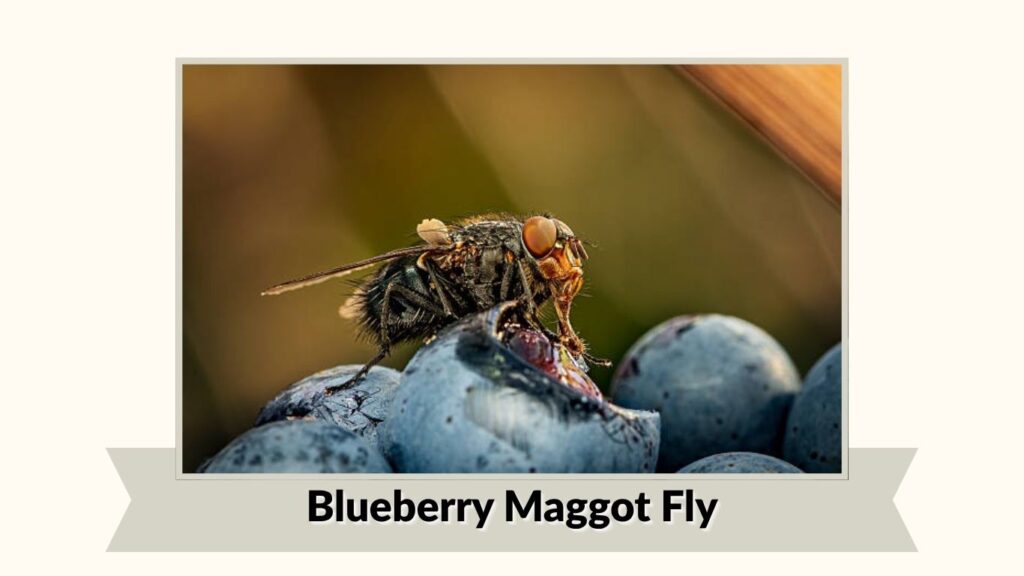
The blueberry maggot fly is an important pest of cultivated and wild blueberries in eastern North America. Its larvae feed completely inside individual berries, making an infestation difficult to notice until the fruit becomes soft or is opened.
Identification
- Adult length: approximately 3–5 mm
- Wingspan: about 8 mm
- Body color: mostly black
- Thorax: white markings
- Abdomen: narrow white bands
- Eyes: reddish or orange
- Wings: dark bands forming a distinctive pattern
- Larvae: white, legless and pointed at one end
Adults closely resemble apple maggot flies. Reliable separation may require comparing wing-band proportions, female ovipositor length and other small structures.
Habitat and Distribution
Blueberry maggot flies occur mainly in eastern Canada and the eastern United States. They inhabit commercial blueberry fields, wild blueberry barrens, bog edges and woodland areas containing blueberries or huckleberries.
Diet and Fruit Damage
The larvae primarily consume wild and cultivated blueberries, although huckleberries can serve as alternate hosts. Infested berries may become soft, shriveled or watery. The maggot remains concealed inside the pulp, creating serious concerns for commercial fresh-fruit production.
Life Cycle
Adults emerge from soil during summer and deposit eggs beneath the skin of ripening berries. Each larva feeds inside a berry before leaving the fruit and entering the soil. The insect overwinters as a pupa and generally produces one generation per year. Its four stages are egg, larva, pupa and adult.
15. Guava Fruit Fly (Anastrepha striata)
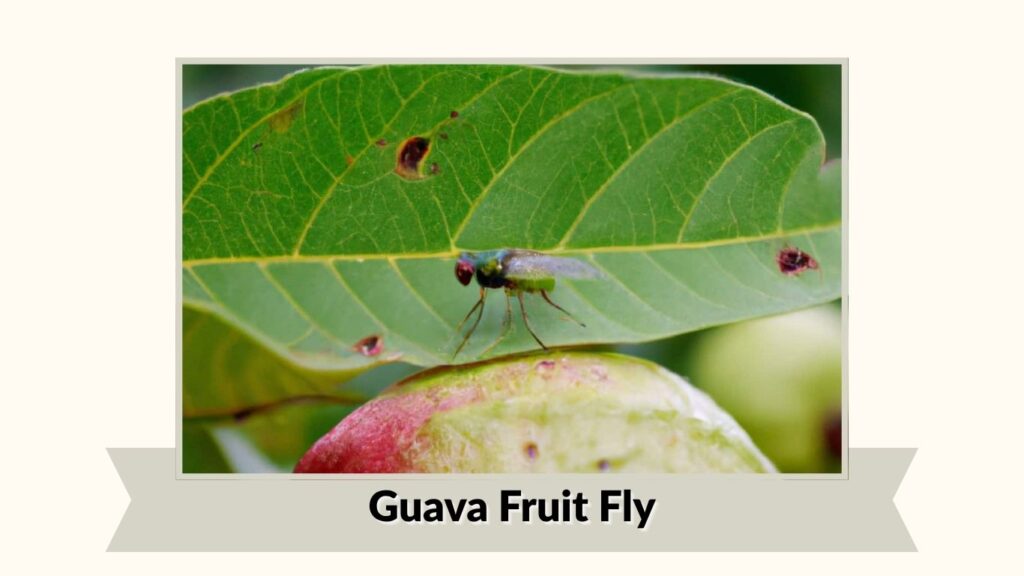
The guava fruit fly is a common tropical American fruit fly closely associated with guavas. Although it is not always considered the most economically destructive Anastrepha species, it can heavily damage backyard guava trees and other tropical fruits.
Identification
- Adult size: medium-sized fruit fly
- Body color: yellowish-brown
- Thorax: broad dark stripes separated by pale areas
- Abdomen: mostly yellow-orange
- Wings: brown and yellow bands forming C-, S- and V-like patterns
- Female: pointed egg-laying structure
- Larvae: white, cylindrical and legless
- Pupae: brown and formed in soil
The striped thorax is an important feature, but professional identification may require inspection of the female ovipositor and wing markings.
Habitat and Distribution
The guava fruit fly occurs from Mexico through Central America and across much of tropical South America. It inhabits forests, farms, orchards and gardens where guavas and other host fruits grow.
Diet and Fruit Damage
Guava is its principal host, but larvae have also been reported from mangoes, mombins, peaches and oranges. Larval feeding breaks down the pulp, producing soft areas, internal rot and premature fruit drop. Infested guavas may contain several maggots.
Life Cycle
Females puncture suitable fruit and place eggs beneath its skin. The larvae hatch and pass through three feeding stages inside the pulp. Mature maggots exit the fruit, fall to the ground and pupate in soil. Warm tropical conditions may permit several generations each year.
16. Sapote Fruit Fly (Anastrepha serpentina)
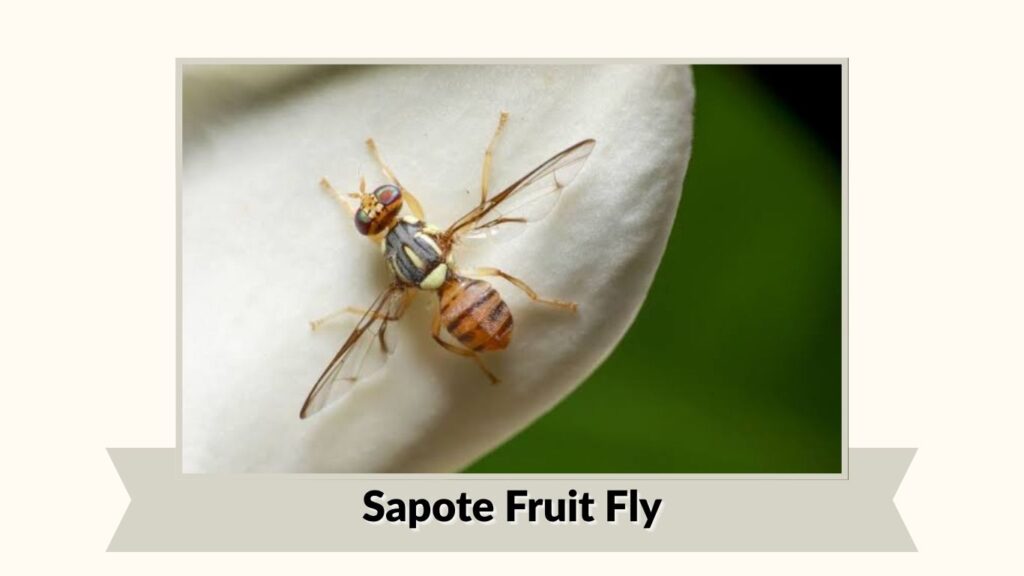
The sapote fruit fly, also known as the serpentine fruit fly, is an important pest of sapodilla, star apple and related tropical fruits. Its dark body and strongly patterned wings distinguish it from many yellow-orange members of the genus Anastrepha.
Identification
- Adult size: medium-sized
- Body color: dark brown
- Thorax: yellow and orange-brown markings
- Abdomen: alternating dark and pale areas
- Wing length: approximately 7.25–8.5 mm
- Wings: broad dark-brown bands
- Female: long, pointed ovipositor
- Larvae: pale, legless maggots developing inside fruit
Detailed wing patterns and the shape of the female ovipositor help separate this species from similar fruit flies.
Habitat and Distribution
The sapote fruit fly is widely distributed from northern Mexico through Central America and into South America as far as Peru and northern Argentina. It occupies tropical and subtropical gardens, orchards and forests containing sapote-family plants.
Diet and Fruit Damage
Preferred hosts include sapodilla and star apple. Larvae may also develop in mangoes, oranges, grapefruit, quince, mammee apple and several other fruits. Their feeding causes internal tunnels, soft flesh, decay and premature fruit fall.
Life Cycle
Females prefer mature green fruit and may deposit hundreds of eggs during their reproductive lives. Larvae feed within the pulp before leaving the fruit and pupating in soil. Under favorable conditions, females can continue laying eggs for several months, allowing populations to remain active wherever host fruit is continuously available.
17. Japanese Orange Fly (Bactrocera tsuneonis)
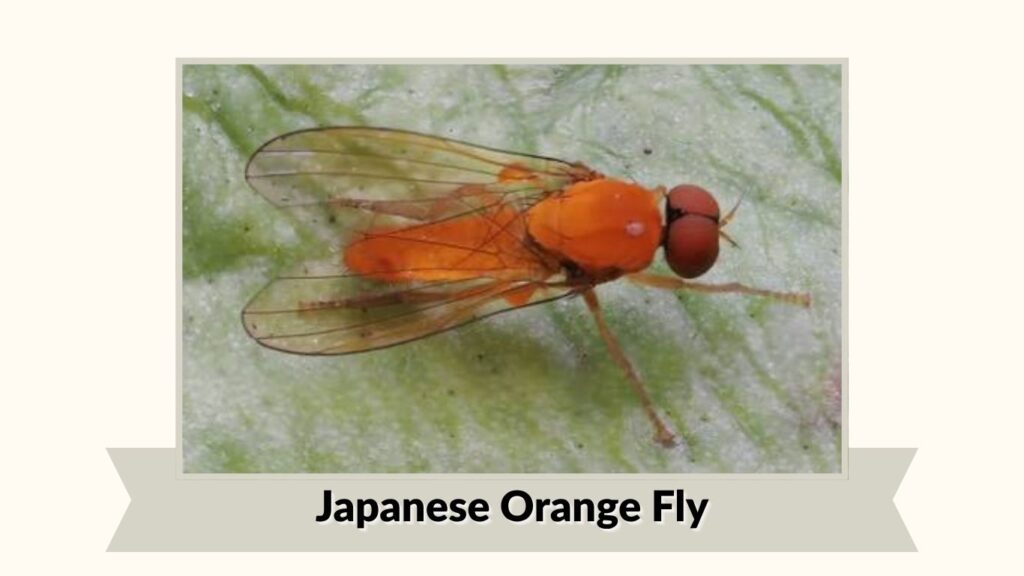
The Japanese orange fly is a large citrus-infesting fruit fly native to parts of East Asia. Females lay eggs beneath citrus rinds, and the larvae feed within individual fruit segments. Although its host range is narrower than that of many tropical fruit flies, established populations can cause significant damage to oranges and mandarins.
Identification
- Adult female length: approximately 11 mm
- Male: slightly smaller than the female
- Head: mainly yellow with a dark triangular marking
- Thorax: reddish or ochre-brown with yellow markings
- Abdomen: orange-brown with a dark T-shaped pattern
- Face: two small or medium black spots
- Wingspan: approximately 10 mm
- Larvae: pale, legless maggots developing inside citrus
The species resembles the Chinese citrus fly, but differences in wing bands, thoracic markings and abdominal patterns help specialists separate them.
Habitat and Distribution
Japanese orange flies occur in parts of Japan, including Kyushu and the Ryukyu Islands, and in southern China. They are associated almost entirely with citrus-growing areas containing oranges, mandarins, tangerines and kumquats. Their documented distribution remains restricted compared with that of the oriental fruit fly.
Diet and Fruit Damage
Adults consume sugary materials such as honeydew produced by aphids, scale insects and psyllids. Larvae feed inside citrus carpels, damaging the pulp and causing infested fruit to fall. Thick-skinned fruit may escape attack because the female’s ovipositor cannot always reach suitable tissue beneath the rind.
Life Cycle
The species normally produces one generation annually in Japan. Adults emerge from early June through mid-July, while most egg laying occurs during July and August. Females place two to six eggs beneath the rind, although usually only one larva survives at each puncture. Mature larvae leave fallen fruit during autumn and pupate within the upper soil layer until the following year.
18. Schoepfia Fruit Fly (Anastrepha interrupta)
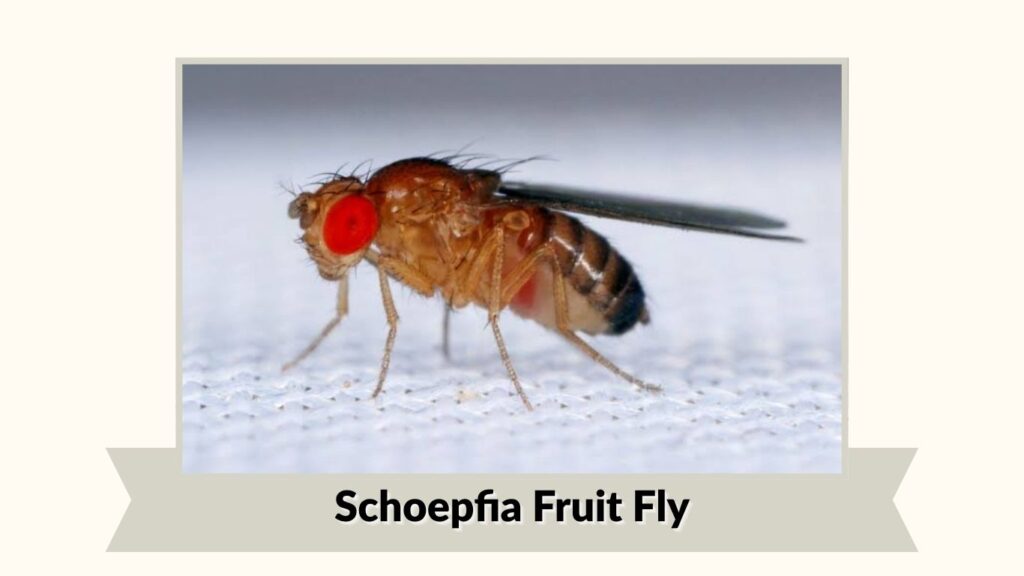
The Schoepfia fruit fly is a native Florida species with an unusually specialized diet. Unlike major agricultural fruit flies that attack dozens of commercial crops, it is known to develop only in the fruit of Schoepfia chrysophylloides, a native shrub or small tree found in southern Florida.
Identification
- Adult size: approximately the size of a house fly
- Body color: mainly yellowish
- Wings: long with yellow and brown patterns
- Thorax: distinctive black scutoscutellar spot
- Thoracic bristles: yellowish-brown
- Female ovipositor: short, broad and finely serrated
- Larvae: white, cylindrical and legless
- Mature larval length: approximately 7.5–9.4 mm
Its lightly colored wing pattern and broad ovipositor help distinguish it from the similar Caribbean fruit fly.
Habitat and Distribution
This species is known only from southern Florida, including coastal counties from Brevard and St. Lucie southward to Miami-Dade, Monroe County and Key West. Its distribution follows that of its native host plant, making it far more localized than most economically important Anastrepha fruit flies.
Diet and Fruit Damage
The larvae are known to feed only inside the fruit of Schoepfia chrysophylloides. Because the species is not known to attack major cultivated fruits, it is not considered an important commercial pest. Adult feeding habits have not been documented in detail, but adults of related species commonly consume plant secretions and sugary liquids.
Life Cycle
The complete life history of the Schoepfia fruit fly has not been thoroughly established. Adults have been reared repeatedly from ripe Schoepfia fruit, confirming that eggs and larvae develop within the host. After feeding, mature larvae are believed to leave the fruit and pupate, following the general developmental pattern of related Anastrepha species. However, exact development times remain undocumented.
19. Spotted-Wing Fruit Fly (Drosophila suzukii)
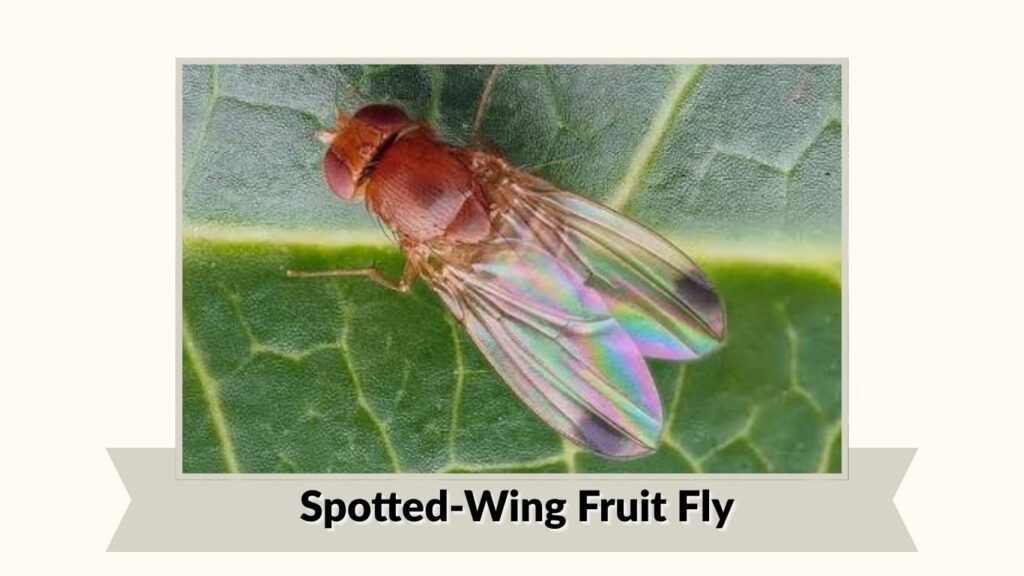
The spotted-wing fruit fly, more accurately called spotted-wing drosophila, is an invasive vinegar fly that attacks healthy ripening fruit. Unlike common kitchen fruit flies, which usually breed in damaged or fermenting produce, females can cut through the skin of intact berries and deposit eggs inside.
Identification
- Adult length: approximately 2–3 mm
- Body color: yellowish-brown
- Eyes: bright red
- Male wings: one dark spot near the tip of each wing
- Female wings: normally lack dark spots
- Female ovipositor: large, dark and serrated
- Eggs: white with two thin breathing filaments
- Larvae: translucent-white maggots about 2–3 mm long
The male’s wing spots are easy to recognize, but females must be identified by their saw-like ovipositors.
Habitat and Distribution
Originally associated with Asia, spotted-wing drosophila has spread across North America, Europe and other fruit-growing regions. It thrives in berry fields, orchards, gardens and wild areas containing soft-skinned fruit. Shaded, humid environments are particularly favorable because the flies are sensitive to extremely hot and dry conditions.
Diet and Fruit Damage
Important hosts include raspberries, blackberries, blueberries, strawberries, cherries, grapes and other soft fruits. Larvae feed inside the flesh, causing localized collapse, leaking juice, softening and decay. Damaged tissue may also become infected by fungi or bacteria, making fruit unsuitable for sale or consumption.
Life Cycle
Females cut into ripening fruit and lay eggs beneath its skin. Eggs hatch within approximately one to three days, and larvae begin breaking down the flesh. A complete generation may develop in only 8–14 days under favorable conditions, allowing as many as 13 generations in one season. Adults may survive for up to nine weeks.
20. Walnut Husk Fly (Rhagoletis completa)
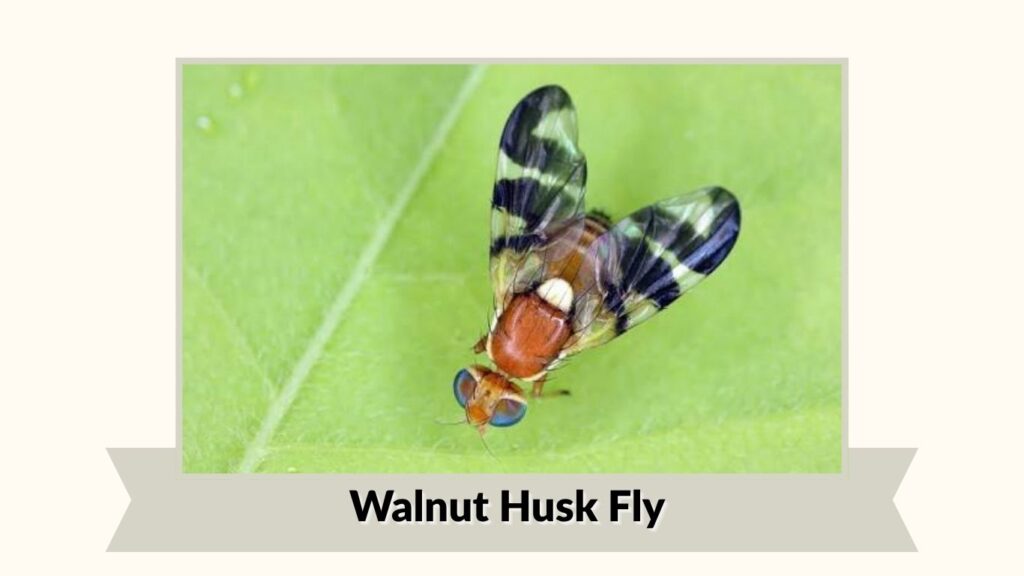
The walnut husk fly is a colorful North American fruit fly whose larvae feed inside the soft outer husks of walnuts. Damage usually stains the shells and makes the husks difficult to remove. Early infestations can also reduce kernel quality, while later attacks may leave the edible nut largely unaffected.
Identification
- Adult size: approximately the size of a house fly
- Eyes: iridescent green
- Body: yellowish-brown with darker markings
- Thorax: yellow spot below the wing attachment
- Wings: three prominent dark bands
- Wing tip: dark band forming a V-shaped pattern
- Female abdomen: pointed with a visible ovipositor
- Larvae: yellowish maggots with dark mouthparts
The strongly banded wings make adults relatively easy to distinguish from ordinary house flies and many other insects found around walnut trees.
Habitat and Distribution
Walnut husk flies occur in walnut-growing areas and infest both black walnuts and cultivated English walnuts. Adults are commonly encountered in orchards, gardens and yards containing mature walnut trees. They are especially important in western North American walnut production.
Diet and Fruit Damage
Females lay eggs beneath the green walnut husk. Larvae feed together inside the fleshy tissue, producing soft black areas and staining the shell. Damaged husks may stick tightly to the nut. Early feeding can produce darkened, shriveled or moldy kernels, while later feeding primarily affects the husk and shell appearance.
Life Cycle
Walnut husk flies normally produce one generation per year. Adults emerge from soil between late spring and early fall, with peak activity commonly occurring from July through mid-August. Females lay groups of about 15 eggs, which hatch within roughly five days. Larvae feed for three to five weeks before entering the soil to pupate. Most emerge the following year, although some pupae remain underground for two years or longer.
FAQs
What is the most common type of fruit fly?
The Mediterranean fruit fly, oriental fruit fly and spotted-wing drosophila are among the best-known species. Their abundance varies by region, climate and available host plants. Some species mainly attack commercial fruit crops, while others are commonly found around gardens or ripening berries.
Do fruit flies bite humans?
Most fruit flies do not bite humans. Their mouthparts are designed for feeding on fruit juices, nectar, microorganisms or decaying plant material. They may land on people, but they do not normally pierce the skin, feed on blood or cause painful bites.
Why are fruit flies harmful to crops?
Many fruit fly species lay eggs beneath the skin of ripening fruit. After hatching, the larvae feed inside the pulp, causing soft spots, tunnels, decay and premature fruit drop. Hidden larvae can also make infested fruit unsuitable for sale, transport or consumption.
How can fruit flies be controlled in gardens?
Collect and destroy fallen or infested fruit, harvest produce promptly and use suitable fruit-fly traps. Protective bags or fine netting can prevent females from reaching developing fruit. Severe agricultural infestations may require approved bait sprays or advice from a local agricultural extension service.
Are all fruit flies the same species?
No. The term “fruit fly” includes many species from different families. Tephritid fruit flies usually infest healthy fruit while it is still growing. Small vinegar flies, such as common Drosophila, are more often attracted to overripe, damaged or fermenting fruit.