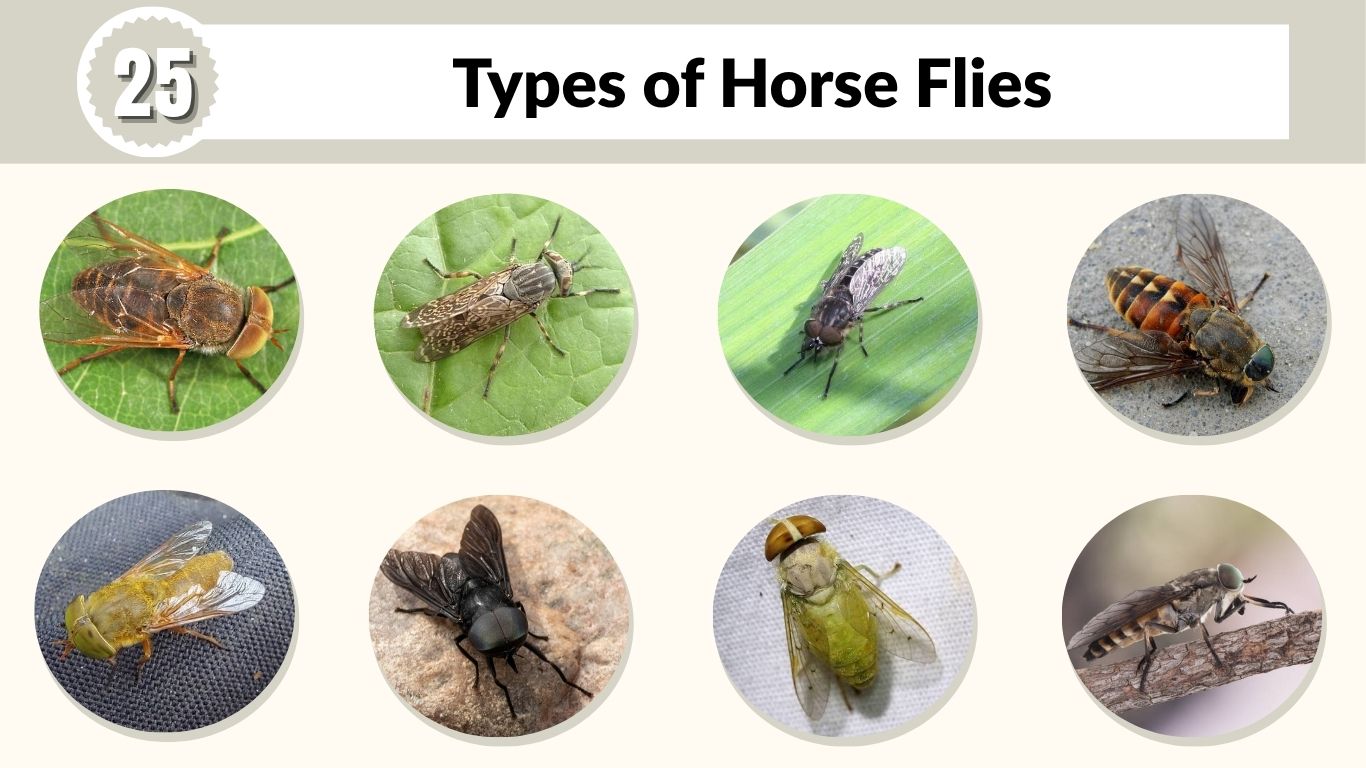
Horse flies are large, fast-flying insects known for their powerful bodies, colorful eyes, and painful bites. More than one species may appear around wetlands, forests, farms, marshes, and livestock areas. Although male horse flies feed mainly on nectar and plant sugars, females require blood to support egg development. Each species differs in size, color, wing pattern, habitat, and geographic range. This guide introduces 25 types of horse flies, including black horse flies, greenheads, clegs, and giant European species. Learning their identifying features can help you recognize them, understand their behavior, and reduce the risk of unwanted bites outdoors more effectively.
1. Black Horse Fly (Tabanus atratus)
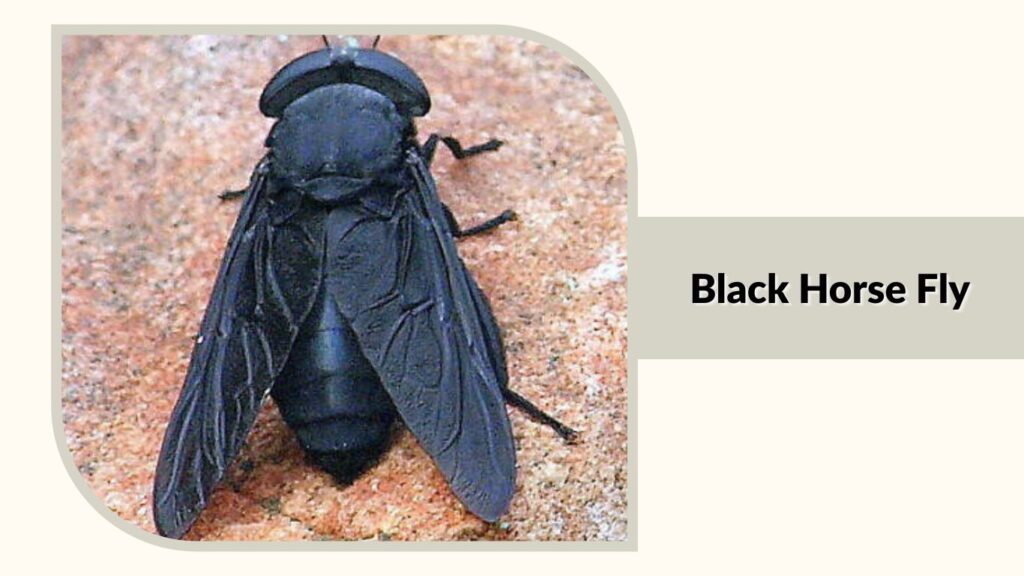
The black horse fly is a large, dark-colored biting fly native to North America. Its glossy black body, smoky wings, and powerful flight make it one of the most noticeable horse fly species. Females feed on mammalian blood, while males rely mainly on nectar and other plant-based liquids.
Identification
- Scientific name: Tabanus atratus
- Family: Tabanidae
- Body color: Glossy black or dark brownish-purple
- Wing color: Dark brown to nearly black
- Body shape: Large, broad, and robust
- Eyes: Large compound eyes that may appear silvery or dark
- Adult size: Approximately 20–28 mm long
Size and Appearance
Black horse flies are among the larger horse flies found in North America. Their bodies are covered with short, sturdy hairs, while their dark wings show clearly defined veins. Female eyes are separated, but male eyes meet or nearly meet across the top of the head. This difference can help distinguish the sexes.
Habitat and Distribution
This species is found mainly across the eastern United States, southeastern Canada, parts of Texas, and northern Mexico. It prefers moist environments near ponds, marshes, ditches, forests, farms, and livestock areas. The larvae develop in wet soil or along the edges of permanent water.
Diet and Behavior
Female black horse flies bite cattle, horses, and other mammals to obtain blood for egg development. Their bites can be painful because their sharp mouthparts cut the skin. Males do not bite and instead feed on nectar and plant juices. Adults are strongest and most active during warm daylight hours.
2. Striped Horse Fly (Tabanus lineola)
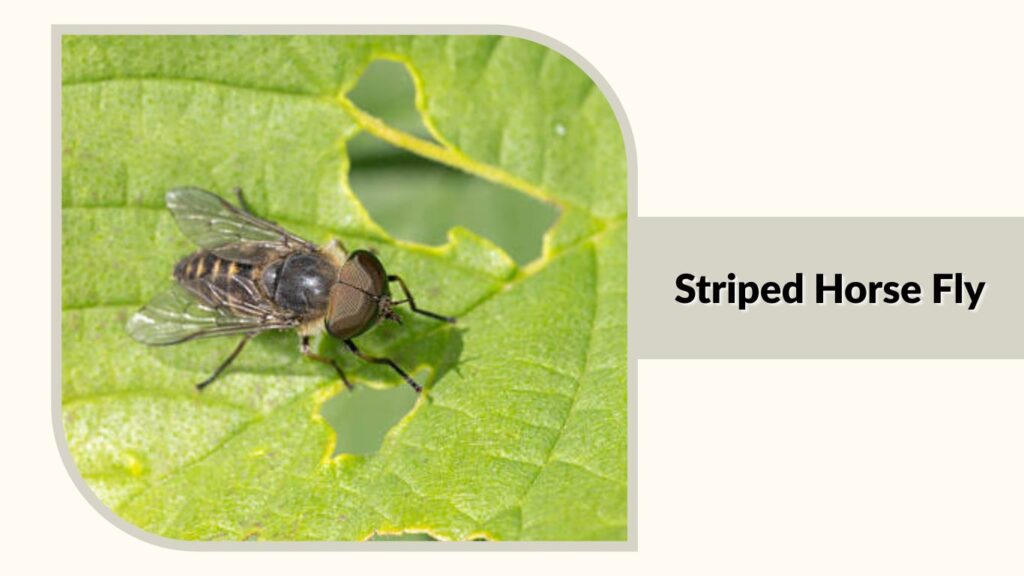
The striped horse fly is a medium-sized biting fly recognized by the pale stripes running along its abdomen. It is widespread across North America but is particularly common in coastal wetlands and salt marshes. Females may bite humans, horses, cattle, pigs, and other mammals, while males feed on plant-based liquids.
Identification
- Scientific name: Tabanus lineola
- Family: Tabanidae
- Body color: Brown or black
- Abdominal markings: Three pale gray longitudinal stripes
- Eye color: Bright green with a purplish band
- Wing color: Mostly clear or lightly tinted
- Adult size: Approximately 12–15 mm long
Size and Appearance
Striped horse flies have compact, sturdy bodies and large, colorful compound eyes. The pale central stripe on the abdomen is one of their most noticeable features. Their eyes are usually metallic green and may have a purple horizontal band. Females have separated eyes, while the eyes of males meet across the top of the head.
Habitat and Distribution
This species occurs across much of the United States and Canada, with particularly large populations along the eastern and southern coasts. It commonly inhabits salt marshes, coastal wetlands, muddy pond edges, and other moist environments. Its larvae develop in mud, damp soil, and shallow wetland habitats.
Diet and Behavior
Female striped horse flies obtain blood from humans and domesticated animals to support egg production. Their bites can be painful because they cut the skin rather than piercing it like mosquitoes. Males feed primarily on nectar. Females often deposit clusters of eggs on grasses growing near marshes or ponds.
3. Greenhead Horse Fly (Tabanus nigrovittatus)
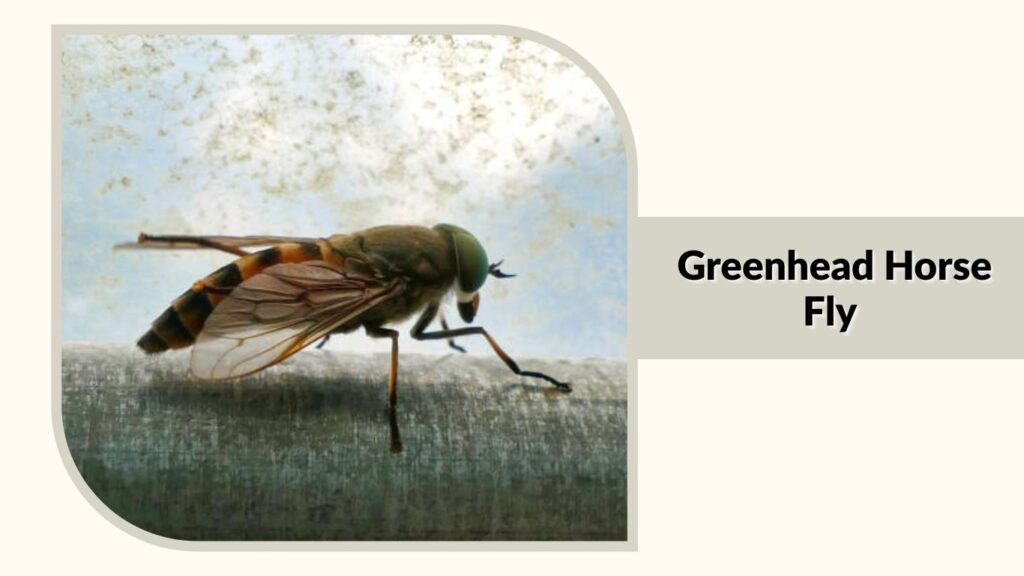
The greenhead horse fly, sometimes called the salt marsh greenhead, is a coastal species known for its brilliant green eyes and painful bite. It is strongly associated with tidal marshes along eastern North America. Large seasonal populations can become troublesome for people, livestock, and pets living near coastal wetlands.
Identification
- Scientific name: Tabanus nigrovittatus
- Family: Tabanidae
- Body color: Grayish-brown
- Eye color: Bright iridescent green
- Abdomen: Dark with a narrow pale line
- Wings: Clear to slightly smoky
- Body shape: Compact and robust
- Adult size: Similar to a large house fly
Size and Appearance
Greenhead horse flies are smaller than many other members of the horse fly family. Their metallic green eyes are their most distinctive characteristic. The body is usually gray or brown, with a darker abdomen and narrow pale markings. Their broad heads, short antennae, and strong wings help distinguish them from ordinary house flies.
Habitat and Distribution
Greenhead horse flies live primarily in coastal salt marshes and wetlands along the eastern coast of North America. Their range extends from the Gulf Coast and Texas northward into Atlantic Canada. Larvae live in intertidal marsh mud, where they prey on worms, small crustaceans, and other invertebrates.
Diet and Behavior
Female greenheads bite mammals to obtain the protein needed to produce additional batches of eggs. They use cutting mouthparts to open the skin and then lap up the blood. Males consume nectar and do not bite. Adults are especially active during warm, sunny summer weather and may travel inland from marshes searching for hosts.
4. Western Horse Fly (Tabanus punctifer)
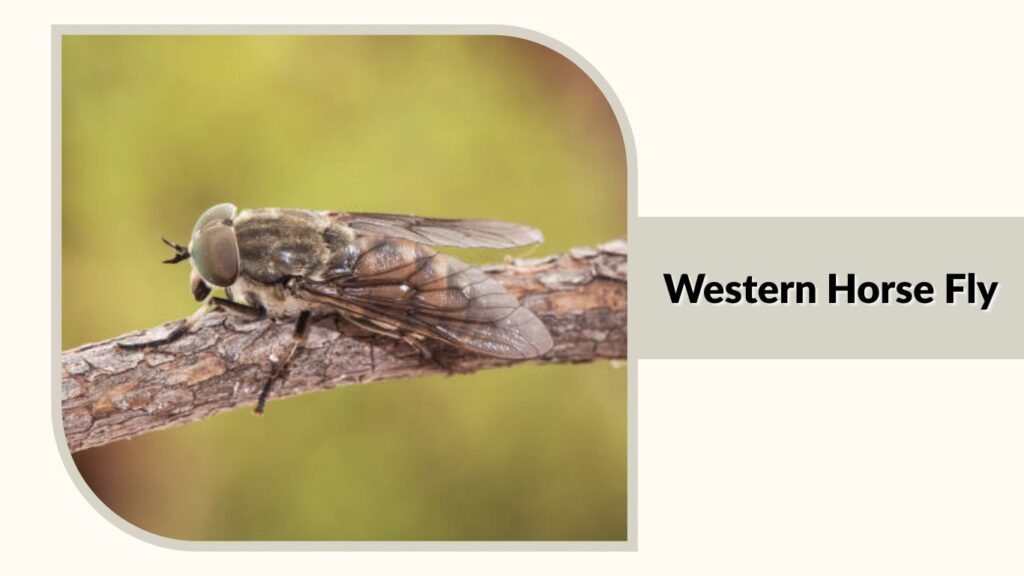
The western horse fly is a large, dark species found mainly in western North America. It has a black abdomen, brownish wings, and a contrasting pale covering across the upper thorax. Females are persistent blood feeders and may attack cattle, horses, wildlife, and occasionally humans.
Identification
- Scientific name: Tabanus punctifer
- Family: Tabanidae
- Body color: Black or dark brown
- Thorax: Creamy white or yellowish covering
- Abdomen: Glossy black
- Wings: Brownish with darker veins
- Legs: Mostly black with pale foreleg bases
- Female size: Approximately 19–22 mm long
Size and Appearance
Western horse flies are among the largest commonly encountered flies in western regions. Their dark abdomen contrasts sharply with the cream-colored hairs covering the upper thorax. The wings are brown near the base and become lighter toward the tips. Their broad body and loud flight make them easy to notice around animals.
Habitat and Distribution
This species occurs west of the Rocky Mountains and has been recorded in California, Utah, Nevada, Colorado, Arizona, and surrounding regions. It is often associated with irrigated valleys, marshes, sloughs, lake margins, and livestock areas. Its larvae develop in marshy mud, damp gravel, and wet soil beside permanent water.
Diet and Behavior
Female western horse flies feed on blood and may repeatedly circle an animal before landing. Their painful bites often cause livestock to stamp, run, or gather together defensively. Males feed on flower nectar and other plant sugars. The adults are strong daytime fliers and become most active during warm weather.
5. Pale Giant Horse Fly (Tabanus bovinus)
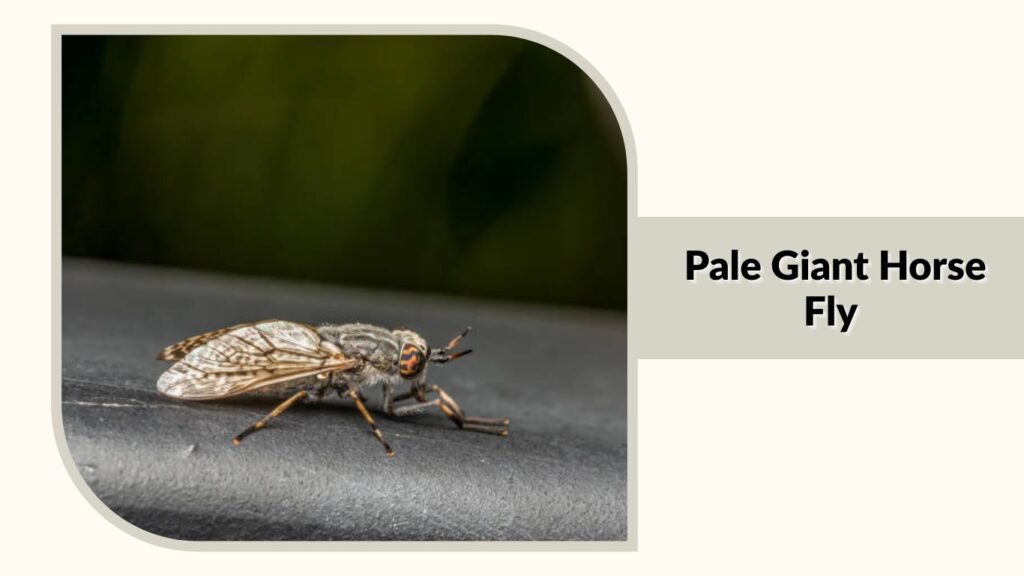
The pale giant horse fly is one of Europe’s larger horse fly species. It has a grayish-brown body, colorful compound eyes, and broad transparent wings. As its scientific and common names suggest, females commonly target cattle, although they may also feed on horses and other large mammals.
Identification
- Scientific name: Tabanus bovinus
- Family: Tabanidae
- Body color: Brownish-gray
- Thorax: Gray-brown with darker stripes
- Abdomen: Brown with pale side markings
- Eyes: Large, colorful, and banded
- Wings: Broad and mostly transparent
- Adult size: Approximately 25–30 mm long
Size and Appearance
Pale giant horse flies have long, heavy bodies and large compound eyes that may display green, bronze, purple, or reddish colors. The thorax is typically grayish-brown, while the abdomen has subtle pale markings along its sides. Their powerful wings produce a deep buzzing sound that is often heard before the fly is seen.
Habitat and Distribution
This species is widely distributed across Europe and neighboring parts of the Palearctic region. It is usually found in warm countryside containing cattle pastures, forest edges, meadows, marshes, streams, and moist soil. The immature stages require damp environments where the predatory larvae can develop.
Diet and Behavior
Females primarily obtain blood from cattle but may also attack horses, deer, and occasionally humans. Males do not bite and generally feed on nectar. Pale giant horse flies are quick, agile fliers that are difficult to swat. Their activity is usually greatest during hot, sunny conditions.
6. Dark Giant Horse Fly (Tabanus sudeticus)
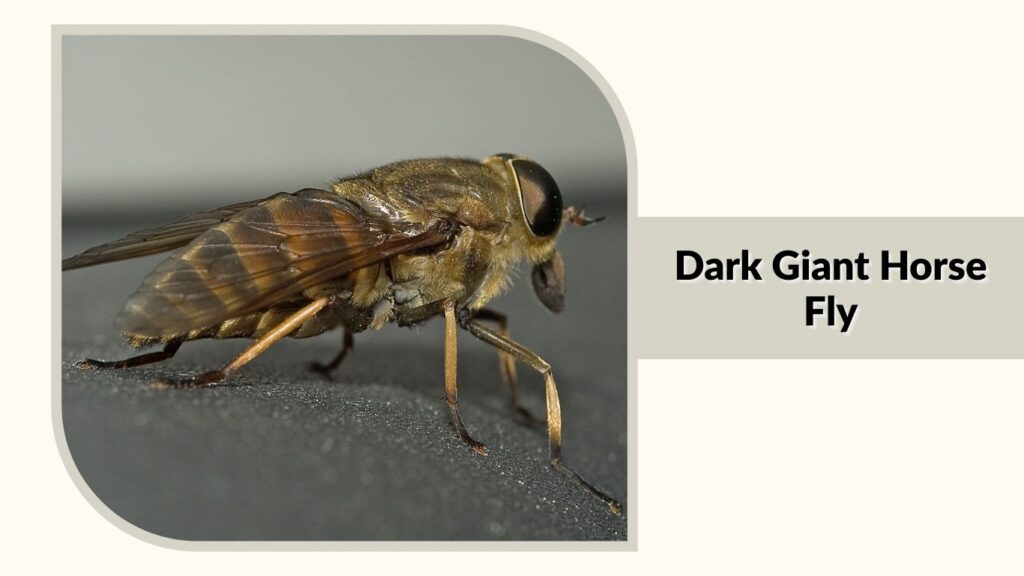
The dark giant horse fly is a large European species with a powerful build and extremely loud flight. It is considered one of Europe’s heaviest flies. Adults are frequently seen around cattle and horses, especially in damp pastures, wooded countryside, upland bogs, and other wet rural habitats.
Identification
- Scientific name: Tabanus sudeticus
- Family: Tabanidae
- Body color: Dark brown
- Abdomen: Broad with faint triangular markings
- Eyes: Uniform dark brown
- Wings: Brownish or smoky
- Body shape: Large, heavy, and robust
- Adult size: Approximately 20–25 mm long
Size and Appearance
Dark giant horse flies have broad brown bodies, heavy thoraxes, and large eyes without the obvious colorful bands seen in some related species. Their wings are slightly smoky and rest flat over the abdomen. The fly produces a deep, loud buzzing noise, which can make it appear more threatening than many smaller horse flies.
Habitat and Distribution
This species occurs across several western and northern European countries. It is especially associated with Britain, Ireland, Scandinavia, and parts of continental Europe. Suitable habitats include upland bogs, damp heathland, wet pastures, stream edges, lightly wooded areas, and fields grazed by livestock.
Diet and Behavior
Females commonly feed on the blood of cattle and horses. Although they can bite humans, they generally show a stronger preference for large grazing animals. Males feed on nectar and plant sugars. Adults fly mainly during warm daylight hours and may repeatedly circle livestock while searching for an appropriate feeding location.
7. Autumn Horse Fly (Tabanus autumnalis)
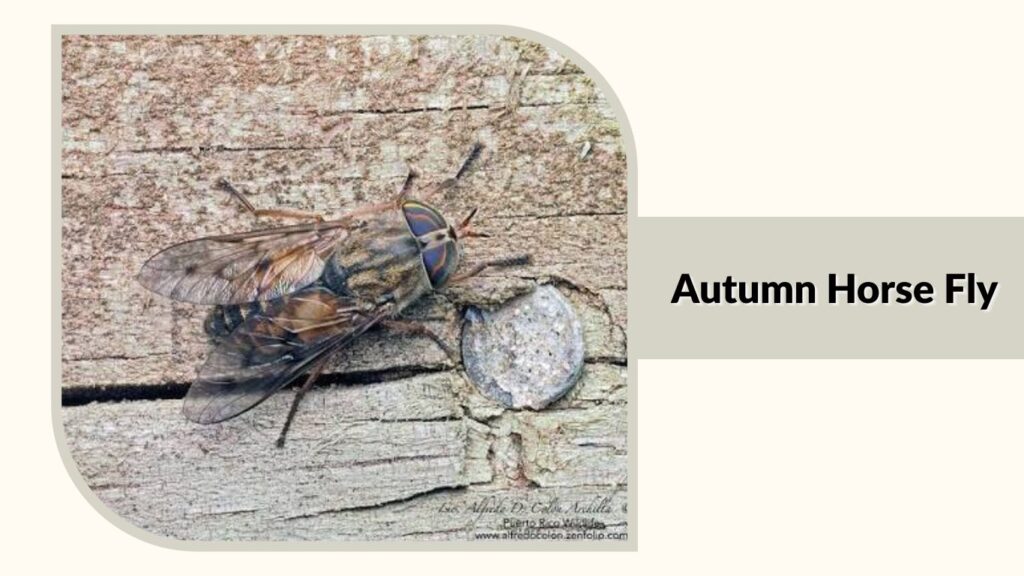
The autumn horse fly, also called the large marsh horse fly, is a medium-to-large European species associated with wet lowlands and coastal marshes. Despite its name, adults may be observed throughout the warmer months. Females feed on the blood of livestock, while males depend on nectar and other sugary plant substances.
Identification
- Scientific name: Tabanus autumnalis
- Family: Tabanidae
- Body color: Grayish-brown
- Thorax: Dark with lighter longitudinal lines
- Abdomen: Brown with pale triangular markings
- Eyes: Large and often greenish or bronze
- Wing length: Approximately 13–16 mm
- Body length: Approximately 16–22 mm
Size and Appearance
Autumn horse flies have sturdy brown bodies with several faint pale markings across the thorax and abdomen. Their broad wings are usually transparent with a slight brown tint. The large compound eyes may appear metallic green or bronze. Females have widely separated eyes, while male eyes meet at the top of the head.
Habitat and Distribution
This species is found across Europe, parts of Asia, and North Africa. It prefers marshy lowlands, wetlands, bogs, coastal marshes, and salt-tolerant habitats. Adults may also appear around wet grazing fields containing livestock. The larvae develop in damp soil, marsh mud, and other moist substrates.
Diet and Behavior
Female autumn horse flies cut the skin of cattle, horses, and other mammals to obtain blood for egg development. Males feed on nectar and do not bite. Adults are active during warm, bright weather and are attracted to movement, dark objects, and large animals. Females usually lay their eggs on vegetation near water.
8. Band-Eyed Brown Horse Fly (Tabanus bromius)
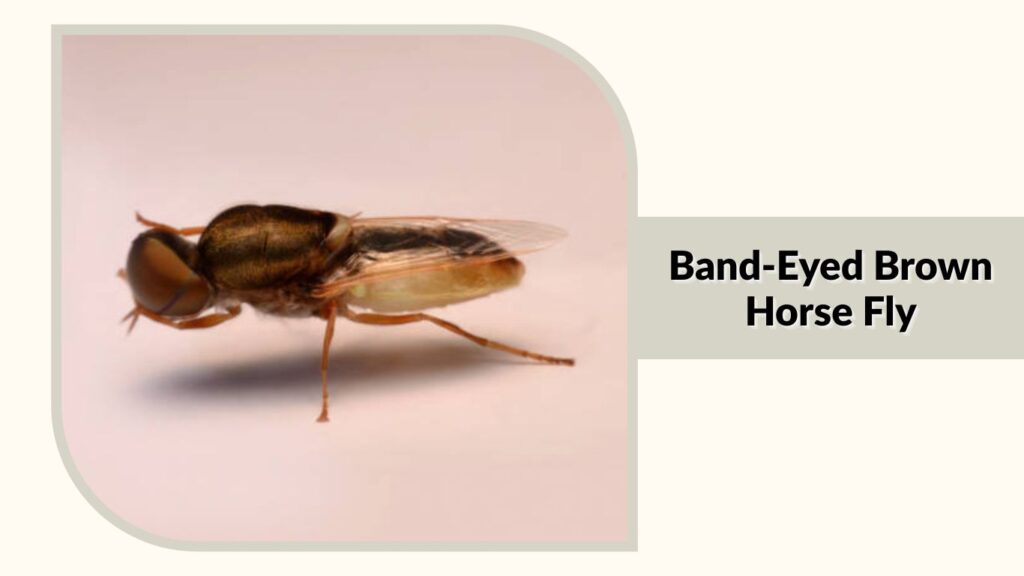
The band-eyed brown horse fly is a medium-sized European horse fly recognized by the colorful band crossing each compound eye. It commonly appears during summer in pastures, open countryside, woodland edges, and other places where livestock are present. Females bite mammals, while males survive on nectar and plant fluids.
Identification
- Scientific name: Tabanus bromius
- Family: Tabanidae
- Body color: Pale brown, buff, or gray
- Abdomen: Dark markings over a lighter background
- Eyes: Greenish with one strong purple or reddish band
- Wings: Mostly transparent
- Adult size: Approximately 13–15 mm long
Size and Appearance
This species has a broad head, sturdy body, and large compound eyes. Live females are easiest to identify because the colored eye band often fades after the insect dies. The abdomen is usually pale buff with dark gray markings, although some individuals have reddish coloring near the base.
Habitat and Distribution
Band-eyed brown horse flies occur throughout much of the Palearctic region. They can live in grasslands, livestock pastures, forest clearings, gardens, and relatively dry countryside. Unlike many horse fly larvae that require very wet mud, their larvae may develop in somewhat drier soil.
Diet and Behavior
Females use cutting mouthparts to obtain blood from cattle, horses, deer, and occasionally humans. Males do not bite and mainly visit flowers for nectar. Adults are most noticeable in warm, bright weather and may repeatedly circle moving animals before choosing a place to land.
9. Yellow-Banded Horse Fly (Tabanus fulvulus)
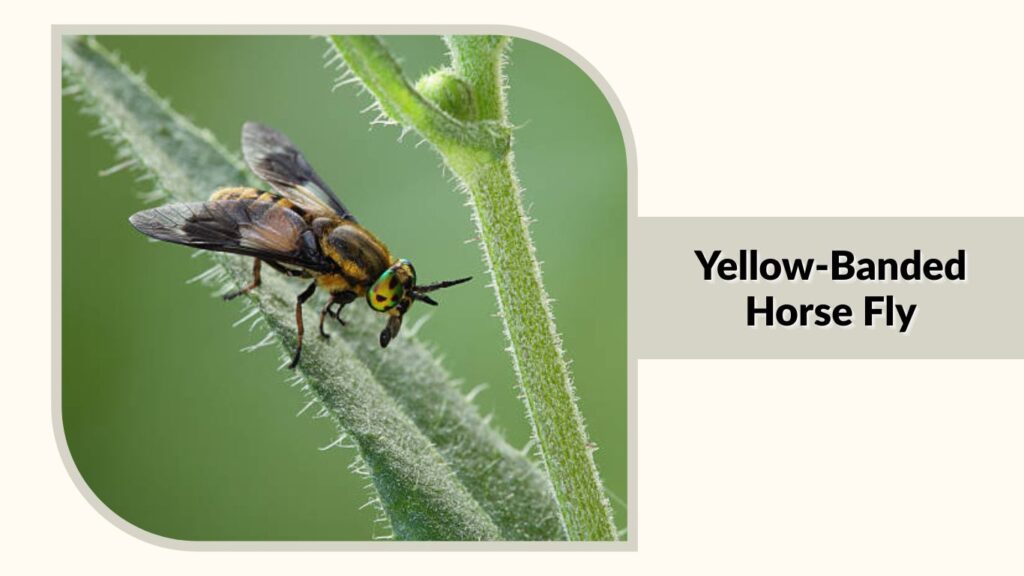
Tabanus fulvulus is a North American horse fly sometimes informally called the yellow-banded or green-eyed horse fly. However, it does not have one universally accepted English common name. It is mainly recorded in the United States, especially in eastern and southeastern regions.
Identification
- Scientific name: Tabanus fulvulus
- Family: Tabanidae
- Body color: Yellowish-brown to dark brown
- Eyes: Large and often metallic green
- Abdomen: Lighter markings may be visible
- Wings: Mostly clear or lightly tinted
- Body shape: Broad and strongly built
Size and Appearance
This species has the sturdy shape typical of true horse flies, with a wide head, short antennae, powerful wings, and large eyes. Females can be recognized by the visible space between their eyes, whereas the eyes of males meet across the upper part of the head.
Habitat and Distribution
Records show Tabanus fulvulus across numerous eastern and southeastern states, including Alabama, Georgia, Maryland, Mississippi, North Carolina, South Carolina, Tennessee, Virginia, and West Virginia. Adults are most likely to occur around warm, moist landscapes, livestock pastures, and wooded wetland edges.
Diet and Behavior
Female flies seek blood from large mammals to obtain nutrients needed for egg production. Males feed on flower nectar and other plant sugars. Females are visually attracted to movement, dark objects, and warm-bodied animals, making livestock and people noticeable targets during outdoor activity.
10. Four-Lined Horse Fly (Silvius quadrivittatus)
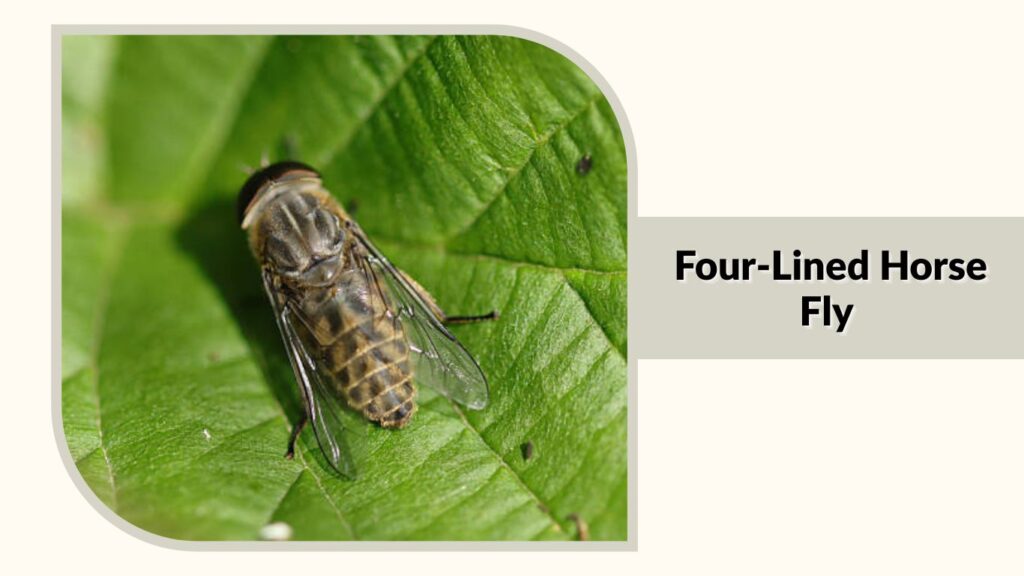
The species previously listed as Tabanus quadrivittatus is more accurately classified as Silvius quadrivittatus. It belongs to the horse and deer fly family and is a relatively small, stream-associated biting fly found in western North America. It may become locally troublesome near permanent waterways.
Identification
- Scientific name: Silvius quadrivittatus
- Family: Tabanidae
- Body shape: Smaller and more slender than many Tabanus
- Body color: Grayish, brown, or yellow-brown
- Abdomen: Longitudinal markings may be visible
- Wings: Clear with darker markings in some individuals
- Eyes: Large compound eyes
Size and Appearance
The four-lined horse fly is less bulky than giant horse flies and has a more compact appearance. Its abdominal markings help create a striped look. Because several small tabanids look similar, confirming the species may require close examination of the antennae, wings, legs, and abdominal pattern.
Habitat and Distribution
This species has been documented in the western United States, including Colorado and Arizona. It is particularly associated with larger permanent streams and nearby vegetation. Moist soil and stream-edge substrates provide suitable places for its immature stages to develop.
Diet and Behavior
Females may bite humans and other mammals, particularly near waterways where local populations are concentrated. Males rely on nectar and do not take blood. Adults are generally active during warm daylight hours and may rest on streamside plants while searching for hosts or mates.
11. Saltmarsh Greenhead (Tabanus conterminus)
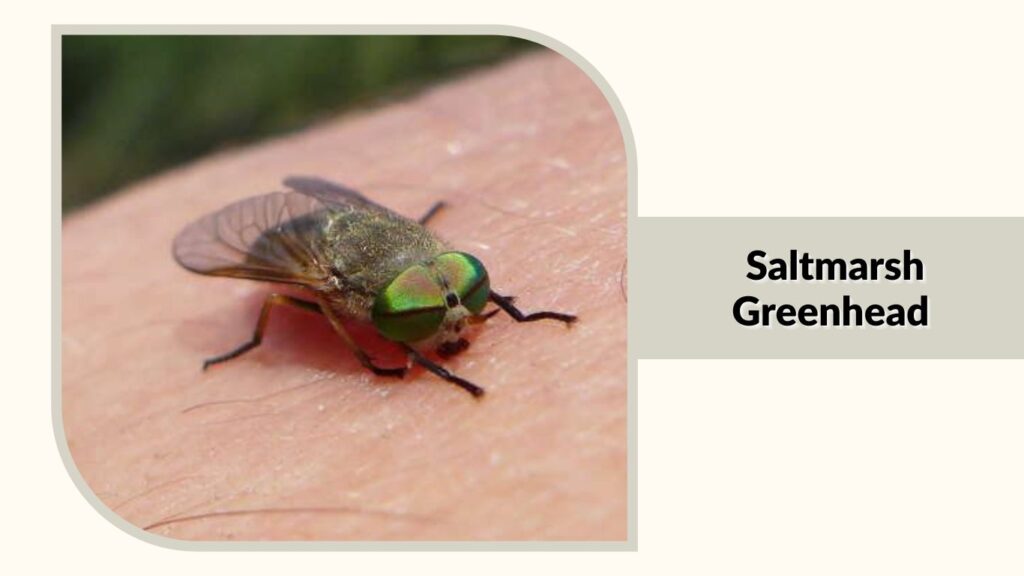
The saltmarsh greenhead is a North American horse fly closely associated with coastal marshes. It resembles other greenhead species but can be distinguished through detailed examination. Females may attack people and livestock, while the larvae develop in muddy areas along salt-marsh creeks and drainage channels.
Identification
- Scientific name: Tabanus conterminus
- Family: Tabanidae
- Body color: Grayish-brown
- Eyes: Often green or iridescent
- Wings: Mostly transparent
- Body shape: Compact and robust
- Adult size: Around 11 mm in some specimens
Size and Appearance
Saltmarsh greenheads are generally smaller than black or American horse flies. They possess large metallic eyes, short antennae, a broad head, and a gray-brown abdomen. Identification can be difficult because several coastal Tabanus species have similar body colors and eye patterns.
Habitat and Distribution
The species occurs in both Canada and the United States. It is strongly connected to coastal salt marshes, where larvae have been collected from muddy banks beside ditches and tidal creeks. Adults may leave the marsh and travel toward beaches, homes, roads, or livestock areas.
Diet and Behavior
Females cut the skin of mammals and lap up the flowing blood. Their bites may cause immediate pain, redness, and localized swelling. Males consume nectar instead of blood. Adults are usually strongest during warm coastal weather and can remain persistent once attracted to a moving host.
12. American Horse Fly (Tabanus americanus)
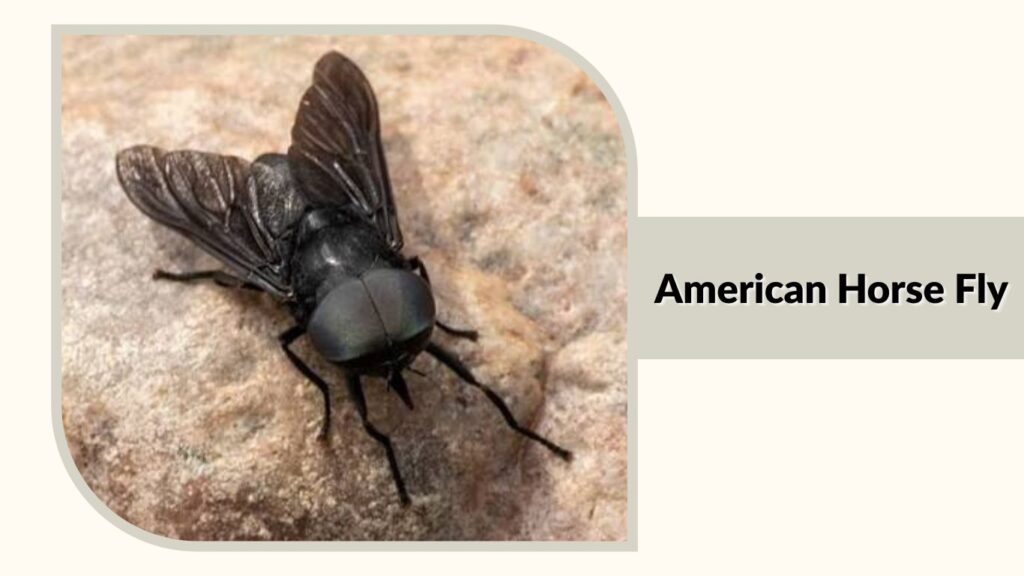
The American horse fly, previously listed as the Florida horse fly, is one of the world’s largest horse fly species. It occurs across much of the eastern and southern United States, including Florida. Its huge body, metallic eyes, and powerful flight make it easy to recognize.
Identification
- Scientific name: Tabanus americanus
- Family: Tabanidae
- Body color: Dark brown to nearly black
- Abdomen: Pale margins between the segments
- Eyes: Metallic green or blue
- Wings: Mainly transparent with brown veins
- Adult size: Approximately 22–33 mm long
Size and Appearance
American horse flies have massive, muscular bodies covered with fine hairs. Their upper surfaces are dark brown, while the underside is lighter gray. Brownish-yellow coloring may appear on the face and legs. Females have separated eyes, but the eyes of males connect across the head.
Habitat and Distribution
This species ranges from parts of Canada through the eastern United States and south into Florida and Texas. It inhabits shaded pasture edges, moist forests, swamps, pond margins, and wetlands. Its predatory larvae develop in mud, damp soil, wet logs, and decaying vegetation.
Diet and Behavior
Females feed on livestock, deer, humans, and other warm-blooded animals. Their large cutting mouthparts produce particularly painful wounds. Males consume nectar and other plant fluids. Adults are agile daytime fliers and may travel several miles from their breeding habitat.
13. Sacken’s Horse Fly (Tabanus sackeni)
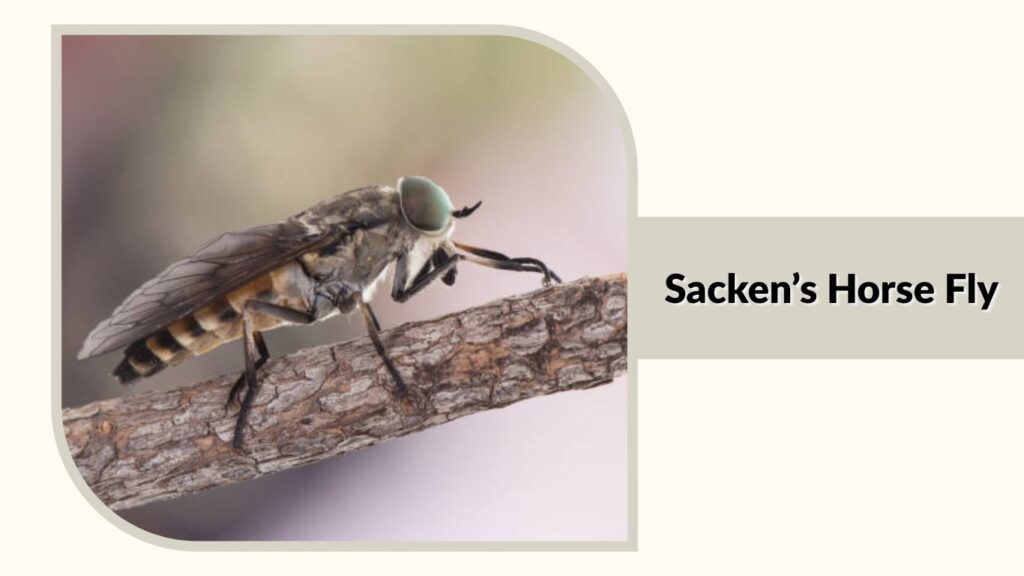
Sacken’s horse fly is a medium-sized North American species found in Canada and the United States. It does not have a widely standardized common name, and detailed information about its individual ecology remains limited. Like other true horse flies, it has a sturdy body, large eyes, and strong wings.
Identification
- Scientific name: Tabanus sackeni
- Family: Tabanidae
- Body color: Brown to dark gray
- Eyes: Large and often iridescent
- Wings: Clear to smoky brown
- Body shape: Medium-sized and robust
- Adult size: Approximately 13.5 mm long
Size and Appearance
This species is much smaller than the American or black horse fly. It has a gray-brown thorax, dark abdomen, short antennae, and wings that rest over the back. Female eyes are separated, while males possess eyes that meet or nearly meet above the head.
Habitat and Distribution
Records confirm that Tabanus sackeni occurs in Canada and the United States, including several eastern regions. Adults have been photographed in states such as Pennsylvania, Maryland, and West Virginia. They may occur around damp woodlands, lowlands, streams, and other habitats suitable for horse fly development.
Diet and Behavior
Females are expected to feed on mammalian blood, as is typical of female Tabanus horse flies. Males feed on nectar and plant liquids. Some individuals have been observed around artificial lights, but there is not enough evidence to consider “crepuscular horse fly” a reliable standard name for this species.
14. Bright Horse Fly (Hybomitra distinguenda)
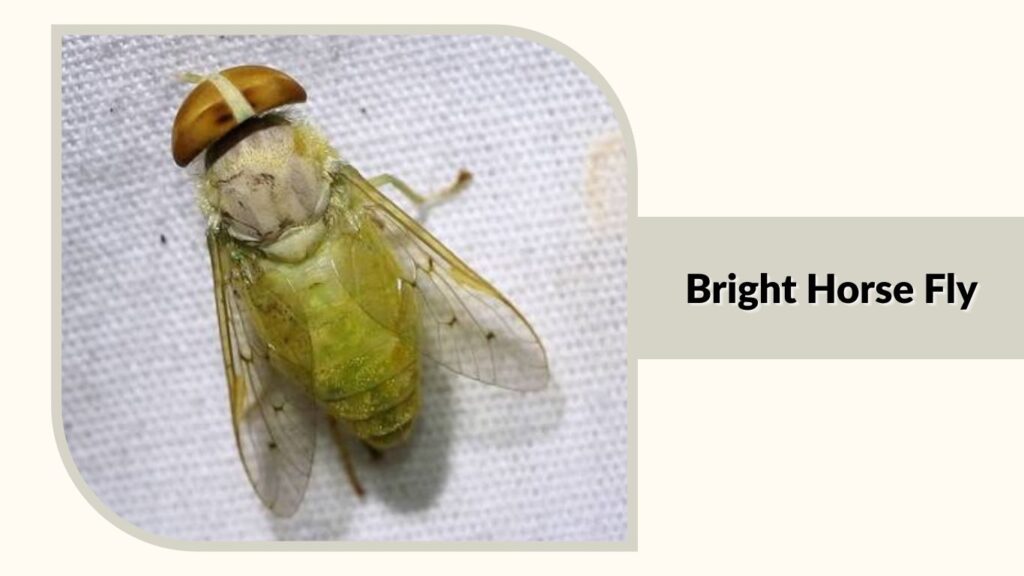
The bright horse fly is a large, strongly built species named for the noticeable yellow-orange patches along the sides of its abdomen. It occurs across parts of the Palearctic region and is one of the more frequently encountered Hybomitra species in southern Britain.
Identification
- Scientific name: Hybomitra distinguenda
- Family: Tabanidae
- Body color: Mostly dark gray or black
- Abdominal markings: Bright yellow-orange side patches
- Eyes: Green or reddish with three dark bands
- Wings: Clear with visible dark veins
- Adult size: Up to approximately 16 mm long
Size and Appearance
This species has a broad, somewhat rectangular abdomen and a heavy thorax. Its orange abdominal patches usually extend across the first three or four segments. The orange-brown areas near the wing bases and the three dark bands across its colorful eyes are also useful identification features.
Habitat and Distribution
Bright horse flies inhabit woodlands, heathlands, wetlands, coastal areas, and damp countryside. In Britain, they are most frequent in southern regions but occur more sparingly farther north. Their predatory larvae are believed to develop in damp soil, decaying wood, and moist plant material.
Diet and Behavior
Females may take blood meals from cattle, horses, wildlife, and occasionally humans. Males feed on nectar and other sugary substances. Males sometimes hover above woodland clearings, while females may be attracted to warm, dark vehicles with running engines. Adults usually appear from June through September.
15. Slender-Horned Horse Fly (Hybomitra montana)
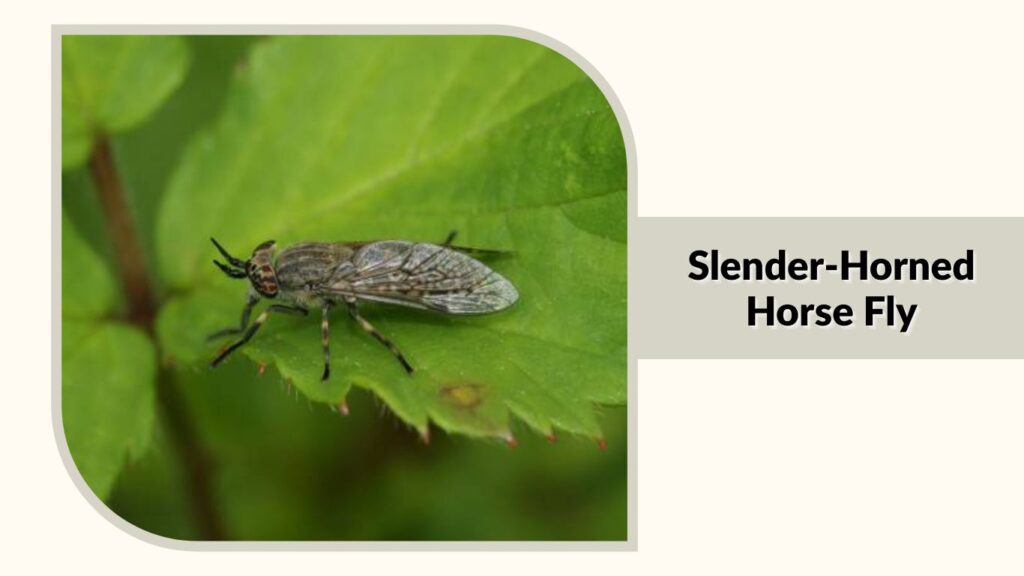
The species previously listed as the broadland horse fly is more commonly known as the slender-horned horse fly. It is a relatively small Hybomitra species associated mainly with upland bogs, fens, wet peatlands, and other cool, moisture-rich environments.
Identification
- Scientific name: Hybomitra montana
- Family: Tabanidae
- Body color: Dark gray or black
- Abdominal markings: Dull orange-brown side patches
- Eyes: Green or turquoise with reddish bands
- Antennae: Relatively narrow third segments
- Adult size: Approximately 12–14 mm long
Size and Appearance
Slender-horned horse flies have comparatively small heads and narrow antennae. Females display a broad dark stripe down the middle of the abdomen, separated by gray triangular markings. Their orange-brown side patches are duller than the vivid orange markings found on the bright horse fly.
Habitat and Distribution
This species is most strongly associated with northern and western Britain, although it occurs elsewhere in Europe. It favors upland fens, bogs, wet peat, bog moss, and occasionally northern salt marshes. Its larvae are presumed to be predators living within saturated peat or moss.
Diet and Behavior
Females obtain blood from mammals to support egg development, whereas males consume nectar and plant sugars. Adults generally fly between May and August. Their close association with undamaged wetlands means they may be uncommon or absent where bogs and fens have been drained.
16. Broad-Headed Horse Fly (Hybomitra lurida)
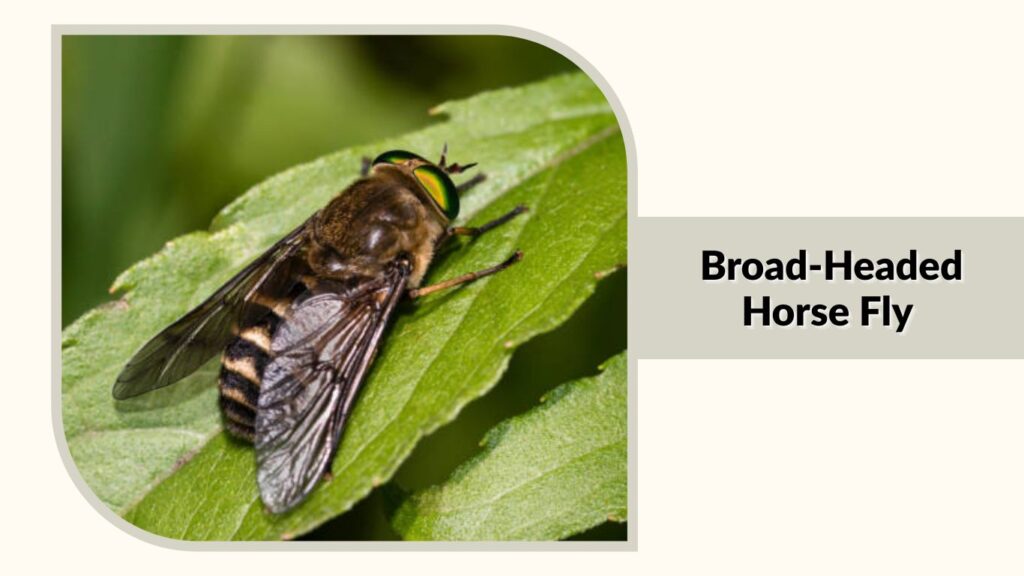
The species previously listed as the northern horse fly is officially called the broad-headed horse fly in some regional records. It is a small, dark horse fly that favors cool boreal forests, peatlands, bogs, and other northern wet habitats.
Identification
- Scientific name: Hybomitra lurida
- Family: Tabanidae
- Body color: Dark brown or black
- Abdominal markings: Dull orange patches near the second segment
- Eyes: Reddish-gray with three dark bands
- Legs: Tibiae partially pale
- Adult size: Approximately 12–13 mm long
Size and Appearance
This species has a compact body, a relatively broad face, and a shiny abdomen. Females possess a noticeable shiny-black area immediately above the antennae. The wings have darkened cross veins, while the legs are partly pale, helping separate it from the entirely black-legged Hybomitra micans.
Habitat and Distribution
Broad-headed horse flies have a northern distribution and are recorded across forested parts of Canada as well as northern Europe. In Britain, most records come from Scotland, particularly boggy areas and pinewoods. Adults are generally observed from May through July.
Diet and Behavior
Females are blood feeders that may target livestock, wild mammals, or humans. Males survive on nectar, honeydew, and plant fluids. The species is most likely to be encountered in cool wetlands rather than hot, dry pastures or heavily developed landscapes.
17. Black-Legged Horse Fly (Hybomitra micans)
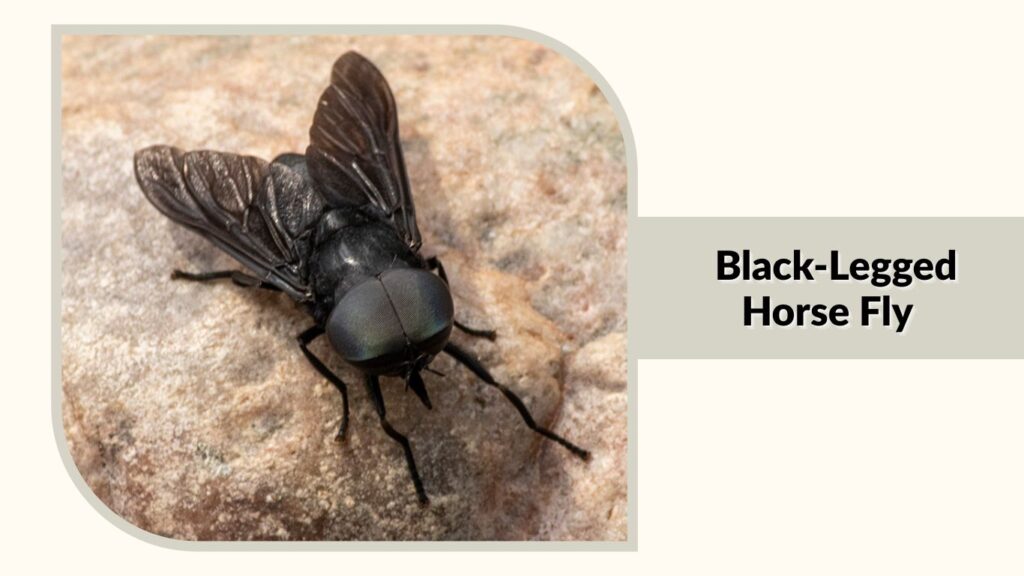
The black-legged horse fly is one of the darkest members of its genus. Its almost completely black body, dark wing veins, and entirely black legs provide its most recognizable features. It is now considered uncommon in several parts of its former British range.
Identification
- Scientific name: Hybomitra micans
- Family: Tabanidae
- Body color: Black or very dark gray
- Leg color: Entirely black
- Antennae: Completely black
- Eyes: Three dark transverse bands
- Adult size: Approximately 15–16 mm long
Size and Appearance
This is a medium-to-large horse fly with a wide, rectangular abdomen. Females may have small gray patches and triangular markings, although these can wear away as the fly ages. Its completely black legs distinguish it from the similar hairy-legged horse fly, which has extensively pale tibiae.
Habitat and Distribution
Historical records are scattered across Britain, particularly in northern and western regions. However, modern sightings are relatively scarce. The species appears to prefer wet grasslands located beside woodland, where moist soil and vegetation provide suitable conditions for its immature stages.
Diet and Behavior
Females can take mammalian blood, while males feed on plant sugars. Both sexes have been observed drinking honeydew from leaves and water beside woodland streams. Males may visit hogweed flowers and hover over open areas. Adult activity generally peaks from late May to mid-June.
18. Hairy-Legged Horse Fly (Hybomitra bimaculata)
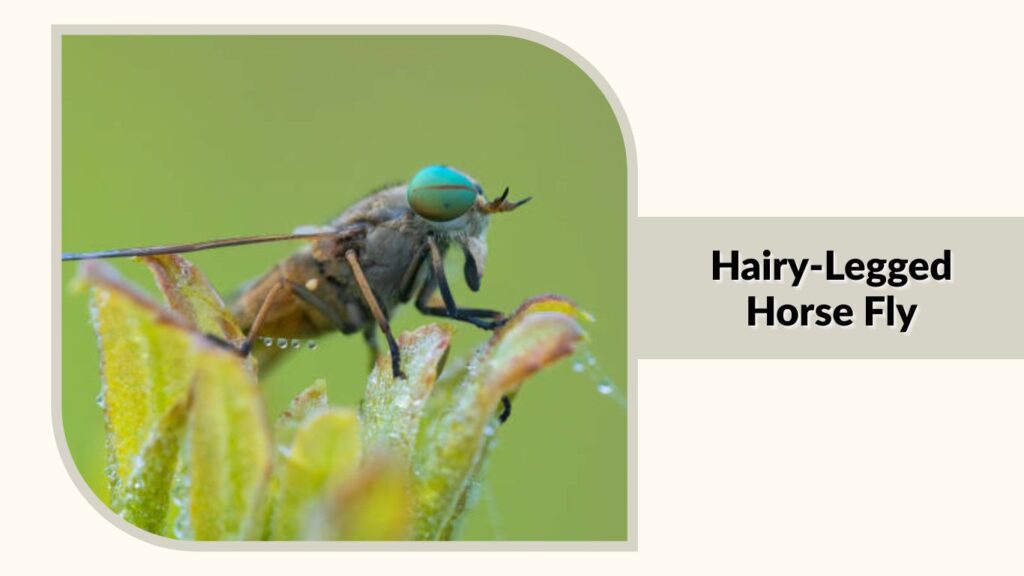
The hairy-legged horse fly is a widespread, variable species named for the long fringes of hair on its middle and hind legs. Its body may be almost entirely dark or marked with orange along the sides of the first abdominal segments.
Identification
- Scientific name: Hybomitra bimaculata
- Family: Tabanidae
- Body color: Black, brown, or partly orange
- Abdominal markings: Gray triangles and occasional orange patches
- Eyes: Green or reddish with three colored bands
- Legs: Pale tibiae with long hair fringes
- Adult size: Approximately 13–16.5 mm long
Size and Appearance
This species has a broad body and a rectangular abdomen. Some females are nearly black, while others possess orange patches on the first two abdominal segments. Long hairs on the middle tibiae and partially pale legs separate it from the black-legged horse fly.
Habitat and Distribution
Hairy-legged horse flies occupy wetlands, open wet woodlands, large marshes, wooded fens, and areas containing waterlogged leaf litter. They are widespread across much of Britain but become less frequent in upland and exposed coastal habitats. Their larvae are predatory and develop in wet organic material.
Diet and Behavior
Females are fast, persistent fliers that may approach humans but primarily obtain blood from cattle and other large mammals. Males feed on flowers and plant sugars and may hover one to three meters above woodland clearings while searching for females.
19. Golden Horse Fly (Atylotus fulvus)
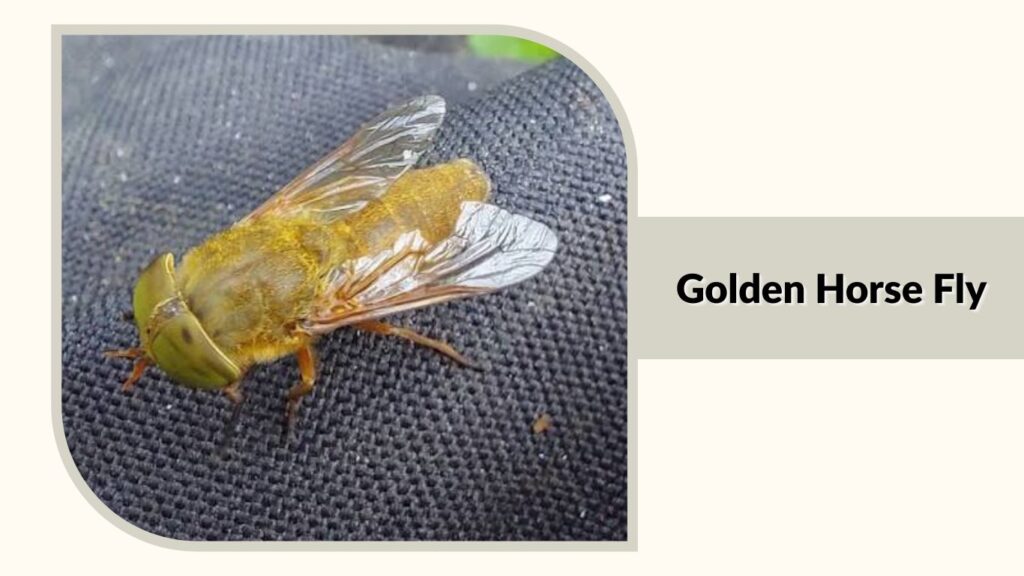
The golden horse fly is a medium-sized species covered with fine golden hairs. Its warm yellow-brown appearance, pale green eyes, orange antennae, and association with acidic bogs make it one of the more distinctive European horse flies.
Identification
- Scientific name: Atylotus fulvus
- Family: Tabanidae
- Body color: Grayish beneath dense golden hairs
- Abdominal markings: Dull orange side patches
- Eyes: Pale green with shifting dark spots
- Legs and antennae: Mostly orange
- Adult size: Approximately 12–14 mm long
Size and Appearance
Fresh adults have a strong golden color created by numerous tiny hairs covering the body. Females usually have orange patches on the first three abdominal segments. Their wings are mostly clear, but the leading edge and basal veins have a noticeable orange tint.
Habitat and Distribution
Golden horse flies are associated with acidic bogs and nutrient-poor mires containing peat pools, bog moss, cotton grass, sundews, and bog asphodel. British records are scattered across southern England, Wales, Cumbria, and Scotland. The larvae probably hunt small invertebrates in wet peat and moss.
Diet and Behavior
Females may feed on mammalian blood, while males rely on nectar and other plant sugars. Adults are typically active between June and August. Because the species depends on specialized bog habitats, it is usually localized rather than commonly encountered across ordinary farmland.
20. Saltmarsh Horse Fly (Atylotus latistriatus)
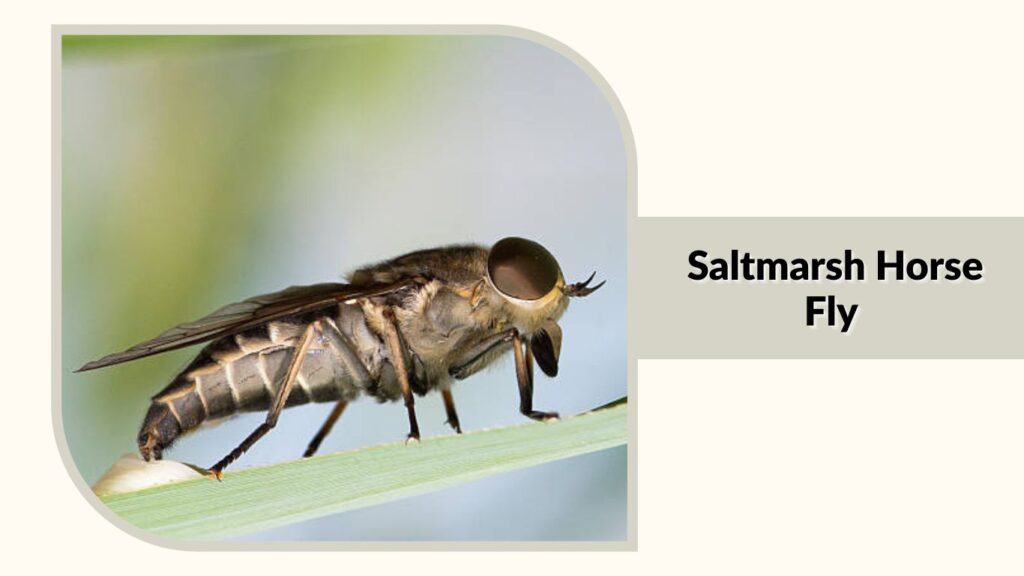
The saltmarsh horse fly is a medium-sized species associated with coastal marshes and other saline wetlands. Its grayish body, orange abdominal patches, large head, and pale green eyes help separate it from darker horse flies. Females may bite humans and large mammals, while both sexes also visit flowers.
Identification
- Scientific name: Atylotus latistriatus
- Family: Tabanidae
- Body color: Olive-gray
- Abdominal markings: Gray central stripe with darker side stripes
- Eyes: Pale gray-green or dull reddish
- Legs: Mostly orange with darker front tarsi
- Adult size: Approximately 12–15 mm long
Size and Appearance
Females have dull orange patches along the first three abdominal segments and dark markings around the sides of several segments. Their antennae are orange, while the wings are clear with relatively dark veins. Males have larger heads, eyes that meet above the head, and long hairs behind the front tibiae.
Habitat and Distribution
This species is distributed across parts of the Palearctic region. In Britain, it is mainly restricted to southern coastal salt marshes. Its larvae develop as predators in mud, wet vegetation, stranded seaweed, and decaying material along the upper saltmarsh.
Diet and Behavior
Adults are generally active from June through August. They visit sea lavender, thistles, wild carrot, and other flowers for nectar. Females may also seek blood and can attempt to bite humans or other mammals encountered near their coastal habitat.
21. Four-Lined Horse Fly (Atylotus rusticus)
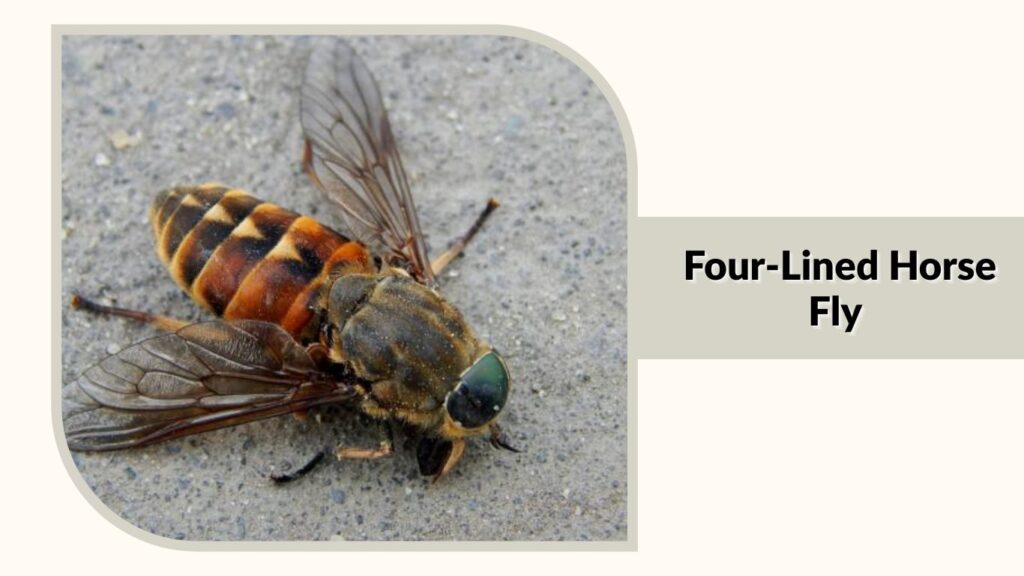
The four-lined horse fly is a pale, medium-sized species with a large head and subtle dark stripes running along its abdomen. It is often associated with warm wetlands, coastal marshes, grazing fields, and other open habitats containing suitable moist ground for larval development.
Identification
- Scientific name: Atylotus rusticus
- Family: Tabanidae
- Body color: Olive-gray
- Abdominal markings: Paired dark longitudinal stripes
- Eyes: Pale green with shifting dark spots in females
- Antennae: Mostly orange
- Adult size: Approximately 12–13 mm long
Size and Appearance
Fresh females are covered with fine olive-gray hairs. Two dark stripes run along the abdomen, with additional dark spots near the sides. The front femora are mostly black. Males have much larger heads, pale green eyes, weaker abdominal stripes, and dull orange patches along the first abdominal segments.
Habitat and Distribution
This horse fly occurs across parts of Europe and neighboring regions. It favors lowland wetlands, grazing marshes, coastal levels, fenland, and other open areas with damp soil. Its distribution can be localized because suitable breeding habitats have declined through drainage and development.
Diet and Behavior
Males commonly visit flowers for nectar and pollen. Females also use plant sugars but require blood for successful egg development. They may target livestock, wildlife, or people. Adults are strongest during warm summer weather and are usually encountered in open, sunny habitats.
22. Notch-Horned Cleg (Haematopota pluvialis)
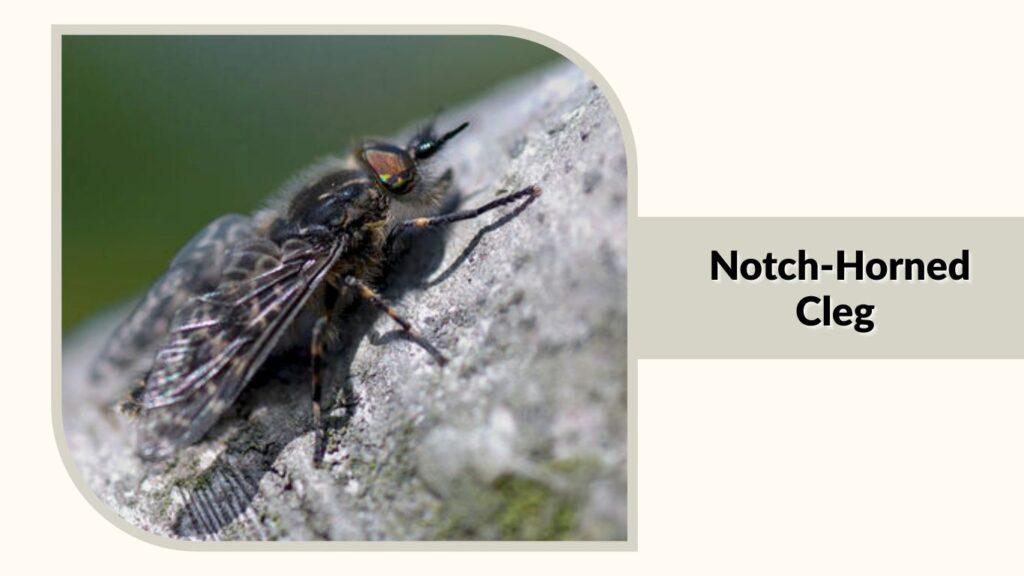
The notch-horned cleg is a small, widespread horse fly recognized by its mottled wings and colorful patterned eyes. It is sometimes called the common cleg. Females are persistent blood feeders capable of delivering painful bites, while males are harmless flower visitors.
Identification
- Scientific name: Haematopota pluvialis
- Family: Tabanidae
- Body color: Olive-brown or gray-brown
- Wings: Strongly mottled and held rooflike
- Eyes: Iridescent with wavy colored bands
- Antennae: First segment notched near the tip in females
- Adult size: Approximately 8–12 mm long
Size and Appearance
This species has a narrower body than many large Tabanus horse flies. The patterned wings fold over the abdomen when resting. Females have separated eyes with bands extending across them, while male eyes meet above the head and display bands mainly across the lower portion.
Habitat and Distribution
The notch-horned cleg is common across Britain and occurs widely through Europe and other parts of the Palearctic region. It lives around livestock pastures, damp woodlands, moorlands, marshes, and rural gardens. Larvae develop in damp soil and decaying wood.
Diet and Behavior
Females cut the skin of horses, cattle, humans, and other mammals before feeding on the blood that collects around the wound. Males feed on nectar and do not bite. Adults may be encountered from May through October, with activity increasing during warm, humid conditions.
23. Black-Horned Cleg (Haematopota crassicornis)
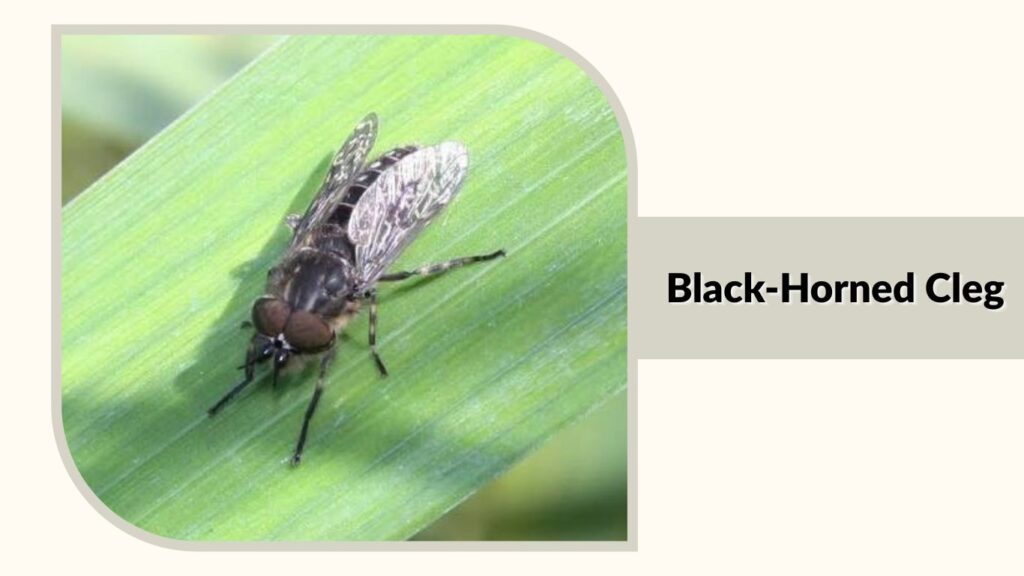
The black-horned cleg is a dark, patterned horse fly named for its completely black antennae. It resembles the notch-horned cleg but normally appears grayer and more strongly marked. Females may actively bite humans and livestock in woodland, pasture, and wetland habitats.
Identification
- Scientific name: Haematopota crassicornis
- Family: Tabanidae
- Body color: Dark gray
- Antennae: Completely black
- Abdomen: Gray with paired pale spots
- Wings: Gray and mottled
- Flight season: May to early September
Size and Appearance
Females have pale gray markings on the thorax and paired spots across several abdominal segments. Their first antennal segments are thick and partly shiny but lack the distinctive notch found on female H. pluvialis. Males have particularly dark abdomens without orange markings on the second and third segments.
Habitat and Distribution
This species is widespread across Britain and occurs in several parts of Europe. It inhabits moist woodland, pond margins, damp pastures, upland areas, and wooded countryside. The immature stages probably develop as predators in wet decaying vegetation or damp soil.
Diet and Behavior
Males visit flowers and consume nectar. Females obtain blood from large mammals, including horses, cattle, deer, and humans. They can be persistent around moving hosts and are most noticeable during warm summer days in damp, sheltered landscapes.
24. Long-Horned Cleg (Haematopota grandis)
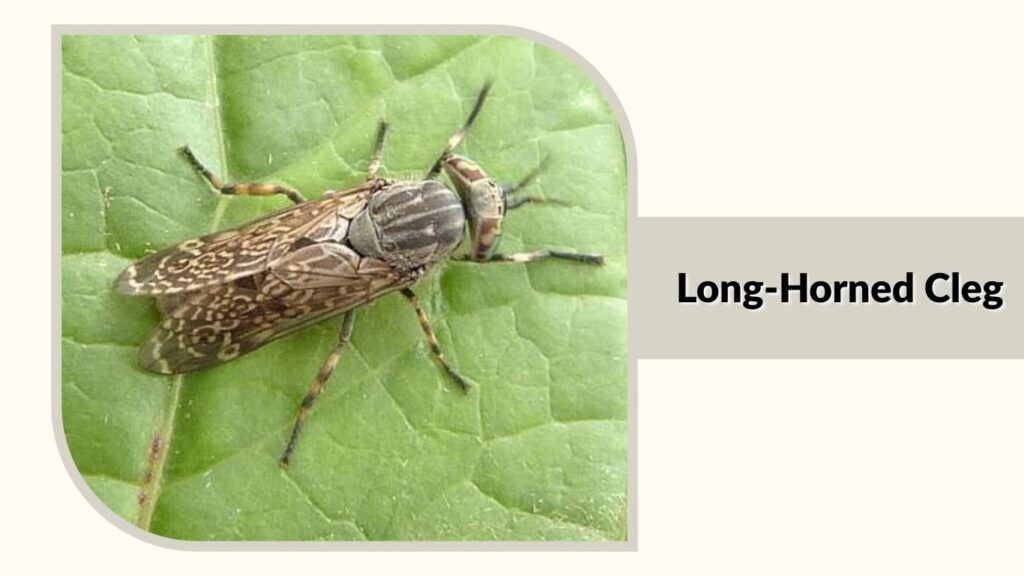
The species previously listed as the large marsh horse fly is more commonly known as the long-horned cleg. It is a patterned European horse fly distinguished by its unusually long first antennal segment. The species is strongly associated with coastal wetlands, especially salt-marsh environments.
Identification
- Scientific name: Haematopota grandis
- Family: Tabanidae
- Common name: Long-horned cleg
- Body color: Gray-brown
- Wings: Mottled with pale and dark markings
- Antennae: First segment unusually long
- Adult size: Approximately 9–13 mm long
Size and Appearance
Long-horned clegs have relatively narrow bodies, patterned wings, large compound eyes, and elongated antennae. The exceptionally long first antennal segment separates them from similar coastal clegs. Detailed identification may require close photographs or examination because several Haematopota species share similar wing patterns.
Habitat and Distribution
This species occurs across parts of Europe, including regions of central, southern, eastern, and northern Europe. It is particularly associated with salt marshes and other low-lying coastal wetlands. Adults may rest among tall grasses and vegetation near muddy breeding areas.
Diet and Behavior
Females are blood feeders and may target livestock or people visiting coastal wetlands. Males are expected to rely mainly on nectar and other plant sugars, as is typical among clegs. Adults are usually active during warm daylight hours when marsh vegetation is dry enough for flight.
25. Golden-Eyed Horse Fly (Philipomyia aprica)
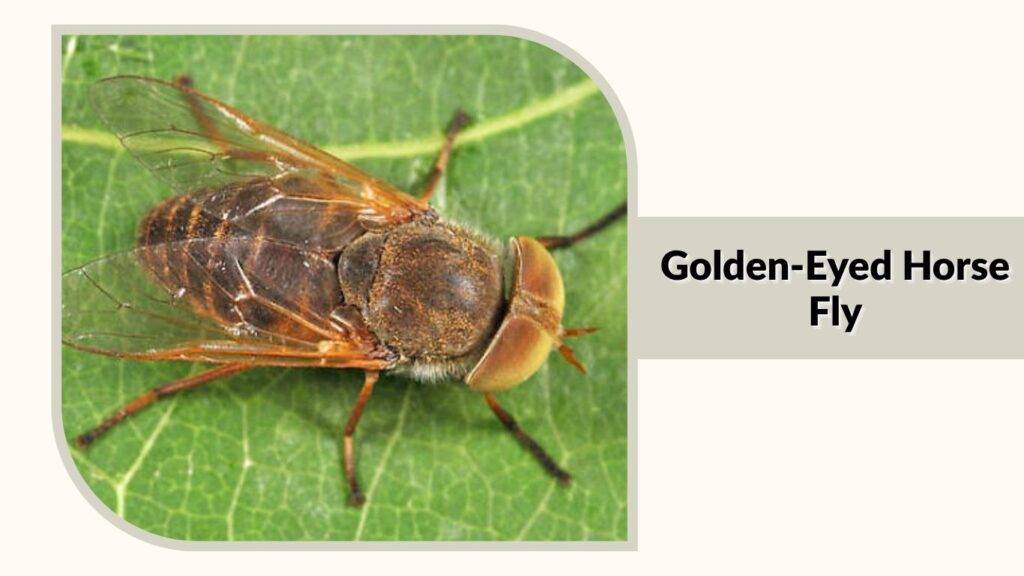
The golden-eyed horse fly is a medium-to-large Eurasian species with brilliant green-reflecting eyes, a hairy brown thorax, and yellow-brown wings and legs. It is particularly noticeable during summer in sunny meadows, peat bogs, and mountain pastures where adults frequently visit flowers.
Identification
- Scientific name: Philipomyia aprica
- Family: Tabanidae
- Thorax: Dark brown and hairy
- Abdomen: Brown-black with pale segment margins
- Eyes: Red-brown with bright green reflections
- Wings and legs: Yellowish-brown
- Adult size: Females about 18 mm; males about 15 mm
Size and Appearance
This species has a strong, compact body and enormous compound eyes. Female eyes are separated and often appear greener, while male eyes meet across the top of the head and may appear reddish. The pointed antennae, hairy thorax, translucent yellow-brown wings, and pale abdominal bands aid identification.
Habitat and Distribution
Philipomyia aprica occurs throughout much of Europe and extends through the Caucasus, Turkey, Iran, the Middle East, and parts of Central Asia. Adults inhabit sunny meadows, mountain pastures, peat bogs, and other open landscapes containing abundant flowering plants.
Diet and Behavior
Adults commonly feed on nectar and pollen, particularly from flowers in the carrot family. Fertilized females also seek blood from cattle, horses, other large mammals, and occasionally humans. They are active daytime fliers and are most frequently encountered during the warm summer months.
FAQs
1. Are all horse flies dangerous to humans?
Horse flies are not usually dangerous, but female horse flies can deliver painful bites. Their bites may cause redness, swelling, itching, and irritation. Serious allergic reactions are uncommon, although sensitive individuals may experience stronger symptoms and should seek medical attention if breathing problems or severe swelling develop.
2. Why do horse flies bite people?
Only female horse flies bite because they need protein from blood to produce eggs. They use sharp mouthparts to cut the skin and then drink the blood. Males do not bite and instead feed on nectar, pollen, honeydew, and other sugary plant liquids.
3. Where do horse flies usually live?
Horse flies commonly live near ponds, marshes, rivers, wetlands, muddy fields, forests, and livestock pastures. Their larvae usually develop in moist soil, mud, or shallow water. Adults may travel away from breeding sites while searching for animals, people, flowers, or suitable egg-laying locations.
4. What is the largest type of horse fly?
The American horse fly and several giant Tabanus species are among the largest horse flies. Some adults can grow more than 30 millimeters long. Their heavy bodies, large eyes, powerful wings, and loud buzzing sounds make them much more noticeable than smaller clegs or deer flies.
5. How can you avoid horse fly bites?
Wear long sleeves, long pants, and light-colored clothing when visiting wetlands, farms, or wooded areas. Insect repellent may provide some protection, although horse flies can be persistent. Avoid outdoor activity during hot daylight hours when they are most active, especially near livestock and standing water.