
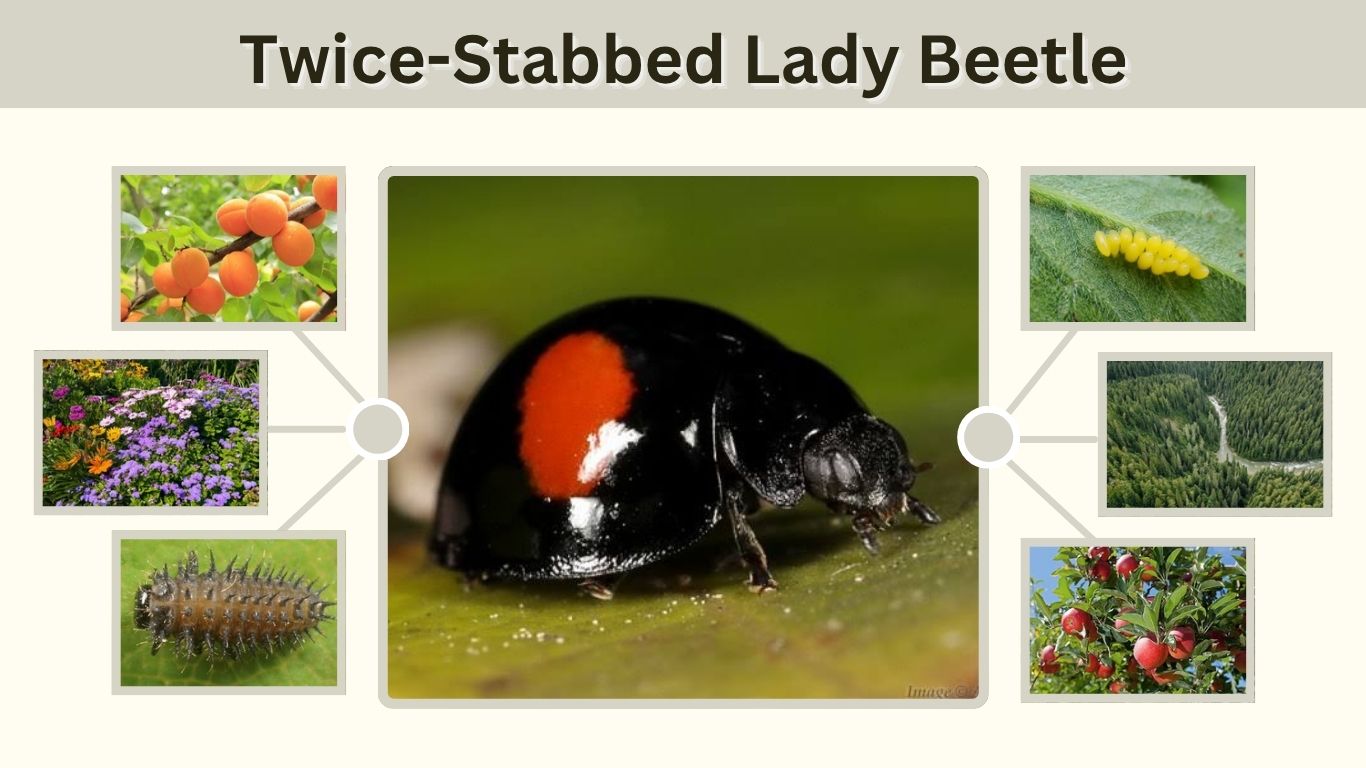
The twice-stabbed lady beetle (Chilocorus stigma) is a fascinating insect recognized by its shiny black body and two bright red spots. Unlike many familiar ladybugs, this species has a distinctive appearance and plays an important role in controlling harmful garden pests. Although its unusual name and dark coloration may seem intimidating, it is generally harmless to humans. Understanding the twice-stabbed lady beetle’s identification, habitat, diet, life cycle, and spiritual meaning can help you appreciate this beneficial insect.
What Is a Twice-Stabbed Lady Beetle?
The twice-stabbed lady beetle is a small predatory beetle native to North America. Its scientific name is Chilocorus stigma, and it belongs to the lady beetle family, Coccinellidae. Despite its unusual appearance, it is closely related to other ladybugs commonly found in gardens, forests, and agricultural landscapes.
Scientific Classification
- Common name: Twice-Stabbed Lady Beetle
- Scientific name: Chilocorus stigma
- Kingdom: Animalia
- Phylum: Arthropoda
- Class: Insecta
- Order: Coleoptera
- Family: Coccinellidae
- Genus: Chilocorus
- Species: C. stigma
Why Is It Called Twice-Stabbed?
The name comes from the two distinctive red spots on its glossy black wing covers. These markings resemble tiny red punctures, giving the insect its dramatic common name.
However, the name does not describe its behavior. Twice-stabbed lady beetles do not possess stingers and do not attack people. Their strong chewing mouthparts are primarily adapted for feeding on small insects.
Twice-Stabbed Lady Beetle Identification
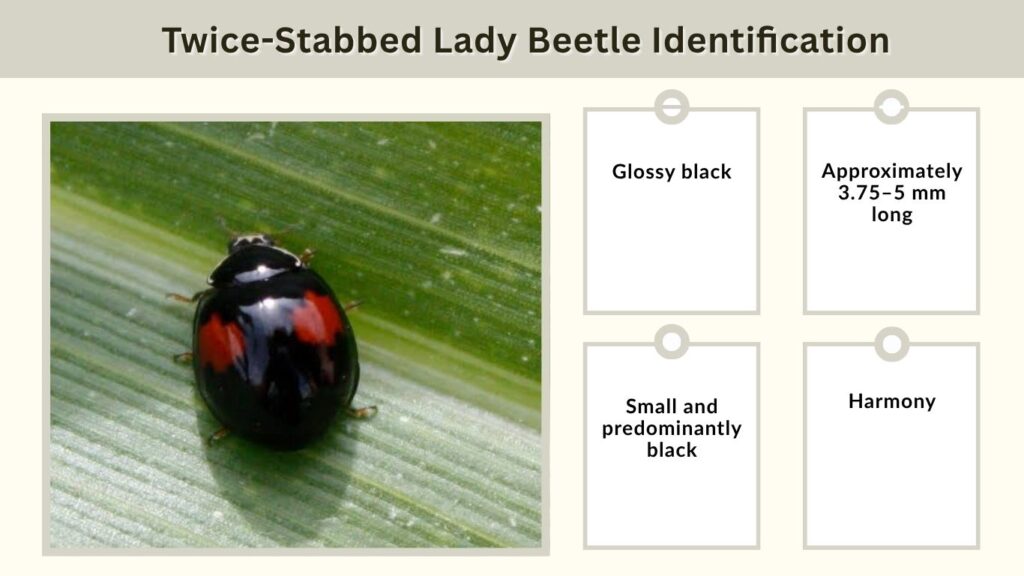
Identifying a twice-stabbed lady beetle is relatively easy when its distinctive markings are clearly visible. Unlike typical red ladybugs with black spots, this species displays the opposite coloration. Its compact body, shiny surface, and bright red markings make it recognizable on tree trunks, branches, and leaves.
Physical Appearance
- Body color: Glossy black.
- Spots: Two prominent red or orange-red spots, one on each wing cover.
- Size: Approximately 3.75–5 mm long.
- Body shape: Rounded, compact, and strongly dome-shaped.
- Head: Small and predominantly black.
- Legs: Short and usually dark.
- Underside: Mostly black, with a reddish or yellowish abdomen.
These characteristics help distinguish Chilocorus stigma from many other North American lady beetles.
Twice-Stabbed Lady Beetle vs. Asian Lady Beetle
The twice-stabbed lady beetle and Asian lady beetle (Harmonia axyridis) belong to the same family but differ in appearance.
Twice-stabbed lady beetles usually have glossy black wing covers with two red spots. Asian lady beetles commonly appear yellow, orange, or red with variable black markings, although some forms are predominantly black.
Asian lady beetles also commonly have pale markings around the pronotum, sometimes forming an M-shaped pattern. Both species are predators of agricultural pests, but Asian lady beetles are more frequently associated with large household aggregations.
Twice-Stabbed Lady Beetle Habitat and Diet
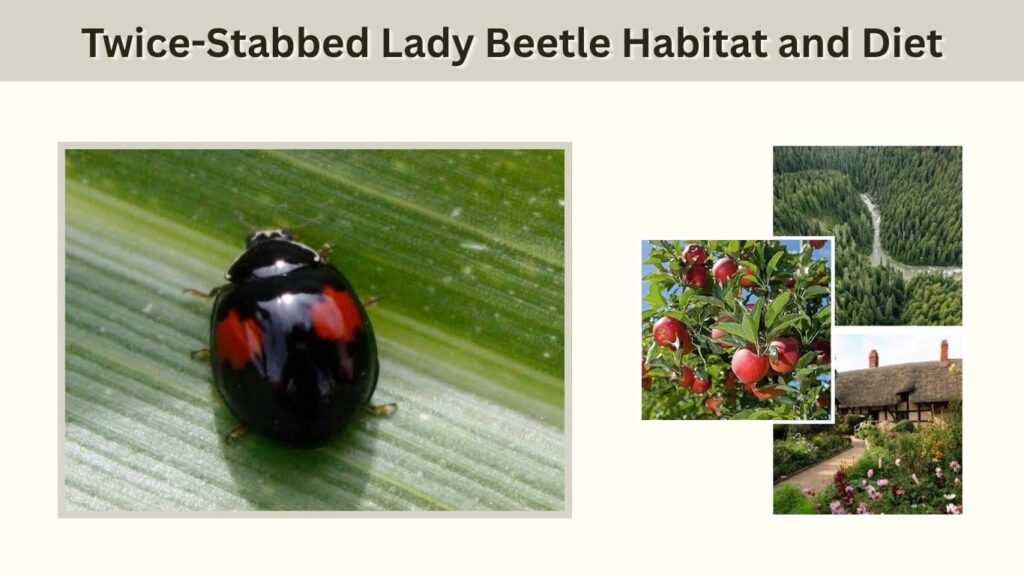
Twice-stabbed lady beetles primarily inhabit environments containing trees and shrubs. Their distribution is closely associated with suitable prey, particularly scale insects. They are valuable natural predators in forests, orchards, and managed landscapes, where they help reduce populations of insects that damage plants.
Where Do Twice-Stabbed Lady Beetles Live?
This species occurs across much of the United States and southern Canada, especially in eastern and central regions. It is generally absent from areas west of the Sierra Nevada.
Common habitats include deciduous forests, conifer plantations, orchards, gardens, and wooded landscapes.
Adults frequently explore tree bark, branches, and leaves while searching for prey. They may also hide in protected locations during colder months.
What Do Twice-Stabbed Lady Beetles Eat?
Both adults and larvae are predators that consume small plant-feeding insects. Their preferred prey includes:
- Armored scale insects
- Pine needle scale insects
- Beech bark scale insects
- Aphids
- Mealybugs
These feeding habits make twice-stabbed lady beetles beneficial for natural pest management. By consuming scale insects, they can reduce pest pressure on trees without damaging healthy plant tissues.
Twice-Stabbed Lady Beetle Life Cycle
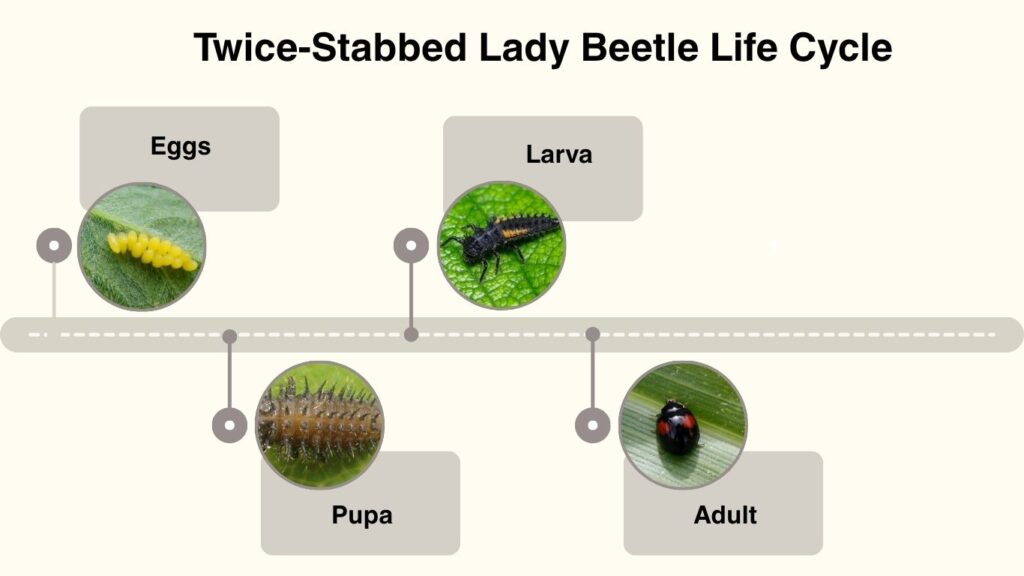
The twice-stabbed lady beetle undergoes complete metamorphosis, progressing through four developmental stages: egg, larva, pupa, and adult. Environmental temperatures and food availability influence its development. In northern regions, the species commonly produces two generations annually, while warmer climates may support several generations.
1. Egg Stage
Female twice-stabbed lady beetles lay small orange eggs, approximately 1.1 mm long. Eggs may be deposited individually or in small groups near suitable feeding areas.
Placing eggs near scale insect colonies improves the likelihood that emerging larvae will find prey.
2. Larval Stage
Twice-stabbed lady beetle larvae look remarkably different from adults. They have elongated, dark gray or black bodies covered with prominent spines.
The larvae actively search for scale insects and other small prey. They pass through four larval instars, shedding their outer covering as they grow.
This is an important feeding stage because developing larvae consume pests while accumulating energy for metamorphosis.
3. Pupal Stage
After completing larval development, the insect enters the pupal stage, often attaching itself to a protected surface.
During this period, its internal structures undergo substantial changes. The pupa generally remains stationary while the adult body forms.
4. Adult Stage
The newly emerged adult eventually develops its characteristic shiny black coloration and red spots.
Adults continue feeding on scale insects and can reproduce when mature. In colder regions, they survive winter in sheltered places such as ground litter and become active again during spring.
Are Twice-Stabbed Lady Beetles Poisonous or Dangerous?
Despite their striking coloration, twice-stabbed lady beetles are not considered dangerous to humans. They do not sting, spread infections through normal contact, or damage household structures. However, like other lady beetles, they possess defensive characteristics that help discourage predators from eating them.
Are Twice-Stabbed Lady Beetles Poisonous?
Twice-stabbed lady beetles are not considered a poisoning hazard from ordinary contact with humans.
Lady beetles can possess distasteful chemical defenses, and many species release defensive body fluid when disturbed. These substances discourage predators and may cause irritation under certain circumstances.
Therefore, the beetle should not be eaten or deliberately crushed against the skin. Its coloration may serve as a warning to potential predators.
Do Twice-Stabbed Lady Beetles Bite?
Twice-stabbed lady beetles have chewing mouthparts, but they are not aggressive toward humans.
An occasional defensive pinch may be possible when a beetle is trapped or handled roughly. Such contact is not generally considered medically significant.
If irritation occurs, gently wash the affected skin with soap and water. Avoid squeezing or crushing the beetle unnecessarily.
Twice-Stabbed Lady Beetle Spiritual Meaning
The twice-stabbed lady beetle sometimes attracts spiritual curiosity because of its unusual black body and two red spots. Although science does not associate insects with supernatural messages, some people interpret encounters with distinctive ladybugs through cultural symbolism, personal beliefs, and traditional ideas about luck.
Spiritual Symbolism and Interpretations
Some symbolic interpretations associate twice-stabbed lady beetles with:
- Protection: The dark body can represent safety or protection from negative influences.
- Transformation: Its metamorphosis may symbolize personal growth and positive changes.
- Balance: The two red spots may represent harmony between opposing forces.
- Good fortune: Like other ladybugs, it may be viewed as a symbol of luck.
These meanings are personal or cultural interpretations rather than established biological facts. There is no universally recognized spiritual meaning specific to Chilocorus stigma.
Are Twice-Stabbed Lady Beetles Beneficial for Gardens?
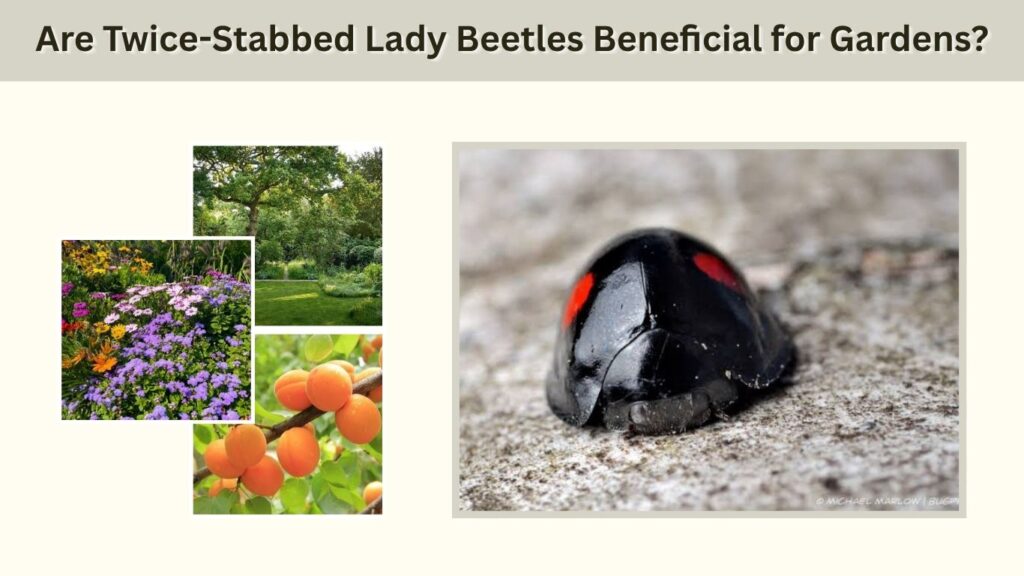
Twice-stabbed lady beetles are useful natural enemies of several destructive plant pests. Their ability to feed on armored scale insects makes them especially valuable around trees, shrubs, and orchards. Gardeners can support these beetles by maintaining suitable habitats and avoiding unnecessary pesticide applications.
How to Attract and Protect Them
Encouraging twice-stabbed lady beetles involves creating conditions that support natural predator populations.
- Maintain healthy trees and shrubs that provide suitable habitats.
- Reduce unnecessary broad-spectrum insecticide applications.
- Preserve some leaf litter and sheltered overwintering areas.
- Monitor scale insect populations before using chemical treatments.
- Protect beneficial insects already living in the garden.
Although some lady beetle species are commercially available for biological control, Chilocorus stigma is not commonly offered through commercial suppliers. Protecting naturally occurring populations is generally the more practical approach.
FAQs
1. Are Twice-Stabbed Lady Beetles Rare?
Twice-stabbed lady beetles are not generally considered rare across their native range. However, their abundance varies depending on location, habitat, and prey availability. They may be easier to find on trees affected by scale insects than in gardens without suitable feeding conditions.
2. What Is a Twice-Stabbed Cactus Lady Beetle?
The twice-stabbed cactus lady beetle (Chilocorus cacti) is a related but separate species. It also has a black body with two reddish spots. It occurs in warmer regions and may be found on cacti and trees. Examination of underside coloration can help distinguish it from Chilocorus stigma.
3. Can Twice-Stabbed Lady Beetles Fly?
Yes, adult twice-stabbed lady beetles can fly. Their hardened wing covers protect functional flight wings underneath. Flying allows them to move between trees, locate new prey populations, find mates, and disperse into suitable habitats when feeding conditions change.
4. What Do Twice-Stabbed Lady Beetle Larvae Look Like?
Twice-stabbed lady beetle larvae have elongated black or dark gray bodies covered with noticeable spines. They look very different from the rounded adults and may resemble small spiny caterpillars. These larvae are beneficial predators and should generally be left undisturbed when discovered on plants.
5. What Should I Do If I Find a Twice-Stabbed Lady Beetle?
If you find a twice-stabbed lady beetle outdoors, it is usually best to leave it alone. It helps control scale insects and other pests. If one enters your home, gently collect it in a container and release it outdoors in a suitable sheltered area.
