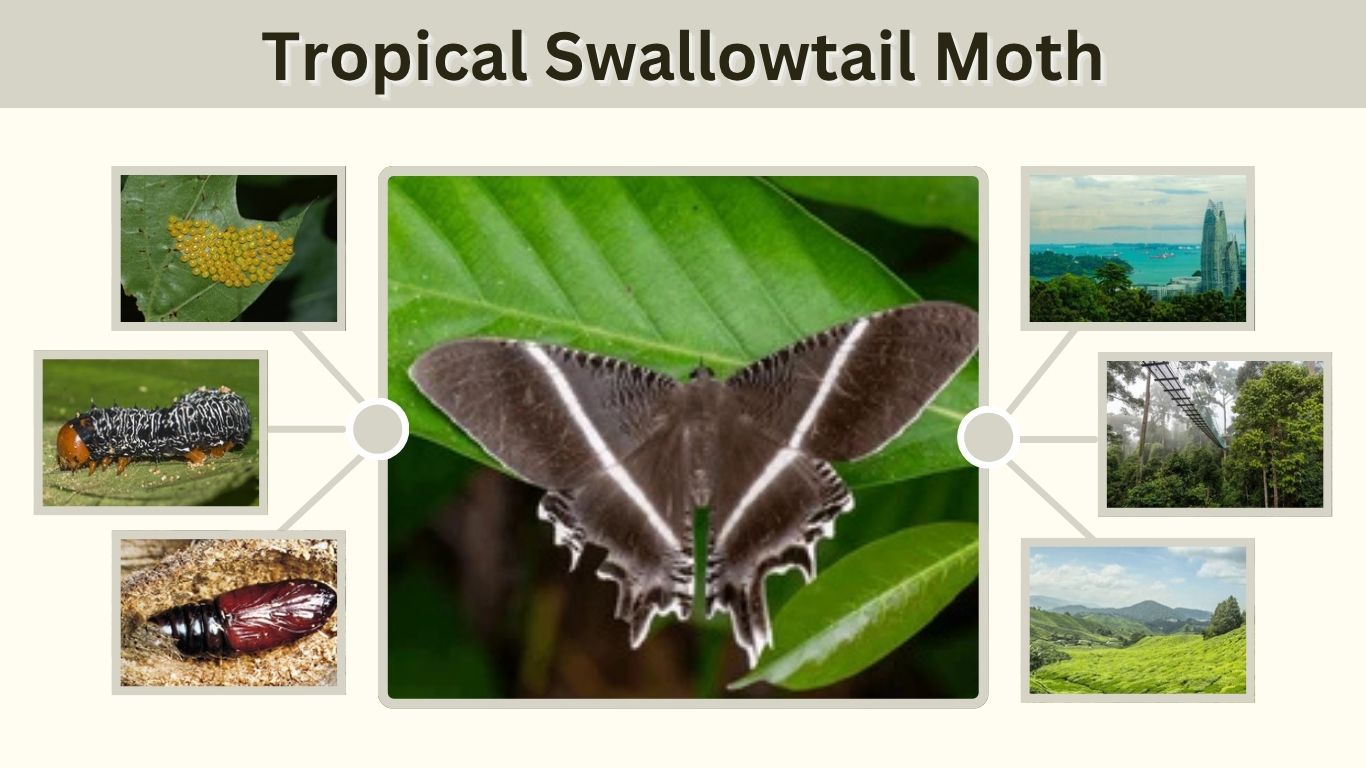
The tropical swallowtail moth is a spectacular large moth known for its broad brown wings, pale bands, and long swallowtail-like extensions. Scientifically called Lyssa zampa, it occurs mainly across tropical and subtropical parts of Asia and is sometimes attracted to bright lights in cities. Despite its dramatic size, this moth is not considered dangerous to people. Its unusual appearance has also inspired questions about symbolism and spiritual meaning. Here is everything to know about its identification, caterpillar, habitat, life cycle, lifespan, and behavior.
What Is a Tropical Swallowtail Moth?
The tropical swallowtail moth (Lyssa zampa) belongs to the family Uraniidae. It is sometimes called the giant uraniid swallowtail or Laos brown butterfly, although it is a moth rather than a butterfly. It is one of the largest uraniid moths and can become especially noticeable when large numbers emerge at the same time.
Identification
Important identification features include:
- Scientific name: Lyssa zampa
- Family: Uraniidae
- Wingspan: Approximately 10–16 cm
- Color: Mainly grayish-brown to dark brown
- Wing markings: Broad pale or whitish bands
- Hindwings: Long tail-like extensions
- Body: Relatively slender compared with the wings
- Activity: Can be active during both daytime and nighttime
- Attraction: Frequently attracted to artificial lights
The long hindwing tails and large wings make the species look somewhat like a swallowtail butterfly, explaining its common name.
Male vs Female
Male and female tropical swallowtail moths look very similar. Females tend to be slightly larger and can appear somewhat lighter in coloration.
Sex differences are much less obvious than in species where males and females have dramatically different markings. Close examination is often necessary to determine sex accurately.
Where Do Tropical Swallowtail Moths Live?
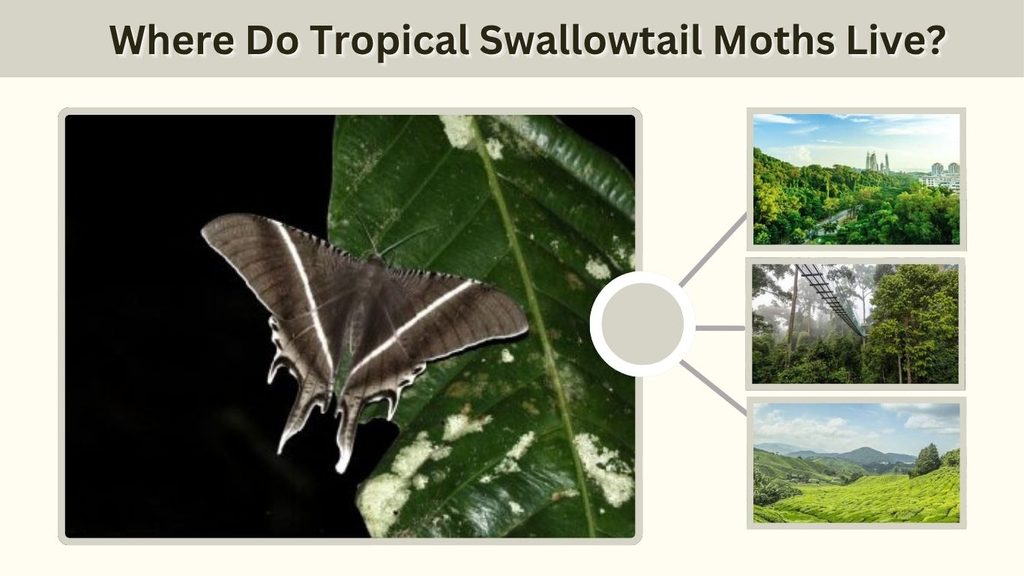
The tropical swallowtail moth is primarily an Asian species associated with tropical and subtropical forests. Its distribution extends across a broad portion of Southeast Asia and into parts of the Himalayan and East Asian regions. The availability of larval host plants is particularly important because caterpillars depend on specific trees for food.
Distribution
The species has been recorded in areas including:
- Malaysia
- Singapore
- Indonesia
- Thailand
- The Philippines
- Parts of India
- Southern China
- Taiwan
- Japan
- Himalayan regions
Its core distribution is centered in Southeast Asia, although occasional records occur farther north and west.
Habitat
Tropical swallowtail moths are strongly associated with forest habitats, including primary and mature secondary rainforest.
Adults sometimes appear far from obvious forest habitat because they are powerful fliers and are attracted to artificial lights. Large moths may therefore turn up on apartment buildings, walls, streets, sports fields, and other urban areas near suitable habitat.
In Singapore, large seasonal emergencies have resulted in unusually high numbers appearing in urban areas.
Tropical Swallowtail Moth Caterpillar
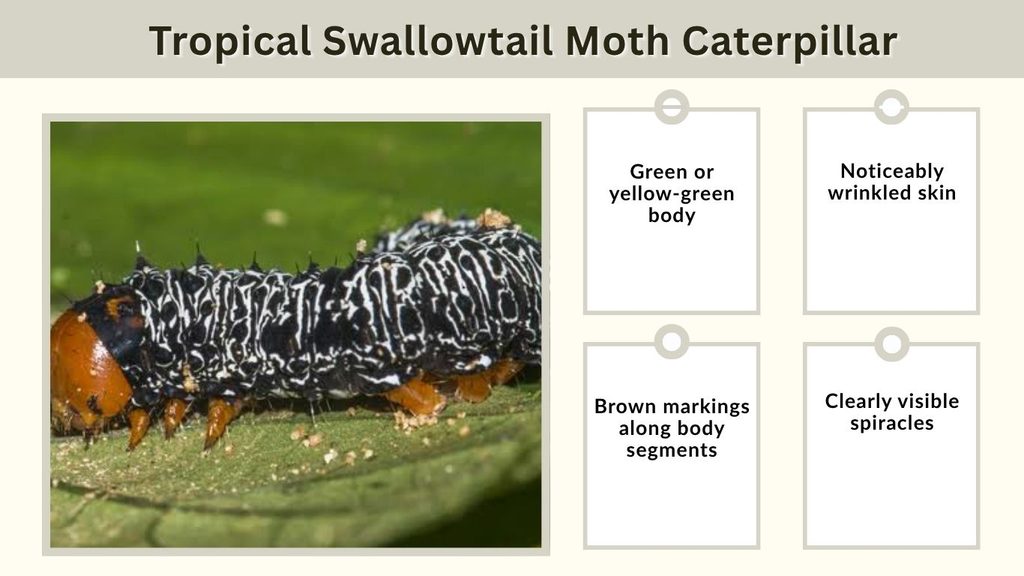
The tropical swallowtail moth caterpillar looks very different from the adult. Larvae spend most of their time feeding and growing on suitable host plants before eventually descending from the trees to pupate. Observations in Singapore have documented final-instar caterpillars around 3.5–4 cm long before pupation.
What Does the Caterpillar Look Like?
The caterpillar is generally pale green to yellow-green, helping it blend with foliage.
Typical features include:
- Green or yellow-green body
- Brownish or reddish-brown head
- Noticeably wrinkled skin
- Brown markings along body segments
- Clearly visible spiracles
- Darker coloration in younger stages
- Strong chewing mouthparts
Young caterpillars can look darker than mature larvae.
What Do the Caterpillars Eat?
One of the best-documented larval host plants is Endospermum diadenum, a tree in the Euphorbiaceae family. Other Endospermum species have also been associated with Lyssa caterpillars.
The caterpillars feed heavily on foliage as they grow. During large outbreaks, groups can remove substantial amounts of leaves from host trees.
This heavy feeding is temporary, and documented host trees have been observed producing new foliage afterward.
Caterpillar Defense
Tropical swallowtail moth caterpillars can use silk as an escape mechanism.
When disturbed, a larva may drop from its host plant while remaining suspended by a silk thread. This behavior can quickly move it away from predators or other threats.
When ready to pupate, mature caterpillars may descend toward the ground and pupate among fallen leaves and other material around the host tree.
Tropical Swallowtail Moth Life Cycle
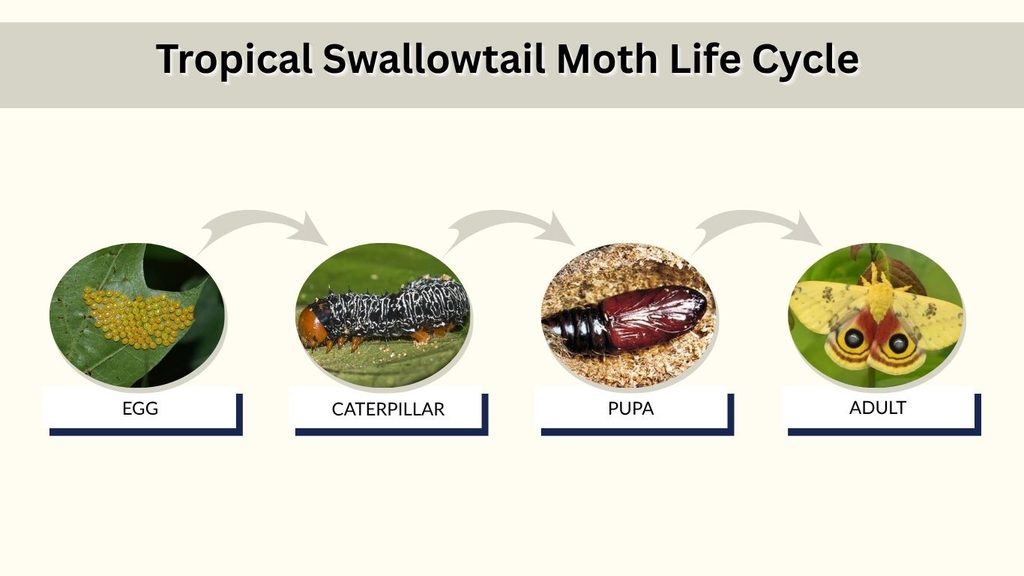
Like butterflies and other moths, Lyssa zampa undergoes complete metamorphosis. Its development passes through four major stages: egg, caterpillar, pupa, and adult. Much of the insect’s growth occurs during the caterpillar stage, while the adult stage is mainly devoted to dispersal and reproduction.
Egg to Caterpillar
The life cycle begins when females deposit eggs associated with suitable host plants.
After hatching, young caterpillars begin feeding on leaves. They grow through several instars, shedding their skin each time their bodies become too large for the existing outer covering.
Feeding becomes increasingly intensive as the larvae mature.
Pupal Stage
Once mature, the caterpillar stops feeding and prepares for metamorphosis.
Some documented tropical swallowtail moth caterpillars descend from their host trees on silk threads and pupate among leaf litter. In one documented Assam observation, a larva pupated on February 24 and the adult emerged on March 19, giving a pupal period of about 23 days in those particular conditions.
Adult Moth
After metamorphosis is complete, the adult emerges with soft wings that must expand and harden before normal flight.
Adults can travel considerable distances and may congregate around lights. Large emergences sometimes result in hundreds or even thousands of moth observations within a relatively short period.
Tropical Swallowtail Moth Lifespan
There is no single well-established lifespan that applies to every tropical swallowtail moth because development and survival vary with temperature, food, predators, and environmental conditions. The adult stage is relatively short compared with the feeding and development stages.
How Long Does the Adult Live?
Limited captive observations show considerable variation.
In one study involving four reared adults, survival after emergence ranged from roughly one day to 10.5 days. The longest-lived individual was regularly provided with nectar solution, while others survived shorter periods. These limited observations should not be treated as an exact lifespan for every wild moth.
The complete life cycle lasts considerably longer because the insect spends time as an egg, caterpillar, and pupa before becoming an adult.
Why Is the Adult Stage Short?
The primary biological purposes of an adult moth are reproduction and dispersal.
The caterpillar stage handles most growth and feeding. Once adulthood is reached, energy is directed toward locating mates, reproducing, moving between habitats, and producing the next generation.
Is the Tropical Swallowtail Moth Dangerous?
Despite its intimidating size, the tropical swallowtail moth is not considered dangerous to humans. There is no evidence that adults are venomous or equipped with a stinger, and they do not normally attack people.
Can Tropical Swallowtail Moths Bite?
There are no reports suggesting that these moths normally bite or sting people. Their adult mouthparts are not designed to inflict defensive bites on humans.
They may fly unexpectedly around lights or land on buildings, but this behavior does not indicate aggression. Available species information describes biting, stinging, venom, and defensive attacks as unreported.
Are the Caterpillars Dangerous?
Tropical swallowtail moth caterpillars are not known for the venomous spines or urticating hairs found on certain medically significant caterpillars.
Even so, avoiding unnecessary handling of unfamiliar wild caterpillars is sensible because individual skin sensitivities can vary.
Their major ecological impact comes from eating leaves rather than harming people.
Why Are Tropical Swallowtail Moths Attracted to Lights?
Tropical swallowtail moths are frequently observed around artificial lighting, particularly during periods of mass emergence. Bright urban lights can draw moths away from forest environments and into developed areas.
Mass Emergence
Large numbers of adults can emerge during favorable periods.
Such events have been documented in Southeast Asia, including Singapore and Malaysia. A major emergence in Singapore during May and June 2014 produced numerous observations throughout urban areas.
Mass appearances can make the species seem suddenly abundant even when few moths were visible weeks earlier.
Attracted individuals sometimes spend the following day resting on walls, buildings, trees, or other sheltered surfaces.
Tropical Swallowtail Moth Meaning and Symbolism
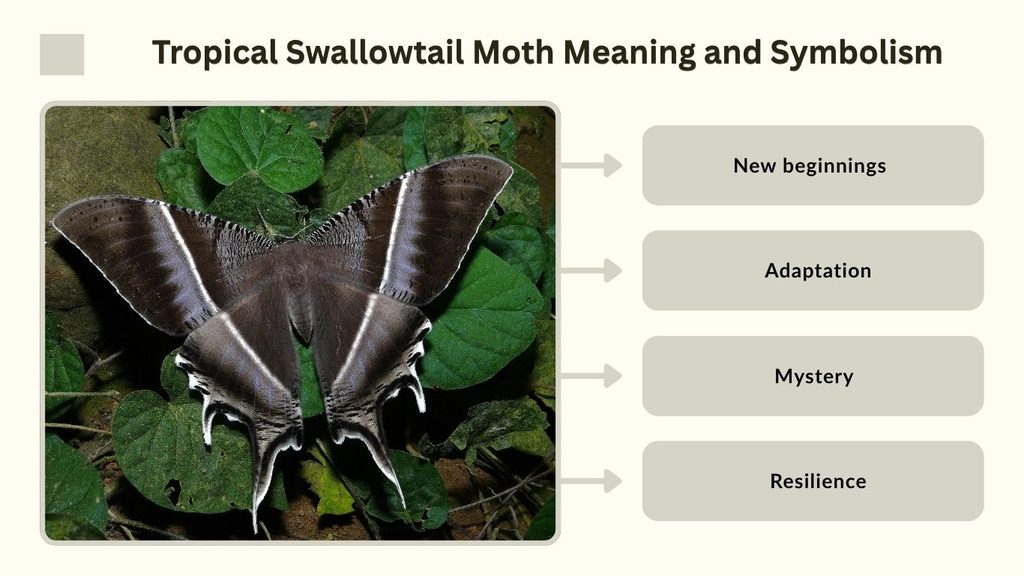
There is no scientifically established spiritual meaning attached to the tropical swallowtail moth. Symbolism surrounding moths comes from cultural traditions, personal beliefs, and interpretations rather than biology. Its dramatic transformation and nighttime behavior nevertheless make it easy to understand why people associate the species with change and mystery.
Tropical Swallowtail Moth Spiritual Meaning
People may interpret an encounter as representing:
- Transformation
- Personal change
- New beginnings
- Adaptation
- Mystery
- Resilience
- Moving through uncertainty
- Attraction toward a goal or “light”
These interpretations are symbolic rather than scientific facts.
Symbolism of Transformation
The strongest natural connection to transformation comes from the moth’s life cycle.
A caterpillar completely reorganizes its body during the pupal stage before emerging as a winged adult. Because of this metamorphosis, moths and butterflies are widely used as symbols of transformation, growth, and transition.
Seeing a tropical swallowtail moth therefore has no proven supernatural prediction or universal message, but individuals can still assign personal or cultural meaning to the experience.
FAQs
Is the tropical swallowtail moth rare?
Its abundance varies considerably by location and season. It can appear uncommon for long periods and then become extremely conspicuous during seasonal mass emergences.
How big is a tropical swallowtail moth?
Adults can have a wingspan of approximately 10–16 cm, making Lyssa zampa one of the largest members of the Uraniidae family.
Is a tropical swallowtail moth a butterfly?
No. Despite its swallowtail-like wings and the alternative name “Laos brown butterfly,” Lyssa zampa is a true moth belonging to the family Uraniidae.
What do tropical swallowtail moth caterpillars eat?
The caterpillars feed on host trees, especially species of Endospermum. Endospermum diadenum is a well-documented host in Singapore.
What does seeing a tropical swallowtail moth mean?
Biologically, it simply means the moth is present in that environment, possibly while dispersing or being attracted to light. Spiritual interpretations involving transformation, change, or renewal are cultural or personal beliefs rather than scientifically demonstrated meanings.