
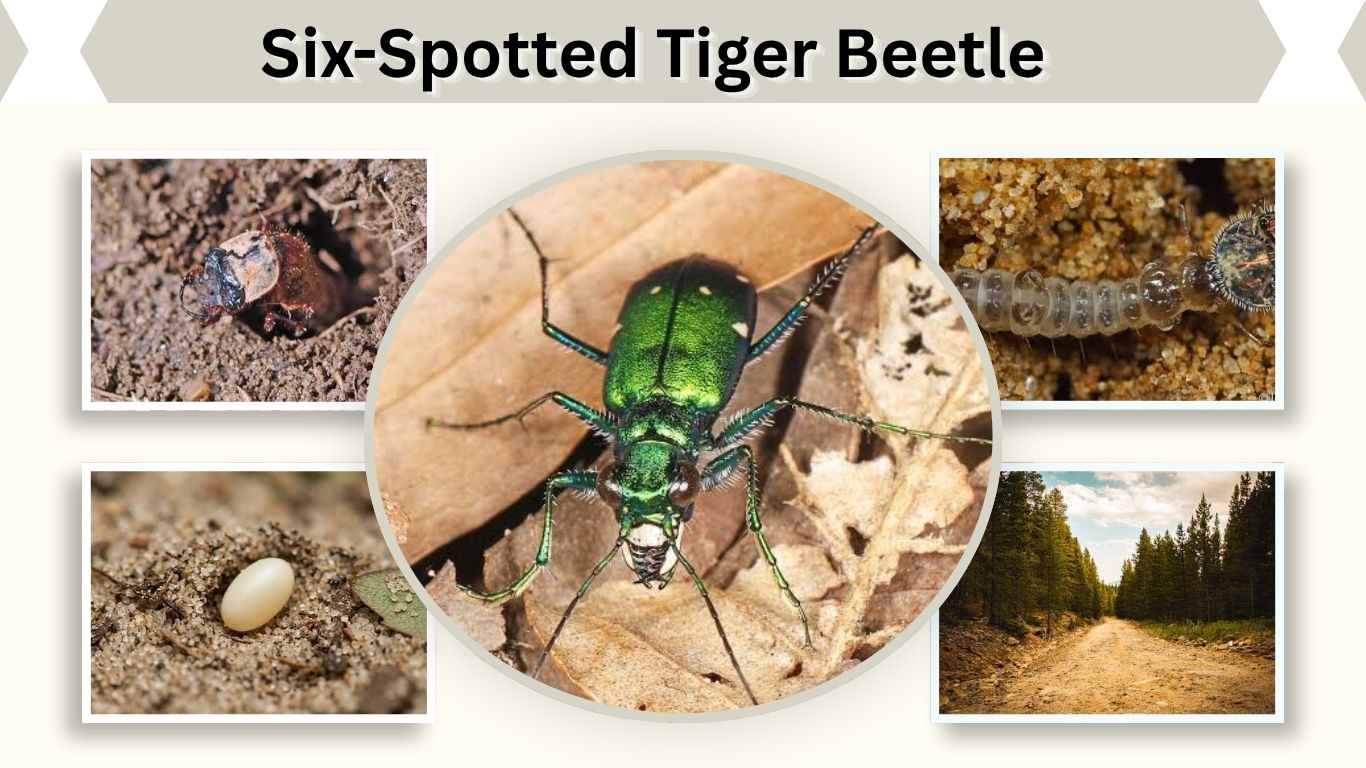
The six-spotted tiger beetle (Cicindela sexguttata) is a beautiful metallic-green insect commonly found in forests, gardens, and woodland trails across eastern North America. Known for its remarkable speed, powerful jaws, and distinctive white spots, this beetle is an active predator that helps control small insects. Although its appearance resembles the invasive emerald ash borer, the six-spotted tiger beetle is a beneficial native species. Understanding its identification, habitat, diet, life cycle, and biting behavior can help you recognize this fascinating insect in nature.
What Is a Six-Spotted Tiger Beetle?
The six-spotted tiger beetle is a small predatory beetle belonging to the ground beetle family, Carabidae. Its scientific name is Cicindela sexguttata, and it is also called the six-spotted green tiger beetle.
Unlike beetles that feed on plants or wood, this species actively hunts smaller arthropods. Its bright coloring, exceptional running ability, and specialized mouthparts make it distinctive among North American beetles.
Six-Spotted Tiger Beetle Scientific Classification
The species belongs to the order Coleoptera and the tiger beetle subfamily Cicindelinae.
Its name, sexguttata, refers to the six pale spots commonly visible on its hardened wing covers. These markings inspired its familiar common name.
However, not every individual has exactly six spots. Natural variation means some beetles display fewer markings or none at all.
Six-Spotted Tiger Beetle Identification
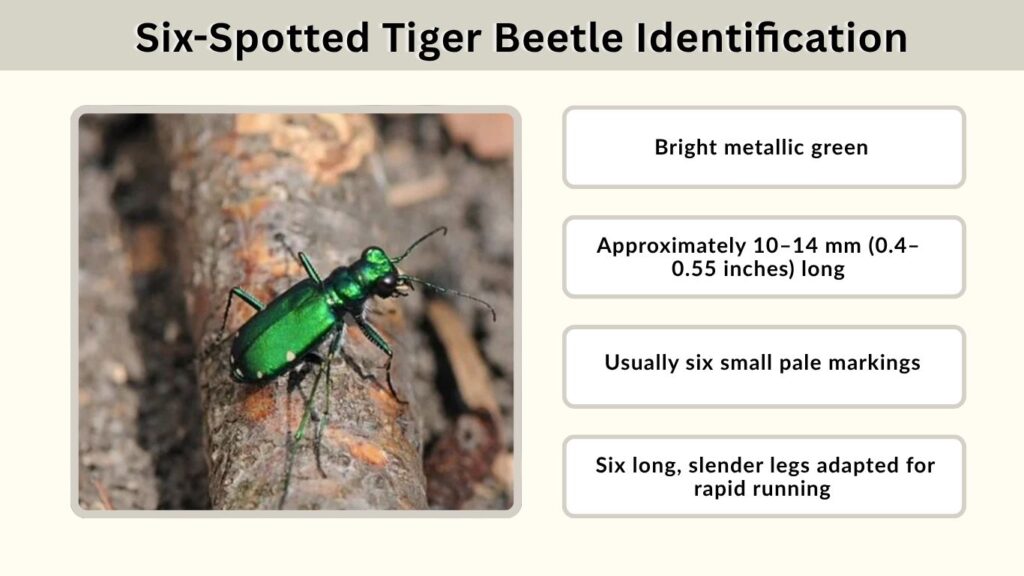
The six-spotted tiger beetle is easily recognized by its brilliant metallic-green body, unusually long legs, and prominent eyes. Adults are generally about 10–14 millimeters long, making them relatively small compared with many other ground beetles.
Their bright appearance helps distinguish them from most woodland insects.
Physical Appearance and Identification
Look for the following features when identifying a six-spotted tiger beetle:
- Color: Bright metallic green, sometimes with blue or turquoise shades.
- Size: Approximately 10–14 mm (0.4–0.55 inches) long.
- White spots: Usually six small pale markings along the edges of the wing covers.
- Eyes: Large, rounded, protruding eyes that help detect prey and movement.
- Legs: Six long, slender legs adapted for rapid running.
- Mouthparts: Prominent curved mandibles used to capture other insects.
Its narrow thorax and broad wing covers give it a distinctive body shape.
Can Six-Spotted Tiger Beetles Have Eight Spots?
Yes. Despite their name, six-spotted tiger beetles can have eight spots, four spots, two spots, or even no visible white markings.
The number of spots varies naturally among individuals and populations.
Consequently, identifying this species solely by counting white spots is unreliable. Its metallic coloring, long legs, prominent eyes, body shape, and preferred habitat provide additional identification clues.
Six-Spotted Tiger Beetle Habitat and Distribution
Six-spotted tiger beetles are native to North America, particularly the eastern United States and southeastern Canada. They inhabit woodland environments with exposed soil, scattered vegetation, and sunny openings.
These environments provide suitable hunting areas and soil conditions for developing larvae.
Where Do Six-Spotted Tiger Beetles Live?
Six-spotted tiger beetles commonly live in deciduous forests, woodland edges, open forest paths, and nearby fields.
They are particularly noticeable on dirt trails where sunlight reaches the ground. Fallen logs, exposed soil, and sparsely vegetated areas also provide suitable hunting locations.
Their geographic distribution includes states such as Maryland, Michigan, Minnesota, Missouri, New York, and Ohio, as well as parts of southern Canada.
When Are Six-Spotted Tiger Beetles Most Active?
Adults are primarily active during spring and early summer, commonly from April through July.
They prefer sunny woodland paths and frequently sprint across exposed ground when disturbed.
Some individuals may remain active into September, depending on local conditions. Adults generally spend winter sheltered underground before emerging during the following spring.
What Do Six-Spotted Tiger Beetles Eat?
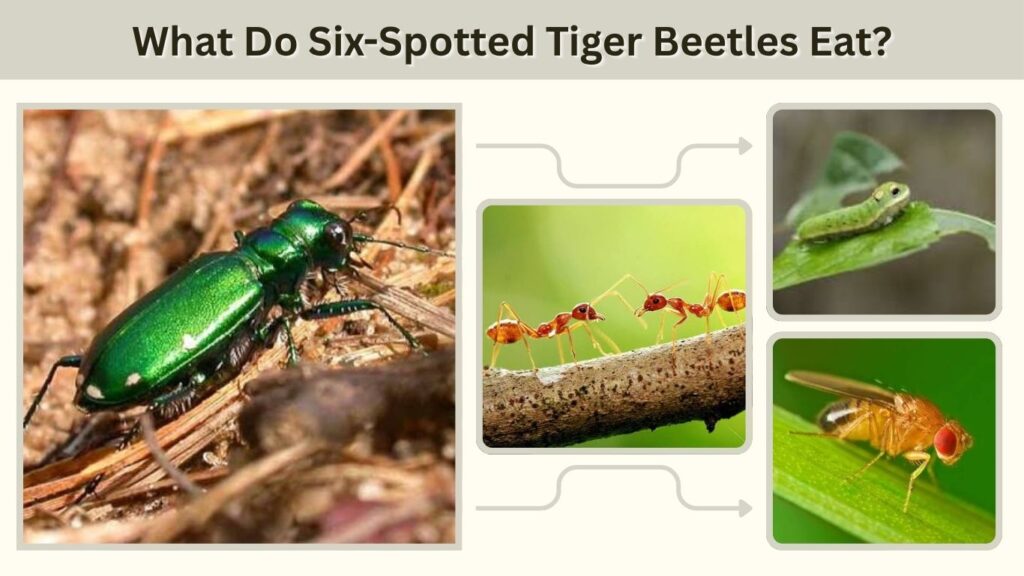
Six-spotted tiger beetles are carnivorous predators that feed on insects and other small arthropods.
Both adults and larvae hunt living prey, although they use different techniques. Adults chase insects across the ground, while larvae wait inside underground burrows.
Six-Spotted Tiger Beetle Diet
Their diet may include:
- Ants: Small ants encountered along woodland trails.
- Caterpillars: Soft-bodied larvae that can be captured with powerful jaws.
- Flies: Small flies and other insects within reach.
- Small spiders: Ground-dwelling arthropods encountered while hunting.
- Other insects: Various small beetles and other suitable invertebrates.
Their prey selection depends largely on availability and the size of the potential meal.
How Do Six-Spotted Tiger Beetles Hunt?
Adult tiger beetles rely on excellent vision and rapid movement to capture prey.
Once a suitable insect is detected, the beetle rushes toward it and grasps it using its sharp, curved mandibles.
Interestingly, tiger beetles can run so quickly that their visual system temporarily struggles to process their surroundings. They often pause briefly before continuing their pursuit.
This stop-and-go hunting behavior is characteristic of many tiger beetle species.
Six-Spotted Tiger Beetle Larvae and Life Cycle
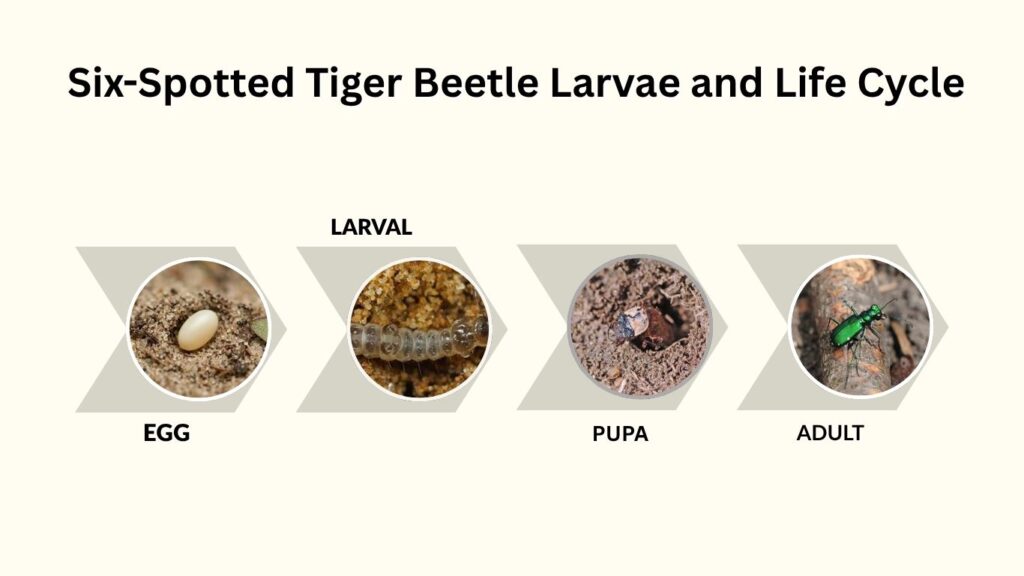
Six-spotted tiger beetles undergo complete metamorphosis, developing through egg, larval, pupal, and adult stages.
Their larvae look very different from adults. Instead of displaying bright green coloring, immature beetles remain underground and use specialized body structures to catch passing prey.
What Do Six-Spotted Tiger Beetle Larvae Look Like?
The larvae are pale or whitish, with darker heads, six legs, and large curved jaws.
Their bodies have a somewhat grub-like appearance, including a prominent hump behind the head.
They construct vertical tunnels in suitable soil, sometimes reaching approximately two feet deep.
Specialized hooks on their abdomens help anchor them within these burrows as they capture passing insects.
Four Stages of the Life Cycle
- Egg: Females deposit eggs individually in suitable soil.
- Larva: Young larvae develop underground and hunt small arthropods from their burrows.
- Pupa: Mature larvae transform within protected underground chambers.
- Adult: Fully developed beetles emerge and begin hunting, mating, and reproducing.
Development time varies with environmental conditions. In this species, overwintering adults can remain sheltered in underground burrows until spring.
Are Six-Spotted Tiger Beetles Poisonous or Dangerous?
Six-spotted tiger beetles are not considered dangerous to humans during ordinary encounters. They are predatory insects, but their natural prey consists of small arthropods rather than people.
They do not possess venomous stingers, and their powerful jaws are primarily used for hunting.
Do Six-Spotted Tiger Beetles Bite Humans?
Yes, six-spotted tiger beetles can bite if someone forcibly handles or restrains them.
Their mandibles are capable of producing a noticeable pinch, but bites are not commonly reported and generally present little medical concern.
If bitten, gently wash the affected area with soap and water. Avoid squeezing or pulling the beetle against your skin.
Can Six-Spotted Tiger Beetles Cause Allergic Reactions?
Specific severe allergic reactions to six-spotted tiger beetles are not well documented.
The species can release a defensive chemical when captured, although it is not generally regarded as medically dangerous.
If contact causes persistent irritation, unusual swelling, or other concerning symptoms, seek medical advice. Difficulty breathing or widespread swelling requires emergency care.
Six-Spotted Tiger Beetle vs. Emerald Ash Borer
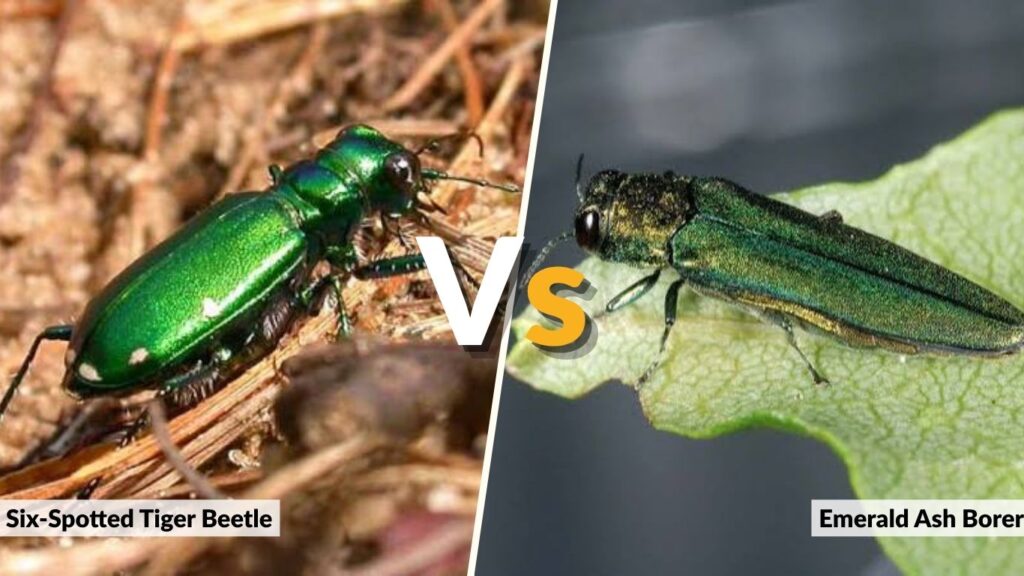
The six-spotted tiger beetle is frequently confused with the emerald ash borer (Agrilus planipennis). Both insects display metallic-green coloring and occur in wooded regions.
However, their body structures, behavior, and ecological roles are substantially different.
Key Differences Between These Beetles
| Feature | Six-Spotted Tiger Beetle | Emerald Ash Borer |
| Body color | Metallic green or blue-green | Metallic emerald green |
| Body shape | Long-legged with prominent eyes | Narrow and bullet-shaped |
| White spots | Often present, sometimes absent | Absent |
| Movement | Runs rapidly along the ground | Commonly seen on or near ash trees |
| Diet | Small insects and arthropods | Ash foliage as adults; inner bark tissues as larvae |
| Ecological role | Beneficial native predator | Invasive ash-tree pest in North America |
The emerald ash borer damages ash trees because its larvae tunnel beneath the bark and disrupt water and nutrient transport.
Six-spotted tiger beetles do not infest ash trees or cause this type of damage.
How to Find Six-Spotted Tiger Beetles
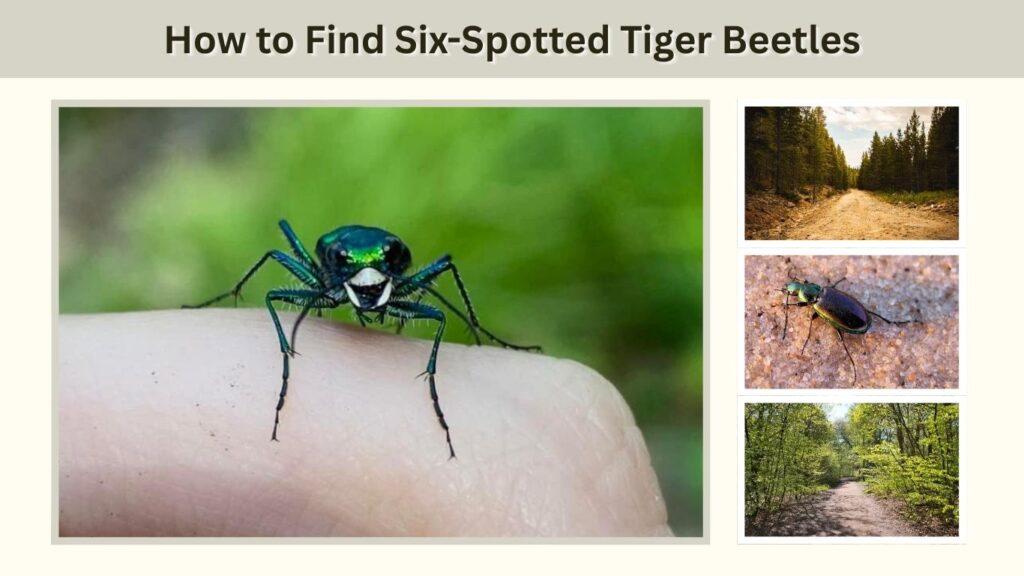
Finding six-spotted tiger beetles is easiest during warm, sunny days in spring and early summer.
They tend to occupy exposed ground where they can detect and chase prey. However, their speed makes close observation challenging.
Tips for Spotting Six-Spotted Tiger Beetles
- Explore woodland trails: Look along sunny sections of dirt paths and forest openings.
- Visit during spring: Adults are particularly noticeable from April to June.
- Watch the ground: Search for small metallic-green insects running rapidly.
- Move slowly: Approach carefully because these beetles quickly flee disturbances.
- Observe without handling: Use photographs to study their markings and behavior.
Larvae are much harder to locate because they spend their development underground.
Are Six-Spotted Tiger Beetles Invasive?
No. Six-spotted tiger beetles are native to North America and are beneficial members of woodland ecosystems.
Unlike invasive wood-boring beetles, they do not damage healthy trees or spread destructive tree infestations.
Why Are Six-Spotted Tiger Beetles Beneficial?
These beetles contribute to natural insect control by feeding on numerous small arthropods.
Their predatory behavior helps support ecological balance within forests, fields, and other suitable habitats.
They also provide food for larger predators and form part of complex woodland food webs.
Because they are beneficial insects, pesticide treatment is generally unnecessary when they appear around gardens or wooded properties.
FAQs
1. Can Six-Spotted Tiger Beetles Fly?
Yes. Six-spotted tiger beetles have functional wings and can fly short distances, particularly when escaping threats or moving between hunting locations.
2. Are Six-Spotted Tiger Beetles Rare?
No. They are relatively common in suitable woodland habitats across much of eastern North America, although abundance varies by region.
3. How Fast Can Six-Spotted Tiger Beetles Run?
They are extremely fast runners for their size. However, a reliable species-specific running-speed figure is not well established, so exact speeds should not be assumed.
4. Do Six-Spotted Tiger Beetles Damage Plants?
No. Six-spotted tiger beetles are predators rather than plant-feeding pests. They do not normally damage garden plants or trees.
5. Why Is It Called the Six-Spotted Tiger Beetle?
Its name comes from the six pale spots commonly present on its wing covers. The word “tiger” refers to its aggressive hunting behavior toward smaller insects.
