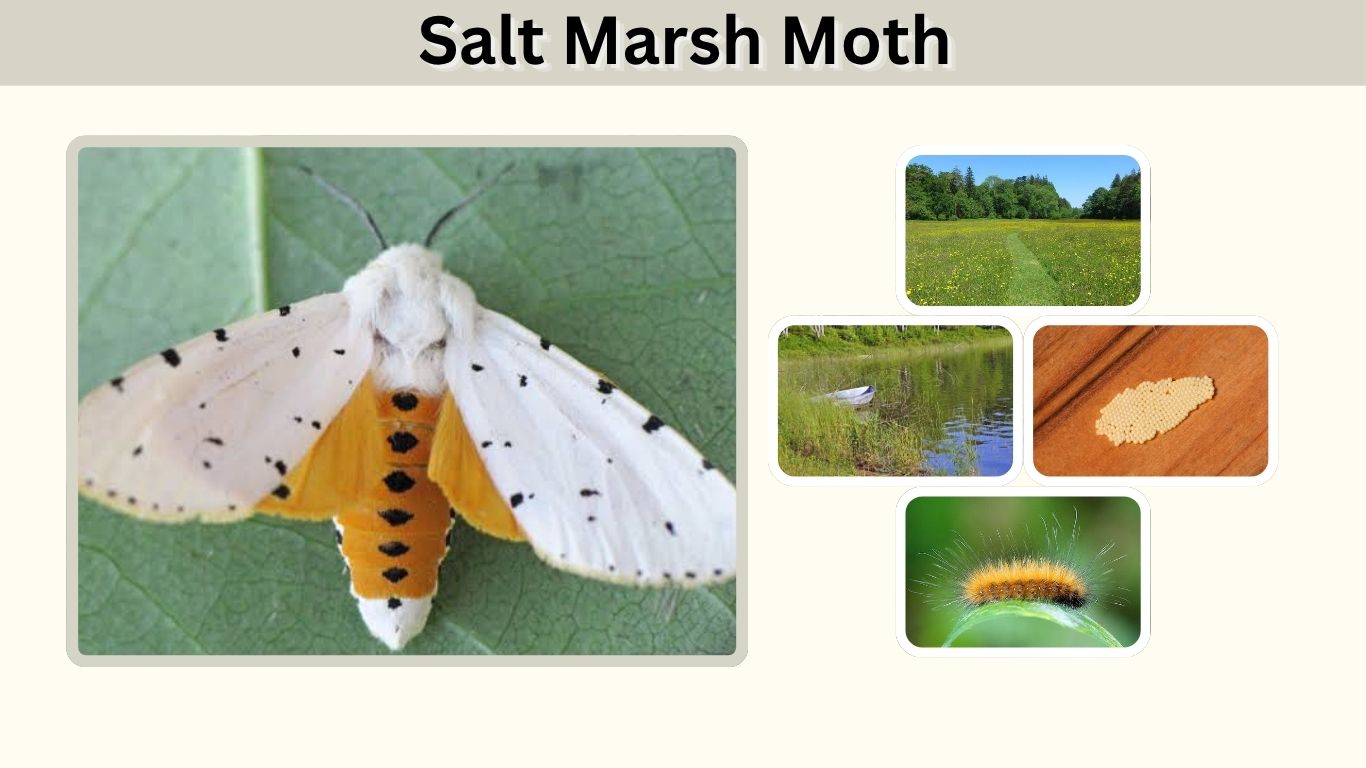
The Salt Marsh Moth (Estigmene acrea) is a widespread North American tiger moth best recognized by its white, black-spotted wings and colorful abdomen. Its caterpillar is a large, extremely hairy “woolly bear” that ranges from pale yellow to reddish brown or almost black. Despite its intimidating hairs, the caterpillar is not considered a stinging species. Salt marsh moth larvae eat many weeds and crops, making them beneficial parts of natural food webs but occasional agricultural pests when populations become unusually large.
What Does a Salt Marsh Moth Look Like?
Adult Salt Marsh Moths are attractive, medium-sized moths with fuzzy bodies and spotted wings. Their appearance differs somewhat between males and females, especially in the hindwings. Adults are nocturnal and frequently come to outdoor lights. The caterpillars look completely different, with dense tufts of long hairs covering bodies that can range considerably in color.
Salt Marsh Moth Identification
Important identification features include:
- Scientific name: Estigmene acrea
- Family: Erebidae, subfamily Arctiinae
- Adult wingspan: about 45–68 mm
- White forewings with numerous black spots
- Fuzzy white thorax
- Yellow, orange, or whitish abdomen with black spots
- Long antennae
- Nocturnal adult behavior
- Hairy caterpillars reaching about 55 mm
- Caterpillars ranging from blond or yellow to brown or black
The adults are sometimes called Salt Marsh Tiger Moths, while the larval stage is commonly known as the Saltmarsh Caterpillar or woolly bear.
Male vs Female Salt Marsh Moth
Sexes can often be separated by coloration. Males usually have dark yellow to orange-yellow hindwings, while female hindwings are predominantly white. Both sexes may have three or four noticeable black blotches on the hindwings.
Females also tend to have larger abdomens because they carry hundreds of eggs. Males use their antennae to detect chemical signals released by females and may fly actively at night while searching for mates.
Salt Marsh Moth Caterpillar
The caterpillar is the stage most commonly encountered crawling across gardens, fields, roads, and sidewalks. Young larvae may feed together, while older individuals become more solitary and can travel surprising distances looking for food. Their dense coat of long hairs often makes people assume they are dangerous, but Salt Marsh Caterpillars differ from genuinely stinging species such as Io moth caterpillars.
What Does the Caterpillar Look Like?
Salt Marsh Caterpillars are highly variable. One individual may be almost yellow, another reddish brown, and another nearly black.
Their bodies are covered with long, upright hairs arising from small orange or dark tubercles. The hairs are particularly long near the front and rear of the body.
Mature larvae can reach approximately 2 inches or 55 mm long. They also move surprisingly quickly for large hairy caterpillars.
Are Salt Marsh Moth Caterpillars Poisonous?
Salt Marsh Caterpillars are not considered poisonous or venomous to humans, and their hairs are not specialized stinging spines.
Texas A&M specifically distinguishes them from stinging caterpillars and describes Salt Marsh Caterpillars as harmless to people. However, unfamiliar hairy caterpillars should still be handled cautiously because many unrelated species do sting, and sensitive individuals may experience irritation from ordinary hairs or insect contact.
Do Salt Marsh Caterpillars Sting?
No. They do not possess the venom-delivering spines associated with true stinging caterpillars.
If identification is uncertain, avoid bare-handed handling. Wearing gloves is a sensible precaution because superficially similar caterpillars can have very different defenses.
What Do Salt Marsh Moth Caterpillars Eat?
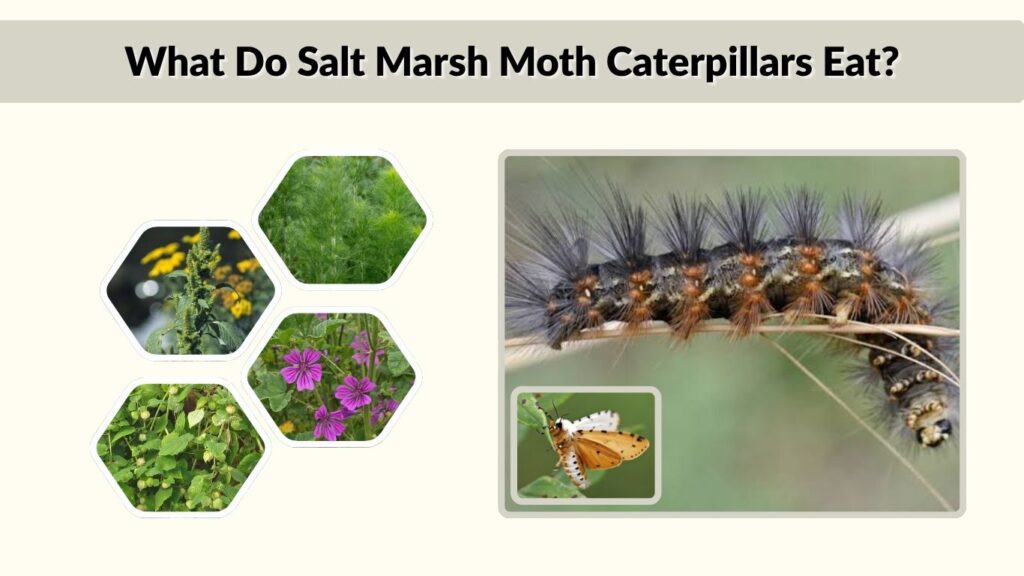
Salt Marsh Caterpillars are highly polyphagous, meaning they can feed on many plant species. Their common name is somewhat misleading because they are not restricted to salt marsh vegetation. Broadleaf weeds are particularly important natural hosts, but older larvae frequently move into gardens and agricultural fields when weeds mature or become scarce.
Common Host Plants
Their diet can include:
- Pigweed
- Ground cherry
- Mallow
- Dog fennel
- Milkweed
- Alfalfa
- Clover
- Cotton
- Soybean
- Tobacco
- Corn
- Beans
- Cabbage
- Lettuce
- Tomato
- Onion
- Carrot
- Beet
- Potato
- Turnip
Pigweed is considered one of their favored weed hosts. They occasionally feed on deciduous trees and shrubs as well.
Will Salt Marsh Caterpillars Eat Hemp?
Yes. Saltmarsh caterpillars can feed on hemp and are recognized as an occasional agricultural pest of the crop.
Young larvae tend to skeletonize leaves by consuming softer tissue, while larger caterpillars create substantial holes and can remove considerable amounts of foliage when populations are high.
Individual caterpillars usually cause limited damage, but numerous mature larvae can become significant defoliators.
Salt Marsh Moth Eggs, Cocoon and Life Cycle
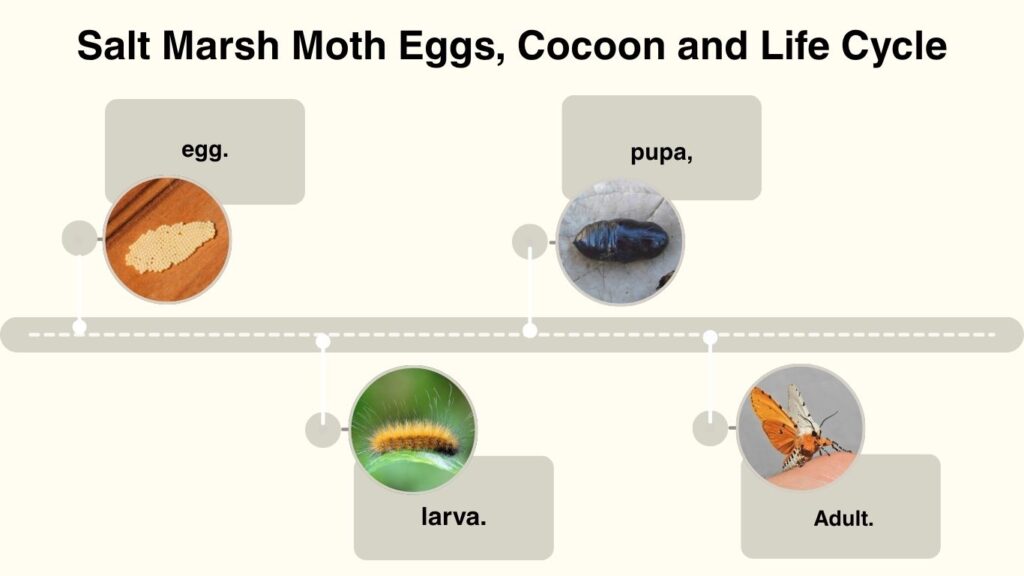
The Salt Marsh Moth undergoes complete metamorphosis, moving through egg, larva, pupa, and adult stages. Development can happen quickly during warm weather, allowing several generations per year in southern areas. Northern populations generally produce fewer generations. The species often becomes particularly noticeable toward late summer and autumn when mature caterpillars disperse in search of food or overwintering sites.
Salt Marsh Moth Life Cycle
The life cycle includes:
- Egg: Females deposit large clusters containing hundreds of small eggs.
- Larva: Caterpillars hatch and pass through approximately five to seven instars.
- Cocoon: Mature caterpillars construct thin cocoons among leaves and surface debris.
- Pupa: Metamorphosis occurs inside the cocoon.
- Adult: White, spotted moths emerge, mate, and begin another generation.
Under ideal conditions, one generation may be completed in about 35–40 days, although around six weeks is more typical in field conditions.
Salt Marsh Moth Eggs
The eggs are nearly spherical and about 0.6 mm in diameter. They are yellow when first deposited but soon become grayish.
Females commonly produce approximately 400–1,000 eggs, although an individual cluster can occasionally contain around 1,200.
Eggs generally hatch within four to five days under favorable conditions. Newly emerged caterpillars measure only around 2 mm long and initially feed together.
Salt Marsh Moth Cocoon
Pupation usually occurs near the soil surface among fallen leaves and plant debris.
The mature caterpillar creates a relatively thin cocoon using silk mixed with hairs from its own body. Inside is a dark brown pupa approximately 30 mm long.
The pupal stage lasts around 12–14 days during active-season generations. In colder regions, overwintering behavior delays development until favorable spring conditions return.
Salt Marsh Moth Habitat and Range
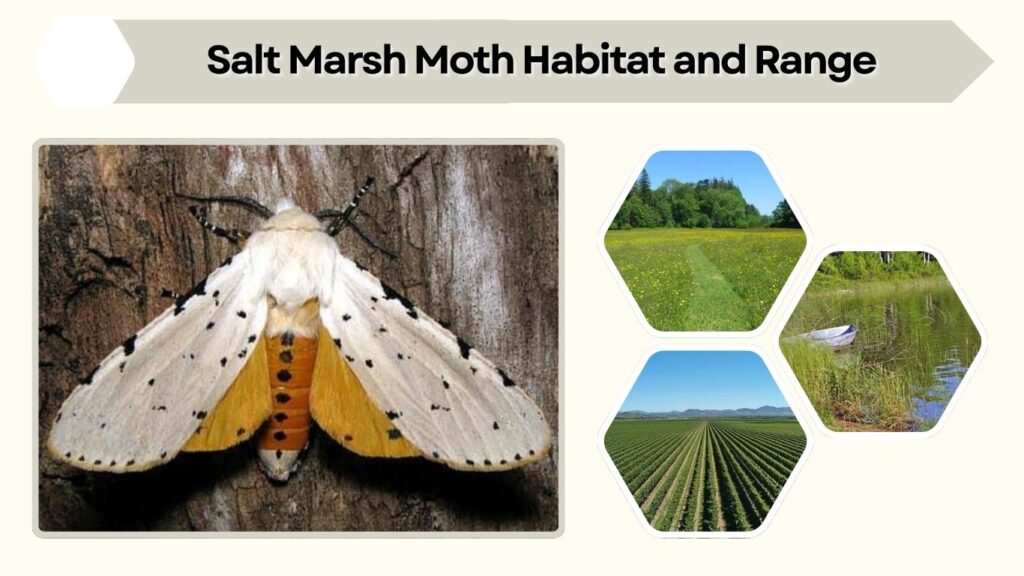
Despite the name, this moth is not confined to coastal salt marshes. It inhabits a broad variety of open environments where suitable weeds and food plants grow. Its unusual common name originated from early observations of caterpillars damaging salt-grass hay near Boston rather than from a strict ecological dependence on salty wetlands.
Where Do Salt Marsh Moths Live?
The species occurs widely across North America, extending through much of the United States into Canada and south toward Central America.
Typical habitats include open woodlands, meadows, agricultural fields, weedy areas, prairie grasslands, gardens, and marshes. Adults are nocturnal and commonly attracted to artificial lights.
Salt Marsh Moths are particularly familiar in states such as Texas, Florida, Ohio, Indiana, California, and other parts of the United States. They also reach parts of southern Canada, including Ontario and Quebec.
Salt Marsh Moths in Texas
Texas provides favorable conditions for the species, and Salt Marsh Caterpillars are widespread there.
Adults can occur throughout much of the year in warm areas. Caterpillars become especially noticeable when mature individuals leave feeding sites and travel across yards, sidewalks, or roads while searching for new food or protected locations.
Is the Salt Marsh Moth Good or Bad?
Whether the Salt Marsh Moth is considered beneficial or troublesome depends largely on where it occurs and how numerous the caterpillars become. In natural habitats, it is simply part of the native ecosystem and serves as prey for predators and parasitoids. In agriculture, however, dense larval populations can consume enough foliage to reduce crop productivity.
Benefits and Possible Problems
Salt Marsh Moths can be viewed from both perspectives:
- Good: They are native insects and part of natural food webs.
- Good: Larvae and adults provide food for other wildlife.
- Good: Natural parasitoids frequently help control their populations.
- Bad: Large numbers can defoliate vegetables and field crops.
- Bad: Older caterpillars consume much more foliage than young larvae.
- Bad: Migrating caterpillars can suddenly enter nearby agricultural fields.
UF/IFAS reports that mature larvae can consume more than 13 square centimeters of thick foliage per day, illustrating why unusually high populations can become agricultural pests.
Should You Remove Them From a Garden?
One or two Salt Marsh Caterpillars usually do not justify major control measures. If they are feeding heavily on valued vegetables, they can often be relocated or removed manually while wearing gloves.
Large agricultural infestations require a different approach because the potential for defoliation increases greatly with caterpillar density. Natural enemies—including several parasitic flies—also help suppress populations.
FAQs
Salt Marsh Moths attract attention because the adult and caterpillar look dramatically different. Most concerns involve the caterpillar’s dense hairs, whether it can sting, what it eats, and why large numbers occasionally appear in gardens or agricultural fields. Understanding its normal life cycle helps distinguish this native tiger moth from genuinely dangerous hairy caterpillars.
1. What is the scientific name of the Salt Marsh Moth?
Its scientific name is Estigmene acrea. The adult is also known as the Salt Marsh Tiger Moth, while its larva is commonly called the Saltmarsh Caterpillar.
2. Are Salt Marsh Moth caterpillars poisonous?
No. Salt Marsh Caterpillars are not considered poisonous or venomous to humans and lack specialized stinging hairs.
3. What do Salt Marsh Caterpillars eat?
They eat many broadleaf weeds and crops, including pigweed, cotton, soybeans, tomatoes, beans, cabbage, corn, tobacco, and numerous other plants.
4. How big does a Salt Marsh Moth get?
Adults have a wingspan of approximately 45–68 mm, while mature caterpillars can reach around 55 mm long.
5. How long is the Salt Marsh Moth life cycle?
During favorable warm conditions, one generation can develop in roughly 35–40 days, though about six weeks between generations is common in the field. Northern populations may have one generation annually, while southern populations can have several.