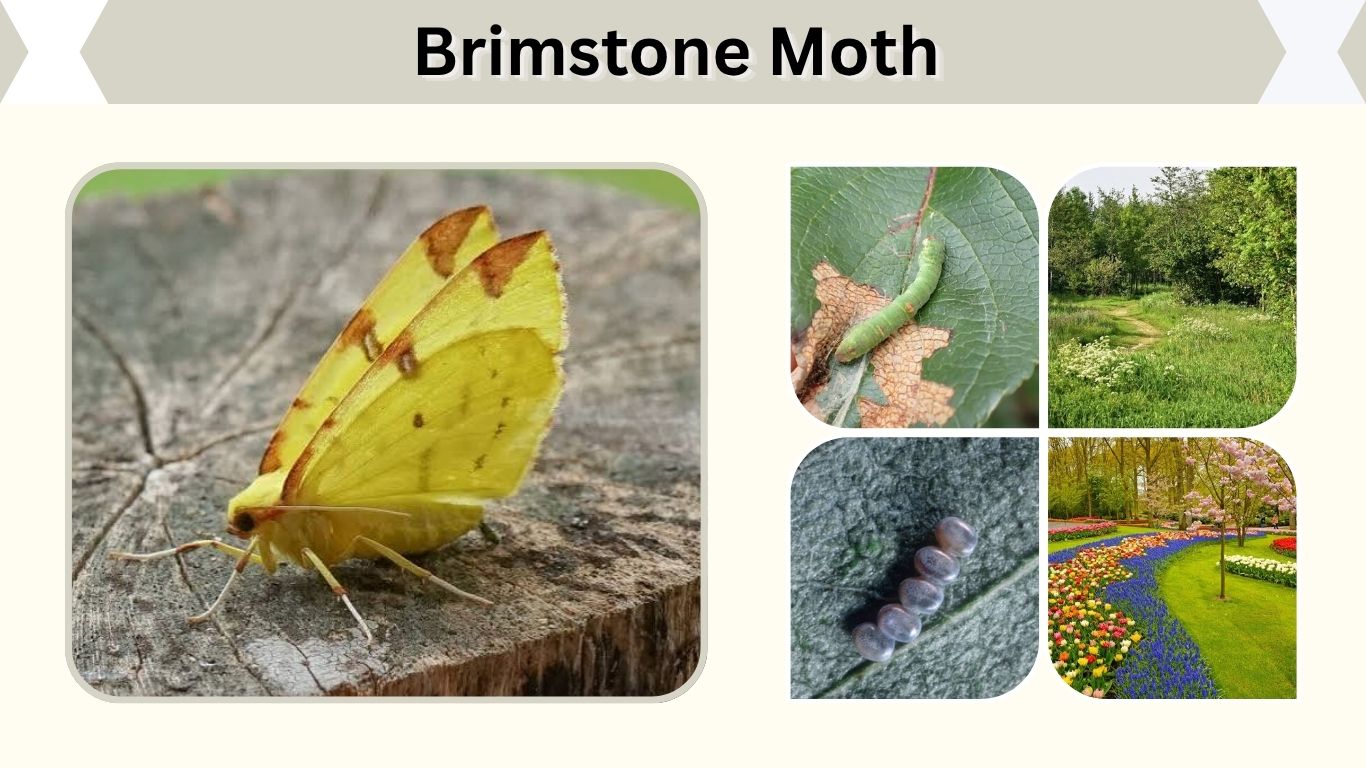
The Brimstone Moth (Opisthograptis luteolata) is a bright yellow geometer moth found widely across Britain and Ireland. Its lemon-yellow wings, reddish-brown markings, and distinctive white forewing spot make adults relatively easy to recognize. The caterpillar is far less obvious because its green, brown, or lichen-colored body provides excellent camouflage on shrubs and trees. Brimstone Moth caterpillars mainly feed on hawthorn, blackthorn, rowan, and other woody plants. The species is common rather than rare and may produce several generations during warm years.
What Does a Brimstone Moth Look Like?
The Brimstone Moth belongs to the geometer moth family, Geometridae. Adults are particularly distinctive because most of the wings are bright yellow rather than the gray or brown coloration common among many nocturnal moths. They often rest with their wings spread and may be disturbed from vegetation during the day, although they are mainly active around dusk and at night.
Brimstone Moth Identification
- Scientific name: Opisthograptis luteolata
- Family: Geometridae
- Bright lemon-yellow wings
- Chestnut or reddish-brown markings along wing edges
- Small white crescent or dash on the forewing
- Wingspan roughly 28–42 mm
- Slender body
- Broad triangular wings
- Frequently attracted to artificial light
UKMoths gives a typical wingspan of about 32–37 mm, while Butterfly Conservation records a broader range of approximately 28–42 mm.
Why Is It Called a Brimstone Moth?
“Brimstone” historically refers to sulfur, a substance famous for its bright yellow color.
The moth’s strong yellow coloration probably explains the common name.
It should not be confused with the Brimstone butterfly, which is a completely different species despite sharing the same yellow coloration and common-name theme.
Brimstone Moth Caterpillar
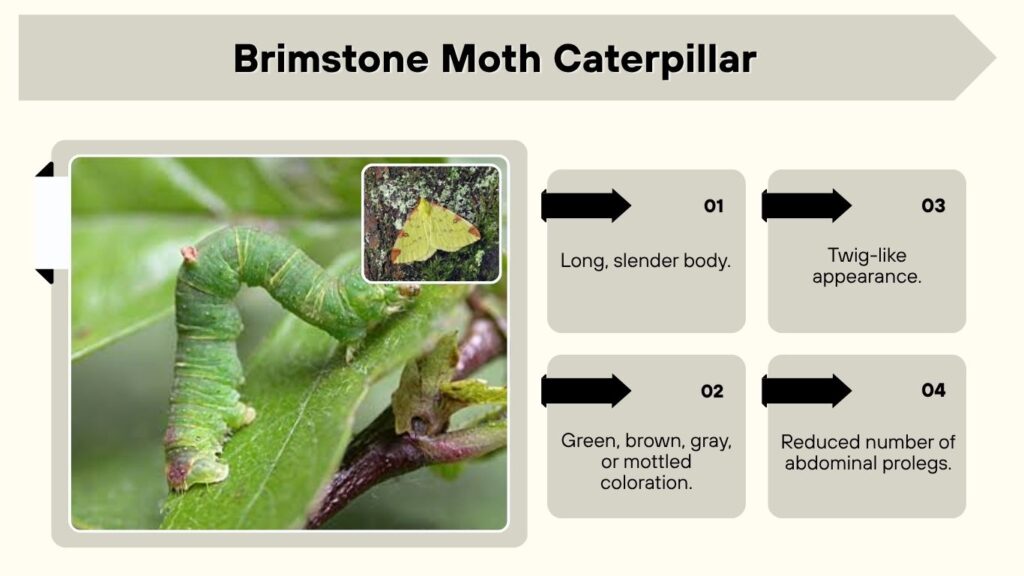
Brimstone Moth caterpillars are classic geometer larvae, sometimes called loopers or inchworms because of the way they move. Their bodies can vary dramatically in color, including green, brown, grayish, and lichen-like forms. This variability helps them blend into branches, leaves, and bark and makes caterpillars much harder to spot than adults.
Caterpillar Identification
A Brimstone Moth caterpillar typically has:
- Long, slender body
- Green, brown, gray, or mottled coloration
- Twig-like appearance
- Reduced number of abdominal prolegs
- Characteristic looping movement
- Small wart-like projection on the upper body
- Mature length around 30–32 mm
- Excellent camouflage against woody vegetation
Some individuals found overwintering on lichen-covered blackthorn can closely resemble the lichen itself.
Why Does the Caterpillar Look Like a Twig?
Camouflage is one of its primary defenses.
A caterpillar can remain extended along a branch and appear remarkably similar to a small twig. Brown individuals blend with stems, while green forms resemble fresh shoots.
This concealment makes it harder for birds and other visual predators to detect them.
What Do Brimstone Moths Eat?
The caterpillar is the main plant-feeding stage. Brimstone Moth larvae eat leaves from several deciduous shrubs and trees rather than relying on one particular host. Their flexible diet helps explain why the species can survive in gardens, hedgerows, woodland, scrub, and other habitats containing suitable woody plants.
Caterpillar Food Plants
Important host plants include:
- Hawthorn
- Blackthorn
- Rowan
- Other suitable deciduous trees and shrubs
Hawthorn and blackthorn are among the most frequently cited host plants.
What Do Adult Brimstone Moths Eat?
Adult Brimstone Moths are primarily concerned with reproduction and are much less intensive feeders than caterpillars.
Many adult moth species obtain carbohydrates from flower nectar, although detailed feeding records for this particular species are less frequently documented than its larval food plants.
The caterpillar stage is therefore the stage most strongly associated with plant consumption.
Brimstone Moth Life Cycle
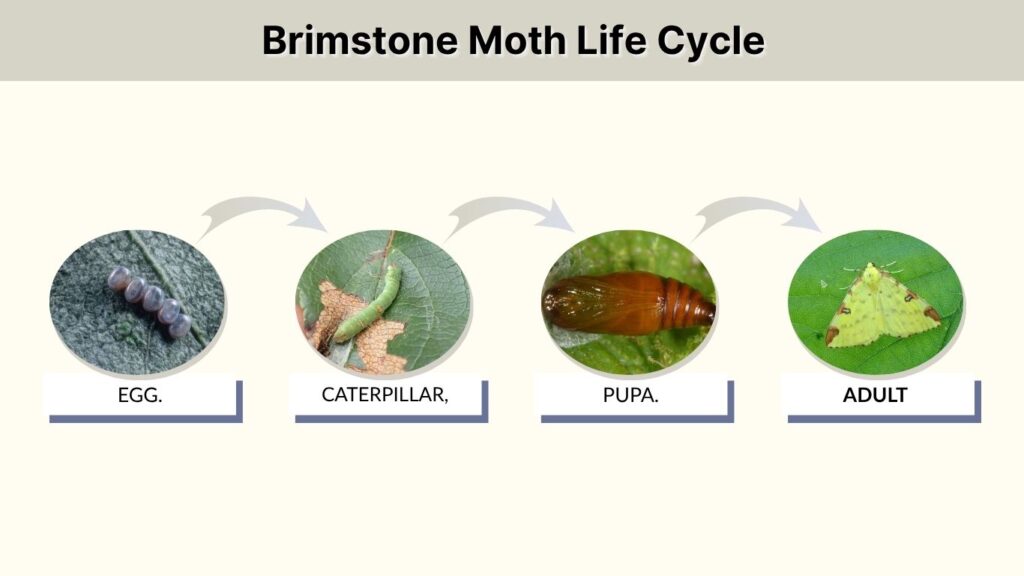
Brimstone Moths undergo complete metamorphosis through egg, caterpillar, pupa, and adult stages. The number of generations depends strongly on climate. Southern British populations may produce as many as three overlapping generations, while populations in the far north may have only one generation annually. Adults can consequently be encountered over a long portion of the year.
Four Life Stages
- Egg: Females lay eggs near suitable caterpillar food plants.
- Caterpillar: Larvae feed on leaves and grow through several molts.
- Pupa: Mature caterpillars pupate among leaves, plant debris, or other protected sites.
- Adult: Yellow moths emerge, mate, and begin another generation.
Depending on location, adults may be seen from April through October.
How Does the Brimstone Moth Survive Winter?
The species can overwinter in more than one developmental stage.
Butterfly Conservation reports that some individuals overwinter as partly grown caterpillars, while others survive as pupae in cocoons among vegetation, debris, or protected cracks.
This flexibility contributes to the long adult flight season.
Are Brimstone Moths Poisonous?
Brimstone Moths are not known as poisonous or venomous moths, and their caterpillars are not recognized as medically significant stinging caterpillars.
They lack the specialized venom-delivering spines associated with dangerous caterpillar species.
Can the Caterpillar Sting?
No typical stinging apparatus is associated with the Brimstone Moth caterpillar.
Its main defenses are camouflage and its ability to resemble plant material rather than painful spines or venom.
As with any wild caterpillar, unnecessary handling is still best avoided, especially if identification is uncertain.
Are Adult Brimstone Moths Dangerous?
Adults are harmless to people.
They do not sting and are not aggressive. A Brimstone Moth attracted to a window or outdoor light is simply navigating toward illumination and poses no threat.
Where Do Brimstone Moths Live?
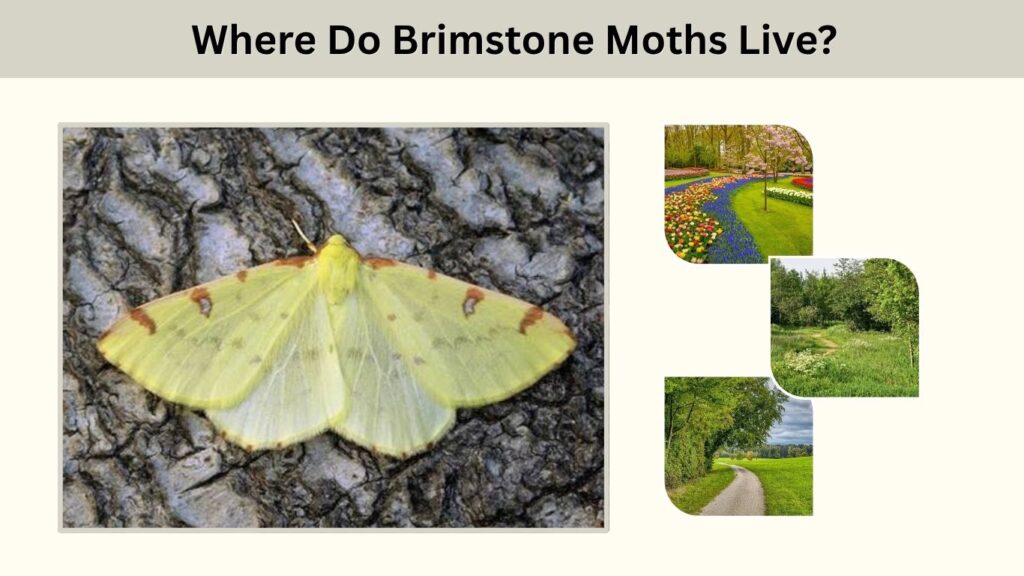
Brimstone Moths use a broad range of habitats because their caterpillars can feed on common shrubs such as hawthorn and blackthorn. They are regularly found in both natural and human-modified landscapes.
Common Habitats
They occur in:
- Hedgerows
- Gardens
- Woodland
- Woodland edges
- Scrub
- Parks
- Countryside
- Areas containing hawthorn and blackthorn
Butterfly Conservation describes the species as common and very well distributed throughout England, Wales, Scotland, Ireland, and the Channel Islands.
Are Brimstone Moths Rare?
No. The Brimstone Moth is currently considered common and widespread in Britain.
UKMoths reports extensive records throughout the country, while Butterfly Conservation lists its conservation status as common rather than threatened.
Brimstone Moth in the UK and Ireland
The species occurs across:
- England
- Wales
- Scotland
- Ireland
- Channel Islands
Its exact number of generations decreases toward colder northern areas. Southern populations can have multiple overlapping broods, whereas far northern populations may produce only one.
Brimstone Moth vs Brimstone Butterfly
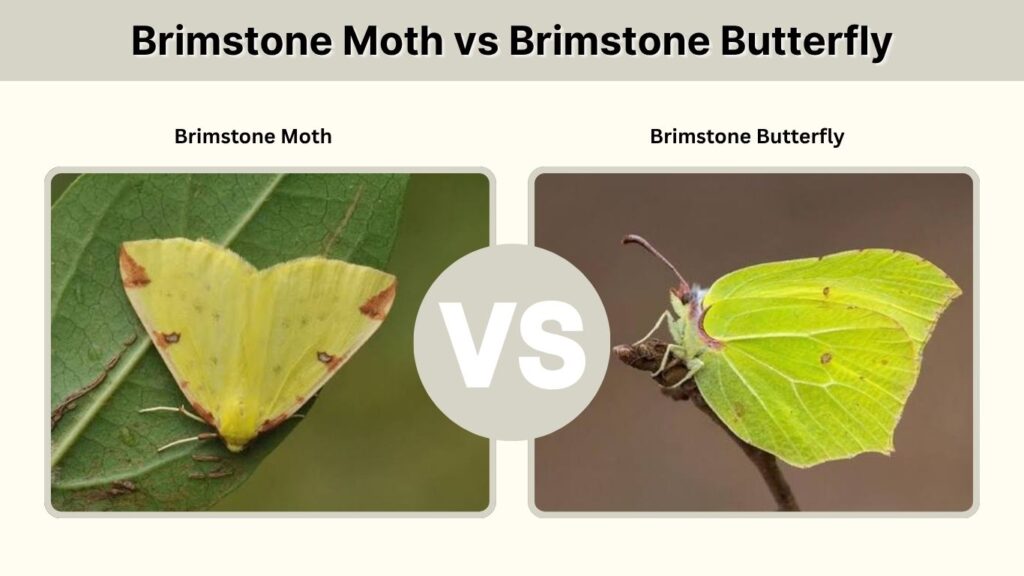
The Brimstone Moth and Brimstone butterfly are frequently confused because both are yellow insects with almost identical common names. They are nevertheless distinctly different species.
Main Differences
| Feature | Brimstone Moth | Brimstone Butterfly |
| Scientific name | Opisthograptis luteolata | Gonepteryx rhamni |
| Group | Moth | Butterfly |
| Wings | Yellow with brown markings | Leaf-shaped yellow/greenish wings |
| Activity | Mainly dusk/night | Daytime |
| Caterpillar food | Hawthorn, blackthorn, rowan | Buckthorn and alder buckthorn |
| Adult season | Mainly April–October | Adults overwinter and can appear early in spring |
The butterfly is also considerably larger and has strongly leaf-shaped wings.
Brimstone Moth Meaning and Symbolism
There is no scientifically established spiritual meaning for seeing a Brimstone Moth.
However, moths are often associated in folklore and modern symbolism with transformation, adaptation, hidden beauty, and attraction to light.
Spiritual Meaning
Someone may personally interpret a yellow Brimstone Moth as representing:
- Transformation
- Hope
- Change
- Renewal
- Optimism
- Finding direction
These are cultural or personal interpretations rather than biological facts about the species.
FAQs
1. What is the scientific name of the Brimstone Moth?
The scientific name is Opisthograptis luteolata. It belongs to the geometer moth family Geometridae.
2. What do Brimstone Moth caterpillars eat?
They feed on several trees and shrubs, particularly hawthorn, blackthorn, and rowan.
3. Are Brimstone Moths poisonous?
No. They are not known as poisonous or venomous moths, and their caterpillars are not recognized as stinging caterpillars.
4. Are Brimstone Moths rare?
No. They are common and widespread across Britain and Ireland.
5. When can you see Brimstone Moths?
Adults can generally be seen from April through October, with the precise season and number of generations varying according to location and climate.