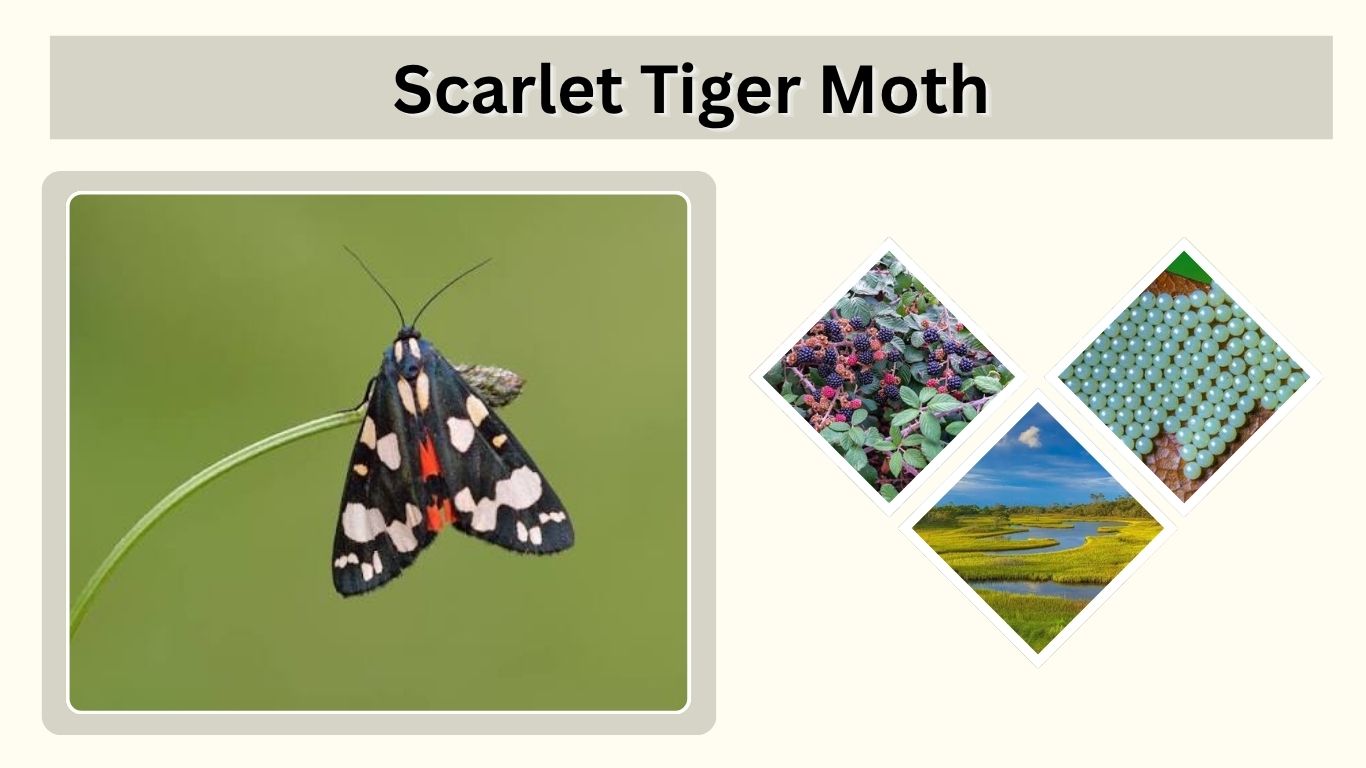
The Scarlet Tiger Moth (Callimorpha dominula) is one of Britain’s most striking day-flying moths, with metallic green-black forewings covered in cream and yellow spots and vivid scarlet hindwings marked with black. It occurs mainly in damp habitats, including riverbanks, fens, marshes, wet meadows, and some gardens. Its hairy caterpillar feeds on several common plants, especially comfrey. Although its appearance can seem intimidating, the caterpillar is not generally regarded as a dangerous stinging species, and adults are harmless to people.
What Does a Scarlet Tiger Moth Look Like?
Scarlet Tiger Moths are medium-sized but extremely noticeable when they open their wings. Their dark forewings can show a metallic green or bluish sheen in sunlight, while the hidden hindwings are bright red. This sudden flash of scarlet coloration makes flying adults easy to recognize. The species is also unusual among tiger moths because adults have developed mouthparts and can visit flowers for nectar.
Scarlet Tiger Moth Identification
Important features include:
- Scientific name: Callimorpha dominula
- Family: Erebidae
- Subfamily: Arctiinae
- Wingspan about 45–55 mm
- Metallic green-black forewings
- White, cream, and yellowish forewing spots
- Bright scarlet-red hindwings
- Large irregular black markings on the hindwings
- Dark body with subtle metallic coloration
- Active during daylight as well as at night
Some individuals show unusual color forms. The rare form rossica, for example, has yellow rather than red areas on the hindwings.
Male vs Female Scarlet Tiger Moth
Males and females have very similar wing colors and patterns, so sex is not always obvious from a quick sighting.
Females are generally heavier-bodied because the abdomen contains developing eggs. Males are often more active flyers and are particularly likely to come to lights, while females may remain closer to vegetation after mating. One regional moth-recording source notes that males readily visit light traps while females are much less likely to do so.
Scarlet Tiger Moth Caterpillar
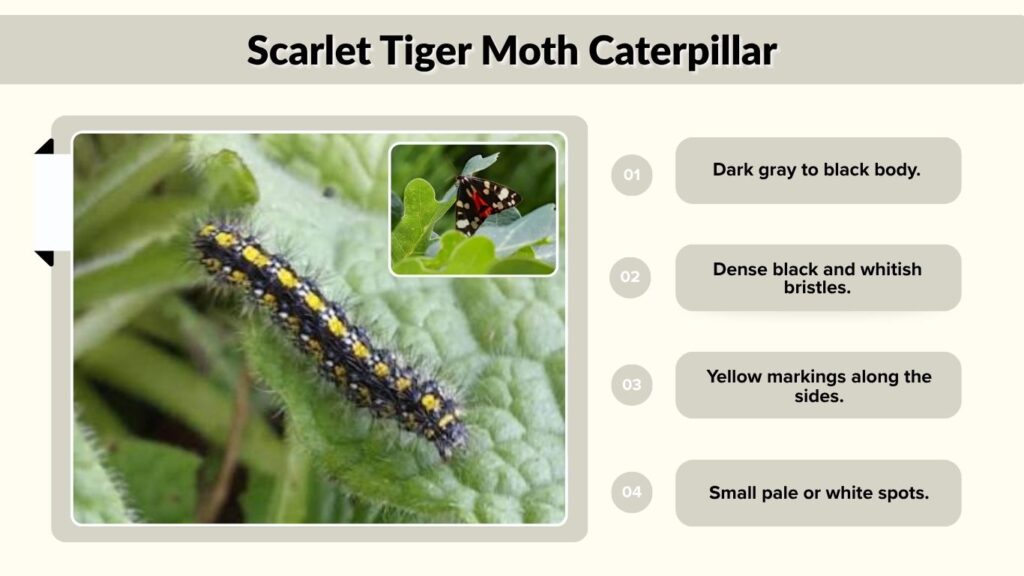
The caterpillar looks very different from the colorful adult. It is dark, hairy, and patterned with pale or yellow markings. Caterpillars hatch during summer, feed for a while, and then spend winter partially grown before becoming active again the following spring. By late spring, mature larvae can be found openly feeding during the daytime on their host plants.
What Does the Caterpillar Look Like?
A Scarlet Tiger caterpillar typically has:
- Dark gray to black body
- Dense black and whitish bristles
- Yellow markings along the sides
- Small pale or white spots
- Clearly segmented body
- Six true legs near the head
- Several pairs of abdominal prolegs
- Mature length around 40–45 mm
The hairs give it a rough woolly appearance. Caterpillars become particularly noticeable from March through May when they emerge from overwintering and resume feeding.
Are Scarlet Tiger Moth Caterpillars Poisonous?
Scarlet Tiger caterpillars are not generally classified among medically important venomous or stinging caterpillars.
Their body is covered with bristles, but these are not comparable to the specialized venomous spines found on caterpillars such as some saturniid species. Still, it is sensible to avoid unnecessary handling of hairy caterpillars because ordinary hairs can irritate sensitive skin, and similar-looking species may have stronger defenses.
Adult Scarlet Tiger Moths do not sting or bite people.
What Do Scarlet Tiger Caterpillars Eat?
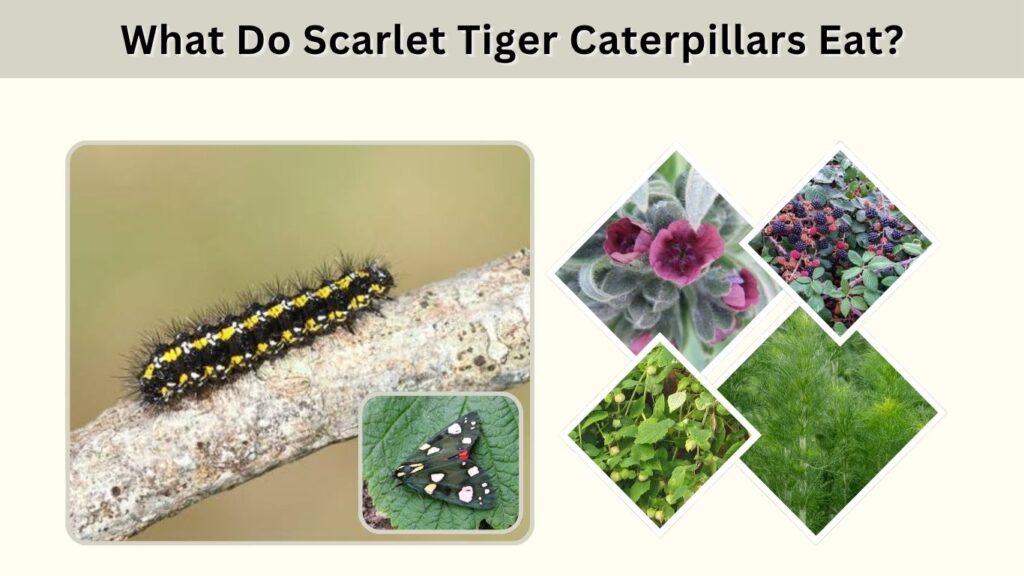
Scarlet Tiger caterpillars are not restricted to one food plant. They feed on several herbaceous plants, particularly in damp habitats. Comfrey is one of the best-known hosts, but caterpillars may expand their diet as they grow. Their ability to use several plants helps explain why the species can survive in riverbanks, marshes, gardens, woodland margins, and similar environments.
Common Food Plants
Recorded host plants include:
- Common comfrey
- Green alkanet
- Common nettle
- Hemp-agrimony
- Hound’s-tongue
- Bramble
- Honeysuckle
- Meadowsweet
- Willow and sallow
- Other nearby herbaceous plants
Comfrey is particularly important and is frequently cited as a favored food plant in Britain. Older caterpillars may wander from their original plant and begin feeding on other suitable vegetation.
What Do Adult Scarlet Tiger Moths Eat?
Unlike many tiger moths, adult Scarlet Tigers have functional mouthparts.
They can visit flowers and drink nectar, providing additional energy during their adult stage. This helps distinguish them biologically from moth groups whose adults have reduced mouthparts and cannot feed.
Adults are often seen resting on foliage during daylight but may also become active around flowers or fly in sunny weather.
Scarlet Tiger Moth Eggs, Cocoon and Life Cycle
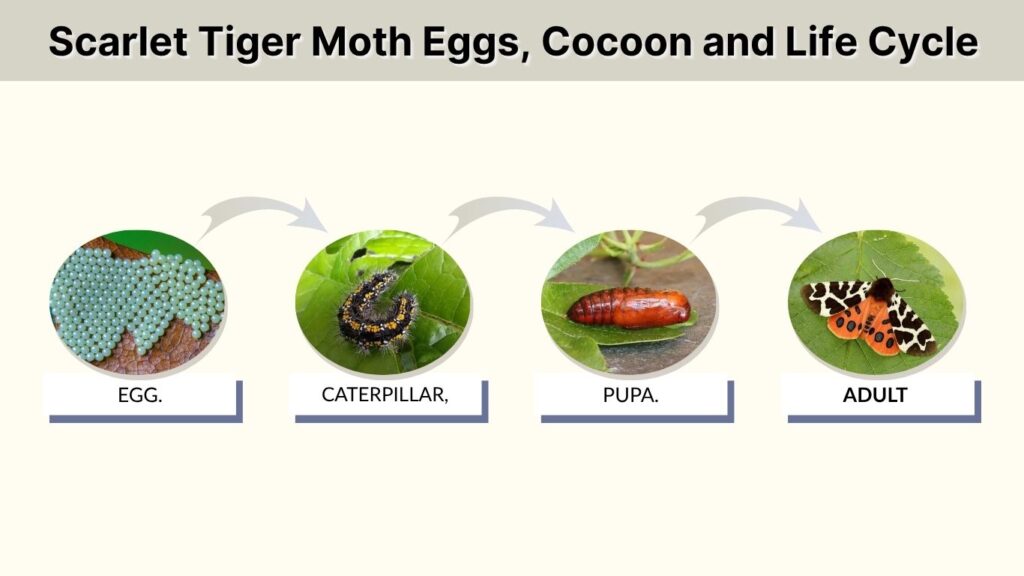
Scarlet Tigers produce one main generation each year in Britain. Adults emerge during early summer, mate, and females deposit eggs on suitable vegetation. The caterpillars hatch quickly, begin feeding, and then overwinter while still immature. Spring growth resumes when temperatures increase and food plants develop. Pupation occurs close to the ground before the next generation of adults emerges.
Scarlet Tiger Moth Life Cycle
The main stages are:
- Egg: Females lay eggs on suitable host plants during summer.
- Young caterpillar: Eggs can hatch in roughly seven days.
- Overwintering larva: Caterpillars spend winter partially grown.
- Spring caterpillar: Feeding resumes from around March.
- Cocoon and pupa: Fully grown larvae pupate in late spring.
- Adult moth: Adults emerge mainly in June and July.
Caterpillars may reach approximately 45 mm before pupation.
Scarlet Tiger Moth Cocoon
A mature caterpillar constructs a silken cocoon among vegetation or leaf litter.
The pupa develops inside while the transformation into an adult takes place. Wildlife Insight reports that adults may emerge within roughly a month of pupation, although temperature and other environmental conditions affect the exact timing.
How Long Do Scarlet Tiger Moths Pupate?
Pupation generally lasts several weeks.
A commonly reported period is roughly one month, but warmer conditions can speed development and cooler temperatures may delay emergence.
This pupal period normally bridges the transition from the fully grown spring caterpillar to the spectacular early-summer adult.
Where Do Scarlet Tiger Moths Live?
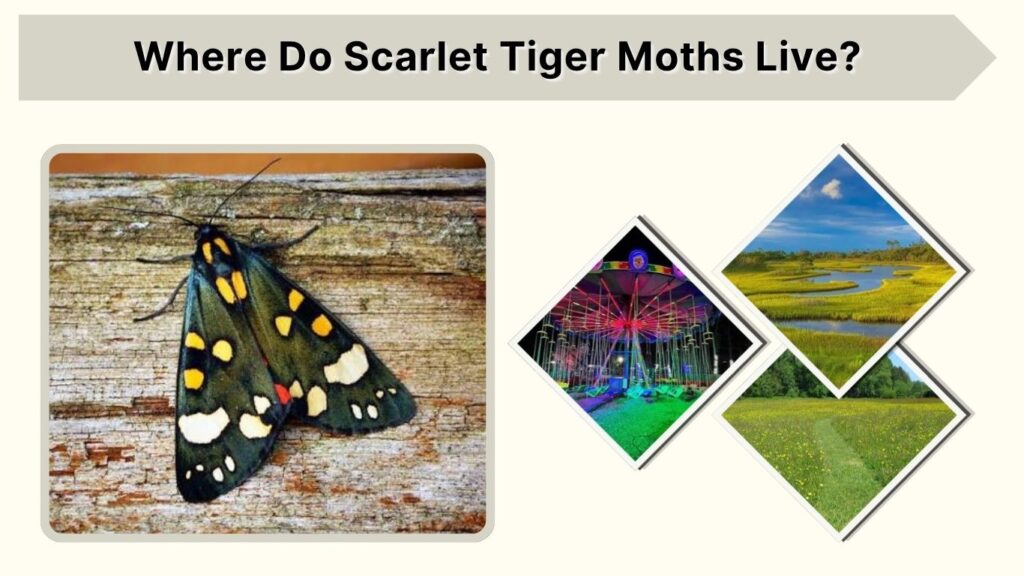
Scarlet Tigers are strongly associated with moist, vegetation-rich habitats, although their British distribution has changed over time. Traditionally they were especially local in southern and western England and Wales. More recent recording indicates that the species has expanded into parts of the Midlands and farther north, making it easier to encounter than older field guides sometimes suggest.
Habitat and UK Distribution
Typical habitats include:
- Riverbanks
- Marshes
- Fens
- Wet meadows
- Floodplains
- Damp woodland
- Coastal cliffs
- Road verges
- Gardens with suitable food plants
The species remains particularly associated with southern and south-western England and Wales, but populations also occur farther north.
Are Scarlet Tiger Moths Rare?
The Scarlet Tiger is better described as local rather than nationally rare in Britain.
Butterfly Conservation’s macro-moth status review classified Callimorpha dominula as Least Concern in Great Britain. More recent Butterfly Conservation reporting also notes increasing numbers and northward range expansion since around 2000.
A moth can therefore be uncommon in one county while locally abundant in another.
Scarlet Tiger Moth Colors and Behavior
The Scarlet Tiger’s intense coloration is one reason the species attracts so much attention. When resting, much of the red is concealed beneath the darker forewings. When disturbed or flying, the hindwings suddenly become visible. Adults are also more active during daylight than many familiar moth species, making them comparatively easy to observe in suitable habitat.
Wing Color Variations
Typical adults have metallic dark forewings with cream or yellow spots and bright red hindwings with black patches.
Several inherited variations have been studied scientifically, including forms with reduced spotting or altered hindwing coloration. The Scarlet Tiger became particularly notable in evolutionary genetics because researchers studied these color-pattern variants over many generations.
When Are Adults Active?
Adults are most often recorded during June and July, although sightings can occur somewhat earlier or later.
They fly in sunshine and may be particularly active during warm afternoons and evenings. They also sometimes come to artificial lights at night.
FAQs
Scarlet Tigers are distinctive enough to identify easily once their red hindwings are visible, but their hairy caterpillars and localized distribution often raise questions. Their annual life cycle, broad caterpillar diet, and unusual ability to fly during daylight make them especially interesting among British tiger moths.
1. What is the scientific name of the Scarlet Tiger Moth?
Its scientific name is Callimorpha dominula. It belongs to the family Erebidae and subfamily Arctiinae.
2. Are Scarlet Tiger caterpillars poisonous?
They are not generally regarded as venomous or dangerous stinging caterpillars. However, avoiding unnecessary handling of hairy caterpillars is sensible.
3. What do Scarlet Tiger caterpillars eat?
They feed on several plants, especially comfrey, green alkanet, nettles, hemp-agrimony, bramble, and related vegetation.
4. Are Scarlet Tiger Moths rare in the UK?
They are locally distributed rather than nationally rare. Their British conservation assessment is Least Concern, and their range has expanded in recent decades.
5. When can you see Scarlet Tiger Moths?
Adults are mainly seen in June and July, especially in damp habitats and sometimes gardens. They can fly during daylight as well as at night.