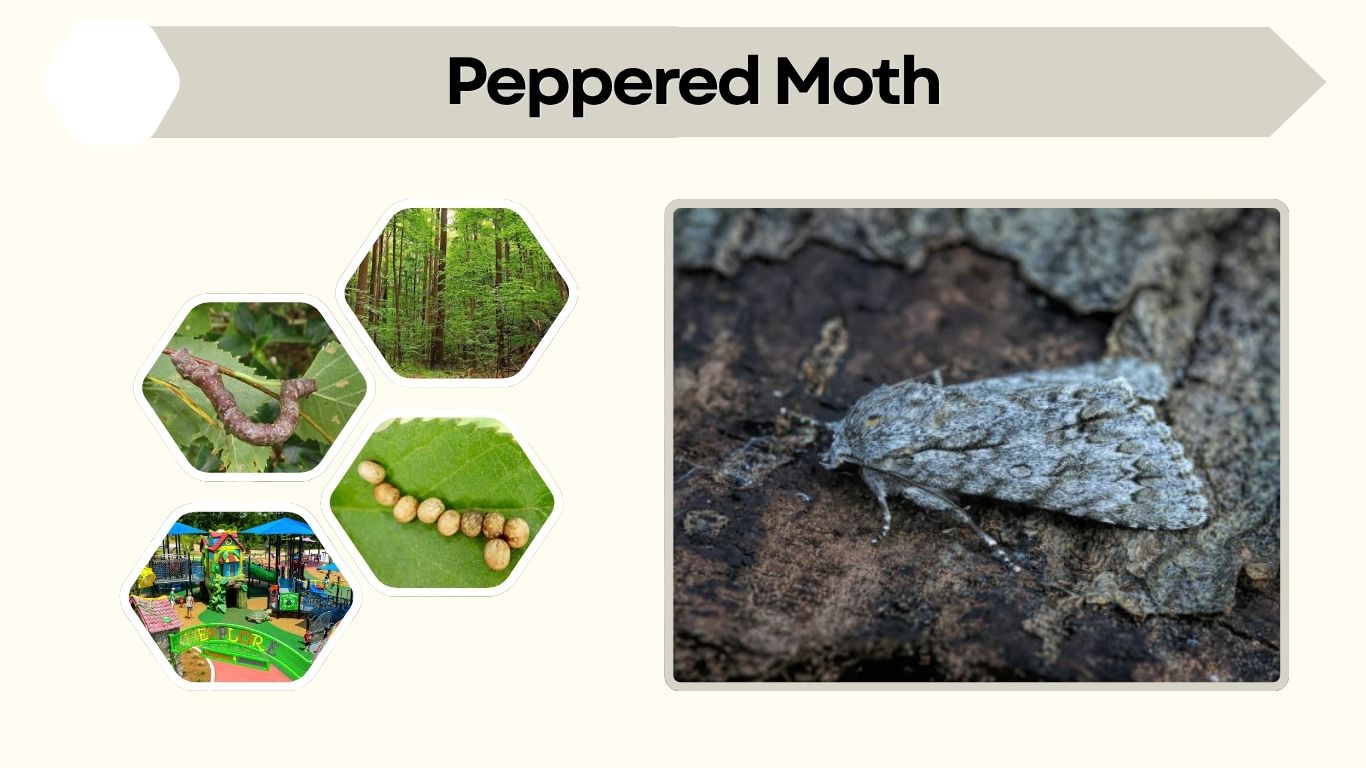
The peppered moth is one of the most famous examples used to explain evolution by natural selection. Scientifically known as Biston betularia, this medium-sized moth occurs in several color forms ranging from pale, speckled gray to nearly black. Its changing abundance during and after the Industrial Revolution became a classic demonstration of how camouflage can influence survival. Beyond its evolutionary history, the peppered moth has an interesting caterpillar stage, broad diet, seasonal life cycle, and several adaptations that help it avoid predators.
What Is a Peppered Moth?
The peppered moth is a nocturnal member of the geometer moth family, Geometridae. Its name comes from the dark speckles scattered across the wings of the typical pale form. Adults usually rest during daylight and become active after dark. Different color forms of the same species have played an important role in studies of camouflage, bird predation, and industrial melanism.
Peppered Moth Identification
Common identification features include:
- Scientific name: Biston betularia
- Family: Geometridae
- Color: White-gray, speckled, intermediate, or nearly black
- Wings: Broad with irregular dark markings
- Body: Thick compared with many geometer moths
- Activity: Mainly nocturnal
- Caterpillar: Slender and twig-like
- Camouflage: Strongly developed in adults and larvae
The pale form is traditionally called typica, while the very dark form is known as carbonaria. An intermediate form is often called insularia.
White, Dark and Black Peppered Moths
The typical peppered moth has pale wings covered with dark spots and irregular markings. On lichen-covered bark, this pattern can make the insect difficult for predators to detect.
The carbonaria form is almost entirely dark because of increased melanin. This black peppered moth became especially famous during the Industrial Revolution.
Both forms belong to the same species. Their different appearances are inherited rather than being caused by an individual moth changing color during its lifetime.
Where Do Peppered Moths Live?
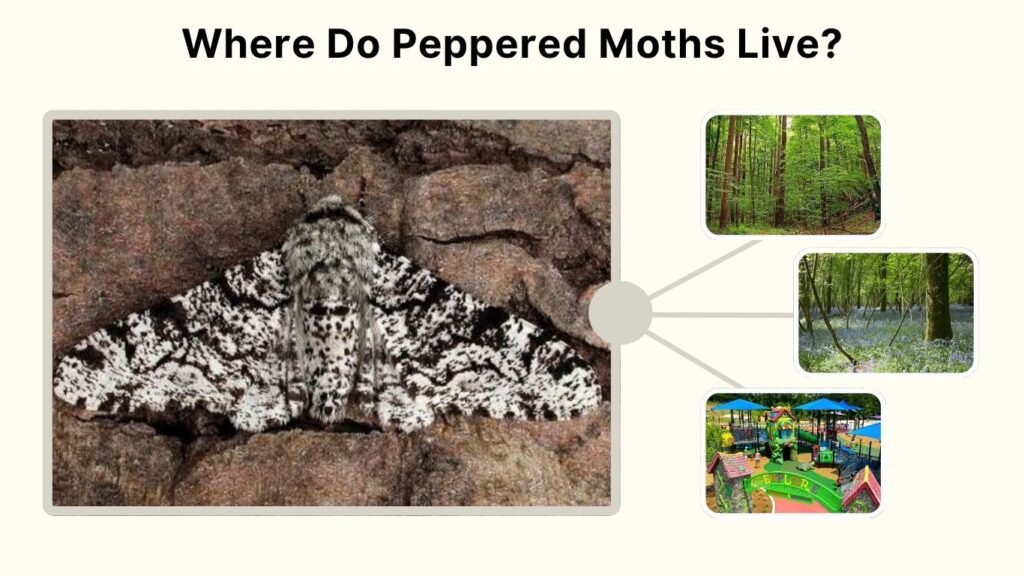
Peppered moths occur mainly in temperate woodland habitats where trees provide food for caterpillars and resting surfaces for adults. The species is particularly famous in Britain because that is where its industrial-era color changes were extensively studied. Related populations also occur across other parts of Europe, Asia, and North America.
Peppered Moth Habitat
Typical habitats include:
- Deciduous forests
- Mixed woodland
- Woodland edges
- Parks
- Gardens
- Hedgerows
- Areas containing birch and willow
- Urban green spaces with mature trees
Adult moths spend daylight hours resting in sheltered locations on or around trees. Their mottled wing patterns help them blend with bark, branches, and other natural surfaces.
Why Tree Bark Matters
Camouflage is important because peppered moths can be preyed upon by birds.
A moth whose coloration closely matches its resting background may be harder to detect. This relationship between background color and survival became central to research on peppered moth evolution.
The environment does not deliberately change a moth’s color. Instead, individuals with better camouflage may survive and reproduce more successfully under particular environmental conditions.
Peppered Moth Caterpillar
Peppered moth larvae look dramatically different from the adults. Like many geometer moth caterpillars, they have fewer abdominal prolegs than most caterpillars, producing the looping movement that gives this family the nickname “inchworms.” Their twig-like shape and variable coloration provide excellent camouflage while they feed on leaves.
Peppered Moth Caterpillar Identification
Peppered moth caterpillars commonly have:
- Slender bodies
- Brown, gray, green, or mixed coloration
- Twig-like shape
- Small bumps resembling bark
- Inchworm-style movement
- Strong camouflage
- Body posture resembling a small branch
When resting, a larva may hold its body away from a branch at an angle, making it look surprisingly similar to a twig.
What Do Peppered Moth Larvae Eat?
The caterpillars feed on the leaves of several deciduous trees and shrubs.
Host plants can include birch, willow, oak, and other broadleaf species. The exact diet varies with location and available vegetation.
Larvae spend most of their time eating and growing. Their ability to blend with twigs and stems helps reduce their chances of being detected while exposed on vegetation.
Peppered Moth Life Cycle
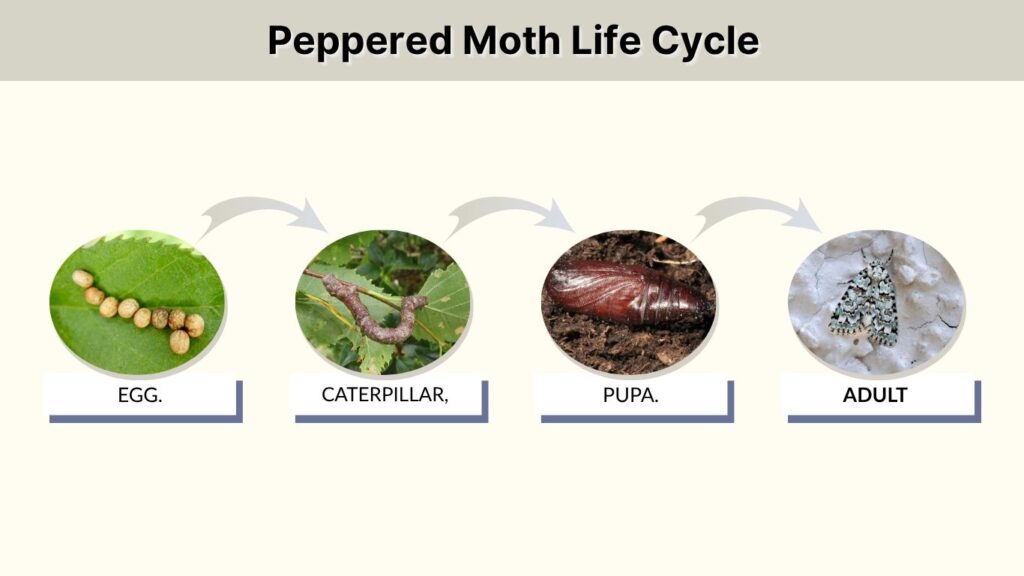
Like other moths and butterflies, peppered moths undergo complete metamorphosis. They pass through four major stages: egg, caterpillar, pupa, and adult. Development is synchronized with seasonal conditions, allowing larvae to feed when host-tree leaves are available and the species to survive unfavorable winter weather.
Peppered Moth Life Cycle Stages
The main stages are:
- Egg: Females lay eggs after mating.
- Larva: Caterpillars hatch and begin feeding.
- Growth: Larvae molt repeatedly while increasing in size.
- Pupa: Mature caterpillars transform into pupae.
- Adult: Moths emerge, mate, and reproduce.
Most of the insect’s physical growth happens during the larval stage.
Peppered Moth Pupa
After completing larval development, the caterpillar enters the pupal stage.
The pupa provides protection while the body undergoes metamorphosis. Depending on climate and seasonal timing, the moth may overwinter in this stage before adults emerge during the following warm season.
Adults live primarily to reproduce and do not spend months actively growing as caterpillars do.
Peppered Moth Evolution and Natural Selection
The peppered moth became famous because populations changed dramatically as industrial pollution altered parts of Britain. Before heavy industrialization, pale peppered moths were widespread. As soot pollution increased, dark moths became much more common in heavily industrialized regions. The pattern provided a striking example of how natural selection can change the frequency of inherited traits within populations.
Peppered Moths Before the Industrial Revolution
Before widespread industrial pollution, many tree surfaces were relatively light and supported lichens.
Pale typica moths were well camouflaged against these backgrounds. Dark moths existed because genetic variation was present, but they were relatively uncommon.
Birds searching visually for resting moths could potentially detect individuals that contrasted strongly against their background more easily.
Peppered Moths During the Industrial Revolution
Industrial activity released large quantities of soot and other pollutants.
In heavily polluted areas:
- Tree surfaces became darker.
- Lichen populations declined.
- Pale moths became more conspicuous.
- Dark carbonaria moths gained better camouflage.
- Dark moths survived more successfully in many polluted areas.
- The dark form increased dramatically in frequency.
This phenomenon became known as industrial melanism.
Importantly, pollution did not transform pale moths into black ones. The dark form resulted from inherited genetic variation already introduced into the population through mutation.
What Happened After Pollution Declined?
As air quality improved during the twentieth century, lichens recovered and tree surfaces became less soot-darkened in many areas.
The selective advantage of the black form decreased. Pale peppered moths subsequently became more common again in many British populations.
This reversal strengthened the peppered moth’s importance as an example of natural selection because the frequency of different color forms changed along with environmental conditions.
How Natural Selection Affected Peppered Moths
Natural selection works when inherited traits influence an organism’s ability to survive and reproduce. Peppered moth coloration provided different levels of camouflage depending on the local environment. Predators did not intentionally create darker moths; they simply removed some more visible individuals before those moths could reproduce.
Natural Selection Explained
The process can be summarized as:
- Peppered moths naturally varied in coloration.
- Color differences were inherited.
- Birds preyed on visible moths.
- Better-camouflaged moths had a survival advantage.
- Survivors were more likely to reproduce.
- Their color-associated genes became more common.
- Environmental change altered which form had the advantage.
This is why peppered moths are frequently used in biology classes, simulations, laboratories, and natural-selection games.
Industrial Melanism
Industrial melanism refers to an increase in dark coloration within animal populations associated with industrialized environments.
The peppered moth became the best-known example because researchers could compare pale and dark individuals across polluted and cleaner environments.
Modern genetic research has also demonstrated that the carbonaria color form has a specific genetic basis, supporting the conclusion that the historical population change represented evolutionary change.
Peppered Moth Camouflage and Predators
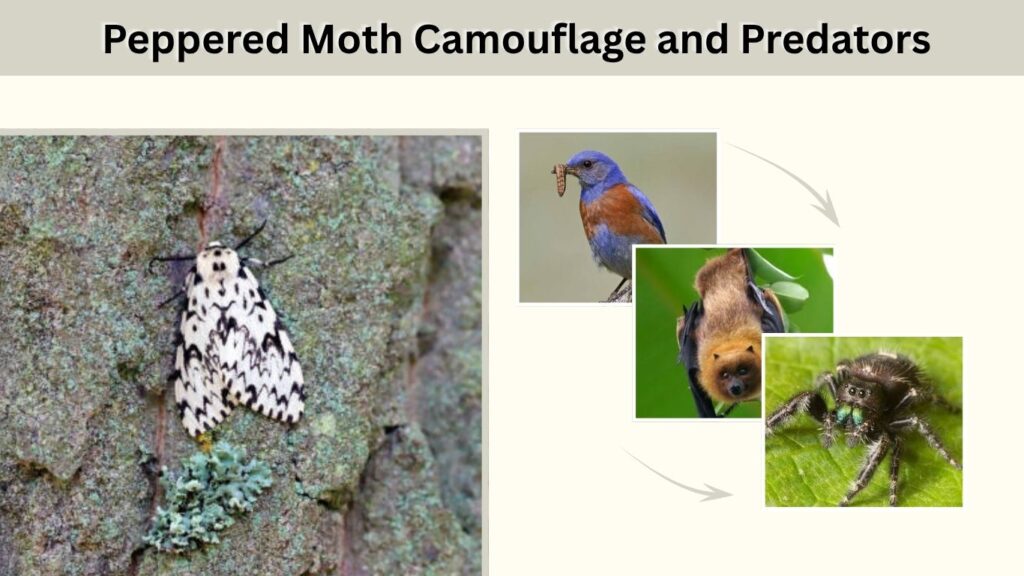
Camouflage does not make peppered moths completely invisible. Birds and other predators can still find them. However, even a modest difference in the probability of being detected can influence population genetics when it operates across many generations.
What Animals Eat Peppered Moths?
Potential predators include:
- Insect-eating birds
- Bats
- Spiders
- Predatory insects
- Small mammals
- Parasitoids that attack immature stages
Bird predation has received particular attention because visual detection can depend strongly on how well a resting moth matches its background.
How Do Peppered Moth Larvae Survive Predators?
Caterpillars rely heavily on camouflage.
Their narrow bodies resemble twigs, while their color can vary with environmental conditions. When resting motionless in a branch-like posture, a larva may become extremely difficult for birds to recognize as food.
This camouflage provides protection without venom, stinging hairs, or aggressive defensive behavior.
Peppered Moth Adaptations
Both adult moths and caterpillars possess adaptations that help them survive. Adult wing coloration reduces visual contrast with resting surfaces, while larvae resemble twigs. Their nocturnal adult activity can also reduce exposure to some daytime predators.
Important Adaptations
Peppered moth adaptations include:
- Speckled wing camouflage
- Dark melanistic coloration in some individuals
- Twig mimicry in caterpillars
- Variable larval coloration
- Nocturnal adult activity
- Seasonal development
- Inchworm movement among branches
These traits did not develop because individual moths “needed” them. They arose through genetic variation and were shaped over generations by natural selection.
How Long Does a Peppered Moth Live?
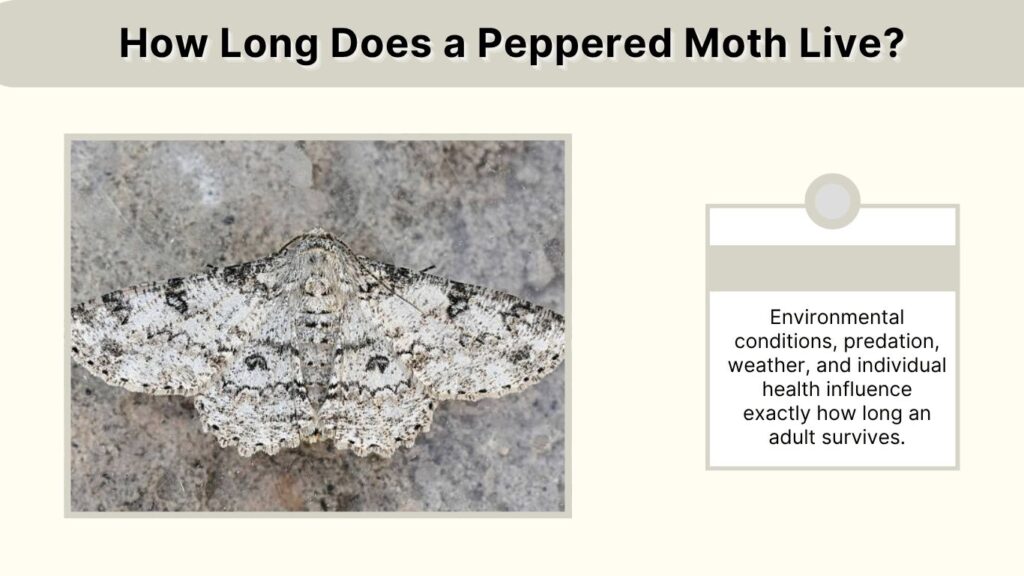
The total life cycle lasts much longer than the adult stage alone. Peppered moths spend substantial portions of their lives as larvae and pupae, while adults have a relatively brief period in which reproduction is the main priority.
Adult Lifespan
Adult moths generally survive for only a short period compared with the entire annual cycle.
After emerging, adults seek mates and females lay eggs. Environmental conditions, predation, weather, and individual health influence exactly how long an adult survives.
The overwintering pupal period can account for several months of the complete life cycle.
FAQs
Peppered moths remain widely studied because their biology combines camouflage, genetics, ecology, predation, and environmental change. Their famous history also provides an accessible way to understand how evolution can occur within observable populations.
What is the scientific name of the peppered moth?
The scientific name is Biston betularia. It belongs to the geometer moth family Geometridae.
Why did peppered moths become dark?
A genetic mutation produced the dark carbonaria form. During periods of heavy industrial pollution, dark moths were better camouflaged in many polluted environments and became more common through natural selection.
What do peppered moth caterpillars eat?
The larvae eat leaves from deciduous trees and shrubs, including birch, willow, oak, and other suitable host plants.
What animals prey on peppered moths?
Birds are particularly important predators of adult peppered moths. Bats, spiders, predatory insects, and other animals may also prey on different life stages.
Why is the peppered moth important to evolution?
The peppered moth provides a well-known example of natural selection. Changes in pollution altered camouflage advantages, causing the frequencies of pale and dark inherited forms to change over generations.