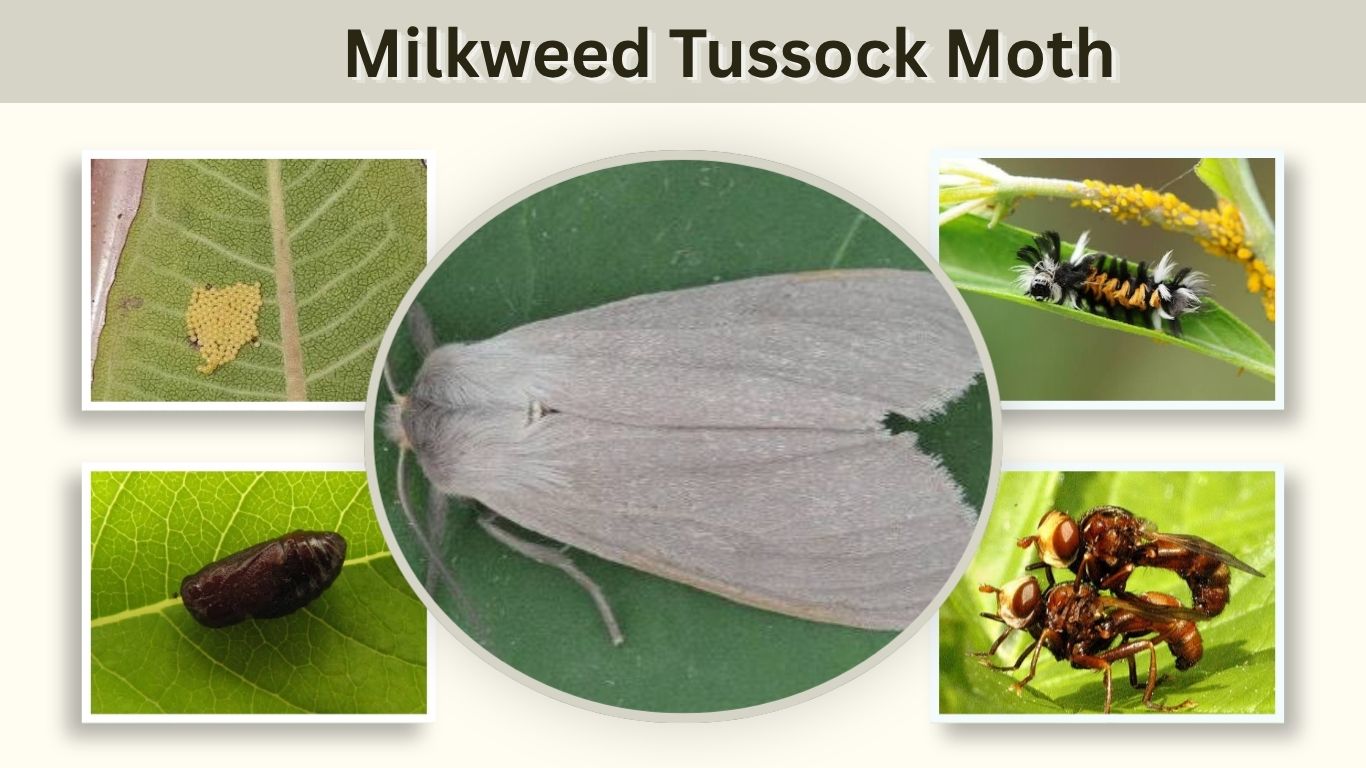
The milkweed tussock moth (Euchaetes egle) is a native North American moth best recognized by its fuzzy orange, black, and white caterpillar. Colonies feed together on milkweed and can strip several plants surprisingly quickly. Although this damage may concern gardeners raising milkweed for monarchs, the moth is neither invasive nor automatically a harmful pest. It is another native milkweed specialist with an important place in the ecosystem. Its caterpillars do not sting, but their hairs and hairy cocoons may irritate sensitive skin, so handling is discouraged.
What Is a Milkweed Tussock Moth?
The milkweed tussock moth is also called the milkweed tiger moth. Despite its common name, it is a tiger moth in the subfamily Arctiinae rather than one of the “true” tussock moths in the subfamily Lymantriinae.
Range and Habitat
This moth occurs throughout much of eastern North America. It is commonly reported in the eastern United States and southern Canada, including Minnesota, Wisconsin, Michigan, Indiana, Ohio, Maine, and surrounding regions.
It inhabits places where milkweed grows, including:
- Meadows and prairies
- Roadsides
- Woodland edges
- Old fields
- Pollinator gardens
- Parks and naturalized landscapes
It is a native species, not an introduced or invasive moth.
Milkweed Tussock Moth Identification
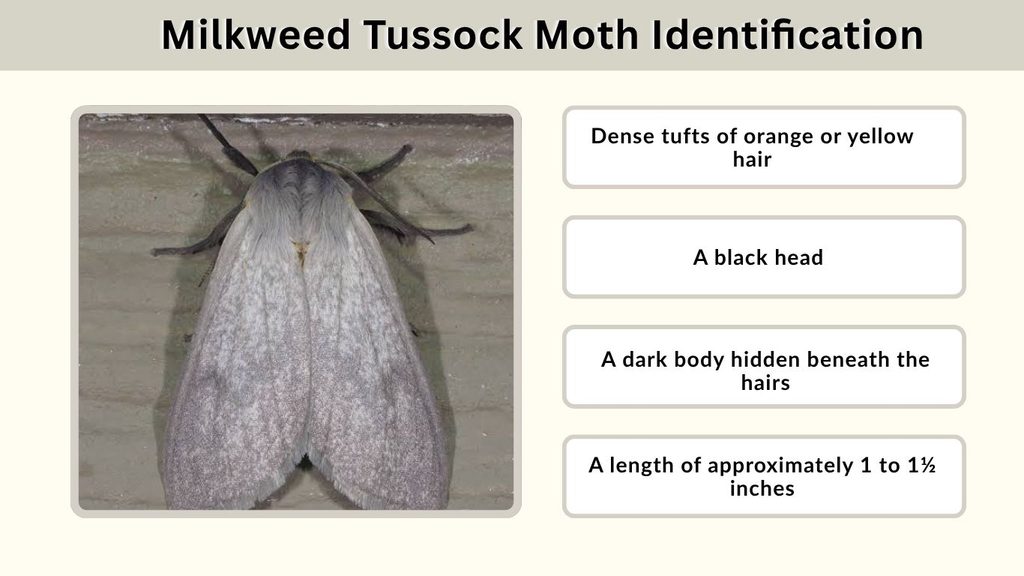
The brightly colored caterpillar is far more noticeable than the adult. Its appearance changes dramatically as it passes through several immature stages.
Young Caterpillar
Newly hatched larvae are pale cream or yellowish with black heads. They have few visible hairs and look completely different from the fuzzy older caterpillars shown in most photographs.
Young larvae gather in large colonies and feed together on the underside of a leaf. They consume the tissue between the veins, leaving behind a skeleton-like network.
Mature Caterpillar
By its third growth stage, the caterpillar develops its characteristic coat. A mature individual has:
- Dense tufts of orange or yellow hair
- Longer black and white hair tufts
- A black head
- A dark body hidden beneath the hairs
- Several noticeably long hair pencils
- A length of approximately 1 to 1½ inches
The orange, black, and white coloring acts as a warning to potential predators that the caterpillar contains defensive chemicals acquired from milkweed.
Adult Milkweed Tussock Moth
The adult is less colorful than the caterpillar. Its identifying features include:
- Dull gray or brownish-gray wings
- Few noticeable wing markings
- A hairy yellow-orange abdomen
- Rows of black spots on the abdomen
- A wingspan reaching approximately 1¾ inches
The bright abdomen is often hidden beneath the folded gray wings while the moth rests. Adults are nocturnal and may be attracted to outdoor lights.
Eggs and Cocoon
Females deposit fuzzy masses of small white eggs on the undersides of milkweed leaves. A cluster can contain dozens or even several hundred eggs.
Mature caterpillars drop to the ground and create gray cocoons containing hairs from their bodies. Inside, each caterpillar transforms into a pupa. The correct term is a moth pupa or cocoon rather than a chrysalis, which generally describes a butterfly pupa.
Milkweed Tussock Moth: Friend or Foe?
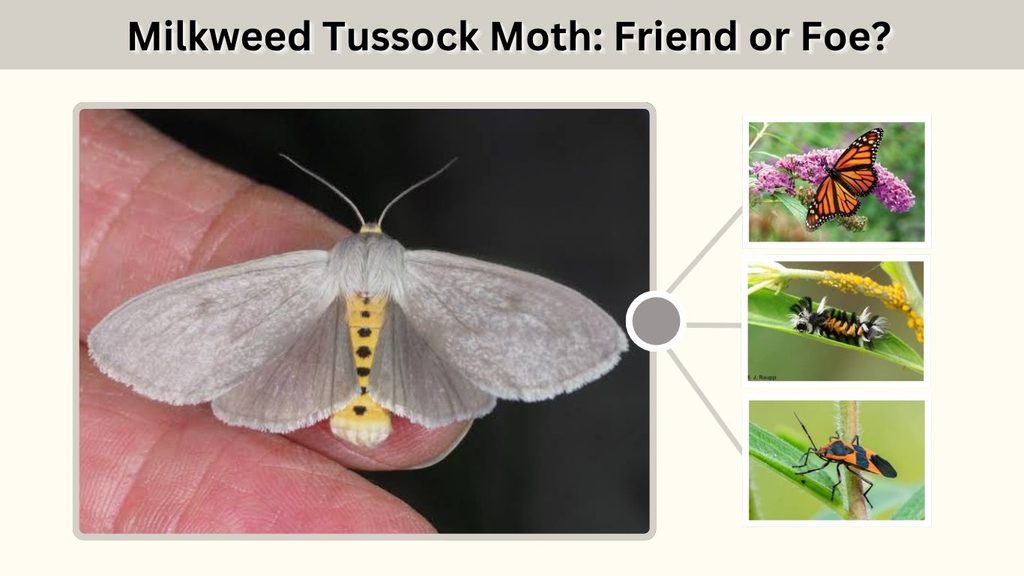
The milkweed tussock moth is best considered a native garden guest. Its caterpillars can cause dramatic temporary damage, but feeding on a host plant does not make a native insect ecologically harmful.
Why It Is a Friend
Milkweed tussock moths contribute to native insect diversity and the wider food web. They have shared milkweed habitats with monarchs and other specialized insects long before people created monarch gardens.
A healthy milkweed patch supports numerous native species, including:
- Monarch butterflies
- Milkweed tussock moths
- Milkweed bugs
- Milkweed beetles
- Native bees and flower-visiting flies
- Predators and parasitoids
Supporting milkweed biodiversity means accepting some chewed leaves. Illinois Extension advises against treating these native milkweed feeders as pests simply because they share plants with monarchs.
When It May Become a Problem
A large colony can skeletonize or completely consume several milkweed plants. This may be concerning when:
- Only one or two milkweed plants are available
- The plants are newly established
- Monarch eggs or larvae are already present
- Caterpillars consume the stems as well as leaves
- Repeated defoliation prevents plant recovery
- Milkweed is being grown commercially
Established common milkweed usually produces additional growth, especially when its roots are healthy. Visible defoliation is therefore not always permanent damage.
Milkweed Tussock Moth vs. Monarch Caterpillar
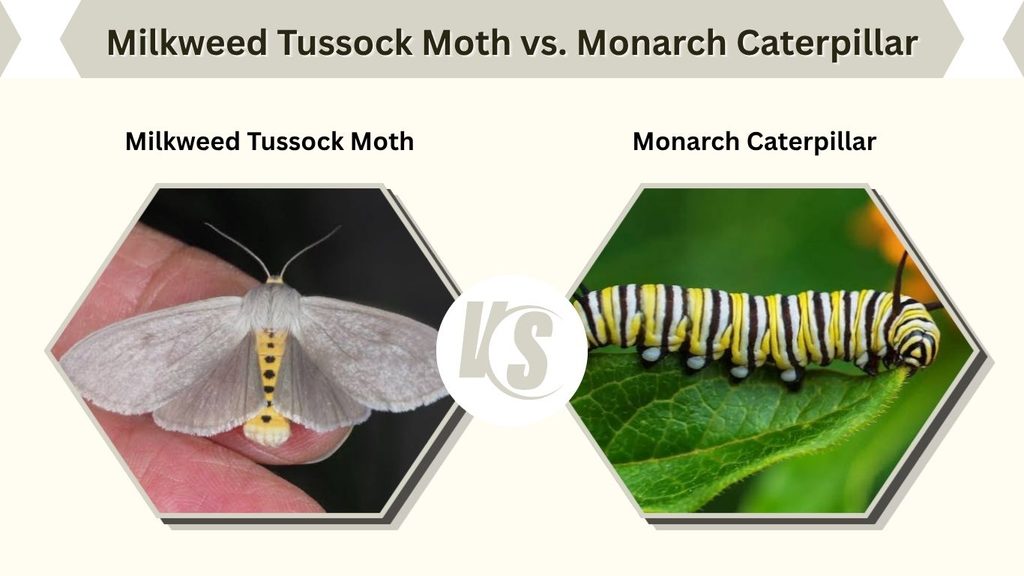
Both species are native milkweed specialists, but they are easy to distinguish.
| Feature | Milkweed tussock moth | Monarch butterfly |
| Appearance | Fuzzy orange, black, and white | Smooth black, white, and yellow bands |
| Feeding behavior | Young larvae feed in colonies | Usually feeds alone |
| Leaf preference | Often older foliage | Frequently younger foliage |
| Pupal stage | Pupa inside a hairy gray cocoon | Exposed green chrysalis |
| Adult | Gray moth with orange abdomen | Large orange-and-black butterfly |
| Activity | Adult primarily nocturnal | Adult active during the day |
Young tussock moth colonies may consume a large amount of foliage, but they seldom eliminate all food available to monarchs across a healthy milkweed patch. Tussock moth caterpillars often favor older shoots, while monarchs commonly use younger growth.
Are Milkweed Tussock Moth Caterpillars Poisonous?
The answer depends on what “poisonous” means. Caterpillars store some of the cardiac glycosides found in milkweed, making them distasteful or toxic to certain predators. Their orange, black, and white coloring advertises this chemical defense.
They are not venomous, and they do not inject poison through a bite or stinger. They should never be eaten, but simply seeing one does not present a danger.
Can You Touch the Caterpillar?
Milkweed tussock moth caterpillars do not have a true stinger. Nevertheless, their dense hairs may cause mechanical irritation or a skin reaction in sensitive individuals.
The safest approach is to avoid handling them, particularly for:
- Young children
- People with sensitive skin
- Anyone with a history of caterpillar reactions
- People handling numerous caterpillars
- Anyone touching cocoons or shed skins
Use gloves or a soft brush if one must be moved. Avoid touching the face or eyes afterward.
Caterpillar Rash
A possible reaction may include:
- Localized itching
- Small red bumps
- Burning or prickling
- Mild swelling
- An irritated patch where contact occurred
Hairy cocoons may be more irritating than living caterpillars because they contain concentrated larval hairs. Wash exposed skin gently with soap and water, change contaminated clothing, and apply a cool compress. Seek medical help for severe swelling, eye exposure, breathing difficulty, or a spreading reaction.
Milkweed sap can also irritate skin and eyes, so symptoms after working around the caterpillars may originate from the plant rather than the insect.
Milkweed Tussock Moth Life Cycle
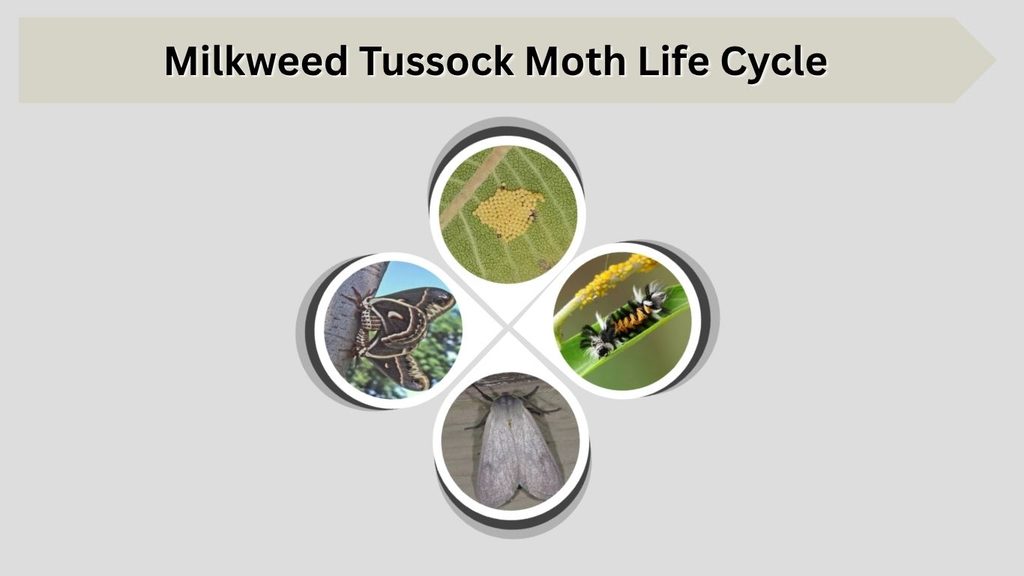
The moth undergoes complete metamorphosis through four stages: egg, caterpillar, pupa, and adult. Seasonal timing and number of generations vary with climate.
1. Egg Stage
The female places a fuzzy mass of white eggs on the underside of a milkweed leaf. Clustering helps the newly hatched larvae begin feeding together.
2. Early Caterpillar Stages
The pale larvae hatch and skeletonize leaves as a group. Feeding between the major veins allows them to avoid some of the plant’s sticky latex.
After molting, the caterpillars develop sparse hairs. The orange, black, and white tufts become prominent by approximately the third instar.
3. Mature Caterpillar
Older caterpillars may remain in small groups or begin feeding individually. They cut or damage major leaf veins, allowing latex to drain before consuming the leaf.
When fully grown, they leave the plant and descend to the ground.
4. Cocoon and Pupa
The caterpillar spins a gray cocoon in leaf litter or another protected location near the soil. Its own hairs become incorporated into the cocoon’s protective covering.
Northern populations generally produce one generation per year and overwinter as pupae. Southern populations may complete two or more generations.
5. Adult Moth
The gray adult emerges, mates, and lays another egg mass. Although the adult appears plain, it retains milkweed-derived chemicals in its body.
Adults can produce ultrasonic clicks that warn hunting bats of their unpleasant taste. Bats may learn to avoid moths associated with this sound.
Diet and Host Plants
Milkweed tussock moth caterpillars specialize in plants from the dogbane family. They do not normally damage trees.
Common Host Plants
Their food plants include:
- Common milkweed
- Swamp milkweed
- Butterfly milkweed
- Other native Asclepias species
- Some dogbane species
Common milkweed is one of the most frequently used hosts. Caterpillars may also appear on ornamental milkweeds grown in pollinator gardens.
How Caterpillars Handle Milkweed Sap
Milkweed releases sticky white latex when damaged. This substance can trap or gum up the mouthparts of small insects.
Young caterpillars avoid much of the latex by eating leaf tissue between the veins. Older larvae may cut a major vein and wait for the latex to drain before feeding beyond the damaged point.
Predators and Natural Defenses
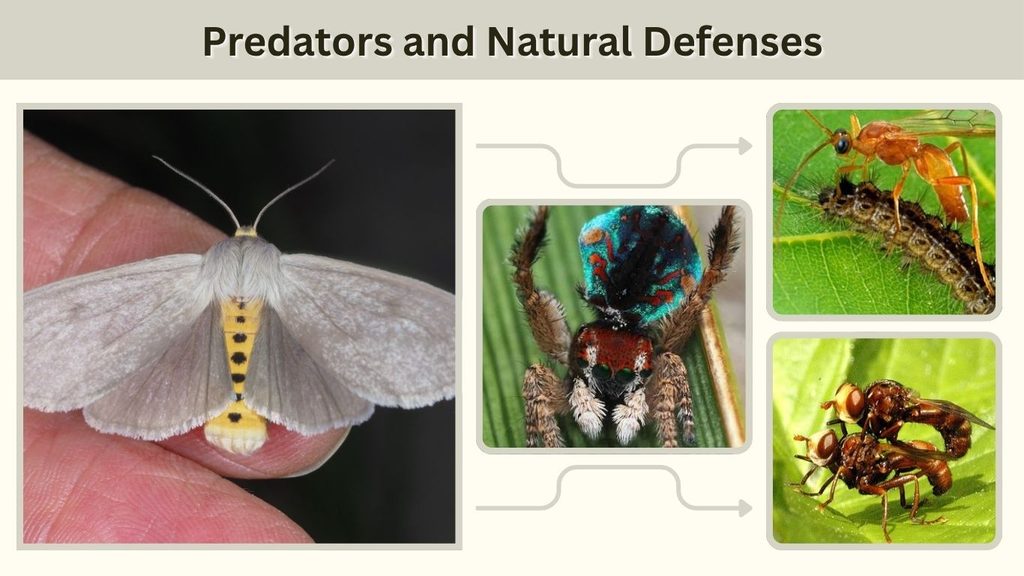
Storing milkweed chemicals protects the caterpillars from many vertebrate predators, but it does not make them invulnerable.
Potential enemies include:
- Predatory bugs
- Spiders
- Parasitic wasps
- Parasitic flies
- Insect diseases
- Predators able to tolerate their chemicals
The bright caterpillar colors discourage visually hunting predators. At night, adult moths rely on ultrasonic warning sounds because bats locate prey using echolocation rather than color.
How to Manage Milkweed Tussock Moths
Control is rarely necessary in a wildlife or monarch garden. The most environmentally responsible response is usually to tolerate the feeding and grow enough milkweed to support multiple native species.
Wildlife-Friendly Options
- Plant several milkweed plants instead of one.
- Grow more than one native milkweed species.
- Allow established plants time to regrow.
- Avoid removing entire colonies unnecessarily.
- Move a few caterpillars with a gloved hand or soft brush to abundant milkweed elsewhere on the same property.
- Protect monarch-occupied stems with separate mesh enclosures when appropriate.
- Avoid pesticides on milkweed.
Do not apply Btk or a broad-spectrum caterpillar insecticide to plants intended for monarchs. A product that kills milkweed tussock moth larvae can also kill monarch caterpillars.
FAQs
Are milkweed tussock moth caterpillars dangerous?
They are not venomous and cannot sting, but their hairs may irritate sensitive skin. Avoid unnecessary handling.
Are milkweed tussock moths invasive?
No. Euchaetes egle is native to North America and forms a natural part of milkweed ecosystems.
Should I remove milkweed tussock moth caterpillars?
Usually not. Consider moving some only when a large colony threatens a very small planting or leaves no foliage for other milkweed specialists.
Do milkweed tussock moth caterpillars hurt monarchs?
They do not attack monarchs, but both species use milkweed and may compete when foliage is extremely limited.
What does an adult milkweed tussock moth look like?
The adult has plain gray wings and a hairy yellow-orange abdomen marked with black spots. Its wingspan can reach approximately 1¾ inches.