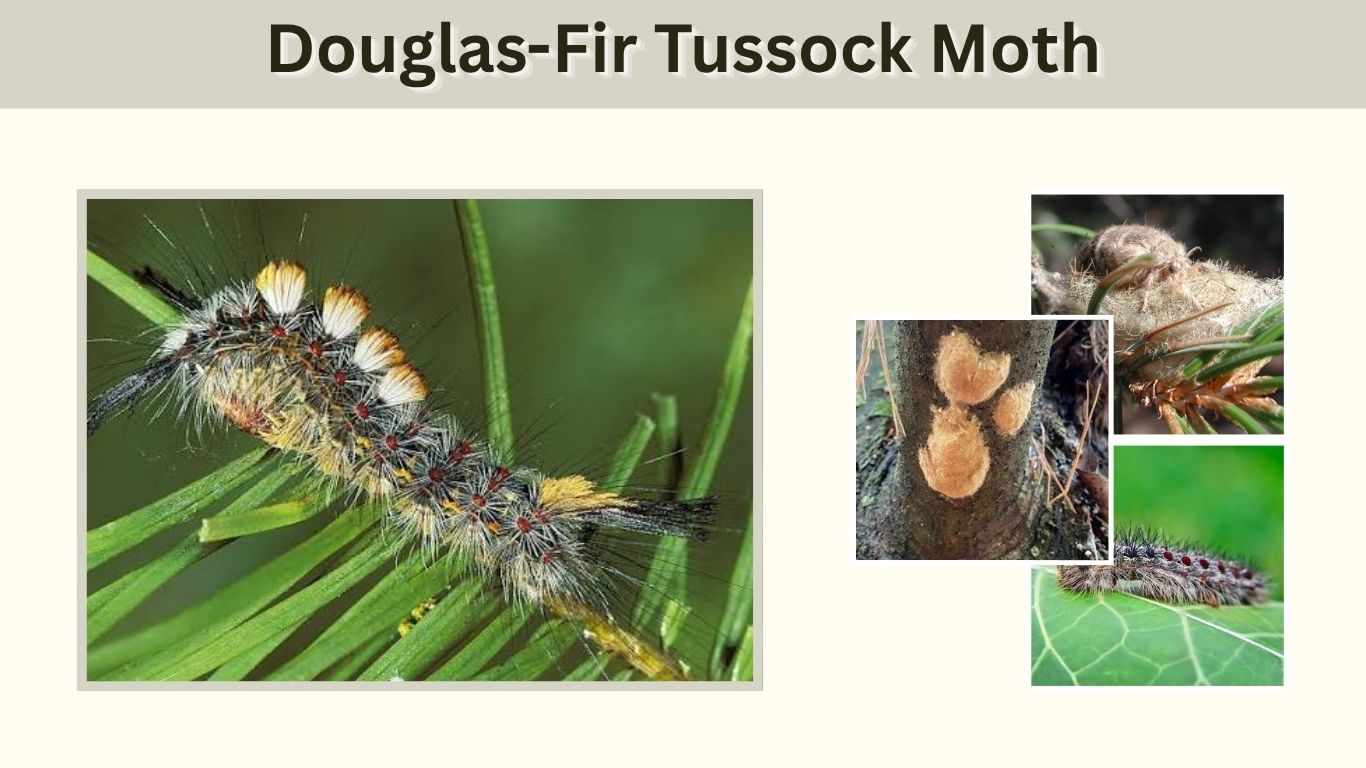
The Douglas-fir tussock moth (Orgyia pseudotsugata) is a native western North American moth whose caterpillars feed on Douglas-fir, true firs, and spruce trees. During periodic outbreaks, large caterpillar populations can remove most of a tree’s needles, kill upper branches, and weaken entire stands. The caterpillars are also a public-health concern because their detachable hairs may cause painful rashes, eye irritation, or respiratory symptoms. Recognizing the insect, avoiding contact, and treating young larvae at the correct time can reduce both tree damage and human exposure.
Douglas-Fir Tussock Moth Identification
The caterpillar is the most noticeable life stage. Its colorful hair tufts give it a distinctive appearance, while the adult male is comparatively plain and the female is wingless.
Caterpillar Identification
A mature Douglas-fir tussock moth caterpillar has:
- A gray or brown body
- A shiny black head
- Four dense, light-brown or cream tussocks along its back
- Two long black hair pencils projecting over the head
- A similar black hair pencil near the rear
- Red spots near the front and end of the abdomen
- An orange stripe along each side
- A mature length of approximately 1.2 to 1.4 inches
Newly hatched caterpillars are small, blackish, and covered with long hairs. They may climb upward before releasing silk and being carried to another tree by the wind.
Adult Male and Female
Adult males have rusty-brown forewings, gray-brown hindwings, and feathery antennae. Their wingspan is approximately one inch, and they are strong flyers.
Adult females are thick-bodied and essentially wingless. They remain on or near the cocoon from which they emerged. After mating, a female deposits her eggs directly on her old cocoon.
Egg Mass and Cocoon
An egg mass contains approximately 300 round, white eggs arranged in several layers. The female covers them with a frothy material mixed with gray body hairs.
The cocoon is:
- Brownish gray
- Spindle-shaped
- Covered with caterpillar hairs
- Attached to foliage, bark, walls, rocks, or nearby objects
The irritating hairs remain active after the caterpillar has disappeared. Old cocoons, shed skins, and egg masses should therefore be treated with the same caution as living larvae.
Are Douglas-Fir Tussock Moth Caterpillars Poisonous?
Douglas-fir tussock moth caterpillars are not venomous and do not possess a stinger. However, their fine hairs can penetrate skin and trigger an inflammatory or allergic reaction sometimes called tussockosis.
Caterpillar Warning
Avoid touching:
- Living or dead caterpillars
- Shed caterpillar skins
- Cocoons and empty pupal cases
- Egg masses
- Contaminated firewood or outdoor furniture
- Clothing carrying loose caterpillar hairs
Hairs may become airborne when caterpillars are abundant or when contaminated material is disturbed. Exposure does not always involve direct contact with a living caterpillar.
Symptoms of Exposure
Possible reactions include:
- Itching or burning skin
- Red bumps or patches
- Raised welts
- Blisters
- Eye redness and watering
- Sneezing or a runny nose
- Coughing
- Throat irritation
- Worsening asthma or allergies
Less commonly, exposure can produce shortness of breath, wheezing, or chest tightness. The National Park Service warns that hairs on caterpillars, egg masses, and cocoons can all cause reactions.
Douglas-Fir Tussock Moth Rash Treatment
Move away from the affected area and avoid rubbing exposed skin. Carefully remove contaminated clothing and wash it separately. Adhesive tape may help lift loose hairs from the skin before gentle washing with soap and water.
Use a cool compress to relieve minor discomfort. A pharmacist or healthcare professional can advise whether an antihistamine, calamine lotion, or mild hydrocortisone cream is appropriate.
Flush exposed eyes with clean water. Seek immediate medical help for breathing difficulty, facial or throat swelling, severe eye pain, widespread blistering, dizziness, or rapidly worsening symptoms.
Host Trees and Geographic Range
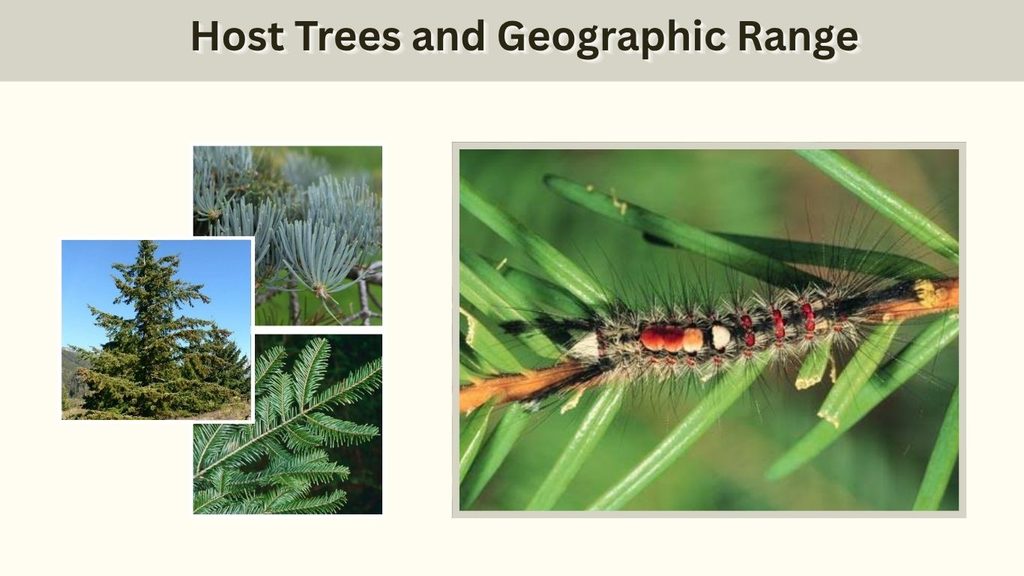
The Douglas-fir tussock moth occurs in conifer forests across western North America. Outbreaks have affected parts of Colorado, Idaho, Washington, Oregon, California, Montana, New Mexico, Arizona, British Columbia, and surrounding regions.
Preferred Host Trees
Caterpillars primarily feed on:
- Douglas-fir
- White fir
- Grand fir
- Subalpine fir
- Blue spruce
- Engelmann spruce
- Other true firs and spruces
Host preference varies geographically. In the Sierra Nevada, white fir is especially important, while Colorado outbreaks frequently affect ornamental blue spruce.
Despite its name, the insect is not limited to Douglas-fir trees. Finding its characteristic caterpillars on spruce or another true fir is entirely possible.
Douglas-Fir Tussock Moth Damage
Caterpillars consume needles rather than boring into wood. Damage usually starts around the upper crown and current year’s growth before spreading downward or onto older foliage.
Early Signs of Damage
Initial symptoms include:
- Partially eaten new needles
- Wilted or brown shoot tips
- Thinning foliage in the upper crown
- Silk strands hanging between branches
- Caterpillars gathered around new growth
- Frass accumulating beneath the tree
Damaged needles may turn brown while remaining temporarily attached. This can make an affected tree appear scorched.
Severe Outbreak Damage
When caterpillars exhaust the tender new growth, they begin feeding on older needles. Large populations may strip entire branches or trees.
Severe defoliation can cause:
- Dead treetops
- Reduced height and trunk growth
- Thin or deformed crowns
- Branch mortality
- Increased susceptibility to bark beetles
- Greater vulnerability to canker-causing fungi
- Complete tree death
A tree may survive moderate damage, but severe or repeated defoliation can be fatal. Conifers cannot replace lost foliage as quickly as many deciduous trees.
Colorado State University reports that damage normally begins at the top and can kill a heavily affected treetop after a single severe season.
Douglas-Fir Tussock Moth Life Cycle
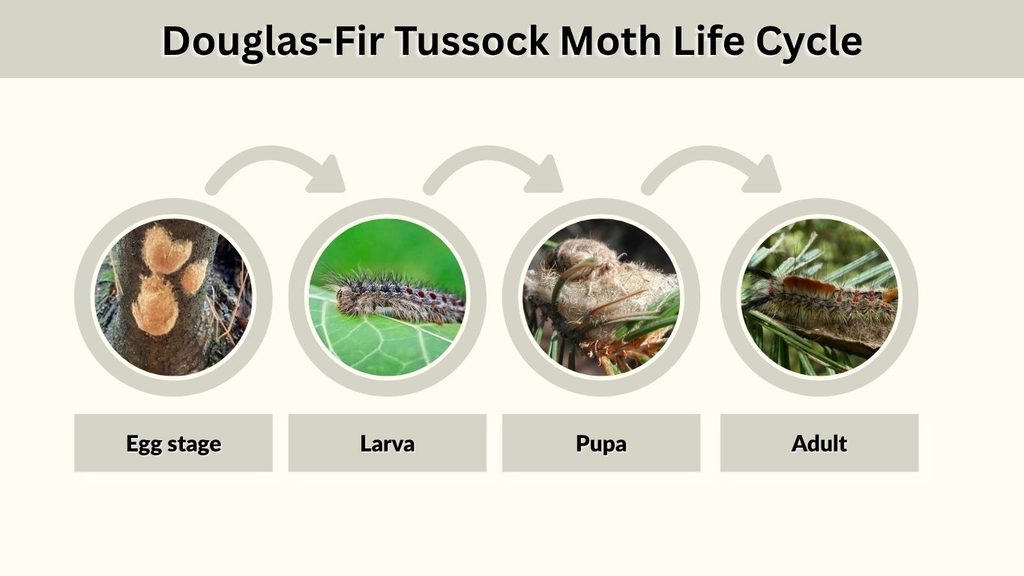
The species completes one generation each year. Eggs remain in place through winter and hatch when new conifer growth becomes available.
1. Overwintering Eggs
The insect spends winter as an egg inside the female’s frothy, hair-covered egg mass. Egg masses remain attached to cocoons, foliage, bark, buildings, and other nearby surfaces.
2. Caterpillar Emergence
Eggs usually hatch from mid-May through mid-June, depending on elevation, weather, and local bud development. Young caterpillars move toward fresh foliage and may disperse on windborne silk.
They first consume tender new needles. As they become larger, they move onto older foliage and require increasing amounts of food.
3. Cocoon and Pupa
By mid-July or August, mature caterpillars stop feeding and spin brownish cocoons. Some remain on the host tree, while others crawl onto walls, rocks, fences, or nearby vegetation before pupating.
4. Adult and Egg Laying
Adults generally emerge from late July through mid-August. Flying males locate wingless females using pheromones. After mating, each female lays an egg mass on or beside her cocoon, beginning the next annual cycle.
Why Douglas-Fir Tussock Moth Outbreaks End
Populations may remain extremely low for years before rapidly increasing. Outbreaks frequently collapse after one or more seasons because predators, parasitoids, and disease spread more effectively through crowded populations.
Natural Enemies
Important natural controls include:
- Parasitic wasps
- Tachinid flies
- Spiders
- Birds that eat young caterpillars
- A species-specific nucleopolyhedrosis virus
Virus-infected caterpillars develop “wilt disease.” They often hang limply from needles or branches by one or two legs before their bodies rupture and release viral particles.
Do not handle these dead caterpillars. Besides containing irritating hairs, they play a role in naturally suppressing the outbreak.
Douglas-Fir Tussock Moth Control
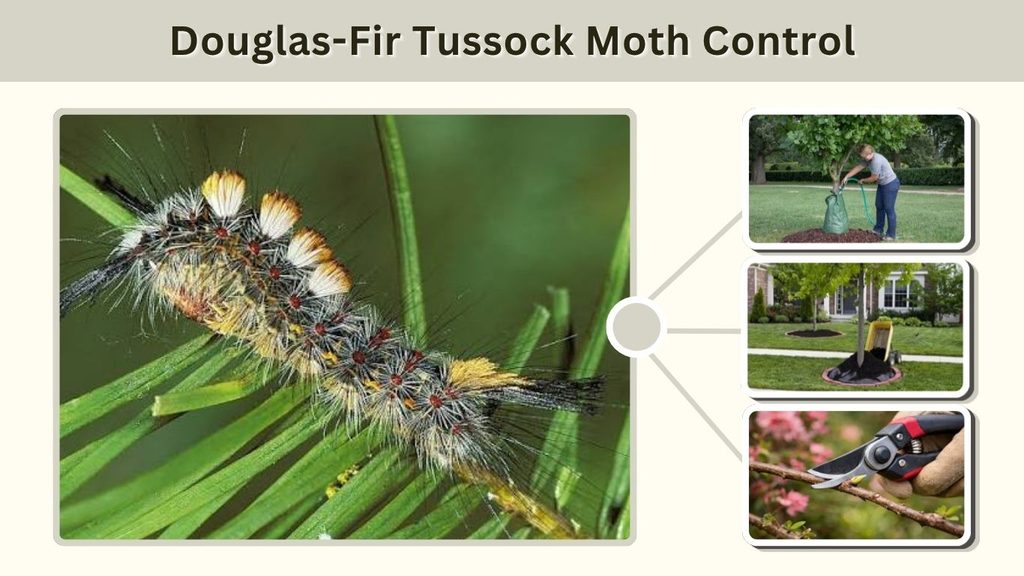
Management should begin with identification and monitoring. A few caterpillars do not necessarily justify pesticide treatment, especially when natural diseases are already collapsing the population.
Inspect for Egg Masses
From late summer through early spring, examine host trees and nearby objects for frothy, grayish egg masses attached to old cocoons.
Finding numerous fresh egg masses suggests a greater risk of defoliation the following spring. However, wait until bud break and confirm that eggs are hatching before arranging a spray treatment.
If accessible egg masses are removed, wear gloves, long sleeves, eye protection, and a suitable mask. Place the material directly into a sealed container without brushing or crushing it.
Treat Young Caterpillars
Registered insecticides are most effective shortly after eggs hatch, while larvae are small and feeding on new growth. Complete coverage of the upper canopy is important because that is where early damage concentrates.
Never apply an insecticide unless the label lists the intended site and pest. Product availability and permitted uses vary by location. Large conifers should be treated by a licensed arborist because reaching the upper crown safely requires specialized equipment.
Pheromone Monitoring
Forestry agencies use pheromone traps as an early-warning system. These traps capture flying males and can indicate that a population is increasing one or more years before visible defoliation becomes severe.
A pheromone trap monitors activity; it does not usually capture enough males to control an established outbreak.
Protect Stressed Trees
Support recovering landscape trees by:
- Watering deeply during drought
- Keeping mulch away from the trunk
- Avoiding root disturbance
- Delaying unnecessary pruning
- Monitoring for bark beetles
- Removing only confirmed dead or hazardous branches
- Consulting an arborist after severe defoliation
FAQs
Can a Douglas-fir tussock moth caterpillar sting?
It does not have a true stinger, but its detachable hairs can penetrate skin and produce a painful, itchy rash.
Are Douglas-fir tussock moths dangerous?
They are primarily dangerous to susceptible conifers. Their hairs can also cause skin, eye, nose, throat, and respiratory irritation in sensitive people.
Can old cocoons still cause a rash?
Yes. Cocoons contain caterpillar hairs that can remain irritating after the adult moth has emerged.
What does a Douglas-fir tussock moth caterpillar eat?
It eats needles from Douglas-fir, true firs, and spruces. Young larvae prefer new growth, while older larvae also consume mature needles.
Should every infestation be sprayed?
No. Small populations may be controlled naturally, and some outbreaks are already collapsing from viral disease. Treatment is most appropriate when numerous young larvae threaten valuable trees.