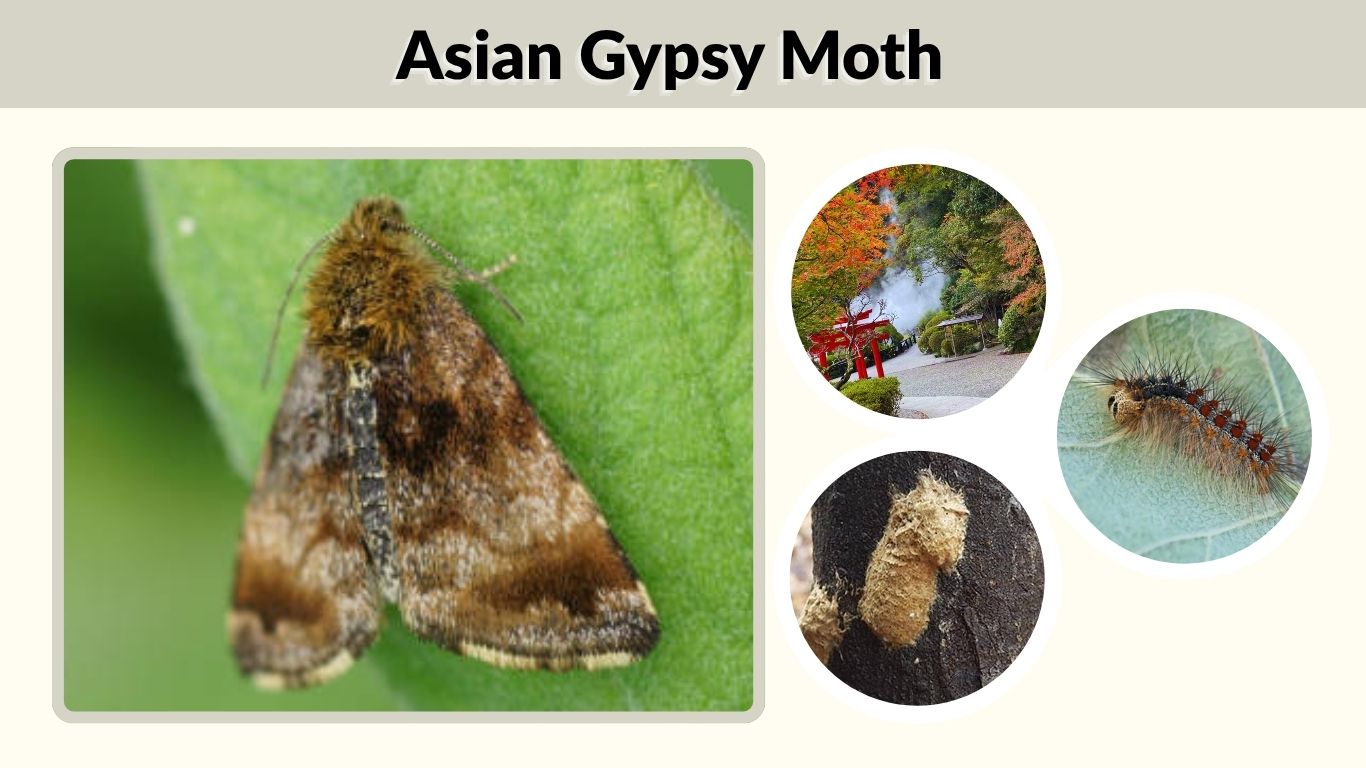
The Asian gypsy moth is an invasive forest pest now officially called the flighted spongy moth complex. Unlike the established European spongy moth, adult Asian-form females can fly, allowing them to spread quickly and deposit eggs on trees, vehicles, cargo, and ocean-going vessels. Their caterpillars consume the foliage of hundreds of deciduous and coniferous plants. Because egg masses can survive long voyages, numerous countries inspect and certify vessels arriving from high-risk Asian ports. This guide covers identification, life cycle, damage, distribution, seasonal activity, and inspection requirements.
What Is the Asian Gypsy Moth?
“Asian gypsy moth,” often abbreviated AGM, was historically used for several closely related Lymantria moths with flight-capable females. Regulatory agencies now call this group the flighted spongy moth complex, or FSMC. It is considered a serious biosecurity threat because its females disperse readily and its caterpillars attack a remarkably broad range of trees.
Scientific Classification
The flighted spongy moth complex includes:
- Lymantria dispar asiatica
- Lymantria dispar japonica
- Lymantria albescens
- Lymantria umbrosa
- Lymantria postalba
These species and subspecies are native to parts of temperate and subtropical Asia. They appear so similar that DNA analysis may be required to separate them from the European spongy moth.
Asian vs. European Spongy Moth
| Feature | Flighted Asian Complex | European Spongy Moth |
| Female flight | Females can fly | Females are flightless |
| Host plants | Very broad, including conifers | Prefers deciduous trees |
| Natural spread | Potentially rapid | Comparatively slow |
| North American status | Not established | Established in many regions |
| Maritime risk | High | Primarily a domestic land-movement issue |
| Identification | DNA testing may be needed | Appearance alone remains difficult |
The ability of females to fly is the most significant difference. One female can leave a port, reach nearby forests, and deposit an egg mass containing hundreds of viable eggs.
Asian Gypsy Moth Identification
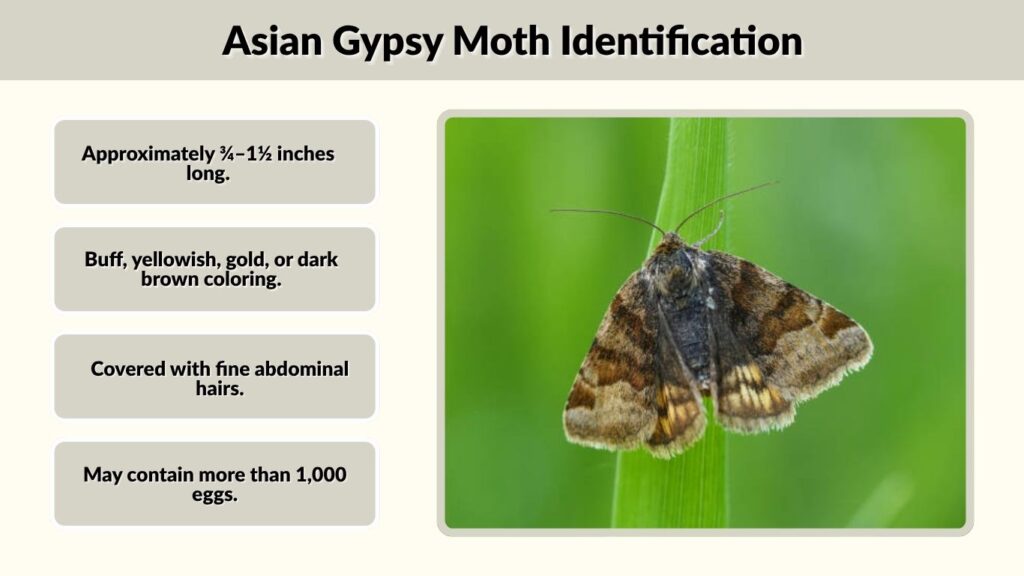
Every life stage should be considered during an inspection. Eggs are particularly important because they tolerate changing temperatures and moisture and can remain attached to a ship throughout an ocean voyage.
Egg Masses
Flighted spongy moth egg masses have the following characteristics:
- Approximately ¾–1½ inches long
- Buff, yellowish, gold, or dark brown coloring
- Covered with fine abdominal hairs
- May contain more than 1,000 eggs
- Slightly raised with a spongelike texture
- Can resemble rust, mud, or weathered sealant
Females deposit eggs on tree trunks, leaves, walls, stones, containers, vehicles, deck structures, ropes, hulls, and rigging. On ships, masses are frequently found near lights because adult females fly at night and are attracted to illuminated surfaces.
Caterpillar Identification
Newly hatched caterpillars are approximately ⅛ inch long, brown or black, and covered with hairs. They release silk threads that allow the wind to carry them away from the hatching location.
Mature larvae display:
- A body reaching approximately 2–3½ inches
- Mottled gray, yellow, brown, or black coloring
- Five pairs of blue spots behind the head
- Six pairs of red spots toward the rear
- Long hairs distributed across the body
- A tan head with darker markings
Their hairs may irritate sensitive skin, so inspectors should avoid unprotected handling.
Adult Moths
Adult males have grayish-brown wings with darker patterns and a wingspan of roughly 1½ inches. Their large, feathery antennae help them locate females.
Females are larger, with white or pale-gray wings marked by dark wavy bands. Some reach a wingspan of approximately 3½ inches. Female flight distinguishes this complex from the established European form. The term “giant Asian gypsy moth” is not an accepted species name and usually refers to an unusually large female.
Habitat, Distribution and Host Plants
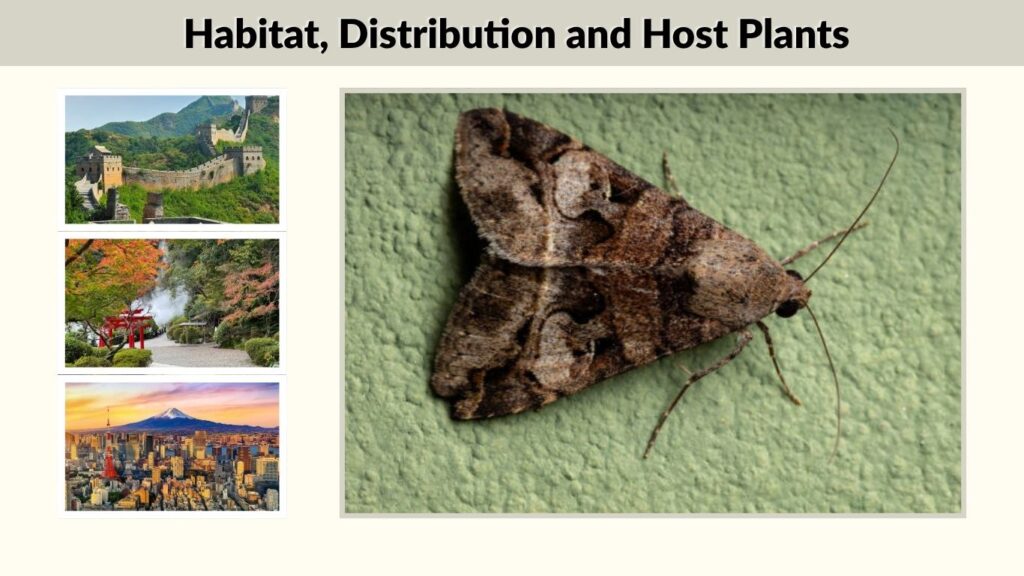
Flighted spongy moths occur naturally in parts of China, Japan, the Korean Peninsula, and far eastern Russia. Different members of the complex have different local distributions, so authorities regulate specified countries, ports, and seasons rather than treating all of Asia as equally risky.
What Do the Caterpillars Eat?
Host plants include:
- Oak and maple
- Birch and willow
- Aspen and poplar
- Apple and other fruit trees
- Beech and alder
- Larch
- Pine and spruce
- Fir and hemlock
- Various ornamental shrubs
The exceptionally broad host range would allow introduced populations to survive in many North American, Australian, and New Zealand forest ecosystems.
Three Ways It Threatens Forests
The pest threatens temperate forests through three major characteristics:
- Broad feeding range: Caterpillars can consume foliage from hundreds of deciduous and coniferous plants.
- Female flight: Females can disperse and establish egg masses farther from the original introduction site.
- Transport-resistant eggs: Egg masses survive long maritime voyages on vessels, cargo, and vehicles.
USDA considers an established population a major threat to forests, orchards, nurseries, and residential landscapes.
Asian Gypsy Moth Damage
The caterpillar is the damaging life stage. Young larvae create small holes in leaves, while older caterpillars may consume almost the entire leaf blade. During an outbreak, thousands of larvae can strip large sections of forest.
Effects on Trees
Defoliation can result in:
- Reduced photosynthesis
- Slower tree growth
- Depleted energy reserves
- Branch dieback
- Increased vulnerability to drought
- Greater susceptibility to disease and borers
- Reduced fruit or seed production
- Death after severe or repeated defoliation
Healthy deciduous trees may replace their leaves after one attack. Conifers are often less able to recover from complete foliage loss and may die after a single severe event.
Environmental and Economic Damage
Heavy infestations could change forest composition, reduce wildlife habitat, damage commercial timber, and increase tree-management costs. Orchards, nurseries, parks, and residential properties would also be affected.
Ports may face quarantines, vessel delays, offshore inspections, cleaning requirements, and expensive eradication programs after a detection. Preventing arrival is substantially easier than eliminating a reproducing population.
Asian Gypsy Moth Life Cycle
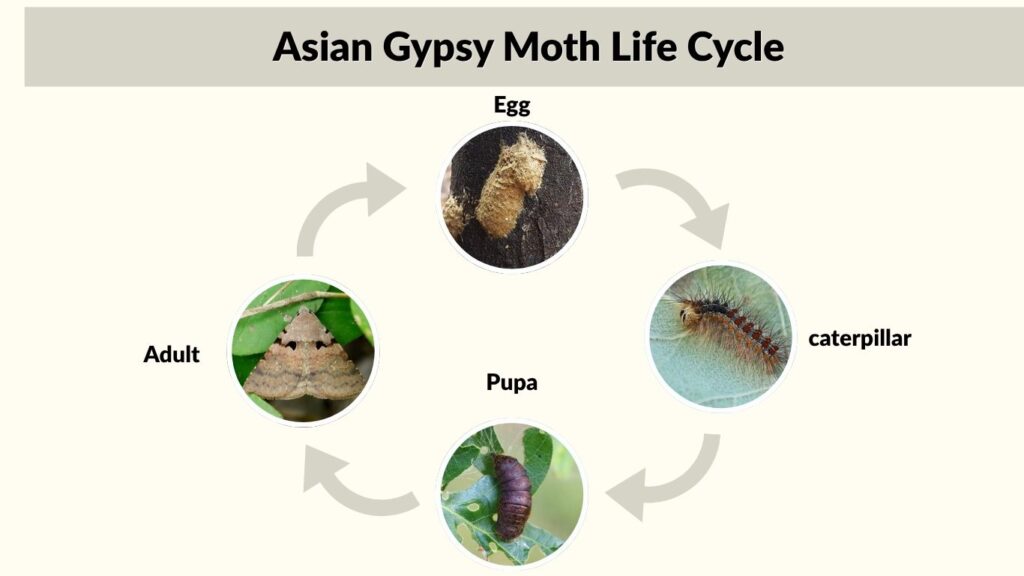
The complex generally completes one generation per year, although timing varies according to species, latitude, temperature, and climate.
Eggs and Caterpillars
Eggs survive unfavorable seasons and hatch when temperatures become suitable. Newly emerged larvae move into vegetation or disperse on silken threads.
The caterpillars feed and molt several times. Males usually pass through fewer larval stages than females, helping explain the considerable size difference between adult sexes.
Pupa and Adult
Mature larvae attach themselves to bark, leaves, structures, or cargo and transform into reddish-brown pupae. They use a small amount of silk but do not produce a complete, enclosed cocoon.
Adults emerge during the local flight season. They mate, and females fly to suitable illuminated or sheltered surfaces where they deposit egg masses. Adults do not feed and survive mainly long enough to reproduce.
Asian Gypsy Moth High-Risk Season
A high-risk or specified-risk period is the time when adult females are flying and most likely to deposit eggs on vessels. Dates vary among countries and port regions.
Current Canadian requirements list these departure-port periods:
| Regulated area | Specified risk period |
| Far eastern Russian ports | June 15–October 15 |
| Northern China, north of Shanghai | June 1–September 30 |
| South Korea | June 1–September 30 |
| Northern Japan | June 15–October 15 |
| Central Japan | June 1–September 30 |
| Southern Japan | May 15–August 31 |
| Okinawa | May 25–June 30 |
These dates can change, and individual destination countries may define different regulated areas or arrival surveillance windows. Always verify the rules for the current voyage rather than relying on a previous year’s schedule.
For 2026, Australia’s heightened vessel-surveillance window runs from January 1 through May 31. Reporting and inspection instructions are communicated through its Maritime and Aircraft Reporting System.
Vessel Inspection and Certification
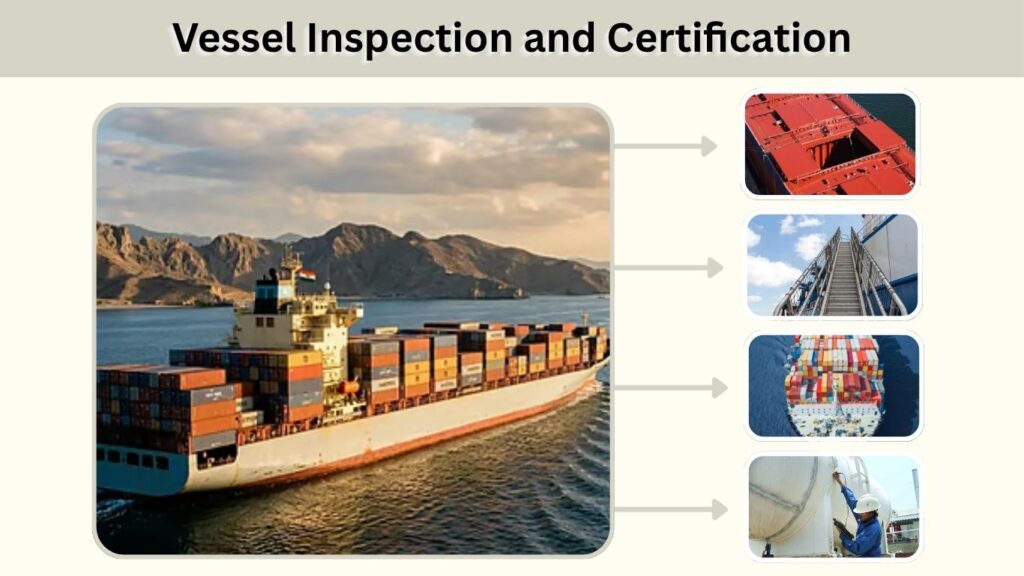
The United States and Canada work with authorities and recognized inspection organizations in China, Japan, South Korea, and Russia. Vessels that call at regulated ports during specified risk periods may require inspection and certification before sailing to North America.
Areas That Require Inspection
Inspectors and vessel crews should examine:
- Hulls and superstructures
- Decks, railings, and ladders
- Masts and rigging
- Cargo holds and hatch covers
- Containers and vehicles
- Ropes, cables, and storage spaces
- Areas around exterior lights
- Protected corners and overhangs
- Lifeboats and safety equipment
Egg masses can resemble rust or dried mud. Surfaces should be examined under strong lighting, with elevated structures checked using safe access equipment.
Inspection Certificate Requirements
A certificate generally confirms that an authorized inspector examined the vessel and found it free from all FSMC life stages. For Canadian entry, the document must come from a recognized national plant-protection organization or approved inspection body.
A vessel that visited multiple regulated ports may require inspection at the final regulated port visited during its risk period or afterward before entering Canadian waters. Authorities may still inspect a certified vessel upon arrival.
How Long Is a Certificate Valid?
There is no single universal Asian gypsy moth certificate-validity period. Validity depends on:
- The destination country
- Ports previously visited
- Dates of those port calls
- Whether calls occurred during specified risk periods
- The port where certification was issued
- Additional high-risk calls after inspection
- The current and previous voyage history
For Canadian entry during its risk season, certain vessels must provide two years of port-call history and certification connected to the last qualifying regulated port. A later call at another high-risk port can make earlier certification insufficient. Vessel operators should confirm validity with the destination authority or shipping agent before departure.
What Happens Without Certification?
An uncertified or infested vessel may face:
- Delayed entry
- Offshore inspection
- Orders to leave territorial waters
- Mandatory cleaning and reinspection
- Restricted movement within port
- Additional fees or penalties
- Refusal of entry
Removing visible egg masses during the voyage does not necessarily replace official certification. Any discovery should be documented and reported honestly to the destination’s biosecurity authority.
Prevention and Reporting
Ships should reduce unnecessary exterior lighting while safely docked in high-risk areas, conduct systematic self-inspections, and remove regulated life stages according to official procedures.
Cargo owners should inspect containers, vehicles, machinery, and outdoor equipment before international transport. A suspected moth, caterpillar, pupa, or egg mass found outside its known range should be photographed, contained when safe, and reported to agriculture or biosecurity officials. Do not transport the specimen to another location.
FAQs
What is the Asian gypsy moth called now?
Its official regulatory name is the flighted spongy moth complex, abbreviated FSMC.
Is the Asian gypsy moth established in North America?
No permanent population is currently recognized. Past introductions have been detected and eradicated.
Can female Asian gypsy moths fly?
Yes. Female flight is the defining characteristic separating this group from the established European spongy moth.
How many eggs are in one egg mass?
A single mass may contain more than 1,000 eggs, although the number varies among females and species.
Does every vessel need an FSMC certificate?
No. Requirements depend on the vessel’s port-call history, the dates of those calls, the arrival country, and its current risk period. Operators must consult the destination’s current official rules.