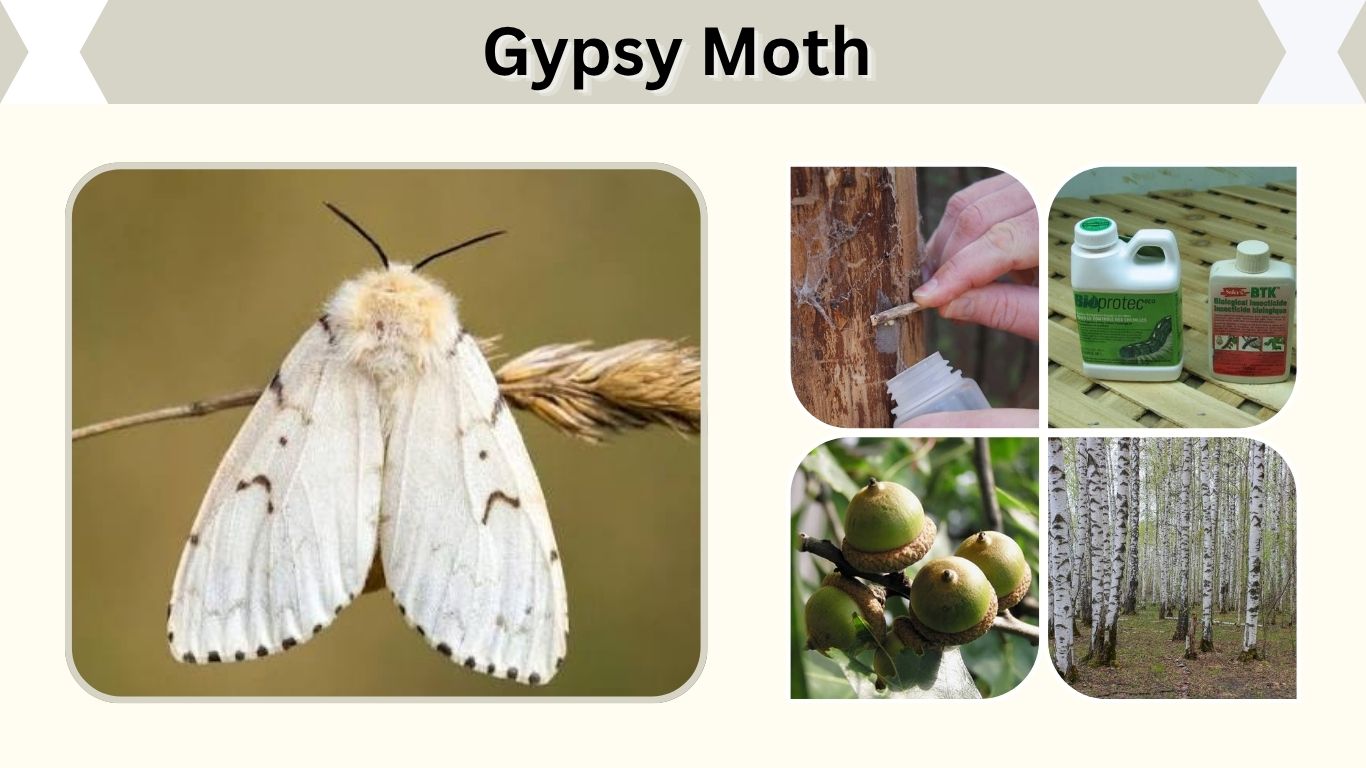
The gypsy moth, now officially called the spongy moth, is an invasive insect capable of stripping leaves from entire forests. Its caterpillars feed on hundreds of tree and shrub species, although oaks are their preferred hosts. Heavy infestations weaken trees, cover outdoor surfaces with wandering larvae, and sometimes cause irritating skin reactions. Scientifically known as Lymantria dispar, this moth passes through egg, caterpillar, pupa, and adult stages. This guide covers its identification, origin, life cycle, damage, rash risk, and effective control methods.
Why Is the Gypsy Moth Now Called the Spongy Moth?
The Entomological Society of America adopted “spongy moth” as the insect’s new common name, and the USDA began using it for regulated Lymantria moths in 2022. The name describes the insect’s sponge-like egg masses. “Gypsy moth” remains common in older publications and everyday searches, but spongy moth is now the preferred official name.
Scientific Name and Classification
The established European spongy moth found in North America is scientifically classified as Lymantria dispar dispar. It belongs to the family Erebidae.
The insect’s basic classification is:
- Order: Lepidoptera
- Family: Erebidae
- Genus: Lymantria
- Species: Lymantria dispar
- North American subspecies: Lymantria dispar dispar
- Current common name: Spongy moth
- Former common name: Gypsy moth
The name “European gypsy moth” has generally been replaced by “spongy moth.” The group formerly called Asian gypsy moths is now officially known as the flighted spongy moth complex.
Where Did the Spongy Moth Come From?
The species is native to parts of Europe, Asia, and North Africa. The European form was brought to Medford, Massachusetts, in 1869 during experiments involving silk-producing insects. Some escaped and established a wild population.
It spread through New England and gradually expanded into the Mid-Atlantic, Midwest, Great Lakes region, and parts of Canada. Moving egg masses attached to vehicles, trailers, firewood, outdoor furniture, and equipment continues to help the insect reach new locations.
What Does a Gypsy Moth Look Like?
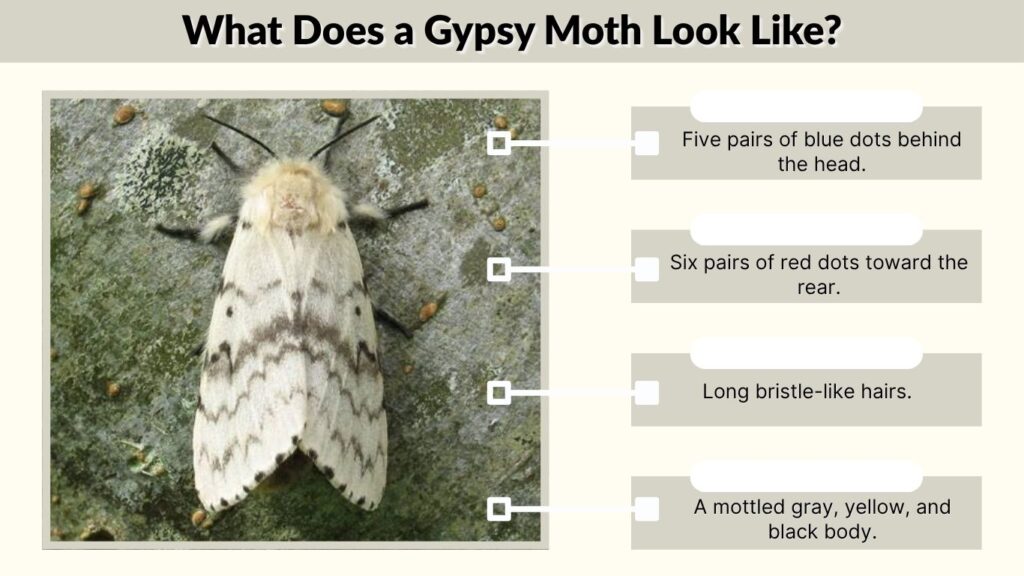
The appearance changes dramatically during development. Caterpillars are the destructive feeding stage, while adults live mainly to reproduce. Male and female moths also differ substantially in color, size, antenna structure, and flight ability.
Caterpillar Identification
Mature spongy moth caterpillars have:
- Five pairs of blue dots behind the head
- Six pairs of red dots toward the rear
- Long bristle-like hairs
- A mottled gray, yellow, and black body
- A tan head marked with dark patterns
- A mature length of approximately 2–3 inches
The five blue and six red dot pairs are the most recognizable features. Newly hatched larvae are tiny, black, and hairy, so their colored spots may not yet be obvious.
Adult Male and Female Moths
Adult males are brown with darker wavy markings across their wings. They have large, feathery antennae that detect female pheromones and are active fliers.
European-form females are larger, creamy white, and marked with dark zigzag lines. Their antennae are relatively thin. Although they possess fully developed wings, established European females in North America cannot fly and remain near their pupation sites to deposit eggs.
Three Main Characteristics
Three useful characteristics for recognizing this insect are:
- Mature caterpillars have five pairs of blue dots followed by six red pairs.
- Adult males are brown, while females are substantially larger and nearly white.
- Females cover their egg masses with buff-colored abdominal hairs, creating a spongy appearance.
Gypsy Moth Nest, Eggs and Life Cycle
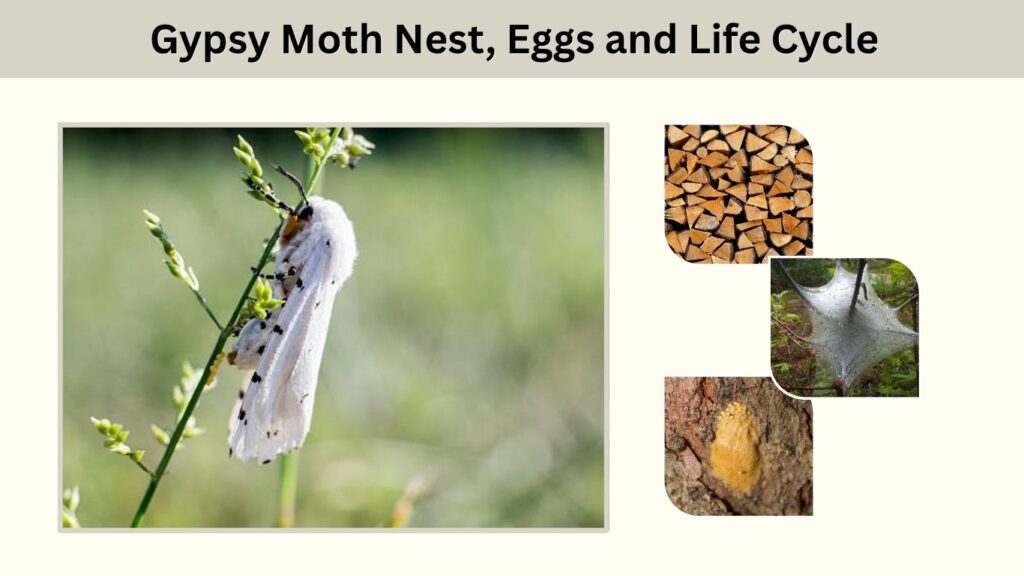
Spongy moths do not build communal silk nests like tent caterpillars. What people call a “gypsy moth nest” is usually an egg mass, a group of resting caterpillars, or silk left around a pupation site. The species completes one generation annually in most of its North American range.
Egg Mass
A female deposits a tan or buff-colored egg mass on a sheltered surface. Common locations include:
- Tree trunks and branches
- Rocks and retaining walls
- Firewood and logs
- House siding
- Trailers and recreational vehicles
- Patio furniture
- Lawn equipment and outdoor toys
An egg mass averages roughly 1½ inches long and ¾ inch wide and may contain up to 1,000 eggs. The eggs remain dormant through winter and hatch during spring.
Caterpillar and Larval Stage
Tiny larvae climb toward light and release silk strands that catch the wind. This “ballooning” behavior can transport them to nearby trees.
Young caterpillars feed mainly during daylight. Older larvae often hide in bark cracks or sheltered locations during the day and climb into the canopy at night. During severe outbreaks, competition for food forces them to wander constantly across houses, driveways, vehicles, and lawns.
Pupa and Adult Stage
After several weeks of feeding and molting, the mature caterpillar finds a protected location and becomes a dark reddish-brown pupa. It may attach itself with a few silk threads, but it does not make a complete fuzzy cocoon.
Adults emerge during summer. Males fly in search of females, mating occurs, and females produce egg masses. The adult moths do not feed and live only long enough to reproduce.
Gypsy Moth Caterpillar vs. Tent Caterpillar
These caterpillars may appear in large numbers at similar times, but their markings and behaviors differ considerably.
| Feature | Spongy Moth Caterpillar | Eastern Tent Caterpillar |
| Back pattern | Five blue and six red dot pairs | Continuous pale stripe |
| Silk nest | Does not build a tent | Builds a large branch tent |
| Preferred trees | Oaks and many hardwoods | Cherry, apple and related trees |
| Resting behavior | Hides under bark or objects | Returns to communal tent |
| Egg placement | Spongy masses on many surfaces | Dark bands around small twigs |
Forest tent caterpillars also lack a silk tent. They can be recognized by pale, keyhole-shaped spots running along the back rather than paired red and blue dots.
What Do Gypsy Moths Eat?
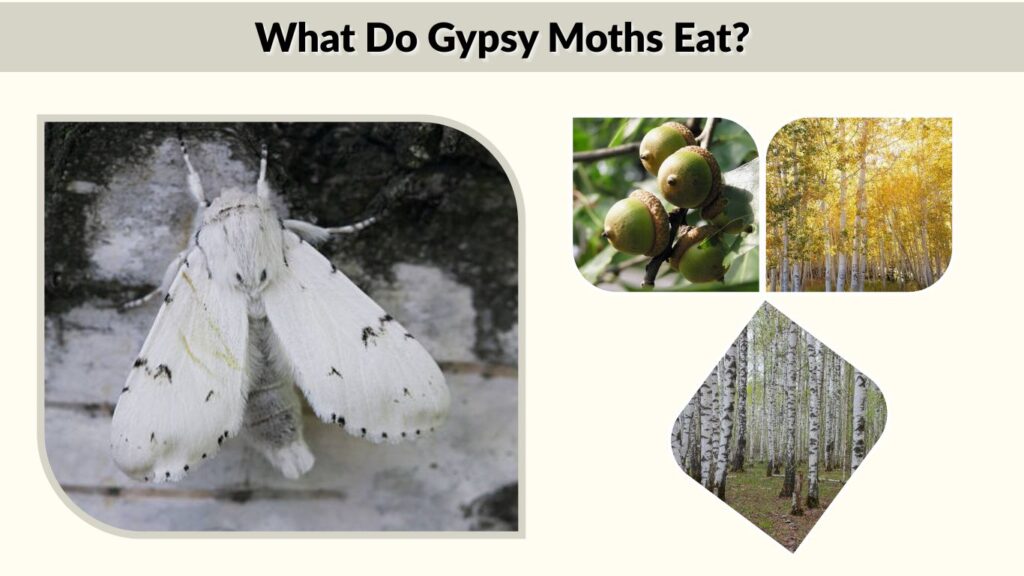
Only the caterpillar stage damages plants. Spongy moth larvae can feed on more than 300 species of trees and shrubs, enabling them to survive in forests, parks, orchards, and residential areas.
Preferred Host Trees
Frequently attacked plants include:
- Oak
- Aspen
- Birch
- Willow
- Poplar
- Apple and crabapple
- Alder
- Basswood
- Hawthorn
- Larch
When preferred deciduous trees become unavailable, older larvae may feed on pine, spruce, hemlock, cedar, and other conifers.
Damage to Trees
Caterpillars chew leaf tissue, sometimes leaving only veins or completely bare branches. Healthy deciduous trees can usually grow replacement leaves after a single defoliation.
Repeated defoliation depletes stored energy and makes trees more vulnerable to drought, disease, fungi, and wood-boring insects. Several consecutive years of heavy feeding can kill weakened hardwoods. Conifers face greater danger because many cannot replace completely lost foliage during the same season.
Are Gypsy Moth Caterpillars Poisonous?
Spongy moth caterpillars are neither poisonous nor equipped with true stinging spines. They do not bite people. However, their fine hairs can irritate the skin, eyes, or respiratory system of sensitive individuals.
Gypsy Moth Rash Symptoms
Contact with loose hairs may cause:
- Red, itchy bumps
- Burning or tingling skin
- Localized swelling
- Watery or irritated eyes
- Sneezing and nasal irritation
- Rare breathing symptoms in sensitive people
Reactions are more common during outbreaks because hairs accumulate on trees, clothing, furniture, and other outdoor surfaces. New York environmental officials advise avoiding direct contact because the hairs can irritate skin.
What to Do After Contact
Avoid scratching the affected area. Remove contaminated clothing and wash exposed skin gently with soap and water. Adhesive tape pressed lightly against the skin may help lift loose hairs. A cool compress can reduce discomfort.
Ask a pharmacist or clinician about an appropriate antihistamine or anti-itch cream. Seek urgent medical care for breathing difficulty, facial swelling, widespread hives, severe eye irritation, or rapidly worsening symptoms.
How to Control Gypsy Moths
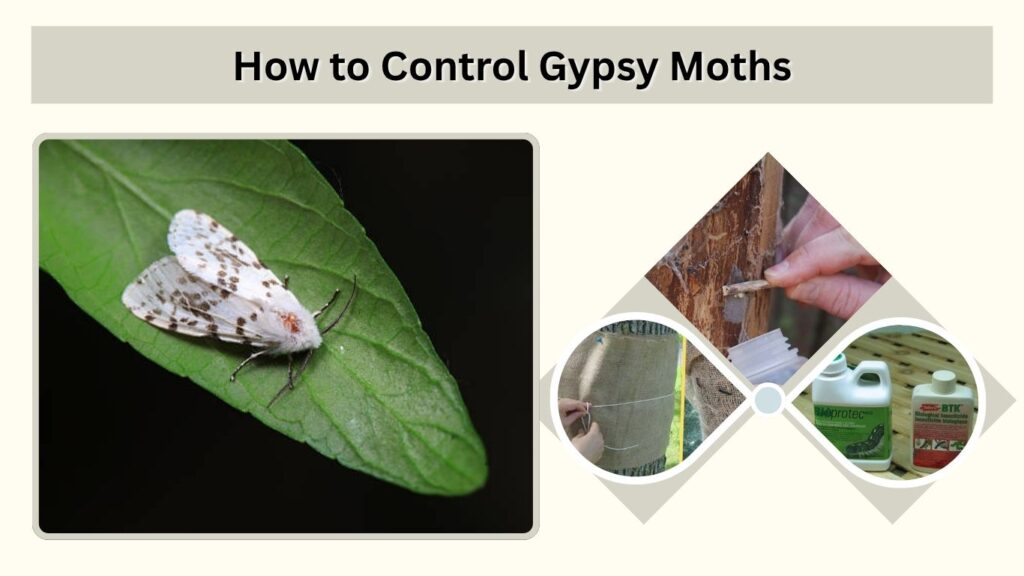
The correct control method depends on the season and life stage. No single backyard technique will eliminate a regional outbreak, but early treatment can protect individual landscape trees.
Remove Egg Masses
From late summer through early spring, inspect trees, outdoor furniture, trailers, equipment, stone walls, and firewood. Carefully scrape egg masses into a container of soapy water and keep them submerged before disposal.
Do not simply scrape egg masses onto the ground because many eggs may survive. Wear gloves, since the covering hairs can irritate sensitive skin.
Use Burlap Collection Bands
Wrap a wide strip of burlap around the trunk and fold the upper portion downward to create a shaded flap. Older caterpillars seeking daytime shelter will gather beneath it.
Check the band every afternoon while caterpillars are active. Wearing gloves, remove the larvae and place them in soapy water. Burlap bands reduce numbers but cannot protect a tree during a major outbreak by themselves.
Apply Btk to Young Caterpillars
Bacillus thuringiensis subsp. kurstaki, commonly called Btk, is a microbial insecticide used against young moth and butterfly caterpillars. Larvae must consume treated leaves for it to work.
Apply only a product specifically labeled for spongy moths, following every direction and restriction. Btk becomes considerably less effective as caterpillars grow and can kill native butterfly and moth larvae feeding on treated plants. Large trees usually require a licensed applicator with suitable equipment.
Care for Defoliated Trees
Support affected landscape trees by:
- Watering deeply during extended dry periods
- Applying a shallow mulch layer away from the trunk
- Avoiding unnecessary pruning
- Protecting roots from construction and soil compaction
- Monitoring for disease or wood-boring insects
- Consulting an arborist before removing a defoliated tree
Do not assume a leafless hardwood is dead. A healthy tree may produce another set of leaves several weeks after the caterpillars stop feeding.
Do Pheromone Traps Control Infestations?
Commercial traps attract male moths and are useful for monitoring populations. A few traps in one yard generally do not capture enough males to prevent mating or stop tree damage.
Government programs may use dense trap networks or area-wide mating disruption, but this approach differs significantly from installing a single homeowner trap.
European vs. Asian Gypsy Moth
The established European form has flightless females, limiting natural adult dispersal. Members of the flighted spongy moth complex include forms whose females can fly, allowing them to spread more quickly.
Flighted forms also have broad host ranges that may include additional conifers. Suspected discoveries outside an established infestation or quarantine area should be reported to state agriculture officials rather than treated or transported.
FAQs
What is the new name for the gypsy moth?
Its current official common name is spongy moth, referring to the insect’s buff-colored, sponge-like egg masses.
Do gypsy moth caterpillars bite?
No. They do not bite or sting people, but their hairs can cause an itchy rash or respiratory irritation in sensitive individuals.
Do gypsy moths build nests?
No. They do not build tentlike communal nests. Apparent nests are usually egg masses, pupation sites, or groups of caterpillars resting together.
What insecticide kills gypsy moth caterpillars?
Btk can control young larvae when applied to foliage according to the label. Older larvae may require different registered products or professional treatment.
Will a tree survive gypsy moth damage?
A healthy deciduous tree often survives one year of defoliation and grows replacement leaves. Repeated defoliation, drought, disease, or attacks on conifers substantially increase the risk of death.