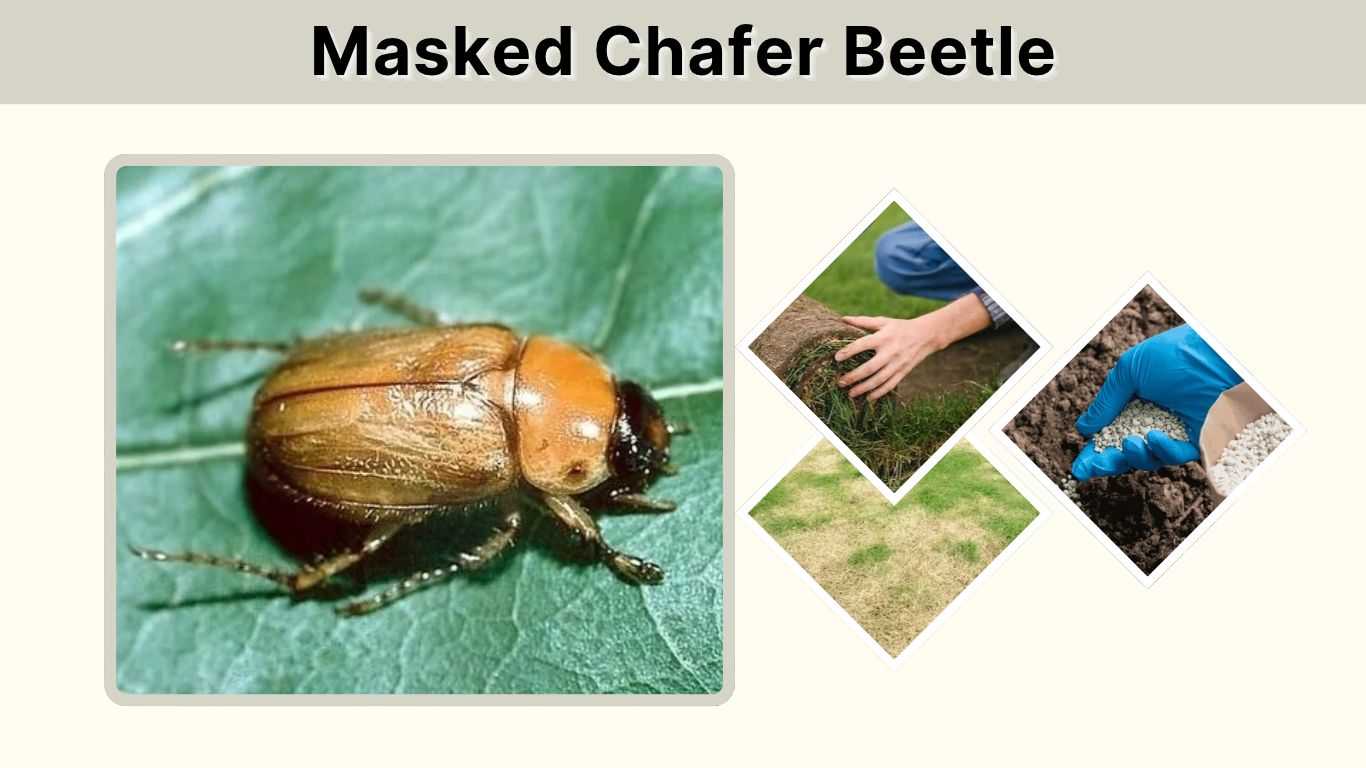
Masked chafer beetles are common lawn insects recognized by their golden-brown bodies, dark facial markings, and nighttime flying behavior. Although adult beetles rarely damage plants, their underground larvae, known as white grubs, can seriously harm turfgrass by feeding on its roots. Northern and southern masked chafers are particularly common across parts of the United States. Heavy infestations may cause brown lawn patches, weakened grass, and increased animal digging. Understanding masked chafer identification, life cycle, feeding behavior, and effective control methods helps homeowners recognize infestations and protect healthy lawns.
What Is a Masked Chafer Beetle?
A masked chafer is a scarab beetle belonging to the genus Cyclocephala and family Scarabaeidae. These beetles receive their common name from the dark markings across their faces, which resemble small masks.
Masked chafers are native to the Americas and occur in lawns, grasslands, agricultural fields, and other grassy environments.
Are Masked Chafers Harmful?
Adult masked chafers are generally harmless and do not cause significant plant damage. However, their larvae feed on grass roots and can weaken turfgrass.
Severe grub infestations may destroy sections of lawns, particularly during periods of drought or environmental stress.
Masked Chafer Beetle Identification
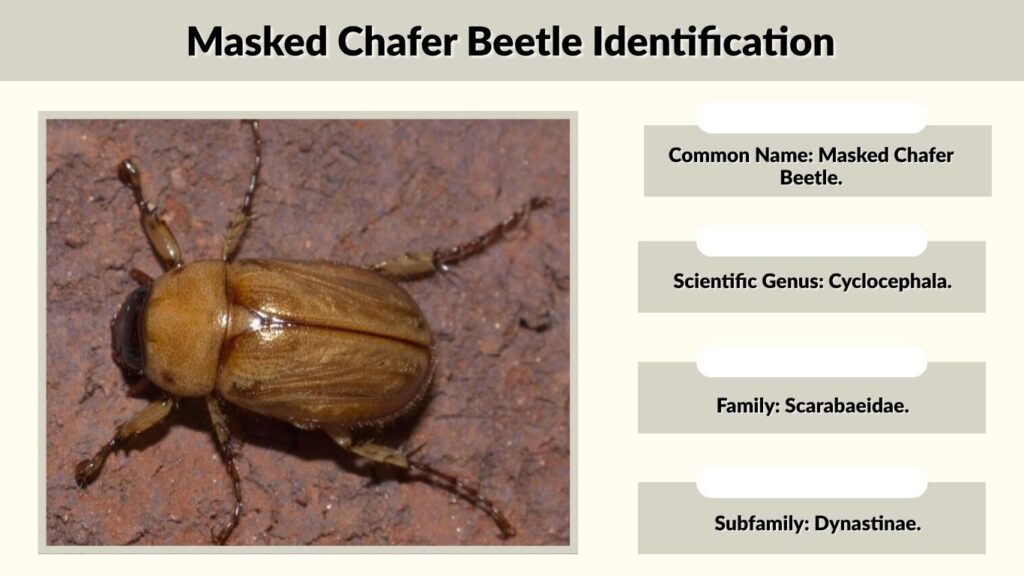
Masked chafer beetles have oval, golden-brown bodies with darker markings around their heads. Their compact appearance resembles several other scarab beetles, including June bugs.
Adults are primarily active at night and frequently gather around outdoor lights during summer.
Physical Characteristics
- Common Name: Masked Chafer Beetle
- Scientific Genus: Cyclocephala
- Family: Scarabaeidae
- Subfamily: Dynastinae
- Body Length: Approximately 10–14 mm
- Body Color: Light brown, tan, or golden-brown
- Head: Dark markings resembling a facial mask
- Antennae: Short with club-shaped tips
- Wings: Hardened outer wing covers
- Activity: Primarily nocturnal
- Habitat: Lawns, grasslands, gardens, and agricultural fields
Northern vs. Southern Masked Chafer
Northern and southern masked chafers are two important turfgrass pests in North America. Both species have similar appearances, feeding habits, and underground developmental stages.
However, their geographic distributions and certain physical characteristics differ.
Northern Masked Chafer
The northern masked chafer (Cyclocephala borealis) occurs across much of the northern and central United States.
Adults are tan or golden-brown with darker heads. Fine hairs along the sides of the abdomen help distinguish them from southern masked chafers.
They commonly emerge during early summer, and their larvae can cause serious lawn damage.
Southern Masked Chafer
The southern masked chafer (Cyclocephala lurida) is common across southern and central regions of the United States.
It resembles the northern species but generally has shorter, less noticeable hairs along the abdominal margins.
Adults are active during warm summer nights and are frequently attracted to artificial lights.
Western Masked Chafers
Western North America also supports masked chafer species, including Cyclocephala hirta and Cyclocephala pasadenae.
These beetles are associated with turfgrass damage in California and surrounding areas.
Their larvae have feeding habits similar to those of northern and southern masked chafers.
What Do Masked Chafer Grubs Look Like?
Masked chafer larvae are white, C-shaped grubs that develop underground. They have reddish-brown heads, six short legs, and thick, segmented bodies.
Mature larvae can reach approximately one inch in length.
Masked Chafer Grub Identification
Masked chafer grubs can be identified by examining the underside of the final abdominal segment.
This area, called the raster, contains scattered spines rather than the distinct V-shaped pattern found on Japanese beetle grubs.
Because white grub species look similar, magnification may be necessary for accurate identification.
Masked Chafer Life Cycle
Masked chafers generally complete one generation annually, although some southern populations may produce additional generations under favorable conditions.
Their development includes four stages: egg, larva, pupa, and adult.
Egg and Larval Stages
Female beetles deposit eggs in soil during summer. The eggs typically hatch within two to three weeks.
Newly emerged larvae begin feeding on grass roots and organic material. They pass through three larval stages while gradually increasing in size.
Pupal and Adult Stages
Mature grubs move deeper underground during colder months and return toward the root zone in spring.
After completing development, they pupate in the soil.
Adults generally emerge during early or midsummer and begin searching for mates.
Masked Chafer Grub Damage to Lawns
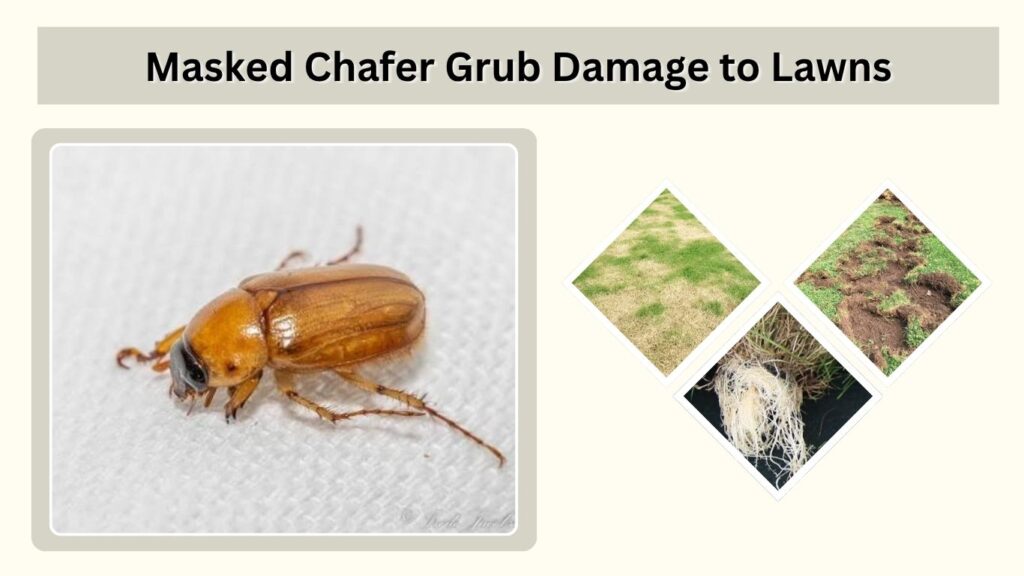
Masked chafer grubs damage lawns by feeding on turfgrass roots. Heavy feeding reduces the grass’s ability to absorb moisture and nutrients.
Affected lawns may develop irregular brown patches, particularly during hot or dry weather.
Signs of Masked Chafer Damage
- Brown Grass: Irregular patches turn yellow or brown.
- Weak Roots: Grass separates easily from the soil.
- Wilting Turf: Damaged areas struggle to recover after watering.
- Visible Grubs: White, C-shaped larvae appear beneath the surface.
- Animal Digging: Skunks, raccoons, and birds disturb turf while searching for grubs.
- Thin Grass: Previously healthy areas gradually lose density.
How Do You Check for Masked Chafer Grubs?
Use a garden spade to lift approximately one square foot of turf from a suspicious area.
Examine the grass roots and upper soil layers for grubs.
Count the larvae and compare their identification features.
Some lawns tolerate several grubs per square foot without serious damage. Treatment decisions should consider lawn health and local pest-management thresholds.
Masked Chafer vs. June Beetle
Masked chafers and June beetles belong to the scarab beetle family, but they differ in appearance and development.
Masked chafers are typically smaller, golden-brown beetles with distinctive dark facial markings.
Many June beetles are larger and belong to the genus Phyllophaga.
How Are Their Grubs Different?
Masked chafer grubs have scattered raster spines without a clearly defined pattern.
Many June beetle grubs have two nearly parallel rows of spines.
Masked chafers usually complete development in one year, while several June beetle species require multiple years.
How to Get Rid of Masked Chafer Grubs
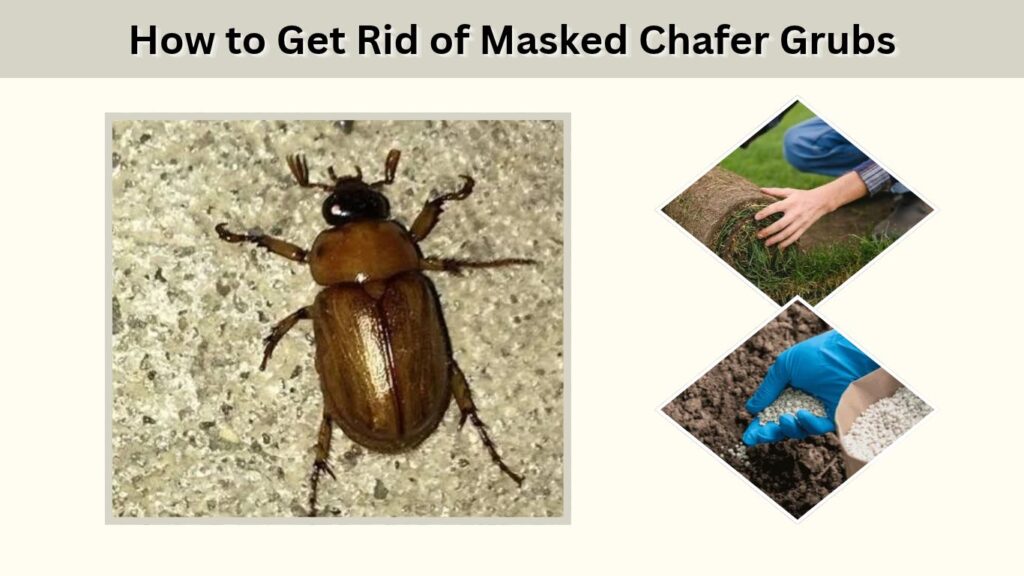
Effective masked chafer control begins with identifying the grubs and determining whether their population is high enough to justify treatment.
Healthy lawns can tolerate limited feeding, so insecticide applications are not always necessary.
Masked Chafer Control Methods
- Inspect Lawn Soil: Check damaged areas for white grubs before applying treatments.
- Maintain Healthy Grass: Proper mowing, fertilization, and irrigation improve turfgrass resilience.
- Use Beneficial Nematodes: Heterorhabditis bacteriophora may help control young grubs under suitable soil conditions.
- Apply Preventive Treatments: Registered products containing chlorantraniliprole may prevent serious infestations.
- Use Curative Treatments: Registered products containing trichlorfon may control actively feeding grubs when applied correctly.
- Monitor Lawn Recovery: Examine treated areas periodically and repair damaged turf after grub activity declines.
When to Treat Masked Chafer Grubs
Treatment timing significantly affects grub control success. Young larvae are generally easier to control than large, mature grubs.
For northern masked chafers in many Midwestern and northern U.S. locations, preventive applications are commonly recommended during June and July.
Best Time for Curative Treatment
Late summer and early autumn are generally suitable periods for treating actively feeding grubs.
In some northern regions, August through October is the recommended curative treatment window, with earlier applications often performing better.
Always follow local extension recommendations and pesticide label instructions because treatment timing varies by climate and product.
How to Prevent Masked Chafer Infestations
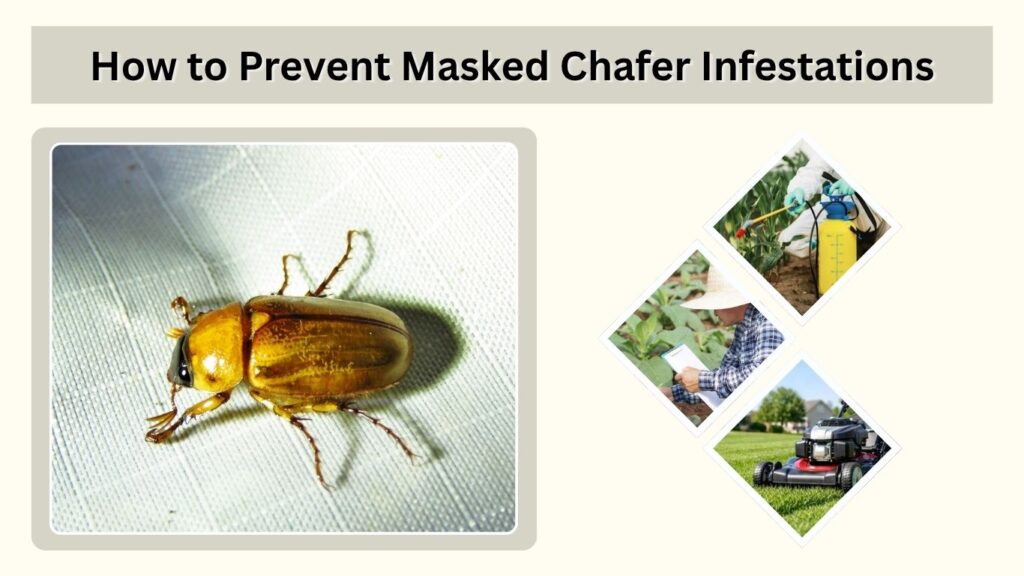
Preventing serious masked chafer infestations involves maintaining healthy turfgrass and monitoring areas with a history of grub damage.
Good lawn management improves root development and helps grass tolerate moderate insect feeding.
Masked Chafer Prevention Tips
Avoid unnecessary pesticide applications when grub populations remain low.
Maintain appropriate mowing heights and water according to turfgrass requirements.
Inspect previously damaged areas during late summer.
Use preventive grub treatments only when monitoring or infestation history indicates a significant risk.
FAQs
1. What Is a Masked Chafer Beetle?
A masked chafer is a scarab beetle belonging to the genus Cyclocephala. Adults have golden-brown bodies and dark facial markings. Their underground larvae are white grubs that feed on grass roots and may damage lawns.
2. Do Masked Chafer Beetles Bite Humans?
Masked chafer beetles are not considered dangerous biting insects. They do not sting and generally avoid confrontation. Their main importance involves lawn damage caused by larvae rather than direct harm to humans or household pets.
3. What Is the Difference Between Northern and Southern Masked Chafers?
Northern masked chafers (Cyclocephala borealis) generally have more noticeable hairs along their abdominal margins. Southern masked chafers (Cyclocephala lurida) have shorter, sparser hairs. Both species produce root-feeding grubs that can damage turfgrass.
4. How Do You Kill Masked Chafer Grubs?
Masked chafer grubs can be managed using properly timed, registered insecticides or beneficial nematodes. Young larvae are generally easier to control. Before treatment, inspect the soil and determine whether grub populations justify intervention.
5. Are Masked Chafer Grubs the Same as Japanese Beetle Grubs?
No. Both are white grubs belonging to the scarab beetle family, but they represent different insects. Masked chafer grubs have scattered raster spines, while Japanese beetle grubs have a distinctive V-shaped spine pattern.