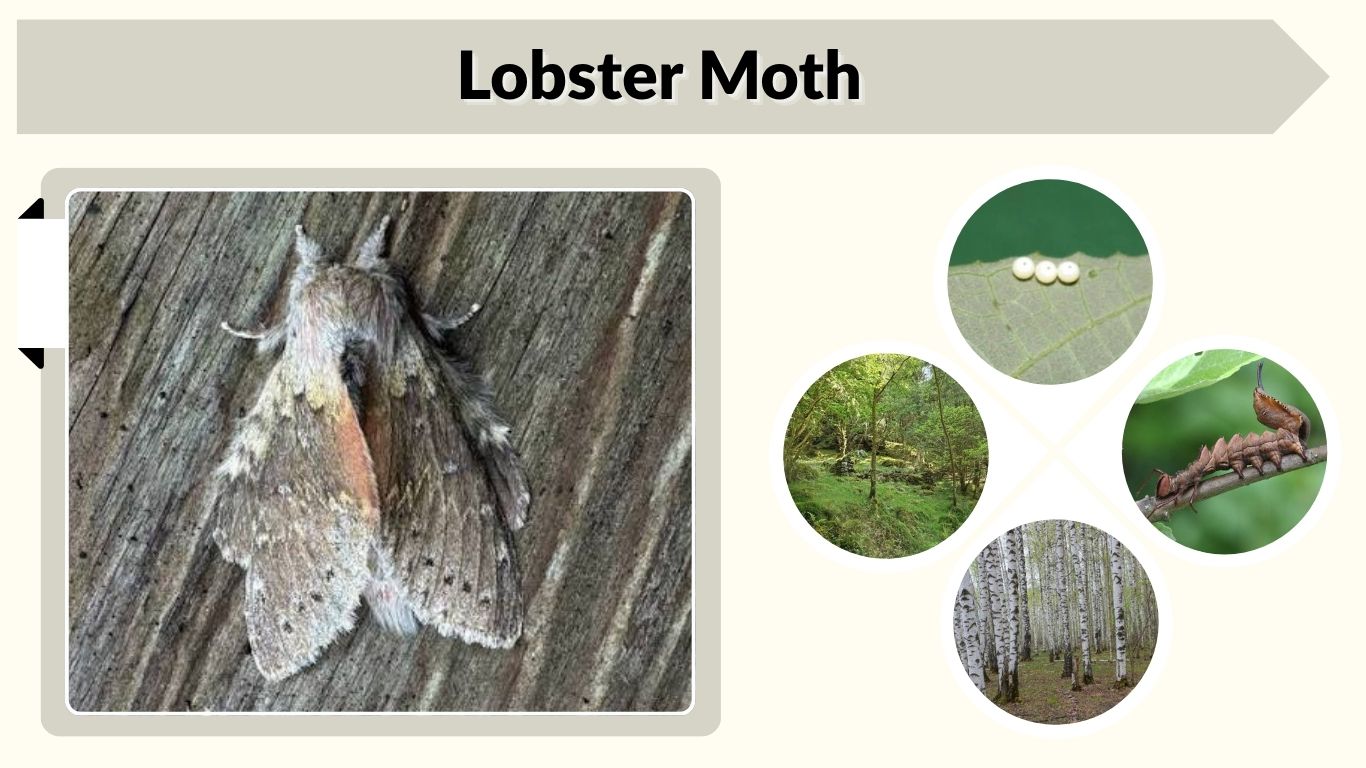
The Lobster Moth (Stauropus fagi) is an unusual woodland moth best known for its extraordinary caterpillar rather than its relatively modest-looking adult form. The larva has long, jointed front legs, a swollen body, raised rear appendages, and a defensive posture that gives it an almost lobster-like appearance. Adults are grayish-brown and well camouflaged against bark. In Britain, the species is found mainly in southern woodland, where caterpillars feed on deciduous trees such as beech and oak. Its unusual appearance, transformation, and defensive adaptations make it one of Europe’s most fascinating moths.
What Is a Lobster Moth?
The Lobster Moth is a member of the prominent moth family Notodontidae. Its scientific name is Stauropus fagi.
Although the adult is attractive in a subtle way, its common name comes from the caterpillar. The mature larva has an unusually shaped body with greatly elongated thoracic legs and modified structures at its rear, creating a creature that can look more like a small crustacean than a conventional caterpillar.
The species occurs across much of Europe and extends through temperate Asia to Japan. In Britain, it is concentrated mainly in southern regions and is associated strongly with broadleaved woodland.
What Does a Lobster Moth Look Like?
Adult Lobster Moths have subdued colors that provide excellent camouflage when resting against tree bark.
Identification
- Gray-brown overall coloration
- Broad forewings with irregular dark markings
- Yellowish and reddish-brown areas on the wings
- Rufous patch along part of the forewing
- Thick, furry-looking thorax
- Broad wings held roof-like when resting
- Male antennae are more strongly feathered
- Wingspan generally about 45–60 mm
The adult is considerably less dramatic than its caterpillar. At rest, the combination of gray, brown, and reddish tones can make it difficult to notice against bark or dead vegetation.
Lobster Moth Caterpillar
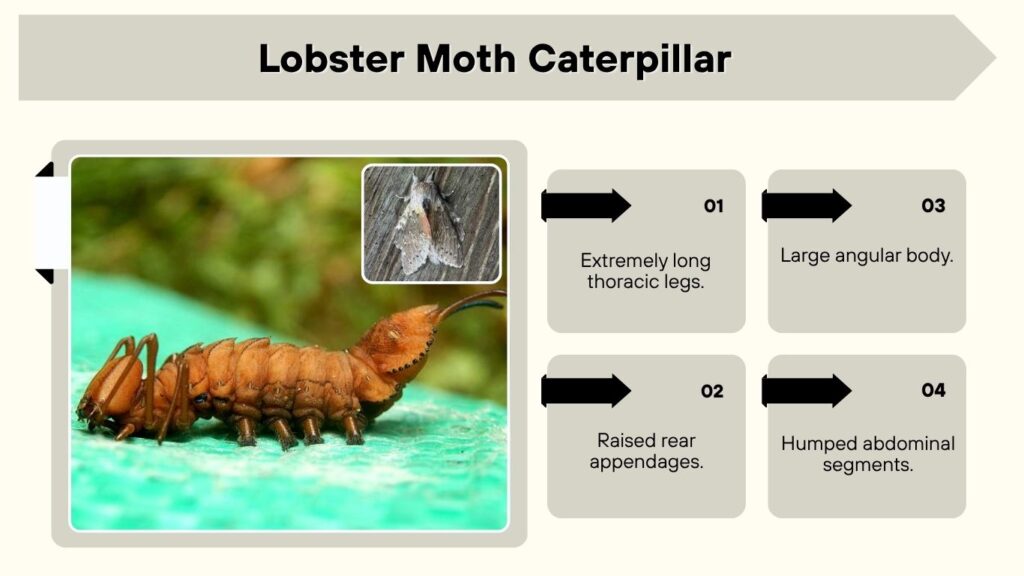
The Lobster Moth caterpillar is the feature that makes this species famous.
Young larvae look particularly strange, with extremely long true legs that they can wave rapidly. The rear end also bears elongated appendages that are held upward.
As the caterpillar grows, its body becomes thicker and more angular. Mature larvae range from yellow-brown and reddish-brown to dark brown, allowing them to blend with twigs, leaves, and bark.
Caterpillar Identification
- Extremely long thoracic legs
- Raised rear appendages
- Large angular body
- Humped abdominal segments
- Brown, reddish, or tan coloration
- Unusual curled defensive posture
- Small head compared with the rest of the body
- Mature larvae can exceed 6 cm in length
The bizarre shape is not accidental. It appears to function primarily as a defense against predators.
Why Does the Caterpillar Look Like a Lobster?
The caterpillar’s long legs, raised tail structures, and curled body create the crustacean-like appearance responsible for the name “Lobster Moth.”
Young larvae may also resemble ants.
When disturbed, they can raise both ends of the body and move their elongated legs rapidly. This unusual display may confuse or discourage potential predators.
Butterfly Conservation material describes the early instars as showing ant-like mimicry, although exactly how predators interpret their appearance remains difficult to prove.
The adult moth itself does not resemble a lobster.
Lobster Moth Habitat
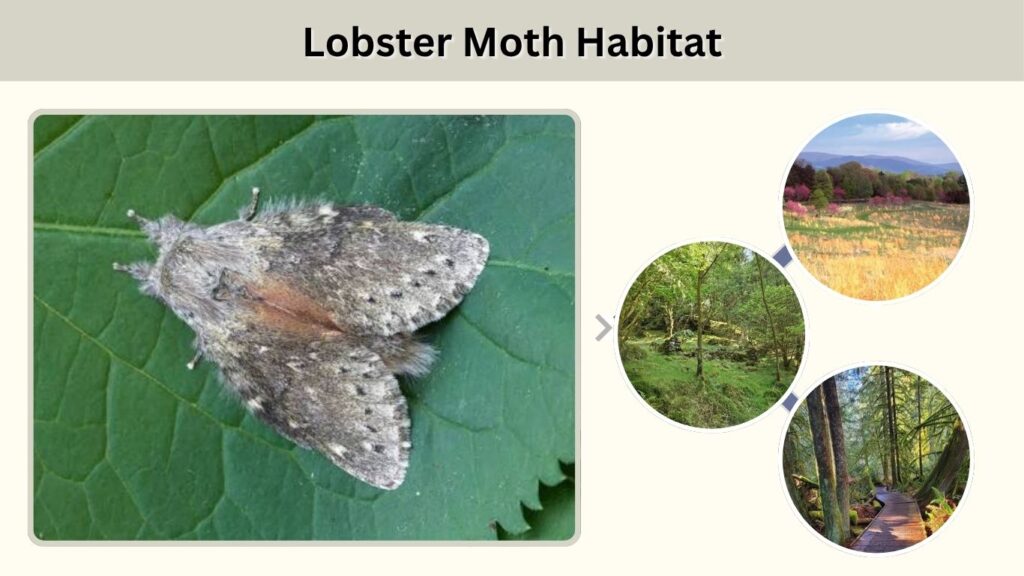
Lobster Moths are closely associated with broadleaved woodland.
Suitable environments include mature deciduous forests, woodland edges, wooded parks, and other areas containing their caterpillar host trees.
In Britain, they occur predominantly in southern areas and are not considered especially common.
Across their wider European range, they can occupy deciduous woodland from relatively low elevations into mountain forests.
Lobster Moth in the UK
The Lobster Moth is a recognized British species and is particularly associated with southern England and parts of Wales.
UKMoths records show that adults are encountered primarily between May and July, with June producing the largest number of records.
The species can sometimes be attracted to moth traps and artificial lights at night, allowing adult moths to be recorded even when caterpillars remain hidden high in trees.
Its distribution becomes more localized farther north.
What Do Lobster Moth Caterpillars Eat?
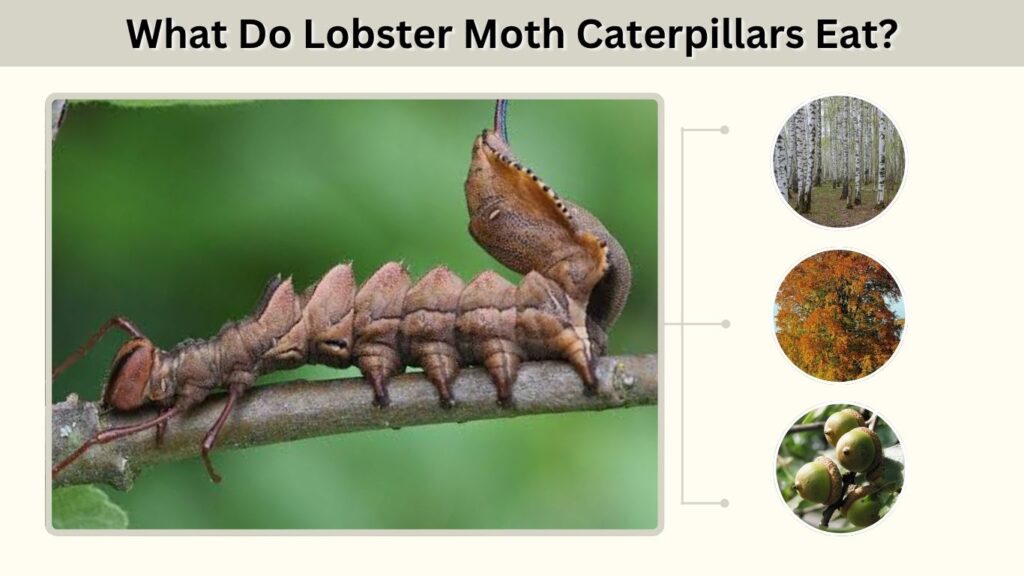
The caterpillar feeds on leaves from a variety of deciduous trees.
Common Host Plants
- Beech
- Oak
- Hazel
- Birch
- Hornbeam
- Willow
- Lime
- Maple
- Chestnut
- Various fruit trees
Beech and oak are among the most frequently associated food plants in Britain.
Young caterpillars feed directly on foliage and continue eating as they pass through several developmental stages.
What Do Adult Lobster Moths Eat?
Adult Lobster Moths do not normally feed.
Instead, they depend on energy reserves accumulated during the caterpillar stage. This means the larva must store enough energy to support metamorphosis, adult flight, mating, and reproduction.
Because adults cannot replenish those energy reserves, the adult period is relatively short and focused almost entirely on reproduction.
Lobster Moth Size
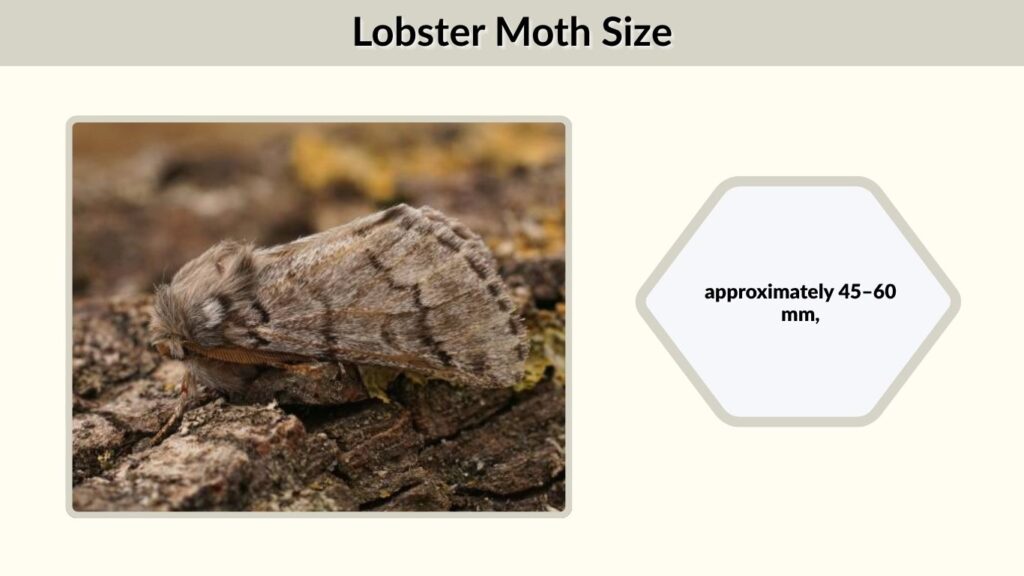
Adult Lobster Moths have a wingspan of approximately 45–60 mm, making them medium-to-large moths compared with many British species.
The caterpillar can look even more impressive because of its elongated legs and raised rear structures.
Fully developed larvae may exceed 60 mm in body length, not including their projecting appendages.
Lobster Moth Life Cycle
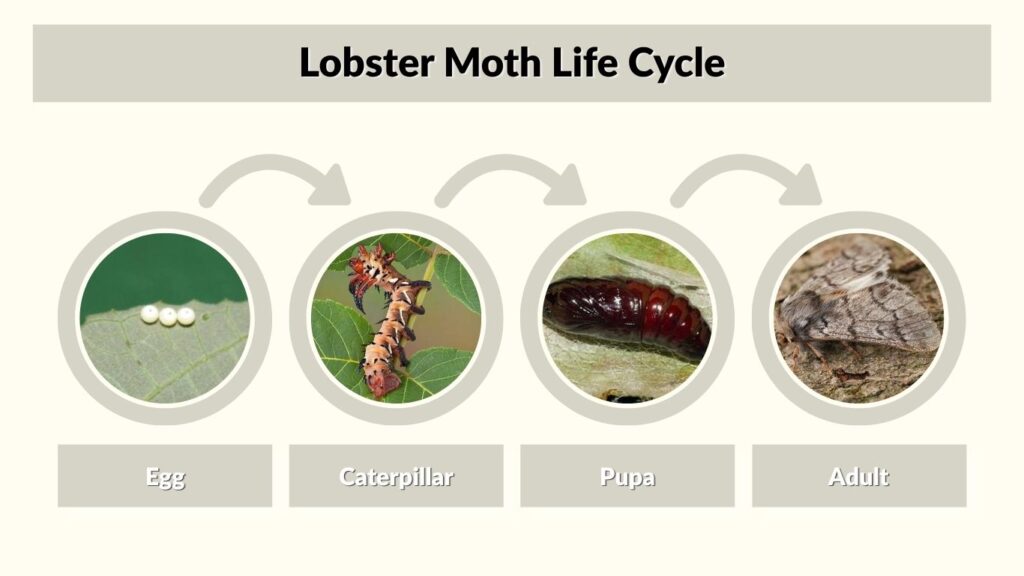
Like other moths, the Lobster Moth undergoes complete metamorphosis:
Egg → Caterpillar → Pupa → Adult
Egg Stage
Females place eggs on suitable host trees. Once the caterpillars hatch, they begin an unusual early development.
Newly hatched larvae first consume their eggshell. One particularly unusual feature reported for this species is that the first instar may eat nothing else until after completing its first molt.
Caterpillar Stage
After the first molt, larvae begin feeding on leaves.
They grow through several instars, changing considerably in appearance. Young caterpillars show especially exaggerated legs and ant-like characteristics, while older larvae become larger, thicker, and more lobster-like.
Pupal Stage
A fully grown caterpillar eventually leaves its food plant and searches among fallen leaves and surface debris for a protected pupation site.
It produces a relatively loose cocoon incorporating plant material and changes into a pupa inside.
Across much of its range, the species passes winter in the pupal stage.
Adult Stage
Adults emerge when seasonal temperatures become suitable.
In Britain, most observations occur from May through July. Once emerged, the moth’s primary tasks are finding a mate and reproducing.
Is the Lobster Moth Caterpillar Poisonous?
The unusual Lobster Moth caterpillar may look intimidating, but its strange appendages are primarily defensive structures rather than venomous stingers.
It is not known as one of the medically significant stinging caterpillars.
However, wild caterpillars should still be handled as little as possible. Handling can stress or injure the insect, and individual people may experience skin irritation after contact with various caterpillars.
Observing it without touching is the safest approach.
Lobster Moth Behavior
Adult Lobster Moths are nocturnal.
During daylight they typically remain motionless in concealed positions, relying on camouflage. At night they become active, and adults may be attracted to artificial lights.
The caterpillar has a completely different defense strategy. Rather than depending entirely on camouflage, it can adopt dramatic postures and wave its unusually long legs when threatened.
Its combination of disguise and unusual movement makes it difficult for predators to recognize immediately as ordinary caterpillar prey.
Flying Lobster Moth
The phrase “flying lobster moth” generally refers simply to the adult Lobster Moth, not a separate species.
The adult is a normal flying moth and lacks the lobster-like shape of its larval stage.
This distinction is important because online photographs of the caterpillar can create the impression that the bizarre lobster-shaped animal somehow retains the same form after developing wings.
It does not. Metamorphosis completely transforms its appearance.
Lobster Moth vs Hummingbird Moth
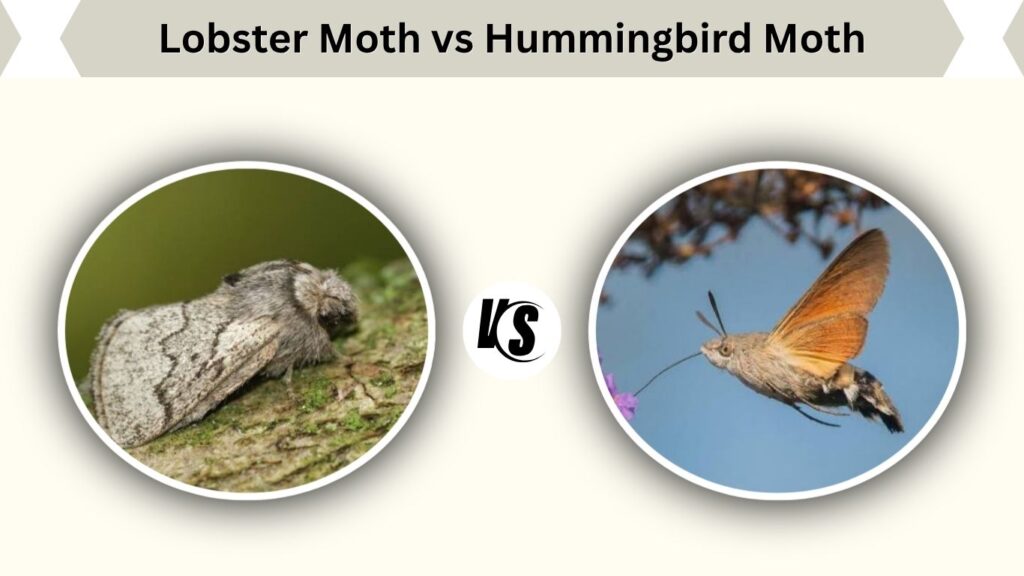
The Lobster Moth should not be confused with a hummingbird hawk-moth.
Hummingbird hawk-moths are fast-flying moths that hover in front of flowers and use a long proboscis to drink nectar.
The Lobster Moth belongs to a different family, has a gray-brown adult appearance, does not feed as an adult, and gets its unusual name from its caterpillar.
Terms such as “lobster tail hummingbird moth” therefore usually refer to confusion between unrelated moths rather than another form of Stauropus fagi.
Interesting Lobster Moth Facts
The most remarkable part of this moth’s biology occurs before adulthood. Its young caterpillar has extremely long legs and can resemble an ant, while later stages adopt the bizarre lobster-like appearance for which the species is named.
Adults are almost the opposite: quiet, gray-brown, well camouflaged, and relatively inconspicuous.
The species also demonstrates how different life stages can serve completely different purposes. The caterpillar spends its time eating and storing energy, while the non-feeding adult uses those reserves almost exclusively for reproduction.
FAQs
Why is it called a Lobster Moth?
The name comes from the caterpillar, whose unusual legs, raised rear structures, and curled posture give it a lobster-like appearance.
Where do Lobster Moths live?
They primarily inhabit broadleaved woodland. Their range extends across much of Europe and temperate Asia, while in Britain they are concentrated mainly in southern regions.
What do Lobster Moth caterpillars eat?
They feed on leaves from broadleaved trees, especially beech and oak, as well as hazel, birch, willow, hornbeam, lime, and several other trees.
How big is a Lobster Moth?
Adults generally have a wingspan of about 45–60 mm. Mature caterpillars can exceed 60 mm in body length.
Do adult Lobster Moths eat?
No. Adults rely on energy stored during their caterpillar stage and spend their relatively short adult lives primarily searching for mates and reproducing.