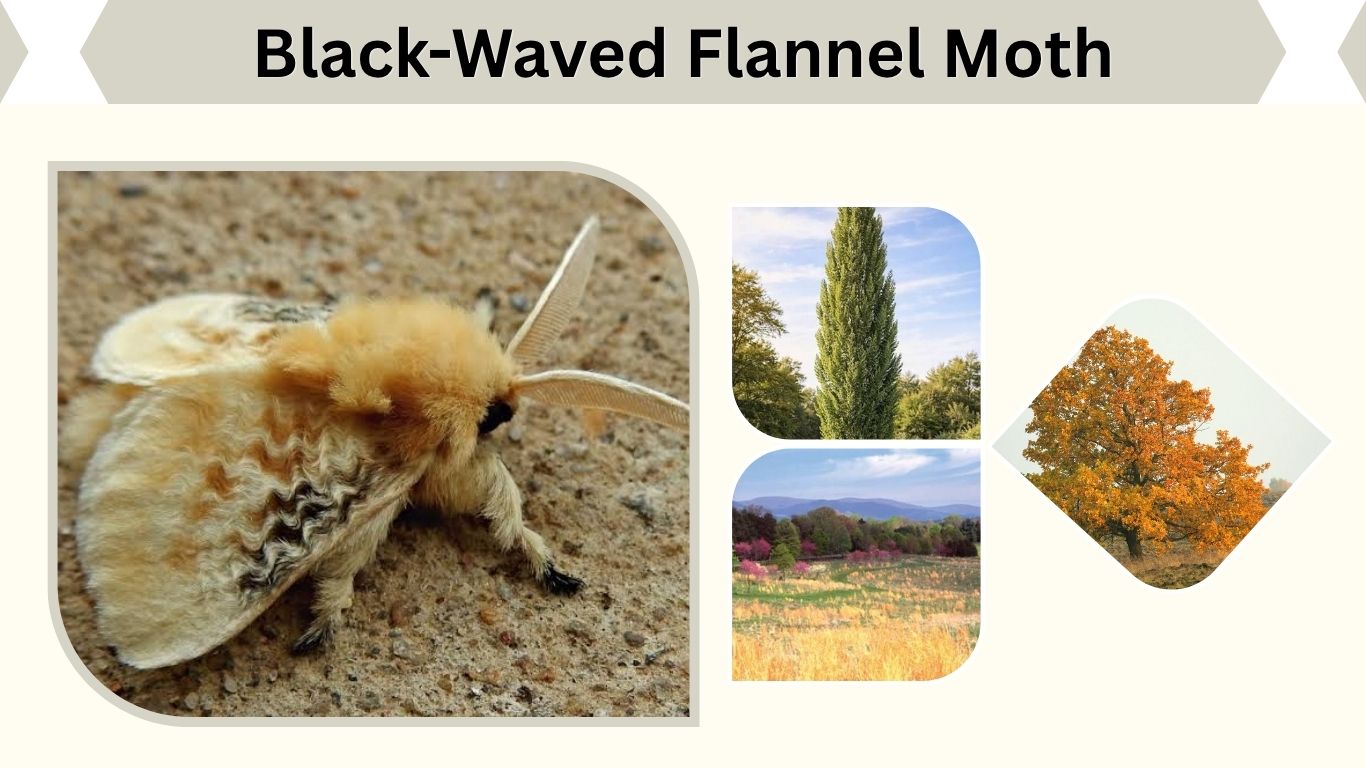
The Black-waved Flannel Moth (Megalopyge crispata) is a small, unusually furry moth found mainly across the eastern United States. Adults are pale cream to yellow with distinctive black, wavy markings along the forewings, giving the species its common name. Its caterpillar looks deceptively soft and fluffy, but hidden beneath its hairs are venom-delivering spines capable of producing a painful sting. Black-waved flannel moth caterpillars feed on many hardwood trees and shrubs, including oak, willow, birch, apple, and cherry. Adults are most often encountered from late spring through early fall.
What Is a Black-Waved Flannel Moth?
The Black-waved Flannel Moth belongs to the family Megalopygidae, commonly known as flannel moths because adults are densely covered with soft, woolly scales.
Its scientific name is Megalopyge crispata. Older sources may list it as Lagoa crispata, but it is currently placed in the genus Megalopyge.
Despite its plush appearance, the adult moth is harmless to people. The caterpillar stage is the one that requires caution because it possesses venomous defensive spines.
What Does a Black-Waved Flannel Moth Look Like?
Adults are compact, heavily furred moths with a distinctive creamy appearance. Their wings may look almost crimped or woolly because of the dense scales covering them.
Identification
- Pale yellowish-cream or nearly white body
- Dense, fluffy scales covering the thorax and legs
- Several sharp black wavy lines along the forewing
- Brownish shading may occur beneath the black markings
- Hindwings generally lack strong markings
- Black tips on the feet may be noticeable
- Broad, feathery antennae in males
- Wingspan approximately 2.5–4 cm
- Females generally appear paler than males
The moth’s thick coat of scales gives it a much softer appearance than most common household moths.
Black-Waved Flannel Moth Caterpillar
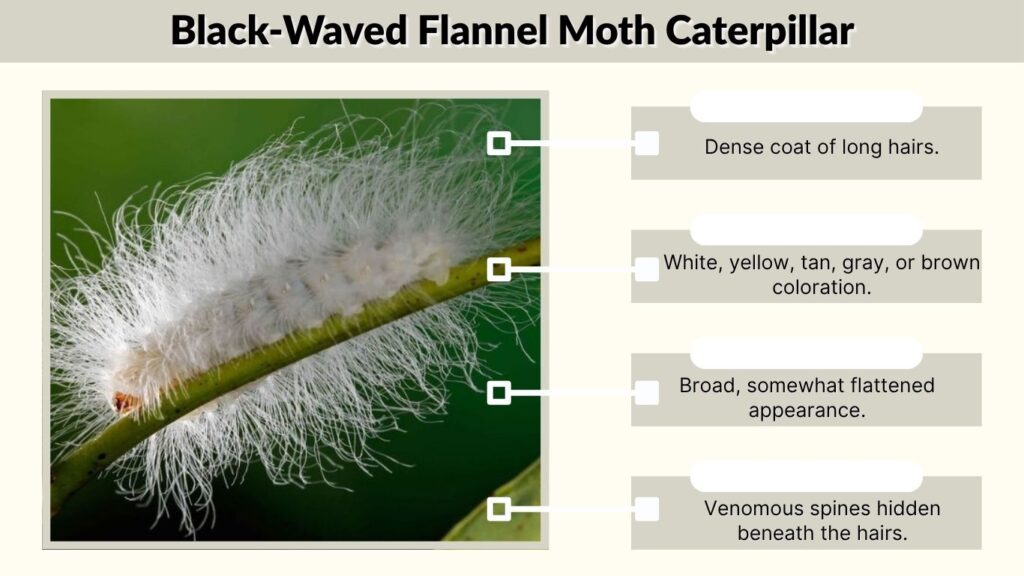
The caterpillar is arguably more recognizable than the adult.
Depending on its age, it can be white, cream, gray, yellowish, tan, or brown and is covered with long hairs. Young larvae can have especially long, wispy hairs, while mature caterpillars become more compact and plush-looking.
Caterpillar Identification
- Dense coat of long hairs
- White, yellow, tan, gray, or brown coloration
- Broad, somewhat flattened appearance
- Venomous spines hidden beneath the hairs
- Younger larvae may appear especially wispy
- Mature larvae resemble other flannel moth caterpillars
The apparent “fur” should never be used as a reason to touch one. The venomous spines are concealed underneath the longer hairs and may penetrate skin on contact.
Does the Black-Waved Flannel Moth Caterpillar Sting?
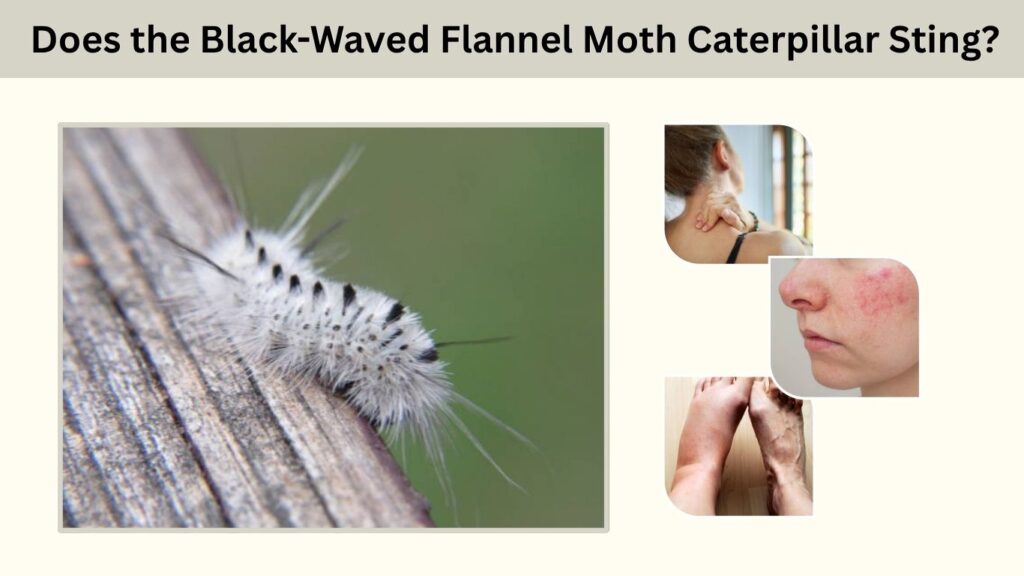
Yes. Black-waved flannel moth caterpillars can sting.
Scientific research specifically examining Megalopyge crispata confirms that its larvae possess a venom system connected to specialized spines. Contact can activate pain-sensitive nerves and produce inflammation.
The University of Kentucky notes that its sting is generally reported as less severe than that of the Southern Flannel Moth’s puss caterpillar, but it can still be painful.
Possible reactions include localized:
- Burning or stinging pain
- Redness
- Swelling
- Skin inflammation
- Tenderness
The severity can vary according to the amount of contact and individual sensitivity.
What to Do After a Caterpillar Sting
Do not rub the affected area because this may push additional spines into the skin.
Sticky tape can be gently applied and removed to help lift embedded spines. Wash the area afterward and use a cold compress for discomfort.
Seek medical assistance if pain or swelling becomes severe, symptoms continue worsening, or there are signs of a serious allergic reaction such as breathing difficulty or widespread swelling. Even dead flannel moth caterpillars can retain irritating spines, so they should not be handled bare-handed.
Black-Waved Flannel Moth Male vs Female
Males and females can look surprisingly different despite belonging to the same species.
Male
Male Black-waved Flannel Moths typically have broad, strongly feathered antennae. Their wings also tend to show stronger dark markings and a somewhat more yellowish coloration.
The large antennae help males detect chemical signals released by females.
Female
Females have noticeably thinner antennae and are usually paler, sometimes appearing almost white. Their black and brown wing markings may also be considerably more subtle.
This sexual difference in antenna shape and coloration can make a male and female look like different moths when seen separately.
What Do the Underwings Look Like?
The forewings carry most of the Black-waved Flannel Moth’s distinctive pattern.
The hindwings are comparatively plain and unmarked, usually maintaining the pale cream or yellowish coloration of the rest of the moth.
When the moth rests with its wings folded, the more recognizable black wavy lines on the forewings remain visible.
Black-Waved Flannel Moth Habitat and Distribution
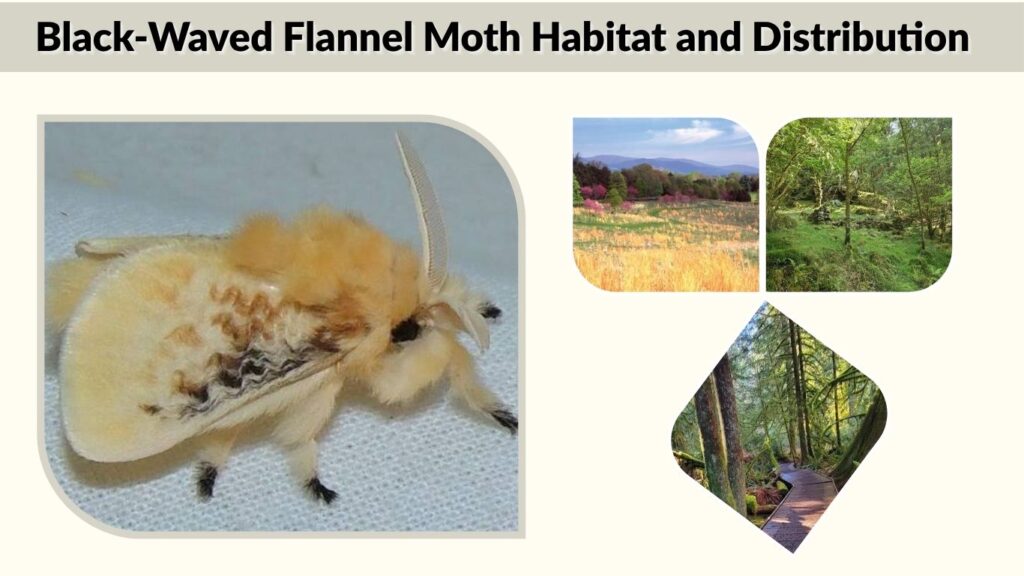
Black-waved Flannel Moths are primarily associated with deciduous forests and wooded landscapes.
Their distribution covers much of the eastern United States. Butterflies and Moths of North America lists the range from New Hampshire south to Florida and west toward Missouri and Louisiana, while other records extend somewhat farther inland.
Adults may also appear around gardens, suburban areas, woodland edges, and homes located near suitable trees.
They are nocturnal and may occasionally be attracted to outdoor lights.
What Do Black-Waved Flannel Moth Caterpillars Eat?
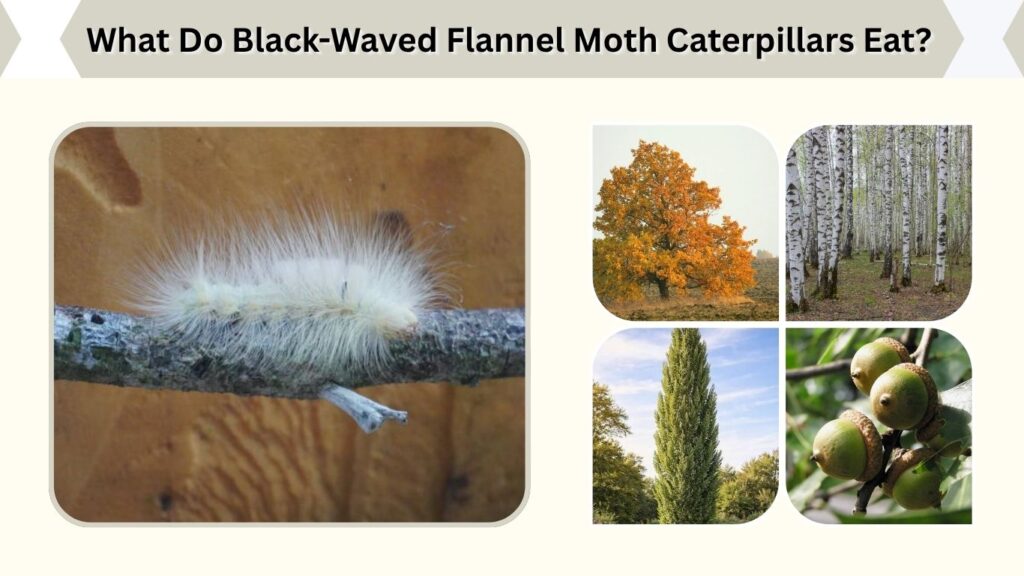
The caterpillar feeds on the foliage of many trees and shrubs rather than relying on a single host species.
Common Host Plants
- Alder
- Apple
- Birch
- Blackberry
- Oak
- Poplar
- Cherry and other Prunus species
- Sassafras
- Willow
- Bayberry and related shrubs
This broad host range allows the species to survive in many different deciduous habitats.
What Do Adult Black-Waved Flannel Moths Eat?
Adults are believed to feed little or not at all.
Like several other moths whose adult lives focus largely on reproduction, they depend substantially on energy accumulated while feeding as caterpillars. BugGuide lists adult feeding as unlikely.
Their adult lifespan is therefore devoted mainly to finding mates and producing the next generation.
Black-Waved Flannel Moth Life Cycle
Like all moths, the Black-waved Flannel Moth undergoes complete metamorphosis:
Egg → Caterpillar → Pupa → Adult
Females deposit eggs on or near appropriate host plants. The larvae hatch and begin eating foliage, passing through several growth stages.
Once mature, a caterpillar produces a protective cocoon and pupates. The adult later emerges, mates, and begins another generation.
Adults are generally recorded from May through October. Northern populations may have one generation annually, while warmer southern areas can support additional generations.
Black-Waved vs Southern Flannel Moth
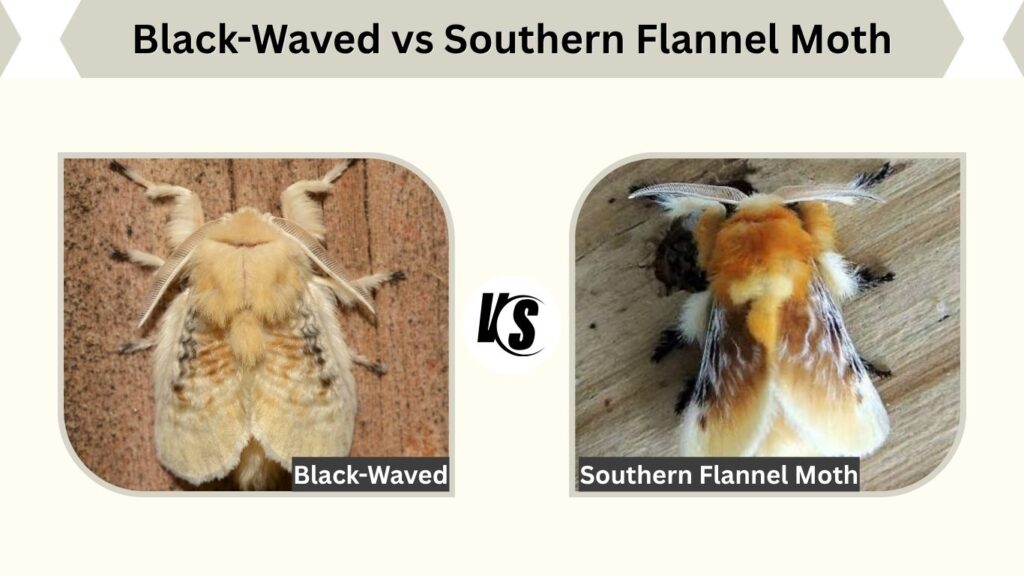
The Black-waved Flannel Moth can be confused with the Southern Flannel Moth (Megalopyge opercularis), whose larva is commonly called the puss caterpillar.
Both belong to the same family and both have venomous caterpillars.
Adult Black-waved Flannel Moths are generally pale cream with obvious dark wavy markings along the forewing. Southern Flannel Moths often appear more strongly orange or golden.
Their caterpillars can be much harder to separate confidently, especially at certain developmental stages. Location, coloration, hair arrangement, and expert identification may all be needed.
Interesting Black-Waved Flannel Moth Facts
The Black-waved Flannel Moth provides an excellent example of why extremely furry caterpillars should not automatically be considered safe to touch. Its dangerous structures are almost completely hidden beneath soft-looking hairs.
The adult is essentially the opposite: although even furrier in appearance, it does not possess the caterpillar’s venomous defensive system.
The species is also fairly small. With a wingspan of only about 2.5–4 cm, its unusually thick coat of scales can make it look considerably larger than it really is.
FAQs
Is the Black-waved Flannel Moth poisonous?
The adult moth is not considered dangerous to touch, but its caterpillar is venomous. Specialized hollow spines deliver venom when they contact skin.
How painful is a Black-waved Flannel Moth caterpillar sting?
It can cause noticeable burning, pain, and inflammation. Its sting is generally considered less severe than that of the Southern Flannel Moth’s puss caterpillar, though reactions vary.
Where are Black-waved Flannel Moths found?
They occur mainly across the eastern United States, particularly in deciduous forests and other areas containing suitable host trees.
What do the caterpillars eat?
They feed on many hardwood trees and shrubs, including oak, birch, willow, apple, cherry, poplar, alder, and sassafras.
How can you tell a male from a female?
Males usually have much broader, feather-like antennae and stronger wing markings. Females have thinner antennae and are typically paler and less strongly patterned.