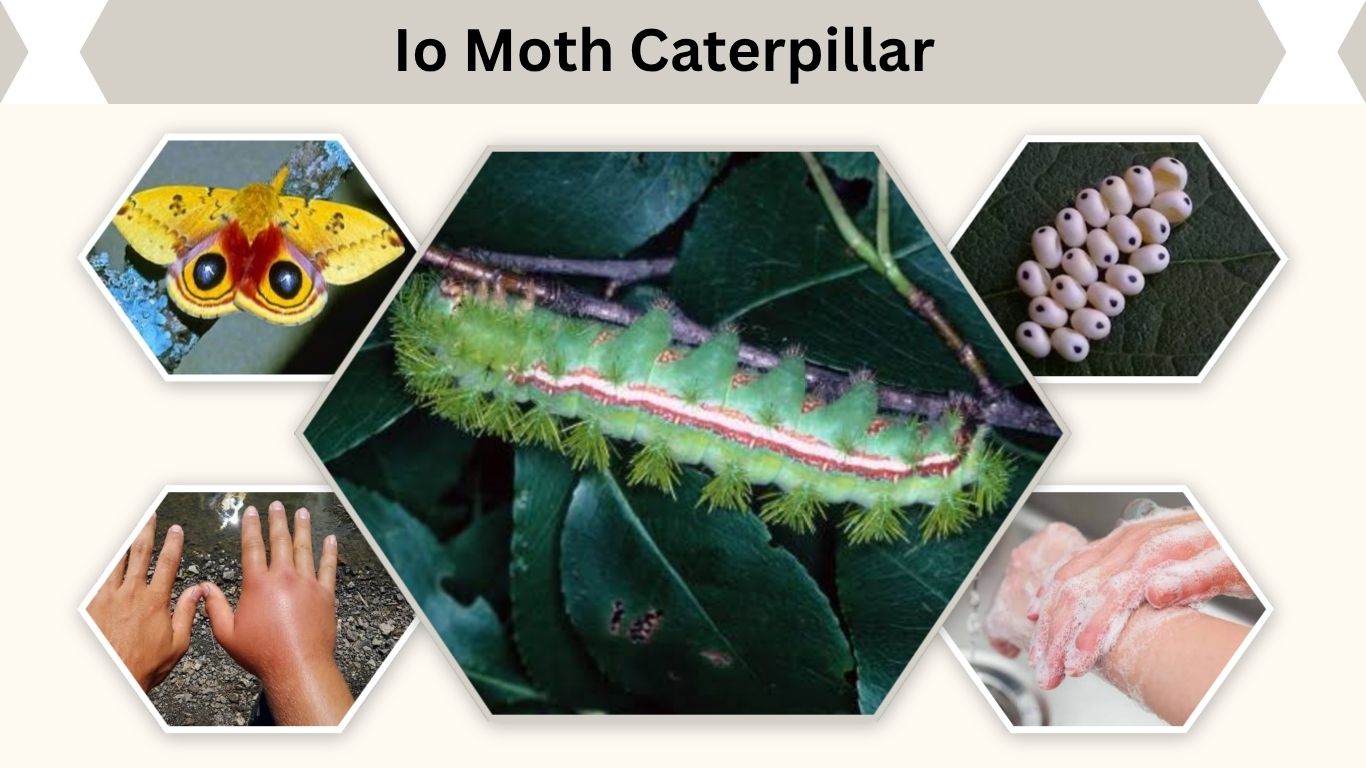
The io moth caterpillar is a bright green, spiny larva of the io moth, Automeris io. It is beautiful, but it should not be handled. Its branched spines can cause a painful sting, itching, redness, and swelling when they touch skin. These caterpillars feed on many trees, shrubs, and garden plants, but they rarely cause serious plant damage. This guide explains how to identify them, treat a sting, understand their life cycle, and manage them safely.
What Is an Io Moth Caterpillar?
The io moth caterpillar is the larval stage of the io moth, a member of the giant silkmoth family, Saturniidae. The adult moth is famous for its large eyespots on the hindwings, while the caterpillar is known for its green body, red-and-white side stripe, and stinging spines. The species occurs from southern Canada through much of the eastern United States and into eastern Mexico.
Young io moth caterpillars often stay together in groups, but older caterpillars become more solitary as they grow. Missouri Department of Conservation notes that young larvae are orange, while mature larvae become yellowish green to bluish green with red-and-white side stripes and bristly stinging spines.
Io Moth Caterpillar Identification
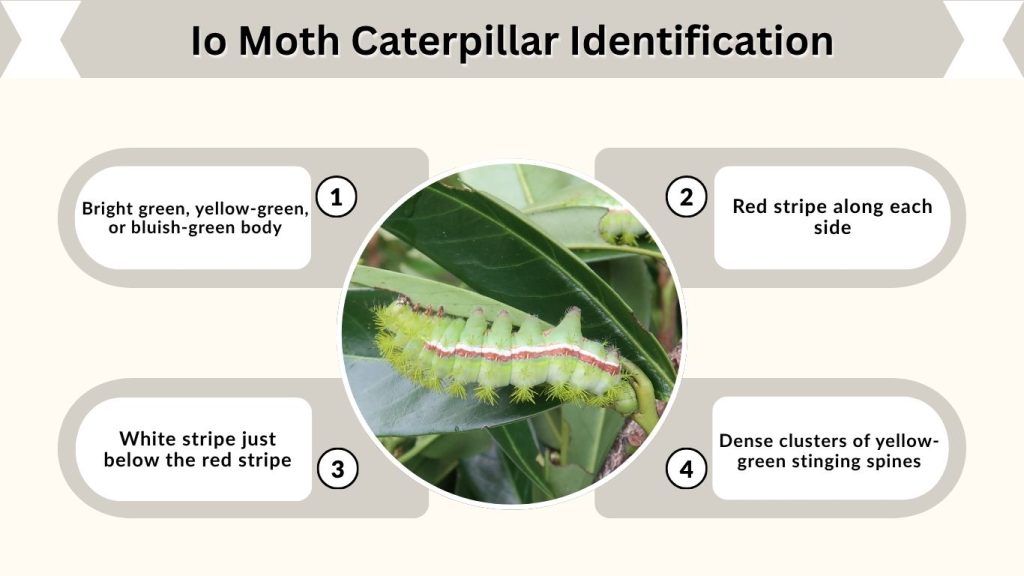
Io moth caterpillars are easier to identify when mature because their warning colors become stronger. They are not smooth caterpillars like tomato hornworms or luna moth caterpillars. Instead, their body is covered with clusters of branched spines that look like tiny green or yellow starbursts.
Key Identification Features
Look for these signs:
- Bright green, yellow-green, or bluish-green body
- Red stripe along each side
- White stripe just below the red stripe
- Dense clusters of yellow-green stinging spines
- Thick, soft caterpillar body
- Young larvae may appear orange or brownish
- Often found on trees, shrubs, and garden plants
| Feature | Io moth caterpillar |
| Scientific name | Automeris io |
| Family | Saturniidae |
| Mature color | Green to bluish green |
| Main warning mark | Red-and-white side stripe |
| Defense | Venomous stinging spines |
| Young behavior | Often feeds in groups |
| Adult moth | Has large hindwing eyespots |
Io Moth Caterpillar Size
Mature io moth caterpillars are medium to large caterpillars. Size varies by age, food quality, and region, but full-grown larvae are usually large enough to be easy to notice on leaves and stems. The adult io moth has a wingspan of about 2 to 3¼ inches.
Does the Io Moth Caterpillar Sting?
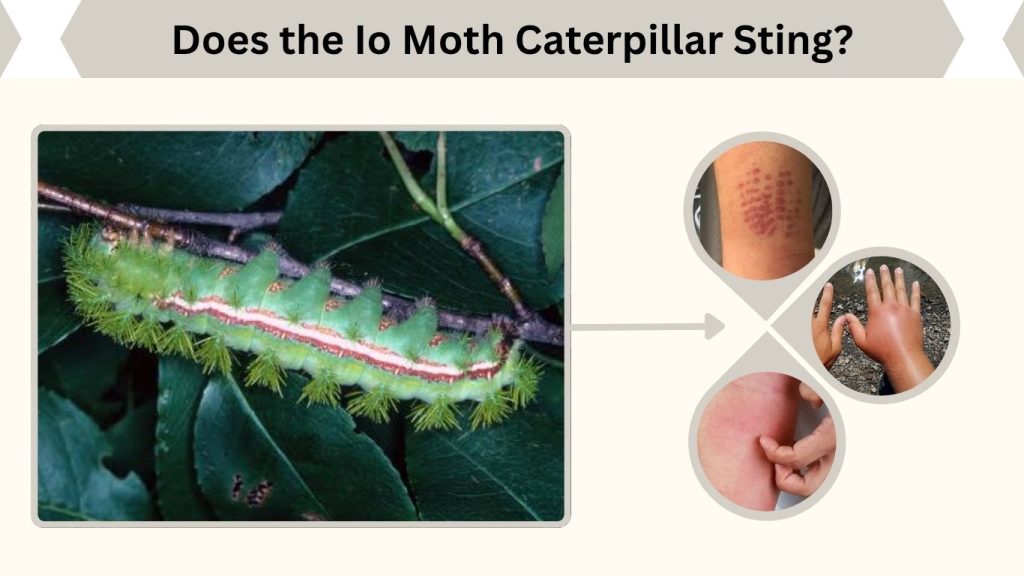
Yes, the io moth caterpillar can sting. It does not bite like an ant or wasp, and it does not chase people. The sting happens when the skin touches its venomous spines. University of Florida IFAS explains that virtually the entire larval body is protected by venomous spines, and when the spine tips penetrate skin, they can break off and release venom.
Io Moth Caterpillar Sting Symptoms
A sting often causes immediate discomfort. Symptoms can include:
- Sharp burning or stinging pain
- Itching
- Redness
- Local swelling
- Raised welt
- Skin irritation
- Tenderness around the contact area
UF IFAS reports that io moth caterpillar stings commonly cause almost immediate painful nettling and itching, followed by a localized welt and reddened flare. Pain often improves within a couple of hours, while the welt and redness may resolve within 6–8 hours. Systemic symptoms are rare.
Is the Io Moth Caterpillar Poisonous or Venomous?
The better word is venomous, not poisonous. A poisonous animal causes harm when eaten or touched because of toxins on or inside the body. A venomous animal delivers toxin through a structure such as a spine, fang, or stinger. The io moth caterpillar has venomous spines that can irritate skin when touched.
Io Moth Caterpillar Sting Treatment
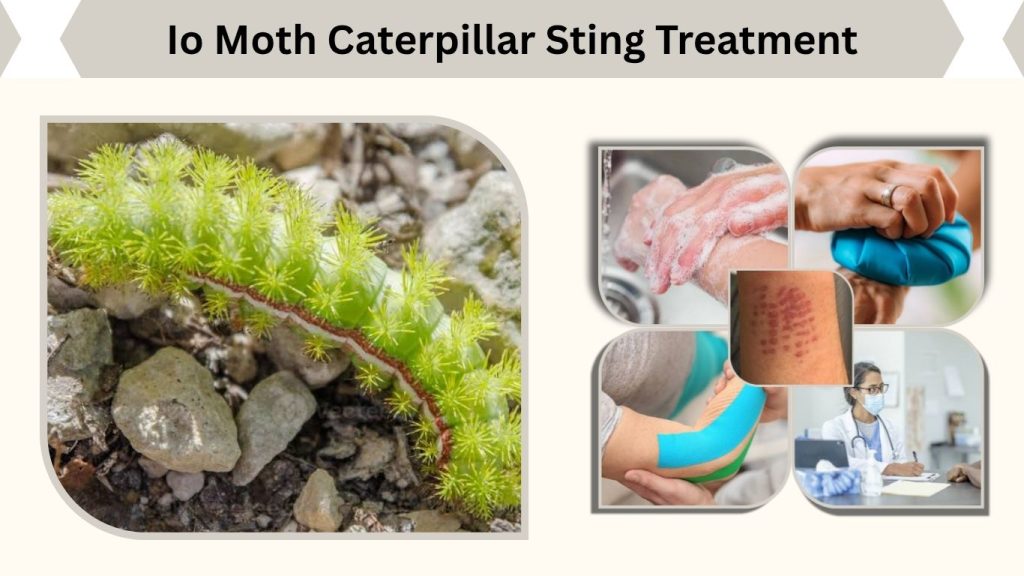
Most io moth caterpillar stings are painful but not life-threatening. Still, some people may react more strongly than others. LSU AgCenter recommends removing urticating hairs and spines with adhesive tape, washing the area with soap and water, applying a cold compress, and watching for allergic reactions or severe symptoms.
First Aid Steps
- Do not rub the area. Rubbing can push spine tips deeper into the skin.
- Use tape to remove spines. Press adhesive tape gently over the area and lift it away.
- Wash with soap and water. Clean the skin after removing as many spines as possible.
- Apply a cold compress. This may reduce pain and swelling.
- Use an over-the-counter sting product if needed. Follow the label directions.
- Seek medical help for severe reactions. Get care if there is trouble breathing, intense swelling, dizziness, abdominal pain, muscle spasms, or signs of allergy.
Texas A&M’s School IPM guidance also notes that ice packs or over-the-counter insect bite and sting products may help, while severe reactions should receive prompt medical attention.
Io Moth Caterpillar Host Plants and Diet
Io moth caterpillars are polyphagous, meaning they feed on many kinds of plants. They are not limited to one host plant. UF IFAS lists common host genera including maple, birch, hickory, hackberry, redbud, bayberry, poplar, cherry, pear, blackberry, sassafras, willow, basswood, elm, and wisteria.
Clemson Extension also notes that larvae feed on many hardwood trees, including oak, birch, hickory, and dogwood.
| Plant group | Examples |
| Trees | Oak, maple, birch, hickory, elm, willow, poplar |
| Fruit-related plants | Cherry, pear, blackberry |
| Shrubs/vines | Wisteria, bayberry, currant, gooseberry |
| Southern hosts | Hibiscus, royal poinciana, red mangrove, Washington fan palm |
| Regional favorites | Sassafras in parts of the Ozarks |
Do Io Moth Caterpillars Eat Roses?
They may feed on many broadleaf plants, and related rose-family plants such as cherry, pear, and blackberry are recorded hosts. However, they are not usually considered a major rose pest. If you find one on roses, avoid touching it directly and remove it carefully with gloves or tools.
Io Moth Caterpillar Life Cycle
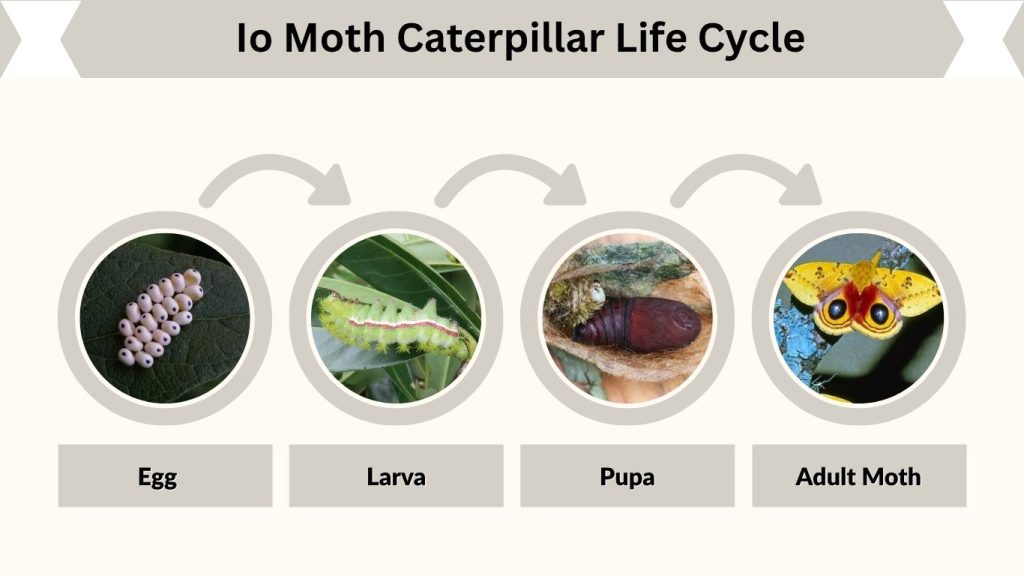
The io moth has complete metamorphosis: egg, larva, pupa, and adult. Females lay clusters of eggs on host plants. After hatching, the caterpillars feed and molt through several stages before spinning a cocoon.
Eggs and Young Caterpillars
Females lay eggs on host plants, often in groups. Young larvae feed together and may move in lines. This group behavior helps explain why homeowners sometimes find several io moth caterpillars on the same plant instead of just one.
Instars and Growth Stages
Io moth caterpillars pass through several larval stages, called instars. UF IFAS notes that saturniid caterpillars typically have five larval instars, though the number can vary under some rearing conditions.
Cocoon and Adult Moth
When fully grown, io moth caterpillars leave the host plant and spin cocoons in leaf litter or protected places such as log or rock crevices. The papery cocoons may be made on the ground in leaf litter or on plants.
Adult io moths do not feed because, like other giant silkmoths, they have reduced mouthparts. Their short adult stage is focused on mating and reproduction.
How to Get Rid of Io Moth Caterpillars Safely
Control is not always necessary. Io moth caterpillars can chew leaves, but they rarely cause major injury to plants. LSU AgCenter states that this moth rarely causes major plant injury, so control is rarely needed.
Safe Control Methods
Use low-risk methods first:
- Wear thick gloves, long sleeves, and eye protection.
- Do not touch caterpillars with bare hands.
- Clip off heavily infested leaves or small branches.
- Drop caterpillars into soapy water if removal is necessary.
- Keep children and pets away from infested plants.
- Avoid broad insecticide spraying when damage is minor.
If caterpillars are on a valuable plant and there are many of them, contact a local extension office for region-specific advice. In most yards, careful hand removal with tools is enough.
Io Moth Caterpillar and Dogs
Io moth caterpillars may irritate dogs if a dog sniffs, licks, mouths, or steps on them. The risk depends on contact level and the dog’s sensitivity. Keep pets away from plants where spiny caterpillars are feeding. If a dog shows drooling, pawing at the mouth, swelling, vomiting, distress, or unusual behavior after contact, call a veterinarian.
Io Moth Caterpillar vs Luna Moth Caterpillar
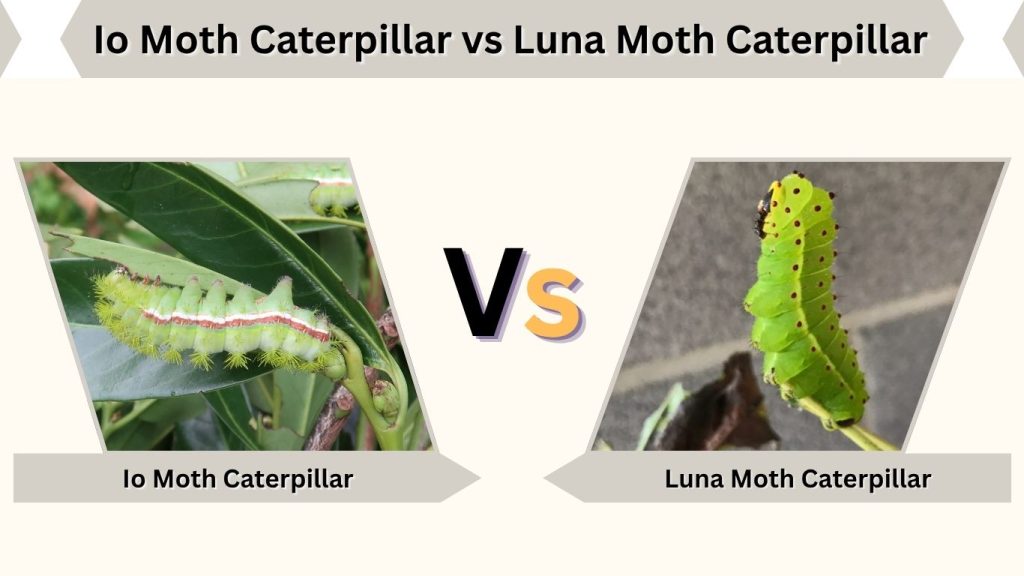
The io moth caterpillar and luna moth caterpillar can both be green, but they are easy to separate. Io moth caterpillars have dense stinging spines and a red-and-white side stripe. Luna moth caterpillars are usually smooth green caterpillars with small bumps and are not covered in dangerous branching spines.
| Feature | Io moth caterpillar | Luna moth caterpillar |
| Body texture | Spiny and bristly | Mostly smooth |
| Sting risk | Yes, venomous spines | No painful stinging spines |
| Main stripe | Red-and-white side stripe | Usually pale side markings |
| Adult moth | Eyespots on hindwings, yellow/brown adults | Large pale green moth with tails |
| Handling | Do not touch | Still best observed without handling |
FAQs
Can an io moth caterpillar sting?
Yes. An io moth caterpillar can sting when its venomous spines touch your skin. The sting usually causes burning pain, itching, redness, and a welt. Avoid handling it with bare hands.
Is the io moth caterpillar poisonous?
It is better described as venomous. The caterpillar has venomous spines that can release irritating venom into the skin. It is not dangerous because it attacks people, but because accidental contact can be painful.
What does an io moth caterpillar eat?
Io moth caterpillars eat many host plants, including oak, maple, birch, hickory, cherry, willow, elm, sassafras, blackberry, pear, and wisteria. Host plants vary by region.
How do you treat an io moth caterpillar sting?
Use adhesive tape to remove embedded spines, wash the area with soap and water, and apply a cold compress. Seek medical help if symptoms are severe, spreading, or include signs of allergy.
Should I kill io moth caterpillars?
Usually, no. They rarely cause serious plant damage and become beautiful native moths. Remove them only if they are in a high-contact area, heavily damaging a valued plant, or creating a safety risk for children or pets.