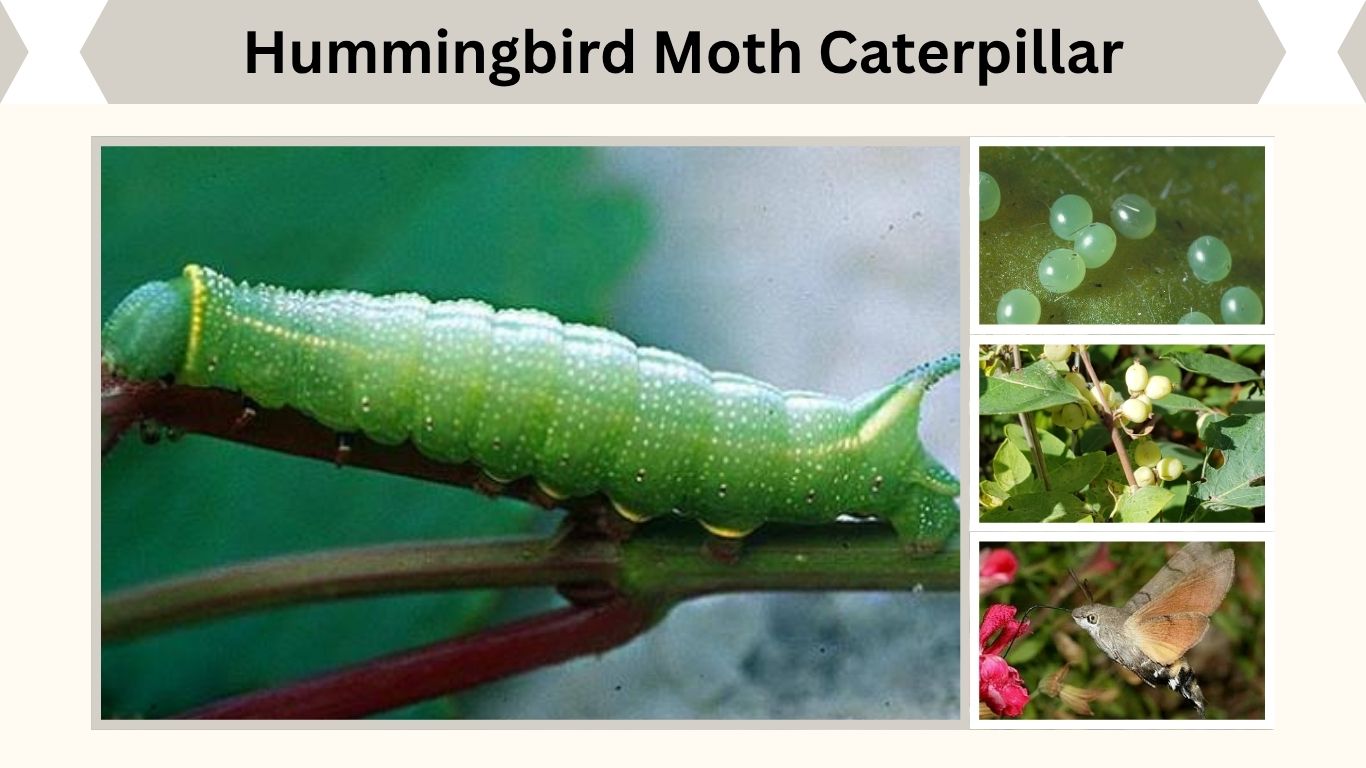
A hummingbird moth caterpillar is the larval stage of a sphinx or hawk moth that later becomes a fast-flying, nectar-feeding adult often mistaken for a tiny hummingbird. These caterpillars are usually chunky, soft-bodied “hornworms” with a harmless tail horn. Some feed quietly on native shrubs, while others, like tomato hornworms, can damage garden plants. This guide explains what they look like, what they eat, how they develop, and how to tell them apart.
What Is a Hummingbird Moth Caterpillar?
The phrase “hummingbird moth caterpillar” is a common name, not one single species. In North America, it often refers to clearwing moths in the genus Hemaris, such as the hummingbird clearwing and snowberry clearwing. It can also refer to other sphinx moth caterpillars because many adult sphinx moths hover at flowers like hummingbirds. The USDA notes that Hemaris moths can hover in front of flowers, sip nectar with long tongues, and even produce an audible hum.
Common Species Behind the Name
Several caterpillars may be called hummingbird moth caterpillars:
| Common name | Scientific name | Adult type | Main region |
| Hummingbird clearwing | Hemaris thysbe | Clearwing hummingbird moth | North America |
| Snowberry clearwing | Hemaris diffinis | Bumblebee-like clearwing moth | North America |
| White-lined sphinx | Hyles lineata | Large hovering sphinx moth | North/Central America |
| Hummingbird hawk-moth | Macroglossum stellatarum | Day-flying hawk moth | Europe, North Africa, Asia |
| Tomato hornworm | Manduca quinquemaculata | Five-spotted hawkmoth | North America |
What Does a Hummingbird Moth Caterpillar Look Like?
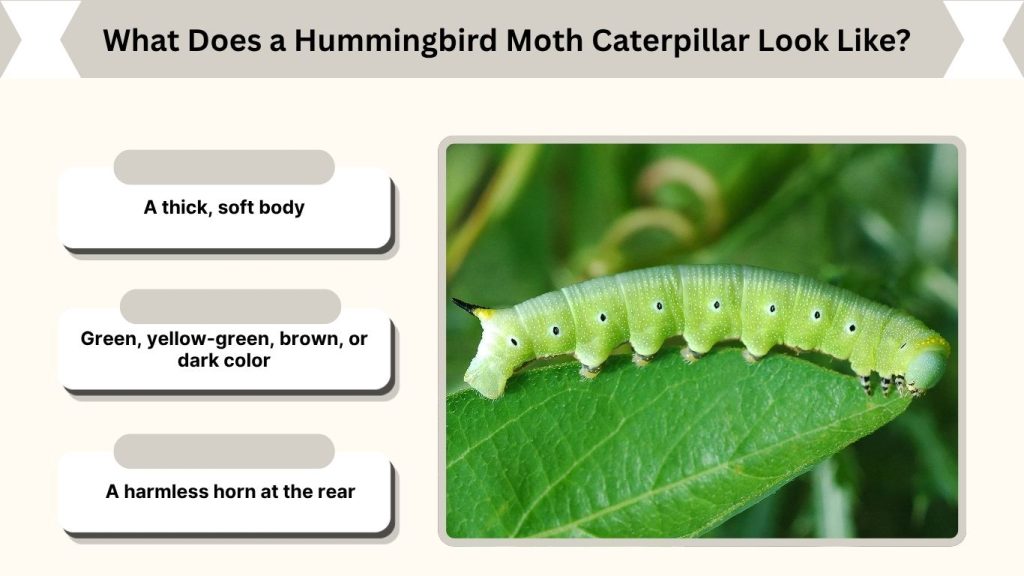
Most hummingbird moth caterpillars look like classic hornworms: plump, smooth caterpillars with a small horn or tail-like spine at the rear. Many are green, yellow-green, or brownish, helping them blend into leaves and stems. Some have pale side stripes, small dots, black spots, or a darker back. NC State Extension describes Hemaris diffinis caterpillars as pale green hornworms with a black horn and black spots along the sides.
Key Identification Marks
Look for these common signs:
- A thick, soft body
- Green, yellow-green, brown, or dark color
- A harmless horn at the rear
- Pale lines along the back or sides
- Small dots or side spots
- Strong grip on stems and leaf undersides
- Feeding damage on specific host plants
The “horn” often worries people, but it is not a stinger. Wisconsin Extension states that the pointed horn on white-lined sphinx caterpillars is harmless to humans.
Size and Color Changes
Young caterpillars may be small and hard to notice. As they feed, they molt several times and become much larger. Many sphinx moth larvae reach impressive sizes; Colorado State University Extension notes that hornworms are among the largest caterpillars in Colorado, with some reaching three inches or more.
Hummingbird Moth Caterpillar Host Plants and Food
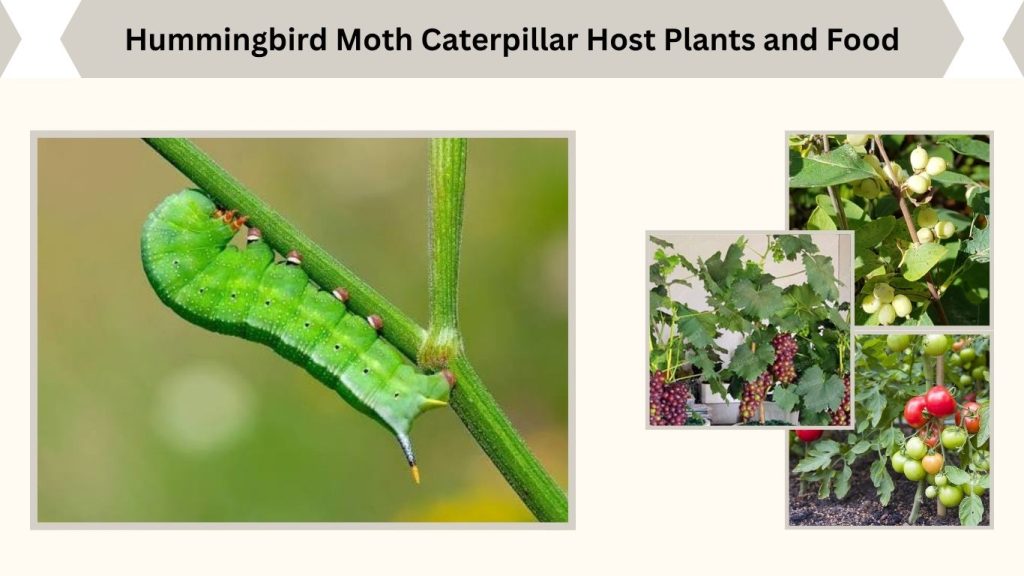
The best way to identify a hummingbird moth caterpillar is to note the plant it is eating. Adult moths drink nectar from many flowers, but caterpillars usually need specific host plants. The USDA lists larval food plants for North American hummingbird moths as honeysuckle, dogbane, and rose-family plants such as hawthorn, cherries, and plums.
Common Host Plants by Type
| Caterpillar type | Common host plants | Notes |
| Hummingbird clearwing | Honeysuckle, snowberry, hawthorn, cherry, plum | Often found on shrubs and small trees |
| Snowberry clearwing | Snowberry, honeysuckle, viburnum, hawthorn, cherry, plum | Clearwing adult resembles a bumblebee |
| Hummingbird hawk-moth | Bedstraws, especially Galium | Common UK/European food plant |
| White-lined sphinx | Evening primrose, grape, purslane, apple, fuchsia, four-o’clock, tomato | Very wide host range |
| Tomato hornworm | Tomato, eggplant, pepper, potato | Can defoliate garden plants |
UKMoths lists bedstraw (Galium) as the larval food plant of the hummingbird hawk-moth. Wisconsin Extension lists a wide range of white-lined sphinx host plants, including apple, evening primrose, four-o’clocks, fuchsia, grape, pentas, purslane, tomato, and willowherb.
What Do They Eat in Gardens?
Most hummingbird moth caterpillars eat leaves, not flowers. Clearwing caterpillars usually feed on woody or shrubby host plants and are rarely serious pests. Iowa State University Extension says hummingbird moths are harmless, their nectar feeding does not harm flowers, and even the hornworm stage of most hummingbird moths is usually of minor importance.
Hummingbird Moth Caterpillar vs Tomato Hornworm
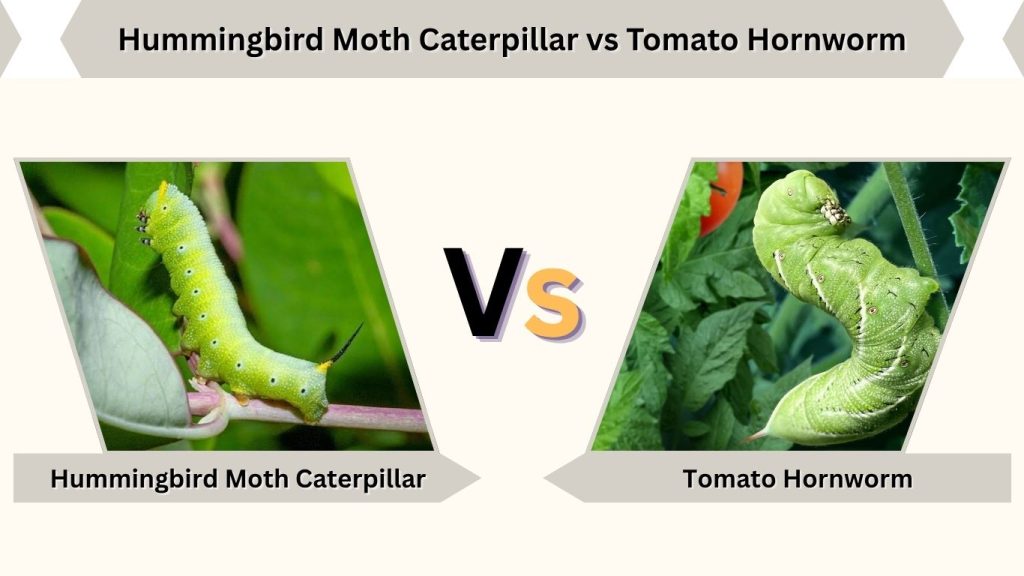
Many people confuse hummingbird moth caterpillars with tomato hornworms. This is understandable because tomato hornworms also become large sphinx moths, and adult sphinx moths may hover at flowers like hummingbirds. However, not every hummingbird moth caterpillar is a tomato hornworm.
Simple Differences
| Feature | Clearwing hummingbird moth caterpillar | Tomato hornworm |
| Main plants | Honeysuckle, snowberry, dogbane, hawthorn, cherry, plum | Tomato, eggplant, pepper, potato |
| Garden damage | Usually minor | Can strip tomato leaves quickly |
| Body look | Often pale green with small spots/lines | Green with V-shaped white markings |
| Horn color | Often dark or black in some species | Usually dark green/black-sided horn |
| Adult moth | Clearwing moth, often day-flying | Five-spotted hawkmoth, mostly night-flying |
Colorado State University Extension explains that tomato hornworms and tobacco hornworms feed on tomatoes and related plants, chewing leaves and sometimes fruit. It also notes that tomato hornworms have V-shaped white side markings, while tobacco hornworms have diagonal dashes and a red horn.
Are Tomato Hornworms Hummingbird Moth Caterpillars?
In a broad sense, yes, they are sphinx moth caterpillars whose adult moths may be casually called hummingbird moths because of hovering flight. In a stricter sense, “hummingbird clearwing caterpillar” usually means a Hemaris caterpillar, not a tomato hornworm. For SEO and reader clarity, explain both meanings so people searching “hummingbird moth caterpillar vs tomato hornworm” do not leave confused.
Life Cycle: From Egg to Hummingbird Moth
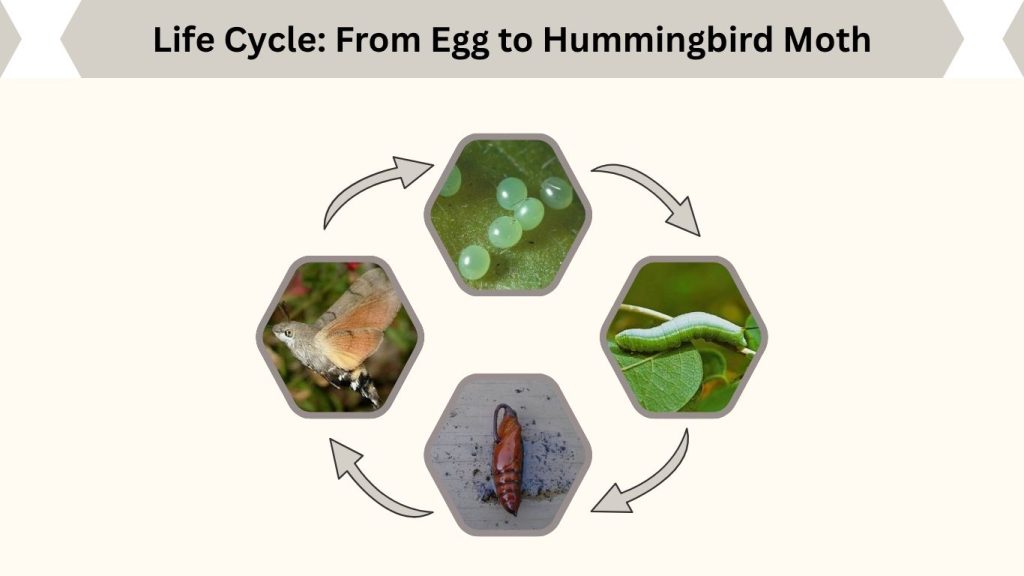
The life cycle has four main stages: egg, caterpillar, pupa, and adult moth. Females lay eggs on suitable host plants. The caterpillar hatches, feeds on leaves, grows through several molts, then moves away from the plant to pupate. Colorado State University Extension notes that full-grown hornworm larvae often leave the host plant and dig into loose soil to pupate a few inches below the surface.
Egg and Caterpillar Stage
Eggs are often laid on the underside of host plant leaves. Once hatched, the tiny caterpillar begins feeding. During this stage, it grows quickly and may change color or markings. If you are trying to identify one, take note of the host plant, body color, horn color, side stripes, and location.
Pupa or Cocoon Stage
Some species pupate in soil, while clearwing hummingbird moths may pupate in leaf litter or soil. NC State Extension notes that Hemaris thysbe caterpillars spin cocoons and pupate in leaf litter or soil.
Adult Moth Stage
The adult moth emerges and begins feeding on nectar. Sphinx moths are strong fliers with rapid wingbeats, and many can hover for long periods in front of flowers. Iowa State University Extension explains that these moths sip nectar using a long, extendable proboscis that coils under the head when not in use.
Are Hummingbird Moth Caterpillars Dangerous or Poisonous?
Hummingbird moth caterpillars are not dangerous to people. Their tail horn is not a stinger, and they do not bite in any meaningful way. Adults are also harmless and do not sting. NC State Extension says Hemaris moths are completely harmless, even though their appearance may resemble stinging insects.
The main issue is plant damage. Clearwing hummingbird moth caterpillars usually do little noticeable harm, but tomato and tobacco hornworms can heavily defoliate tomatoes and related crops. If you find a large hornworm on tomato plants, hand-picking is often the easiest control method in a small garden.
What to Do If You Find One
If the caterpillar is on honeysuckle, snowberry, viburnum, dogbane, hawthorn, cherry, plum, or another ornamental/native host plant, it is usually best to leave it alone. It may become a helpful pollinating moth later. Avoid spraying broad insecticides on host plants because they can kill caterpillars, moths, butterflies, bees, and other beneficial insects.
In the Garden
If you want more hummingbird moths, grow both nectar flowers and caterpillar host plants. Good nectar flowers include bee balm, phlox, honeysuckle, verbena, petunia, and other tubular blooms. The USDA notes that adults are likely to visit flowers such as phlox, beebalm, honeysuckle, and verbena.
If It Is on Tomato Plants
If the caterpillar is eating tomato leaves, identify whether it is a tomato hornworm or tobacco hornworm. Remove it by hand and relocate it away from vegetables, or use a targeted biological option such as Bacillus thuringiensis for young caterpillars if damage is severe. Colorado State University Extension lists hand-picking and Bacillus thuringiensis as control options for tomato hornworms.
FAQs
What caterpillar turns into a hummingbird moth?
Several sphinx moth caterpillars can turn into moths commonly called hummingbird moths. In North America, clearwing caterpillars such as Hemaris thysbe and Hemaris diffinis are classic examples. White-lined sphinx and tomato hornworm adults may also be casually called hummingbird moths because they hover at flowers.
What does a hummingbird moth caterpillar eat?
It depends on the species. Clearwing hummingbird moth caterpillars often eat honeysuckle, snowberry, dogbane, hawthorn, cherry, plum, and related plants. Hummingbird hawk-moth caterpillars feed on bedstraw, while tomato hornworms eat tomato and other nightshade plants.
Is a hummingbird moth caterpillar poisonous?
No, hummingbird moth caterpillars are not poisonous to people. Their rear horn may look sharp, but it is not a stinger. They are safe to observe, though it is still best to avoid handling caterpillars roughly.
Is a tomato hornworm a hummingbird moth caterpillar?
A tomato hornworm becomes a sphinx moth, and sphinx moths are sometimes called hummingbird moths because of their hovering flight. However, it is not the same as a hummingbird clearwing caterpillar. Tomato hornworms are vegetable pests, while clearwing hummingbird moth caterpillars usually feed on shrubs and cause little damage.
How long is a hummingbird moth caterpillar?
Many hummingbird moth caterpillars grow from small hatchlings to large hornworms. Some hornworms can reach about three inches or more when mature, depending on the species. Size alone is not enough for identification, so check the host plant, markings, horn color, and location.