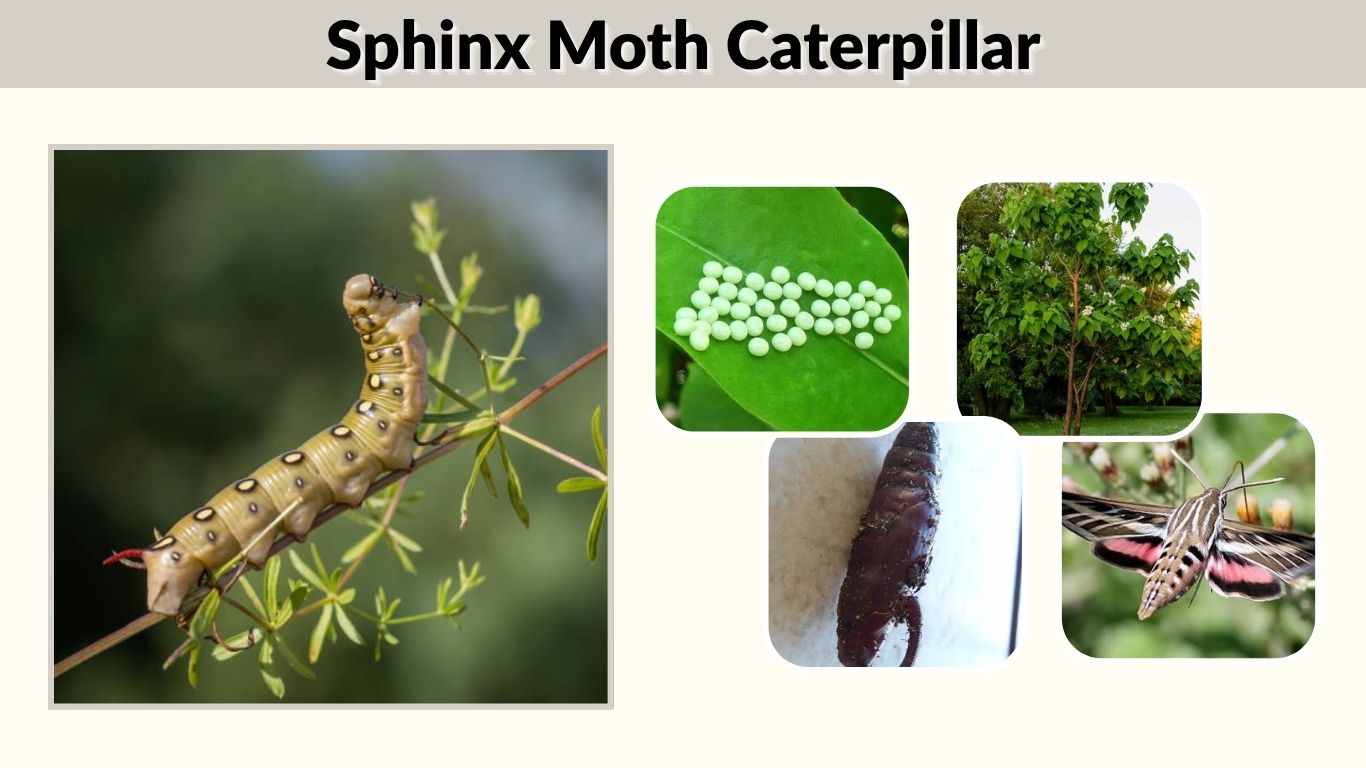
Sphinx moth caterpillars are large, smooth-bodied larvae that later become sphinx moths, also called hawk moths or hummingbird moths. Many are known as hornworms because they have a horn-like tail at the rear of the body. Some are green, brown, black, striped, or spotted, and several species look dramatic enough to be mistaken for poisonous caterpillars or even small snakes. This guide explains sphinx moth caterpillar identification, common types, diet, host plants, life cycle, and safety.
What Is a Sphinx Moth Caterpillar?
A sphinx moth caterpillar is the larval stage of a moth in the family Sphingidae. These caterpillars are often called hornworms because many species have a curved or pointed tail horn. They feed on leaves of specific host plants before pupating and becoming adult sphinx moths.
Adult sphinx moths are strong fliers. Many hover at flowers like tiny hummingbirds while drinking nectar. The Missouri Department of Conservation notes that sphinx moths are also called hawk moths and that mature caterpillars usually burrow into soil or leaf litter to pupate.
What Does a Sphinx Moth Caterpillar Look Like?
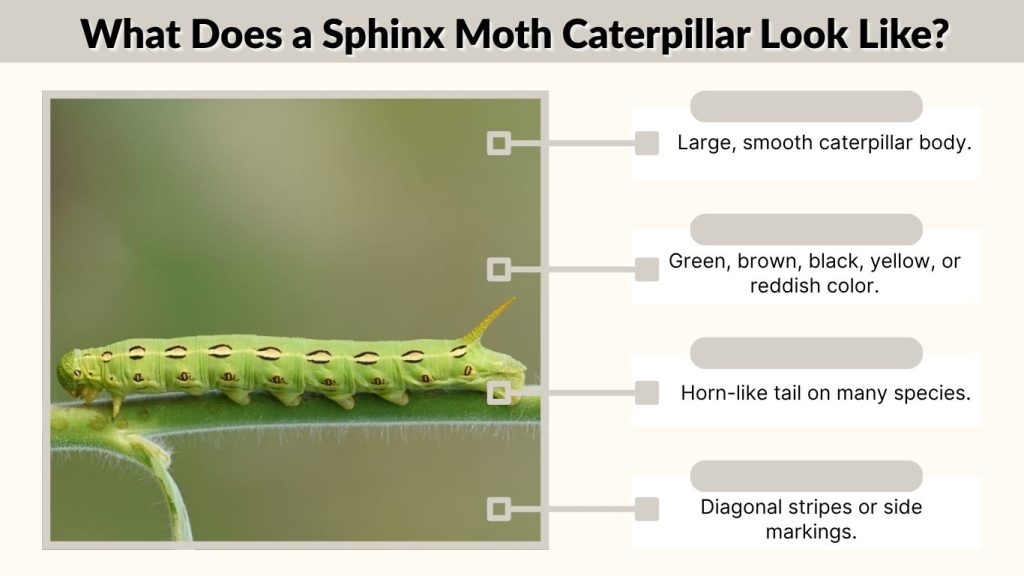
Most sphinx moth caterpillars are thick, smooth, and cylindrical. They usually have a soft body, a large head area, and a rear horn. Some have diagonal stripes, eyespots, speckles, or bold color patterns.
Sphinx Moth Caterpillar Identification
Look for these features:
- Large, smooth caterpillar body
- Green, brown, black, yellow, or reddish color
- Horn-like tail on many species
- Diagonal stripes or side markings
- Fake eyespots in some species
- Strong grip on stems and leaves
- Often found on specific host plants
- May curl or raise the front body when disturbed
The “horn” at the rear looks intimidating, but it is not a stinger.
Sphinx Moth Caterpillar Size
Sphinx moth caterpillars are usually medium to large compared with many garden caterpillars. Some mature larvae can reach 3 inches or more, depending on species.
| Type | Typical Appearance | Approximate Mature Size |
| White-lined sphinx | Green, brown, or black; stripes and spots | Up to about 3 inches |
| Tersa sphinx | Slender, green or brown; eyespots | Around 2–3 inches |
| Carolina sphinx | Green hornworm; diagonal white stripes | Up to 3–4 inches |
| Achemon sphinx | Large, patterned, often on grape | Around 3 inches |
| Catalpa sphinx | Yellow/black or pale with dark markings | Around 2–3 inches |
Is a Sphinx Moth Caterpillar Poisonous?
Most sphinx moth caterpillars are not poisonous or venomous to people. They do not sting, and the tail horn is harmless. Some may thrash or curl when handled, but they are not dangerous like stinging caterpillars.
Still, it is better not to handle unknown caterpillars with bare hands. Some people can get mild skin irritation from insects, plants, or frass, and caterpillars collected from gardens may have pesticide residue.
Are Sphinx Moth Caterpillars Poisonous to Dogs?
Most sphinx moth caterpillars are not considered seriously poisonous to dogs, but dogs should not be encouraged to eat them. A pet may drool, vomit, or have stomach upset after chewing caterpillars. If symptoms are strong or your dog ate many caterpillars, contact a veterinarian.
Sphinx Hawk Moth Caterpillar
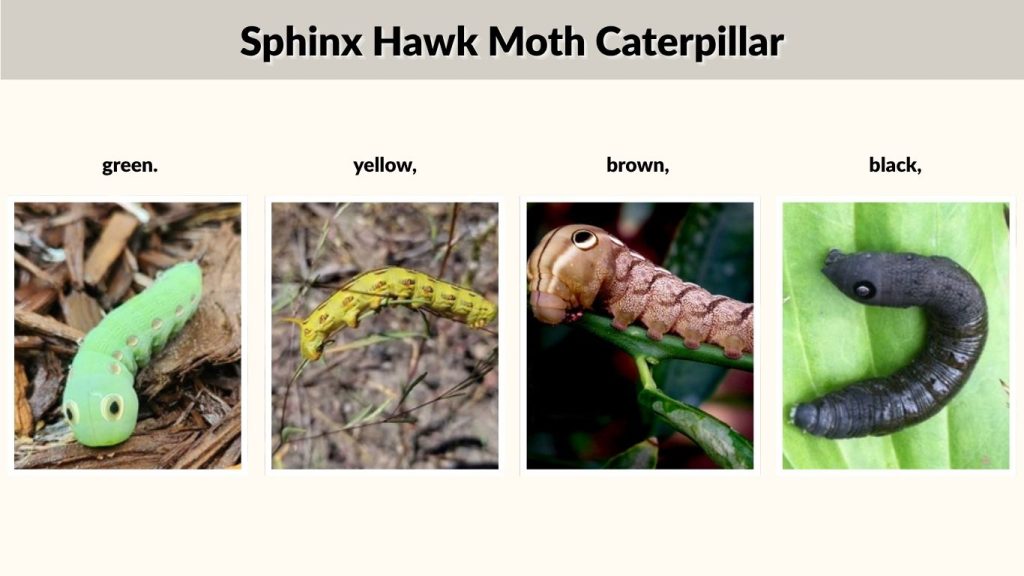
“Sphinx hawk moth caterpillar” is another common name for sphinx moth larvae. In many regions, people use the terms sphinx moth, hawk moth, hummingbird moth, and hornworm for related insects in the same family.
Some sphinx hawk moth caterpillars have eyespots near the front of the body. When disturbed, they may pull in the head and swell the front segments, making them look like a small snake. This is a defense display, not a sign that they are poisonous.
White-Lined Sphinx Moth Caterpillar
The white-lined sphinx moth caterpillar is one of the most common and widespread sphinx caterpillars in North America. It can be green, yellow, brown, or black, often with stripes, spots, or variable markings.
University of Wisconsin Horticulture says white-lined sphinx caterpillars use a wide host range, including apple, evening primrose, four-o’clocks, fuchsia, grape, purslane, tomato, and other plants.
White-Lined Sphinx Moth Caterpillar Diet
White-lined sphinx caterpillars may feed on:
- Evening primrose
- Grape
- Apple
- Purslane
- Tomato
- Four-o’clocks
- Fuchsia
- Rose-family plants
- Willowherbs
- Various herbs and weeds
University of Nevada, Reno Extension notes that white-lined sphinx caterpillars feed on many plant parts, including leaves, green fruits, and stems, and that adults feed on nectar without damaging plants.
Teresa Sphinx Moth Caterpillar
The tersa sphinx moth caterpillar is usually green or brown and has eye-like spots along the sides. These eyespots make it look snake-like when it raises the front of its body.
NC State Extension lists tersa sphinx caterpillar host plants including pentas, broadleaf buttonweed, candy corn vine, catalpa, firebush, smooth buttonplant, and joe-pye weed.
Is the Teresa Sphinx Moth Caterpillar Poisonous?
No, the tersa sphinx moth caterpillar is not known as a stinging or venomous caterpillar. Its eyespots are defensive markings. They may scare predators, but they do not mean the caterpillar is dangerous.
Carolina Sphinx Moth Caterpillar
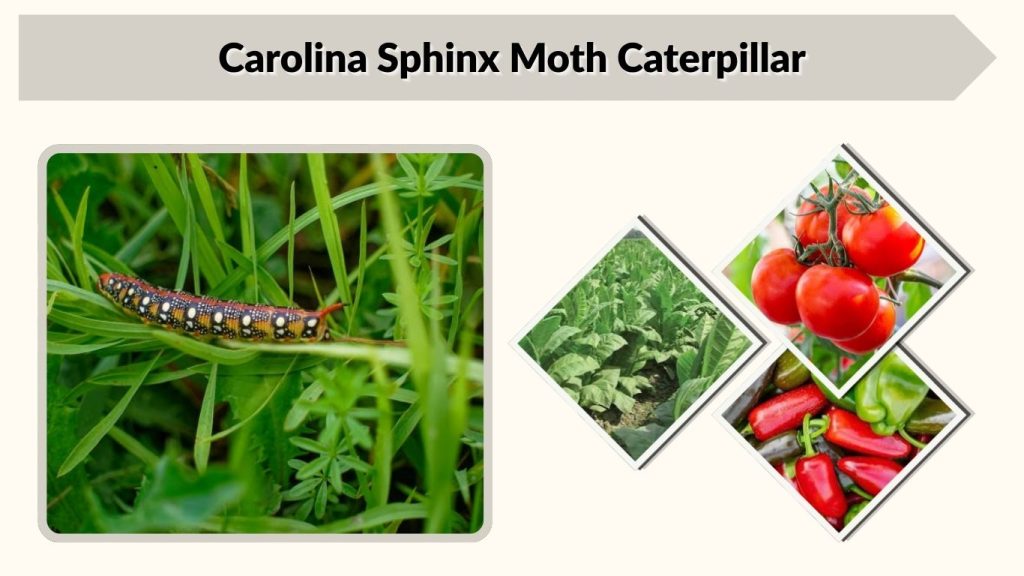
The Carolina sphinx moth caterpillar is better known as the tobacco hornworm. It is a large green caterpillar with diagonal white lines and a rear horn. It often feeds on plants in the nightshade family.
Common host plants include:
- Tobacco
- Tomato
- Pepper
- Eggplant
- Potato
- Other nightshade relatives
Tomato gardeners often confuse Carolina sphinx caterpillars with tomato hornworms. Both can eat leaves quickly and leave dark droppings on lower leaves or soil.
Achemon Sphinx Moth Caterpillar
The achemon sphinx moth caterpillar is often found on grape-family plants. It may be green, brown, or patterned depending on stage. Mature larvae can be large and may lose the obvious tail horn in later stages, leaving an eye-like button.
Common host plants include grape, Virginia creeper, and related vines. Missouri Extension notes that achemon sphinx caterpillars occur from early summer to fall and may have one to two generations per year.
Pandora and Pandorus Sphinx Moth Caterpillars
Pandora and pandorus sphinx caterpillars are often associated with grapevines and Virginia creeper. They can be colorful and may have strong patterns. Some have dramatic eyespots or side markings that make them stand out.
They are usually not dangerous, but they can chew leaves. Small numbers on wild vines are usually not a problem.
Catalpa Sphinx Moth Caterpillar
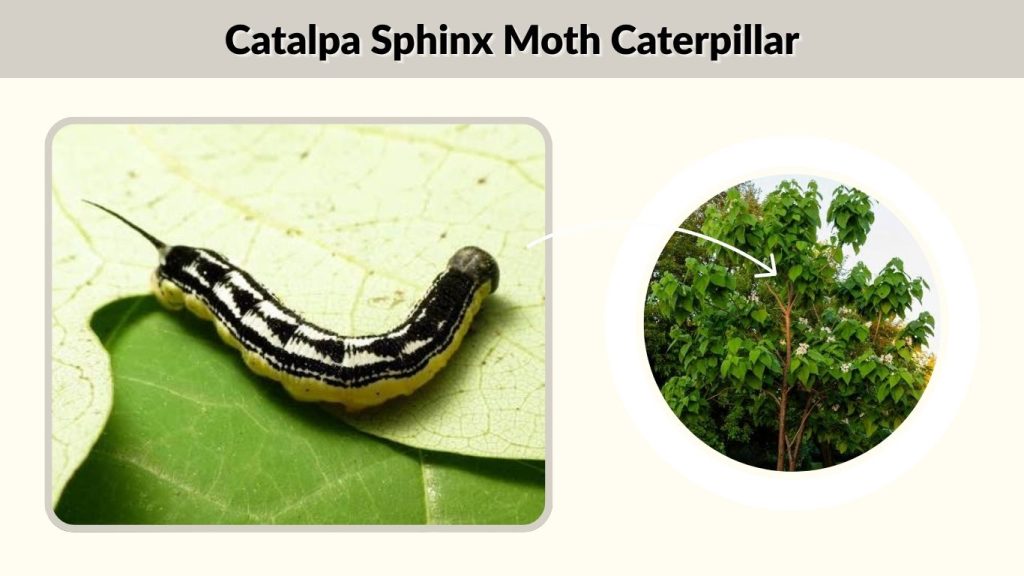
The catalpa sphinx moth caterpillar feeds mainly on catalpa trees. It is also called the catalpa worm. These caterpillars are famous among anglers because they are sometimes used as fishing bait.
Catalpa sphinx caterpillars can appear in groups and may defoliate catalpa trees. Healthy trees often recover, but repeated heavy feeding can stress them.
Rustic Sphinx Moth Caterpillar
The rustic sphinx moth caterpillar is often green with diagonal markings, though color can vary. It feeds on several ornamental and wild plants in warm regions.
Common host plants may include:
- Jasmine
- Fringe tree
- Gardenia
- Bignonia-family plants
- Other shrubs and vines
Rustic sphinx caterpillars are not considered poisonous, but they may be noticeable because of their size.
What Do Sphinx Moth Caterpillars Eat?
Sphinx moth caterpillars eat leaves, tender stems, flowers, or sometimes green fruit, depending on species. Most are tied to specific host plants. For example, white-lined sphinx caterpillars have a very broad diet, while catalpa sphinx caterpillars are strongly linked to catalpa trees.
Common Food Plants
- Grape
- Virginia creeper
- Tomato
- Tobacco
- Evening primrose
- Purslane
- Apple
- Catalpa
- Elm
- Willow
- Poplar
- Walnut
- Pawpaw
- Plumeria
- Pentas
- Firebush
If you want to identify a sphinx moth caterpillar, note the plant it is feeding on. Host plant is one of the best clues.
Sphinx Moth Caterpillar Life Cycle
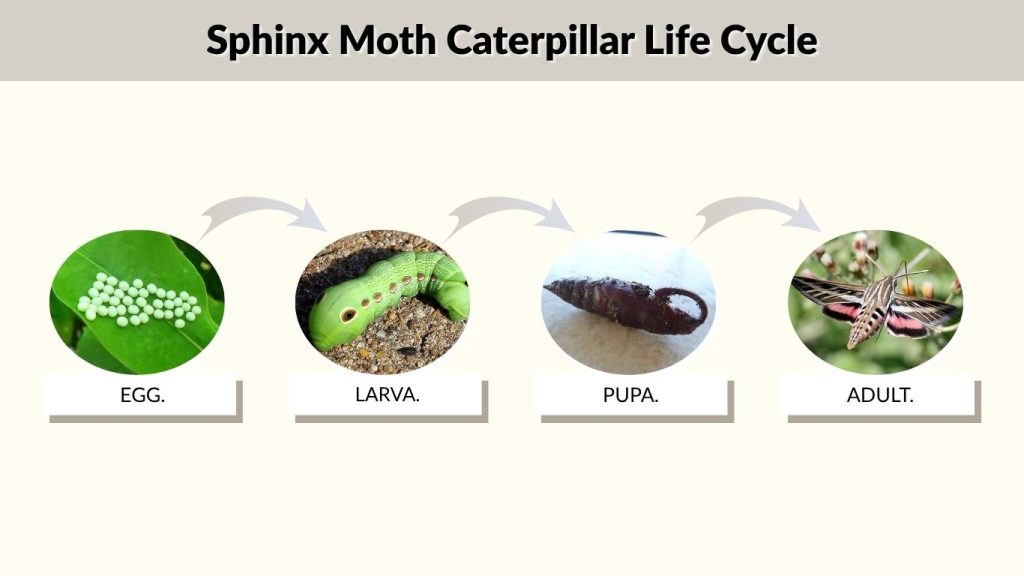
Sphinx moths develop through four stages: egg, larva, pupa, and adult. University of California IPM explains that sphinx moths have these four life stages and often overwinter as mature larvae or pupae in litter or topsoil.
Life Cycle Stages
- Egg: Laid on or near host plants.
- Larva: Caterpillar feeds and grows through several molts.
- Pupa: Mature caterpillar usually burrows into soil or leaf litter.
- Adult: Moth emerges, mates, and lays eggs.
Most mature sphinx caterpillars do not make obvious hanging cocoons. Many leave the host plant and pupate underground or under leaf litter.
Sphinx Moth Caterpillar Cocoon
People often search for “sphinx moth caterpillar cocoons,” but many sphinx moths do not form a thick visible cocoon above ground. Instead, mature caterpillars burrow into soil and pupate there. A few species may make a thin cocoon near the soil surface or in leaf litter.
If you are raising one, provide a container with clean soil or leaf litter so the caterpillar can pupate naturally.
How to Care for a Sphinx Moth Caterpillar
If you want to raise a sphinx moth caterpillar, you need to know its host plant. A caterpillar found on grape should usually be fed grape or related vines. One found on tomato should be fed tomato or related nightshade leaves.
Basic Care Tips
- Keep it in a ventilated container.
- Feed fresh leaves from the same host plant.
- Avoid leaves treated with pesticides.
- Add a paper towel for easy cleaning.
- Remove old frass daily.
- Provide soil or leaf litter when it becomes mature.
- Do not handle it too much.
- Release the adult moth where you found the caterpillar, if appropriate.
Do not move caterpillars across regions, and do not release nonnative species.
Sphinx Moth Caterpillar in Arizona, Texas, Florida and California
Sphinx moth caterpillars are found across much of North America, but species vary by region. White-lined sphinx caterpillars are especially common in western and central areas, including Arizona, New Mexico, Utah, Colorado, California, and Texas.
In warm states like Florida and Texas, species such as tersa sphinx, rustic sphinx, tetrio sphinx, fig sphinx, and Carolina sphinx may also be seen. Regional host plants are often the best clue for identification.
Are Sphinx Moth Caterpillars Good or Bad?
Sphinx moth caterpillars can be both helpful and harmful. Adult moths are important pollinators, especially for deep tubular flowers. Caterpillars provide food for birds, reptiles, and other wildlife. However, some species can damage garden plants when numbers are high.
A few caterpillars on wild plants usually do not need control. Heavy feeding on tomatoes, grapes, or ornamental plants may require handpicking or other management.
FAQs
What does a sphinx moth caterpillar look like?
A sphinx moth caterpillar is usually large, smooth, and thick-bodied. Many have a horn-like tail, diagonal stripes, spots, or eyespots. Colors can include green, brown, black, yellow, or reddish tones depending on species.
Is a sphinx moth caterpillar poisonous?
Most sphinx moth caterpillars are not poisonous or venomous. The tail horn is not a stinger. However, you should avoid handling unknown caterpillars with bare hands because some people may get mild irritation.
What does a sphinx moth caterpillar eat?
Sphinx moth caterpillars eat host plant leaves. Common host plants include grape, tomato, tobacco, evening primrose, purslane, catalpa, elm, willow, walnut, pawpaw, plumeria, pentas, and Virginia creeper.
What does a white-lined sphinx moth caterpillar eat?
White-lined sphinx moth caterpillars eat many plants, including evening primrose, grape, apple, purslane, tomato, four-o’clocks, fuchsia, rose-family plants, and willowherbs.
Do sphinx moth caterpillars turn into hummingbird moths?
Yes, some sphinx moth caterpillars become adult moths commonly called hummingbird moths because they hover at flowers while drinking nectar. White-lined sphinx moths and clearwing sphinx moths are examples.