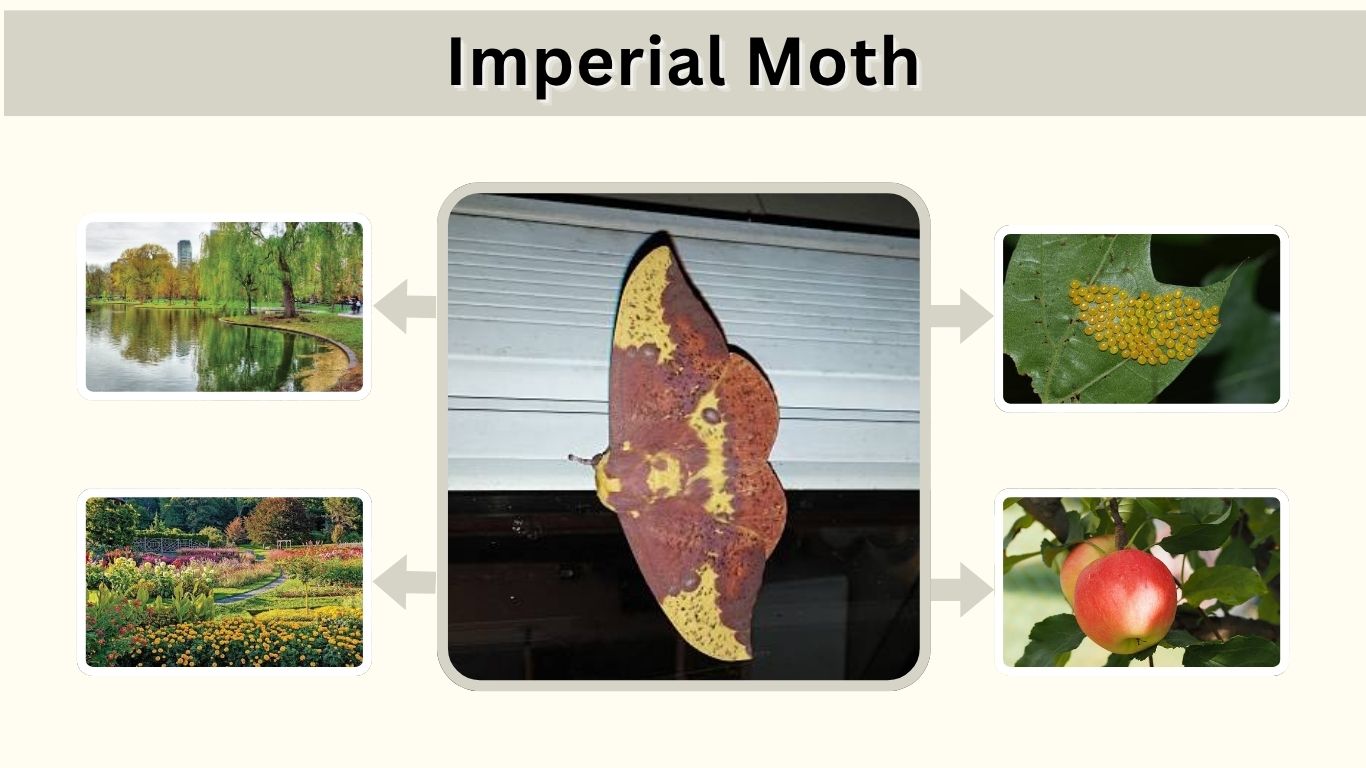
The imperial moth (Eacles imperialis) is a large, colorful silk moth found across much of eastern and central North America. Adults are best known for their yellow wings covered with purple, brown, or reddish markings, while their caterpillars can appear green, brown, reddish, or almost black. Although their large size may look intimidating, imperial moths are generally harmless to people. This guide covers imperial moth identification, caterpillars, diet, host plants, male and female differences, life cycle, pupa, lifespan, habitat, and other important facts.
What Is an Imperial Moth?
The imperial moth belongs to the giant silk moth family Saturniidae. Adults are primarily nocturnal and may occasionally appear around outdoor lights during warm summer nights. Like many other giant silk moths, adults live only briefly and concentrate almost entirely on reproduction rather than feeding.
Imperial Moth Identification
Adult imperial moths can be recognized by several features:
- Scientific name: Eacles imperialis
- Family: Saturniidae
- Main colors: Yellow with purple, brown, or reddish markings
- Body: Large and heavily built
- Wings: Broad with scattered dark markings
- Activity: Mostly nocturnal
- Antennae: More feathered in males
- Nature: Harmless to humans
The amount of yellow and purple can vary considerably among individuals.
Imperial Moth Size
Imperial moths are among the larger moths encountered in North America. Adults commonly have wingspans of about 3 to 6 inches, with females generally growing larger than males.
Their thick bodies and broad wings make them particularly noticeable when resting on tree trunks, walls, or outdoor structures.
Imperial moth caterpillars are also impressive in size and may grow to roughly 4 inches long before pupation.
Is an Imperial Moth Poisonous?
Adult imperial moths are not poisonous or venomous. They cannot sting and do not have biting mouthparts capable of hurting people.
Their caterpillars have noticeable hairs, projections, and horn-like structures that can look threatening. However, imperial moth caterpillars are not considered dangerously venomous like Io moth caterpillars.
Avoid unnecessary handling because their hairs or spines may irritate sensitive skin.
Imperial Moth Caterpillar
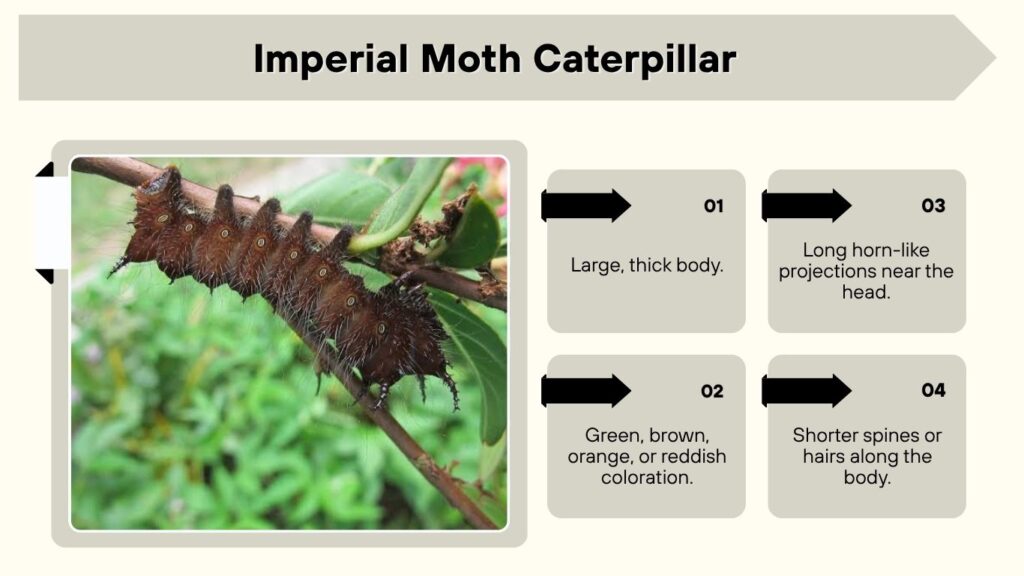
The imperial moth caterpillar is large and highly variable in color. Depending on its age and individual variation, it may be bright green, reddish-brown, orange-brown, dark brown, or nearly black. Several long projections near the front of the body give the larva an unusual appearance.
Imperial Moth Caterpillar Identification
A mature caterpillar typically has:
- Large, thick body
- Green, brown, orange, or reddish coloration
- Long horn-like projections near the head
- Shorter spines or hairs along the body
- Small breathing spots along the sides
- Length reaching approximately 3 to 4 inches
The caterpillar’s color may change as it develops through successive growth stages.
Are Imperial Moth Caterpillars Poisonous?
Imperial moth caterpillars are not generally considered poisonous or medically significant stinging caterpillars.
Their spines may look dangerous, but they are primarily defensive structures. Some people can experience mild skin irritation after handling hairy or spiny caterpillars, so observing them without touching is the safest choice.
They should not be confused with Io moth caterpillars, which possess venomous spines capable of producing a painful sting.
Green, Brown, and Red Imperial Moth Caterpillars
Color alone should not be used to identify this species.
Imperial caterpillars may be:
- Bright or dull green
- Reddish-brown
- Orange-brown
- Dark brown
- Nearly black
Changes can occur as the caterpillar grows. Looking at body shape, projections, markings, host plant, and overall structure provides a more reliable identification.
Imperial Moth Life Cycle
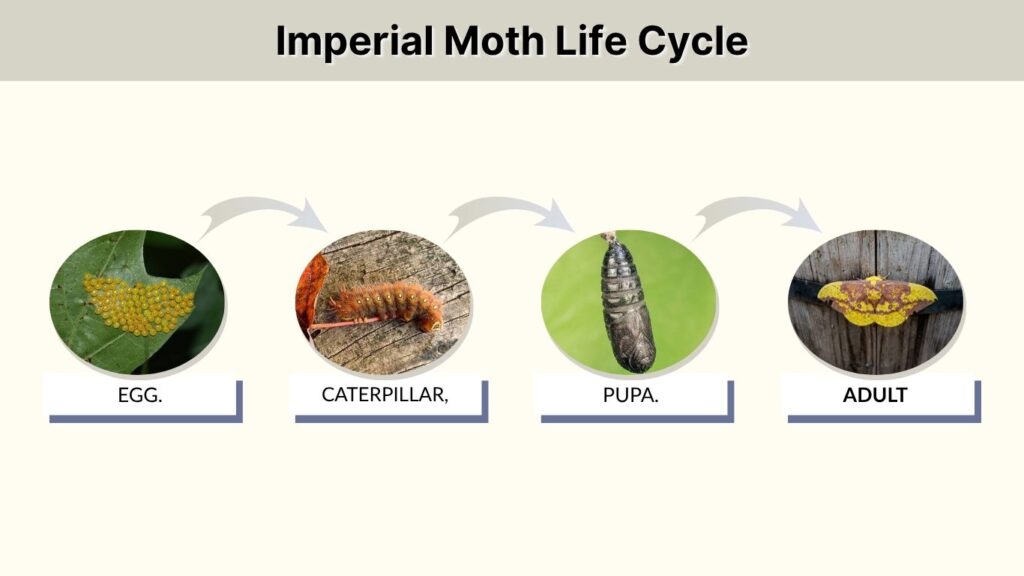
The imperial moth undergoes complete metamorphosis with four major stages: egg, caterpillar, pupa, and adult. Most feeding occurs during the larval stage. After reaching full size, the caterpillar leaves its host plant and typically pupates in the soil rather than spinning a large exposed cocoon.
Imperial Moth Eggs
After mating, females lay eggs on suitable host plants.
The eggs hatch into small caterpillars that immediately begin feeding on leaves. Young larvae pass through several instars, becoming larger each time they molt.
Females may distribute eggs across different leaves or plants, helping reduce competition among their offspring.
Caterpillar Development
The caterpillar’s primary role is to eat and grow.
During development it:
- Feeds heavily on leaves
- Passes through several instars
- Molts repeatedly
- Changes color and appearance
- Stores energy for adulthood
- Eventually leaves the host plant to pupate
By the final stage, it has grown dramatically compared with the newly hatched larva.
Imperial Moth Pupa
Unlike many silk moths that construct obvious silk cocoons on branches, imperial moth caterpillars usually burrow into loose soil and form their pupae underground.
The pupa is dark brown and relatively large. In colder areas, the species may spend winter in this stage.
When temperatures become suitable, the adult emerges from the pupa, works its way to the surface, and expands its wings.
Does an Imperial Moth Make a Cocoon?
Imperial moths do not normally make the large silk cocoons associated with species such as Cecropia moths.
Instead, a mature caterpillar usually enters the soil before pupating. People sometimes loosely refer to this stage as a “cocoon,” but technically the insect is primarily protected by its hardened pupal casing and surrounding soil.
Imperial Moth Male vs Female
Male and female imperial moths share similar yellow-and-purple patterns, but several characteristics can help distinguish them. Females usually have larger bodies, while males tend to have more strongly developed antennae for detecting female pheromones.
Male Imperial Moth
Male imperial moths typically have:
- More feathery antennae
- Narrower abdomen
- Slightly smaller body
- Often more extensive purple coloration
- Strong nighttime flight while searching for females
Their antennae are highly sensitive to chemical signals released by receptive females.
Female Imperial Moth
Female imperial moths usually have:
- Larger, heavier bodies
- Wider abdomens
- Less feathery antennae
- Often more yellow on the wings
- Abdomen adapted for carrying eggs
After mating, females seek appropriate host trees on which to lay their eggs.
Male vs Female Differences
The easiest differences include:
- Females are generally larger.
- Males usually have broader, more feathery antennae.
- Female abdomens are noticeably thicker.
- Males may display more purple coloration.
- Females often appear predominantly yellow.
Coloration varies, so antennae and body shape are usually more reliable than color alone.
Imperial Moth Diet and Host Plants
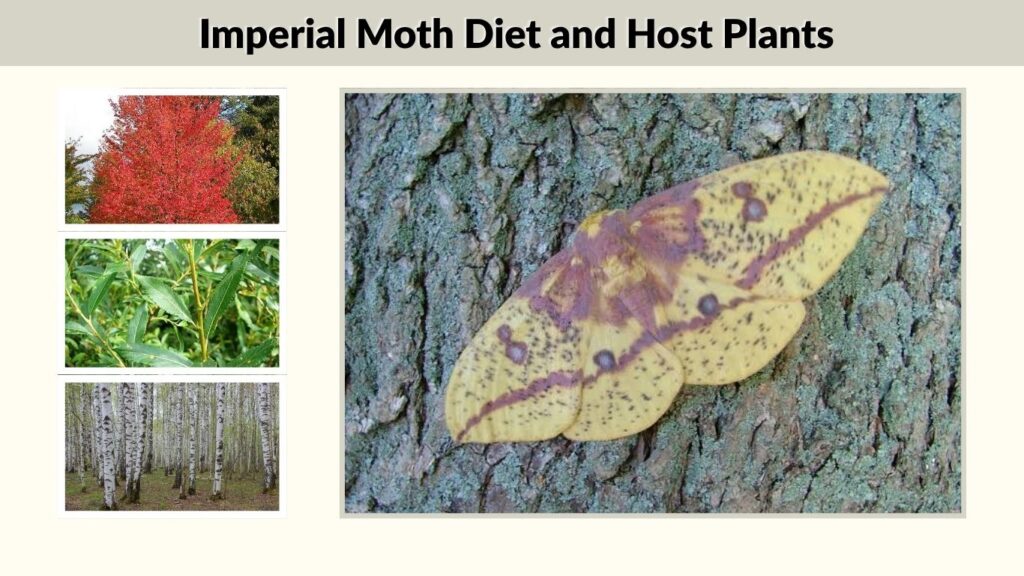
Imperial moth caterpillars feed on numerous trees, allowing the species to survive in a variety of forests and suburban landscapes. Adults, however, do not feed. Their short adult lives are fueled entirely by nutrients accumulated while they were caterpillars.
What Do Imperial Moth Caterpillars Eat?
Common host plants include:
- Pine
- Oak
- Maple
- Sweetgum
- Sassafras
- Cedar
- Birch
- Sycamore
- Hickory
- Other woody trees
Host preferences vary across the moth’s range.
What Do Adult Imperial Moths Eat?
Adult imperial moths do not normally eat.
Their mouthparts are reduced and not functional for regular feeding. They depend on stored energy gathered during the caterpillar stage.
This is why caterpillars spend so much time eating before pupating.
Imperial Moth Habitat and Range
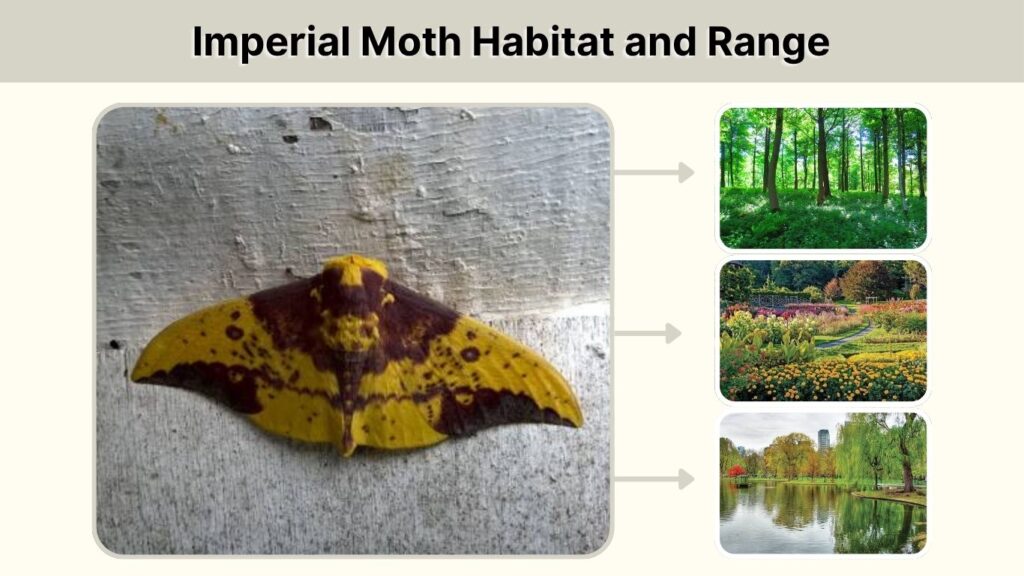
Imperial moths inhabit forests, woodland edges, parks, and residential areas containing suitable host trees. They are distributed through large parts of eastern and central North America, although their abundance can differ considerably from one region to another.
Where Are Imperial Moths Found?
Imperial moths occur in many U.S. states, including:
- Florida
- Georgia
- North Carolina
- South Carolina
- Virginia
- Maryland
- Pennsylvania
- Ohio
- Michigan
- Indiana
- Texas
Populations also extend into portions of Canada and farther south.
How Long Does an Imperial Moth Live?
The complete life cycle may last many months, particularly when the moth spends winter as a pupa.
The adult stage is much shorter. Adults generally survive for roughly one to two weeks, depending on environmental conditions.
Because adults do not feed, their limited energy is mainly used for flying, mating, and egg production.
Imperial Moth Meaning and Symbolism
Because moths undergo dramatic metamorphosis, they are often associated symbolically with transformation, personal change, renewal, and adaptation. The imperial moth’s large size and bright coloration can make encounters particularly memorable.
Spiritual interpretations vary widely and are based on personal or cultural beliefs rather than scientific evidence. Seeing an imperial moth does not biologically predict good luck, bad luck, or future events.
FAQs
1. Are imperial moth caterpillars poisonous?
No. Imperial moth caterpillars are not considered dangerously poisonous or venomous, although their hairs and projections may irritate sensitive skin.
2. What do imperial moth caterpillars eat?
They feed on leaves from many trees, including pine, oak, maple, sweetgum, sassafras, cedar, and hickory.
3. How big is an imperial moth?
Adults commonly have wingspans of about 3 to 6 inches. Females are usually larger and heavier than males.
4. How can you tell a male imperial moth from a female?
Males typically have broader, more feathered antennae and narrower abdomens. Females have larger, thicker bodies and often show more yellow coloration.
5. How long does an imperial moth live?
The adult typically lives for only around one to two weeks. However, the complete life cycle can take many months when the pupal stage lasts through winter.