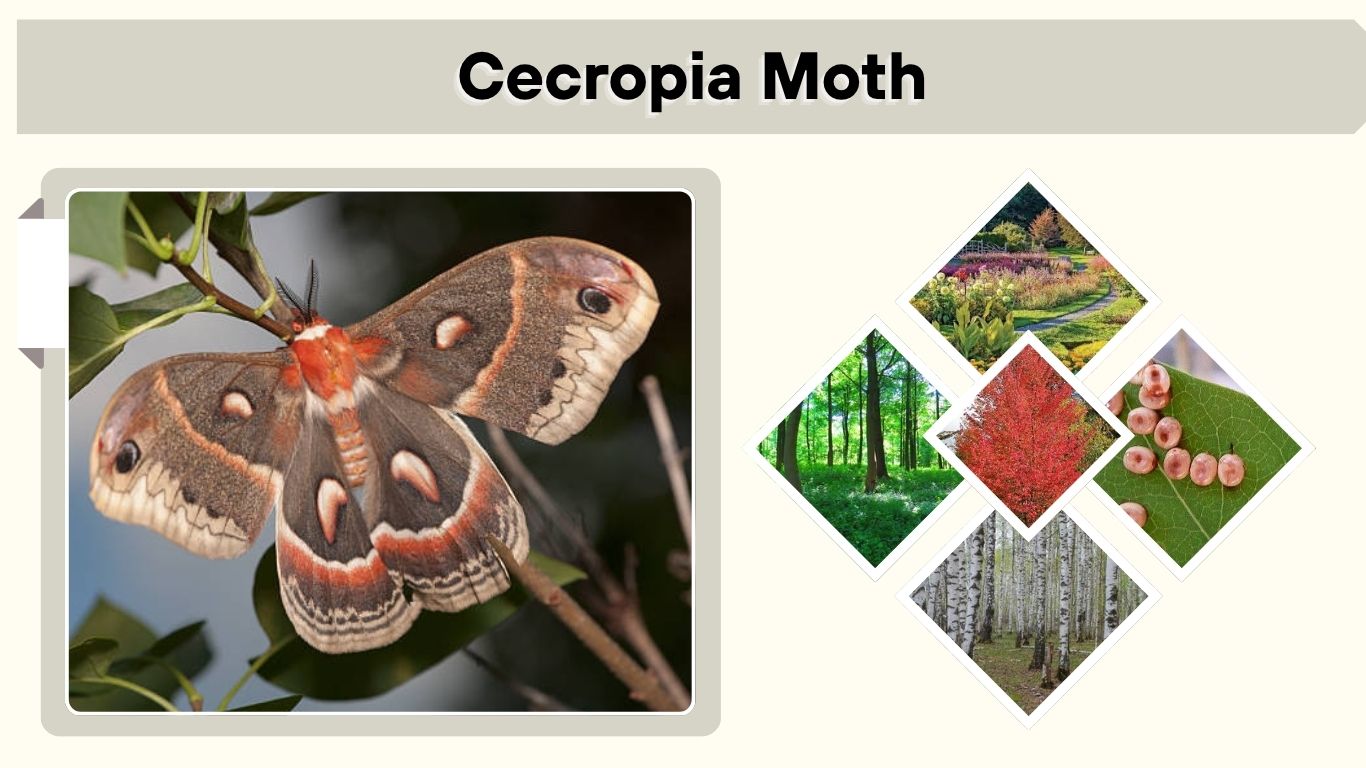
The Cecropia moth (Hyalophora cecropia) is the largest native moth in North America and one of the most impressive members of the giant silk moth family. Its enormous patterned wings, red-and-white markings, and thick body make an adult difficult to overlook. The species is equally fascinating as a caterpillar, developing from a tiny dark larva into a large green caterpillar covered with colorful bumps. From eggs and host plants to cocoons, lifespan, size, and male versus female differences, the Cecropia moth has a remarkable life cycle.
What Is a Cecropia Moth?
The Cecropia moth belongs to the Saturniidae family, commonly called giant silk moths. It spends most of its life developing through egg, caterpillar, and pupal stages before becoming a spectacular adult. Adults are primarily nocturnal and are sometimes attracted to outdoor lights. Despite their intimidating size, Cecropia moths are harmless to humans.
Cecropia Moth Identification
An adult Cecropia moth can be identified by several distinctive characteristics:
- Scientific name: Hyalophora cecropia
- Family: Saturniidae
- Color: Brown, red, black, white, and orange
- Wings: Broad with white crescent-shaped markings
- Body: Thick and covered with reddish hairs
- Antennae: Large and feather-like, especially in males
- Activity: Primarily active at night
- Behavior: Harmless and nonaggressive
Their combination of size and colorful wing markings makes them difficult to confuse with most common moths.
Cecropia Moth Size and Wingspan
Cecropia moths are enormous compared with typical backyard moths. Adults usually have a wingspan of approximately 5 to 7 inches, although individual size varies.
Females tend to have larger, heavier bodies because they carry eggs. Males are usually slightly smaller but possess particularly large, feathery antennae.
The caterpillars can also become impressively large, often reaching about 4 inches in length before pupation.
Are Cecropia Moths Dangerous?
Cecropia moths are not dangerous. Adult moths do not sting or bite people, and their large appearance should not be mistaken for aggression.
Unlike several other striking caterpillars, Cecropia moth caterpillars do not possess the venomous stinging spines associated with species such as Io moth caterpillars.
They are best observed without excessive handling, but simply finding one in a garden is not a reason for concern.
Cecropia Moth Caterpillar
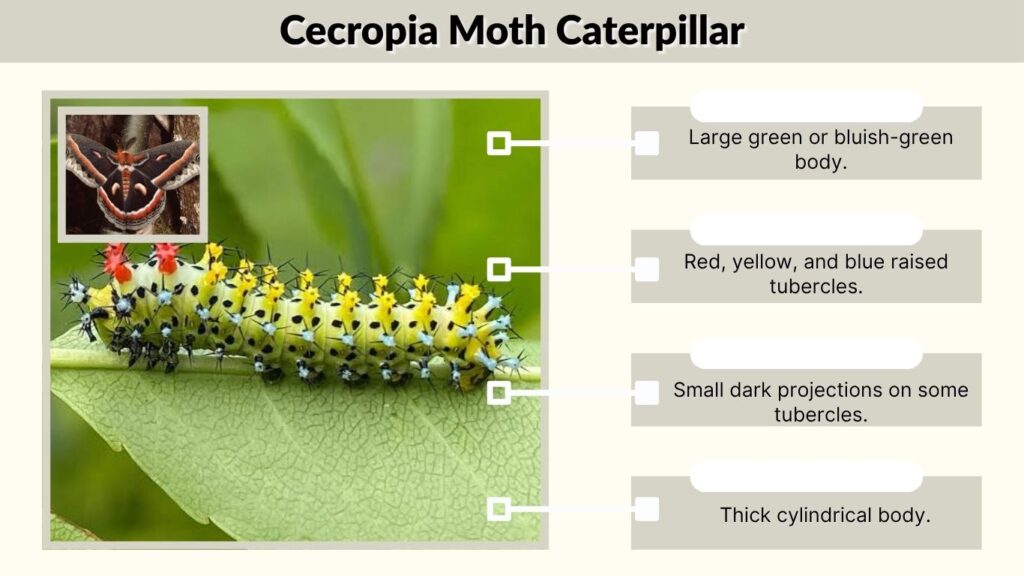
The Cecropia moth caterpillar changes dramatically as it develops. Newly hatched larvae bear little resemblance to mature caterpillars. After several molts, they eventually become large green caterpillars decorated with colorful tubercles. Their unusual appearance can make them seem threatening, even though they are generally harmless.
What Does a Cecropia Caterpillar Look Like?
Mature Cecropia caterpillars have several recognizable features:
- Large green or bluish-green body
- Red, yellow, and blue raised tubercles
- Small dark projections on some tubercles
- Thick cylindrical body
- Several pairs of abdominal prolegs
- Length of around 3 to 4 inches when fully grown
The large red and yellow projections near the front of the body are particularly noticeable.
Cecropia Moth Caterpillar Stages
Cecropia caterpillars pass through several larval stages called instars. They shed their skin between each stage to accommodate their rapidly growing bodies.
Young caterpillars start small and relatively dark. As development continues, their coloration changes and the characteristic tubercles become more prominent.
During the final instar, the caterpillar spends much of its time eating. It must store enough energy not only to complete metamorphosis but also to support the adult moth, which does not feed.
Are Cecropia Moth Caterpillars Poisonous?
Cecropia moth caterpillars are not considered poisonous or venomous. Their colorful bumps can look like dangerous spines, but they do not function like the venom-injecting structures found on some stinging caterpillars.
People should still avoid unnecessarily handling wild caterpillars because rough handling can injure them, and sensitive individuals may occasionally experience skin irritation from contact with insects or plant material.
Cecropia Moth Life Cycle
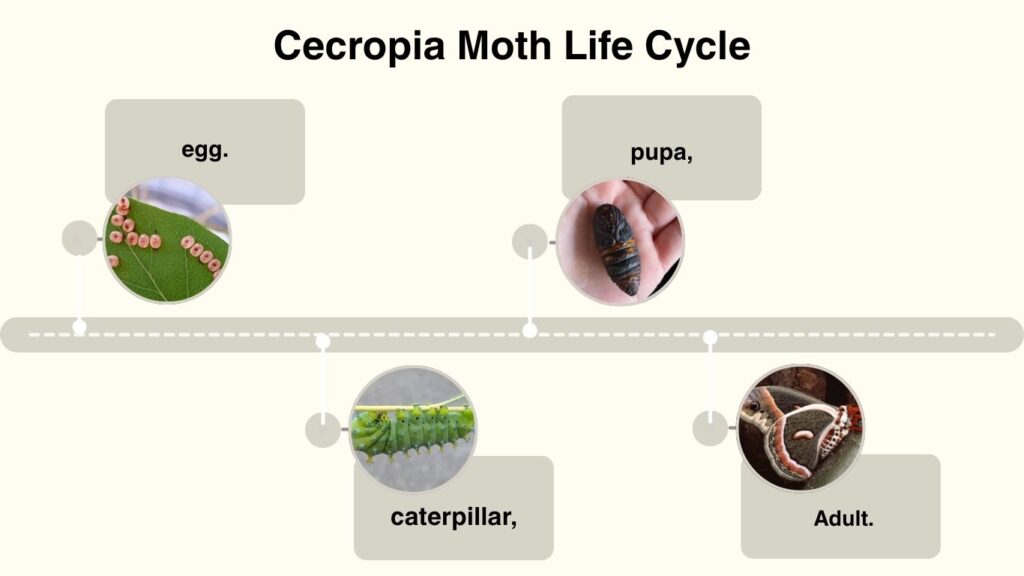
The Cecropia moth undergoes complete metamorphosis. Its life begins as an egg before progressing through caterpillar, pupa, and adult stages. Much of the species’ life is actually spent developing rather than flying as an adult moth. In colder regions, the pupal stage can last through winter before an adult emerges the following spring.
Cecropia Moth Eggs
After mating, a female lays eggs on or near suitable host plants.
The eggs are relatively small compared with the enormous caterpillars they eventually produce. Once conditions are suitable, larvae hatch and begin feeding on nearby leaves.
Females can produce many eggs, although only a portion of offspring survive predators, weather, disease, and other natural hazards.
Caterpillar Development
Once hatched, Cecropia caterpillars begin eating leaves and growing rapidly.
They repeatedly molt as their bodies become larger. Their primary purpose during this stage is to consume enough food to accumulate the energy needed for metamorphosis and adult reproduction.
After reaching full size, the caterpillar stops feeding and begins searching for an appropriate location to construct its cocoon.
Cecropia Moth Cocoon and Pupa
The Cecropia moth caterpillar produces a strong silk cocoon that is commonly attached to a twig or branch.
The cocoon helps protect the pupa from weather and some predators. Inside, the caterpillar transforms dramatically as larval tissues are reorganized into adult structures.
Important features of this stage include:
- Strong silk construction
- Usually attached to woody vegetation
- Contains the developing pupa
- Can remain through cold winter weather
- Adult moth eventually emerges through the cocoon
The term pupa refers to the developing insect inside, while the cocoon is the protective silk covering around it.
Adult Emergence
When development is complete and environmental conditions are suitable, the adult emerges from its cocoon.
Its wings initially appear soft and folded. The moth pumps fluid into them until they expand to full size. After the wings harden, the moth becomes capable of flight.
Adults then focus almost entirely on finding a mate and reproducing.
Cecropia Moth Male vs Female
Male and female Cecropia moths look similar at first glance, but several physical differences make them relatively easy to distinguish. Antennae and abdomen size are the most useful characteristics. These differences reflect their reproductive roles, with males specializing in locating females and females carrying large numbers of eggs.
Male Cecropia Moth
Male Cecropia moths have extremely broad, feathery antennae. These sensitive structures help them detect pheromones released by females, sometimes from considerable distances.
Males generally have:
- Very large feathery antennae
- Narrower abdomen
- Slightly smaller overall body
- Strong nighttime flight behavior
A male may travel considerable distances while searching for a female.
Female Cecropia Moth
Females normally have much larger, rounded abdomens because they contain developing eggs.
Their antennae are feathery but generally less broad than those of males.
After mating, females search for appropriate places to lay eggs, preferably where newly hatched caterpillars will have access to suitable food plants.
Male vs Female Differences
The easiest characteristics to compare are:
- Males have larger, more feathered antennae.
- Females have thicker abdomens.
- Females are often heavier-bodied.
- Males are typically more active while searching for mates.
- Both sexes share similar dramatic wing patterns.
Cecropia Moth Host Plants and Diet
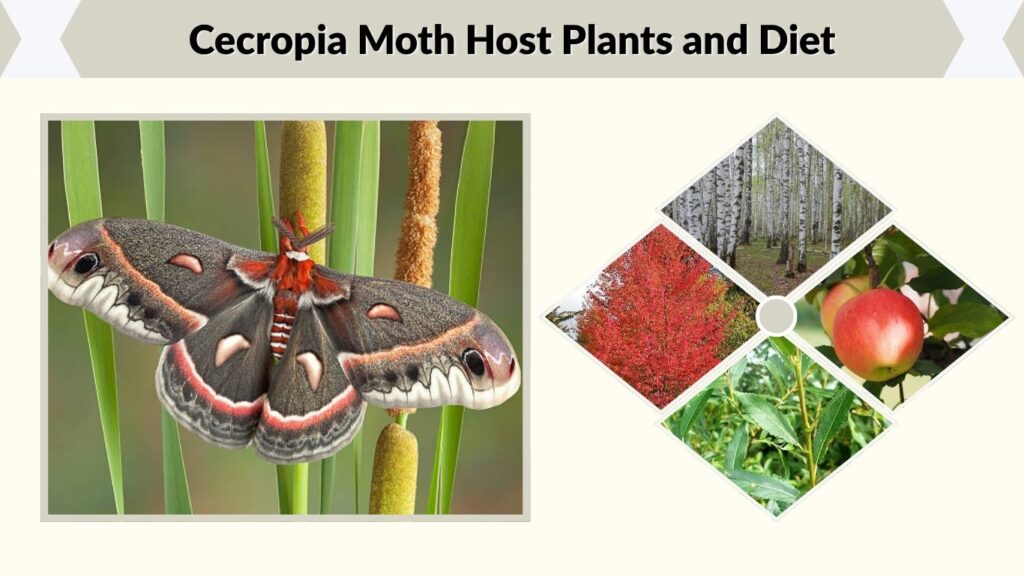
Cecropia moth caterpillars can feed on many different deciduous trees and shrubs. This broad diet allows the species to survive in forests, woodland edges, parks, farms, and suburban landscapes. Adult Cecropia moths, however, have a completely different relationship with food because their digestive and mouth structures are not designed for normal adult feeding.
Cecropia Moth Host Plants
Common host plants include:
- Maple
- Birch
- Willow
- Apple
- Cherry
- Elm
- Poplar
- Alder
- Dogwood
- Other deciduous trees and shrubs
The exact plants used can vary by location and availability.
What Does a Cecropia Caterpillar Eat?
Cecropia caterpillars feed mainly on the leaves of their host plants.
Their appetite increases significantly as they grow. Large final-stage caterpillars consume substantial amounts of foliage because they must store all the energy needed for pupation and adult life.
Despite their size, isolated caterpillars rarely cause serious damage to healthy mature trees.
What Does an Adult Cecropia Moth Eat?
Adult Cecropia moths do not eat.
Like many giant silk moths, adults have greatly reduced mouthparts. They survive using stored fat and energy accumulated while they were caterpillars.
This unusual adaptation means the adult stage is relatively brief and focused almost completely on reproduction.
Cecropia Moth Habitat, Range, and Lifespan
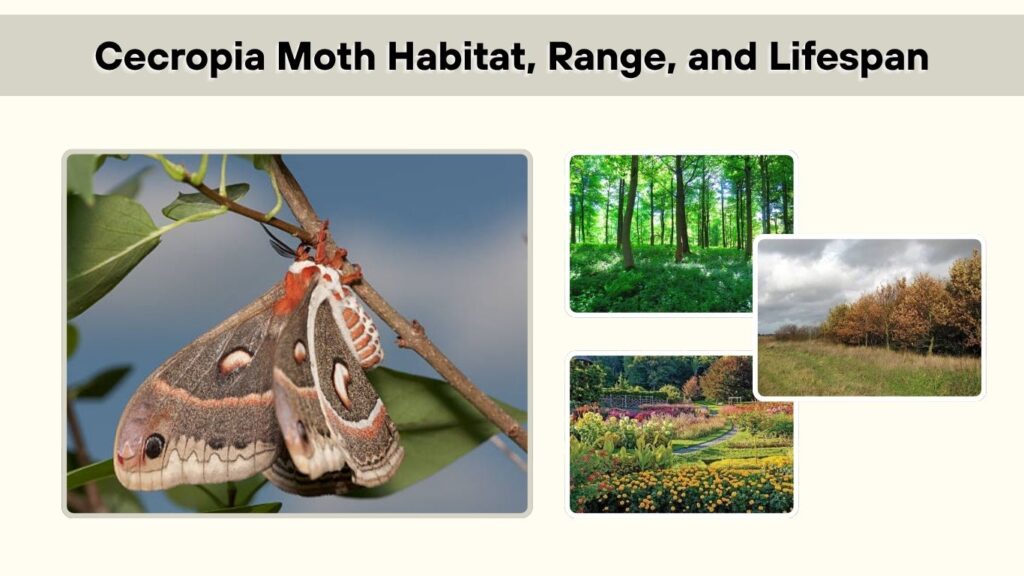
Cecropia moths occur throughout much of eastern and central North America. They inhabit places where suitable host trees are available, including forests, woodland edges, gardens, and suburban environments. Climate strongly influences their development because moths in colder areas usually spend the winter protected inside their cocoons.
Cecropia Moth Range
Cecropia moths can be found across large portions of the United States and southern Canada.
Sightings are commonly reported in states such as:
- Minnesota
- Michigan
- Wisconsin
- Ohio
- New York
- Pennsylvania
- Other eastern and central states
Their distribution generally corresponds with suitable climate and host plant availability.
How Long Does a Cecropia Moth Live?
The entire life cycle may extend across many months because the moth can overwinter as a pupa.
The adult stage, however, is much shorter. Adult Cecropia moths generally survive for only about one to two weeks.
Since they cannot eat, adults depend entirely on stored energy. During this short period, their main goals are mating and egg laying.
FAQs
1. Is a Cecropia moth poisonous?
No. Adult Cecropia moths are not poisonous or venomous, and their caterpillars do not possess the dangerous stinging spines found on some other moth larvae.
2. What do Cecropia moth caterpillars eat?
They eat leaves from many deciduous trees and shrubs, including maple, willow, birch, cherry, apple, poplar, and elm.
3. How big does a Cecropia moth get?
Adults commonly reach wingspans of approximately 5 to 7 inches, making the Cecropia moth the largest native moth species in North America.
4. How can you tell a male Cecropia moth from a female?
Males have much larger, more feathery antennae, while females usually have thicker and more rounded abdomens.
5. How long does a Cecropia moth stay in its cocoon?
The pupal period varies depending on season and climate. In colder regions, Cecropia moths commonly remain inside their cocoons through winter and emerge when warmer conditions return.