
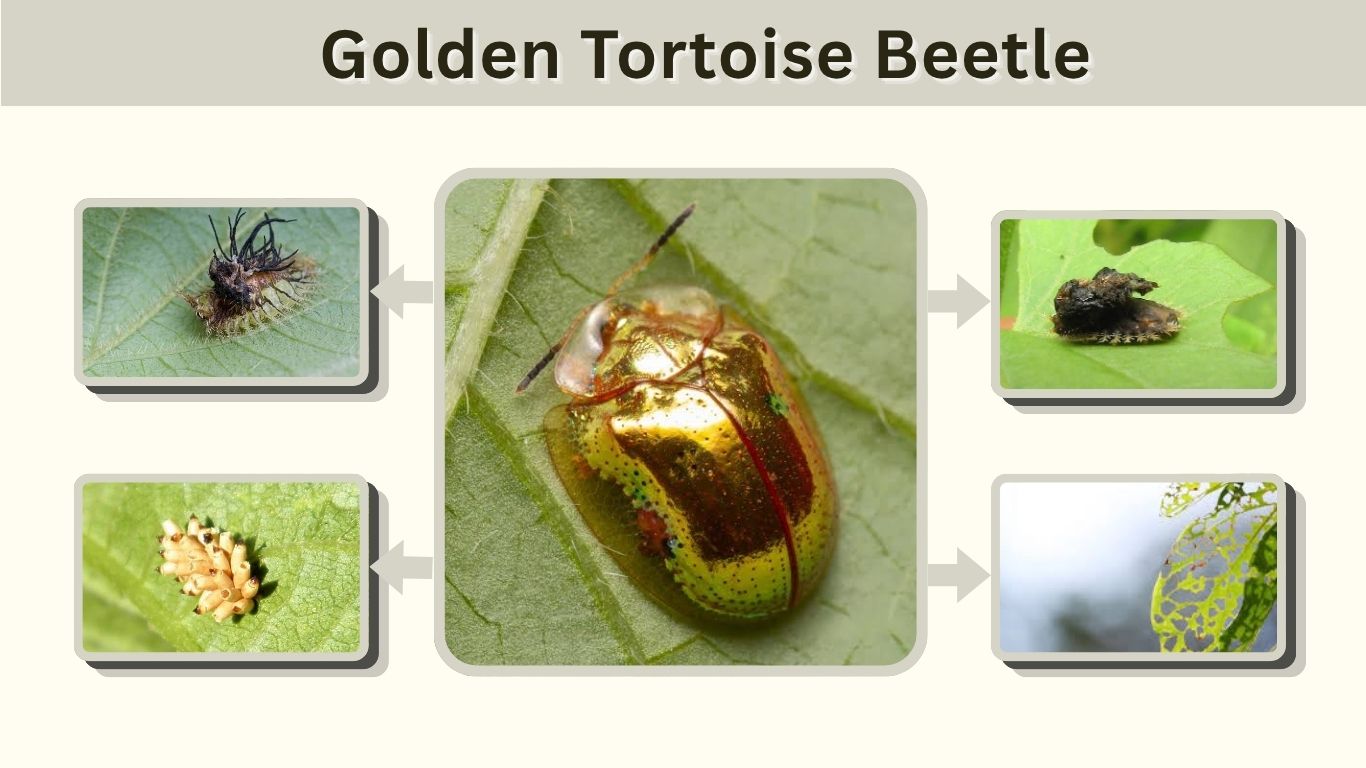
The golden tortoise beetle is one of the most fascinating insects in nature, recognized for its shiny, metallic-gold appearance and unusual ability to change color. Scientifically known as Charidotella sexpunctata, this tiny beetle belongs to the leaf beetle family and commonly lives on morning glory and sweet potato plants. Although its beautiful golden shell resembles a miniature piece of jewelry, the insect plays a natural role in garden ecosystems. Understanding its identification, habitat, diet, life cycle, and behavior can help you recognize this remarkable beetle.
What Is a Golden Tortoise Beetle?
The golden tortoise beetle is a small leaf-eating insect belonging to the family Chrysomelidae. Its rounded body and protective, shell-like wing covers resemble a tiny tortoise, giving the beetle its common name. Unlike most beetles, it has transparent edges surrounding its body, creating an unusual appearance.
Golden Tortoise Beetle Identification
You can identify a golden tortoise beetle by examining several physical characteristics:
- Color: Bright metallic gold, sometimes changing to orange, reddish-brown, or bronze.
- Size: Approximately 5–7 millimeters long.
- Body shape: Rounded, flattened, and slightly dome-shaped.
- Shell: Shiny wing covers with transparent outer margins.
- Head: Mostly concealed beneath the protective shield.
- Legs: Small legs tucked underneath the body.
- Wings: Functional wings that allow adults to fly between plants.
The beetle’s golden appearance and transparent edges help distinguish it from ordinary ladybugs and other small garden beetles.
| Feature | Golden Tortoise Beetle |
| Scientific name | Charidotella sexpunctata |
| Family | Chrysomelidae |
| Common name | Golden tortoise beetle |
| Adult size | 5–7 mm |
| Main colors | Gold, orange, reddish-brown |
| Diet | Leaves of morning glory relatives |
| Habitat | Gardens, fields, and vegetation |
| Distribution | Primarily the Americas |
Why Does the Golden Tortoise Beetle Change Color?
One of the most remarkable characteristics of the golden tortoise beetle is its ability to change color. A beetle that appears brilliantly golden may become reddish or brown when disturbed. This unusual behavior makes it especially interesting to scientists studying insect coloration.
How Golden Tortoise Beetles Change Color
The metallic appearance comes from microscopic structures in the insect’s outer covering that reflect light. This phenomenon is called structural coloration.
Moisture influences how these structures reflect light. When beetles become stressed, their appearance can change from reflective gold to orange or reddish-brown.
The exact color-change mechanism in Charidotella sexpunctata has not been fully established, although a fluid-based mechanism has been demonstrated in a closely related species.
After death, golden tortoise beetles generally lose their brilliant metallic shine and become duller.
Where Do Golden Tortoise Beetles Live?
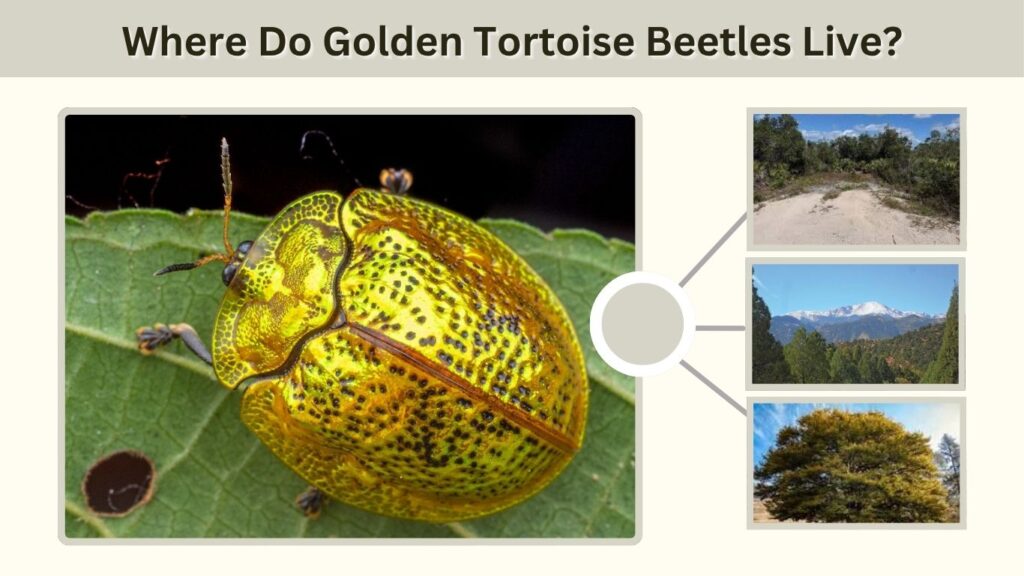
Golden tortoise beetles inhabit areas containing suitable host plants. They are especially associated with morning glory vines, bindweed, and sweet potato plants. Their small size makes them difficult to notice, even in gardens where they are relatively common.
Golden Tortoise Beetle in Virginia
The golden tortoise beetle occurs naturally in Virginia and other eastern United States locations. It may be spotted during warmer months, particularly on the undersides of leaves.
In Virginia, suitable habitats include vegetable gardens, wildflower areas, field edges, and places containing morning glory vines.
Golden Tortoise Beetle Distribution
The species occurs across much of eastern North America, with records also extending into western regions and farther south into the Americas.
It has been documented in states including Florida, Texas, Missouri, Colorado, and California.
Golden-colored tortoise beetles also occur in India, Africa, and other regions, but many belong to different species. Not every golden tortoise beetle found worldwide is Charidotella sexpunctata.
What Do Golden Tortoise Beetles Eat?
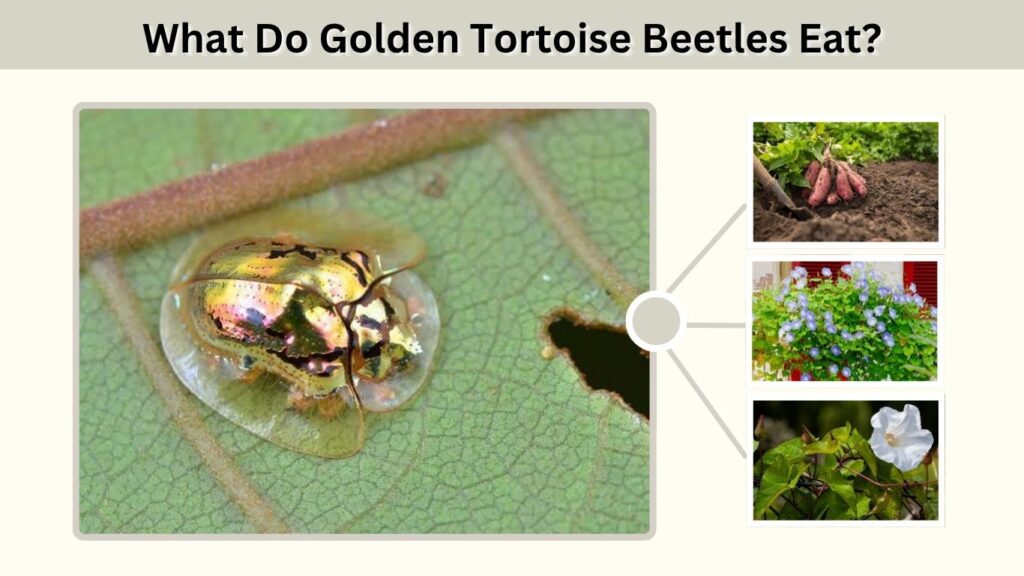
Golden tortoise beetles are herbivorous insects that feed primarily on leaves. Both adults and larvae consume vegetation, particularly plants belonging to the morning glory family, Convolvulaceae.
Their feeding commonly produces small, irregular holes in leaves. However, isolated beetles usually cause minimal damage.
Common Golden Tortoise Beetle Host Plants
Their primary food plants include:
- Morning glory: One of their most familiar hosts, providing tender leaves for adults and larvae.
- Sweet potato: Beetles feed on the foliage rather than the underground tubers.
- Bindweed: A common wild host found in fields, gardens, and disturbed habitats.
- Ornamental sweet potato vines: Decorative varieties may attract feeding beetles.
- Moonflower: Another member of the morning glory family that may serve as a host.
Unlike predatory ladybugs, golden tortoise beetles do not feed primarily on aphids or other garden insects.
Golden Tortoise Beetle Life Cycle
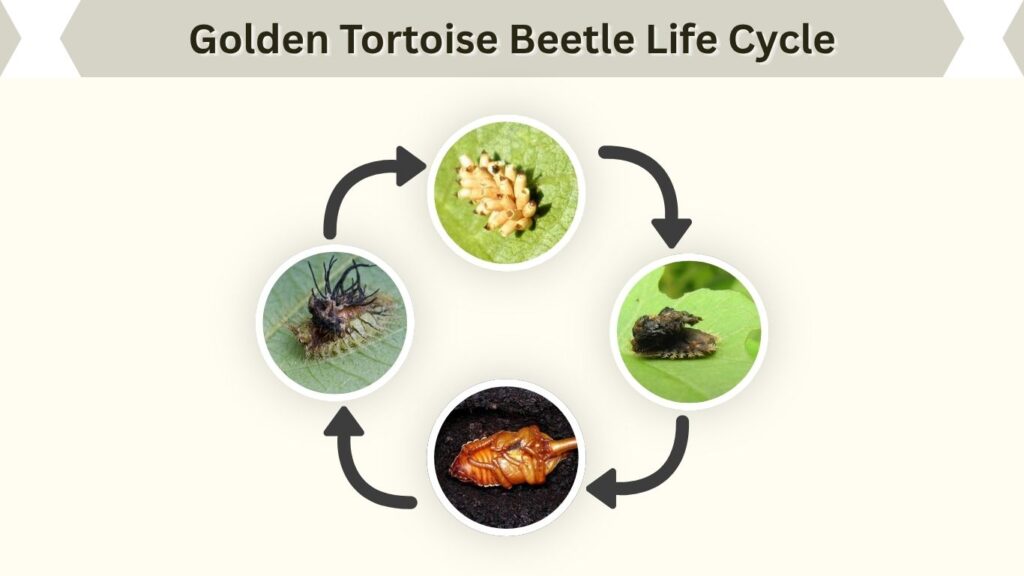
The golden tortoise beetle undergoes complete metamorphosis, developing through four distinct stages: egg, larva, pupa, and adult. Development depends on environmental conditions, including temperature and food availability.
In suitable warm conditions, development from egg to adult takes approximately 40 days.
Four Stages of Development
1. Egg stage: Female beetles deposit tiny, pale eggs on host plants, frequently beneath leaves. The eggs typically hatch within 5–10 days.
2. Larval stage: Newly hatched larvae have flattened bodies with defensive spines. They feed on foliage and develop over approximately 14–21 days.
3. Pupal stage: Mature larvae attach themselves to leaves and transform into pupae. This stage commonly lasts 7–14 days.
4. Adult stage: Adults emerge with their characteristic rounded bodies. They feed, reproduce, and may survive through winter in a dormant state.
In many northern regions, golden tortoise beetles produce one generation annually.
Golden Tortoise Beetle Larvae
Golden tortoise beetle larvae look completely different from adults.
They have flattened, spiny bodies that may appear yellowish, brown, or reddish. Their most unusual characteristic is a defensive structure called a fecal shield.
Larvae collect their waste and shed skins on a fork-like structure at the rear of their bodies. They can position this material above themselves to discourage predators.
Are Golden Tortoise Beetles Harmful?
Golden tortoise beetles are generally harmless to humans and pets. They are not considered medically significant insects and do not possess venomous stingers.
Their primary interaction with humans occurs when they feed on garden plants.
Are They Harmful to Plants?
Although their appearance is attractive, golden tortoise beetles can occasionally become minor agricultural or garden pests.
Both larvae and adults create holes in leaves, potentially reducing the ornamental appearance of plants.
However, serious damage is uncommon, and healthy established plants generally tolerate limited feeding.
How to Get Rid of Golden Tortoise Beetles
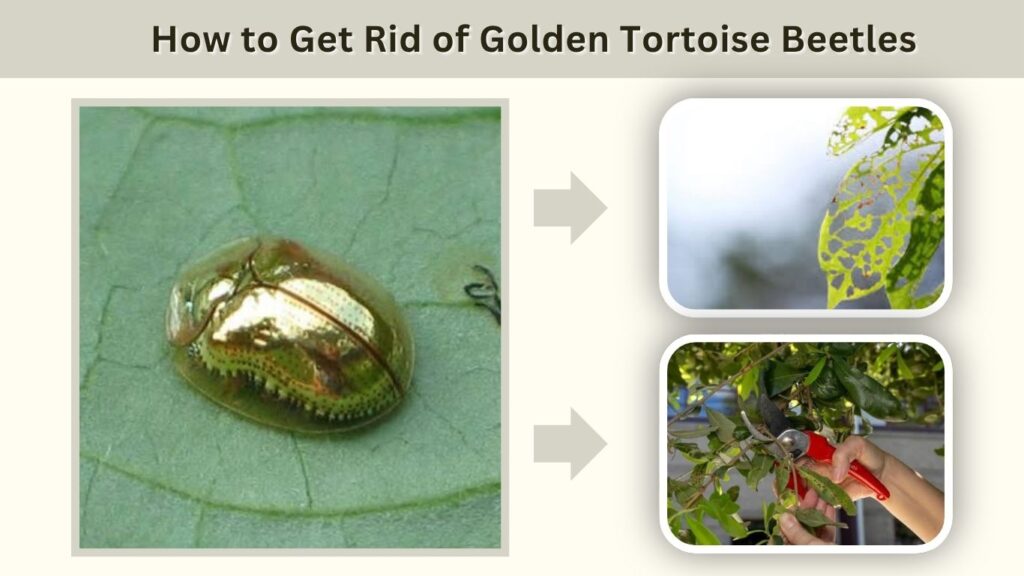
Golden tortoise beetle control is rarely necessary because small populations generally cause little economic damage. If numerous beetles are damaging ornamental plants or young sweet potato foliage, simple garden management practices can help reduce their numbers.
Consider these management methods:
- Handpick adult beetles: Remove visible beetles from leaves and relocate or dispose of them appropriately.
- Inspect leaf undersides: Look for eggs, larvae, and feeding damage regularly.
- Remove heavily infested leaves: Prune affected foliage only when necessary.
- Manage nearby host weeds: Reduce unwanted bindweed and morning glory growth around vulnerable crops.
- Encourage natural enemies: Maintain habitat for beneficial insects that prey on beetles and larvae.
Chemical treatment is generally unnecessary. If an infestation becomes severe, choose a product specifically registered for the affected plant and pest, and follow its instructions.
Different Types of Tortoise Beetles
Tortoise beetles include numerous species displaying distinctive colors, patterns, and body shapes. Some resemble tiny metallic shields, while others have spotted, green, yellow, or brown shells.
Several recognizable types include:
Clavate Tortoise Beetle
The clavate tortoise beetle (Plagiometriona clavata) has transparent margins and an unusual dark central pattern. It commonly feeds on plants in the nightshade family, including eggplant and related species.
Mottled Tortoise Beetle
The mottled tortoise beetle (Deloyala guttata) displays metallic golden, bronze, and patterned coloration. Like the golden tortoise beetle, it feeds on members of the morning glory family.
Eucalyptus Tortoise Beetle
Eucalyptus tortoise beetles include species that feed on eucalyptus foliage. Some can damage eucalyptus plantations and ornamental trees, making them economically important in affected regions.
These insects should not be confused with the American golden tortoise beetle, even when they have similar rounded body shapes.
Interesting Golden Tortoise Beetle Facts
Golden tortoise beetles possess several fascinating biological characteristics that distinguish them from other insects.
- Their golden shine comes from light-reflecting structures rather than actual gold.
- Adults can become reddish or brown when disturbed.
- The broad shell-like margins help protect their legs and head.
- Their larvae carry protective shields constructed from waste and shed skins.
- Adult beetles can fly despite their compact, rounded appearance.
- Their metallic coloration usually disappears after death.
- Their primary food plants belong to the morning glory family.
- Despite their striking appearance, they are not necessarily rare in suitable habitats.
Their defensive adaptations and unusual coloration make golden tortoise beetles an interesting subject for insect observation and scientific research.
FAQs
1. Do Golden Tortoise Beetles Bite Humans?
Golden tortoise beetles are not known for biting humans. They primarily feed on plant leaves and are generally harmless when encountered in gardens.
2. Are Golden Tortoise Beetles Poisonous?
Golden tortoise beetles are not considered poisonous or venomous to humans. Their unusual appearance does not indicate a dangerous insect.
3. Are Golden Tortoise Beetles Rare?
Golden tortoise beetles are not globally rare, although their small size and seasonal activity can make sightings uncommon. They may be locally abundant where suitable host plants grow.
4. How Long Do Golden Tortoise Beetles Live?
Their lifespan varies with environmental conditions. Development from egg to adult takes approximately 40 days, while adults may survive for several additional months, including an overwintering period.
5. Are Golden Tortoise Beetles Made of Real Gold?
No. Their metallic appearance is produced by microscopic structures that reflect light. The shell contains no actual gold, and its brilliant shine often disappears after the beetle dies.
