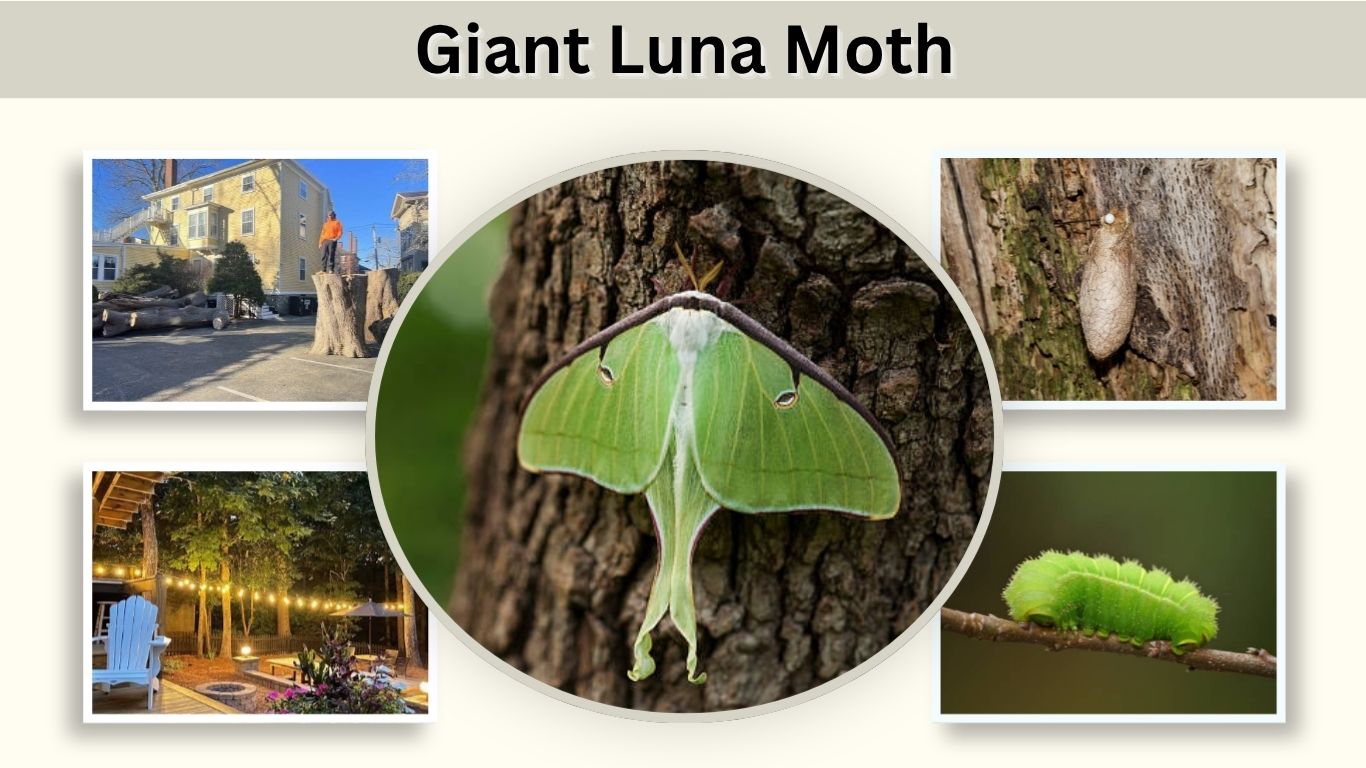
The giant Luna moth, scientifically known as Actias luna, is one of the most striking large moths found in North America. With pale green wings, long hindwing tails, and distinctive eyespots, it belongs to the giant silk moth family, Saturniidae. Despite the phrase “giant Luna moth,” it is not a separate species from the regular Luna moth. The word “giant” simply describes its impressive size and appearance.
Adult Luna moths can reach around 3 to 4 inches across, while their caterpillars grow into thick, bright green larvae before forming a cocoon and transforming into adults.
What Is a Giant Luna Moth?
A giant Luna moth is simply a Luna moth, Actias luna, one of the better-known members of the giant silk moth family.
The adult has broad pale green wings, long curved tails, and eyespots on all four wings. These features give the insect a dramatic appearance, particularly when it is resting with its wings fully spread.
Unlike many smaller moths, Luna moths are large enough to cover much of an adult person’s palm.
Giant Luna Moth Identification
Look for these features:
- Pale lime-green wings
- Wingspan of roughly 3–4 inches
- Long tails extending from the hindwings
- Circular eyespots on each wing
- White or pale fuzzy body
- Pinkish, reddish, or purplish wing margins
- Large feathery antennae
- No functional mouthparts in the adult stage
Adult Luna moths live only long enough to reproduce. They rely on energy stored during the caterpillar stage rather than feeding as adults.
How Big Is a Giant Luna Moth?
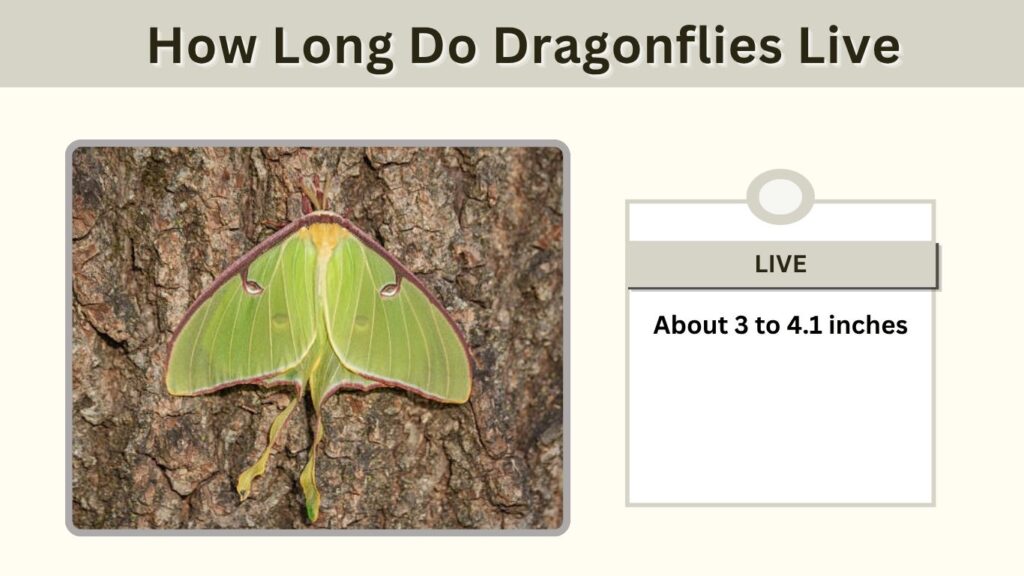
An adult Luna moth generally has a wingspan of about 3 to 4.1 inches, although some descriptions give slightly larger maximum measurements.
That size makes it considerably larger than the small brown or gray moths commonly seen around household lights.
Giant Luna Moth Size Comparison
A Luna moth with fully extended wings can be approximately as wide as:
- An adult palm
- A small smartphone
- A large index card
- Several common garden moths placed side by side
The long tails also make the moth appear larger than its measured wingspan.
Although Luna moths are large, they are not the world’s largest moths. Some tropical moth species can reach substantially greater wingspans.
Giant Luna Moth Caterpillar
The giant Luna moth caterpillar is almost as impressive as the adult.
A mature caterpillar is thick, bright green, and generally about 2.5 to 3 inches long.
What Does a Giant Luna Moth Caterpillar Look Like?
Identification features include:
- Bright green body
- Thick, rounded appearance
- Small raised bumps
- Sparse hairs
- Yellowish lines along the sides
- Occasional red or orange spots
- Green head
- No large rear horn
The lack of a prominent horn helps distinguish Luna moth caterpillars from tomato and tobacco hornworms.
Luna Moth Giant Green Caterpillar
People who find an unusually large green caterpillar on a tree sometimes identify it as a “Luna moth giant green caterpillar.”
That can be correct, but several other giant silk moth caterpillars are also green.
Luna moth caterpillars commonly feed on trees such as:
- Hickory
- Walnut
- Sweetgum
- Birch
- Pecan
- Persimmon
Host plants can vary geographically.
A caterpillar’s plant, body markings, bumps, and overall shape should all be considered before identification.
Life Cycle of a Giant Luna Moth
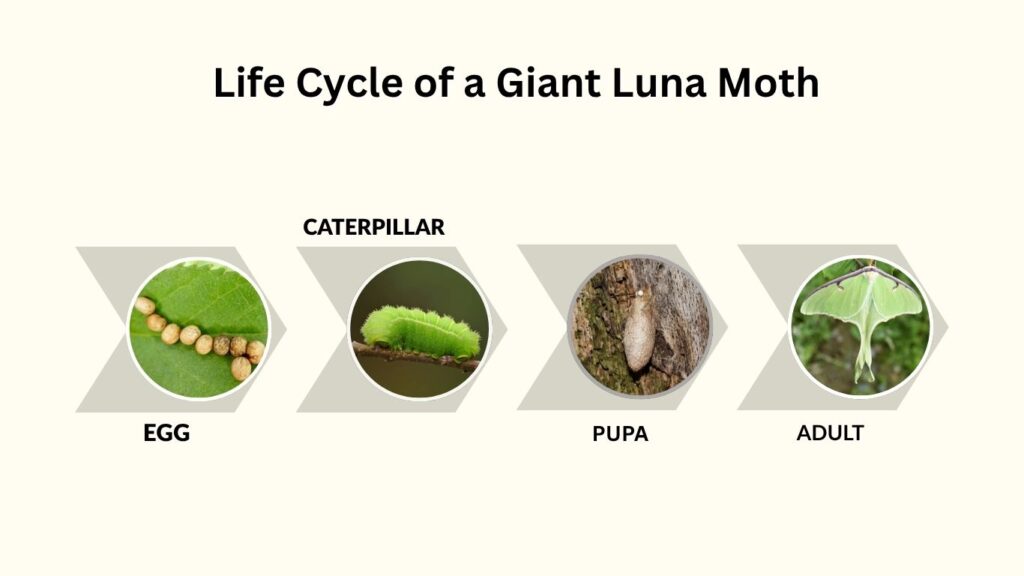
The Luna moth goes through four major stages:
- Egg
- Caterpillar
- Pupa inside a cocoon
- Adult moth
Female Luna moths place eggs on suitable host plants. After hatching, the larvae begin feeding and grow through several stages known as instars.
Caterpillar to Cocoon
Once the caterpillar reaches full size, it stops feeding and begins preparing to pupate.
The larva produces silk and commonly wraps leaves around itself to create a brownish cocoon.
The cocoon may eventually fall with leaves onto the ground, where it can remain hidden among leaf litter.
Inside, the caterpillar transforms into a pupa and eventually into an adult Luna moth.
Adult Stage
After emerging, the adult expands its wings and allows them to harden.
The adult stage is short, often lasting about a week.
Its primary purpose is reproduction. Because adult Luna moths do not eat, they must rely entirely on energy accumulated while they were caterpillars.
Giant Luna Moth in Florida
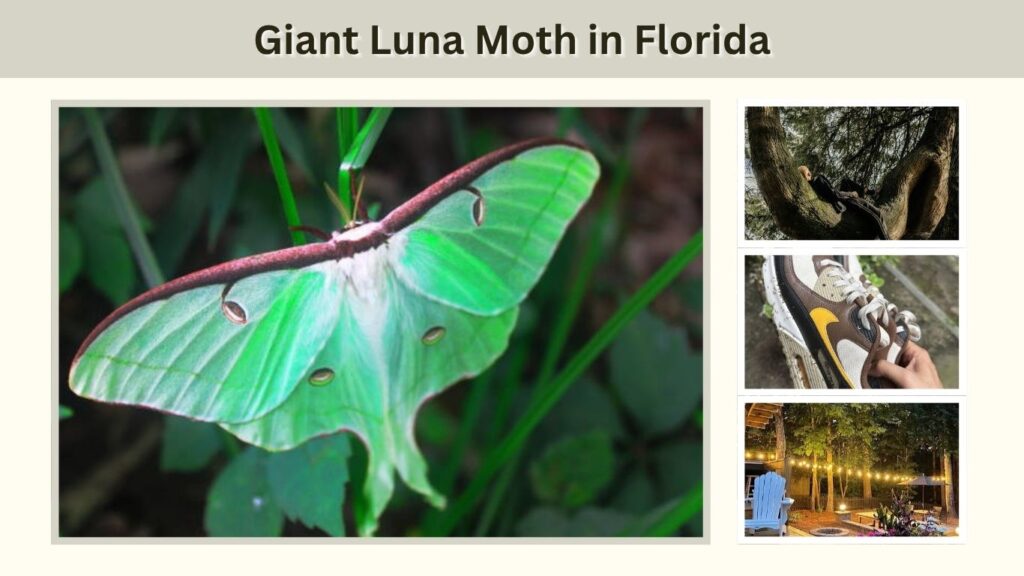
Luna moths can be found in Florida, along with much of eastern North America.
Florida’s warmer climate allows a longer active season than occurs in cooler northern areas.
In warmer regions, Luna moths may produce multiple generations during a year, while northern populations may have fewer.
Where You Might See One
Adult Luna moths are nocturnal and can occasionally be found:
- Near porch lights
- On building walls
- Resting on tree trunks
- Around wooded yards
- Near forest edges
- In areas containing suitable host trees
Because adults are attracted to lights, homeowners sometimes discover one resting near a porch or garage in the morning.
Is There a Giant Yellow Luna Moth?
The normal adult Luna moth is predominantly pale green, not bright yellow.
However, coloration can vary.
Some individuals may appear yellow-green because of:
- Natural variation
- Lighting
- Camera settings
- Age
- Fading after death
- Environmental conditions
Therefore, the phrase giant yellow Luna moth often refers to an unusually yellow-looking Luna moth rather than a separate species.
Giant Yellow Luna Moth Caterpillar
The caterpillar is normally green as well.
A caterpillar can sometimes look yellowish-green during particular developmental stages, especially under strong lighting.
If an insect is strongly yellow and lacks the typical Luna moth features, it may instead be another silk moth species.
Is There a Giant Purple Luna Moth?
A naturally occurring Luna moth is not normally purple.
However, parts of the moth can have reddish, pinkish, or purplish coloration, particularly along the leading edges of the wings.
Photographs, artistic illustrations, fantasy creatures, or edited images can exaggerate this coloration and produce something described as a giant purple Luna moth.
A fully purple Luna moth would therefore not represent the normal coloration of Actias luna.
Luna Moth vs Other Giant Silk Moths
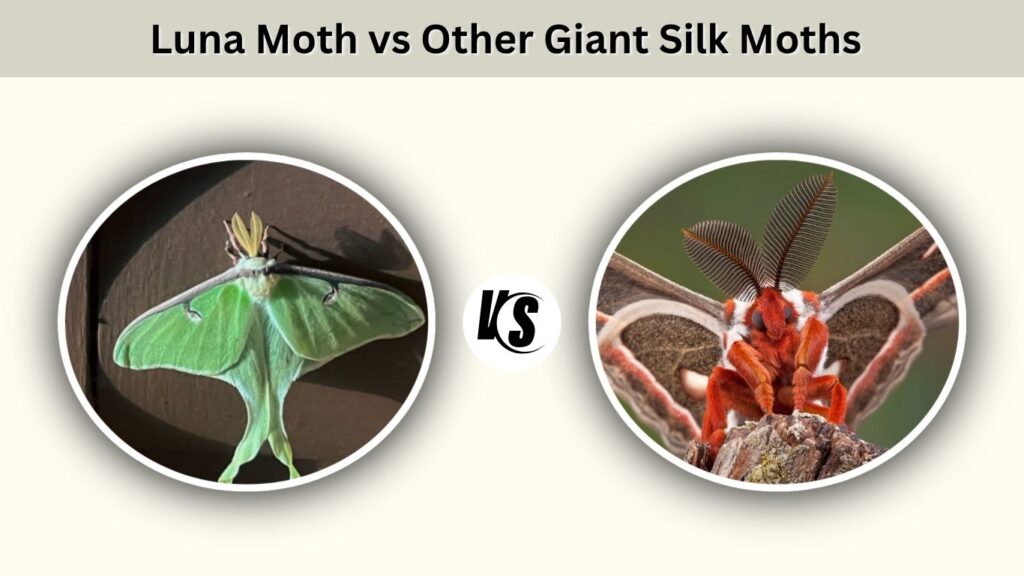
Luna moths belong to Saturniidae, a family containing several impressive large moths.
| Species | General Appearance | Key Feature |
| Luna moth | Pale green | Long hindwing tails |
| Cecropia moth | Red, gray, black and white | Very large patterned wings |
| Polyphemus moth | Brown and tan | Large hindwing eyespots |
| Imperial moth | Yellow and brown | Large irregular patches |
| Promethea moth | Brown, black or reddish | Strong male-female differences |
The long tails and pale green coloration make the Luna moth one of the easiest giant silk moths to recognize.
Why Is It Called a Giant Silk Moth?
Luna moths are classified within the giant silk moth family, Saturniidae.
Members of this family are generally recognized for:
- Large bodies
- Broad wings
- Prominent eyespots
- Large caterpillars
- Silk-producing larvae
The caterpillar creates silk when building its cocoon, which explains the “silk moth” part of the name.
“Giant” refers to the relatively large size of the moths compared with many other moth families.
Giant Luna Moth and Dr. Dolittle
Searches for terms such as “giant lunar moth Dr. Dolittle” or “Dr. Dolittle giant Luna moth” generally relate to fictional giant moth imagery associated with Doctor Dolittle rather than a real separate species.
Real Luna moths are impressive insects, but they do not grow to human-sized proportions.
Movies, fantasy artwork, games, and fictional stories often enlarge recognizable animals or insects for dramatic effect.
Giant Luna Moth vs Giant Lunar Moth
“Luna moth” is the common name generally used for Actias luna.
People sometimes call it a lunar moth, likely because “luna” means moon.
However, “giant lunar moth” can also be used informally when people are referring to large moon moths or Luna moths.
For accurate identification of the North American species, Luna moth is the preferred common name.
Are Giant Luna Moths Dangerous?
No. Luna moths are harmless to people.
Adults do not bite, sting, or feed on humans.
Their large size can be surprising, particularly when they suddenly fly toward a porch light, but they are not aggressive.
The caterpillars also lack the dangerous stinging spines found on some other large caterpillars.
If you encounter one, it is generally best to leave it undisturbed.
Interesting Giant Luna Moth Facts
- The scientific name is Actias luna.
- It belongs to the giant silk moth family.
- Adults are pale green with long hindwing tails.
- The wingspan is commonly around 3–4 inches.
- Adult Luna moths do not eat.
- Caterpillars can grow close to 3 inches long.
- Caterpillars feed on several types of hardwood trees.
- Adults are primarily active at night.
- Males have especially large feathery antennae.
- The long tails may help interfere with bat attacks.
FAQs
Is a giant Luna moth a different species?
No. “Giant Luna moth” normally refers to the standard Luna moth, Actias luna. Luna moths belong to the giant silk moth family, which explains why people often add the word “giant” when describing them.
How large can a giant Luna moth get?
Most adults have a wingspan of roughly 3 to 4 inches, although individual size varies. Their broad wings and extremely long hindwing tails can make them appear larger than their actual wingspan.
What does a giant Luna moth caterpillar look like?
The caterpillar is large, bright green, and thick-bodied. Mature larvae may approach 3 inches in length and have small raised bumps, fine hairs, yellowish markings, and sometimes reddish spots along their sides.
Are yellow Luna moths real?
Luna moths are normally pale green, although some individuals may appear yellow-green. Lighting, photography, age, and natural color variation can make a Luna moth look more yellow than usual.
Can you find giant Luna moths in Florida?
Yes. Luna moths occur in Florida and many other parts of eastern North America. Florida’s warm climate can support a relatively long Luna moth season, and adults may occasionally appear around outdoor lights near wooded areas.