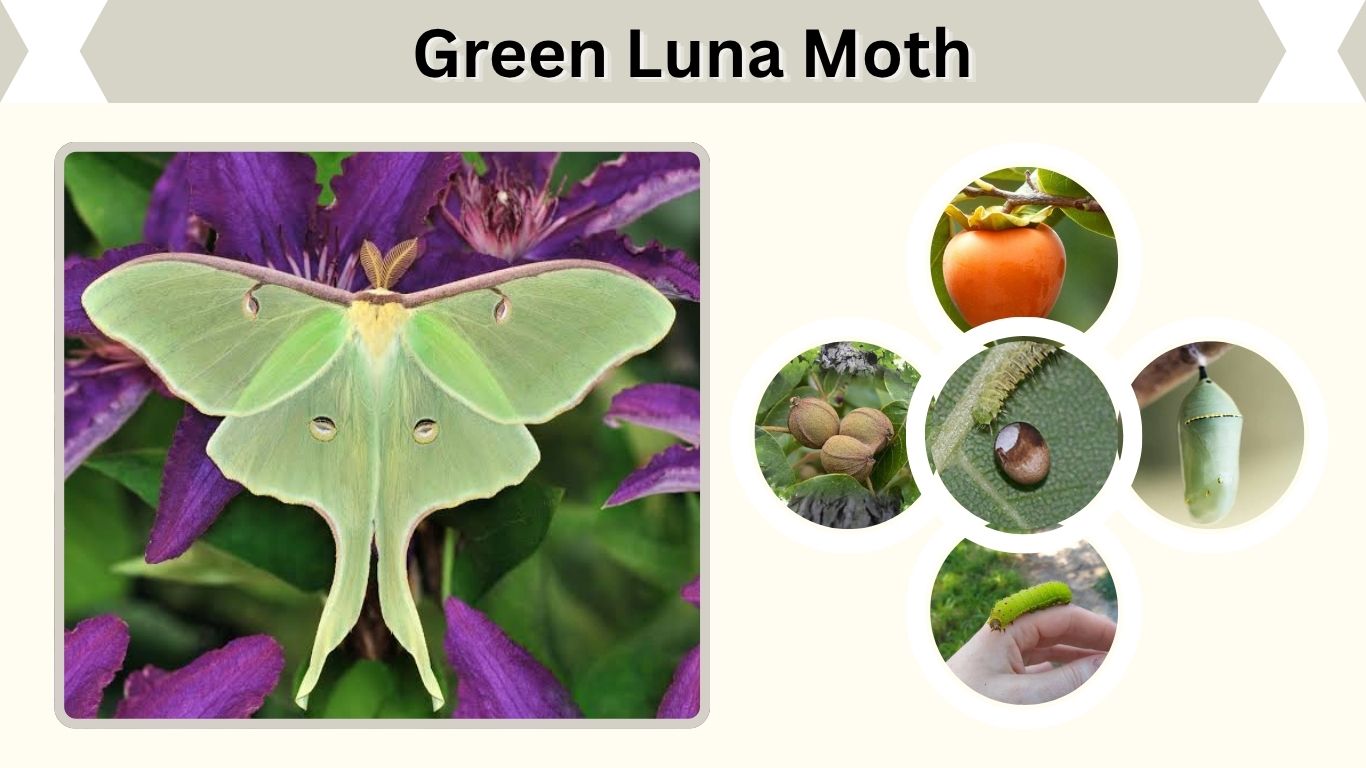
The green luna moth is one of North America’s most recognizable insects. Its large pale-green wings, transparent eyespots, feathery antennae, and long hindwing tails give it an almost magical appearance. Scientifically known as Actias luna, this nocturnal moth belongs to the giant silkworm moth family. Although the adult is impressive, it lives for only a few days and cannot eat. Its earlier stages include a large green caterpillar and a leaf-wrapped cocoon hidden near the ground.
What Is a Green Luna Moth?
“Green luna moth,” “luna green moth,” and “green lunar moth” are common names used for Actias luna. It is a native North American giant silkworm moth found mainly in deciduous forests.
Its range extends through eastern North America, from southern Canada to Florida and west toward eastern Texas and the Great Plains. Luna moths are generally associated with woodlands containing the trees their caterpillars need for food.
| Feature | Green luna moth |
| Scientific name | Actias luna |
| Family | Saturniidae |
| Adult wingspan | About 3–4¼ inches |
| Adult color | Pale, lime, mint, or blue-green |
| Caterpillar color | Bright green |
| Activity | Primarily nocturnal |
| Adult diet | None |
| Adult lifespan | Roughly 4–7 days |
Green Luna Moth Identification
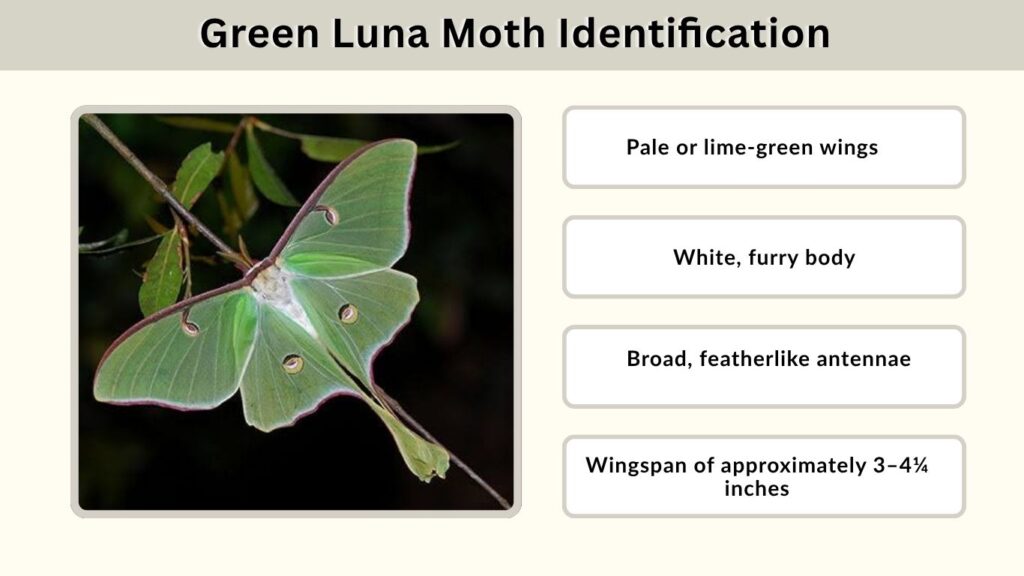
An adult luna moth is relatively easy to recognize because few North American moths combine its green color, eyespots, and exceptionally long tails.
Key Characteristics
Look for:
- Pale or lime-green wings
- One transparent eyespot on each wing
- Long, curved tails extending from the hindwings
- White, furry body
- Dark leading edges on the front wings
- Broad, featherlike antennae
- Wingspan of approximately 3–4¼ inches
The antennae can help distinguish the sexes. Males usually have broader, more feathered antennae for detecting female pheromones. Females generally have narrower antennae and fuller abdomens containing eggs.
Are All Luna Moths Green?
Adult luna moths are characteristically green, but the exact shade varies. Individuals may appear lime green, mint green, pale green, yellow-green, or slightly blue-green.
Spring adults may have deeper green wings with reddish-purple or pink outer margins. Later generations can appear more yellowish-green with yellow edges. Females are sometimes described as more blue-green, while males may look more yellow-green.
Therefore, a pink-and-green luna moth is usually a normal color variation rather than a separate species.
Green Luna Moth Caterpillar
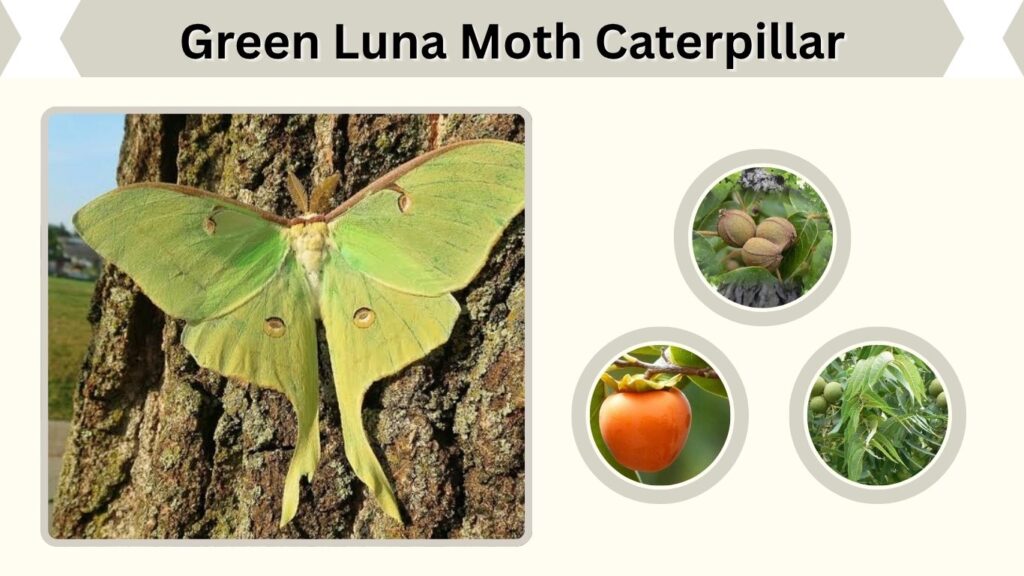
The luna moth begins life as a tiny egg before becoming a large green caterpillar. A full-grown caterpillar commonly measures about 2⅛–2¾ inches, although some may approach 3½ inches.
How to Identify the Caterpillar
A mature luna moth caterpillar generally has:
- A thick, bright-green body
- Narrow yellow lines across the body segments
- A pale stripe along each side
- Small reddish, pink, or yellow raised spots
- Sparse short hairs
- A green or brownish head
Young caterpillars look somewhat different from mature larvae. They pass through five growth stages called instars, shedding their skin between each stage. Shortly before making a cocoon, the green caterpillar may become reddish or brownish and begin wandering away from its feeding area.
What Does a Luna Moth Caterpillar Eat?
The caterpillar feeds on the leaves of broadleaf trees. Common host plants include:
- Hickory
- Walnut
- Pecan
- Sweetgum
- Persimmon
- Sumac
- White birch
Host preferences can vary geographically. Northern populations commonly use white birch, while southern populations frequently use walnuts, hickories, sweetgum, sumac, and persimmon. The caterpillars are solitary and rarely become numerous enough to cause significant tree damage.
Green Luna Moth Cocoon
After completing its caterpillar stage, the luna moth spins a thin, single-layered silk cocoon. The caterpillar usually wraps leaves around the cocoon, providing camouflage.
Unlike cocoons that remain firmly attached to branches, luna moth cocoons often fall to the ground with autumn leaves. They may remain hidden in leaf litter throughout winter before the adults emerge in spring. In warmer regions, several generations may develop during one year.
Avoid removing or burning all fallen leaves beneath host trees. Some may contain overwintering luna moth cocoons and other beneficial insects.
Green Luna Moth Life Cycle
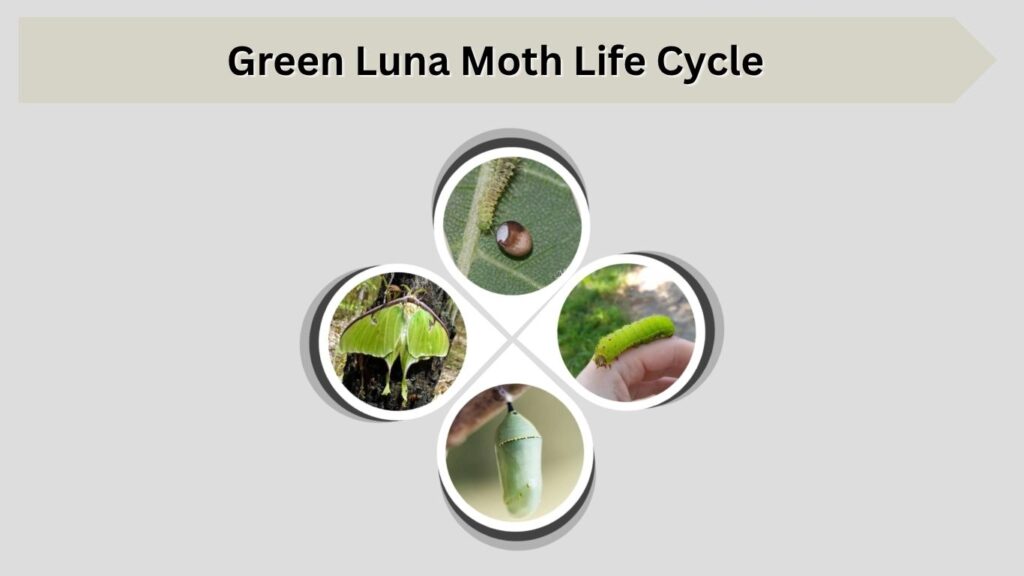
A luna moth undergoes complete metamorphosis through four main stages:
- Egg: A female deposits eggs singly or in small groups on suitable host plants.
- Caterpillar: The larva feeds on leaves and grows through five instars.
- Cocoon and pupa: The mature caterpillar spins a cocoon among leaves.
- Adult moth: The adult emerges, expands its wings, mates, and lays eggs.
Eggs commonly hatch in about 8–13 days. Caterpillar development from hatching to pupation takes around a month or longer, depending on temperature and other environmental conditions.
How Long Does an Adult Luna Moth Live?
The adult stage is remarkably brief, usually lasting only about four days to one week. Adult luna moths have reduced, nonfunctional mouthparts, so they cannot eat or drink. They survive entirely on energy stored during the caterpillar stage.
Their limited adult life is devoted to finding a mate and reproducing. Females release pheromones at night, and males use their sensitive antennae to locate them.
Why Does the Luna Moth Have Long Tails?
The long hindwing tails are not purely decorative. Research indicates that their twisting movement can interfere with the echolocation used by hunting bats.
A bat may direct its attack toward the moving tail rather than the moth’s body. Damage to a tail may allow the moth to escape an otherwise fatal encounter.
The eyespots may also distract or startle predators, while the green wings provide camouflage among leaves.
Is a Green Moth Always a Luna Moth?
No. Several insects may appear green, but a true luna moth has a distinctive combination of four eyespots and two long hindwing tails.
A large green moth without tails may be another giant silkworm moth or a sphinx moth. Luna moth caterpillars can also be confused with Polyphemus moth caterpillars. On a luna caterpillar, the yellow markings generally occur near the rear edge of each body segment; on a Polyphemus caterpillar, they are positioned closer to the middle.
Green Luna Moth Meaning and Symbolism
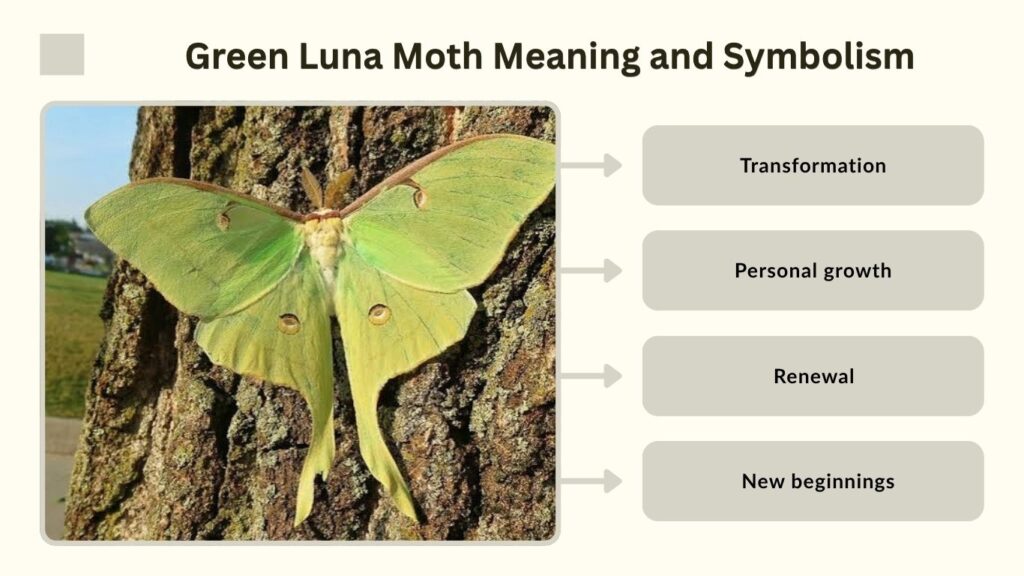
The scientific name and common name refer to the moon-like markings on the wings. The word “luna” means moon, which contributes to the moth’s association with nighttime and lunar imagery.
In artwork, tattoos, and popular symbolism, the green luna moth is often associated with:
- Transformation
- Personal growth
- Renewal
- New beginnings
- Intuition
- The brief nature of life
- Moving through darkness toward change
These are cultural interpretations rather than scientifically established meanings. A luna moth appearing near a home normally means suitable habitat, seasonal activity, or attraction to outdoor lights—not a supernatural event.
What Should You Do After Finding One?
A resting luna moth should generally be left where it is. Newly emerged adults require several hours to expand and harden their wings. Handling can remove wing scales or damage the delicate tails.
Reduce unnecessary outdoor lighting at night, avoid broad pesticide use, preserve native host trees, and leave some natural leaf litter beneath trees. Artificial nighttime lighting may disrupt the moth’s ability to find mates.
FAQs
Is a green luna moth rare?
Luna moths are widely distributed in eastern North America, but adults are not seen often because they are nocturnal and live for only a few days. Their green camouflage also makes them difficult to notice while resting among leaves.
Does a green luna moth bite?
No. Adult luna moths cannot bite because they have nonfunctional mouthparts. They cannot eat, sting, or harm people. Their large size may appear intimidating, but they are harmless and should be handled as little as possible.
What does a pink-and-green luna moth mean?
Pink or reddish-purple wing edges are a normal feature of some luna moths, particularly adults from spring generations. The coloration does not indicate that the moth is poisonous, diseased, or a different species.
Where do luna moths go during the day?
Adults usually rest on tree trunks, walls, vegetation, or other sheltered surfaces during daylight. Their activity increases after dark, when males search for females and females seek appropriate places to lay eggs.
Why did I find a luna moth near a light?
Luna moths are strongly attracted to artificial light, particularly ultraviolet wavelengths. Porch lights and other bright nighttime lighting can draw them away from normal mating activity. Turning unnecessary lights off can reduce this disturbance.