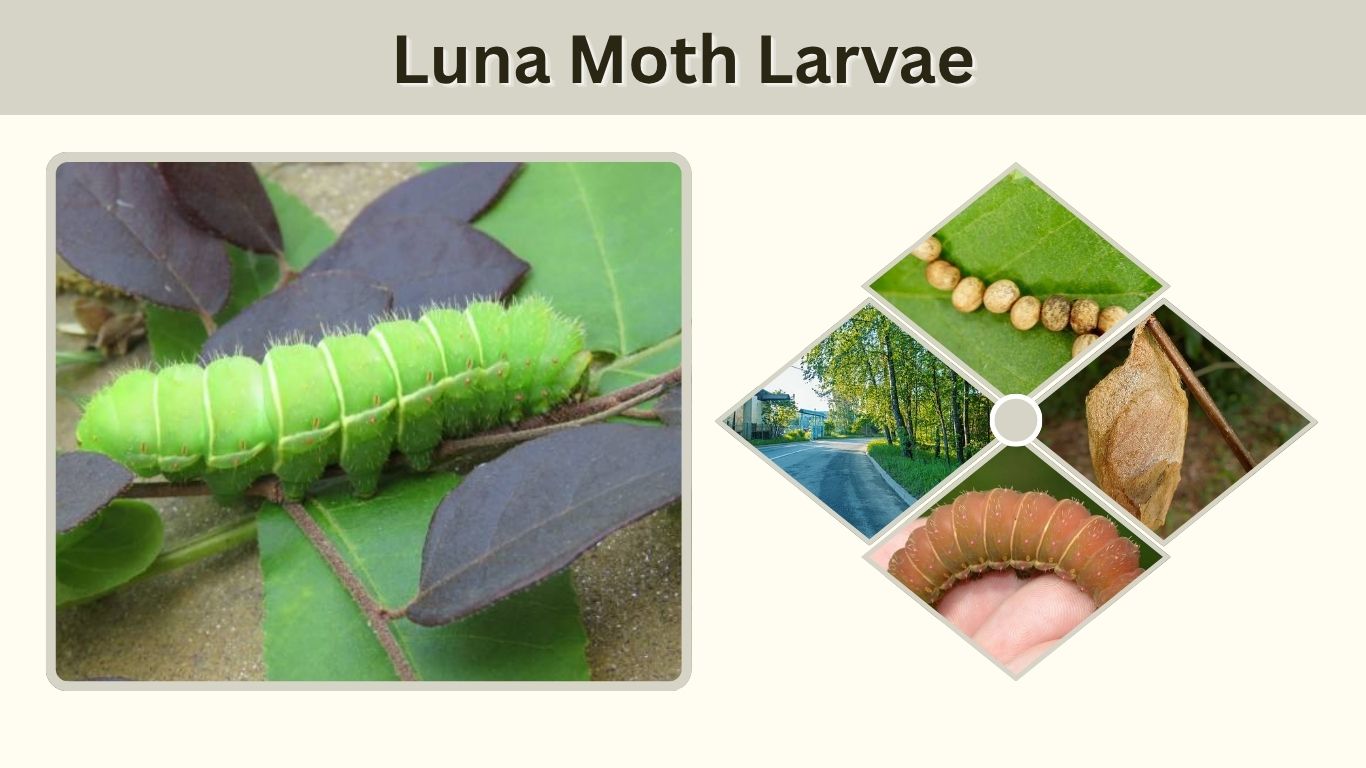
Luna moth larvae are the caterpillar stage of the Luna moth (Actias luna), one of North America’s most recognizable giant silk moths. They begin life as tiny caterpillars and eventually grow into thick, bright green larvae that can reach nearly 3 inches long. During this stage, their main job is to eat, grow, and store enough energy for metamorphosis.
Luna moth larvae feed primarily on the leaves of certain hardwood trees, pass through several growth stages, and eventually spin a silk cocoon before becoming adults.
What Do Luna Moth Larvae Look Like?
Young Luna moth larvae look quite different from mature caterpillars. Newly hatched larvae are tiny and may appear dark, yellowish, or pale green before becoming progressively greener as they grow.
Fully developed larvae are generally bright green with thick, segmented bodies.
Luna Moth Larvae Identification
Common characteristics include:
- Bright lime-green body
- Thick, rounded shape
- Small raised bumps on body segments
- Sparse fine hairs
- Thin yellowish lines along the sides
- Occasional reddish or orange spots
- Green head
- No prominent tail horn
- Around 2.5–3 inches long when mature
Their green coloration gives them excellent camouflage while feeding among leaves.
Luna Moth Larvae Stages
Luna moth larvae pass through several developmental stages known as instars.
An instar is the period between molts. Because a caterpillar’s outer skin cannot continuously expand, the larva periodically sheds it and grows a larger one.
First Instar
Newly hatched larvae are very small and begin feeding soon after emerging from their eggs.
Their coloration may initially be darker than that of mature caterpillars.
Middle Instars
During the middle stages, the caterpillars become noticeably greener and larger.
They spend most of their time eating leaves and resting on their host plant.
Final Instar
The final instar produces the familiar large green Luna moth caterpillar.
At this point, the larva has a thick body and strong green coloration. Once fully grown, it eventually stops feeding and prepares to pupate.
How Big Are Luna Moth Larvae?
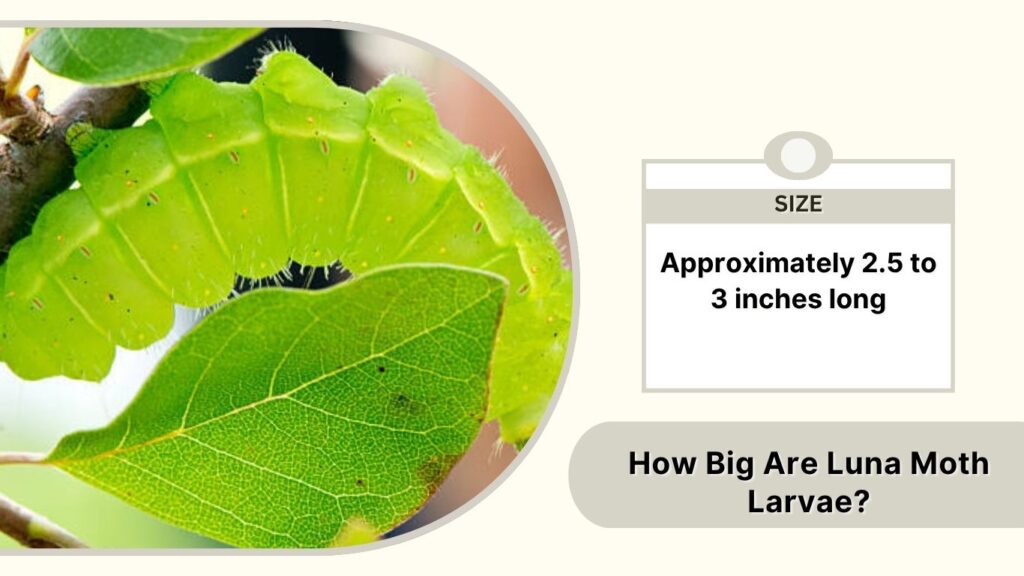
A fully grown Luna moth larva usually reaches approximately 2.5 to 3 inches long.
Young larvae, however, are only a fraction of that size.
| Development Stage | Approximate Appearance |
| Newly hatched larva | Tiny, only several millimeters long |
| Early instars | Small and slender |
| Middle instars | Increasingly green and thick |
| Mature larva | Around 2.5–3 inches |
| Pupa | Compact and enclosed in a cocoon |
Growth can vary depending on temperature, food availability, genetics, and overall health.
What Do Luna Moth Larvae Eat?
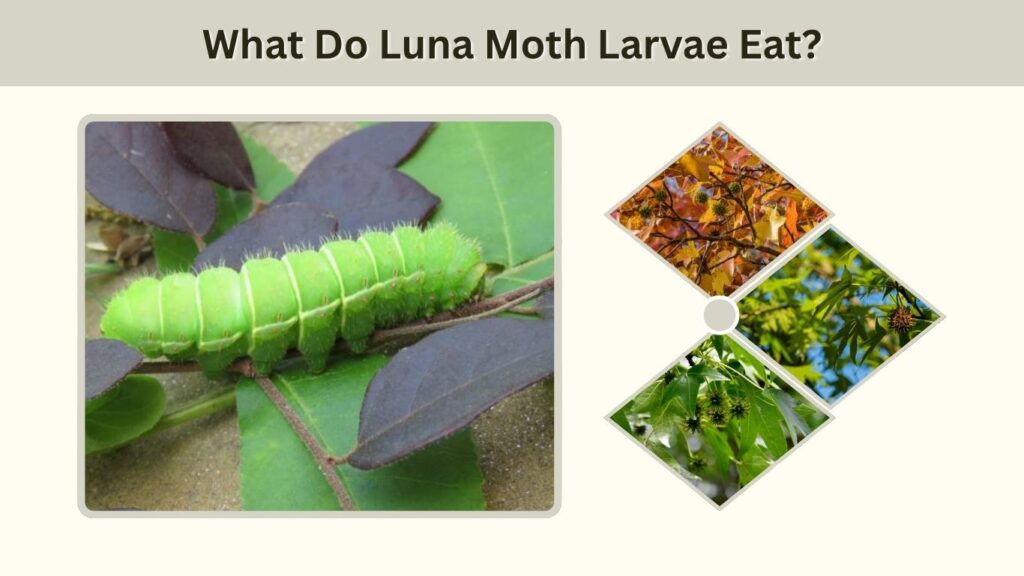
Luna moth caterpillars feed exclusively during the larval stage. Adults do not eat, making the caterpillar’s feeding period extremely important.
The larvae consume leaves from several species of deciduous trees.
Luna Moth Larvae Food
Common host plants include:
- Walnut
- Hickory
- Sweetgum
- Birch
- Pecan
- Persimmon
The exact preferred foliage can differ depending on geographic location.
One important point is that Luna moth caterpillars may become accustomed to the plant species they begin eating. Switching to an entirely different host plant later can sometimes result in poor feeding.
How Much Do Luna Moth Larvae Eat?
Young caterpillars eat relatively small amounts.
As they grow, their appetite increases dramatically. Mature larvae can consume considerable amounts of foliage while preparing for pupation.
You may notice irregular holes, missing leaf edges, or partially eaten leaves on host plants.
Despite their appetite, Luna moth caterpillars rarely become serious pests in ordinary backyard situations.
Luna Moth Larvae Habitat
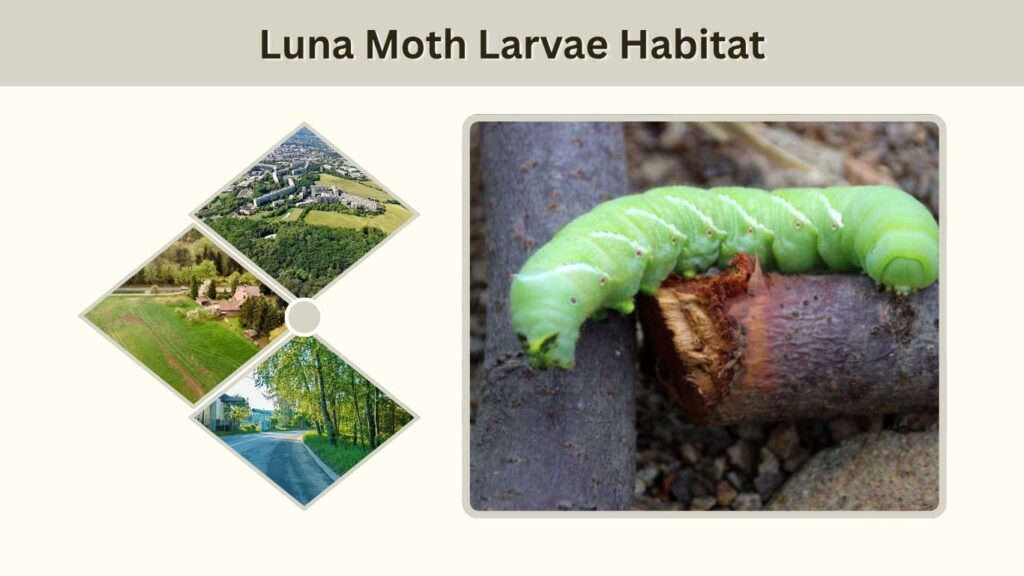
Luna moth larvae live primarily on the trees and shrubs that provide their food.
They are generally associated with wooded habitats containing suitable hardwood trees.
Typical environments include:
- Deciduous forests
- Woodland edges
- Wooded suburban areas
- Parks
- Large gardens
- Areas containing walnut, hickory, sweetgum, or birch trees
Their bright green coloring helps them disappear visually among foliage.
How Long Does a Luna Moth Larva Live?
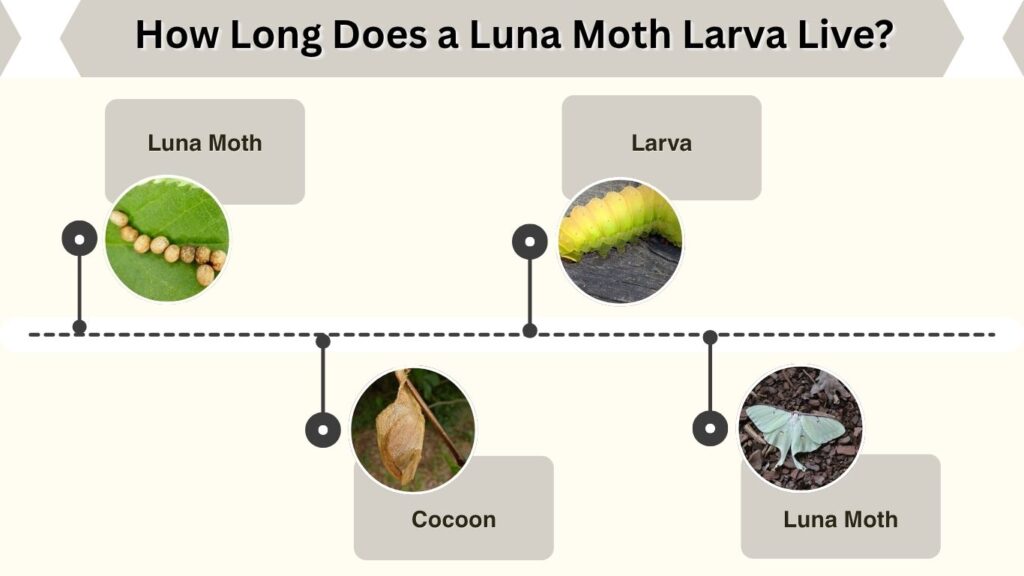
The caterpillar stage generally lasts several weeks, depending on temperature, climate, food quality, and geographic location.
During warmer conditions, larvae typically develop faster. Cooler weather can slow their growth.
The overall sequence is:
Egg → Larva → Cocoon/Pupa → Adult
Once the caterpillar reaches maturity, it stops eating and begins preparing its cocoon.
How Long Does It Take Luna Moth Larvae to Mature?
Luna moth larvae generally need around four to six weeks to progress from newly hatched caterpillars to mature larvae under favorable conditions.
Development is not identical for every caterpillar.
Factors that influence growth include:
- Temperature
- Quality of foliage
- Humidity
- Genetics
- Health
- Population density
- Geographic location
A caterpillar that is actively eating and regularly molting is usually progressing normally.
Luna Moth Larvae Care
People sometimes raise Luna moth caterpillars to observe their life cycle.
Captive care requires clean conditions, fresh host foliage, good ventilation, and careful handling.
Feeding Luna Moth Larvae
Provide fresh leaves from a suitable host plant.
Whenever possible, continue using the same type of foliage the caterpillar was already eating.
Leaves should be:
- Fresh
- Free of pesticides
- Free of chemical sprays
- Clean
- Replaced before becoming dry or wilted
Avoid collecting foliage from areas that may have been treated with insecticides.
Keeping the Enclosure Clean
Luna moth larvae produce increasing amounts of waste as they grow.
Remove old leaves and droppings regularly to prevent mold and bacterial buildup.
Good airflow is equally important. A sealed container with excessive moisture can quickly become unhealthy.
Avoid Excessive Handling
Caterpillars should generally be handled as little as possible.
Their bodies are delicate, especially during molting.
If a caterpillar becomes motionless and stops feeding before shedding its skin, disturbing it can cause injury.
Best Temperature Range for Luna Moth Larvae
Luna moth larvae generally do well under moderate room-temperature conditions, roughly in the low-to-mid 70s °F.
Extreme heat should be avoided because it can increase stress and dehydration, while unusually cold conditions may slow development considerably.
Rather than focusing on one exact temperature, aim for:
- Stable moderate temperatures
- Good ventilation
- No direct intense sunlight on the enclosure
- Protection from overheating
- Fresh foliage at all times
Natural seasonal conditions within the Luna moth’s native range are usually a good guide.
Do All Luna Moth Larvae Survive in Captivity?
No. Even under careful conditions, not every caterpillar survives.
Losses can occur because of:
- Disease
- Mold
- Poor ventilation
- Contaminated foliage
- Pesticide exposure
- Dehydration
- Failed molts
- Excessive handling
- Genetic problems
Young larvae can be particularly sensitive.
Good hygiene and suitable food greatly improve their chances, but successful development cannot be guaranteed.
Why Is My Luna Moth Larva Not Eating?
A caterpillar suddenly stopping its feeding does not always mean something is wrong.
It may be preparing to molt.
Before molting, Luna moth larvae can remain still for an extended period. They may attach themselves to a leaf or twig and appear inactive.
A mature caterpillar will also stop eating when it is ready to pupate.
However, prolonged inactivity combined with discoloration, unusual softness, odor, or other abnormalities may indicate poor health.
What Is a Pink Luna Moth Larva?
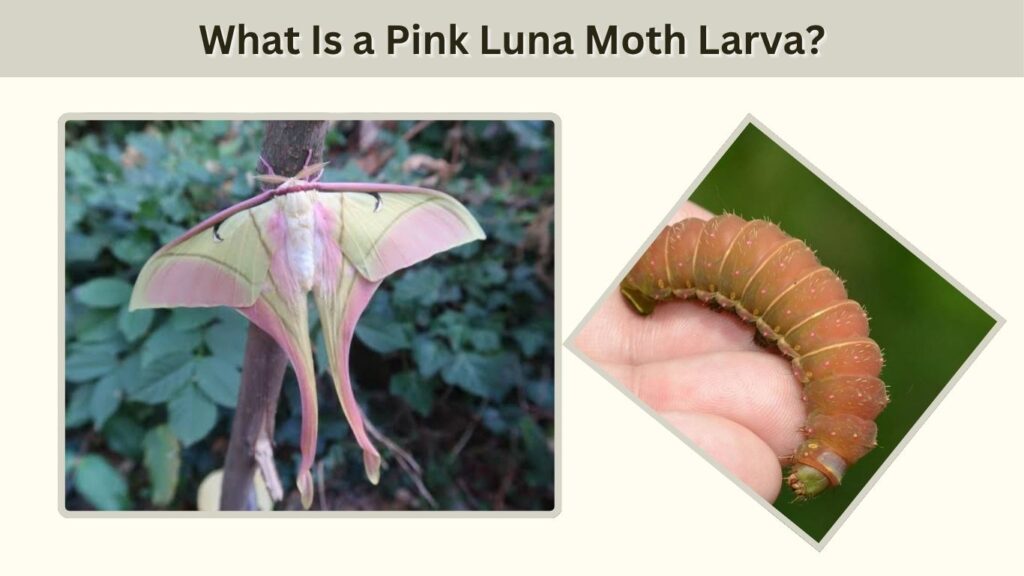
Luna moth caterpillars are normally green, but mature larvae can sometimes develop reddish, pinkish, or brownish coloration shortly before pupation.
This change can surprise people who expect Luna moth larvae to remain green throughout development.
A color change near the end of the caterpillar stage may occur as the larva prepares to leave its feeding location and construct its cocoon.
A pinkish Luna moth larva is therefore not necessarily a separate variety.
From Luna Moth Larva to Cocoon
When the caterpillar finishes growing, it enters the next phase of its life.
It stops feeding and begins producing silk.
The larva often uses nearby leaves while creating its cocoon.
What Happens Inside the Cocoon?
Inside, the caterpillar becomes a pupa.
During pupation, its body undergoes a complete transformation into an adult Luna moth.
When development is complete, the adult emerges with small, soft wings. It pumps fluid into them until they reach their full size.
The resulting moth looks dramatically different from the green caterpillar that entered the cocoon.
Luna Moth Larvae for Sale
Luna moth eggs, caterpillars, cocoons, and livestock are occasionally offered by butterfly or moth breeders.
However, anyone considering keeping Luna moth larvae should first check local regulations because rules involving the transport, sale, or release of native insects can vary by location.
It is also important to obtain specimens responsibly rather than removing large numbers from wild populations.
Interesting Luna Moth Larvae Facts
Luna moth larvae are remarkable even before becoming adults.
- They belong to the giant silk moth family.
- Mature caterpillars can approach 3 inches long.
- Their green color provides natural camouflage.
- They pass through several instars.
- Larvae eat heavily, while adult Luna moths do not eat.
- They feed mainly on hardwood tree foliage.
- Mature larvae produce silk to create a cocoon.
- Their coloration may change before pupation.
- They are not aggressive toward people.
- A caterpillar can transform into an adult with a wingspan of roughly 3–4 inches.
FAQs
Are Luna moth larvae poisonous?
Luna moth larvae are not considered poisonous or dangerously venomous to people. Their small bumps and sparse hairs should not be confused with the large stinging spines found on certain other caterpillar species.
What foliage do Luna moth larvae eat?
They commonly eat leaves from walnut, hickory, sweetgum, birch, pecan, and persimmon trees. Host preference can vary by region, and larvae often do best when allowed to continue feeding on the same plant species they started with.
How large do Luna moth larvae get?
A mature Luna moth caterpillar normally grows to around 2.5–3 inches long. It becomes substantially thicker during its final instar and may look almost finger-sized before preparing to pupate.
Why does a Luna moth larva turn pink?
Some mature larvae develop reddish or pinkish coloration as they approach pupation. This may occur shortly before they stop eating and begin searching for a suitable location to form their cocoon.
How long before Luna moth larvae become moths?
The larval period commonly lasts several weeks. After reaching maturity, the caterpillar forms a cocoon and pupates. The length of the pupal stage varies considerably with temperature, season, and whether the insect overwinters before emerging.