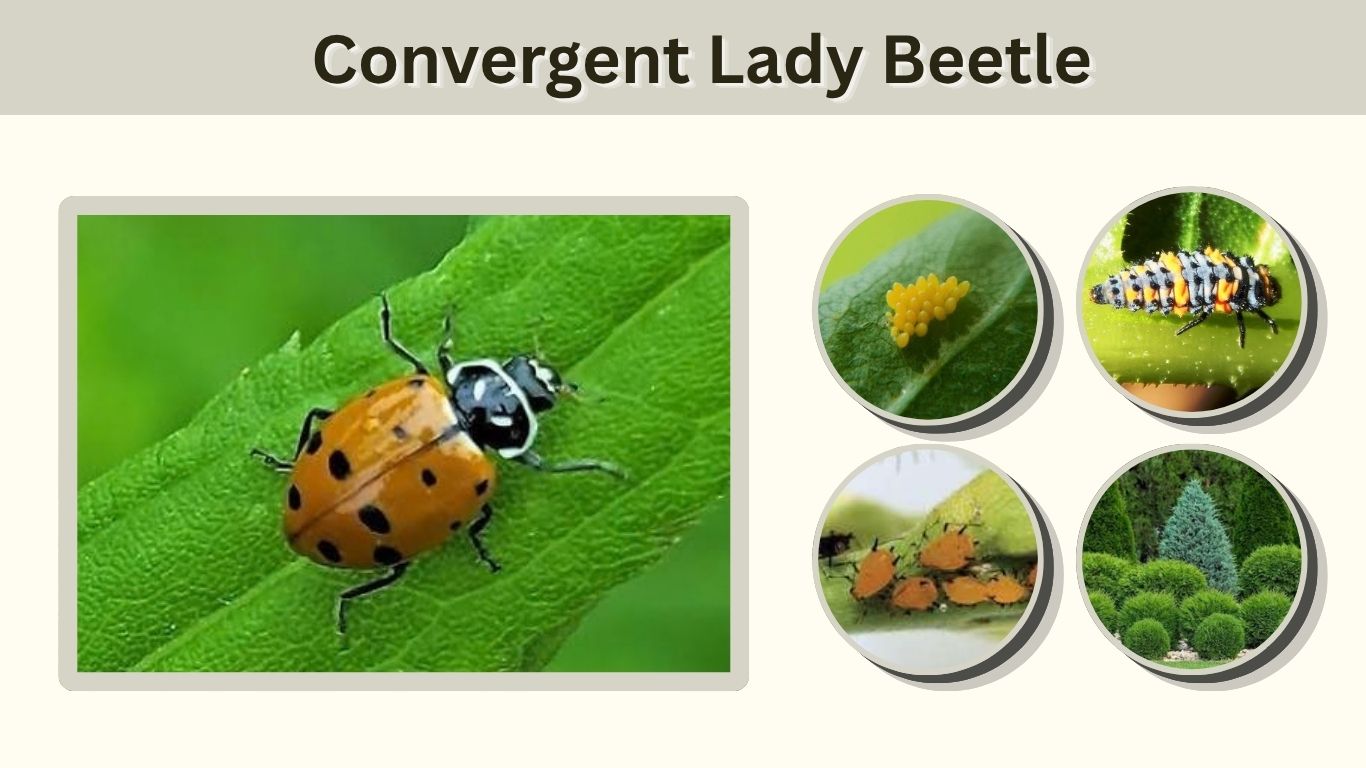
The convergent lady beetle (Hippodamia convergens) is a beneficial insect commonly found in gardens, agricultural fields, and natural habitats across North America. Recognized by its orange-red body, black spots, and distinctive white markings behind its head, this native ladybug plays an important role in controlling aphids and other plant pests. Both adults and larvae feed on soft-bodied insects, making them valuable natural predators. This guide explores convergent lady beetle identification, life cycle, diet, habitat, behavior, and the key differences between convergent and Asian lady beetles.
What Is a Convergent Lady Beetle?
The convergent lady beetle is a predatory beetle belonging to the family Coccinellidae, commonly known as ladybugs or ladybird beetles. It is one of the most recognizable native lady beetles in North America. Its scientific name, Hippodamia convergens, refers to the distinctive white lines behind its head that angle toward one another. The species helps suppress populations of agricultural and garden pests.
Scientific Classification
| Classification | Name |
| Common Name | Convergent Lady Beetle |
| Scientific Name | Hippodamia convergens |
| Kingdom | Animalia |
| Phylum | Arthropoda |
| Class | Insecta |
| Order | Coleoptera |
| Family | Coccinellidae |
| Genus | Hippodamia |
The species is native to the Americas and is especially associated with vegetation supporting aphid populations.
Convergent Lady Beetle Identification
Adult convergent lady beetles have several identifiable features:
- Size: Usually approximately 4–7 mm long.
- Color: Orange to reddish-orange wing covers.
- Black spots: Up to 13 spots, although some individuals have few or none.
- Head: Black with pale markings.
- Thorax: Black with a white border and two converging white lines.
- Body shape: Slightly elongated and oval rather than perfectly round.
- Antennae: Short with clubbed tips.
The converging white markings are particularly useful for identification, although certain closely related Hippodamia species have similar patterns.
Convergent Lady Beetle vs. Asian Lady Beetle
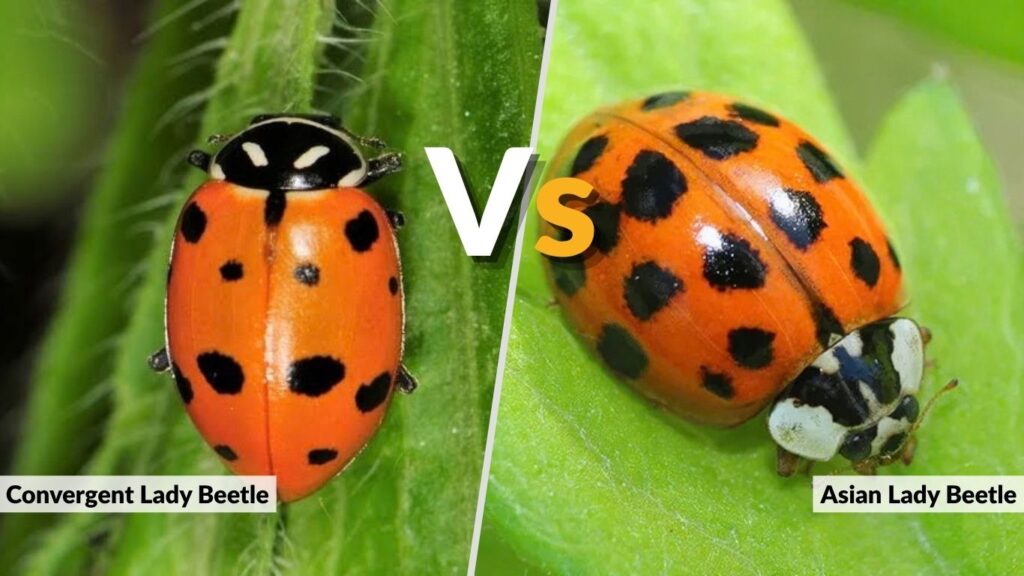
Convergent lady beetles and Asian lady beetles are often confused because both may have red or orange wing covers with black spots. However, they are different species with distinct identification features, geographic origins, and behaviors. Knowing their differences is helpful for gardeners and homeowners, particularly because Asian lady beetles frequently gather around buildings during colder weather.
Key Differences Between the Two Species
Asian Lady Beetle
| Feature | Convergent Lady Beetle | Asian Lady Beetle |
| Scientific name | Hippodamia convergens | Harmonia axyridis |
| Origin | Native to the Americas | Native to Asia |
| Body shape | More elongated oval | Generally rounder |
| Spots | 0–13 | Variable, often up to 19 |
| Thorax marking | Two converging white lines | Often a black M or W |
| Home invasions | Less commonly problematic | Frequently aggregates in buildings |
Spot counts alone are not reliable for identifying either species. The markings directly behind the head are generally more helpful.
Convergent Lady Beetle vs. Ladybug
A convergent lady beetle is a type of ladybug. The terms ladybug, ladybird beetle, and lady beetle refer to members of the same beetle family.
The main distinction is that Hippodamia convergens identifies one particular species, while “ladybug” describes a broad group containing thousands of species worldwide.
Convergent Lady Beetle Life Cycle
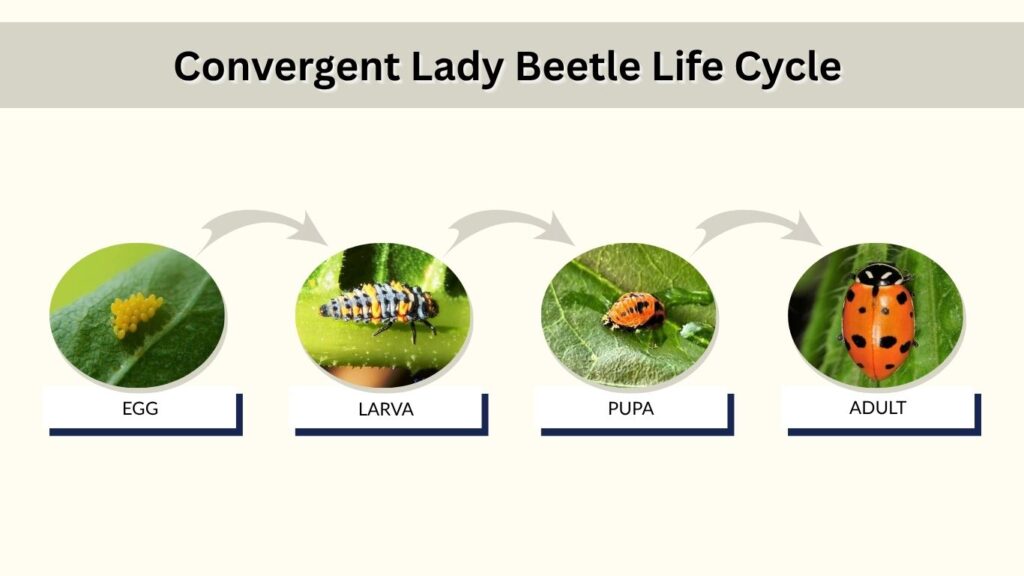
The convergent lady beetle undergoes complete metamorphosis, developing through four stages: egg, larva, pupa, and adult. Each stage looks different and serves a distinct biological purpose. The complete development period depends on temperature, food availability, and environmental conditions. Under favorable laboratory conditions, the transition from egg to adult can take approximately three weeks.
Four developmental stages of the convergent lady beetle.
Eggs and Hatching Time
Female convergent lady beetles lay clusters of approximately 10–30 elongated yellow eggs on leaves and stems, often near aphid colonies.
Under favorable temperatures, the eggs may hatch within three to four days.
Placing eggs near food sources allows young larvae to begin hunting almost immediately after emerging.
Convergent Lady Beetle Larvae
Convergent lady beetle larvae resemble tiny alligators rather than adult ladybugs. Their elongated bodies are primarily dark with orange markings.
Larvae pass through four growth stages called instars. They are active predators and often consume large numbers of aphids as they grow.
Their unusual appearance sometimes causes gardeners to mistake them for harmful insects, although they are beneficial predators.
Pupal and Adult Stages
After completing larval development, the insect attaches itself to a plant surface and transforms into a pupa.
The pupa is typically orange with darker markings. An adult eventually emerges with fully developed wings and reproductive structures.
University of Florida research recorded an average egg-to-adult development time of approximately 21 days at 77°F (25°C) under controlled laboratory conditions.
What Do Convergent Lady Beetles Eat?
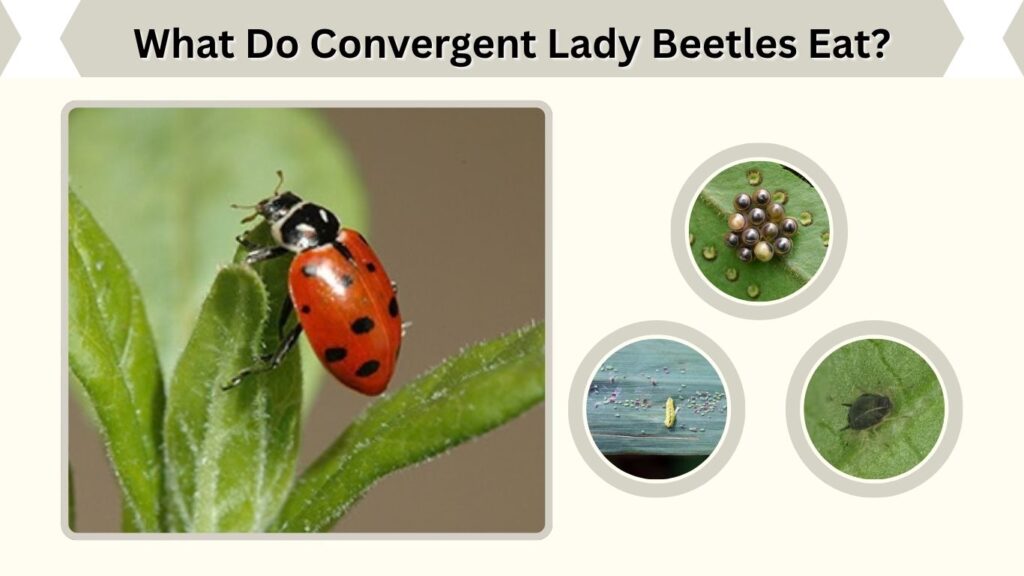
Convergent lady beetles are primarily predators of aphids, making them important natural enemies of insects that damage crops and ornamental plants. Both adults and larvae actively search for prey, often congregating where pest populations are abundant. When aphids become scarce, they may consume other small insects or supplement their diets with nectar, pollen, and honeydew.
Common Food Sources
Their diet includes:
- Aphids: Their primary prey, including species attacking vegetables and flowers.
- Whiteflies: Small, soft-bodied plant-feeding insects.
- Insect eggs: Eggs of several other insects.
- Small larvae: Vulnerable immature insects.
- Nectar and pollen: Supplemental food for adults when prey is limited.
How They Help Control Aphids
Convergent lady beetles can provide valuable biological pest control.
Larger larvae may consume 30–50 aphids daily, while adults may eat even more when prey is abundant.
Their feeding helps reduce aphid pressure on plants such as roses, vegetables, and agricultural crops. However, the effectiveness of natural control depends on predator abundance and pest populations.
Convergent Lady Beetle Habitat and Distribution
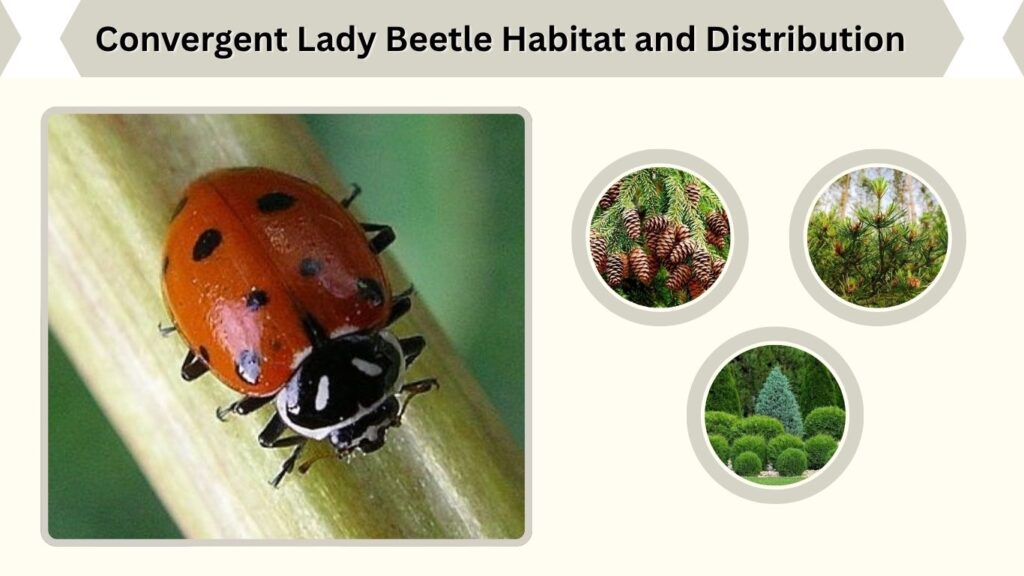
The convergent lady beetle occupies a wide range of environments throughout the Americas. Its distribution includes much of the United States, western Canada, Mexico, and parts of Central and South America. These insects are closely associated with plants supporting aphids, so their presence often changes seasonally according to food availability, weather conditions, and migration patterns.
Where Do Convergent Lady Beetles Live?
They commonly inhabit vegetable gardens, grasslands, agricultural fields, orchards, flowering plants, and other vegetated environments.
Adults are strong fliers and can move between habitats in search of prey.
Their populations may become especially noticeable during periods of heavy aphid activity.
Migration and Winter Shelter
Convergent lady beetles sometimes gather in large groups to survive unfavorable conditions.
In California, many migrate to mountain foothills and protected locations in the Sierra Nevada or Coast Ranges, where they may aggregate during summer or winter dormancy.
Adults subsequently return to lower-elevation feeding habitats when seasonal conditions become favorable.
Are Convergent Lady Beetles Good or Bad?
Convergent lady beetles are generally considered beneficial insects rather than household or garden pests. They help regulate aphid populations without damaging healthy plants. Unlike certain other beetles, they do not feed primarily on leaves or destroy crops. Although they possess defensive mechanisms, they are not considered dangerous to humans under normal circumstances.
Do Convergent Lady Beetles Bite?
Convergent lady beetles have chewing mouthparts and may occasionally nip when handled or trapped.
However, they are not aggressive toward people, and their bites are not generally medically significant.
Like other lady beetles, they may release defensive body fluids when disturbed, which can cause minor irritation in sensitive individuals.
Are Convergent Lady Beetles Poisonous?
They are not venomous and do not inject toxins through a bite.
However, their defensive secretions can taste unpleasant to predators, so they should not be deliberately eaten or handled excessively.
For gardeners, their beneficial pest-control activity greatly outweighs the minor inconvenience they may occasionally cause.
How to Encourage Convergent Lady Beetles in Your Garden
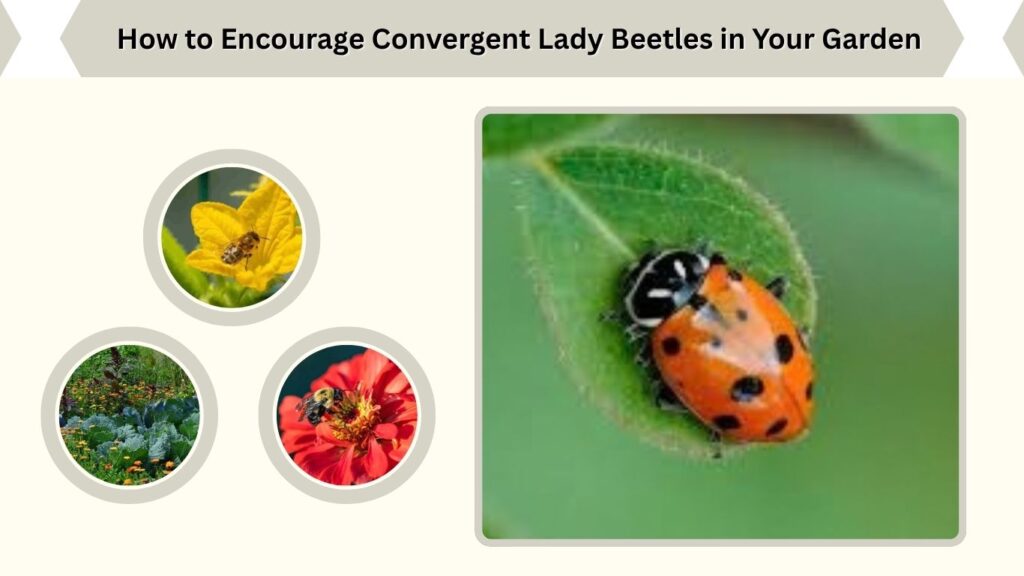
Encouraging native convergent lady beetles is a practical way to support natural pest management. Gardens containing diverse flowering plants, appropriate shelter, and abundant prey are more likely to attract these beneficial insects. Creating a suitable habitat is generally more dependable than releasing large numbers of commercially purchased beetles, which frequently disperse shortly after release.
Ways to Attract Convergent Lady Beetles
- Grow flowering plants: Provide nectar and pollen from flowers suited to your region.
- Reduce broad-spectrum pesticides: Avoid unnecessary treatments that kill beneficial predators.
- Maintain plant diversity: Grow different flowering and vegetable species.
- Manage ants: Ants sometimes protect aphids from predators in exchange for honeydew.
- Preserve suitable shelter: Provide natural vegetation and undisturbed areas where beneficial insects can survive.
Should You Buy Live Convergent Lady Beetles?
Live convergent lady beetles are available through biological-control suppliers, but purchasing them does not guarantee lasting aphid control.
Many commercially sold beetles are collected from natural aggregation sites and may quickly fly away following release.
Cornell University and UC IPM both caution that releasing collected adults may be ineffective because of their tendency to disperse. Encouraging established local populations is often a more sustainable option.
FAQs
Convergent lady beetles attract attention because of their distinctive markings, unusual larval appearance, and ability to control pests. Gardeners also frequently wonder whether they should purchase these insects or simply encourage wild populations. The following questions address important identification, feeding, and behavior concerns for anyone interested in this beneficial beetle species.
1. Are convergent lady beetles beneficial?
Yes. Both adults and larvae consume aphids and other small pests, making them beneficial predators in gardens and agricultural environments.
2. How many spots does a convergent lady beetle have?
Adults can have up to 13 black spots, but the number varies considerably. Some individuals have very few spots or none at all.
3. How long do convergent lady beetles live?
Their lifespan depends on food availability, temperature, and season. Adults may live for several months, and some survive longer through periods of dormancy.
4. Do convergent lady beetle larvae bite humans?
Larvae possess jaws for capturing prey and may occasionally nip when handled, but they are not aggressive toward humans and are not considered dangerous.
5. Can convergent lady beetles fly?
Yes. Adult convergent lady beetles have functional flight wings beneath their hardened wing covers and can travel between plants and habitats searching for food.