
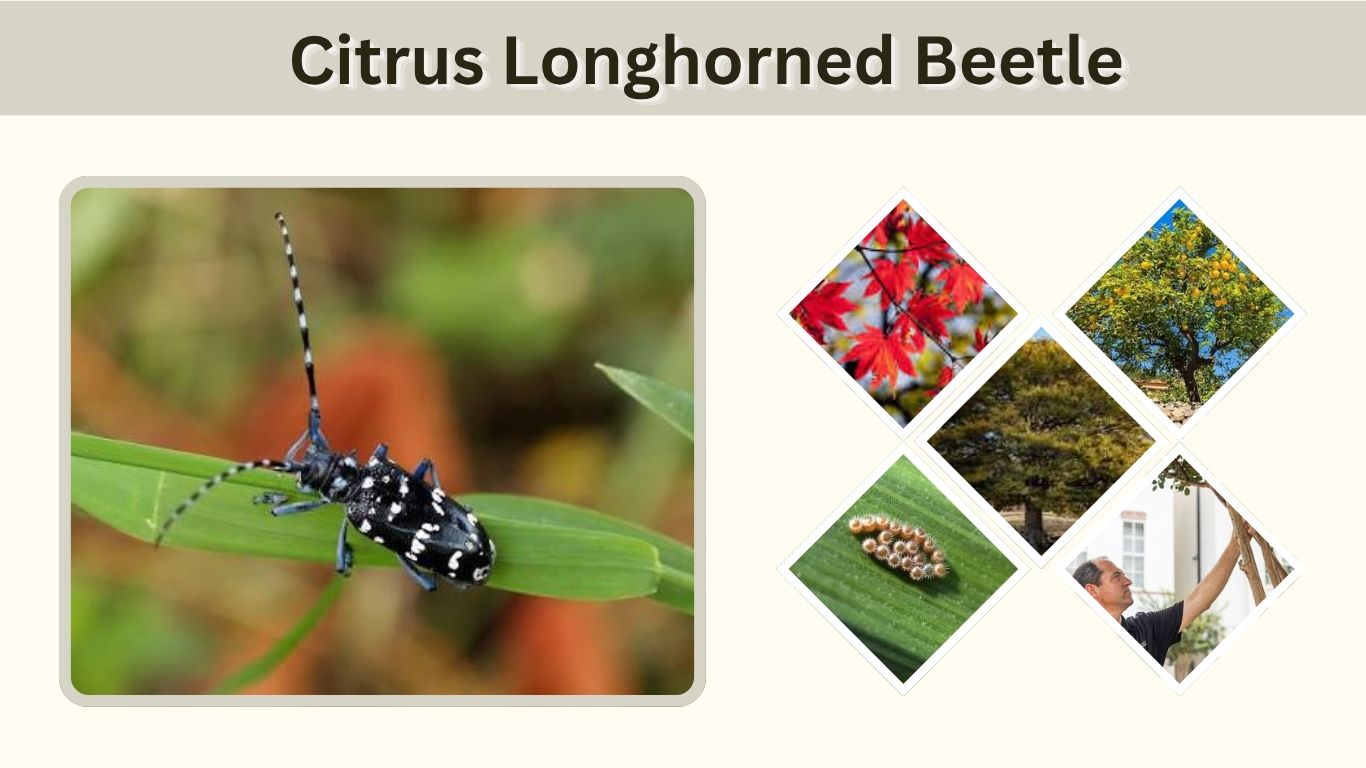
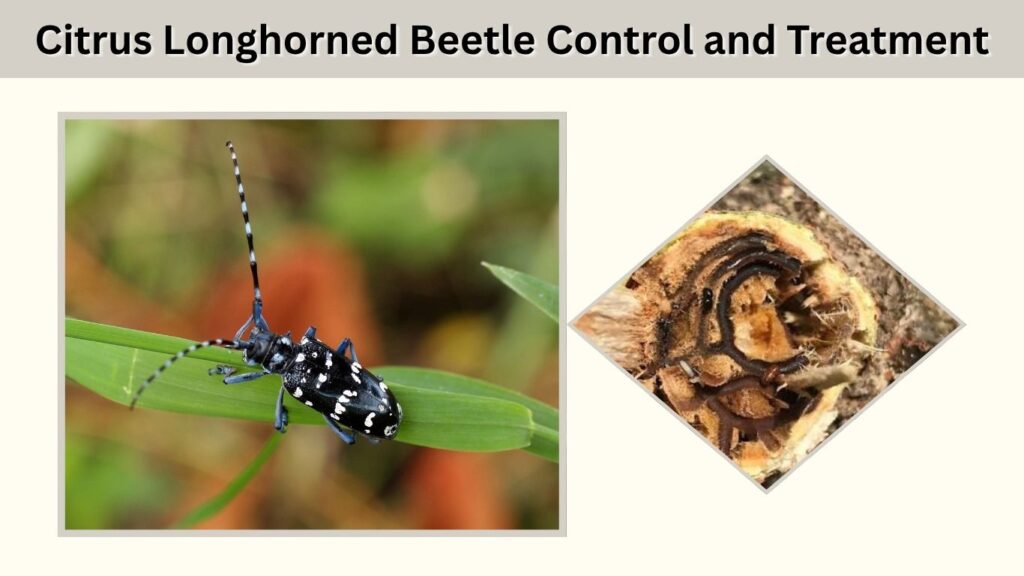
The citrus longhorned beetle (Anoplophora chinensis) is an invasive wood-boring insect known for its glossy black body, white spots, and exceptionally long antennae. Native to Asia, this beetle threatens citrus trees, hardwood forests, and ornamental plants by tunneling through living wood. Its larvae can weaken tree trunks and roots, eventually causing serious damage or death. Understanding citrus longhorned beetle identification, habitat, life cycle, diet, and control methods is essential for protecting vulnerable trees and preventing this destructive pest from spreading.
What Is a Citrus Longhorned Beetle?
The citrus longhorned beetle is a large insect belonging to the Cerambycidae family. It is also known as the citrus root cerambycid or black-and-white longhorned beetle.
Unlike many wood-boring beetles that primarily develop in dead or weakened trees, this species can attack apparently healthy trees.
Its larvae tunnel into woody tissues, damaging the tree’s internal structure and interfering with its normal growth.
Citrus Longhorned Beetle Facts
| Feature | Description |
| Common Name | Citrus Longhorned Beetle |
| Scientific Name | Anoplophora chinensis |
| Family | Cerambycidae |
| Order | Coleoptera |
| Native Range | East and Southeast Asia |
| Adult Size | 21–37 mm |
| Body Color | Glossy black with white spots |
| Diet | Living tree tissues |
| Preferred Hosts | Citrus, maple, apple, and other hardwoods |
| Life Cycle | Egg, larva, pupa, adult |
| Invasive Status | Regulated invasive tree pest |
The beetle is closely related to the Asian longhorned beetle (Anoplophora glabripennis), another invasive species that damages hardwood trees.
Citrus Longhorned Beetle Identification and Appearance
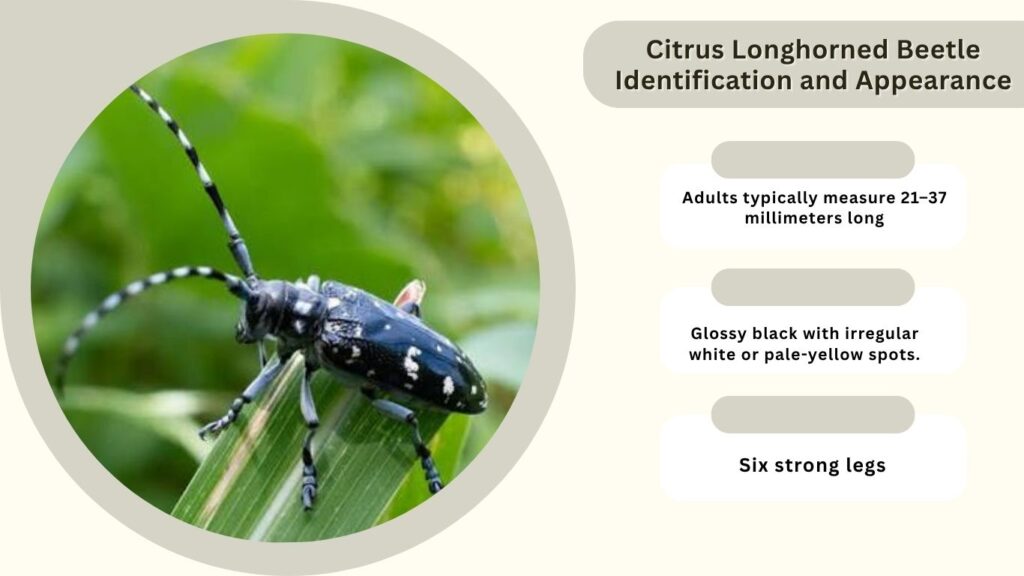
Citrus longhorned beetles have distinctive physical characteristics that make adults recognizable. Their contrasting black-and-white coloring and extremely long antennae are particularly noticeable.
However, several native beetles resemble this species, making careful identification important.
How to Identify a Citrus Longhorned Beetle
Look for these characteristics:
- Body size: Adults typically measure 21–37 millimeters long.
- Body color: Glossy black with irregular white or pale-yellow spots.
- Antennae: Long, segmented antennae featuring alternating black and pale bands.
- Legs: Six strong legs, sometimes with a bluish appearance.
- Wing covers: Hardened black elytra with scattered white markings.
- Thorax: Pronotum with a prominent spine on each side.
Male beetles generally have antennae approximately twice their body length. Females have shorter antennae relative to body size.
Another identifying feature is the rough, granular texture near the base of their wing covers.
Where Do Citrus Longhorned Beetles Live?
Citrus longhorned beetles naturally occur in parts of East and Southeast Asia, including China, Japan, and the Korean Peninsula.
They inhabit forests, citrus orchards, agricultural landscapes, and areas containing suitable hardwood trees.
Citrus Longhorned Beetle Distribution
Their distribution includes several important regions:
- Asia: Native populations occur across parts of East and Southeast Asia.
- Europe: Introduced populations and outbreaks have occurred in several continental European countries.
- United States: Detected in Washington in 2001, but the infestation was eradicated.
- United Kingdom: Individual beetles have been intercepted, but no established outbreak is known.
The species spreads internationally mainly through infested living plants, particularly ornamental trees and bonsai.
According to the USDA National Invasive Species Information Center, the citrus longhorned beetle is not currently established in the United States.
Citrus Longhorned Beetle Life Cycle
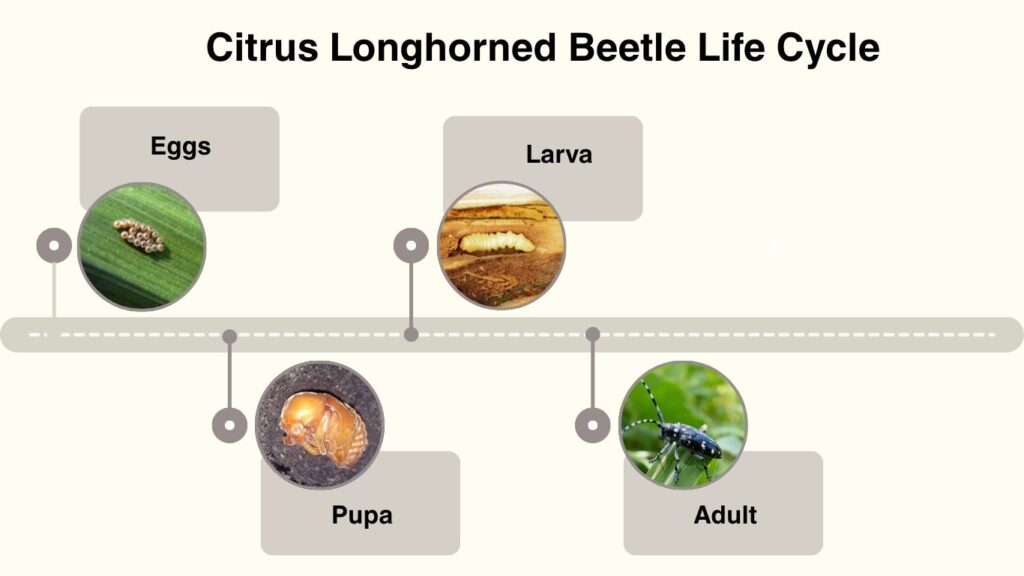
The citrus longhorned beetle undergoes complete metamorphosis, passing through four developmental stages.
Its development generally takes one to two years in parts of its native range, although cooler climates may extend the process considerably.
1. Egg Stage
Female beetles chew small slits into the bark near the base of tree trunks or exposed roots.
They deposit individual eggs beneath the bark, where they remain protected during development.
The eggs are approximately 5–6 millimeters long and generally hatch within one to three weeks.
2. Larval Stage
Newly hatched larvae feed beneath the bark before moving deeper into the tree.
They are creamy white, legless grubs with strong jaws adapted for chewing woody material.
Mature larvae can reach approximately 50–56 millimeters long.
The larval stage causes the greatest damage because the insects create extensive tunnels within trunks and roots.
3. Pupal Stage
After completing larval development, the beetle forms a pupal chamber inside the wood.
During this stage, the insect transforms into its adult form.
Pupation generally lasts four to six weeks, depending on environmental conditions.
4. Adult Stage
Adults emerge through circular exit holes in the bark.
They feed on leaves, twigs, and young bark before mating and laying eggs.
Adult emergence often occurs between April and August in warmer parts of the beetle’s range, although timing varies by climate.
What Do Citrus Longhorned Beetles Eat?
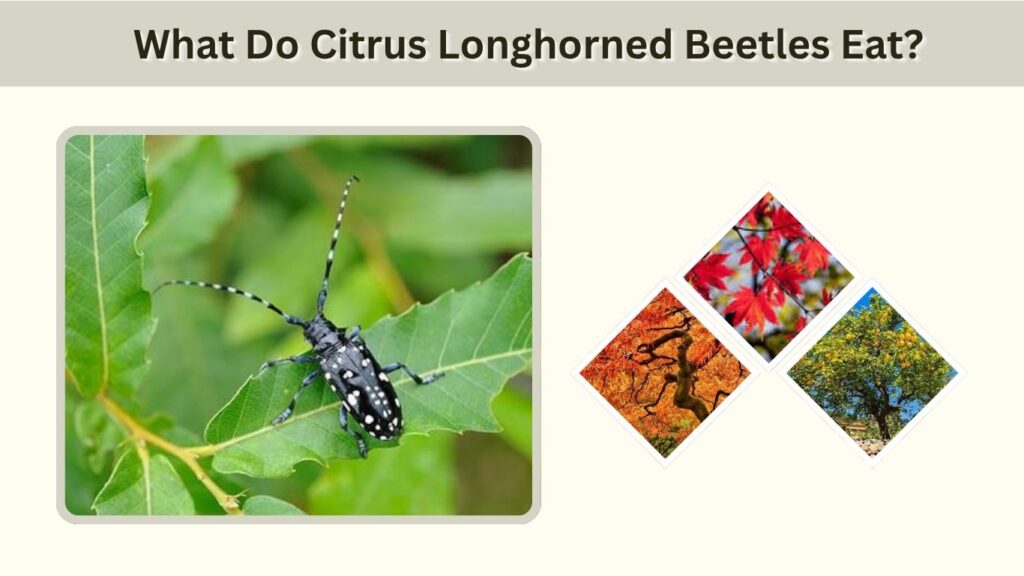
Citrus longhorned beetles feed on a wide variety of living trees and woody plants.
Adults consume leaves, leaf stalks, and tender bark, while larvae feed beneath the bark and inside woody tissues.
Common Citrus Longhorned Beetle Host Trees
Important host plants include:
- Citrus trees: Orange, lemon, lime, and related species.
- Maple trees: Frequently associated with introduced beetles.
- Apple trees: Vulnerable to internal larval feeding.
- Willow trees: Suitable hosts for development.
- Poplar trees: Susceptible to wood-boring damage.
- Birch trees: Another recognized host.
- Pear trees: May support beetle development.
- Elm trees: Included among susceptible hardwood species.
Despite its common name, the citrus longhorned beetle is not restricted to citrus plants.
Its broad host range makes it a serious concern for forests, orchards, nurseries, and urban landscapes.
Citrus Longhorned Beetle Damage to Trees
Citrus longhorned beetle larvae damage trees by tunneling through their lower trunks and roots.
Their feeding galleries weaken the wood and disrupt the movement of water and nutrients.
Severe infestations can cause branch decline, structural instability, and eventually tree death.
Signs of Citrus Longhorned Beetle Damage
Common warning signs include:
- Circular exit holes: Usually 6–11 millimeters in diameter.
- Sawdust-like material: Frass collecting around the tree base.
- Egg-laying scars: Small slits or marks in the bark.
- Tree decline: Yellowing leaves and weakening branches.
- Root damage: Internal feeding in exposed roots and lower trunks.
- Woody tunnels: Irregular galleries beneath the bark.
Unlike the Asian longhorned beetle, which frequently attacks the upper trunk and branches, citrus longhorned beetle damage is often concentrated near the trunk base and roots.
Citrus Longhorned Beetle Control and Treatment
Controlling citrus longhorned beetles requires early detection and careful management.
Because larvae develop deep inside wood, ordinary insecticide sprays cannot reliably eliminate established infestations.
In countries where the insect is regulated, suspected outbreaks should be managed under official plant-health guidance.
Effective Citrus Longhorned Beetle Control Methods
1. Inspect vulnerable trees regularly
Examine the lower trunk, exposed roots, and surrounding soil for exit holes, egg-laying scars, and sawdust-like material.
2. Report suspected beetles
Contact local agricultural or plant-health authorities if you discover a beetle resembling Anoplophora chinensis.
3. Remove confirmed infested trees
Official eradication programs may remove and destroy infested trees to prevent further spread.
4. Avoid moving infested plants
Do not transport potentially infested nursery stock, bonsai, or other host material outside regulated areas.
5. Consider professional treatments
Approved insecticides, protective barriers, and biological control techniques have been used in some countries.
However, treatment suitability varies, and suspected infestations should be professionally assessed before action.
Citrus Longhorned Beetle vs. Asian Longhorned Beetle
The citrus longhorned beetle and Asian longhorned beetle belong to the same genus and share similar black-and-white markings.
However, several characteristics can help distinguish them.
| Feature | Citrus Longhorned Beetle | Asian Longhorned Beetle |
| Scientific Name | Anoplophora chinensis | Anoplophora glabripennis |
| Adult Color | Black with white spots | Black with white spots |
| Wing Cover Base | Distinct rough granules | Generally smoother |
| Egg-Laying Sites | Lower trunk and exposed roots | Trunk and branches |
| Larval Damage | Mainly lower trunk and roots | Trunk and branches |
| Host Plants | Citrus and many hardwoods | Primarily hardwoods |
Because their appearances overlap considerably, expert identification is recommended whenever a suspected invasive longhorned beetle is discovered.
Citrus Longhorned Beetle in Animal Crossing: New Horizons
The citrus long-horned beetle also appears in Animal Crossing: New Horizons (ACNH), where players can catch and sell it.
Unlike the real invasive insect, its in-game appearance is simply part of the game’s insect collection system.
Citrus Longhorned Beetle ACNH Price and Location
| Feature | Animal Crossing Details |
| Location | Tree stumps |
| Availability | All year |
| Time | All day |
| Northern Hemisphere | All months |
| Southern Hemisphere | All months |
| Selling Price | 350 Bells |
| Flick Selling Price | 525 Bells |
How to Catch a Citrus Longhorned Beetle in ACNH
First, leave a tree stump on your island by cutting down a tree with an axe.
Watch the stump for a citrus long-horned beetle to appear.
Approach carefully with your net equipped, then swing when you are close enough.
The insect can appear throughout the year, making it relatively easy to collect.
FAQs
1. Are Citrus Longhorned Beetles Dangerous to Humans?
Citrus longhorned beetles are not poisonous or venomous. However, their strong jaws can deliver a painful pinch when handled. Their greatest danger comes from damaging living trees, weakening trunks and roots, and threatening forests, orchards, and ornamental landscapes.
2. Can Citrus Longhorned Beetles Fly?
Yes, adult citrus longhorned beetles have functional wings and can fly between suitable trees. However, their most concerning long-distance spread occurs through the movement of infested nursery plants, bonsai, and other living woody material transported across regions or countries.
3. How Long Do Citrus Longhorned Beetles Live?
The citrus longhorned beetle usually completes its development in approximately one to two years under favorable conditions. Cooler temperatures can extend development to several years. Adult beetles live for a much shorter period, during which they feed, mate, and reproduce.
4. Are Citrus Longhorned Beetles Found in the UK?
Citrus longhorned beetles are not established in the United Kingdom. However, individual beetles have been intercepted, particularly in imported ornamental plants. Suspected sightings should be reported to the appropriate plant-health authority because the species threatens native and cultivated hardwood trees.
5. How Can You Prevent Citrus Longhorned Beetles?
Prevent citrus longhorned beetles by inspecting susceptible trees, purchasing plants from reputable suppliers, and avoiding movement of potentially infested nursery stock. Report suspicious beetles, exit holes, or tree damage promptly. Follow official quarantine and eradication instructions whenever an infestation is suspected.
