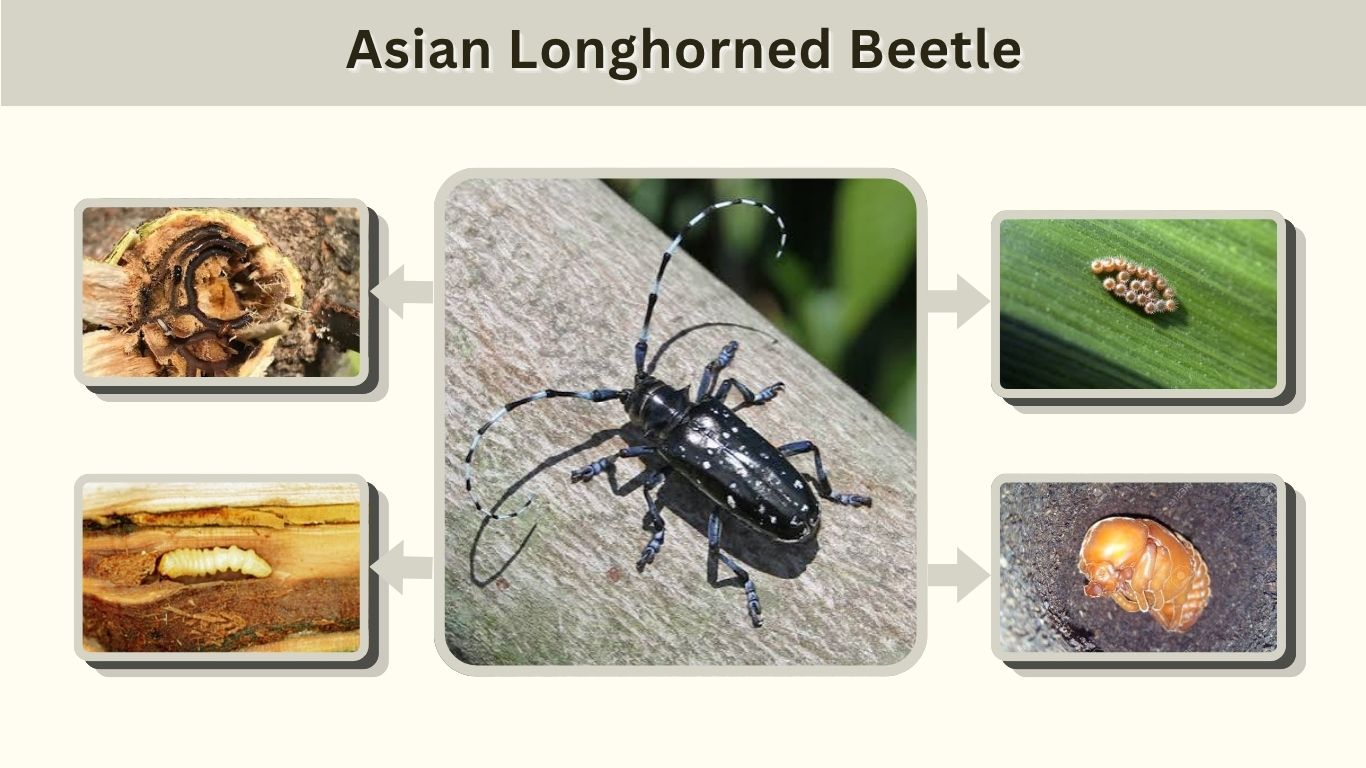
The Asian longhorned beetle (Anoplophora glabripennis) is a destructive invasive insect that threatens hardwood trees across North America and parts of Europe. Recognized by its shiny black body, white spots, and exceptionally long antennae, this beetle causes serious damage by tunneling through living trees. Originally native to Asia, it reached the United States through international trade and became a major concern for forests and urban landscapes. Understanding Asian longhorned beetle identification, life cycle, host trees, damage, and control methods is essential for detecting infestations and protecting valuable trees.
What Is an Asian Longhorned Beetle?
The Asian longhorned beetle is a wood-boring insect belonging to the Cerambycidae family. It is sometimes called the Asian longhorn beetle or starry sky beetle because of its distinctive black-and-white appearance.
Unlike many native beetles, this invasive species attacks healthy hardwood trees. Its larvae feed beneath the bark and tunnel through wood, gradually weakening the tree.
Asian Longhorned Beetle Facts
| Feature | Description |
| Common Name | Asian Longhorned Beetle |
| Scientific Name | Anoplophora glabripennis |
| Family | Cerambycidae |
| Native Range | China and the Korean Peninsula |
| Adult Size | Approximately 20–35 mm |
| Color | Glossy black with irregular white spots |
| Diet | Living hardwood tree tissues |
| Preferred Host | Maple trees |
| Life Cycle | Egg, larva, pupa, adult |
| Invasive Status | Serious invasive forest pest |
The species is especially concerning because infested trees cannot recover from extensive internal damage.
Asian Longhorned Beetle Identification and Appearance
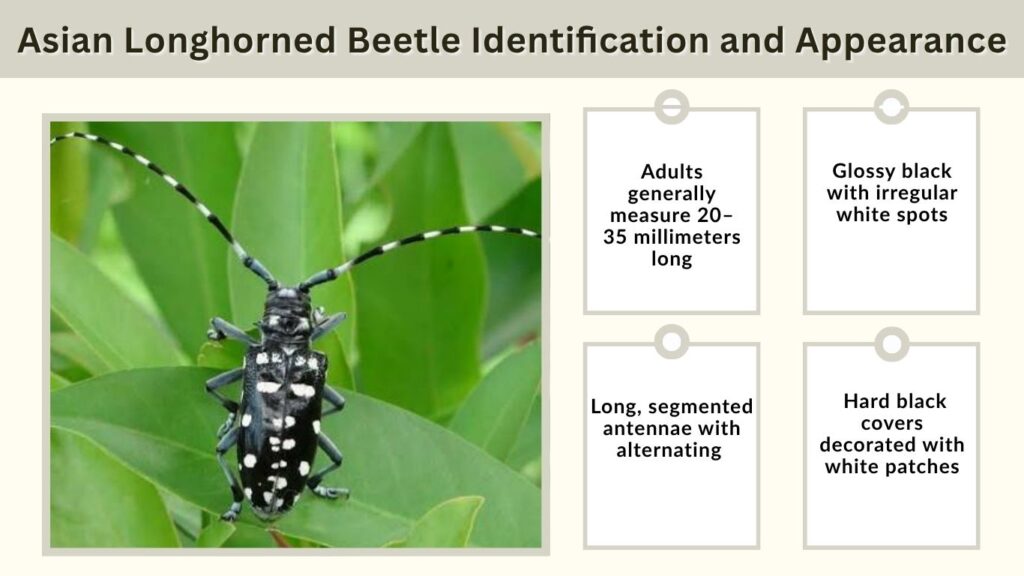
Asian longhorned beetles have several distinctive physical characteristics. Adults are relatively large, with shiny black bodies and contrasting white markings.
Their unusually long antennae are among the easiest features to recognize. However, several native longhorned beetles have similar appearances.
How to Identify an Asian Longhorned Beetle
Look for these identifying features:
- Body size: Adults generally measure 20–35 millimeters long.
- Body color: Glossy black with irregular white spots.
- Antennae: Long, segmented antennae with alternating black and white bands.
- Legs: Six legs, sometimes displaying a bluish appearance.
- Wing covers: Hard black covers decorated with white patches.
- Body shape: Elongated, oval, and relatively broad.
Male beetles generally have longer antennae relative to their bodies than females.
Adults are most noticeable during warm summer months when they emerge from trees, mate, and lay eggs.
Where Do Asian Longhorned Beetles Come From?
The Asian longhorned beetle is native to eastern Asia, particularly China and the Korean Peninsula.
It became established outside its native range through international trade, especially when infested wood was used in shipping materials.
How Did Asian Longhorned Beetles Get to America?
Scientists believe the beetle entered the United States inside untreated wooden packaging materials, including pallets and crates imported from Asia.
The first established U.S. infestation was discovered in Brooklyn, New York, in August 1996.
Additional infestations were subsequently detected in several states, prompting federal eradication programs.
Where Are Asian Longhorned Beetles Found in the United States?
As of October 2026, federal eradication activities continue in portions of:
- New York
- Massachusetts
- Ohio
- South Carolina
In September 2026, officials expanded quarantine areas around Mount Pleasant and Hollywood, South Carolina.
Michigan continues to monitor for the pest, but its state invasive species program reports no confirmed detections.
The United Kingdom successfully eradicated its known outbreak in Kent in 2019.
Asian Longhorned Beetle Life Cycle
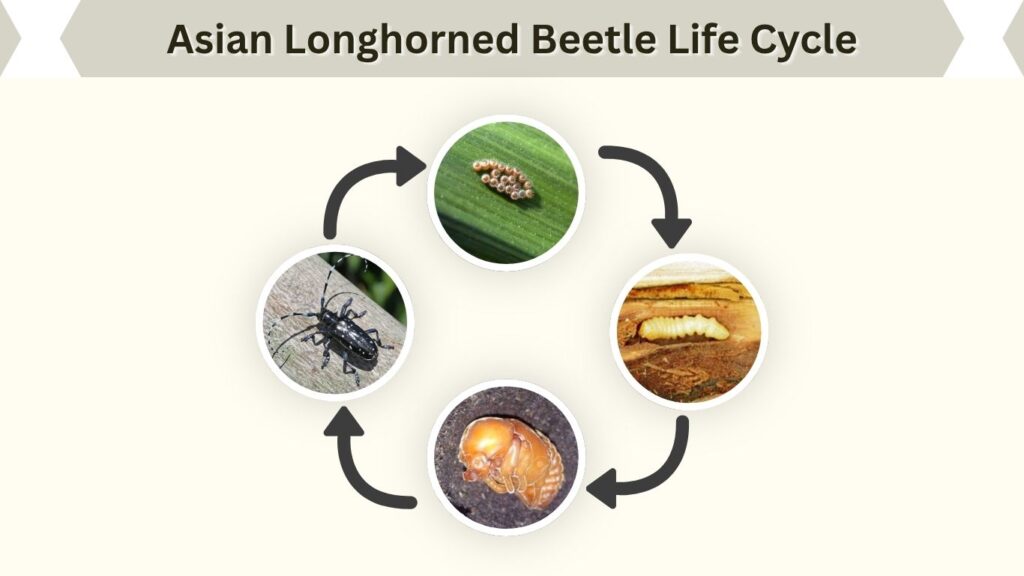
Asian longhorned beetles undergo complete metamorphosis, passing through four developmental stages. Their life cycle usually takes approximately one to two years, depending on temperature and environmental conditions.
1. Egg Stage
Female beetles chew small depressions into the bark of suitable hardwood trees.
They deposit individual eggs beneath the bark, protecting them from external conditions.
The eggs generally hatch within one to two weeks during favorable temperatures.
2. Larval Stage
Asian longhorned beetle larvae are creamy white, legless grubs with enlarged thoracic segments and powerful jaws.
Initially, they feed beneath the bark. As they grow, they tunnel deeper into the tree’s sapwood.
Mature larvae can reach approximately 50–60 millimeters in length.
The larval stage causes the greatest damage because feeding tunnels disrupt the movement of water and nutrients.
3. Pupal Stage
After completing larval development, the insect forms a pupal chamber inside the wood.
During pupation, its body transforms into an adult beetle.
This stage typically lasts several weeks, depending on environmental conditions.
4. Adult Stage
The adult beetle emerges by chewing a circular exit hole through the wood and bark.
Adults feed, mate, and lay eggs on suitable trees, beginning another generation.
Adult activity is generally highest during summer and early autumn.
What Do Asian Longhorned Beetles Eat?
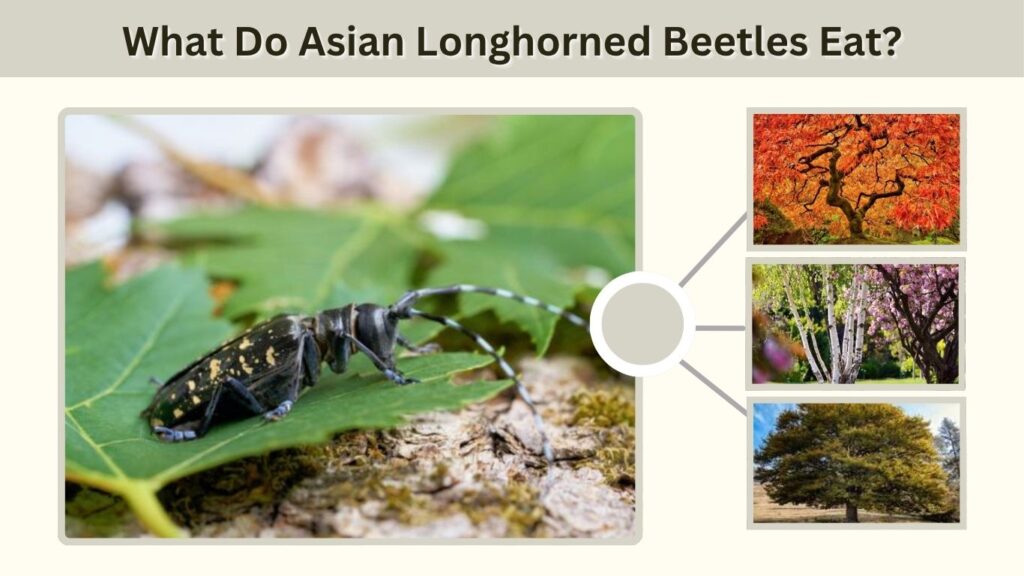
Asian longhorned beetles feed primarily on living hardwood trees. Their feeding habits change during development.
Adults consume bark from young twigs, leaf stalks, and sometimes leaves, while larvae feed on tissues beneath the bark and inside the wood.
Common Asian Longhorned Beetle Host Trees
Important host trees include:
- Maple trees: Among the most preferred hosts.
- Birch trees: Vulnerable to larval tunneling.
- Willow trees: Suitable for feeding and reproduction.
- Elm trees: Can support developing larvae.
- Buckeye trees: Recognized hosts in North America.
- Poplar trees: Attacked under suitable conditions.
Other hardwood species may also be vulnerable. Host suitability varies by tree species and local conditions.
Asian Longhorned Beetle Damage to Trees
Asian longhorned beetles are especially destructive because their larvae tunnel through living wood.
As larvae develop, their galleries weaken branches and interfere with essential tree functions. Severe infestations can eventually kill mature trees.
Common Signs of Asian Longhorned Beetle Damage
Watch for these warning signs:
- Round exit holes: Circular openings approximately 6–12 millimeters across.
- Egg-laying scars: Small oval or rounded depressions in tree bark.
- Sawdust-like material: Frass collecting on branches or beneath trees.
- Weeping sap: Sap leaking from damaged bark.
- Branch dieback: Declining branches and premature leaf yellowing.
- Internal tunnels: Feeding galleries visible in damaged or cut wood.
These symptoms can resemble damage caused by native wood-boring insects, so professional identification is important.
Why Are Asian Longhorned Beetles a Problem?
The beetle threatens forests, urban shade trees, parks, and commercial hardwood resources.
Infested trees may become structurally unstable, increasing the risk of falling branches.
Large-scale tree losses can also reduce wildlife habitat, affect biodiversity, increase maintenance costs, and diminish the environmental benefits of urban forests.
Asian Longhorned Beetle Control and Treatment
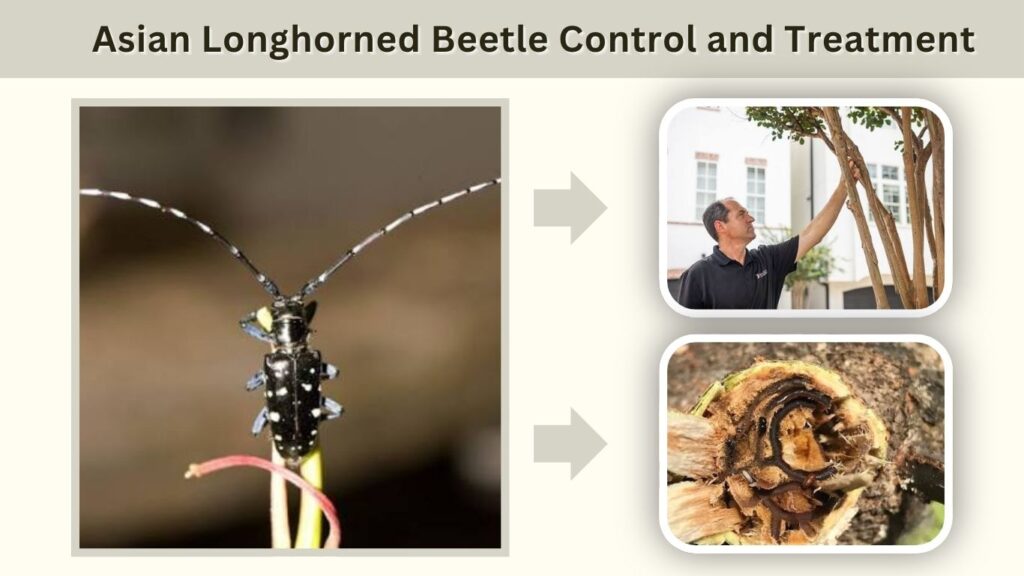
Controlling Asian longhorned beetles requires early detection and coordinated management.
Because larvae remain protected inside living trees, ordinary surface insecticides cannot reliably eliminate established infestations.
In the United States, eradication efforts are primarily coordinated by federal and state plant-health authorities.
Effective Asian Longhorned Beetle Control Methods
1. Inspect susceptible trees regularly
Examine maples and other host trees for exit holes, egg-laying scars, frass, and unusual branch decline.
2. Report suspected infestations
Contact your state agricultural department or USDA APHIS when you discover a suspicious beetle or damaged tree.
3. Remove confirmed infested trees
Authorities may remove and destroy infested trees to prevent further reproduction and spread.
4. Follow wood movement restrictions
Never transport potentially infested firewood, logs, or untreated tree material from regulated areas.
5. Use professional preventive treatments when appropriate
Government eradication programs may use approved systemic insecticide treatments on selected uninfested host trees.
These treatments require professional assessment and are not substitutes for removing confirmed infested trees.
Asian Longhorned Beetle Look-Alikes
Several native insects resemble Asian longhorned beetles. Correct identification helps prevent unnecessary removal of beneficial or harmless species.
Asian Longhorned Beetle vs. White-Spotted Pine Sawyer
The white-spotted pine sawyer (Monochamus scutellatus) is a commonly confused native beetle.
| Feature | Asian Longhorned Beetle | White-Spotted Pine Sawyer |
| Body | Shiny black | Dull black or bronze |
| Markings | Multiple irregular white spots | Often smaller pale markings |
| Antennae | Black-and-white bands | Generally less distinctly banded |
| Host Trees | Mainly hardwoods | Primarily conifers |
| Distinctive Feature | Glossy spotted wing covers | White scutellar spot near wing bases |
If identification is uncertain, photograph the beetle and consult local invasive species authorities.
Are Asian Longhorned Beetles Dangerous to Humans?
Asian longhorned beetles are not poisonous or venomous and do not normally attack people.
However, their strong jaws can deliver a painful pinch if the insect is handled carelessly.
Their primary danger is environmental rather than medical. By damaging hardwood trees, they can create falling-branch hazards and contribute to the destruction of forest ecosystems.
FAQs
1. Can Asian Longhorned Beetles Fly?
Yes, Asian longhorned beetles have functional wings and can fly between trees. Most movement occurs over relatively short distances, but longer flights are possible. Their movement can spread infestations into nearby forests, gardens, parks, and residential neighborhoods.
2. Do Asian Longhorned Beetles Bite Humans?
Asian longhorned beetles can bite when handled or threatened, but they rarely cause serious injuries. Their mandibles are designed for chewing plant tissues rather than attacking humans. Avoid direct handling and report suspected invasive beetles to the appropriate authorities.
3. Are Asian Longhorned Beetles Poisonous?
No, Asian longhorned beetles are not considered poisonous or venomous. They do not possess stingers or inject venom. Although they pose little direct danger to humans, their larvae cause extensive internal damage to hardwood trees and surrounding ecosystems.
4. Can a Tree Survive an Asian Longhorned Beetle Infestation?
A lightly infested tree may remain alive temporarily, but repeated larval tunneling progressively weakens its structure. Confirmed infested trees are generally removed under eradication programs because treating them does not reliably eliminate all developing beetles or prevent further spread.
5. How Can You Prevent Asian Longhorned Beetles?
Inspect vulnerable hardwood trees regularly, avoid transporting untreated firewood, and report suspicious insects or tree damage immediately. Follow local quarantine restrictions and cooperate with eradication programs. Early detection is essential for preventing Asian longhorned beetles from spreading into new areas.