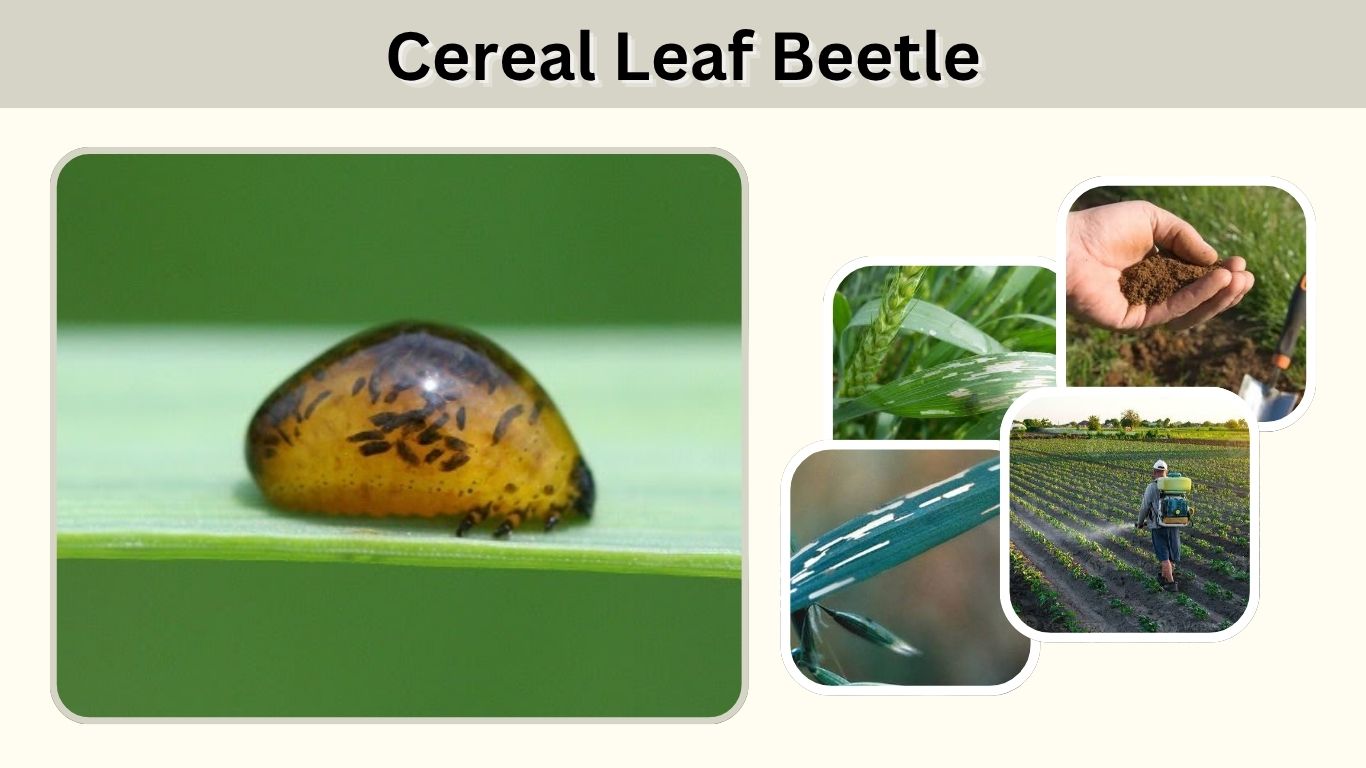
The cereal leaf beetle (Oulema melanopus) is a small agricultural pest that attacks wheat, barley, oats, and other cereal crops. Although adult beetles feed on leaves, their larvae usually cause the most significant damage by removing green leaf tissue and reducing photosynthesis. Severe infestations can affect grain development and crop yields. Understanding cereal leaf beetle identification, life cycle, feeding habits, and control methods helps farmers recognize infestations early. This guide explains how to identify cereal leaf beetles, recognize their damage, and manage their populations effectively.
What Is a Cereal Leaf Beetle?
The cereal leaf beetle is a leaf-feeding insect belonging to the family Chrysomelidae. Originally native to Europe and Asia, it has spread to several agricultural regions, including North America.
The beetle primarily attacks cereal grains, particularly wheat, oats, and barley. Both adults and larvae feed on leaves, but larvae are responsible for most economically significant damage.
Cereal leaf beetles generally produce one generation annually. Their activity is closely associated with spring temperatures and cereal crop development.
Although these insects can become serious agricultural pests, many populations remain below damaging levels because of natural predators, parasitoid wasps, and environmental conditions.
How to Identify Cereal Leaf Beetles
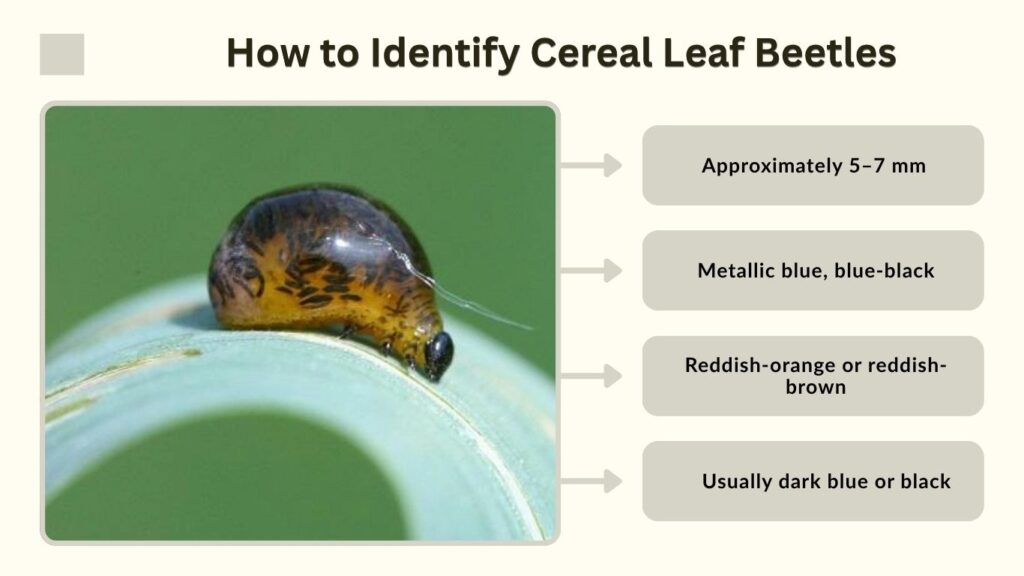
Cereal leaf beetles have distinctive physical characteristics that help distinguish them from other insects found in grain fields. Their appearance changes considerably between the egg, larval, and adult stages. Identifying each stage is important because treatment decisions depend on pest development and population density.
Adult Cereal Leaf Beetle Identification
Adult cereal leaf beetles are small, elongated insects with metallic coloring.
Common identification characteristics include:
- Body length: Approximately 5–7 mm, although measurements vary.
- Wing covers: Metallic blue, blue-black, or greenish-blue.
- Thorax: Reddish-orange or reddish-brown.
- Head: Usually dark blue or black.
- Legs: Orange to reddish-brown.
- Body shape: Narrow, elongated, and slightly cylindrical.
Adults are commonly observed resting or feeding on cereal leaves during spring.
Cereal Leaf Beetle Eggs
Cereal leaf beetle eggs are tiny, elongated structures deposited on the upper surfaces of grass or cereal leaves.
Freshly laid eggs are usually yellowish-orange and gradually darken before hatching.
Females deposit eggs individually, in pairs, or sometimes in short rows along the leaf surface. Each egg measures approximately 1 mm in length.
Finding eggs during crop inspections can help farmers anticipate upcoming larval activity.
Cereal Leaf Beetle Larvae
Cereal leaf beetle larvae look considerably different from adults.
Their bodies are pale yellow with dark heads and six small legs. However, they often appear dark brown, shiny, and slug-like.
This appearance results from a protective coating made of mucus and fecal material.
The coating, sometimes called a fecal shield, helps protect the larvae from drying conditions and some natural enemies.
Mature larvae reach approximately 6 mm in length and are commonly found feeding on upper leaf surfaces.
Cereal Leaf Beetle Life Cycle
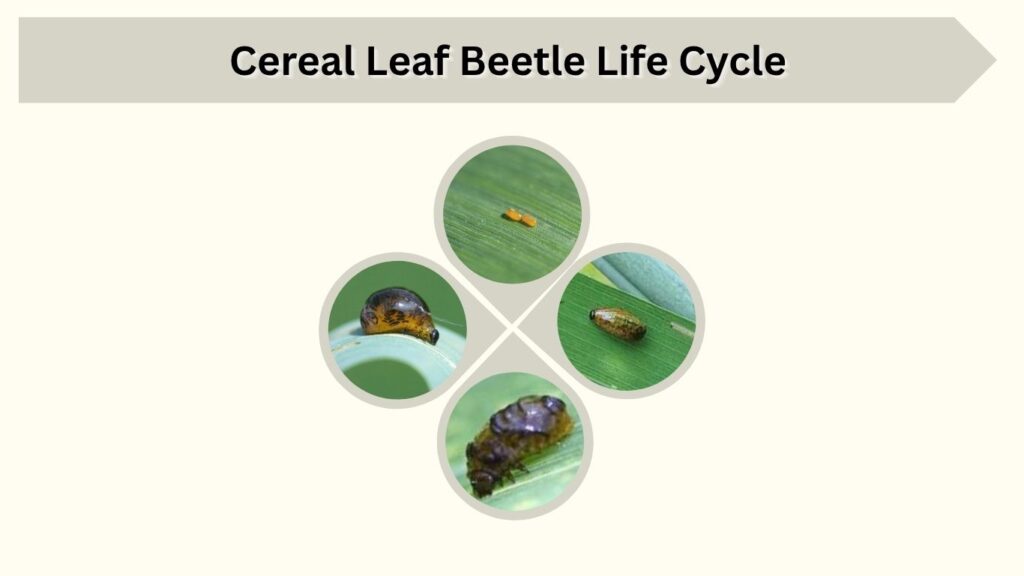
The cereal leaf beetle undergoes complete metamorphosis, developing through egg, larva, pupa, and adult stages. Understanding its life cycle helps farmers identify when crops are most vulnerable and when control measures may be effective. Seasonal timing varies with temperature, location, and crop development.
Four Stages of Development
- Egg stage: Female beetles deposit yellowish-orange eggs on cereal leaves during spring. Eggs hatch after several days or longer, depending on temperature.
- Larval stage: Newly hatched larvae feed on leaf surfaces and gradually develop their protective fecal covering. They pass through four larval stages, with older larvae consuming the most tissue.
- Pupal stage: Mature larvae drop to the soil and form protective earthen cells. Inside these cells, they transform into adults.
- Adult stage: New adults emerge, feed on suitable grasses, and eventually seek protected locations for dormancy and overwintering.
In temperate regions, adults usually overwinter in leaf litter, field borders, grass crowns, and other sheltered places.
What Do Cereal Leaf Beetles Eat?
Cereal leaf beetles are herbivorous insects that feed primarily on plants belonging to the grass family.
Their preferred hosts include wheat, barley, and oats, although they can also use other cultivated and wild grasses.
Additional host plants include rye, triticale, corn, timothy grass, and several forage grasses.
Both adults and larvae consume leaf tissue rather than grain kernels. Their feeding removes photosynthetic surfaces and can reduce plant productivity.
Spring-planted cereals, especially oats, may attract substantial egg-laying activity because they provide young, actively growing leaves.
The beetles also use wild grasses around agricultural fields as alternative food sources.
Cereal Leaf Beetle Damage in Wheat and Other Crops
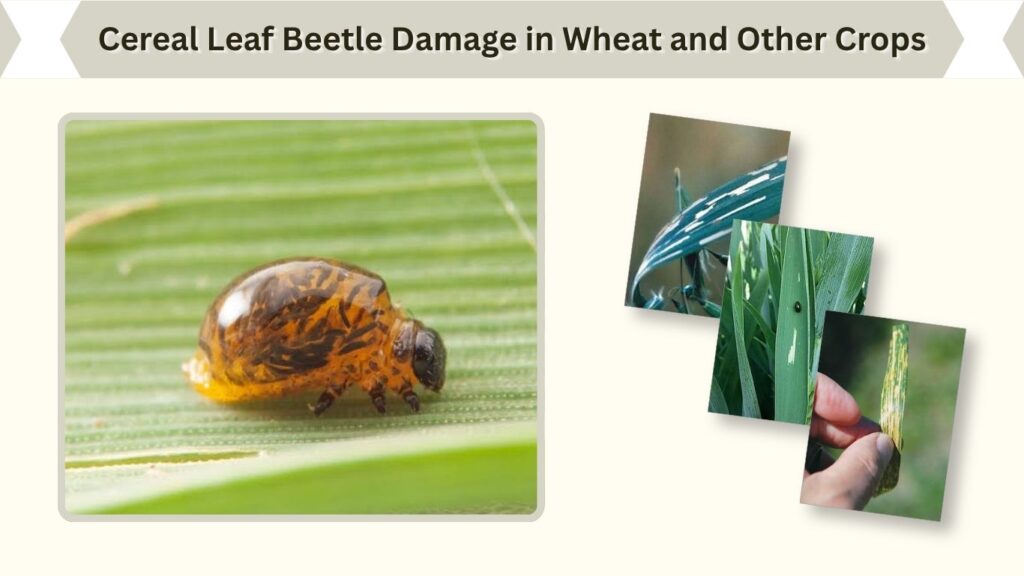
Cereal leaf beetle damage occurs when adults and larvae remove tissue from cereal leaves. Although both developmental stages contribute, larval feeding generally causes greater economic losses. Infestations become particularly concerning when larvae attack the upper leaves responsible for supporting grain development.
Signs of Cereal Leaf Beetle Damage
Typical signs include:
- White streaks: Long, pale feeding marks running parallel to leaf veins.
- Windowpane damage: Thin, translucent areas where larvae have removed the upper leaf tissue.
- Frosted appearance: Severely damaged leaves appear silvery or bleached.
- Leaf drying: Heavily affected leaf tips may become white and dry.
- Visible larvae: Dark, shiny larvae may be present on damaged foliage.
These symptoms can become noticeable across large sections of heavily infested fields.
Cereal Leaf Beetle Damage in Wheat
Wheat is especially vulnerable when larvae feed on the flag leaf, the uppermost leaf directly below the grain head.
The flag leaf provides a substantial portion of the photosynthetic energy required for grain filling.
Severe larval damage can reduce grain weight and overall yield.
However, finding a few beetles does not automatically indicate an economically damaging infestation. Crop growth stage, pest density, and plant condition determine the potential impact.
Damage in Barley and Oats
Cereal leaf beetles also attack barley and oats, producing similar white feeding streaks.
Oats can be particularly attractive to adult beetles during egg laying. Heavy larval populations may reduce green leaf area and interfere with normal crop development.
When Should You Scout for Cereal Leaf Beetles?
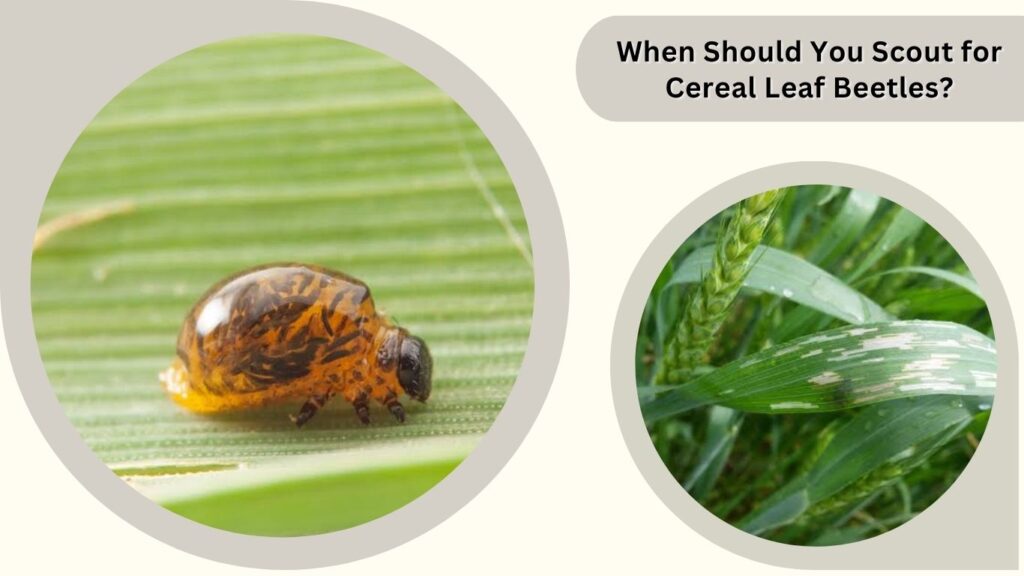
Regular field scouting is essential because cereal leaf beetles are not always distributed evenly across crops. Monitoring should begin when overwintering adults become active in spring and continue through the vulnerable growth stages. Accurate counts help farmers distinguish harmless beetle activity from infestations that require treatment.
How to Monitor Beetle Populations
A practical scouting procedure includes:
- Inspect several representative locations throughout the field.
- Examine cereal stems, leaves, and developing flag leaves.
- Count visible eggs and larvae.
- Record the crop growth stage and extent of leaf damage.
- Check field borders separately because populations may be uneven.
- Repeat inspections when eggs are present but have not yet hatched.
Cereal Leaf Beetle Economic Threshold
An economic threshold indicates when pest numbers justify considering treatment to prevent financial losses.
Threshold recommendations differ by region.
For example, Oregon State University recommends approximately three eggs or larvae per tiller before the boot stage and one larva per flag leaf at the boot stage.
University of Delaware guidance uses a different threshold of 25 eggs and/or larvae per 100 tillers, with treatment timing influenced by the proportion that have hatched.
These figures are region-specific examples, not universal standards. Farmers should follow local agricultural extension guidance before deciding to spray.
How to Control Cereal Leaf Beetles
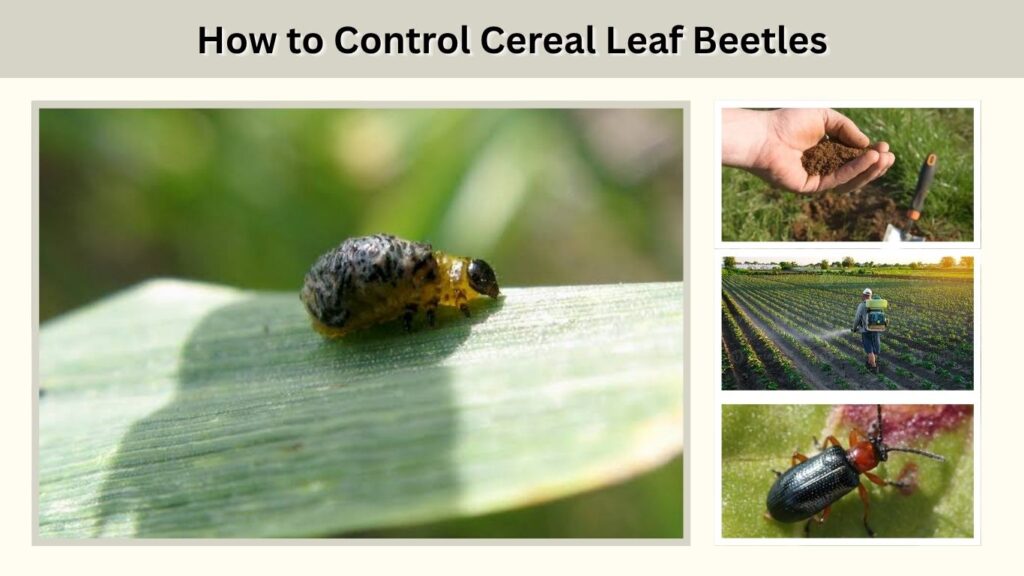
Effective cereal leaf beetle control combines field monitoring, agricultural practices, natural enemies, and selective insecticide use when justified. This integrated pest management approach helps protect crop yields while reducing unnecessary pesticide applications. Because larvae cause most damage, management strategies generally focus on detecting and controlling damaging larval populations.
Cultural Control Methods
Several agricultural practices can help reduce cereal leaf beetle pressure.
Appropriate planting dates may reduce exposure to egg-laying adults. Maintaining healthy crops also improves tolerance to moderate leaf damage.
Depending on local recommendations, management practices may include crop rotation, suitable tillage, management of alternative grass hosts, and targeted trap crops.
Some regions have also investigated using oats as trap crops to attract egg-laying beetles away from economically important cereals.
These methods work best as part of a broader pest management program rather than as guaranteed standalone solutions.
Biological Control of Cereal Leaf Beetles
Natural enemies play an important role in regulating cereal leaf beetle populations.
One particularly important species is Tetrastichus julis, a tiny parasitoid wasp that attacks cereal leaf beetle larvae.
Female wasps deposit eggs inside beetle larvae. The developing wasp larvae eventually kill their hosts during the pupal stage.
Other predators, including some ladybird beetles and generalist predatory insects, may consume beetle eggs or immature insects.
Conserving beneficial insects and avoiding unnecessary broad-spectrum insecticide applications can support natural pest regulation.
Chemical Control of Cereal Leaf Beetles
Chemical treatment may be justified when scouting confirms that populations exceed locally recommended economic thresholds.
Registered insecticides can reduce cereal leaf beetle populations, particularly when applied against young larvae.
However, spraying too early may fail to control larvae that hatch later.
Treatments applied after larvae finish feeding may provide little economic benefit.
Farmers should select products legally registered for the crop and pest in their location, follow label directions, observe preharvest intervals, and protect beneficial insects whenever possible.
FAQs
Are Cereal Leaf Beetles Harmful to Humans?
Cereal leaf beetles are not considered dangerous to humans. They do not normally bite or sting people. Their importance comes from agricultural damage, particularly when large larval populations feed on economically valuable cereal crops.
Where Do Cereal Leaf Beetles Live?
Cereal leaf beetles live in agricultural fields, grasslands, and other locations containing suitable grass hosts. Adults overwinter in protected vegetation, leaf litter, and field margins before moving into cereal crops during spring.
Can Cereal Leaf Beetles Damage Corn?
Yes. Cereal leaf beetles can feed on corn leaves, particularly during adult feeding periods. However, wheat, barley, and oats are generally more important hosts. Their presence on corn does not necessarily indicate serious economic damage.
What Protects Cereal Leaf Beetle Larvae?
Cereal leaf beetle larvae cover their bodies with mucus and fecal material, forming a protective coating. This shield helps reduce drying and provides some protection against predators, although parasitoid wasps can still attack the larvae.
What Is the Best Time to Control Cereal Leaf Beetles?
Control is generally most effective when populations exceed local treatment thresholds and small larvae are actively feeding. Regular scouting helps identify this period before substantial damage occurs, particularly on the flag leaves of developing cereal crops.