
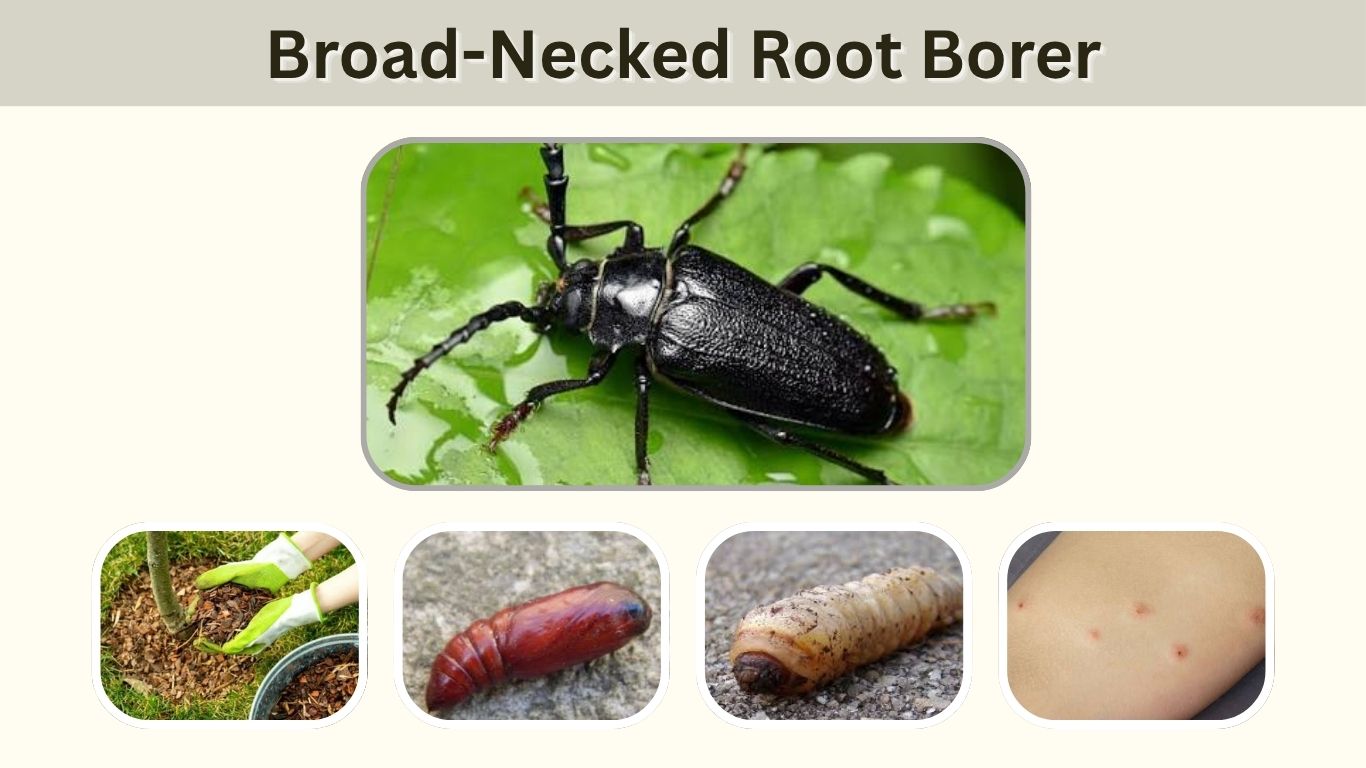
The broad-necked root borer is a large, dark beetle found in forests, gardens, and wooded neighborhoods across eastern North America. Its broad body, powerful jaws, and unusual pointed structure on females often raise questions about bites and stings. Although adults are not aggressive toward people, their larvae can damage the roots of trees and shrubs over several years. Learning how to identify broad-necked root borer beetles, distinguish males from females, recognize root damage, and use practical control methods can help protect vulnerable trees without unnecessary pesticide treatments.
What Is a Broad-Necked Root Borer?
The broad-necked root borer (Prionus laticollis) is a large longhorn beetle belonging to the family Cerambycidae. It is native to eastern North America and commonly inhabits deciduous forests, gardens, and wooded residential areas.
Unlike beetles that tunnel through tree trunks, broad-necked root borer larvae feed primarily on underground roots. Their feeding can weaken young or stressed trees and interfere with water and nutrient absorption.
Adult beetles are most visible during summer, particularly around tree bases and outdoor lights.
Broad-Necked Root Borer Identification
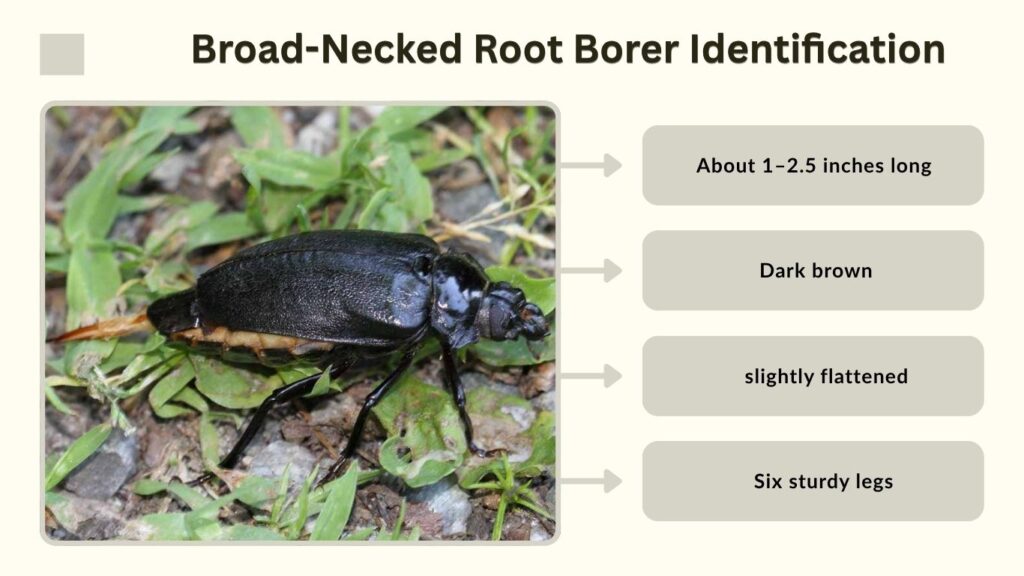
Broad-necked root borers are recognizable by their large bodies, broad thoraxes, and dark coloring. Adults range from reddish-brown to nearly black, with females generally larger and heavier than males.
Their distinctive physical features help separate them from other longhorn beetles and common garden insects.
Physical Characteristics of Broad-Necked Root Borers
Common identifying characteristics include:
- Body size: Adults typically measure , with some large females approaching 3 inches.
- Body color: Dark brown, reddish-brown, or nearly black.
- Body shape: Broad, elongated, and slightly flattened.
- Antennae: Long, segmented antennae, usually thicker in males.
- Thorax: A wide pronotum with small toothlike projections along its edges.
- Legs: Six sturdy legs adapted for walking across soil and rough surfaces.
Broad-Necked Root Borer Larvae Appearance
Broad-necked root borer larvae are large, creamy-white grubs with cylindrical bodies and darker brown heads.
They possess powerful chewing mouthparts that allow them to feed on underground woody roots.
Unlike adults, larvae remain hidden beneath the soil for several years. Mature larvae can reach several inches long before entering the pupal stage.
Broad-Necked Root Borer Male vs. Female
Male and female broad-necked root borers differ noticeably in size, antennae, and flying ability. These differences are especially useful when identifying adults found near trees or outdoor lights.
Females are generally larger and more heavily built, while males are smaller and more mobile.
Male Broad-Necked Root Borer
Male broad-necked root borers have relatively slender bodies and prominent, strongly segmented antennae.
Their smaller size allows them to fly more readily than females. Males are frequently attracted to porch lights and other artificial lighting during summer evenings.
They actively search for females during the breeding season and are more likely to be observed flying around wooded residential areas.
Female Broad-Necked Root Borer
Female broad-necked root borers are noticeably larger, broader, and heavier than males.
They are generally considered flightless or nearly flightless and are often found walking on the ground near trees.
Females possess a specialized egg-laying structure called an ovipositor. This pointed organ extends from the abdomen and can resemble a large stinger.
The ovipositor is used during reproduction, not for attacking humans.
Do Broad-Necked Root Borers Sting or Bite?
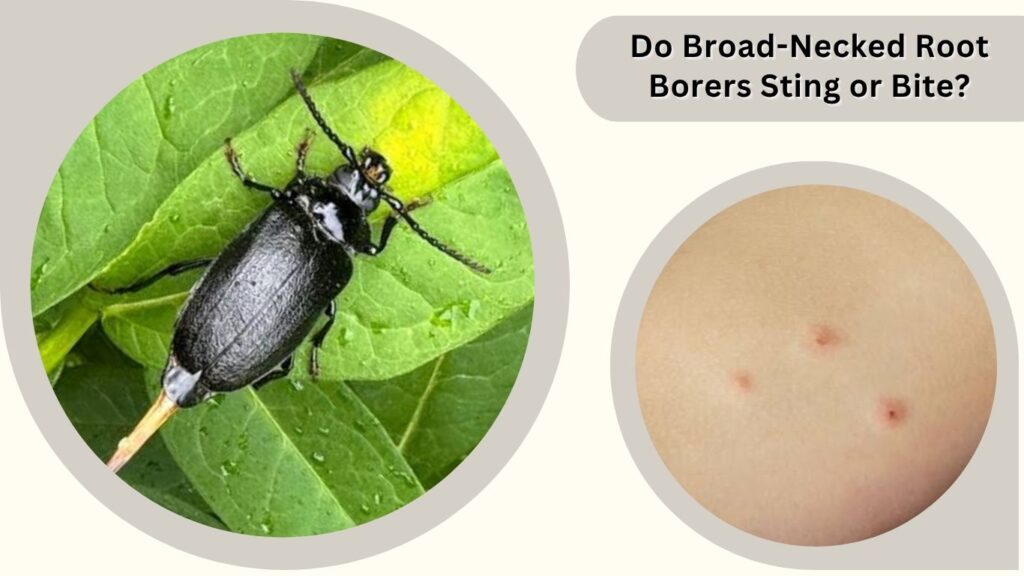
Broad-necked root borers may appear intimidating because of their large jaws and the pointed organ visible on some females.
However, these beetles do not possess venomous stingers and are not aggressive toward people. Their main defensive behavior is attempting to escape when disturbed.
Does a Broad-Necked Root Borer Have a Stinger?
No, broad-necked root borers cannot sting.
The pointed structure extending from a female’s abdomen is an ovipositor, which helps her deposit eggs into soil or protected locations near tree roots.
Although the ovipositor resembles a stinger, it does not function as one and cannot inject venom.
Can a Broad-Necked Root Borer Bite Humans?
Yes, broad-necked root borers can deliver a painful pinch with their strong mandibles if handled roughly.
Their bites are defensive and do not involve venom. Minor injuries may cause temporary redness or discomfort.
If bitten, wash the affected area with soap and water and apply a cold compress.
Seek medical attention if a wound develops signs of infection or serious symptoms occur.
Avoiding direct handling is the easiest way to prevent bites.
Are Broad-Necked Root Borers Dangerous or Poisonous?
Broad-necked root borers are not poisonous or venomous, and they are not considered dangerous to humans or pets.
However, their underground feeding habits can make them troublesome agricultural and landscape pests.
Larvae may cause significant root damage when infestations develop around vulnerable fruit trees, ornamentals, or shrubs.
Adult beetles generally pose little threat to people, while the larvae are responsible for most economically important damage.
Broad-Necked Root Borer Habitat and Diet
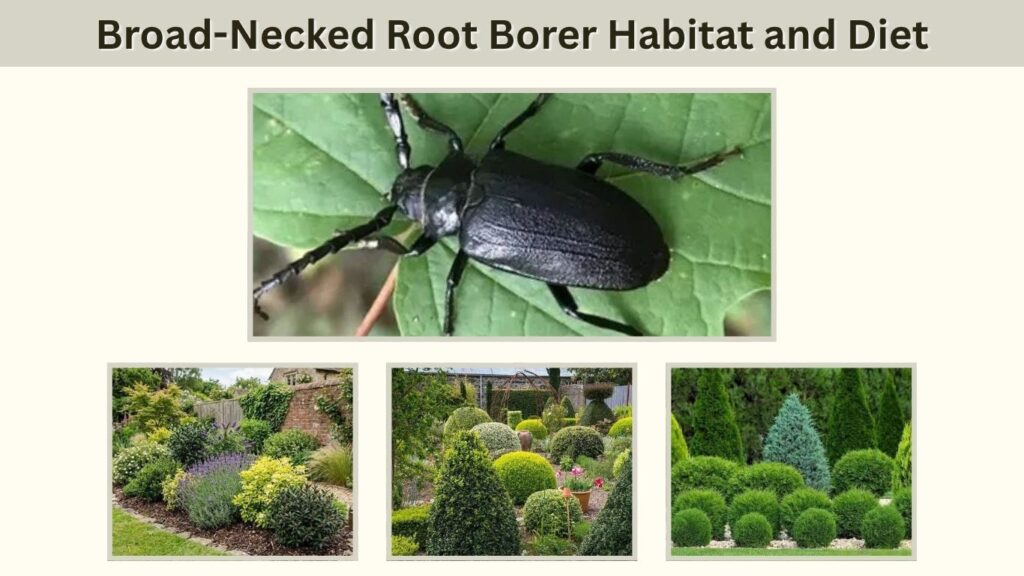
Broad-necked root borers inhabit wooded environments throughout eastern North America. They occur in areas including New York, Pennsylvania, Maryland, Massachusetts, and Connecticut.
Their preferred habitats contain suitable trees, shrubs, and underground roots that support larval development.
Where Do Broad-Necked Root Borers Live?
Adult beetles are commonly found near deciduous forests, orchards, gardens, and tree-lined residential areas.
They are most active during warmer months, especially from June through September, depending on location.
Females often remain near the soil surface, while males may fly toward outdoor lighting.
What Do Broad-Necked Root Borers Eat?
Broad-necked root borer larvae feed on the living roots of trees and shrubs, including apple, cherry, oak, maple, and related woody plants.
They chew root tissues and sometimes tunnel into larger roots, gradually weakening the plant.
Adults may feed on foliage, but their feeding usually causes less serious damage than larval activity.
Broad-Necked Root Borer Life Cycle
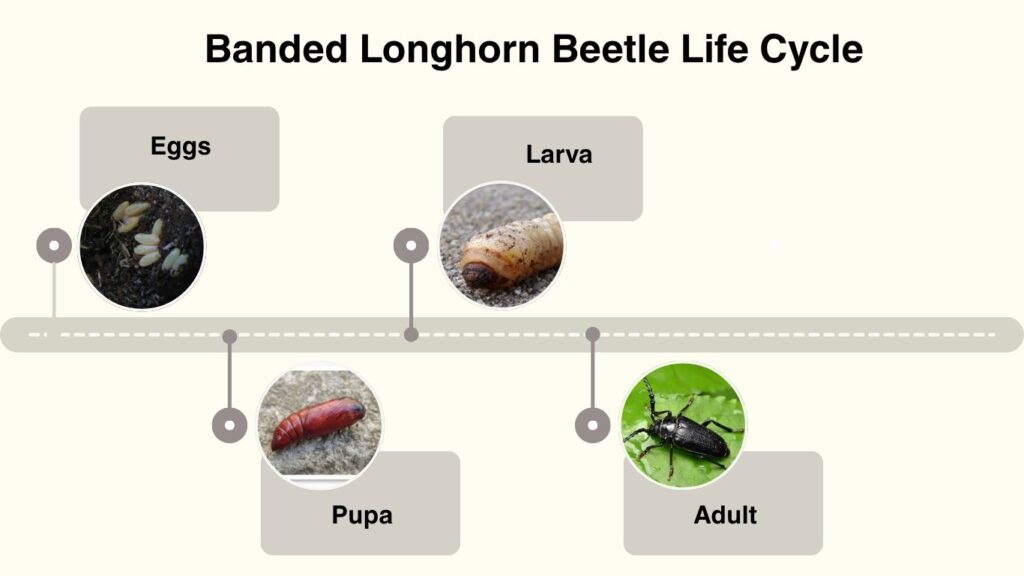
Broad-necked root borers undergo complete metamorphosis through egg, larval, pupal, and adult stages.
Their development typically lasts several years because larvae spend an extended period feeding underground.
Eggs and Larval Development
Female beetles deposit eggs in soil or leaf litter near suitable host roots.
After hatching, young larvae burrow downward and begin feeding on underground root tissues.
As they grow, they consume larger roots and may move toward the root crown.
Larval development commonly lasts around three years and can take longer under certain conditions.
Pupal and Adult Stages
Mature larvae pupate in underground chambers near the roots of their host plants.
Adult beetles emerge during late spring or summer, depending on local conditions.
Males search for females, and mating is followed by another period of egg laying.
Signs of Broad-Necked Root Borer Damage
Root damage caused by broad-necked root borer larvae often develops slowly. Because most feeding occurs underground, affected trees may show general symptoms of stress before the cause becomes obvious.
Severe infestations can weaken young trees and increase their vulnerability to drought and other environmental problems.
Common Signs of Root Borer Infestation
Watch for these symptoms in vulnerable trees:
- Yellowing leaves: Foliage becomes pale because damaged roots absorb fewer nutrients.
- Wilting branches: Trees struggle to transport enough water during dry weather.
- Slow growth: New shoots and leaves develop poorly.
- Branch dieback: Portions of the canopy gradually decline.
- Root damage: Excavated roots may show deep grooves, tunnels, or missing bark.
- Poor anchorage: Severely damaged roots may leave trees unstable.
These symptoms can also result from root diseases, drought, or soil problems. Confirming the cause is important before selecting treatment.
How to Get Rid of Broad-Necked Root Borers
Broad-necked root borer control can be challenging because larvae live underground and remain protected inside root tissues.
Management should focus on maintaining tree health, identifying active infestations, and preventing further damage.
Effective Broad-Necked Root Borer Control Methods
Recommended approaches include:
- Inspect affected trees: Look for thinning foliage, unexplained dieback, and damaged roots near the base.
- Maintain tree health: Provide appropriate watering and avoid unnecessary root disturbance.
- Remove severely infested plants: When practical, removing badly damaged plants and infested root material may reduce local breeding sites.
- Reduce tree stress: Prevent soil compaction, mechanical injuries, and excessive fertilization.
- Seek professional assessment: Consult an arborist or local extension specialist if root damage is extensive.
Do Insecticides Work Against Root Borers?
Chemical control is difficult because larvae feed deep within roots and soil.
There is no universally effective insecticide treatment for broad-necked root borers. Any pesticide application must be specifically labeled for the pest, host plant, and intended use.
For valuable trees or commercial plantings, consult a qualified pest management professional before considering treatment.
How to Prevent Broad-Necked Root Borer Infestations
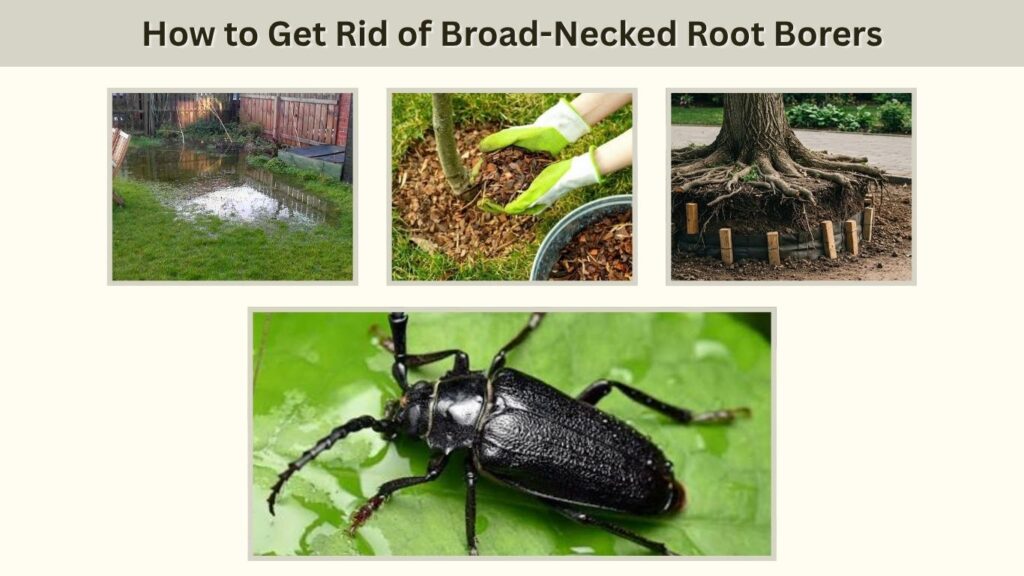
Prevention focuses on reducing plant stress and monitoring susceptible trees. Healthy trees are generally better equipped to tolerate limited root injury than weakened plants.
Proper soil management and regular inspections also make it easier to detect problems before extensive damage develops.
Broad-Necked Root Borer Prevention Tips
Useful preventive practices include:
- Water appropriately: Avoid prolonged drought stress and waterlogged soil.
- Protect tree roots: Limit digging, soil compaction, and construction damage near trees.
- Maintain mulch properly: Keep organic mulch around the root zone but away from the trunk.
- Monitor young trees: Inspect newly planted fruit and ornamental trees for declining growth.
- Identify unusual damage: Investigate unexplained dieback before applying pesticides.
These practices cannot guarantee complete prevention, but they support tree health and improve early detection.
FAQs
1. Are Broad-Necked Root Borers Invasive?
No. Broad-necked root borers are native to eastern North America. Although their larvae can damage trees, they are not considered invasive insects within their native range.
2. Can Female Broad-Necked Root Borers Fly?
Female broad-necked root borers are generally flightless or nearly flightless because of their large, heavy bodies. Smaller males can fly and are commonly attracted to lights.
3. Should You Kill a Broad-Necked Root Borer?
Killing an occasional adult beetle is usually unnecessary. However, confirmed larval infestations damaging valuable trees may require professional pest management.
4. How Long Do Broad-Necked Root Borers Live?
Their complete life cycle usually takes around three years, sometimes longer. Most of this time is spent underground as developing larvae.
5. Can Broad-Necked Root Borers Kill Trees?
Yes. Severe larval feeding can destroy important roots, weaken young trees, and contribute to tree death. Established healthy trees may tolerate lighter damage.
