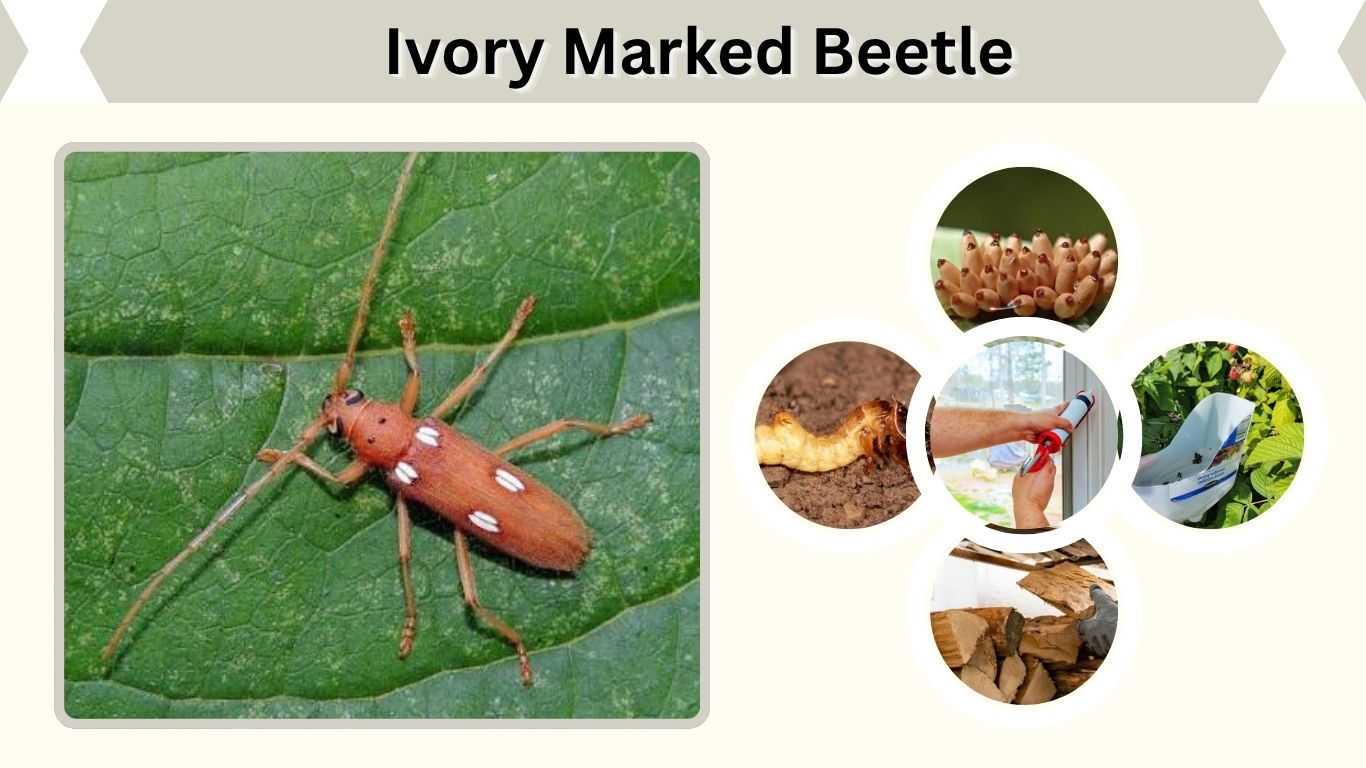
The ivory marked beetle is a distinctive wood-boring insect recognized by its golden-brown body, long antennae, and creamy-white spots. Often found near hardwood trees, firewood, and occasionally inside homes, this beetle can appear alarming because of its unusual markings. Although ivory marked beetles are generally harmless to humans, their larvae can damage wooden materials and remain hidden for years. Understanding ivory marked beetle identification, bites, lifespan, life cycle, and control methods can help homeowners identify these insects and prevent unnecessary wood damage.
What Is an Ivory Marked Beetle?
The ivory marked beetle, commonly called the ivory-marked borer, is a longhorn beetle in the family Cerambycidae. Its scientific name is traditionally Eburia quadrigeminata, although newer taxonomic treatments place it in the genus Coeleburia.
This species is native to North America and is commonly associated with hardwood forests, dead trees, and seasoned wood.
Unlike many destructive tree borers, ivory marked beetles primarily develop in dead or compromised wood rather than healthy living tree tissues.
Their larvae tunnel deep into hardwood, where they can remain for unusually long periods before emerging as adult beetles.
Ivory Marked Beetle Identification and Appearance
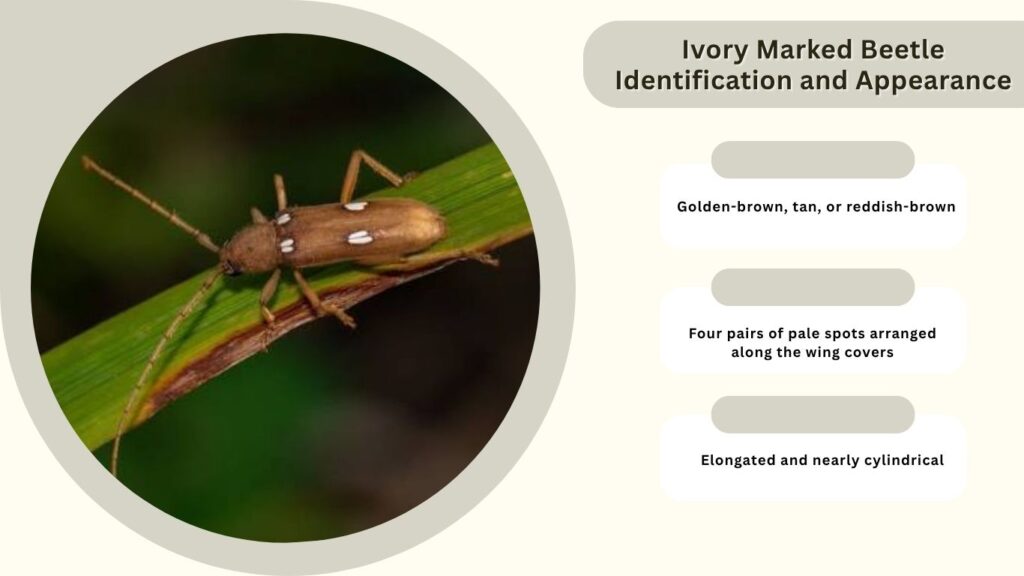
Ivory marked beetles have several recognizable physical features. Their distinctive white markings are particularly useful for distinguishing them from other brown longhorn beetles.
Adult Ivory Marked Beetle
Adult ivory marked beetles generally measure approximately ½ to 1 inch long, excluding their antennae.
Common identification features include:
- Body color: Golden-brown, tan, or reddish-brown.
- Ivory markings: Four pairs of pale spots arranged along the wing covers.
- Antennae: Long, slender, and sometimes longer than the body.
- Body shape: Elongated and nearly cylindrical.
- Legs: Six relatively long, brown legs.
- Thorax: Brown with small lateral spines and dark markings.
The pale markings usually appear as eight distinct ivory-colored spots, often surrounded by darker brown areas.
Ivory Marked Beetle Larvae
Ivory marked beetle larvae are pale, elongated grubs that develop inside hardwood.
They have segmented bodies, hardened mouthparts, and a slightly enlarged front section.
Mature larvae can reach approximately 30 millimeters in length.
Because they spend most of their development tunneling inside wood, homeowners rarely see them unless an infested log or wooden object is opened.
Are Ivory Marked Beetles Dangerous or Poisonous?
Ivory marked beetles are not considered dangerous to humans. They are not venomous, do not possess stingers, and are not known to transmit diseases to people.
Their appearance may seem intimidating because of their long antennae and prominent mouthparts, but these beetles generally avoid contact with humans.
Unlike mosquitoes, fleas, and other biting insects, ivory marked beetles do not seek blood meals.
Their primary concern involves the internal damage their larvae can cause to hardwood and wooden products.
Do Ivory Marked Beetles Bite?
Ivory marked beetles can potentially pinch human skin with their chewing mouthparts if handled roughly.
However, bites are uncommon, and these insects are not naturally aggressive toward humans.
A defensive pinch may produce minor discomfort, but significant injuries are unlikely.
If bitten, wash the affected area with soap and water. Seek medical attention if unusual swelling, persistent pain, or signs of infection develop.
Avoid handling unfamiliar beetles directly.
Why Is an Ivory Marked Beetle in My House?
Finding an ivory marked beetle indoors does not necessarily indicate an active household infestation.
Adult beetles are attracted to artificial lights at night and may accidentally enter homes through open doors or windows.
However, these beetles have another unusual way of appearing indoors.
Their larvae can survive inside hardwood that was harvested and processed into furniture, flooring, doors, or other wooden structures.
After completing development, adults emerge through small holes in the finished wood.
This means a beetle may appear from furniture that has been inside a house for several years.
Repeated sightings near the same wooden item may indicate that larvae were present before the wood was installed.
Ivory Marked Beetle Life Cycle and Lifespan
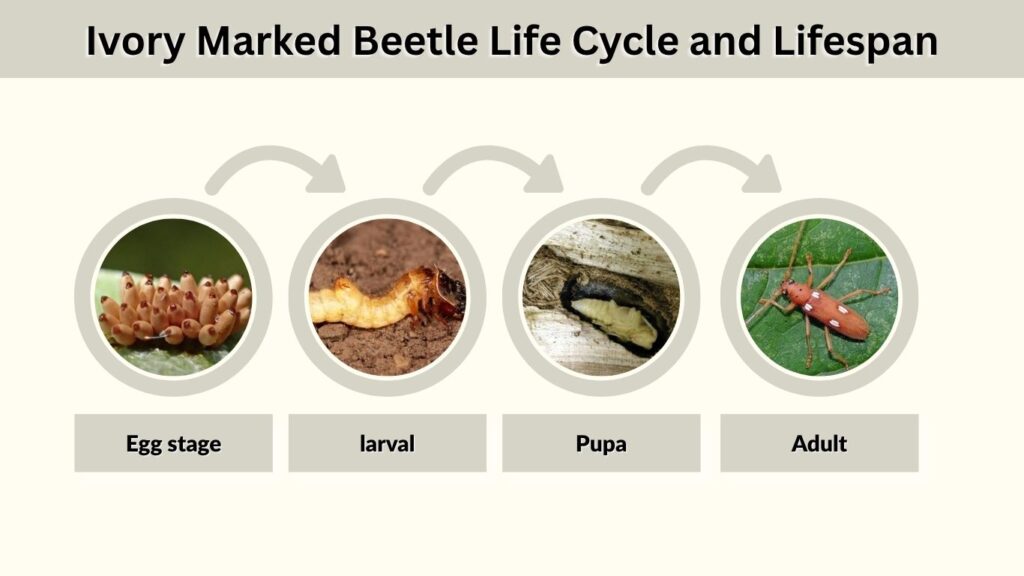
Ivory marked beetles undergo complete metamorphosis through four developmental stages: egg, larva, pupa, and adult.
Under typical outdoor conditions, development commonly takes around two years. However, larvae developing in dry, processed wood may survive considerably longer.
1. Egg Stage
Female beetles lay eggs in cracks, crevices, or exposed areas of suitable dead hardwood.
After hatching, young larvae begin tunneling into the wood.
2. Larval Stage
Larvae feed on woody tissues and create galleries inside the heartwood.
These tunnels gradually increase in size as the larvae develop.
Development can become exceptionally slow when infested wood is cut, dried, and processed.
3. Pupal Stage
Mature larvae form pupal chambers inside the wood.
During this stage, their bodies transform into adult beetles.
4. Adult Stage
Fully developed beetles emerge through exit holes and begin searching for mates and suitable egg-laying locations.
Most adults are active during summer, particularly from June through August.
How Long Can Ivory Marked Beetles Live?
Ivory marked beetles are famous for their unusually long developmental periods.
In exceptional documented cases, adults have emerged from finished wooden materials after several decades.
One remarkable report involved beetles emerging from a birch bookcase approximately 40 years old.
This does not mean adult beetles live for 40 years. Rather, the prolonged period occurs primarily during their immature development inside wood.
Ivory Marked Beetle Damage and Infestation Signs
Ivory marked beetle larvae create tunnels through the heartwood of hardwood trees and lumber.
Although they normally develop in dead or damaged wood, their galleries can reduce the quality of finished wooden materials.
Common Signs of Ivory Marked Beetle Damage
- Round exit holes: Small openings where adult beetles emerge.
- Internal tunnels: Galleries extending into hardwood.
- Wood particles: Frass or debris associated with larval tunneling.
- Adult beetles: Beetles appearing near flooring, furniture, or wooden structures.
- Localized damage: Small holes or weakened sections in previously infested wooden products.
Damage to furniture or flooring often becomes visible only after an adult beetle emerges.
Finding a single exit hole does not automatically mean there is an ongoing infestation. The insect may have completed development without reproducing inside the building.
How to Get Rid of Ivory Marked Beetles
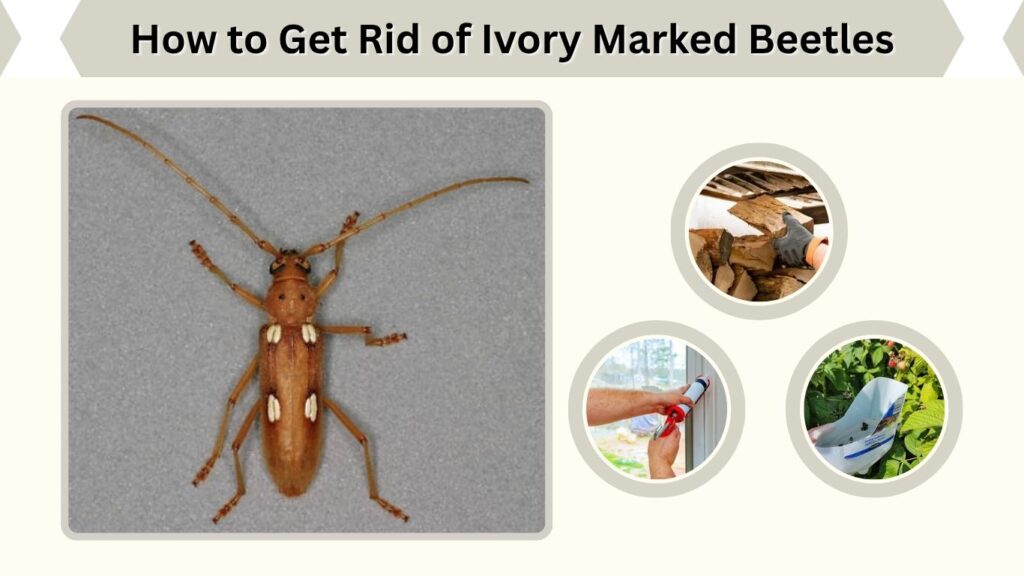
Ivory marked beetle control depends on whether insects are entering from outdoors or emerging from previously infested wooden materials.
Most isolated encounters do not require chemical treatments.
1. Remove Adult Beetles
Capture individual beetles using a container or vacuum cleaner.
Release them outdoors if appropriate, or dispose of collected insects safely.
2. Inspect Wooden Materials
Examine furniture, flooring, doors, and stored hardwood for fresh exit holes.
If multiple beetles emerge from the same object, arrange a professional inspection to identify the source.
3. Store Firewood Properly
Keep firewood outdoors and away from exterior walls.
Bring indoors only the quantity needed for immediate use.
Avoid transporting untreated firewood between distant locations.
4. Seal Entry Points
Repair damaged window screens and seal gaps around doors.
Reducing unnecessary nighttime lighting near entrances may also help limit beetles attracted to the building.
5. Seek Professional Pest Control When Necessary
If repeated beetle emergence causes significant damage to valuable wooden materials, consult a licensed pest-management professional.
Treatment may involve evaluating, repairing, or replacing affected wood.
Routine indoor insecticide spraying is generally unnecessary for isolated ivory marked beetle sightings.
Lesser Ivory Marked Beetle vs. Ivory Marked Beetle
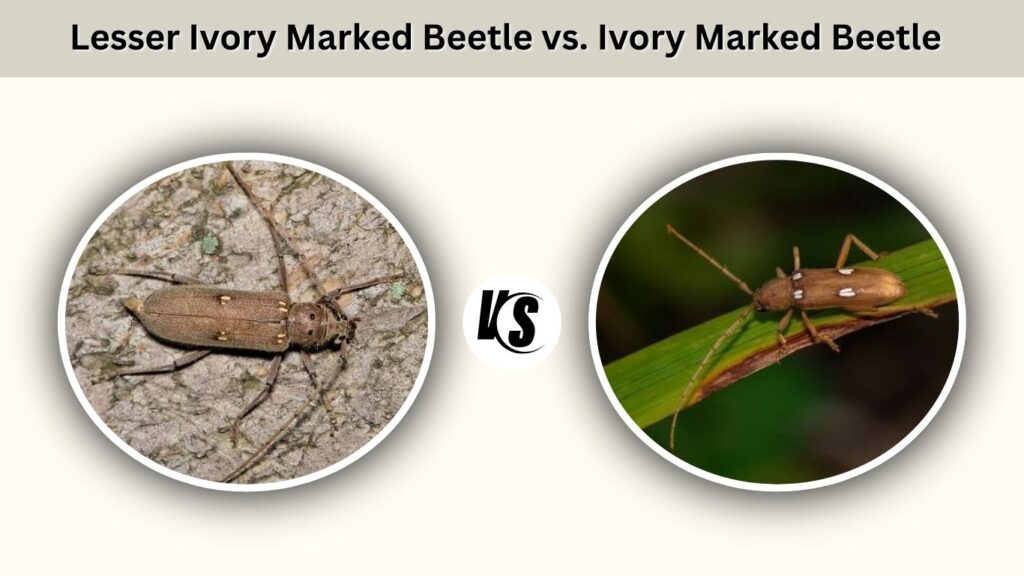
The lesser ivory-marked beetle (Eburia mutica) is a related longhorn beetle that resembles the common ivory marked beetle.
Both species have elongated bodies, long antennae, and pale markings on their wing covers.
| Feature | Ivory Marked Beetle | Lesser Ivory-Marked Beetle |
| Scientific name | Coeleburia quadrigeminata (formerly Eburia) | Eburia mutica |
| Body color | Tan to golden-brown | Often grayish-brown |
| Ivory spots | Usually prominent | Often smaller or less conspicuous |
| Range | Mainly eastern North America | South-central U.S. into Mexico |
| Larval habitat | Hardwood heartwood | Dead branches of various trees |
Because their markings can vary, accurate identification may require examining detailed photographs or consulting an insect specialist.
Ivory Marked Beetle Habitat and Geographic Range
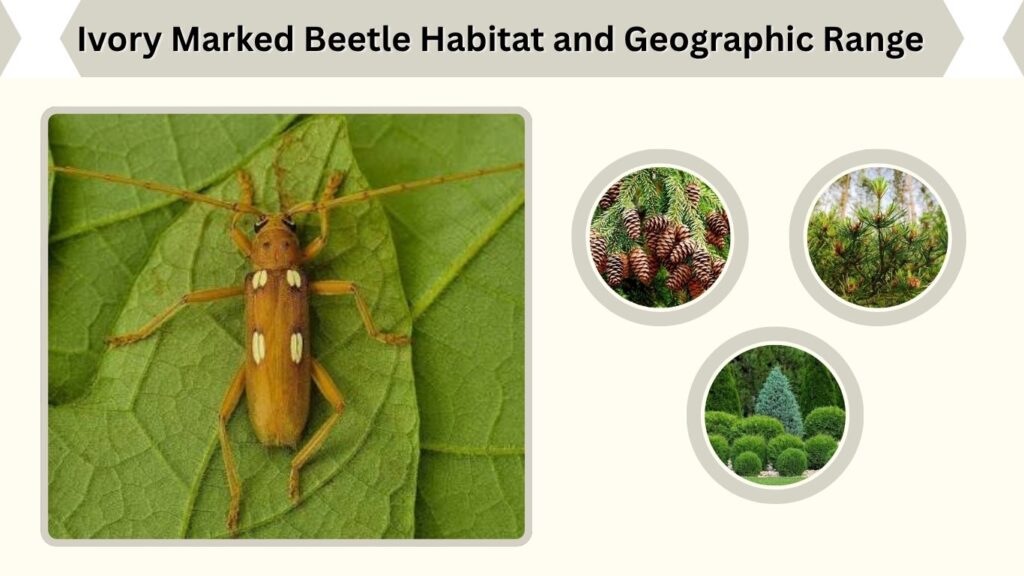
Ivory marked beetles occur throughout much of the eastern and central United States.
They have been recorded in states including Kentucky, Ohio, New Jersey, Missouri, Texas, and Florida.
Their preferred habitats include deciduous forests, wooded residential areas, and locations containing dead hardwood.
Common host trees include oak, hickory, ash, maple, cherry, elm, and locust.
Adults are primarily active at night and may be attracted to porch lights or illuminated windows.
As native insects, they also contribute to the natural breakdown of dead wood in forest ecosystems.
Ivory Marked Beetle Spiritual Meaning
In symbolic interpretations, the ivory marked beetle may be associated with patience, transformation, resilience, and personal growth.
These interpretations are inspired by the beetle’s long developmental period and transformation from larva to adult.
However, there is no established scientific or universal spiritual meaning specifically associated with ivory marked beetles.
Any symbolic significance depends on personal beliefs and cultural traditions rather than the insect’s biological characteristics.
FAQs
1. Are Ivory Marked Beetles Harmful to Humans?
No. Ivory marked beetles are generally harmless to humans. They are not venomous, do not sting, and rarely bite unless handled roughly.
2. Are Ivory Marked Beetles Dangerous to Cats?
Ivory marked beetles are not known to be poisonous to cats. However, pets should be discouraged from eating insects because ingestion may cause irritation or digestive discomfort.
3. Can Ivory Marked Beetles Fly?
Yes. Adult ivory marked beetles have functional wings beneath their hardened wing covers. They can fly and are frequently attracted to artificial lights at night.
4. Are Ivory Marked Beetles Household Pests?
They can occasionally damage finished hardwood when larvae already present in the wood complete development. However, they are not typical household pests that continuously reproduce in dry indoor furniture.
5. Which States Have Ivory Marked Beetles?
Ivory marked beetles are native to much of eastern and central North America. They occur in states such as Kentucky, Ohio, New Jersey, Missouri, Florida, and Texas, along with many surrounding regions.