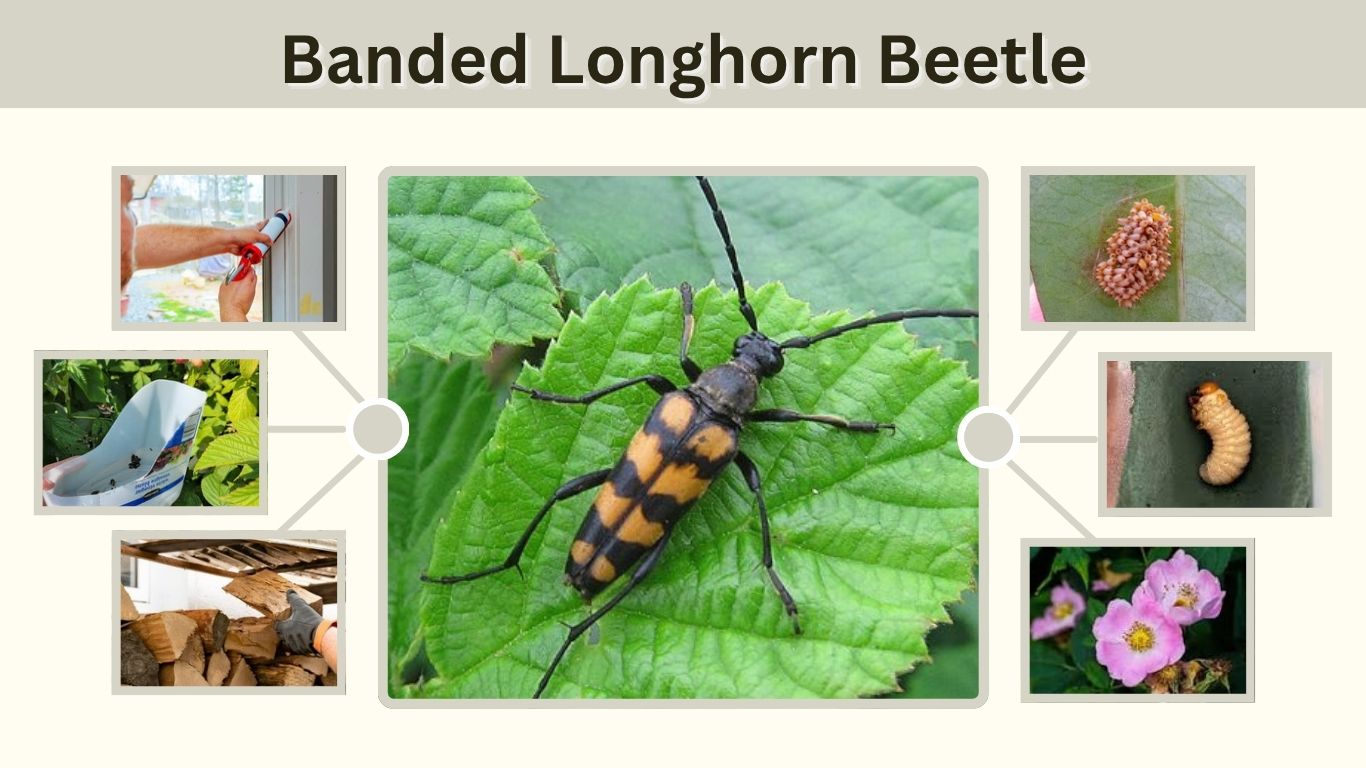
The banded longhorn beetle is a colorful wood-associated insect known for its yellow-striped body, long antennae, and habit of visiting flowers. Often seen in gardens, meadows, and woodland edges, this beetle plays a useful role in nature by feeding on flowers and helping decompose dead wood. Although its unusual appearance may cause concern, it is generally harmless to humans and healthy trees. Understanding banded longhorn beetle identification, feeding habits, life cycle, habitat, and related species can help you recognize these fascinating insects.
What Is a Banded Longhorn Beetle?
The banded longhorn beetle (Typocerus velutinus) belongs to the family Cerambycidae and the subfamily Lepturinae, commonly known as flower longhorn beetles.
It is native to North America and frequently appears on wildflowers during late spring and summer.
Unlike many destructive wood-boring beetles, this species primarily develops in decaying wood. Adult beetles feed on nectar and pollen, while larvae consume deteriorating woody material.
Banded longhorn beetles are generally considered beneficial insects because they participate in flower pollination and deadwood decomposition.
Banded Longhorn Beetle Identification
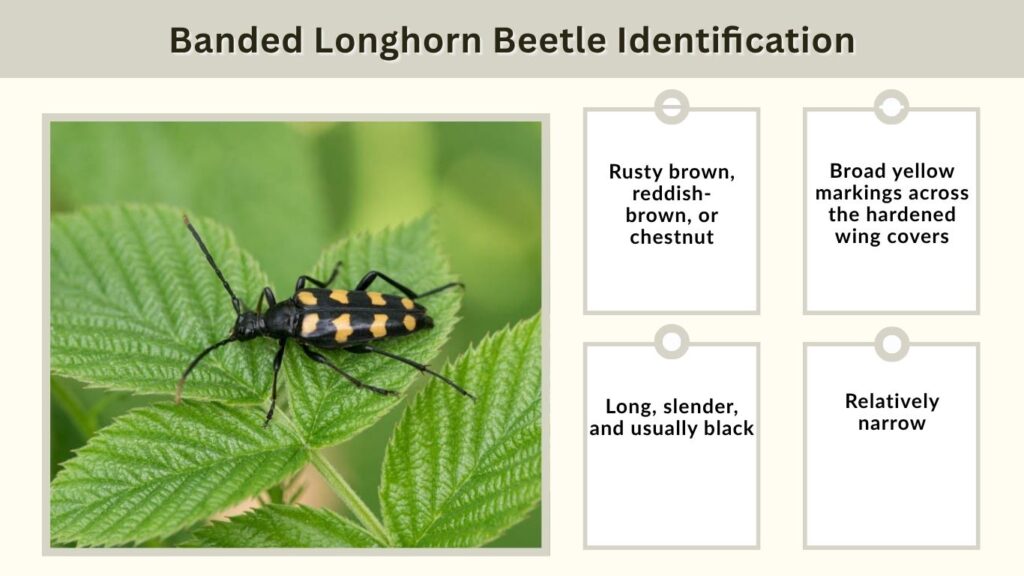
Banded longhorn beetles have distinctive yellow and reddish-brown markings that help distinguish them from many other beetles.
Their elongated bodies, narrow legs, and prominent antennae give them a somewhat wasp-like appearance.
Adult Banded Longhorn Beetle Appearance
Adult banded longhorn beetles typically measure 8–14 millimeters long, although individual sizes vary.
Key identification features include:
- Body color: Rusty brown, reddish-brown, or chestnut.
- Yellow bands: Broad yellow markings across the hardened wing covers.
- Antennae: Long, slender, and usually black.
- Head: Dark-colored, with prominent eyes and mouthparts.
- Thorax: Relatively narrow, often covered with fine golden hairs.
- Legs: Long and slender, commonly tan to reddish-brown.
- Body shape: Elongated, tapering toward the rear.
The yellow markings may vary in shape and intensity. Some individuals have well-defined bands, while others display broken or reduced markings.
Banded Longhorn Beetle Larvae
Banded longhorn beetle larvae are pale, soft-bodied grubs that develop inside decaying wood.
Their bodies are elongated, with a somewhat enlarged thoracic region and small, hardened mouthparts.
Unlike adult beetles, larvae have no functional walking legs and remain concealed within their wooden habitat.
They gradually develop by feeding on deteriorating wood until they are ready to pupate.
Banded Longhorn Beetle Life Cycle
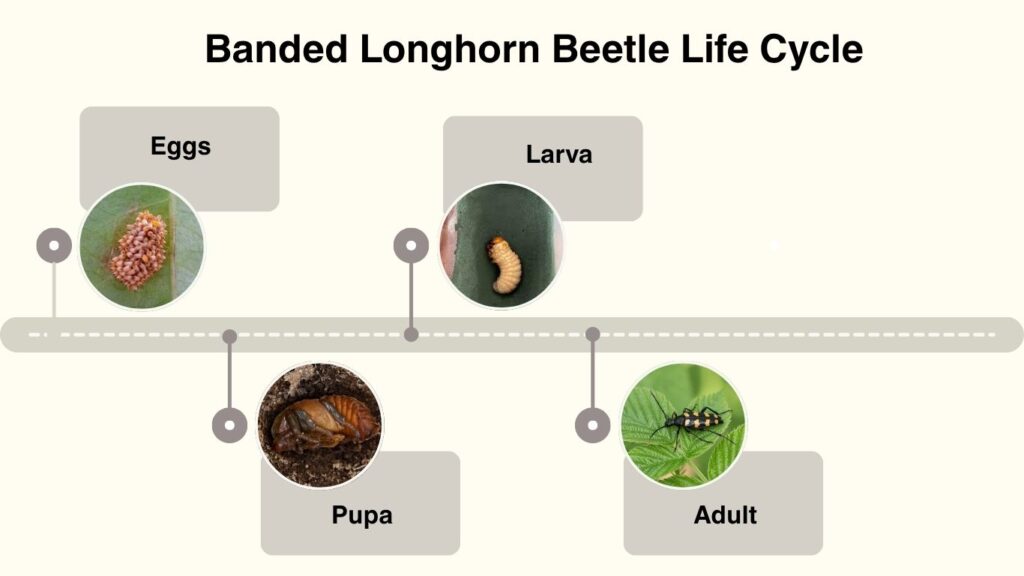
Banded longhorn beetles undergo complete metamorphosis involving four developmental stages: egg, larva, pupa, and adult.
Their life cycle is closely associated with dead or decaying woody material.
1. Egg Stage
Female beetles deposit eggs in suitable cracks or crevices in deteriorating wood.
These protected locations provide newly hatched larvae with immediate access to food.
2. Larval Stage
After hatching, larvae tunnel through wood while feeding.
They consume decaying woody material and gradually grow through several developmental stages.
The length of larval development depends on environmental conditions and wood quality.
3. Pupal Stage
Mature larvae construct protected chambers inside the wood, where they transform into pupae.
During this stage, adult body structures, including wings, legs, and antennae, develop.
4. Adult Stage
Adult beetles emerge from the wood and begin searching for flowers, mates, and breeding locations.
Adults are usually observed from May through September, depending on regional temperatures.
What Do Banded Longhorn Beetles Eat?
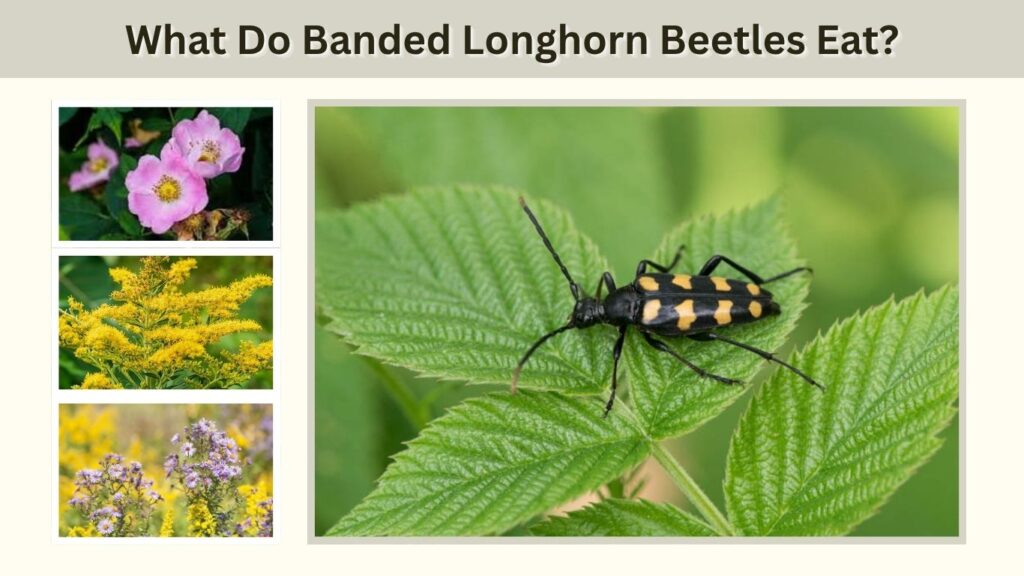
Banded longhorn beetles have different feeding habits during their adult and larval stages.
Adult beetles primarily consume nectar and pollen from flowering plants. Their visits can help transfer pollen between flowers.
Common flower sources include:
- Wild roses
- Queen Anne’s lace
- Goldenrod
- Asters
- Other open, pollen-rich wildflowers
Their long legs and slender bodies allow them to move easily across flower clusters.
Larvae, however, feed inside dead and decomposing wood.
Common developmental substrates include decaying oak, hickory, birch, and poplar wood.
By breaking down deteriorating wood, larvae contribute to natural nutrient recycling.
Do Banded Longhorn Beetles Bite or Sting?
Banded longhorn beetles do not have stingers and are not venomous.
They are not aggressive toward humans and generally attempt to escape when disturbed.
However, like other longhorn beetles, they possess chewing mouthparts and may deliver a minor defensive pinch if handled roughly.
A bite is uncommon and generally causes little more than brief discomfort.
If a beetle pinches your skin, gently wash the area with soap and water.
Avoid squeezing or grabbing these insects with bare hands. Instead, allow them to crawl onto a leaf or other surface if relocation is necessary.
Are Banded Longhorn Beetles Good or Bad?
Banded longhorn beetles are generally considered beneficial rather than harmful.
Adults visit flowers for nectar and pollen, potentially helping with pollination.
Their larvae participate in the decomposition of dead wood, contributing to healthy woodland ecosystems.
Unlike major forest pests, Typocerus velutinus does not normally attack healthy trees or cause significant structural damage.
Their presence in gardens often indicates nearby flowering plants and suitable natural habitats.
In most situations, these beetles should be left undisturbed.
Different Types of Banded Longhorn Beetles
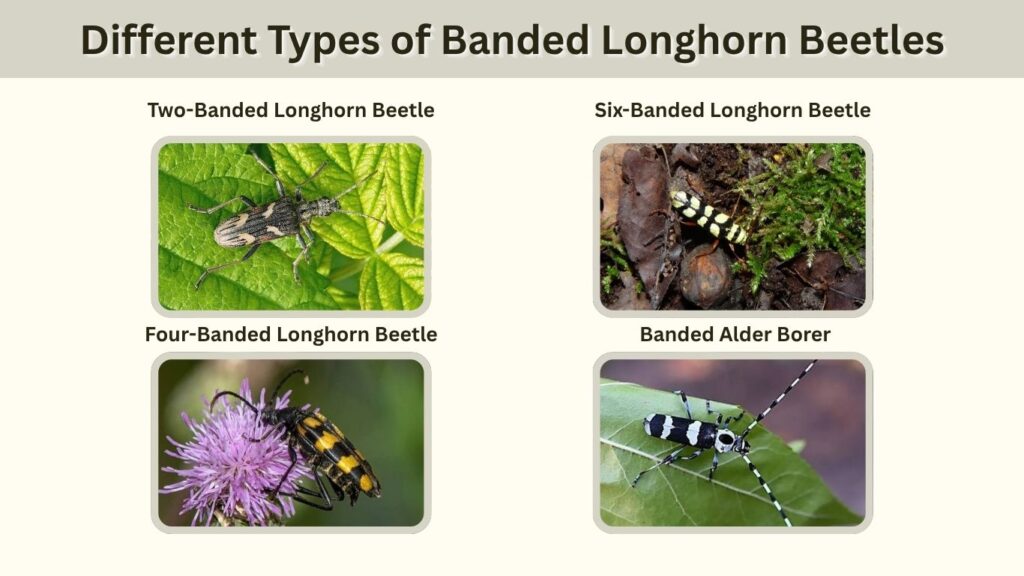
Several longhorn beetle species have banded markings. Although their common names sound similar, they are not all closely related or found in the same regions.
1. Two-Banded Longhorn Beetle
The two-banded longhorn beetle (Rhagium bifasciatum) is found in Britain and other parts of Europe.
Adults may reach approximately 22 millimeters long.
They have elongated, dark bodies with prominent pale yellow bands on their wing covers.
Their larvae develop inside dead wood, frequently from coniferous trees.
Adults are commonly observed on woodland vegetation, fallen logs, and tree trunks.
2. Four-Banded Longhorn Beetle
The four-banded longhorn beetle (Leptura quadrifasciata) is a European species recognizable by four yellow bands crossing its dark wing covers.
Adults usually measure approximately 11–20 millimeters long.
They inhabit woodlands and frequently visit flowers during summer.
Their larvae develop in dead or decaying wood from several tree species, including birch, oak, and willow.
3. Six-Banded Longhorn Beetle
The six-banded longhorn beetle (Dryobius sexnotatus) is an uncommon North American species associated with mature hardwood forests.
Adults measure approximately 18–25 millimeters long and display distinctive yellow markings against a dark body.
Its larvae develop in hardwood trees, particularly large, old sugar maples.
This species is considered rare or threatened in several areas, making habitat conservation especially important.
4. Banded Alder Borer
The banded alder borer (Rosalia funebris) is native to western North America.
It has striking black-and-white markings, exceptionally long banded antennae, and a pale thorax with a prominent dark spot.
Its larvae develop in dead or declining hardwood branches.
Despite its dramatic appearance, it is generally not considered a significant pest.
Longhorn Beetle With Red Pronotum and Black Elytra
A longhorn beetle with a red pronotum, black wing covers, and banded antennae may belong to a different species rather than the common banded longhorn.
The pronotum is the shield-like section immediately behind the head, while the elytra are the hardened wing covers.
For example, the red-necked longhorn beetle (Aromia bungii) has a bright reddish pronotum and shiny black wing covers, although its antennae are normally uniformly black.
Other longhorn beetles may have pale bands on their antennae.
Accurate identification requires examining the full body pattern, antennae, size, and geographic location.
Banded Longhorn Beetle Habitat and Range
The banded longhorn beetle occurs throughout much of eastern North America.
Its range extends from parts of eastern Canada through the eastern United States and west into portions of the central United States.
Common habitats include woodland edges, open fields, gardens, meadows, and areas containing decaying hardwood.
Adults are frequently observed on blooming flowers during warm, sunny weather.
They may also occasionally appear around outdoor lights.
Dead logs, fallen branches, and flowering vegetation provide the resources needed for different stages of development.
How to Get Rid of Banded Longhorn Beetles
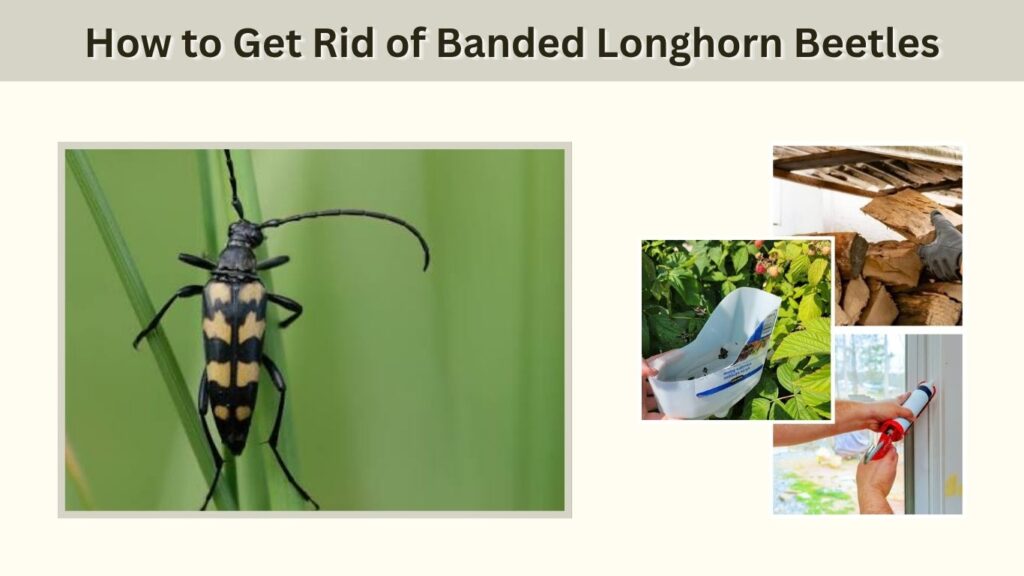
Banded longhorn beetles rarely require control because they do not normally damage healthy trees, homes, or garden plants.
However, if one enters your house, several simple methods can help.
1. Remove beetles safely: Capture individual beetles using a container and release them outdoors.
2. Inspect firewood: Check stored logs for developing wood-boring insects, particularly if beetles repeatedly emerge indoors.
3. Seal entry points: Repair damaged window screens and close gaps around exterior doors.
4. Manage outdoor lighting: Reduce unnecessary nighttime lighting near entrances if it attracts flying insects.
5. Avoid unnecessary pesticides: Chemical treatments are generally not needed for harmless flower-visiting longhorn beetles.
Preserving flowering plants and suitable deadwood away from buildings supports beneficial insects without creating household problems.
FAQs
1. Are Banded Longhorn Beetles Dangerous?
No. Banded longhorn beetles are generally harmless to humans and pets. They have no stingers or venom and rarely attempt to bite unless handled roughly.
2. Can Banded Longhorn Beetles Fly?
Yes. Adult banded longhorn beetles have functional wings beneath their hardened wing covers. They fly between flowers, wooded habitats, and suitable breeding locations.
3. Do Banded Longhorn Beetles Damage Trees?
Their larvae mainly feed on dead or decaying wood rather than healthy living trees. As a result, they are not usually considered serious tree pests.
4. Are Banded Longhorn Beetles Found in the UK?
The North American banded longhorn, Typocerus velutinus, is not native to the UK. However, Britain has other banded longhorn species, including the two-banded and four-banded longhorn beetles.
5. What Is the Scientific Name of the Banded Longhorn Beetle?
The scientific name of the banded longhorn beetle commonly found in eastern North America is Typocerus velutinus. It belongs to the longhorn beetle family Cerambycidae.