
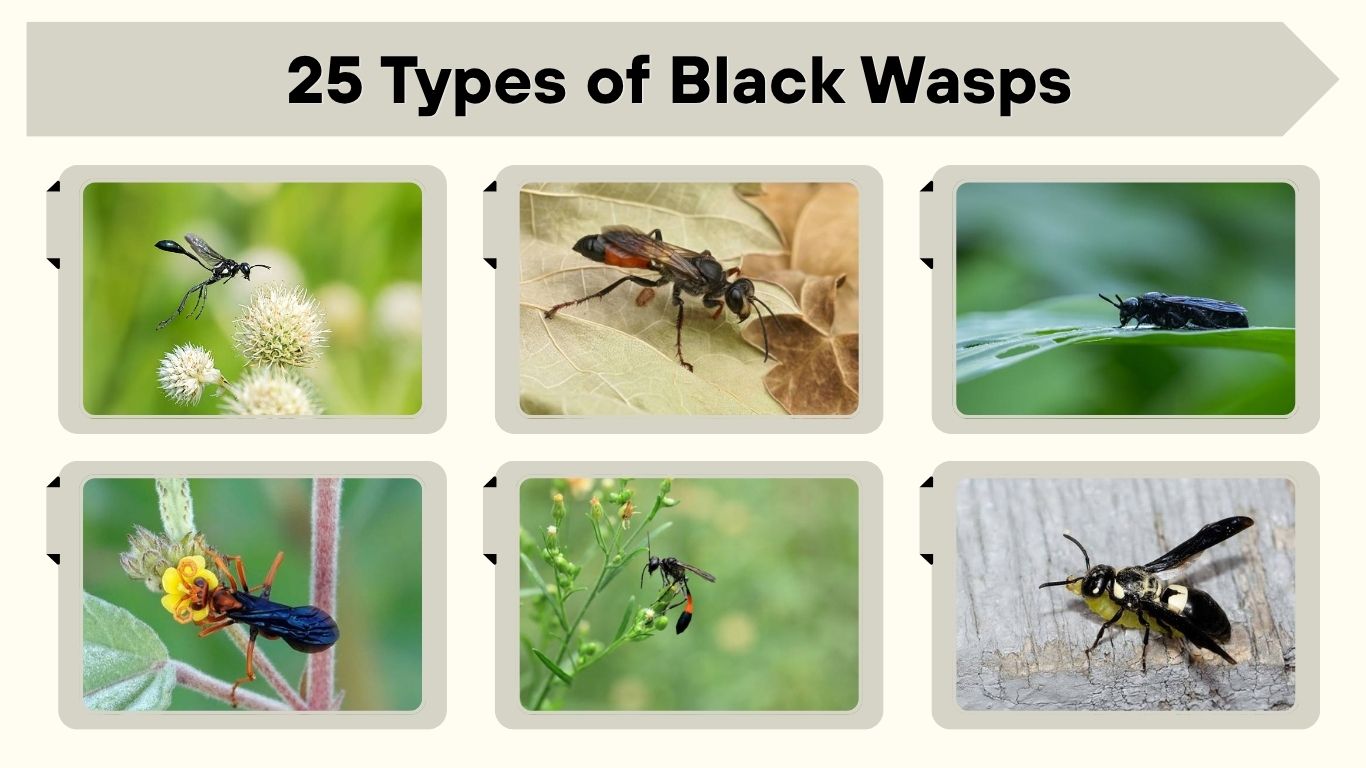
Have you ever spotted a large black wasp flying around your garden or building a nest near your home? Black wasps come in different sizes, shapes, and colors, from glossy black hunters to species with metallic blue wings or yellow markings. Some live alone, while others form colonies. In this guide, we’ll explore 25 types of black wasps, including their identification features, habitats, nesting behaviors, and lifecycles to help you recognize them more easily.
1. Great Black Wasp
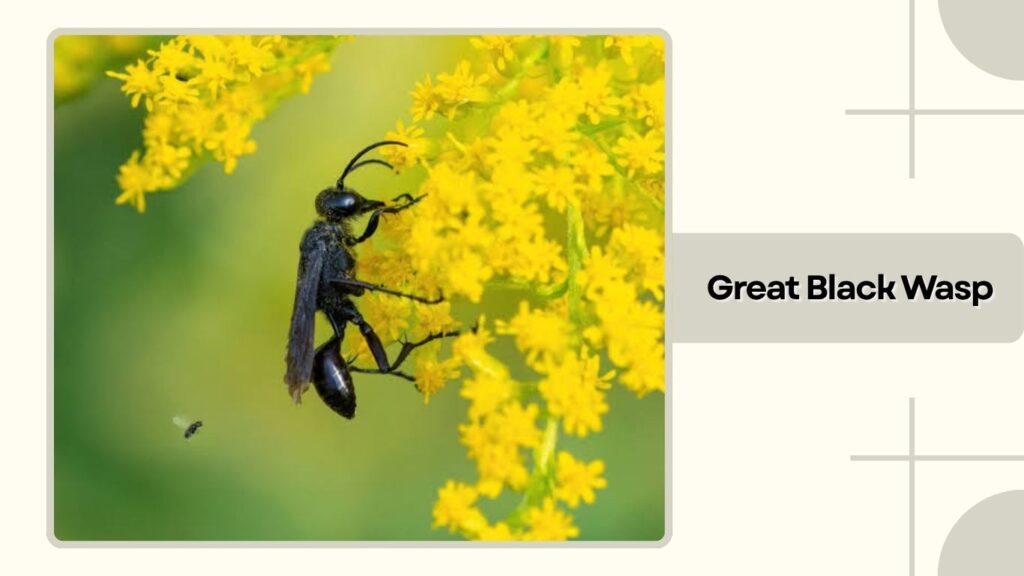
The Great Black Wasp (Sphex pensylvanicus) is a large, solitary wasp commonly found across North America. Known for its entirely black body and smoky wings, this species is frequently spotted in gardens, meadows, and open fields. Unlike social wasps, Great Black Wasps build individual underground nests and generally avoid aggressive interactions with humans.
Identification
- Scientific Name: Sphex pensylvanicus
- Size: 20–35 mm long
- Color: Entirely black with a slightly bluish sheen
- Wings: Dark, smoky black with a bluish reflection
- Body Shape: Slender waist, elongated abdomen, and long legs
- Antennae: Long, dark, and slightly curved
Habitat and Behavior
Great Black Wasps prefer sunny, open habitats such as gardens, grasslands, meadows, and woodland edges. Females dig underground burrows in loose, well-drained soil to create nesting chambers.
These wasps primarily hunt katydids and grasshoppers, which they paralyze and carry into their nests as food for developing larvae. Adults frequently visit flowers to consume nectar, making them beneficial pollinators.
Lifecycle and Reproduction
The female Great Black Wasp constructs underground nesting chambers and supplies each with paralyzed insects before laying an egg. After hatching, the larva feeds on the stored prey and develops within the protected chamber.
The larvae eventually pupate and emerge as adults during the warmer months. Great Black Wasps are solitary, and females can sting when handled or threatened, but they are generally not aggressive toward people.
2. Organ-Pipe Mud Dauber
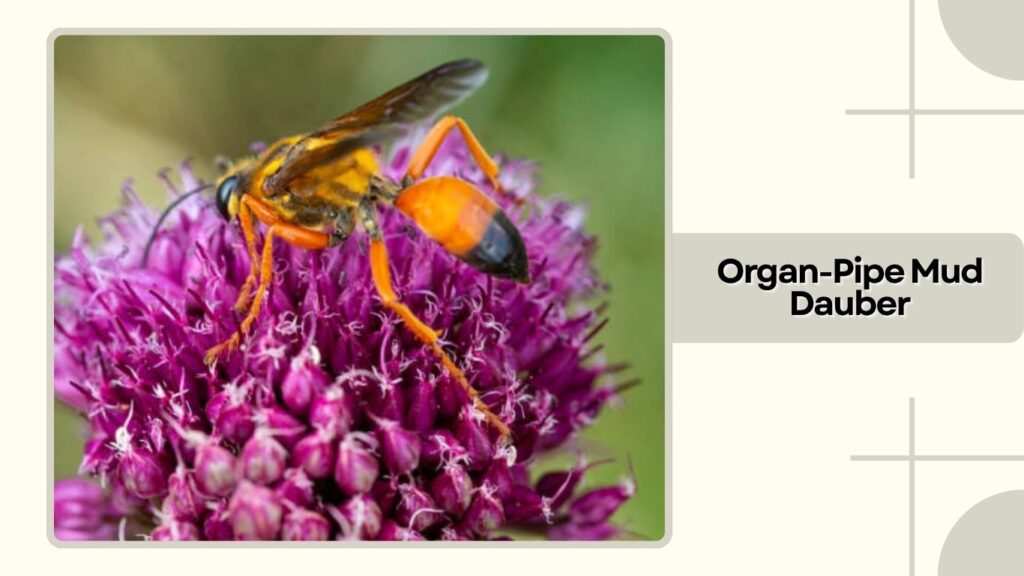
The Organ-Pipe Mud Dauber (Trypoxylon politum) is a solitary black wasp recognized for its unusual tubular mud nests. Commonly found throughout eastern North America, this species has a glossy black body and long, narrow waist. It is generally nonaggressive and plays an important role in controlling spider populations.
Identification
- Scientific Name: Trypoxylon politum
- Size: Approximately 13–25 mm long
- Color: Shiny black with occasional pale markings on the legs
- Wings: Dark, smoky wings with a subtle bluish reflection
- Body Shape: Slender waist and elongated abdomen
- Antennae: Long, thin, and black
Habitat and Behavior
Organ-Pipe Mud Daubers prefer sheltered locations such as building walls, bridges, garages, and roof overhangs. Females construct long, cylindrical mud tubes resembling the pipes of a musical organ.
These wasps primarily hunt spiders, which they paralyze using their stingers. The captured spiders are transported to nesting chambers to provide nourishment for developing larvae.
Lifecycle and Reproduction
Female Organ-Pipe Mud Daubers construct individual mud chambers and fill them with paralyzed spiders before laying eggs. Each chamber is sealed with mud after sufficient food has been stored.
After hatching, the larvae consume the spiders and eventually develop into pupae inside their chambers. Adults emerge when development is complete, usually during suitable warm-weather conditions.
3. Blue Mud Dauber
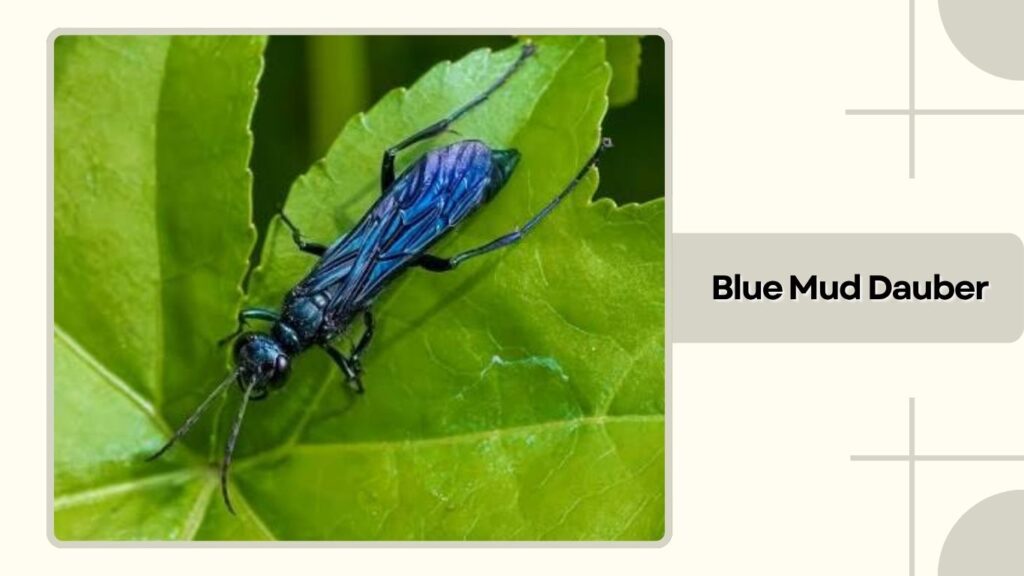
The Blue Mud Dauber (Chalybion californicum) is a striking solitary wasp recognized by its metallic blue-black body. Found throughout much of North America, this species frequently visits gardens, flowering plants, and sheltered buildings. Unlike many other mud daubers, it commonly reuses abandoned mud nests instead of constructing entirely new ones.
Identification
- Scientific Name: Chalybion californicum
- Size: Approximately 10–23 mm long
- Color: Metallic blue-black with a shiny appearance
- Wings: Dark blue or purple with an iridescent reflection
- Body Shape: Slender body with a narrow waist
- Antennae: Long, curved, and dark-colored
Habitat and Behavior
Blue Mud Daubers commonly inhabit gardens, meadows, woodland edges, and residential areas. They often inspect existing mud nests beneath roof overhangs, inside sheds, or on protected walls.
Females specialize in hunting spiders, including black widows. Adults primarily feed on flower nectar and rarely behave aggressively toward people unless physically threatened.
Lifecycle and Reproduction
Female Blue Mud Daubers renovate existing mud chambers and supply them with paralyzed spiders before laying their eggs.
Once the eggs hatch, larvae consume the stored spiders and gradually develop within the sealed chambers. They eventually enter the pupal stage before emerging as mature wasps.
This species generally lives independently rather than forming large colonies. Its spider-hunting behavior makes it a useful natural predator around gardens and buildings.
4. Mexican Grass-Carrying Wasp
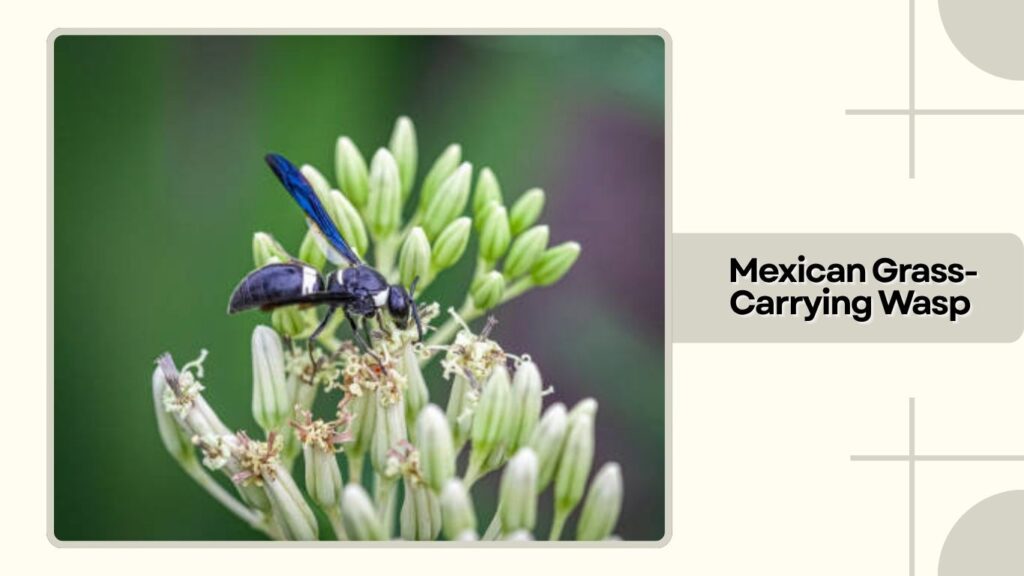
The Mexican Grass-Carrying Wasp (Isodontia mexicana) is a solitary black wasp known for carrying dry grass into its nesting cavities. Originally native to North America, this species has also become established in parts of Europe. Its slender black body, smoky wings, and unusual nesting behavior make it recognizable among black wasps.
Identification
- Scientific Name: Isodontia mexicana
- Size: Approximately 15–20 mm long
- Color: Predominantly black with a slight bluish sheen
- Wings: Dark, smoky wings
- Body Shape: Slender waist, elongated abdomen, and long legs
- Antennae: Long, black, and slightly curved
Habitat and Behavior
Mexican Grass-Carrying Wasps commonly inhabit gardens, meadows, woodland edges, and areas containing hollow plant stems or abandoned insect tunnels.
Unlike ground-nesting wasps, females use existing cavities and line them with dry grass. They frequently hunt tree crickets and other small orthopteran insects, paralyzing them to provide food for their offspring.
Lifecycle and Reproduction
The female selects a suitable nesting cavity and places paralyzed insects inside before laying an egg. She separates individual brood chambers using pieces of dry grass.
After hatching, the larvae feed on the stored insects and develop inside their protected chambers. They eventually pupate before emerging as adults.
These wasps do not establish social colonies and are generally peaceful around humans.
5. Steel-Blue Cricket Hunter
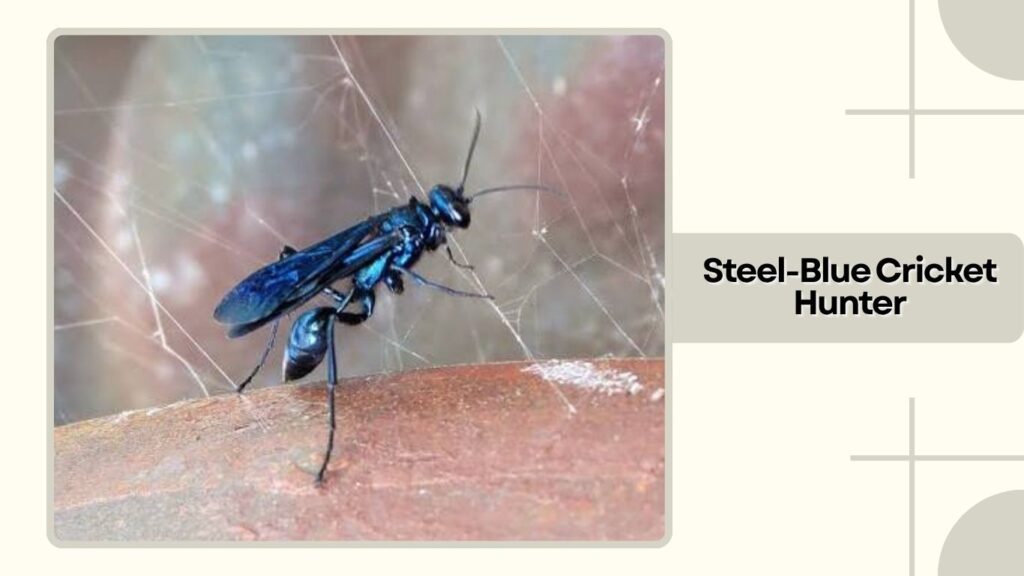
The Steel-Blue Cricket Hunter (Chlorion aerarium) is a solitary wasp recognized for its metallic blue-black body and specialized cricket-hunting behavior. Widely distributed across North America, this species is frequently observed in open grasslands, sandy areas, and meadows. Its slender appearance and dark iridescent wings make it easily confused with Blue Mud Daubers.
Identification
- Scientific Name: Chlorion aerarium
- Size: Approximately 15–30 mm long
- Color: Metallic blue-black with a glossy finish
- Wings: Dark blue with an iridescent reflection
- Body Shape: Slender waist, elongated abdomen, and long legs
- Antennae: Long, black, and slightly curved
Habitat and Behavior
Steel-Blue Cricket Hunters prefer open habitats such as meadows, grasslands, sandy fields, and woodland edges. Females construct underground burrows, sometimes branching from existing cicada killer nesting tunnels.
These wasps primarily hunt field crickets, which they immobilize using venomous stings. Captured crickets are transported into underground chambers where they serve as food for developing larvae.
Lifecycle and Reproduction
Female Steel-Blue Cricket Hunters prepare underground nesting chambers and supply them with several paralyzed crickets before laying an egg.
Once the egg hatches, the larva feeds on the stored prey and gradually develops within the chamber. It eventually pupates and emerges as an adult.
These wasps live independently and generally avoid confrontation with humans unless threatened or handled.
6. Four-Toothed Mason Wasp
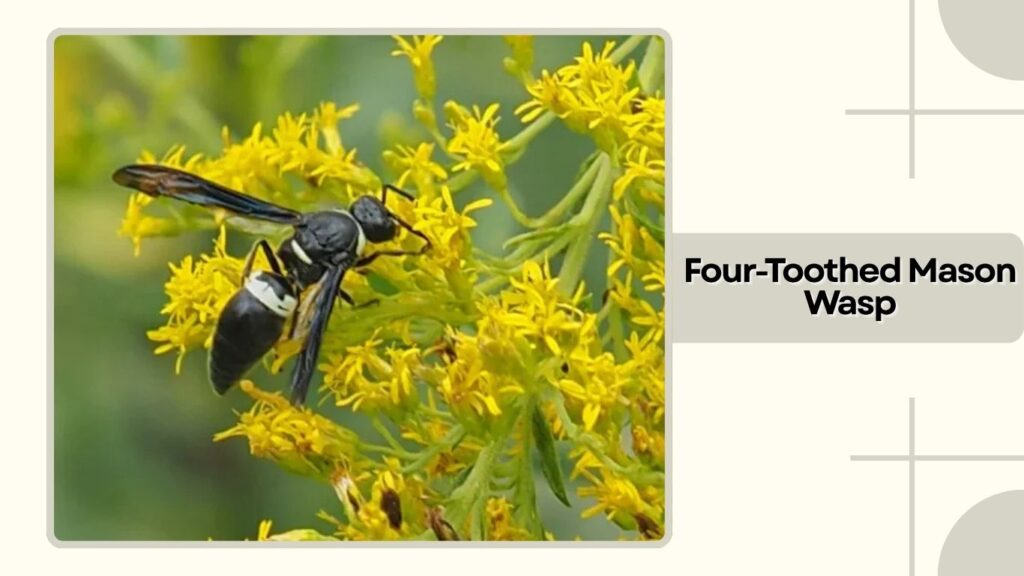
The Four-Toothed Mason Wasp (Monobia quadridens) is a solitary black wasp distinguished by its prominent white abdominal band. Commonly found across eastern North America, this species frequently visits gardens, flowering plants, and wooded areas. Its distinctive markings and caterpillar-hunting behavior make it an interesting member of the mason wasp group.
Identification
- Scientific Name: Monobia quadridens
- Size: Approximately 15–20 mm long
- Color: Glossy black with a broad white abdominal band
- Wings: Dark, smoky wings with a subtle purplish sheen
- Body Shape: Compact thorax, narrow waist, and elongated abdomen
- Antennae: Dark-colored, with curved tips in males
Habitat and Behavior
Four-Toothed Mason Wasps commonly inhabit gardens, woodland edges, open fields, and residential landscapes. Females frequently select existing cavities in wood, abandoned insect tunnels, or other sheltered openings for nesting.
These wasps primarily hunt caterpillars, particularly those associated with leaf-rolling moths. Adults consume nectar from flowers and contribute to pollination while searching for food.
Lifecycle and Reproduction
Female Four-Toothed Mason Wasps place paralyzed caterpillars inside nesting chambers before laying their eggs. The chambers are separated and sealed using mud partitions.
After hatching, larvae feed on the stored caterpillars and develop within their protected nests. They eventually enter the pupal stage before emerging as adults.
Unlike social wasps, this species does not form large defensive colonies and is generally nonaggressive toward humans.
7. Black Potter Wasp
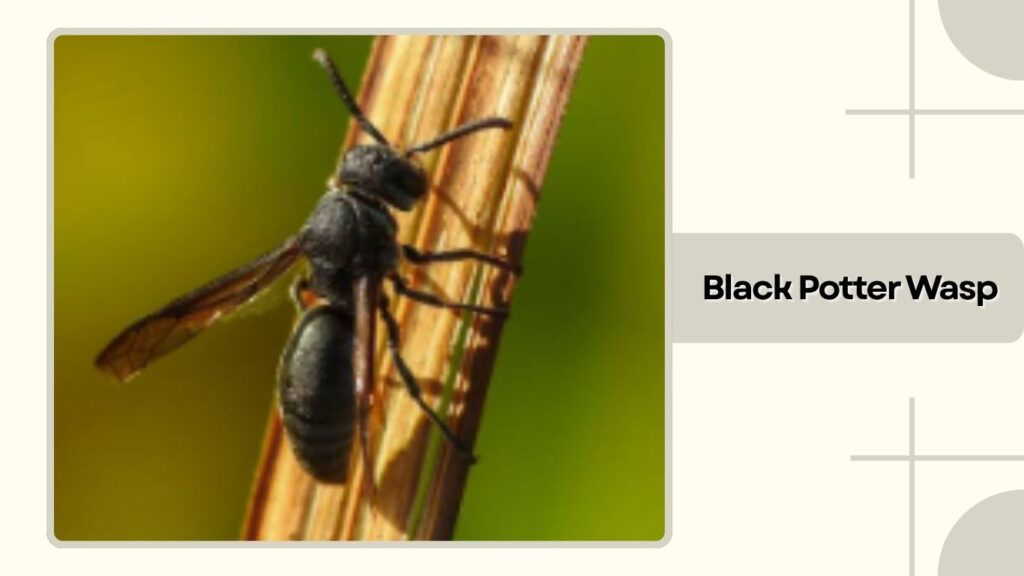
The Black Potter Wasp (Delta pyriforme philippinense) is a solitary wasp known for its dark body and distinctive mud nests. Found in parts of Southeast Asia, particularly the Philippines, this wasp builds small, pot-shaped structures to protect its developing offspring. Its caterpillar-hunting behavior makes it beneficial for natural pest control in gardens and agricultural environments.
Identification
- Scientific Name: Delta pyriforme philippinense
- Size: Medium to large wasp
- Color: Predominantly black with some orange markings
- Wings: Dark brown to smoky-colored
- Body Shape: Slender waist with a rounded abdomen
- Antennae: Long and often orange-colored
Habitat and Behavior
Black Potter Wasps commonly inhabit gardens, farmland, woodland edges, and residential areas. Females construct mud nests on sheltered surfaces, including walls, rocks, and other structures.
These wasps primarily hunt caterpillars, which they paralyze and transport into their nesting chambers. Adults visit flowers for nectar and generally avoid confrontation with humans.
Lifecycle and Reproduction
Female Black Potter Wasps construct individual mud chambers and lay an egg inside each chamber. They provide paralyzed caterpillars as food for their developing larvae.
After hatching, the larvae consume the stored prey and gradually mature. They eventually pupate within the protected mud chambers before emerging as adults.
Unlike social wasps, Black Potter Wasps live independently and do not establish large colonies.
8. Black Spider Wasp
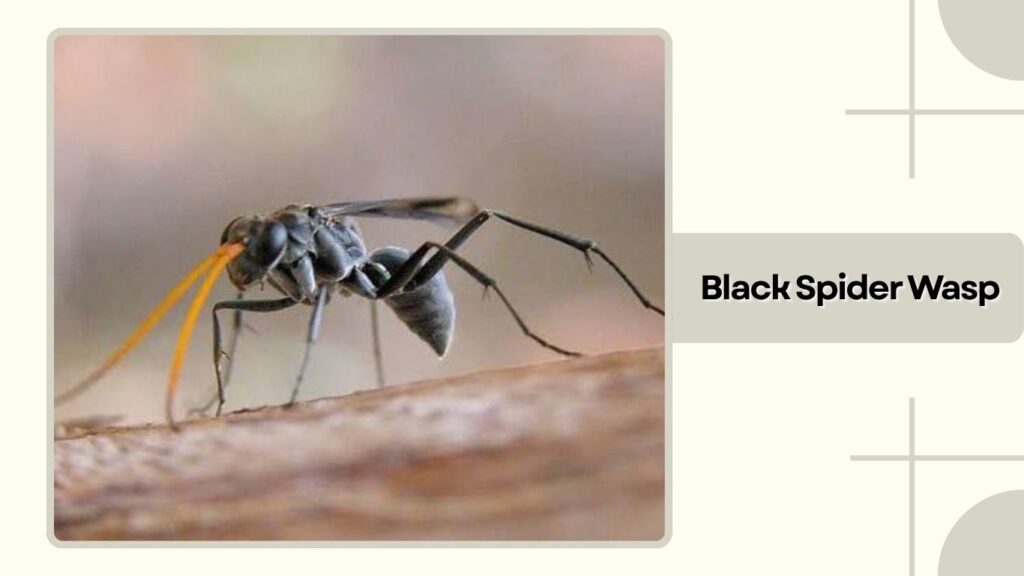
The Black Spider Wasp (Anoplius nigerrimus), also called the Common Black Spider Wasp, is a solitary hunting wasp belonging to the family Pompilidae. Known for its predominantly black body and spider-hunting behavior, this species occurs across parts of Europe, Asia, and North America. It plays an important ecological role by regulating spider populations.
Identification
- Scientific Name: Anoplius nigerrimus
- Size: Approximately 5–11 mm long
- Color: Predominantly black with fine dark hairs
- Wings: Transparent to slightly smoky
- Body Shape: Slender body with long legs
- Antennae: Dark, elongated, and slightly curved
Habitat and Behavior
Black Spider Wasps inhabit grasslands, gardens, woodland clearings, and areas with exposed soil. They frequently search through low vegetation and ground surfaces for spiders.
Females hunt various spiders, including wolf spiders and ground spiders. They immobilize their prey using venom and transport it to a suitable nesting location.
These wasps usually remain solitary and rarely show aggression toward humans unless directly threatened.
Lifecycle and Reproduction
Female Black Spider Wasps prepare nesting chambers beneath stones, inside abandoned insect burrows, or within loose soil.
A paralyzed spider is placed inside a chamber, where the female lays an egg. After hatching, the larva feeds on the spider while developing.
The larva eventually pupates within its protected nesting chamber. Once development is complete, the adult emerges and begins hunting or searching for mates.
9. Black Giant Ichneumon Wasp
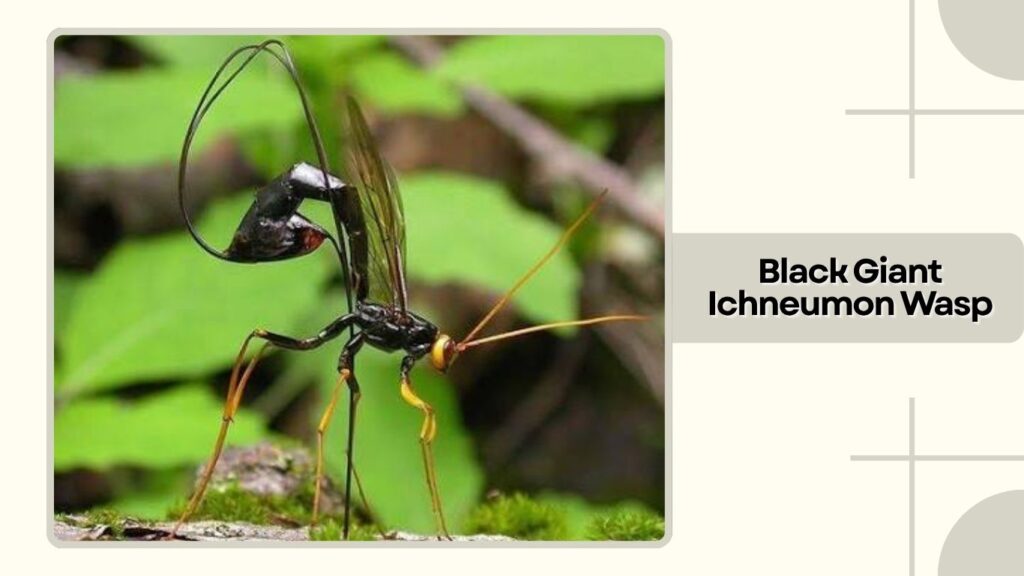
The Black Giant Ichneumon Wasp (Megarhyssa atrata) is a remarkable parasitic wasp recognized for its slender black body and extremely long egg-laying organ. Commonly found in deciduous forests across eastern North America, this species is often observed on tree trunks. Despite its intimidating appearance, it is harmless to humans and helps control wood-boring insect populations.
Identification
- Scientific Name: Megarhyssa atrata
- Size: Approximately 35–40 mm in body length
- Color: Glossy black body with a yellowish head
- Wings: Dark, transparent, or smoky-colored
- Body Shape: Long, narrow abdomen with slender legs
- Ovipositor: Extremely long in females, sometimes reaching 130 mm
Habitat and Behavior
Black Giant Ichneumon Wasps primarily inhabit deciduous forests, woodland edges, and areas containing dead or weakened trees.
Females use their exceptionally long ovipositors to locate wood-boring larvae hidden beneath tree bark. They can penetrate wood to deposit eggs near suitable hosts.
Although the ovipositor resembles a dangerous stinger, it is specialized for egg-laying rather than attacking humans.
Lifecycle and Reproduction
Female Black Giant Ichneumon Wasps deposit eggs on the larvae of wood-boring insects, particularly pigeon horntails.
After hatching, the wasp larva feeds on its host and gradually develops. It eventually pupates within the wood before emerging as an adult.
This parasitic lifecycle helps regulate wood-boring insect populations naturally.
10. American Pelecinid Wasp
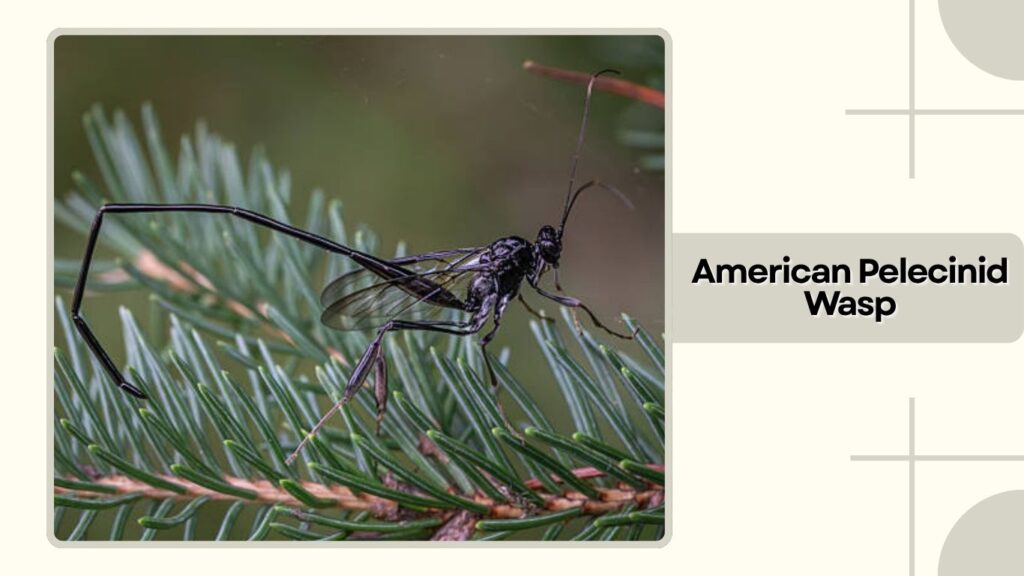
The American Pelecinid Wasp (Pelecinus polyturator) is a distinctive black parasitic wasp recognized for its unusually long, slender abdomen. Found throughout much of North, Central, and South America, this species is frequently observed near forests, gardens, and grassy areas. Despite its unusual appearance, it poses little threat to humans.
Identification
- Scientific Name: Pelecinus polyturator
- Size: Females approximately 51–62 mm long
- Color: Glossy black throughout the body
- Wings: Short, transparent, and slightly smoky
- Body Shape: Extremely long, thin, segmented abdomen
- Antennae: Long, slender, and dark-colored
Habitat and Behavior
American Pelecinid Wasps commonly inhabit deciduous forests, woodland edges, gardens, and open grassy environments. Adults may be observed flying slowly near vegetation or searching along the ground.
Females use their elongated abdomens to locate beetle grubs living beneath the soil surface. Adult wasps may consume nectar from flowering plants.
Unlike many stinging wasps, American Pelecinid Wasps do not possess functional defensive stingers.
Lifecycle and Reproduction
Female American Pelecinid Wasps insert their long abdomens into soil to deposit eggs on beetle larvae, particularly June beetle grubs.
After hatching, the wasp larva develops by feeding on its host, eventually killing it.
The developing wasp then pupates underground before emerging as an adult. In some North American populations, females can reproduce without mating, a process known as parthenogenesis.
11. Black-Headed Mason Wasp
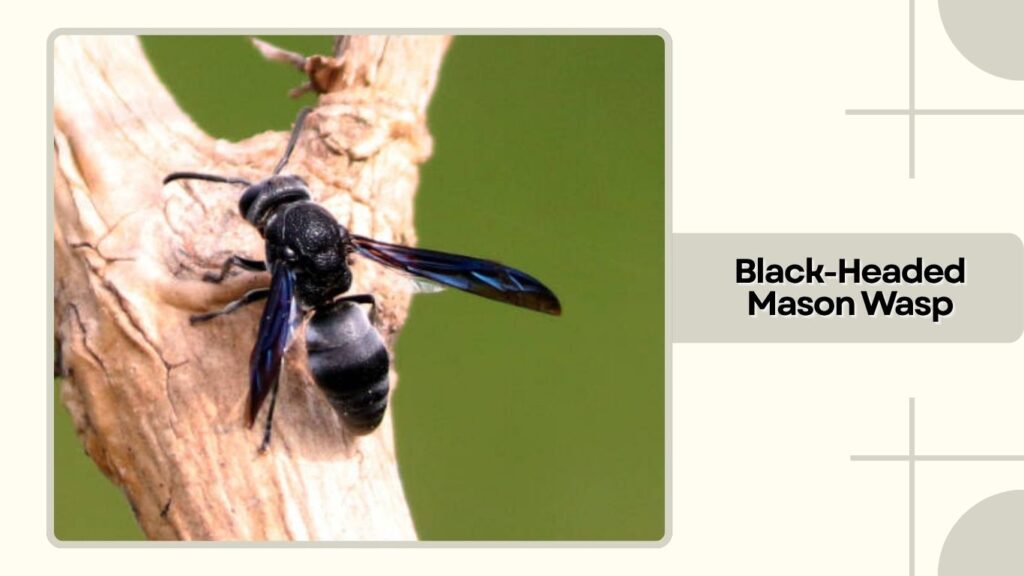
The Black-Headed Mason Wasp (Odynerus melanocephalus) is a solitary wasp recognized for its dark head, black body, and pale abdominal markings. Found in parts of Europe and neighboring regions, this species prefers open habitats with exposed clay-rich soil. Its underground nesting habits and insect-hunting behavior make it an important natural predator.
Identification
- Scientific Name: Odynerus melanocephalus
- Size: Approximately 8–11 mm long
- Color: Black with whitish-yellow abdominal bands
- Wings: Transparent with a slightly smoky appearance
- Body Shape: Compact thorax with a narrow waist
- Antennae: Dark with lighter coloring near the base
Habitat and Behavior
Black-Headed Mason Wasps inhabit grasslands, heathlands, open fields, coastal habitats, and disturbed areas containing clay-rich soil.
Females excavate underground nesting chambers and construct short, chimney-like entrances using excavated soil.
These wasps primarily collect weevil larvae and occasionally small caterpillars to provision their nests. Adults also visit flowering plants, including wild carrot and clover, for nectar.
Lifecycle and Reproduction
Female Black-Headed Mason Wasps create individual underground brood chambers and supply them with insect larvae before laying their eggs.
After hatching, the developing wasp larvae consume the stored prey and grow inside their protected chambers.
They eventually enter the pupal stage and emerge as adults during suitable seasonal conditions.
As solitary wasps, they do not establish large colonies and are generally nonaggressive toward humans.
12. Black-and-White Mason Wasp
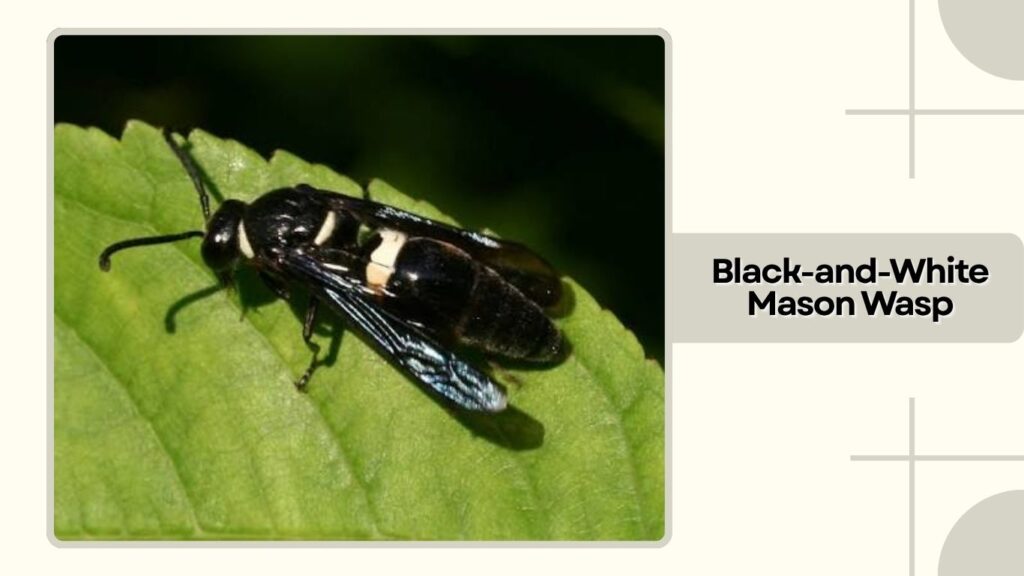
The Black-and-White Mason Wasp (Euodynerus leucomelas) is a solitary wasp recognized for its contrasting black and white markings. Found across Canada and parts of the United States, this species commonly nests in existing cavities in wood. Its caterpillar-hunting behavior helps regulate populations of small insects in natural environments.
Identification
- Scientific Name: Euodynerus leucomelas
- Size: Approximately 10–12 mm long
- Color: Black with distinctive white markings
- Wings: Transparent to slightly smoky
- Body Shape: Compact thorax with a narrow waist
- Antennae: Dark-colored and slightly curved
Habitat and Behavior
Black-and-White Mason Wasps inhabit woodland edges, gardens, grasslands, and areas containing dead wood or hollow plant stems. Females use existing tunnels in wood rather than constructing exposed mud nests.
These wasps hunt small caterpillars, which they paralyze and carry into nesting chambers. Adults may visit flowers to obtain nectar.
They generally avoid human interaction and do not form aggressive social colonies.
Lifecycle and Reproduction
Female Black-and-White Mason Wasps select suitable nesting cavities and divide them into individual chambers using mud partitions.
Each chamber receives paralyzed caterpillars and an egg. After hatching, the larva consumes the stored food and develops inside the protected nest.
The larva eventually pupates before emerging as an adult. These wasps reproduce independently, and their nesting activities contribute to natural caterpillar population control.
13. Blue-Winged Wasp
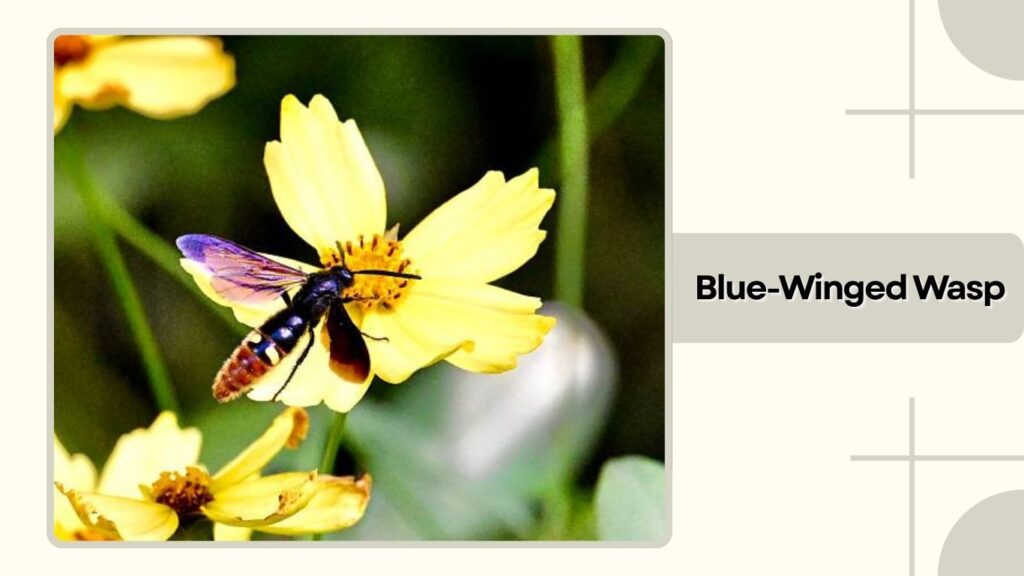
The Blue-Winged Wasp (Scolia dubia) is a solitary parasitic wasp recognized by its metallic blue wings and distinctive black-and-reddish body. Commonly found across eastern North America, this species frequently visits flowering plants during summer. It is especially beneficial because its larvae develop by feeding on beetle grubs living underground.
Identification
- Scientific Name: Scolia dubia
- Size: Approximately 20–25 mm long
- Color: Black head and thorax with reddish-orange abdominal sections
- Wings: Metallic blue or violet with an iridescent appearance
- Body Shape: Sturdy thorax with a slightly elongated abdomen
- Antennae: Dark-colored, longer in males
Habitat and Behavior
Blue-Winged Wasps prefer gardens, lawns, meadows, and open grassy areas where beetle larvae are abundant.
Adult wasps frequently visit goldenrod, milkweed, and other flowering plants for nectar. Females search underground for beetle grubs, particularly Japanese beetle and green June beetle larvae.
These wasps are generally nonaggressive while feeding or searching for hosts.
Lifecycle and Reproduction
Female Blue-Winged Wasps burrow into the soil to locate suitable beetle grubs. Once a grub is found, the female paralyzes it with her sting and deposits an egg on its body.
After hatching, the wasp larva feeds on the immobilized grub and gradually develops.
The mature larva creates a cocoon underground, where it remains protected until emerging as an adult during favorable seasonal conditions.
14. Black Paper Wasp
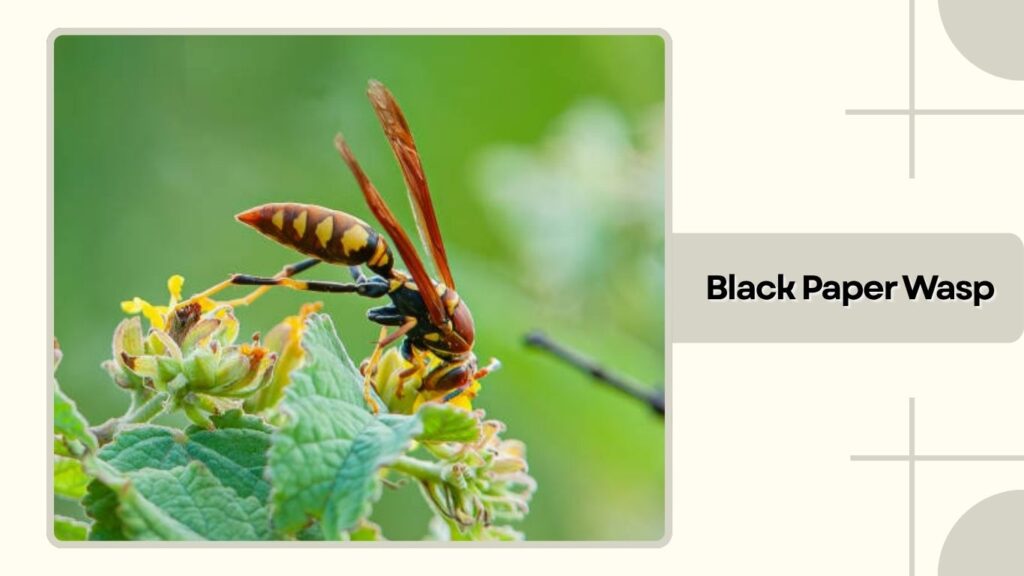
The Black Paper Wasp is a general name used for dark-colored paper wasps, including some Northern Paper Wasps (Polistes fuscatus). These social wasps are commonly found in gardens, woodlands, and residential areas across North America. They construct exposed, umbrella-shaped nests from chewed wood fibers and help control populations of caterpillars and other insects.
Identification
- Scientific Name: Polistes fuscatus (one possible species)
- Size: Approximately 15–21 mm long
- Color: Dark brown to black with variable reddish or yellow markings
- Wings: Smoky brown or amber-colored
- Body Shape: Slender waist with an elongated abdomen
- Antennae: Long, slightly curved, and brownish-black
Habitat and Behavior
Black Paper Wasps commonly inhabit gardens, woodland edges, parks, and residential buildings. They frequently construct nests beneath roof overhangs, under decks, and on sheltered branches.
Unlike solitary wasps, these insects live in small social colonies containing reproductive females and workers.
They primarily collect caterpillars and other soft-bodied insects to feed their larvae. Adults consume nectar and other sugary substances.
Lifecycle and Reproduction
In spring, overwintered reproductive females establish new colonies and construct paper nests containing exposed hexagonal cells.
Eggs hatch into larvae, which receive food from adult wasps. After completing development, the larvae pupate and emerge as adults.
Colonies expand during warmer months, producing new reproductive individuals before winter. These wasps can sting when their nests are disturbed.
15. Bald-Faced Hornet
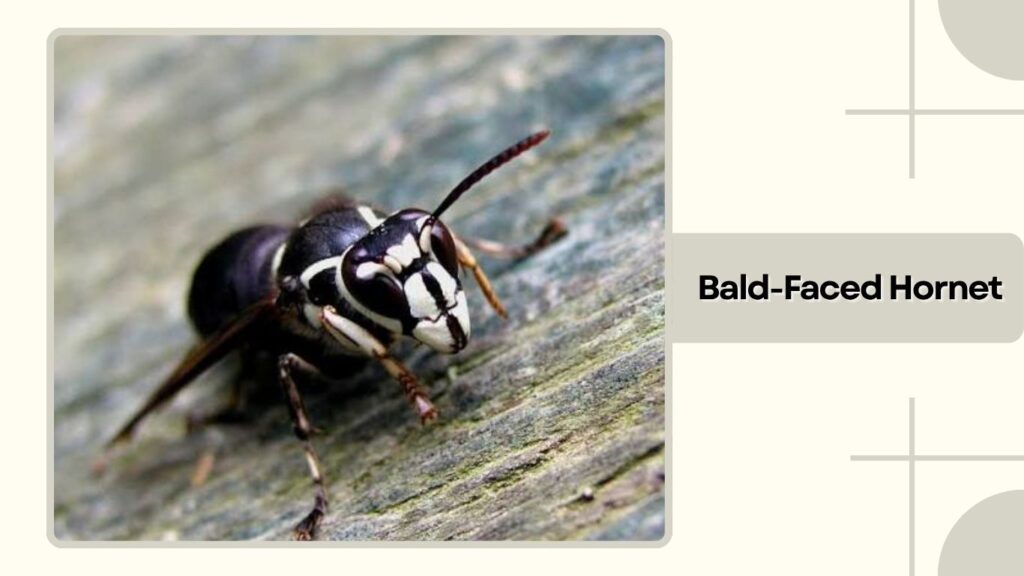
The Bald-Faced Hornet (Dolichovespula maculata) is a large, black-and-white social wasp commonly found throughout North America. Despite its name, it is not a true hornet but a close relative of yellowjackets. This species is recognized for its distinctive white facial markings and large, enclosed paper nests.
Identification
- Scientific Name: Dolichovespula maculata
- Size: Workers approximately 12–18 mm long; queens can reach 20 mm
- Color: Predominantly black with prominent white markings
- Wings: Dark, smoky, and slightly transparent
- Body Shape: Robust thorax with a tapered abdomen
- Antennae: Black and slightly curved
Habitat and Behavior
Bald-Faced Hornets inhabit forests, gardens, parks, and suburban areas. They construct large, oval-shaped paper nests in trees, shrubs, and beneath building overhangs.
These wasps live in organized colonies containing a queen and numerous workers. Adults collect nectar and sugary foods while hunting flies, caterpillars, and other insects to feed their larvae.
They are strongly defensive around their nests and can deliver repeated stings when threatened.
Lifecycle and Reproduction
In spring, an overwintered queen establishes a new nest and lays her first eggs. The emerging workers gradually take over feeding, nest construction, and colony defense.
As the colony expands, additional brood chambers are constructed.
During late summer and autumn, colonies produce males and new queens. After mating, fertilized queens seek sheltered overwintering locations.
The original colony eventually dies, and new queens establish fresh nests the following spring.
16. Black Hornet
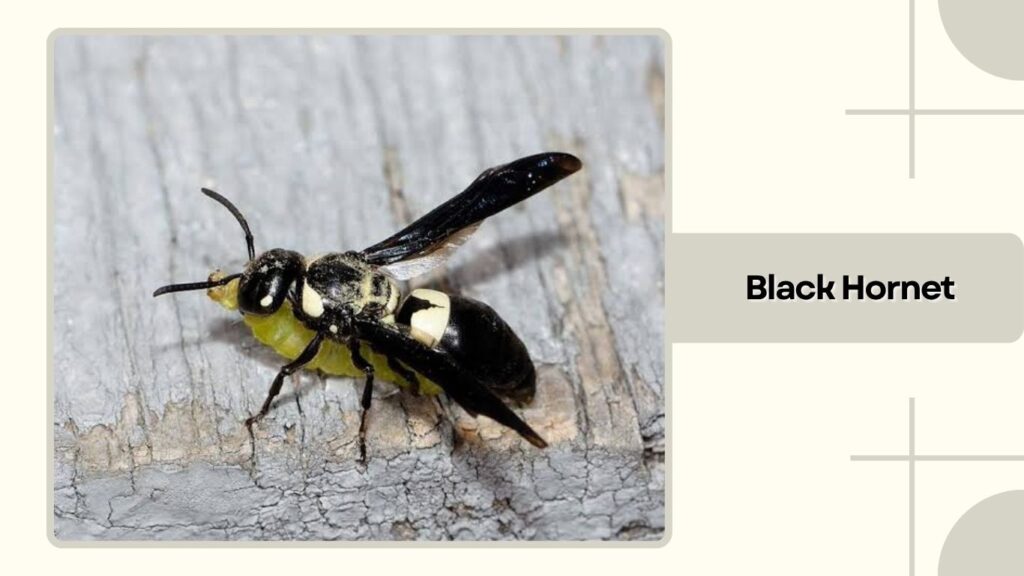
The Black Hornet (Vespa dybowskii), also known as Dybowski’s Hornet, is a dark-colored social wasp found in parts of East Asia. This species is particularly interesting because of its unusual reproductive behavior, which includes taking over colonies belonging to other hornet species. Its predominantly black body and reddish-brown markings distinguish it from many other hornets.
Identification
- Scientific Name: Vespa dybowskii
- Size: Workers approximately 17–24 mm; queens up to 30 mm
- Color: Predominantly black with reddish-brown markings
- Wings: Dark brown with a smoky appearance
- Body Shape: Robust thorax and broad, segmented abdomen
- Antennae: Dark brown to reddish-brown
Habitat and Behavior
Black Hornets inhabit temperate forests, wooded landscapes, and areas containing suitable nesting cavities in Japan, Korea, China, and parts of Russia.
They commonly use above-ground cavities, including hollow trees, for nesting. These hornets hunt insects to feed their developing larvae and obtain sugary foods as adults.
They can be highly defensive when their colonies are disturbed.
Lifecycle and Reproduction
Black Hornets have an unusual reproductive strategy involving social parasitism. A queen may invade a colony of another hornet species, such as the European Hornet or Japanese Yellow Hornet.
After replacing the original queen, she lays eggs that are raised by the host colony’s workers.
However, Black Hornets can also establish colonies independently. Their offspring develop through egg, larval, pupal, and adult stages, following the typical hornet lifecycle.
17. Black-Tailed Hornet
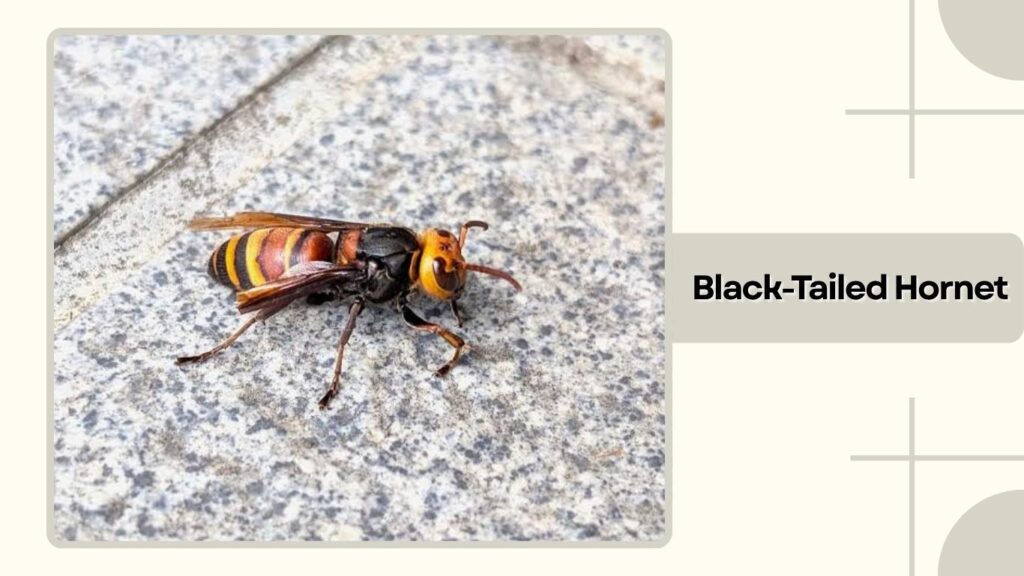
The Black-Tailed Hornet (Vespa ducalis) is a large social wasp recognized for its distinctive black abdominal tip and reddish-orange markings. Native to parts of East and Southeast Asia, this hornet commonly inhabits forests, wooded landscapes, and rural environments. Unlike many other hornets, it specializes in hunting the larvae and pupae of paper wasps.
Identification
- Scientific Name: Vespa ducalis
- Size: Workers approximately 24–32 mm long
- Color: Black with reddish-orange and yellow abdominal markings
- Wings: Brownish, transparent, and slightly smoky
- Body Shape: Robust thorax with a broad, segmented abdomen
- Antennae: Long, dark brown to reddish-brown
Habitat and Behavior
Black-Tailed Hornets commonly inhabit forests, woodland edges, agricultural landscapes, and rural gardens. They often construct underground nests in sheltered cavities.
These hornets primarily hunt paper wasp larvae and pupae, sometimes repeatedly attacking the same paper wasp colony. Adults also consume nectar and other sugary substances.
Although they are generally less defensive away from their nests, they can deliver painful stings when threatened.
Lifecycle and Reproduction
In spring, fertilized queens establish new colonies and begin laying eggs inside protected nesting chambers. The developing larvae receive food collected by the queen and, later, worker hornets.
As workers emerge, they take responsibility for hunting, nest maintenance, and colony protection.
During the reproductive season, colonies produce males and new queens. After mating, fertilized queens overwinter and establish new colonies the following year.
18. Rusty Spider Wasp
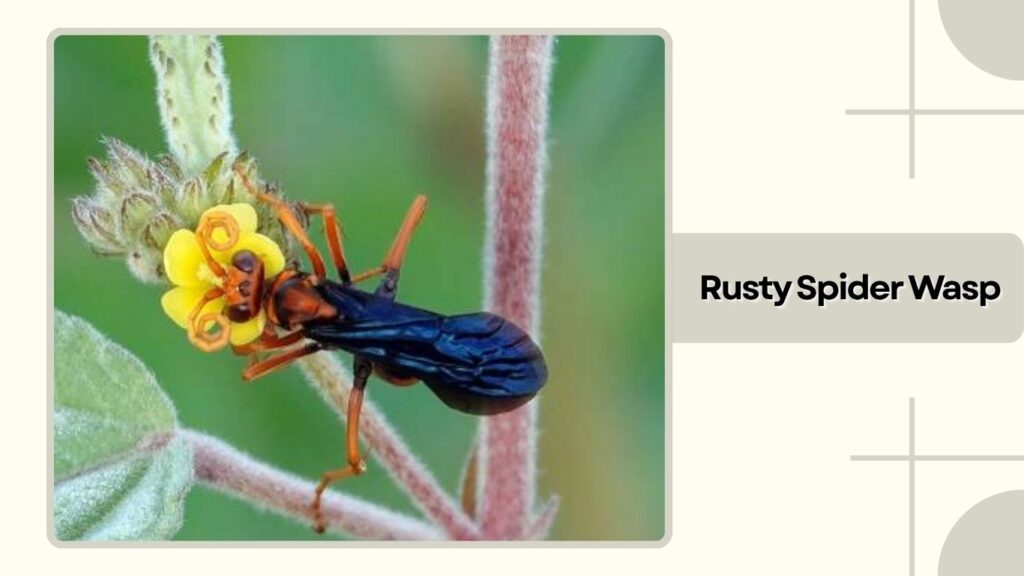
The Rusty Spider Wasp (Tachypompilus ferrugineus) is a solitary hunting wasp known for its reddish-brown body, dark markings, and metallic-looking wings. Native to the Americas, this species is frequently observed in gardens, grasslands, and woodland edges. Although it is not entirely black, its dark abdominal bands and wings give it a distinctive appearance.
Identification
- Scientific Name: Tachypompilus ferrugineus
- Size: Approximately 15–25 mm long
- Color: Rusty reddish-brown with dark abdominal bands
- Wings: Dark violet-blue with an iridescent reflection
- Body Shape: Slender waist with long, spiny legs
- Antennae: Long, dark, and slightly curved
Habitat and Behavior
Rusty Spider Wasps inhabit open fields, woodland edges, gardens, and rocky areas. Females frequently search along the ground for wandering spiders, particularly wolf spiders.
They use venomous stings to paralyze captured spiders before transporting them to protected nesting locations. Adults commonly visit flowering plants for nectar.
These wasps are solitary and generally avoid humans unless directly disturbed or handled.
Lifecycle and Reproduction
Female Rusty Spider Wasps prepare shallow underground nests in sheltered locations beneath vegetation, rocks, or other protective structures.
After capturing and paralyzing a spider, the female places it inside the nest and deposits a single egg on its body.
The developing larva feeds on the spider before entering the pupal stage. Once development is complete, a new adult emerges.
Their spider-hunting behavior contributes to the natural regulation of spider populations.
19. Tarantula Hawk Wasp
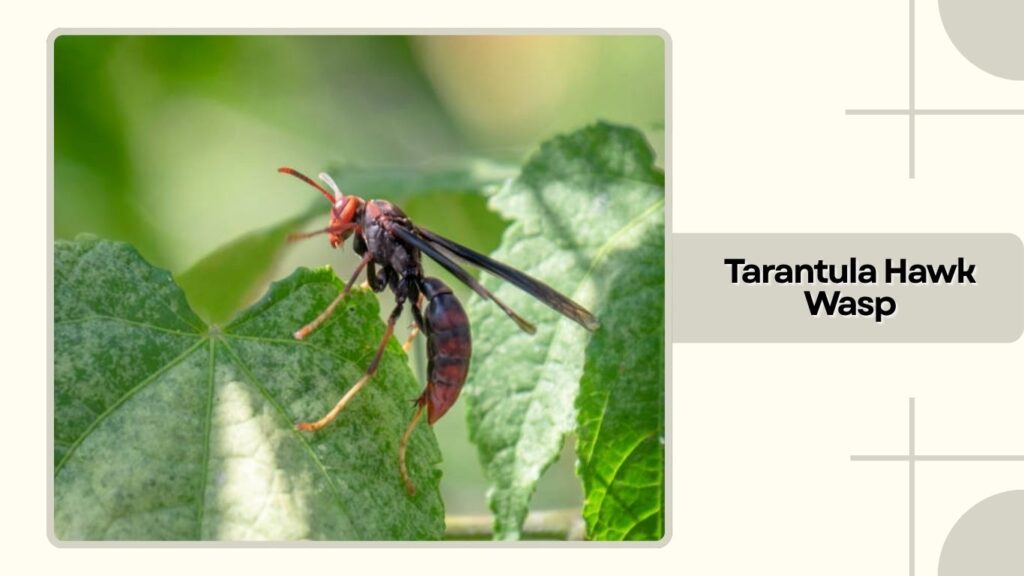
The Tarantula Hawk Wasp is a large solitary wasp belonging to the genera Pepsis and Hemipepsis. One well-known species is Pepsis thisbe, recognized for its metallic blue-black body and bright orange wings. Commonly found in warm, dry habitats, these wasps are famous for hunting tarantulas and possessing an exceptionally painful defensive sting.
Identification
- Scientific Name: Pepsis thisbe (representative species)
- Size: Can reach approximately 50 mm long
- Color: Metallic blue-black with a glossy appearance
- Wings: Bright orange to reddish-orange
- Body Shape: Large, slender body with long legs
- Antennae: Long, dark, and often curled in females
Habitat and Behavior
Tarantula Hawk Wasps inhabit deserts, grasslands, scrublands, and other warm environments. They frequently visit flowering plants to feed on nectar.
Females search for tarantulas on the ground and inside burrows. After locating a suitable spider, they use their powerful stingers to paralyze it.
Despite their painful sting, these wasps generally avoid attacking humans unless threatened or handled.
Lifecycle and Reproduction
Female Tarantula Hawk Wasps drag paralyzed tarantulas into underground burrows and deposit an egg on each captured spider.
After hatching, the larva feeds on the immobilized tarantula, gradually consuming its tissues while developing.
The larva eventually forms a cocoon and enters the pupal stage. Once development is complete, the adult wasp emerges and begins its independent life.
These wasps reproduce individually rather than forming social colonies.
20. Black-and-Yellow Mud Dauber
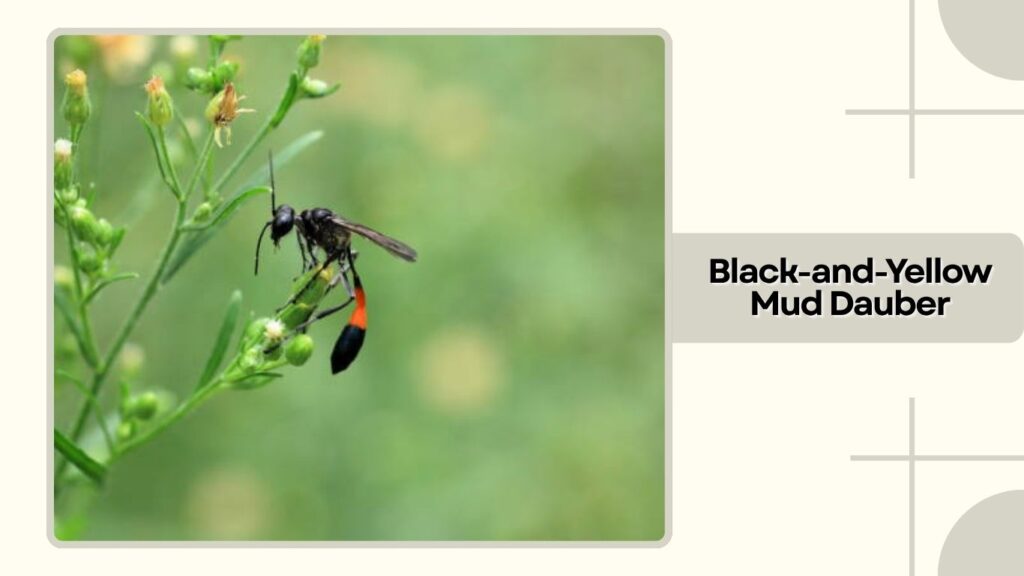
The Black-and-Yellow Mud Dauber (Sceliphron caementarium) is a solitary wasp recognized by its striking black and yellow markings and extremely narrow waist. Common throughout North America and introduced to several other regions, this species constructs distinctive mud nests on sheltered surfaces. It is a beneficial predator that helps control spider populations.
Identification
- Scientific Name: Sceliphron caementarium
- Size: Approximately 20–28 mm long
- Color: Black with bright yellow markings
- Wings: Transparent to slightly smoky brown
- Body Shape: Extremely narrow waist with an elongated abdomen
- Antennae: Long, slender, and black
Habitat and Behavior
Black-and-Yellow Mud Daubers inhabit gardens, woodland edges, agricultural areas, and residential environments. Females commonly build mud nests beneath roof overhangs, bridges, sheds, and other protected structures.
These wasps collect moist mud to construct individual cylindrical nesting chambers. They primarily hunt spiders, which are immobilized and stored as food for their developing offspring.
Adults consume nectar from flowering plants and are generally nonaggressive toward humans.
Lifecycle and Reproduction
Female Black-and-Yellow Mud Daubers construct mud chambers and fill them with paralyzed spiders before laying a single egg inside each chamber.
The chamber is sealed with mud to protect the developing offspring.
After hatching, the larva consumes the stored spiders and gradually grows. It eventually pupates inside a protective cocoon before emerging as an adult.
Unlike social wasps, these insects do not form colonies or actively defend their nests.
21. Black-Bellied Hornet
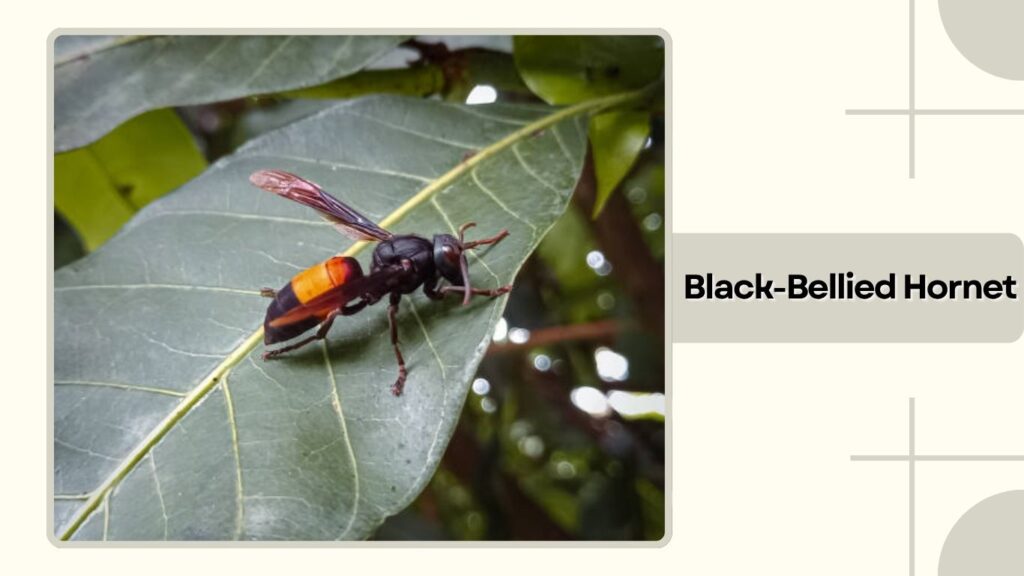
The Black-Bellied Hornet (Vespa basalis) is a large social wasp recognized by its dark black abdomen and reddish-brown head and thorax. Native to parts of South and East Asia, this species is particularly common in forested mountainous regions. It is known for building large paper nests and displaying strong defensive behavior when its colony is threatened.
Identification
- Scientific Name: Vespa basalis
- Size: Workers approximately 20–22 mm; queens up to 32 mm
- Color: Black abdomen with reddish-brown head and thorax
- Wings: Dark brown with a smoky appearance
- Body Shape: Robust thorax with a broad, segmented abdomen
- Antennae: Dark brown and slightly curved
Habitat and Behavior
Black-Bellied Hornets commonly inhabit forests, mountainous landscapes, and woodland edges. They construct paper nests in trees, shrubs, and occasionally sheltered ground cavities.
These hornets hunt other insects, including honey bees, to feed their developing larvae. Adults also consume nectar, tree sap, and other sugary substances.
They are highly defensive around their nests and can deliver painful stings when disturbed.
Lifecycle and Reproduction
In spring, fertilized queens establish new colonies and begin laying eggs in paper brood cells.
The developing larvae receive food from the queen and later from emerging workers. As the colony grows, workers expand the nest and collect food.
During the reproductive season, colonies produce males and new queens. Fertilized queens eventually establish new colonies, continuing the reproductive cycle.
22. Black Tiphiid Wasp
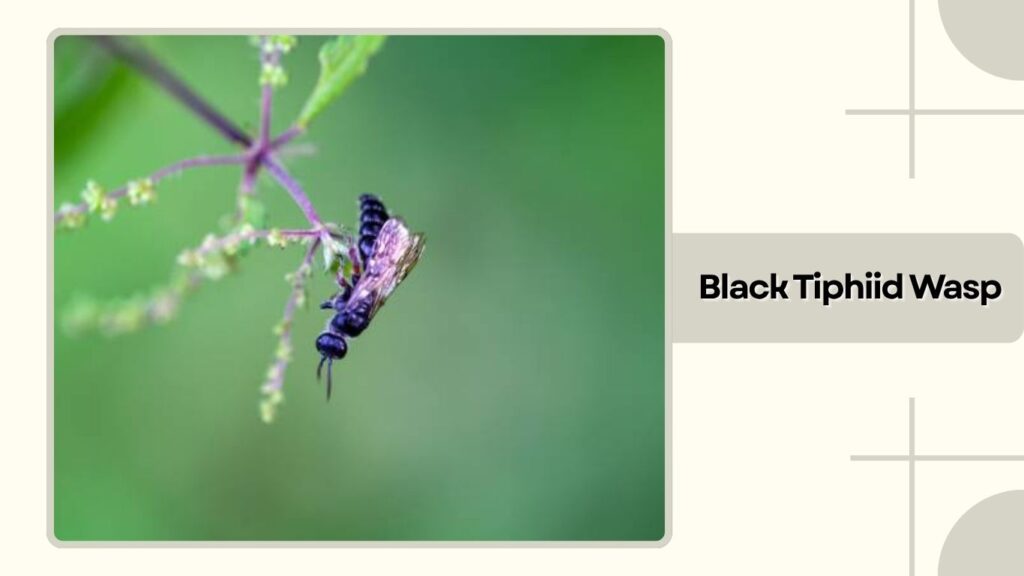
The Black Tiphiid Wasp refers to dark-colored parasitic wasps belonging to the family Tiphiidae. One representative species is the Spring Tiphia (Tiphia vernalis), a small, shiny black wasp originally native to East Asia and introduced into North America. This beneficial insect helps control Japanese beetles and other lawn-damaging beetle grubs.
Identification
- Scientific Name: Tiphia vernalis
- Size: Approximately 9–13 mm long
- Color: Shiny black with fine body hairs
- Wings: Transparent to slightly smoky
- Body Shape: Compact body with a narrow waist
- Antennae: Short to moderately long and dark-colored
Habitat and Behavior
Black Tiphiid Wasps commonly inhabit lawns, gardens, agricultural fields, and grassy landscapes containing beetle larvae.
Females search underground for Japanese beetle and Oriental beetle grubs. After finding a suitable host, they temporarily paralyze it and attach an egg to its body.
Adults feed on nectar and sugary honeydew produced by other insects. They are solitary and generally nonaggressive toward humans.
Lifecycle and Reproduction
Female Spring Tiphia Wasps lay individual eggs on beetle grubs beneath the soil surface.
After hatching, the developing larva feeds externally on its host until the grub dies. The mature larva then spins a protective cocoon underground.
The wasp completes its development inside the cocoon and overwinters before emerging the following spring.
This parasitic lifecycle makes the species an important natural enemy of destructive beetle larvae.
23. Black Scoliid Wasp
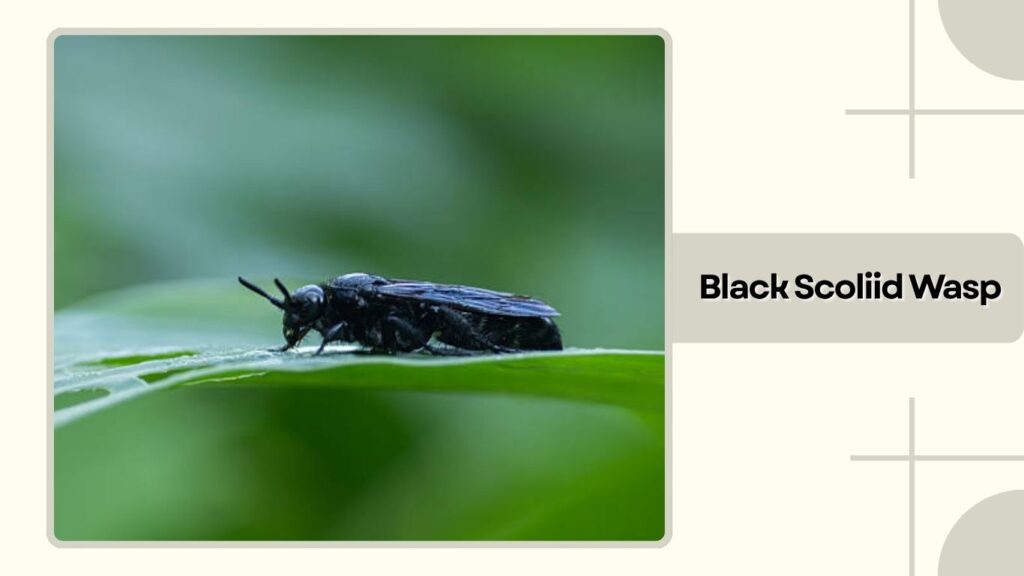
The Black Scoliid Wasp refers to dark-bodied species belonging to the family Scoliidae. One representative species is the Double-Banded Scoliid Wasp (Scolia bicincta), recognized for its black, hairy body and two prominent white abdominal bands. Commonly found in eastern and central North America, this solitary wasp helps control beetle populations by parasitizing underground grubs.
Identification
- Scientific Name: Scolia bicincta
- Size: Approximately 15–25 mm long
- Color: Predominantly black with two creamy-white abdominal bands
- Wings: Dark with subtle bluish or violet reflections
- Body Shape: Sturdy, hairy body with a broad abdomen
- Antennae: Black and slightly curved
Habitat and Behavior
Black Scoliid Wasps commonly inhabit gardens, meadows, grasslands, and woodland edges. Adults frequently visit flowering plants during late summer and early autumn.
Females search beneath the soil for scarab beetle grubs. Once a suitable host is located, they sting and immobilize it before depositing an egg on its body.
These wasps are generally peaceful toward humans and contribute to natural pest regulation.
Lifecycle and Reproduction
Female Black Scoliid Wasps lay individual eggs on paralyzed beetle grubs found underground.
After hatching, the wasp larva feeds on its host, gradually consuming the grub as it develops.
Once feeding is complete, the mature larva spins a cocoon and enters the pupal stage beneath the soil.
The adult eventually emerges during favorable seasonal conditions. Unlike social wasps, these insects do not establish defensive colonies.
24. Black Sand Wasp
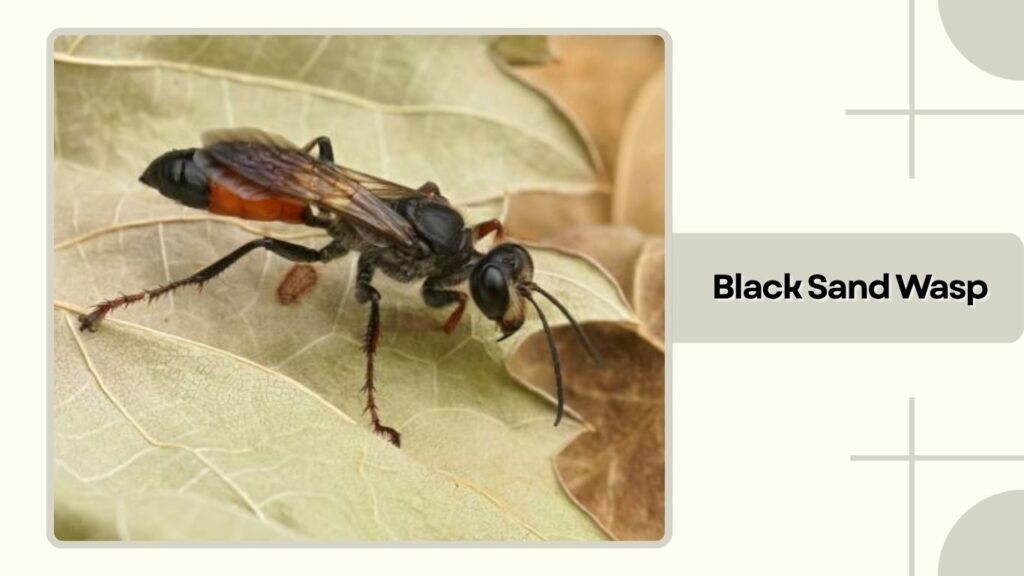
The Black Sand Wasp is a descriptive name for predominantly black sand-nesting wasps, including the American Sand Wasp (Bembix americana). This solitary species is commonly found across North America, particularly in sandy grasslands, gardens, and open fields. Its distinctive black-and-white markings and fly-hunting behavior make it an interesting member of the sand wasp group.
Identification
- Scientific Name: Bembix americana
- Size: Approximately 16–20 mm long
- Color: Black with interrupted white abdominal bands
- Wings: Transparent with brownish veins
- Body Shape: Robust thorax with a tapered abdomen
- Antennae: Dark-colored and relatively short
- Eyes: Large, often greenish compound eyes
Habitat and Behavior
Black Sand Wasps prefer open habitats containing loose, sandy soil. Females excavate individual underground burrows, sometimes close to the nests of other females.
These wasps primarily hunt flies, capturing them during flight and carrying them into underground nesting chambers.
Adults consume flower nectar and generally avoid aggressive encounters with humans.
Lifecycle and Reproduction
Female Black Sand Wasps excavate nesting chambers beneath sandy soil and lay an egg on captured prey.
After hatching, the larva receives additional flies supplied by its mother throughout development.
Unlike species that store all their prey before sealing their nests, American Sand Wasps continue provisioning their larvae until they approach pupation.
The mature larvae eventually form cocoons underground, where they develop into adults.
Their fly-hunting behavior makes them beneficial insects in many outdoor environments.
25. Black Thread-Waisted Wasp
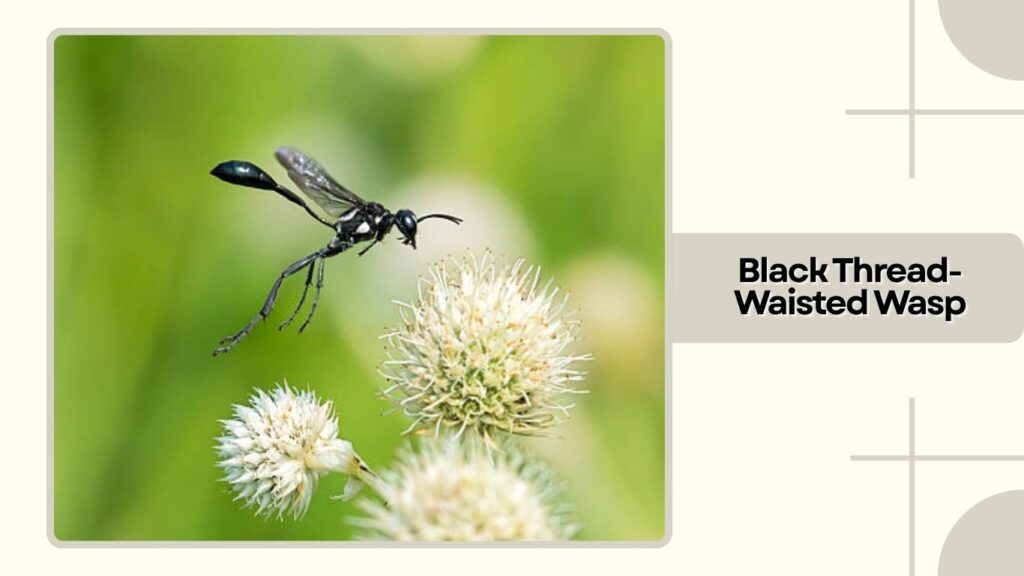
The Black Thread-Waisted Wasp refers to dark-colored members of the family Sphecidae. One representative species is the Gold-Marked Thread-Waisted Wasp (Eremnophila aureonotata), recognized for its glossy black body, extremely narrow waist, and small golden patches. Found across parts of North and Central America, this solitary wasp is frequently observed visiting flowers and hunting caterpillars.
Identification
- Scientific Name: Eremnophila aureonotata
- Size: Approximately 20–22 mm long
- Color: Glossy black with golden or silvery patches
- Wings: Dark, smoky wings with a slight bluish reflection
- Body Shape: Extremely long, narrow waist and elongated abdomen
- Antennae: Long, thin, and black
Habitat and Behavior
Black Thread-Waisted Wasps commonly inhabit open fields, meadows, gardens, and woodland edges. They prefer areas containing suitable soil for underground nesting.
Adults frequently visit wildflowers, particularly Queen Anne’s lace and other nectar-producing plants.
Females hunt large caterpillars, which they paralyze and transport into underground burrows. These wasps generally avoid confrontation with humans unless threatened.
Lifecycle and Reproduction
Female Black Thread-Waisted Wasps dig individual burrows in sandy or compact soil and prepare nesting chambers for their offspring.
Each chamber is typically supplied with a single large, paralyzed caterpillar before an egg is laid.
After hatching, the larva feeds on the caterpillar and gradually develops within the protected chamber.
The mature larva eventually pupates underground before emerging as an adult.
These solitary wasps help regulate caterpillar populations while also visiting flowers for nectar.
FAQs
1. Are Black Wasps Dangerous to Humans?
Most black wasps are not aggressive toward humans. Solitary species, such as Great Black Wasps and Blue Mud Daubers, rarely sting unless handled or threatened. However, social species may aggressively defend their nests.
2. Do Black Wasps Sting?
Yes, female black wasps generally possess stingers. Their sting intensity varies depending on the species. Tarantula Hawk Wasps are especially famous for their extremely painful stings, although they rarely attack without provocation.
3. Where Do Black Wasps Build Their Nests?
Black wasps build nests in different locations depending on their species. Great Black Wasps construct underground burrows, Mud Daubers build mud nests on sheltered surfaces, and some social wasps create paper nests in trees or building cavities.
4. What Do Black Wasps Eat?
Adult black wasps commonly feed on flower nectar and other sugary substances. Many species hunt spiders, grasshoppers, crickets, or caterpillars to feed their larvae. Their feeding habits contribute to natural insect population control.
5. Are All Black Wasps Solitary?
No, not all black wasps are solitary. Great Black Wasps, Spider Wasps, and Mud Daubers typically live independently. However, dark-colored Paper Wasps and Hornets establish social colonies with queens, workers, and organized nesting structures.
