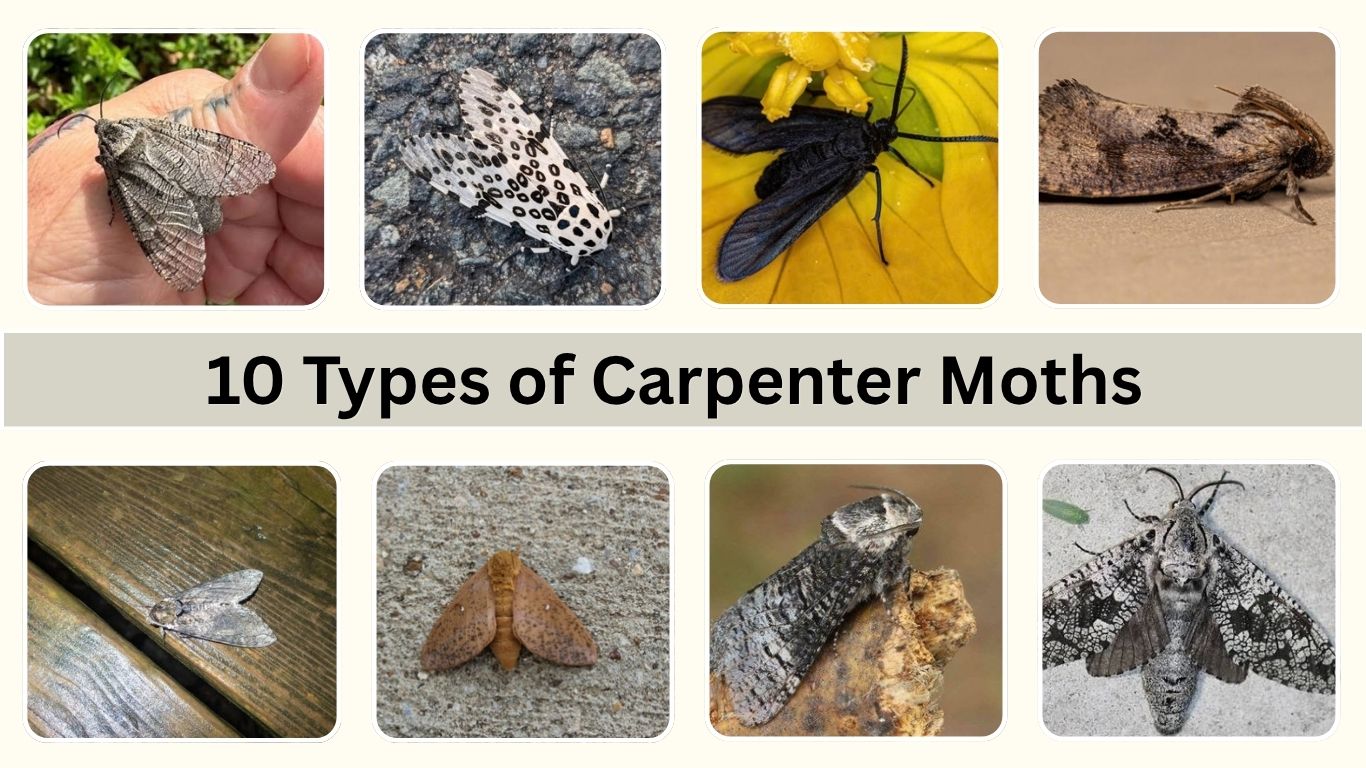
Carpenter moths are fascinating members of the Cossidae family, best known for their wood-boring caterpillars that develop inside trees, stems, and branches. These moths vary greatly in size, color, host plants, and geographic range, from relatively small carpenterworms to the enormous Giant Wood Moth. Some species prefer hardwood trees such as oak, poplar, and pecan, while others are associated with pine or eucalyptus. In this guide, you’ll discover 10 types of carpenter moths along with their identification features, habitats, feeding behavior, and life cycles.
1. Carpenterworm Moth
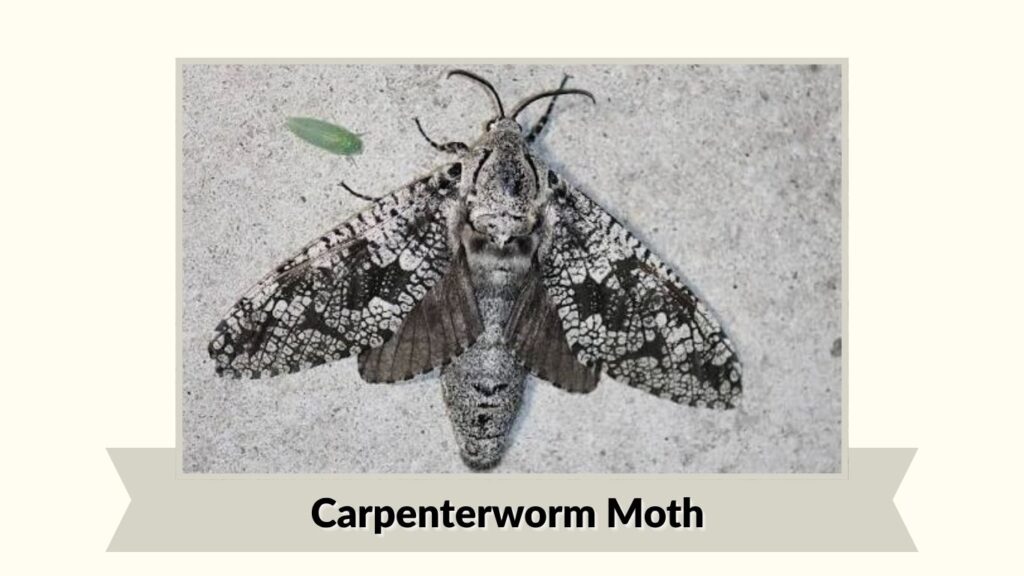
The Carpenterworm Moth is a large, heavy-bodied moth best known for its wood-boring caterpillars. The species most often referred to by this common name is Prionoxystus robiniae. Its larvae tunnel deeply into the trunks and branches of hardwood trees, sometimes remaining inside the wood for several years. Adults are less destructive and are mainly noticeable because of their large size and mottled, bark-like appearance.
Identification
- Adults are large, robust moths with mottled gray, black, and whitish wings.
- Females may have a wingspan of around 3 inches and are generally larger than males.
- Male hindwings may show noticeable yellowish-orange coloration.
- Mature larvae are usually creamy white, pinkish, or greenish-white.
- Caterpillars have a dark brown head and can reach roughly 2–3 inches in length.
- Bark may show holes, sawdust-like frass, sap staining, or protruding pupal cases where larvae have been active.
Habitat and Distribution
Carpenterworm moths occur across much of the United States and into southern Canada. They are closely associated with deciduous forests, shade trees, shelterbelts, and landscaped areas containing suitable hardwood hosts. Common host trees include oak, poplar, cottonwood, maple, willow, ash, elm, and black locust. Regional preferences vary, with poplars being particularly important hosts in some western areas.
Behavior and Diet
Adult moths do not cause the characteristic tree damage; the larval stage is responsible. Young caterpillars enter beneath the bark and eventually tunnel through sapwood and heartwood. These galleries can weaken stems and branches, reduce tree vigor, and create defects in lumber. Larvae continue enlarging their tunnels as they grow and often push frass and wood debris from entrance openings.
Lifespan and Life Cycle
Females deposit hundreds of eggs in bark crevices, near wounds, or beneath moss and lichens. After hatching, larvae bore into the tree and spend most of their development protected inside the wood. The complete life cycle is unusually long, commonly taking about three to four years in cooler regions, although development can be faster in warmer southern areas. Pupation occurs inside the larval tunnel before the adult moth emerges, typically during late spring or summer.
2. Little Carpenterworm Moth
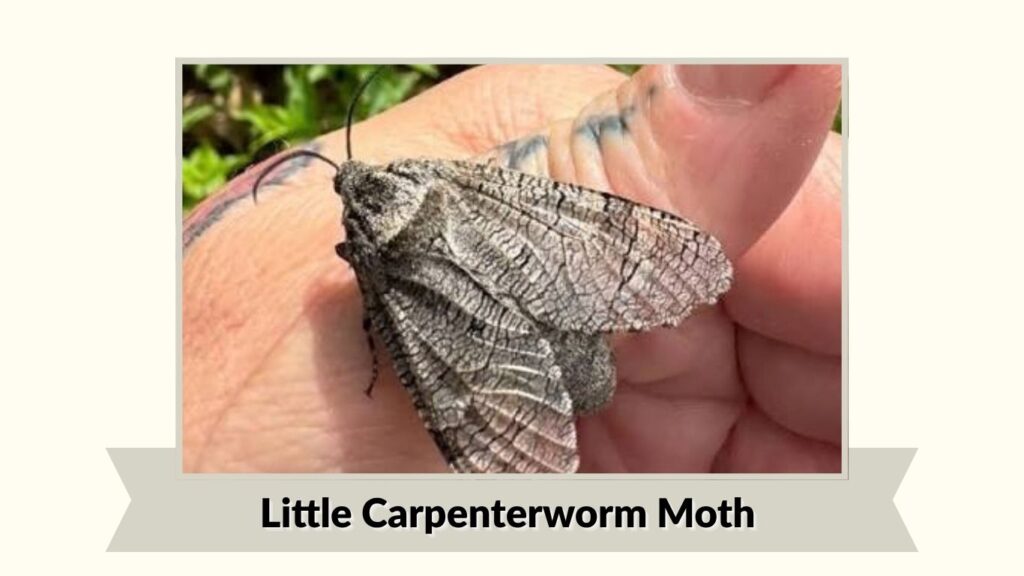
The Little Carpenterworm Moth (Prionoxystus macmurtrei) is a wood-boring moth found across a broad section of eastern and central North America. Despite its common name, the adult is still a fairly large moth, with a wingspan that can reach about 75 mm. Its larvae develop inside hardwood trees, where their tunneling can affect both tree health and the quality of valuable lumber.
Identification
- Adult wingspan is approximately 45–75 mm.
- Forewings are mottled gray and dark brown to black.
- Thin dark lines cross the forewings.
- Wings can appear slightly translucent when spread.
- Larvae are usually pinkish to whitish.
- Caterpillars have a dark head and thoracic shield.
- Mature larvae may grow to about 57 mm long.
Habitat and Distribution
Little Carpenterworm Moths are associated mainly with hardwood forests and areas containing mature deciduous trees. Their documented range extends from Ontario and Quebec south to Florida, west to Texas, and north through parts of the central United States to Minnesota. Ash, maple, and oak are important host trees for developing larvae.
Behavior and Diet
The caterpillar is the damaging stage. After entering a host tree, it feeds and tunnels beneath the bark and eventually deeper into the sapwood and woody tissues. These galleries may reduce the commercial value of hardwood lumber. Adults are primarily concerned with reproduction and are sometimes encountered around lights during their spring and summer flight period.
Lifespan and Life Cycle
Development is unusually slow compared with many moths. The complete life cycle generally takes about two to three years. Larvae initially occupy tissues near the bark before moving into sapwood and deeper wood as they mature. Pupation takes place within the tunnel, providing protection until adult emergence. Adults are most commonly recorded from April through July.
3. Poplar Carpenterworm Moth
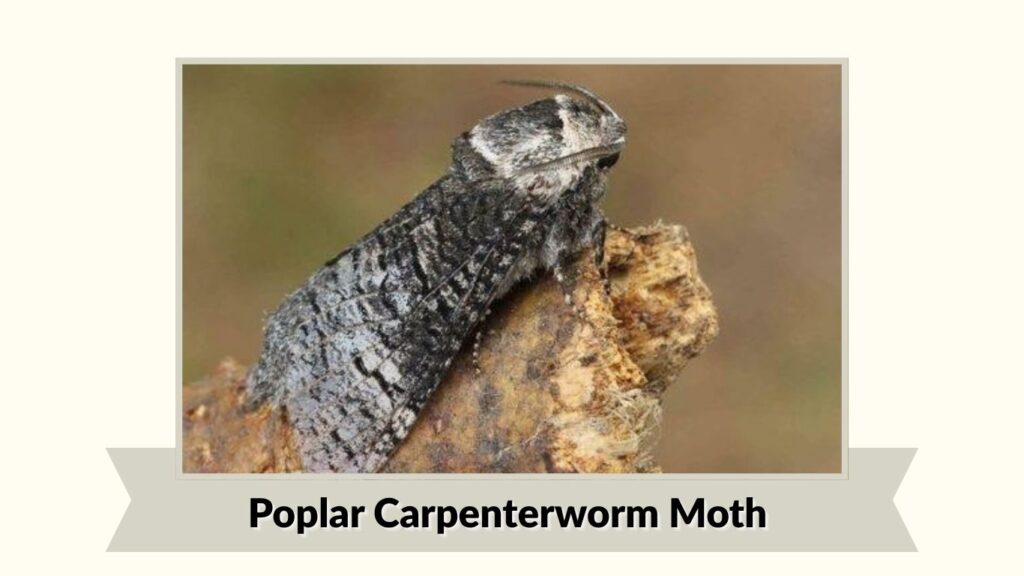
The Poplar Carpenterworm Moth (Acossus centerensis) is a North American carpenter moth closely associated with poplars and aspens. Like other carpenterworms, its caterpillars spend their development hidden within woody plant tissue. Infestations can be difficult to notice initially because most larval activity occurs beneath the bark, although holes, expelled frass, and weakening of branches may eventually reveal their presence.
Identification
- Adults are medium to large, heavy-bodied moths.
- Male wingspans are roughly 40–50 mm.
- Females are larger, reaching approximately 50–64 mm.
- Wings are generally mottled in subdued gray and brown shades.
- The coloration provides effective camouflage against tree bark.
- Larval activity may produce entrance holes and accumulations of frass around damaged bark.
Habitat and Distribution
This species has a distinctly northern North American distribution. It occurs from New Jersey west through Illinois and North Dakota and across Canada from Quebec and Ontario to British Columbia. Poplars are its principal hosts, with trembling aspen and balsam poplars among the trees associated with larval development.
Behavior and Diet
Poplar Carpenterworm larvae are internal wood borers. After entering a suitable tree, caterpillars feed within woody tissues and create galleries that may weaken trunks or branches. Repeated attacks can make trees more vulnerable to breakage from wind or snow and may add stress to trees already affected by drought or disease.
Lifespan and Life Cycle
Females place eggs where newly hatched larvae can gain access to suitable host tissue. The larvae then spend the longest portion of the life cycle protected inside the tree. As they mature, their galleries enlarge and expelled wood debris may become visible externally. Eventually, mature larvae pupate and adults emerge to mate and begin another generation. Because the immature stages remain concealed, much of the moth’s life is rarely observed directly.
4. Pecan Carpenterworm Moth
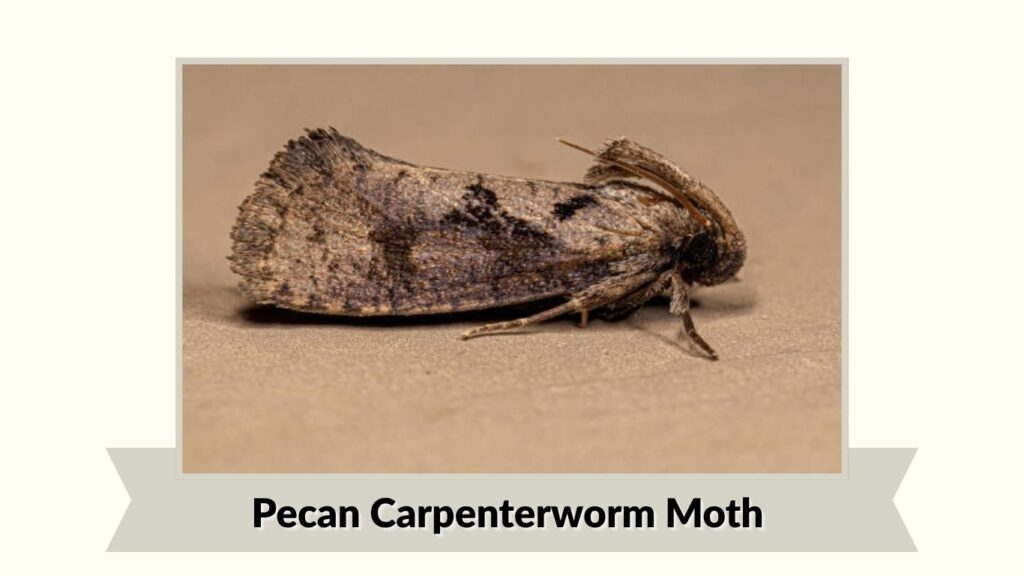
The Pecan Carpenterworm Moth (Cossula magnifica) is a distinctive wood-boring moth of the southeastern United States. As its common name suggests, pecan is an important larval host, although the caterpillars can also use several other hardwood trees. Adults are modestly sized compared with some carpenter moths, while the larvae spend their development concealed inside woody plant material.
Identification
- Adult wingspan is approximately 32–45 mm.
- Adults have elongated wings and a relatively robust body.
- Wing coloration provides camouflage when resting against bark.
- Adults may be attracted to lights at night.
- Wood-boring caterpillars develop within host trees.
- Pecan is one of the best-known larval host plants.
Habitat and Distribution
The Pecan Carpenterworm Moth occurs primarily in the southeastern United States. Records extend from North Carolina south through Florida and west through Mississippi to Texas. Its distribution overlaps regions where pecan and other suitable hardwood hosts are common, including forests, woodlands, orchards, and landscapes containing mature trees.
Behavior and Diet
Caterpillars are wood borers and obtain their nutrition from tissues inside host trees. Species of hickory, including pecan, are important hosts, while persimmon and oak have also been recorded. This hidden feeding behavior protects larvae from many predators but can make infestations difficult to detect until evidence of boring becomes visible.
Lifespan and Life Cycle
The life cycle begins when females lay eggs near suitable host material. Newly hatched caterpillars enter woody tissue and continue feeding as they grow. Pupation eventually occurs after larval development is complete, followed by emergence of the winged adult. Adults have been recorded mainly from March through June, although exact timing varies with location and seasonal temperatures.
5. Anna Carpenterworm Moth
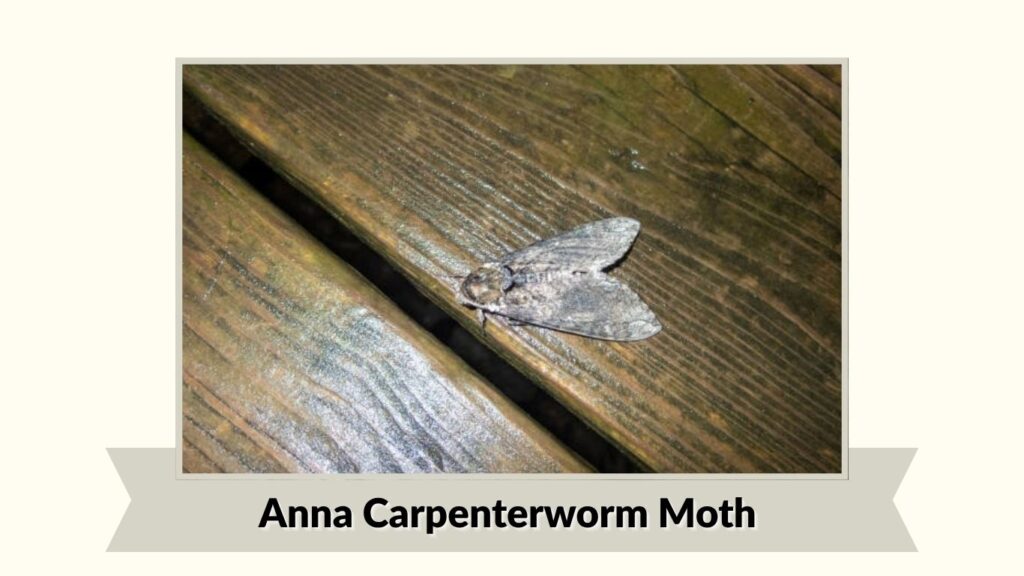
The Anna Carpenterworm Moth (Givira anna) is a relatively small member of the carpenter moth group found primarily in the eastern and southeastern United States. Its subtle gray-brown coloration makes it easy to overlook when resting on bark. Adults can be distinguished from similar carpenter moths by characteristic markings on their forewings, while recent host records associate its larval stage with pines.
Identification
- Wingspan is approximately 25–36 mm.
- Overall coloration is usually brownish gray.
- Forewings have a darker shaded transverse band.
- A noticeable pale or white discal mark occurs on the forewing.
- It resembles the Black-lined Carpenterworm Moth.
- Adults are comparatively small for carpenter moths.
Habitat and Distribution
Anna Carpenterworm Moths have been recorded in states including Florida, Georgia, Alabama, Louisiana, Mississippi, Texas, Arkansas, Oklahoma, Kansas, Tennessee, Kentucky, Indiana, Maryland, North Carolina, and South Carolina. This distribution places the species largely within warm temperate woodland regions of the eastern and southern United States.
Behavior and Diet
As with other carpenter moths, the larval stage is associated with plant tissue rather than exposed foliage feeding. Updated North American host records identify pine (Pinus) as a larval host genus. This means much of the immature stage can remain concealed from casual observation. Adult moths are nocturnal and may be encountered around artificial lights.
Lifespan and Life Cycle
The female lays eggs associated with suitable host plants, after which the newly hatched larvae begin their concealed feeding stage. Larvae grow through a series of molts before eventually pupating and producing adults. Adults have been recorded from roughly March through August, indicating a relatively extended seasonal flight window across the species’ broad southern range.
6. Black-Lined Carpenterworm Moth
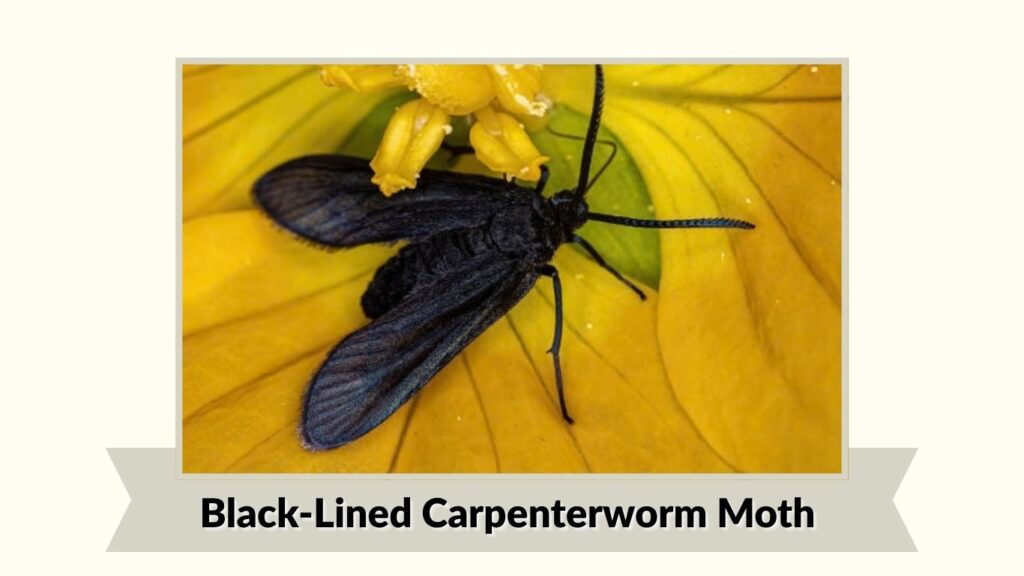
The Black-Lined Carpenterworm Moth (Inguromorpha basalis) is a small carpenter moth recognized by its patterned wings and dark linear markings. It occurs mainly in the southeastern United States and belongs to the same broader carpenter moth group as several other wood-boring species. Adults are nocturnal and can sometimes be found resting near outdoor lights in the early morning.
Identification
- Adult wingspan is approximately 26–38 mm.
- Wings are patterned with contrasting dark lines.
- Adults have a relatively compact, robust body.
- Forewing markings help distinguish the species from similar carpenter moths.
- Coloration blends effectively with bark and other natural surfaces.
- It can resemble the Anna Carpenterworm Moth, which is generally more brownish gray.
Habitat and Distribution
The Black-Lined Carpenterworm Moth is a North American species concentrated in the southeastern United States. Its documented range extends from New Jersey south through Florida and west into Missouri and Arkansas. Within this area, adults may be encountered in wooded environments and landscapes containing suitable larval host plants.
Behavior and Diet
Adults are mainly active at night, and observations show that they may approach artificial lighting. The immature stages follow the carpenterworm pattern of developing in association with woody plants. Because larvae remain concealed for much of their development, adults are often the stage most likely to be noticed by people. Their cryptic wing patterns provide useful camouflage during daytime resting periods.
Lifespan and Life Cycle
Like other carpenter moths, this species undergoes complete metamorphosis through egg, larval, pupal, and adult stages. Larval development occupies most of the life cycle, followed by pupation and eventual emergence as a winged adult. Adult Black-Lined Carpenterworm Moths have been documented from May through August, with timing varying according to latitude and local climate.
7. Pine Carpenterworm Moth
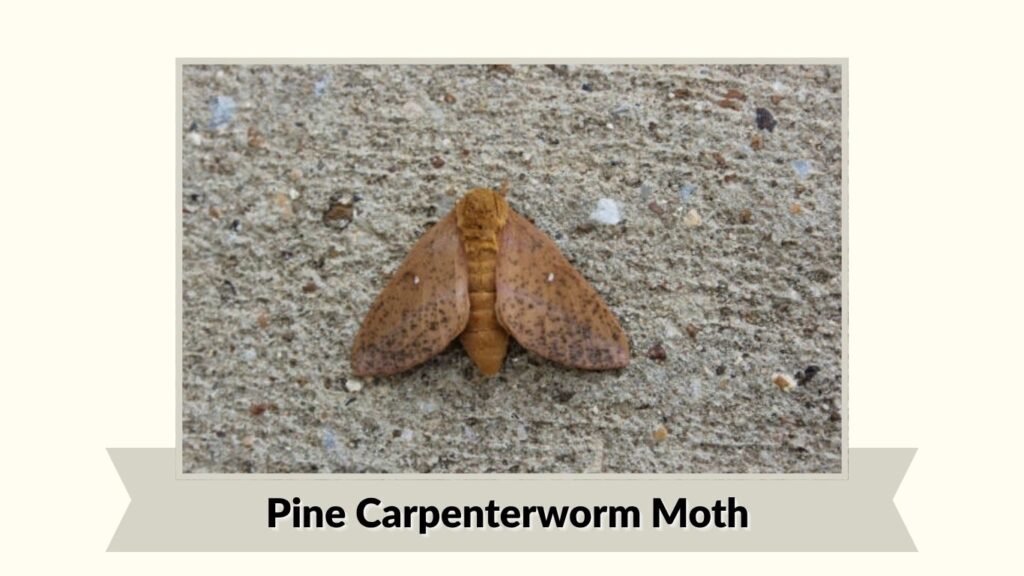
The Pine Carpenterworm Moth (Givira lotta) is a relatively small member of the carpenter moth family Cossidae. Unlike carpenterworms associated mainly with hardwood trees, this species is strongly connected with pines, particularly ponderosa pine. Its caterpillars live in woody plant material, while the adults are nocturnal moths that are far less noticeable than the damage or galleries produced during the larval stage.
Identification
- Scientific name: Givira lotta
- Belongs to the family Cossidae
- Adult wingspan is around 30 mm
- Generally smaller than many other carpenter moths
- Wings have subdued coloration that blends well with bark
- Associated closely with ponderosa pine
- Adults are most often recorded during the warmer months
Habitat and Distribution
Pine Carpenterworm Moths are primarily associated with pine forests of the southwestern and western United States. Records include Arizona and Colorado, with broader records also reported from California and New Mexico. Their habitat follows the availability of suitable pine hosts. Ponderosa pine is particularly important, and larvae have been documented mining the rough outer bark near the base of these trees.
Behavior and Diet
The larval stage is responsible for the moth’s characteristic relationship with trees. Caterpillars develop in the bark of pines rather than feeding openly on foliage. This concealed lifestyle provides protection from weather and many predators.
Adults are nocturnal and may occasionally come to artificial lights. They are mainly concerned with mating and reproduction rather than causing tree damage.
Lifespan and Life Cycle
The life cycle follows the typical moth sequence of egg, larva, pupa, and adult. The larval stage occupies the host tree and is the longest and least visible part of development. Adults have been recorded mainly from June through August. Detailed information about the exact total development time of Givira lotta is limited, so its lifespan is less thoroughly documented than that of some larger carpenterworm species.
8. Aspen Carpenterworm Moth
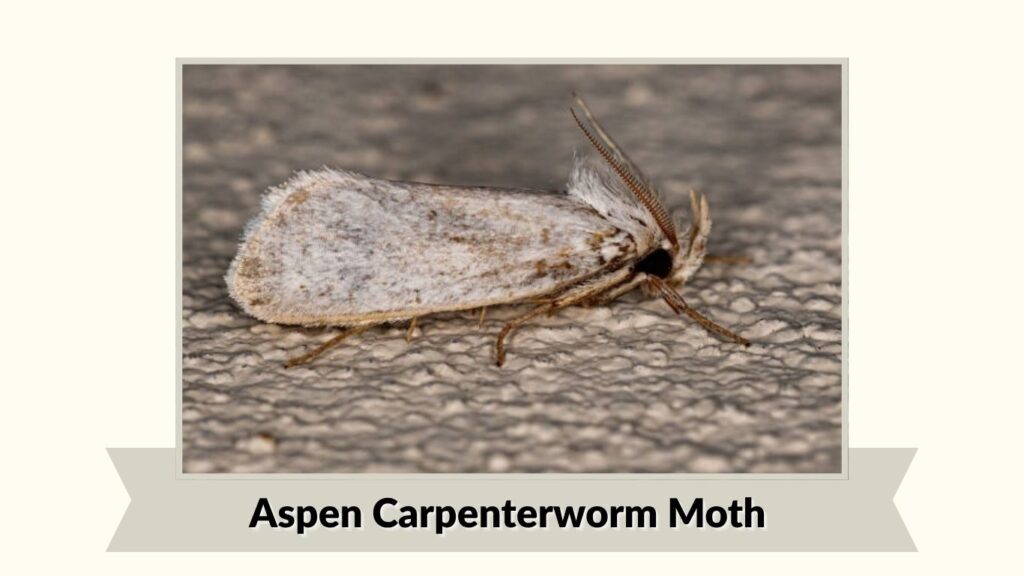
The Aspen Carpenterworm Moth (Acossus populi) is a large, heavy-bodied carpenter moth strongly associated with poplars, especially trembling or quaking aspen. Its caterpillars live inside trunks and stems, producing galleries within the wood. Adults are gray and well camouflaged against tree bark, while infestations are more often recognized by boring debris, entrance holes, or pupal remains than by seeing the larvae themselves.
Identification
- Adult wingspan is approximately 50–68 mm
- Body is heavy and predominantly light gray
- Forewings are dirty white to gray
- Wings contain networks of fine, broken dark-gray lines
- Thorax has a narrow pale band bordered by darker markings
- Male antennae are somewhat feathery
- Female antennae are more serrated or threadlike
- Adults resemble Poplar Carpenterworm Moths
Habitat and Distribution
Aspen Carpenterworms occur across parts of Canada and the United States. They are particularly associated with mature woodland containing poplars and trembling aspen, often in areas near wetlands. The species is widespread in Alberta and has also been documented in British Columbia, Ontario, California, Nevada, Colorado, and northern Rocky Mountain regions.
Behavior and Diet
Larvae are wood borers that create galleries through trunks and stems of Populus species. Quaking aspen is one of their most characteristic hosts. Because larvae remain inside the tree, they are rarely visible unless damaged wood is opened.
Adults are nocturnal and are commonly collected around lights. Heavy infestations can weaken wood, although the species is generally not considered a major economic pest in many areas.
Lifespan and Life Cycle
Relatively little is known about the complete life history. After hatching, larvae enter poplar wood and remain protected in galleries while developing. Related carpenterworms require several years to mature, and specialists suggest the Aspen Carpenterworm likely also has a multi-year larval period. Adults in Alberta are most often observed from mid-June through late July.
9. Leopard Moth
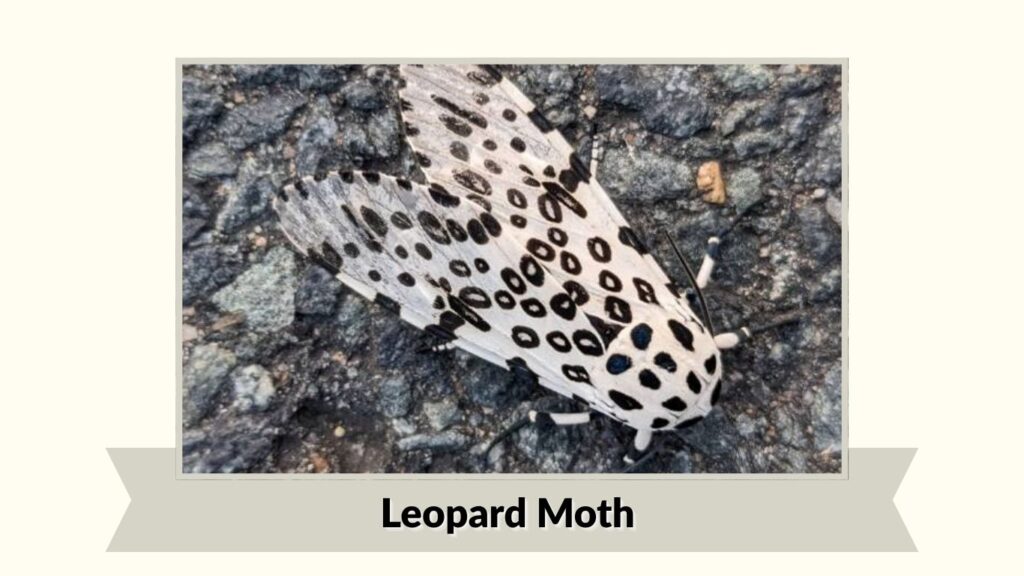
The Leopard Moth (Zeuzera pyrina) is one of the most visually distinctive carpenter moths. Instead of the gray-brown camouflage common among many Cossidae, it has pale wings covered with numerous dark blue-black or black spots. Its caterpillars are wood borers that develop inside a wide variety of deciduous trees and shrubs, including many fruit trees.
Identification
- Wingspan is approximately 45–65 mm
- Wings are white or slightly translucent
- Numerous black or blue-black spots cover the wings
- Body carries similar dark spotting
- Males are noticeably smaller than females
- Mature larvae can reach around 60 mm long
- Caterpillars are yellowish with a dark head
- Frass around holes can indicate larval activity
Habitat and Distribution
The Leopard Moth is native across parts of Europe, North Africa, and Asia and has also been introduced into North America. In Britain, it occurs in England and Wales and can be found in open woodland, scrub, parks, orchards, and gardens.
Behavior and Diet
Adult Leopard Moths are nocturnal and are attracted to lights, although they may occasionally be seen resting on tree trunks during daylight. Adults cannot feed.
The caterpillars consume internal woody tissues of many plants. Recorded hosts include apple, pear, cherry, plum, walnut, oak, elm, ash, willow, maple, poplar, and numerous other trees and shrubs. Their galleries may extend deeply through branches and stems.
Lifespan and Life Cycle
Females generally lay eggs in bark cracks or wounds during early summer. Newly hatched larvae enter stems and branches and remain there through multiple seasons. Larval development typically requires about two to three years. When mature, the caterpillar pupates inside its feeding gallery in a silken cocoon before the adult eventually emerges.
10. Giant Wood Moth
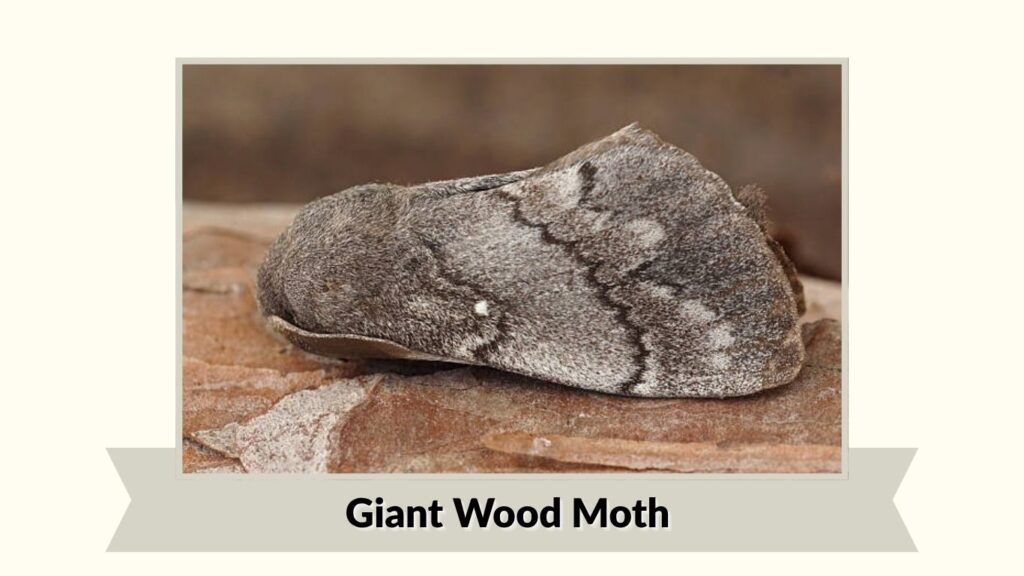
The Giant Wood Moth (Endoxyla cinereus) is among the most impressive members of the carpenter moth family and is regarded as the world’s heaviest moth. Large females can weigh around 30 grams and reach a wingspan of roughly 23 cm. Native to Australia, this enormous species spends most of its life hidden as a larva associated with eucalyptus trees before emerging briefly as a non-feeding adult.
Identification
- Scientific name: Endoxyla cinereus
- Female wingspan can approach 23 cm
- Large females may weigh about 30 grams
- Females are considerably larger than males
- Wings are mottled gray and brown
- Coloration provides camouflage against eucalyptus bark
- Adults have large, thick bodies
- Among the heaviest moth species known
Habitat and Distribution
Giant Wood Moths are native to Australia. Their accepted range covers parts of eastern, southern, and southwestern Australia, although much of the best-known biological information comes from Queensland and New South Wales. They are strongly associated with eucalyptus habitats where suitable trees support developing larvae.
Behavior and Diet
The immature stage has a complicated feeding ecology. Very young caterpillars may disperse on silk threads and are thought to feed around roots before later entering eucalyptus trunks. Older larvae occupy chambers beneath the bark and feed on living tissue generated around their burrows.
Adult Giant Wood Moths have reduced mouthparts and do not feed. Their brief adult stage is devoted almost entirely to mating and reproduction.
Lifespan and Life Cycle
Females can produce thousands of tiny eggs. After hatching, larvae undergo a long developmental period before eventually entering eucalyptus trunks and creating large chambers. Development may extend for several years overall, although some details of the early life cycle remain incompletely understood. Pupation takes place within the tree, and adults emerge primarily during the Australian summer. The adult survives only a few days.
FAQs
1. What are carpenter moths?
Carpenter moths are members of the family Cossidae. They are best known for their caterpillars, which often bore into the bark, stems, trunks, or roots of woody plants. Many species spend far more time as concealed larvae than as adult moths.
2. Do carpenter moths damage trees?
Some species can damage trees because their caterpillars create tunnels inside trunks and branches. Heavy infestations may weaken wood or increase the chance of branch breakage. However, the amount of damage varies considerably by moth species, host tree, and infestation level.
3. What do carpenter moth caterpillars eat?
Most carpenter moth caterpillars feed on plant tissues. Depending on the species, they may consume bark, sapwood, living tissues around tunnels, roots, or internal woody material. Host plants range from hardwoods such as oak and poplar to pines and eucalyptus.
4. How long do carpenter moths live?
The larval stage may last several years in some carpenter moth species. Carpenterworms and Leopard Moths are examples of species with long wood-boring development. In contrast, the adult stage is generally much shorter and may last only days or weeks.
5. Are carpenter moths dangerous to humans?
Carpenter moths are not considered dangerous to people. Adults do not sting, and many species have limited or nonfunctional feeding mouthparts. Their main significance is ecological or related to the damage that wood-boring larvae can sometimes cause to trees.