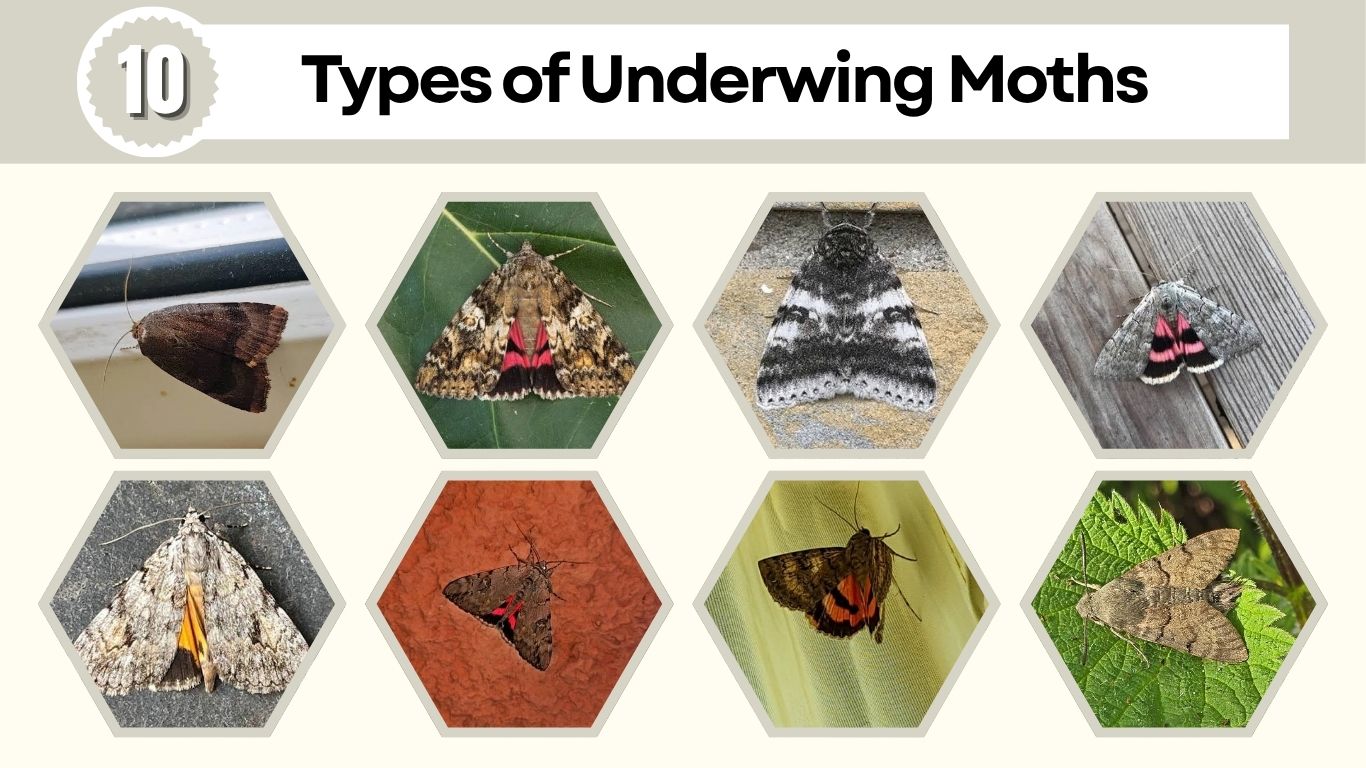
Underwing moths are fascinating insects best known for their bark-like forewings and colorful hidden hindwings. Most belong to the genus Catocala and spend the daytime resting on tree trunks, where their camouflage helps them avoid predators. When disturbed, they suddenly reveal bright red, orange, pink, white, or yellow hindwings before flying away. In this guide, you’ll discover 10 types of underwing moths, along with their identification features, habitats, behaviors, diets, and life cycles.
1. Magdalen Underwing
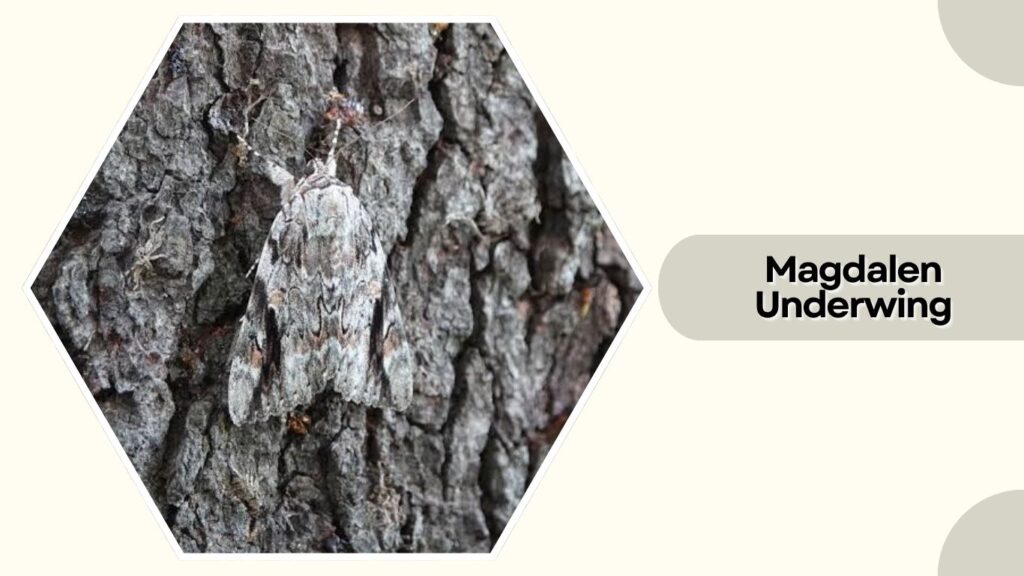
The Magdalen Underwing (Catocala illecta) is a striking moth in the family Erebidae. At rest, its brownish forewings blend easily with tree bark, helping it remain concealed during daylight hours. When disturbed or in flight, however, it reveals bright orange hindwings marked with bold black bands. This contrast is one of the key features that makes underwing moths so distinctive.
Identification
- Scientific name: Catocala illecta
- Family: Erebidae
- Wingspan: About 2¼–2¾ inches
- Forewing color: Tan, gray, or brown with irregular dark lines
- Hindwing color: Bright orange with contrasting black bands
- Body shape: Broad-winged and robust
- Caterpillar: Slender with alternating dark and pale bands
- Key feature: Bright hindwings remain hidden when the moth is resting
Habitat and Distribution
Magdalen Underwings are found mainly in deciduous forests, woodland borders, floodplain forests, and other areas where their larval host plants occur. In places such as Michigan, they are especially associated with lowland forests and shrub habitats containing honey locust. During the daytime, adults may rest on tree trunks, rocks, beneath ledges, or among leaf litter, where their bark-like forewings provide excellent camouflage.
Behavior and Diet
Adults are nocturnal and may be attracted to artificial lights at night. When resting, they usually keep their brightly colored hindwings covered. If startled, the sudden flash of orange and black may surprise predators long enough for the moth to escape. Caterpillars feed on woody members of the pea family, particularly honey locust, black locust, and leadplant. Adults may also be attracted to sugary bait placed on tree trunks by moth enthusiasts.
Lifespan and Life Cycle
The life cycle begins when females lay eggs near suitable host plants. After hatching, caterpillars feed on foliage and grow through several larval stages. Young larvae commonly feed in tree canopies, while mature caterpillars eventually descend toward the ground before pupating. After the pupal stage, adult moths emerge and become active mainly at night. The timing of development depends on seasonal temperature, host-plant availability, and local environmental conditions.
2. Hawthorn Underwing
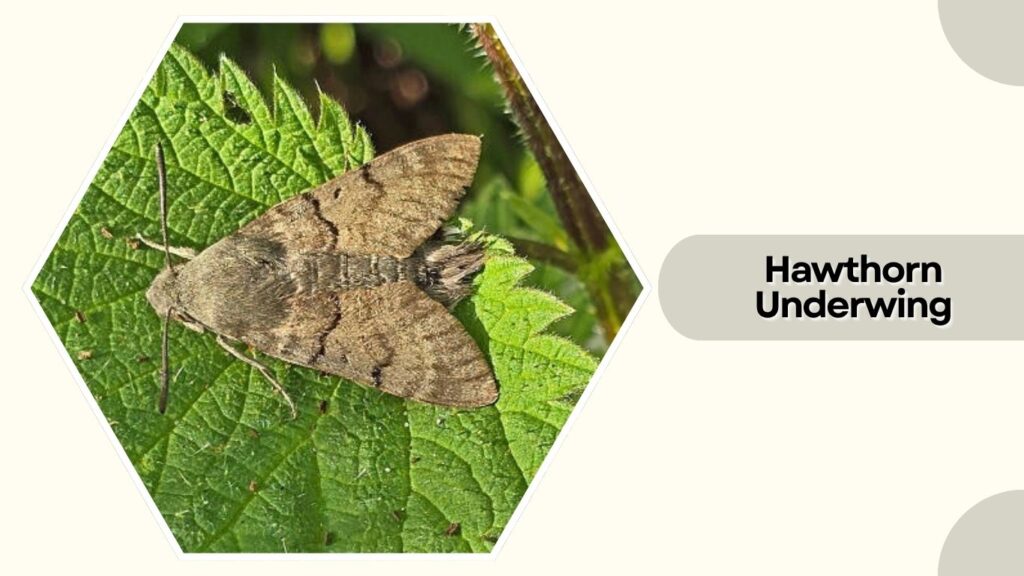
The Hawthorn Underwing (Catocala crataegi), also called the Chokeberry Underwing, is a medium-sized North American underwing moth in the family Erebidae. Its muted forewings provide effective camouflage against tree bark, while the hindwings display the brighter coloration typical of many Catocala species. Adults are mainly seen during summer, particularly in woodland habitats containing their larval host plants.
Identification
- Scientific name: Catocala crataegi
- Family: Erebidae
- Wingspan: About 40–50 mm
- Forewings: Grayish-brown with irregular darker markings
- Hindwings: Contrasting orange with dark bands
- Body: Robust and patterned to blend with bark
- Flight period: Mainly June through August
Habitat and Distribution
Hawthorn Underwings occur across eastern and central North America. Their range extends through portions of Canada and south through much of the eastern United States. They favor deciduous woodland, woodland edges, and shrubby environments where hawthorn and related trees grow.
Behavior and Diet
Adults are nocturnal and commonly remain motionless against bark during daylight. Their cryptic forewings help conceal them from predators. Caterpillars feed on trees and shrubs in the rose family. Documented host genera include hawthorn, apple, cherry or plum, and pear.
Lifespan and Life Cycle
This species generally produces one generation annually. Eggs give rise to caterpillars that feed on suitable woody host plants before pupating. Adults appear mainly in summer, with exact timing varying according to latitude and climate. The annual cycle allows larval development to coincide with fresh foliage on host trees.
3. Wonderful Underwing
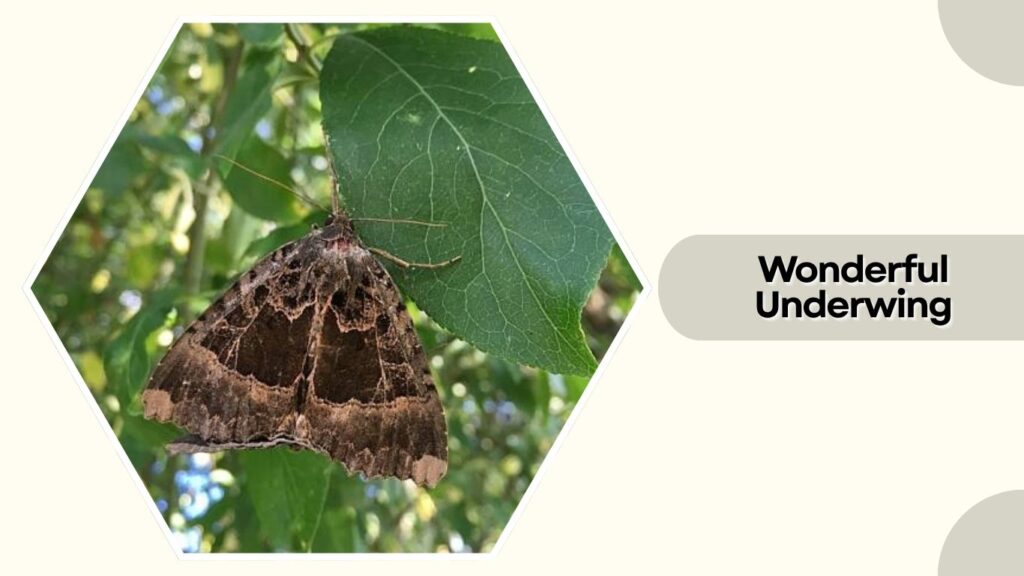
The Wonderful Underwing (Catocala mira) is a colorful North American underwing moth whose appearance changes dramatically when its wings open. At rest, gray patterned forewings dominate its appearance and provide camouflage. In flight, orange hindwings marked with strong black bands become visible. The species is closely associated with trees and shrubs in the rose family.
Identification
- Scientific name: Catocala mira
- Family: Erebidae
- Wingspan: Approximately 40–50 mm
- Forewings: Gray with a paler diagonal area
- Hindwings: Orange with bold black bands
- Wing fringe: Contrasting or checkered appearance
- Adult activity: Primarily nocturnal
- Main flight season: Summer
Habitat and Distribution
Wonderful Underwings occur broadly in eastern and central North America, with records extending from southern Canada into much of the eastern United States and south toward Florida and Texas. They are most likely to occur in woodland edges, forests, and other habitats containing suitable larval host plants.
Behavior and Diet
During daylight, adults can rest against bark where their gray forewings make them difficult to detect. When disturbed, opening the wings suddenly exposes the bright hindwing pattern. Caterpillars feed on foliage of plants in the rose family, especially hawthorn, apple, and Prunus species such as cherries and plums.
Lifespan and Life Cycle
The Wonderful Underwing generally has one generation per year. Caterpillars develop on their host plants before pupating and transforming into adults. Adults are primarily encountered during summer, particularly around July and August in much of their range. Seasonal timing varies somewhat depending on local climate.
4. Charming Underwing
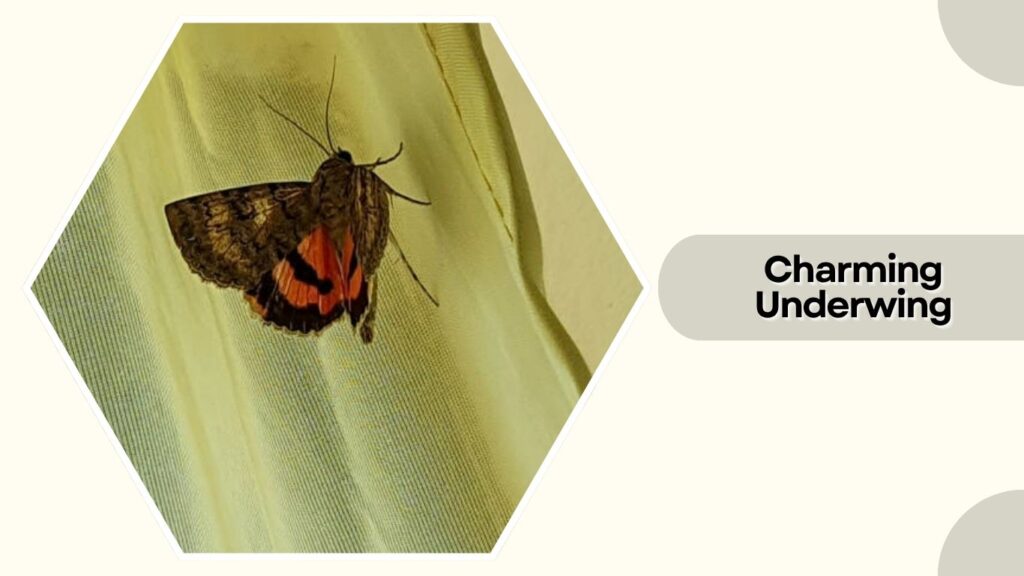
The Charming Underwing (Catocala blandula) is a medium-sized moth found primarily across northern and eastern North America. Like many underwing moths, it combines highly camouflaged forewings with more conspicuous hindwings. This combination helps the moth remain nearly invisible while resting but gives it a much more noticeable appearance when flying.
Identification
- Scientific name: Catocala blandula
- Family: Erebidae
- Wingspan: Roughly 42–50 mm
- Forewings: Gray to brown with irregular markings
- Hindwings: Orange to reddish-orange with black patterning
- Body: Stout and bark-colored
- Flight period: Mainly July through September
- Resting posture: Wings folded flat over the body
Habitat and Distribution
The Charming Underwing occurs from eastern Canada west into central Alberta and south into parts of the northern and northeastern United States. It inhabits woodland, woodland margins, and landscapes where its larval food plants are present.
Behavior and Diet
Adults are primarily active after dark and spend daylight hours resting on trunks or other sheltered surfaces. Caterpillars have been recorded feeding on serviceberry, hawthorn, apple, poplar, and willow. These host relationships connect the species strongly with wooded and shrubby habitats.
Lifespan and Life Cycle
Eggs hatch into caterpillars that spend their active feeding period on host-tree foliage. As the larvae mature, they eventually stop feeding and pupate before emerging as winged adults. Adults are most commonly recorded from midsummer into early fall. The species follows a strongly seasonal development pattern adapted to temperate climates.
5. Sweet Underwing
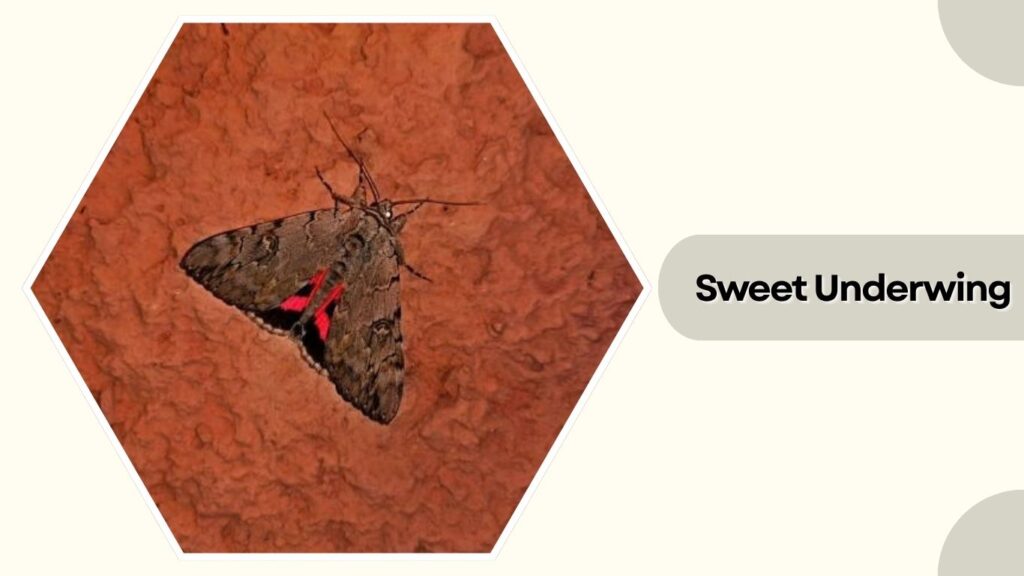
The Sweet Underwing (Catocala dulciola), also known as the Quiet Underwing, is a North American species in the family Erebidae. It is another classic example of the underwing camouflage strategy: subdued forewings conceal the moth while resting, whereas brighter hindwings become apparent once it takes flight. Its caterpillars are associated particularly with members of the rose family.
Identification
- Scientific name: Catocala dulciola
- Family: Erebidae
- Wingspan: Around 40–45 mm
- Forewings: Grayish or brownish with bark-like markings
- Hindwings: Brightly colored with contrasting dark bands
- Body: Stout and well camouflaged
- Adult season: Mainly early to midsummer
- Other common name: Quiet Underwing
Habitat and Distribution
Sweet Underwings have been recorded from New York south through Virginia and west into portions of Missouri, Illinois, and Michigan. They occur mainly in wooded environments and forest margins where hawthorn, cherry, plum, and related host plants are available.
Behavior and Diet
Adults are nocturnal and rely heavily on camouflage during daylight. Their bark-patterned forewings make them difficult to distinguish from tree trunks. Caterpillars feed primarily on foliage of rose-family plants, with hawthorn and Prunus among documented host genera.
Lifespan and Life Cycle
Sweet Underwings generally complete one generation each year. Caterpillars feed during the growing season and eventually pupate before the adult stage emerges. Adults are primarily encountered during June and July in much of the known range. Seasonal conditions and latitude can cause some variation in the exact emergence period.
6. Girlfriend Underwing
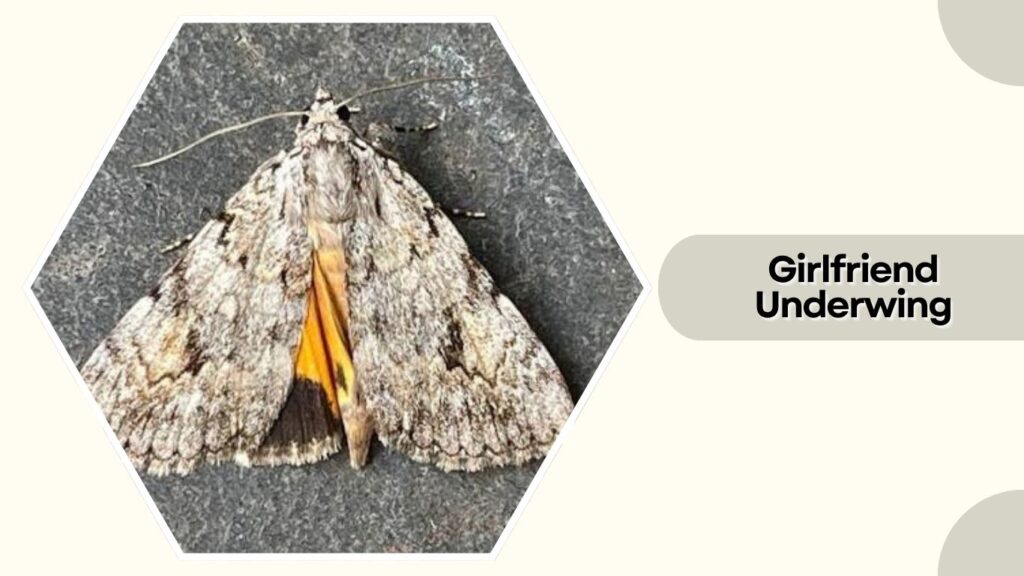
The Girlfriend Underwing (Catocala amica) is a relatively small species of underwing moth native to North America. Its gray-brown forewings resemble tree bark, but the hindwings provide greater contrast when exposed. The species belongs to a group of Catocala whose hindwing pattern differs somewhat from many familiar orange-and-black underwings.
Identification
- Scientific name: Catocala amica
- Family: Erebidae
- Wingspan: About 35–40 mm
- Forewings: Grayish-brown with irregular darker lines
- Body: Compact and bark-colored
- Hindwings: Contrasting coloration without the strong medial black band seen in many Catocala
- Activity: Mainly nocturnal
- Size: Smaller than many larger underwing species
Habitat and Distribution
Girlfriend Underwings occur from southern Canada through much of the United States east of the Rocky Mountains, extending into areas of the Southwest and Texas. They are commonly associated with deciduous woodland and habitats containing oaks, which serve as important larval host plants.
Behavior and Diet
Adults rest quietly during daylight and become active after dark. Their mottled forewings make them difficult to detect against bark. The caterpillars feed on oak foliage, making oak-rich forests and woodland edges especially important habitats for the species.
Lifespan and Life Cycle
Females lay eggs associated with suitable host-tree habitats. The caterpillars hatch and feed on oak leaves, growing through several larval stages before pupation. Adults emerge during the warmer part of the year and become active primarily at night. As with many temperate Catocala moths, development is synchronized with seasonal availability of fresh host foliage.
7. Sleepy Underwing
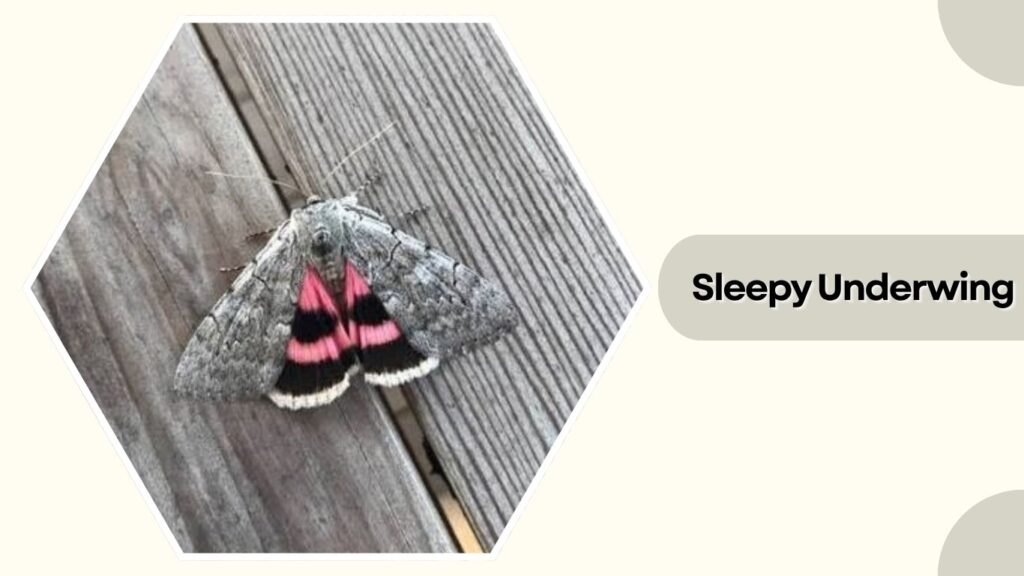
The Sleepy Underwing (Catocala concumbens), also called the Pink Underwing, is a colorful North American moth in the family Erebidae. Like many Catocala species, it hides its brighter colors while resting. Its pale gray forewings blend against tree bark, while the concealed hindwings display striking pink and black bands that become visible when the moth flies or is disturbed.
Identification
- Scientific name: Catocala concumbens
- Family: Erebidae
- Wingspan: About 60–75 mm
- Forewings: Pale gray with whitish and tan shading
- Forewing markings: Thin, sharp black lines
- Hindwings: Bright pink, occasionally yellowish
- Hindwing bands: Broad black markings
- Fringe: Wide and whitish
Habitat and Distribution
Sleepy Underwings occur across eastern and parts of central North America. Their documented range extends from Nova Scotia south into the North Carolina mountains and west through Manitoba and South Dakota. Because their caterpillars depend on poplars and willows, the moths are often associated with deciduous forests, river corridors, woodland edges, wetlands, and other places where these trees grow.
Behavior and Diet
Adults are primarily nocturnal. During daylight they rest against bark, where their gray-patterned forewings provide camouflage. If disturbed, taking flight suddenly exposes the vivid pink-and-black hindwings. Caterpillars feed on foliage of poplar (Populus) and willow (Salix) species, making these trees important for reproduction and larval development.
Lifespan and Life Cycle
The Sleepy Underwing passes through egg, caterpillar, pupa, and adult stages. Larvae develop by feeding on their host-tree foliage before pupating and eventually emerging as adults. Adult flight records generally extend from June through September, although the exact emergence period varies with climate and location.
8. White Underwing
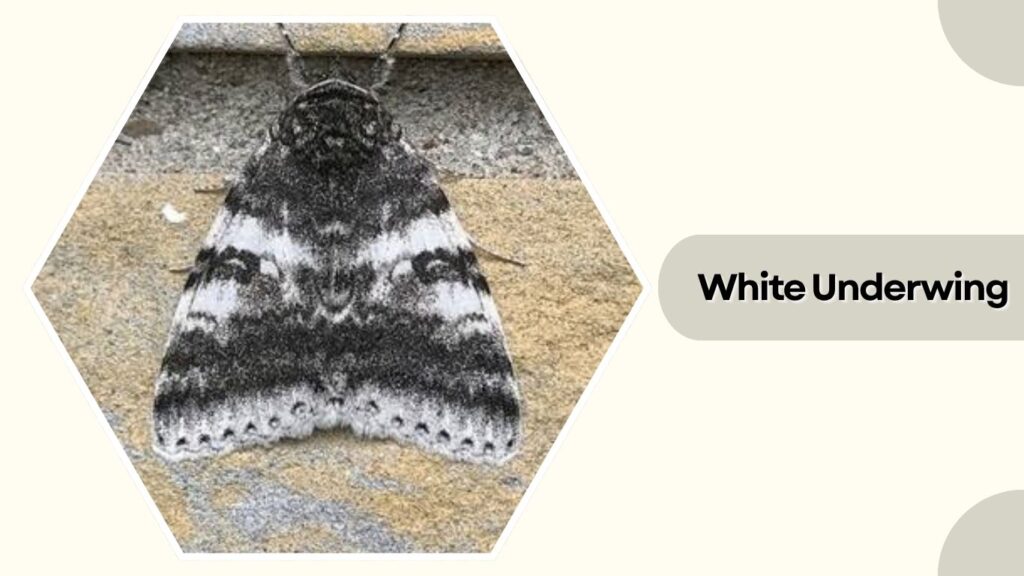
The White Underwing (Catocala relicta), sometimes called the Relict, is one of the most easily recognized North American underwing moths. Unlike the red, orange, or pink hindwings of many related species, this moth has dramatic black hindwings crossed by a broad white band. Its gray and whitish forewings provide excellent camouflage, particularly when resting on pale tree bark.
Identification
- Scientific name: Catocala relicta
- Family: Erebidae
- Wingspan: About 67–80 mm
- Forewings: White, gray, or blackish with irregular markings
- Hindwings: Predominantly black
- Key feature: Bold white band crossing each hindwing
- Body: Grayish with darker thoracic markings
- Resting appearance: Highly camouflaged against pale bark
Habitat and Distribution
White Underwings have a broad northern North American distribution. They occur across much of Canada and extend south into portions of the United States. They are commonly associated with deciduous or mixed forests containing aspen, poplar, willow, and birch. Their pale forewing pattern is especially effective when adults rest on light-colored bark.
Behavior and Diet
Adults are active mostly at night and can remain motionless on trunks during the day. Their black-and-white hindwings remain concealed beneath the forewings until the moth takes flight. Caterpillars feed primarily on quaking aspen, balsam poplar, willow, and white birch, although additional woody hosts have been recorded.
Lifespan and Life Cycle
Females lay eggs associated with suitable host trees, and overwintering can occur in the egg stage. Caterpillars hatch when conditions become favorable and feed on host leaves before pupating. Adults are typically encountered from July through October, depending on geographic location. The species generally follows a strongly seasonal annual development pattern.
9. Scarlet Underwing
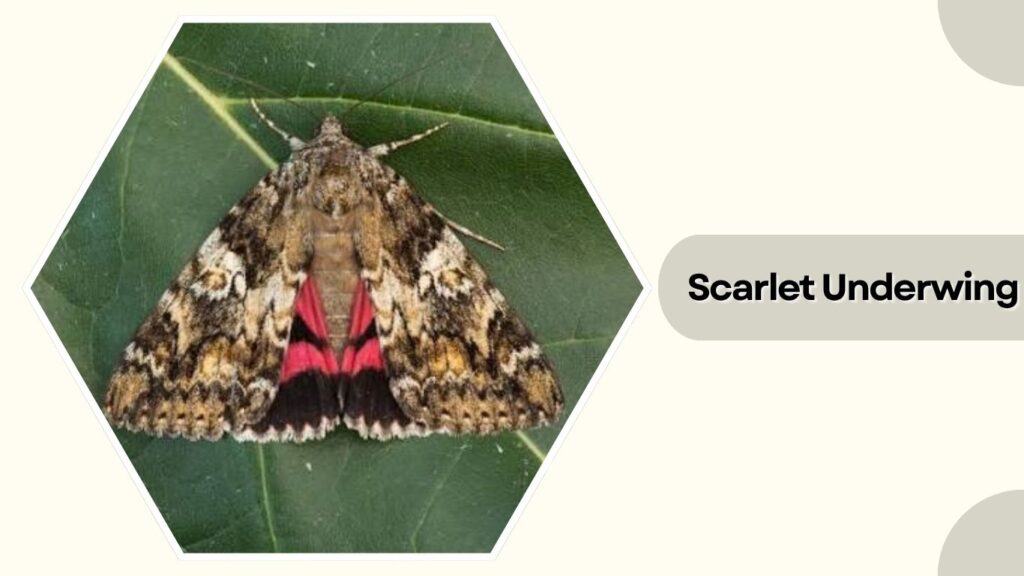
The Scarlet Underwing (Catocala coccinata) is a striking North American moth recognized for its brilliant red hindwings. While resting, its mottled light-gray forewings conceal this intense coloration and help the moth blend into tree bark. Once disturbed, the sudden display of scarlet and black makes it one of the more visually distinctive species in the underwing group.
Identification
- Scientific name: Catocala coccinata
- Family: Erebidae
- Wingspan: About 57–70 mm
- Forewings: Mottled light gray
- Forewing markings: Black lines and a broad dark basal dash
- Hindwings: Bright scarlet to red
- Hindwing markings: Strong black bands
- Fringe: Primarily white, sometimes with red near the tip
Habitat and Distribution
Scarlet Underwings occur from southern Canada through the eastern United States, with their distribution extending westward along river valleys into parts of the Great Plains and south toward Florida. They are closely associated with oak-containing forests and woodland edges because oaks provide the principal food plants for their caterpillars.
Behavior and Diet
During the day, adults rely on their mottled forewings for camouflage. They become active mainly after dark and may be encountered around wooded habitats. The caterpillars are foliage feeders and rely particularly on oak (Quercus) species, including scrub oaks and other native oaks.
Lifespan and Life Cycle
Eggs eventually hatch into caterpillars that feed externally on oak leaves. After passing through their larval growth stages, they pupate and later emerge as adults. Adult Scarlet Underwings are generally recorded between June and September, with local temperature and latitude influencing the precise flight period.
10. Little Nymph Underwing
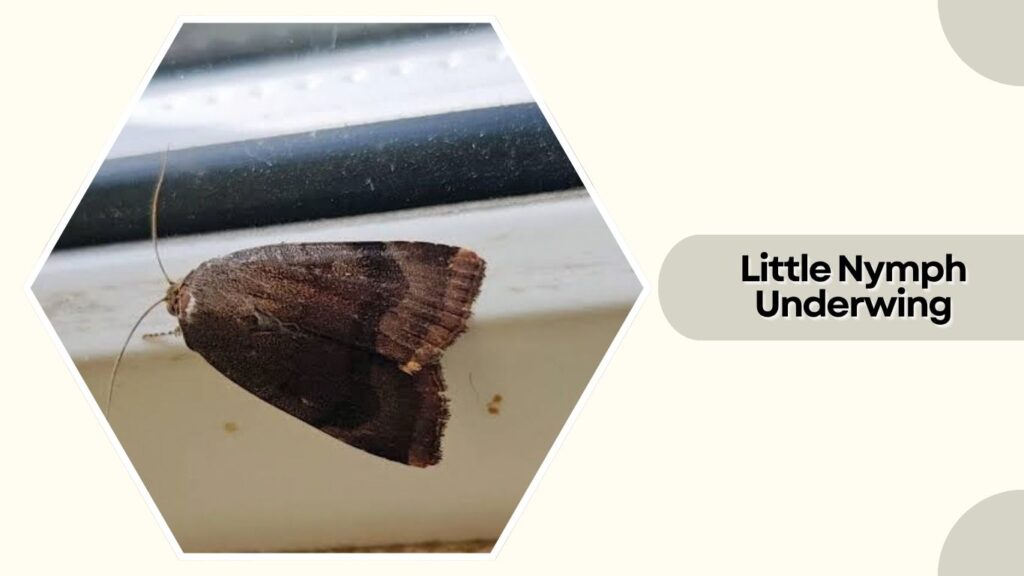
The Little Nymph Underwing (Catocala micronympha), also called the Little Bride Underwing, is one of the smaller members of the Catocala genus. Its forewings carry intricate gray and brown patterns that resemble bark, while its hidden hindwings show bright yellow-orange areas bordered and crossed by black. This combination provides both effective camouflage and a dramatic appearance in flight.
Identification
- Scientific name: Catocala micronympha
- Family: Erebidae
- Wingspan: About 35–50 mm
- Forewings: Mottled gray to brown
- Forewing pattern: Irregular lines resembling tree bark
- Hindwings: Yellow-orange to orange
- Hindwing markings: Bold black bands and dark margins
- Size: Relatively small compared with many other underwings
Habitat and Distribution
Little Nymph Underwings occur across a large portion of eastern and central North America. Their range includes southern Canada and much of the eastern United States, extending south to Florida and west through Texas and the central states. Oak woodlands, dry forests, woodland margins, and other habitats containing suitable host trees provide important breeding environments.
Behavior and Diet
Adults spend daylight hours resting in camouflaged positions and become more active after dark. Their smaller size and cryptic coloration can make them difficult to notice when the wings are closed. Caterpillars are strongly associated with oaks, including live oak, post oak, and other Quercus species; additional host records include maple.
Lifespan and Life Cycle
Little Nymph Underwings generally have about one generation per year. Caterpillars feed on host-tree foliage before entering the pupal stage, after which adults emerge. Depending on location, adult activity has been recorded from April through September, giving southern populations a longer apparent flight season than populations farther north.
FAQs
1. What are underwing moths?
Underwing moths are primarily moths in the genus Catocala, known for having cryptically patterned forewings and often brightly colored hindwings. When resting, the forewings cover the hindwings, allowing the moth to blend into tree bark. When disturbed, the hidden colors suddenly become visible.
2. Why do underwing moths have brightly colored hindwings?
The colorful hindwings are thought to function as a defensive display. A resting moth can remain difficult to detect because of its bark-like forewings. When it suddenly flies, the flash of red, orange, pink, white, or yellow can surprise or confuse a predator before the moth lands and becomes camouflaged again.
3. What do underwing moth caterpillars eat?
The food plant depends on the species. Many underwing caterpillars feed on deciduous trees and shrubs. Oaks, willows, poplars, aspens, hawthorns, cherries, and related woody plants serve as important hosts for different Catocala species.
4. Are underwing moths harmful to people?
Underwing moths are generally harmless to people. Adults do not bite or sting, and their caterpillars are primarily foliage feeders. Their ecological role includes serving as food for birds, bats, and other predators while using native trees and shrubs as larval host plants.
5. When are underwing moths most active?
Adult underwing moths are primarily nocturnal, becoming active from evening through the night. The seasonal flight period differs among species and regions. Many North American species are most commonly encountered from late spring or summer into early fall.