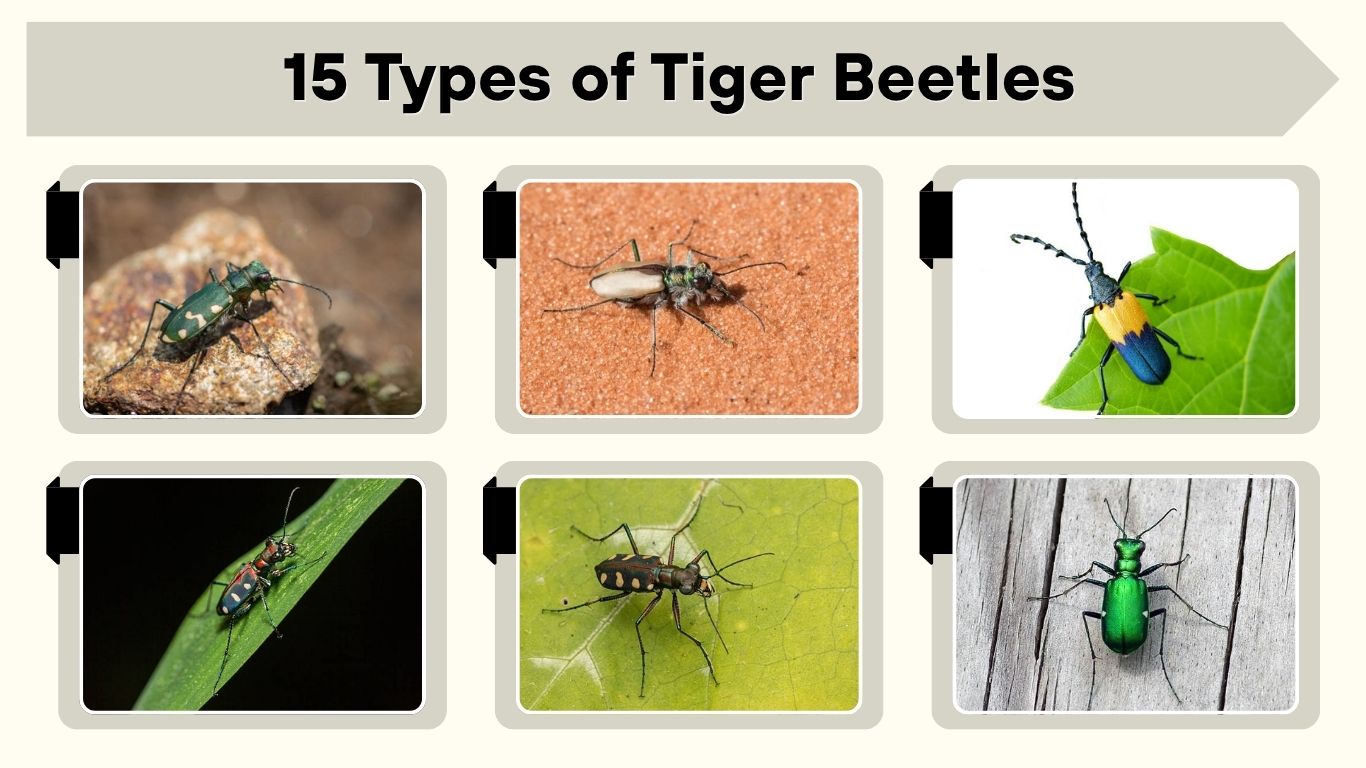
Tiger beetles are among the fastest and most visually striking predatory beetles found in open habitats such as trails, riverbanks, dunes, clay banks, and woodland paths. They are known for large eyes, powerful mandibles, long running legs, and quick hunting behavior. Different species vary in color, markings, habitat preference, and geographic range. In this guide, we cover 15 types of tiger beetles, including their identification features, habitat and distribution, behavior and diet, and general lifespan and life cycle.
1. Six-Spotted Tiger Beetle
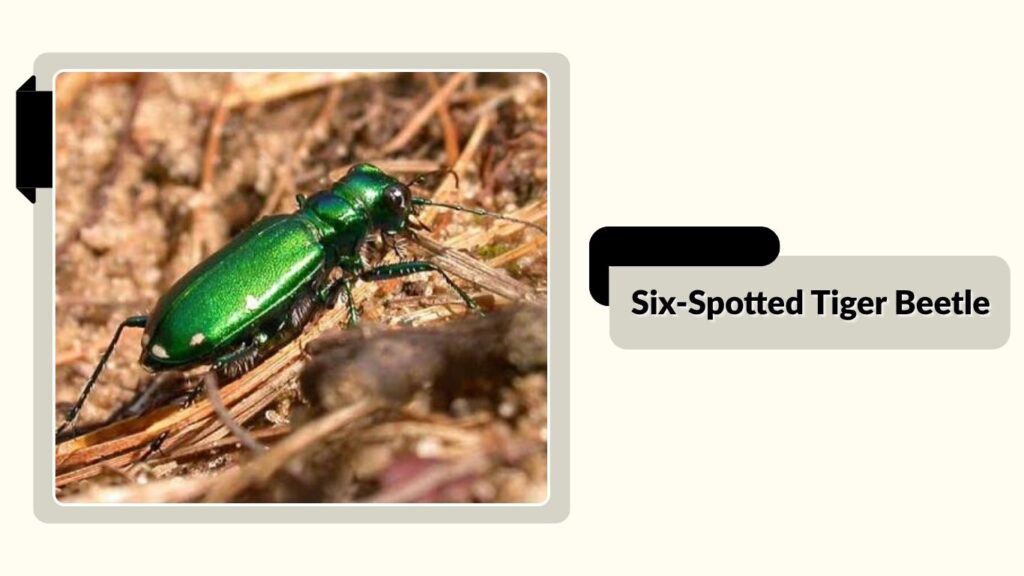
The Six-Spotted Tiger Beetle is one of the most recognizable tiger beetles in North America because of its vivid metallic green body and active hunting behavior. Despite its name, the number of pale spots on the wing covers can vary between individuals. This fast-moving ground beetle is commonly seen on sunny forest paths, woodland edges, and trails where it searches for small insects.
Identification
- Bright metallic green to blue-green body
- Usually about 10–14 mm long
- Long, slender legs built for fast running
- Large, prominent eyes
- Strong, curved mandibles
- Pale or white spots along the edges of the wing covers
- Spot number can vary and may be fewer or more than six
- Narrow body with a shiny metallic appearance
- Often seen running rapidly across bare ground
Habitat and Distribution
Six-Spotted Tiger Beetles are widely distributed across much of eastern North America. They are particularly common in deciduous woodlands, forest clearings, dirt roads, hiking trails, and sunny paths. Adults prefer open areas where sunlight reaches the ground because warmer surfaces support their active hunting style. They may also appear along woodland edges and disturbed areas with exposed soil.
Behavior and Diet
This beetle is an active daytime predator. Instead of waiting for prey, it runs quickly across the ground and uses its excellent vision to detect small insects. Its diet includes ants, small flies, caterpillars, spiders, and other tiny arthropods.
When disturbed, adults often fly a short distance ahead before landing again, which can make them difficult to approach. Their speed and powerful mandibles make them effective hunters compared with many other ground-dwelling beetles.
Lifespan and Life Cycle
The life cycle begins when females lay eggs in soil. After hatching, the larvae create vertical burrows where they wait near the entrance for passing prey.
Larvae use their strong jaws to grab insects and pull them into the burrow. They pass through several developmental stages before pupating underground. Adults usually become active during warmer months, especially in spring and early summer.
The complete development from egg to adult can take a year or longer depending on climate and environmental conditions.
2. Bronzed Tiger Beetle
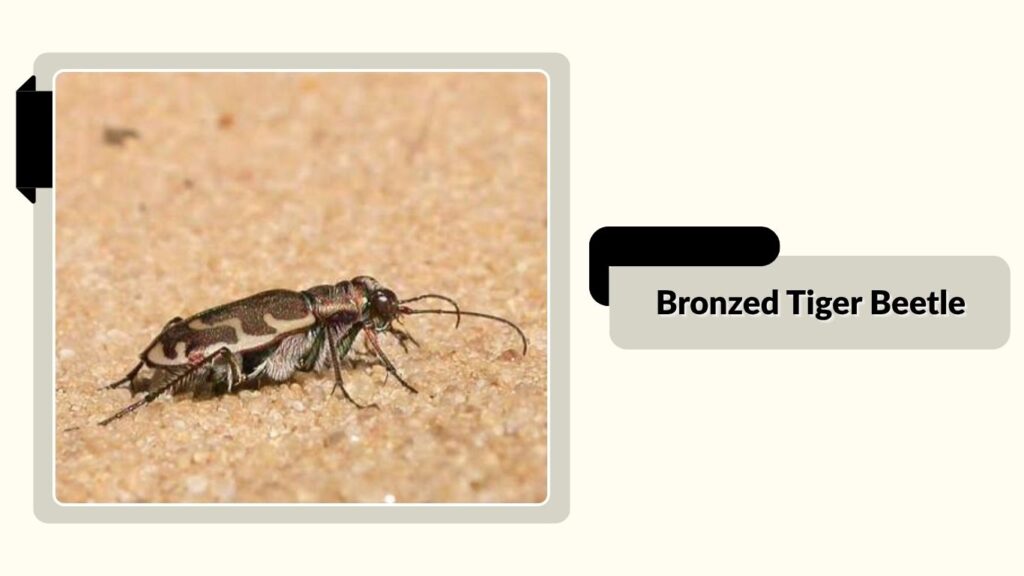
The Bronzed Tiger Beetle is a fast-moving predatory beetle recognized by its dark bronze to metallic brown coloration. It is commonly associated with open ground, sandy paths, and disturbed habitats where it can run freely while hunting. Like other tiger beetles, it relies heavily on speed, sharp vision, and powerful mandibles to capture small arthropods.
Identification
- Metallic bronze to brown body
- Usually medium-sized for a tiger beetle
- Large, rounded eyes
- Long legs adapted for rapid running
- Strong, curved mandibles
- Pale markings may occur along the wing covers
- Shiny surface in bright sunlight
- Narrow head and thorax
- Quickly runs or flies when disturbed
Habitat and Distribution
Bronzed Tiger Beetles generally prefer open areas with exposed soil. They may be encountered along sandy trails, gravel roads, woodland openings, riverbanks, and sparsely vegetated ground.
Their distribution varies by species and region, but suitable habitat usually provides plenty of sunlight and open running space. Adults commonly select areas where vegetation is low enough for them to detect and pursue prey efficiently.
Behavior and Diet
These beetles are active hunters during warm daylight hours. They run rapidly over the ground, stopping frequently to locate prey with their large eyes.
Their diet consists mainly of ants, flies, small beetles, spiders, and other arthropods. After spotting prey, the beetle quickly closes the distance and captures it using its strong mandibles.
When approached by humans or predators, it may fly several feet before landing and resuming its activity.
Lifespan and Life Cycle
Females lay eggs in suitable soil, where the larvae later construct vertical burrows. Larvae remain close to the burrow opening and ambush insects passing nearby.
They go through several larval stages before pupating underground. Adults emerge when environmental conditions become suitable. Depending on climate and species, development may take one year or extend across multiple seasons.
3. Festive Tiger Beetle
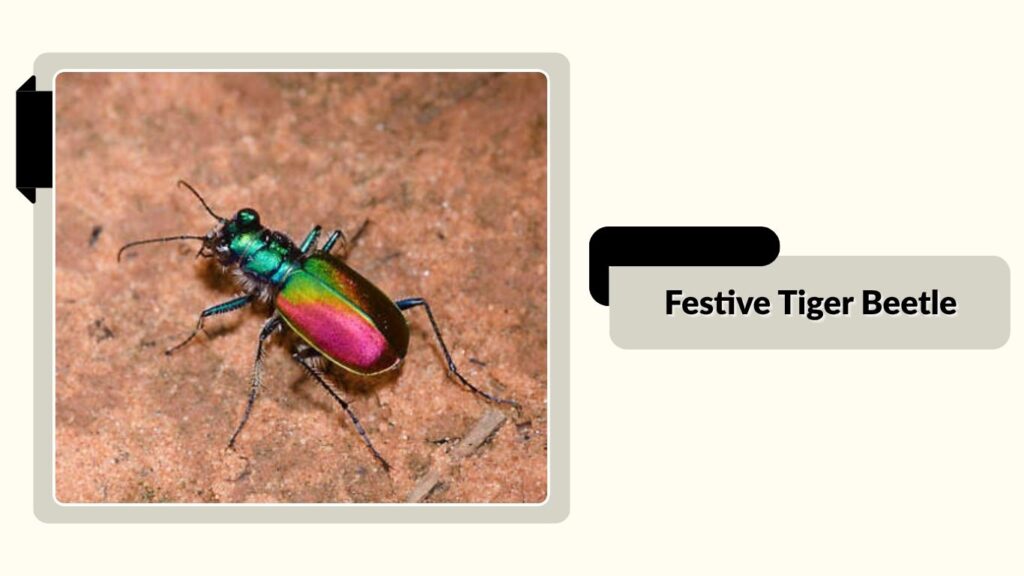
The Festive Tiger Beetle is an attractive species known for its colorful metallic body and contrasting pale markings. It is typically found in warm, open habitats where bare soil allows it to hunt efficiently. Its bright appearance, quick movements, and aggressive predatory behavior make it a striking member of the tiger beetle group.
Identification
- Metallic green, bronze, or reddish coloration
- Distinct pale markings on wing covers
- Long, slender legs
- Prominent compound eyes
- Powerful toothed mandibles
- Shiny body surface
- Medium-sized tiger beetle
- Narrow waist-like connection between body sections
- Fast-running behavior
Habitat and Distribution
Festive Tiger Beetles favor sunny environments with sandy or loose soil. Typical habitats include riverbanks, trails, open woodland edges, beaches, and disturbed ground.
They generally avoid heavily shaded areas because their activity is strongly influenced by warmth and sunlight. Local distribution depends on soil condition, vegetation density, and availability of prey.
Behavior and Diet
Adults are visual hunters that patrol exposed soil during the day. Their large eyes help them locate moving insects, while their long legs allow rapid pursuit.
Common prey includes ants, small flies, caterpillars, spiders, and other insects that cross the ground. Adults may pause frequently while running because rapid movement can temporarily reduce visual tracking accuracy.
When threatened, the beetle commonly flies a short distance away rather than remaining hidden.
Lifespan and Life Cycle
Eggs are deposited individually in soil. After hatching, larvae build narrow burrows that function as both shelter and hunting sites.
The larva waits near the entrance and attacks passing insects with its strong jaws. Hooks on its body help anchor it within the burrow.
After several larval stages, it pupates underground. Adults later emerge to feed and reproduce, completing a life cycle that may require a year or more.
4. Cow Path Tiger Beetle
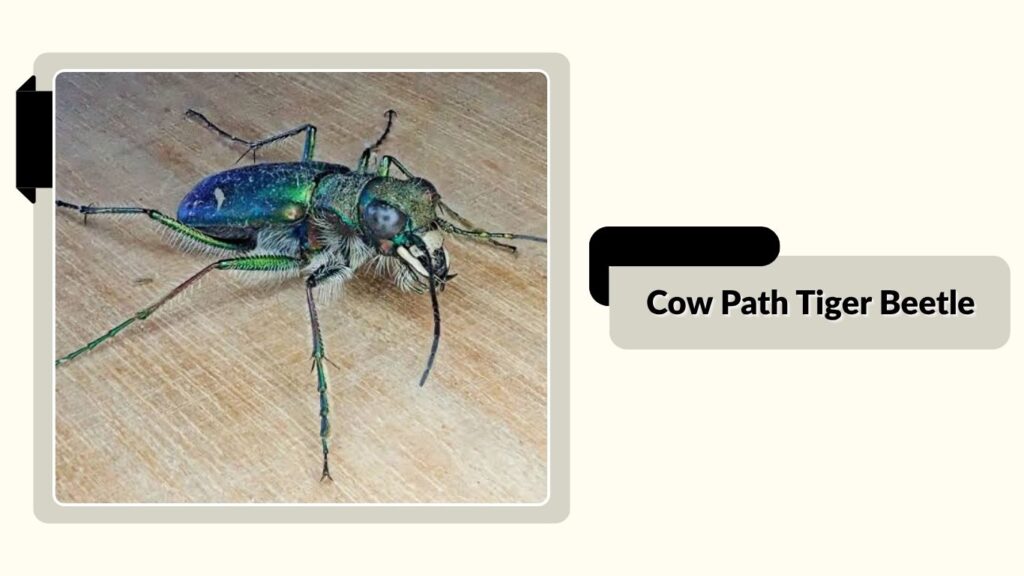
The Cow Path Tiger Beetle gets its common name from its association with open trails, paths, and compacted ground. Its coloration helps it blend with soil while still displaying the metallic shine typical of many tiger beetles. It is an alert predator that spends much of the day running across exposed ground in search of small insects.
Identification
- Brown, bronze, or metallic body coloration
- Pale markings on the wing covers
- Large protruding eyes
- Long running legs
- Strong sickle-shaped mandibles
- Streamlined body
- Medium size
- Quick movements across bare ground
- Short flights when disturbed
Habitat and Distribution
This beetle is associated with paths, roadsides, open fields, woodland trails, and other areas where soil remains relatively exposed.
Compacted ground can provide suitable habitat because adults require open surfaces for hunting. Some populations may also occur near sandy banks or disturbed agricultural areas.
Behavior and Diet
Cow Path Tiger Beetles are active during sunny weather and depend heavily on body temperature for speed. They often bask briefly before becoming highly active.
They prey on ants, flies, spiders, and other small arthropods. Hunting involves short bursts of rapid running followed by pauses.
Their coloration provides some camouflage against soil, while their flight response helps them escape predators and approaching people.
Lifespan and Life Cycle
Females select suitable soil for egg laying. Each young larva develops in a vertical burrow and spends much of its immature life waiting for prey near the surface.
Larvae grab passing insects and retreat deeper into the burrow when threatened. Development includes several larval stages followed by an underground pupal stage.
Adults appear during favorable seasonal conditions. The full life cycle may require one or more years depending on temperature, food availability, and local climate.
5. Big Sand Tiger Beetle
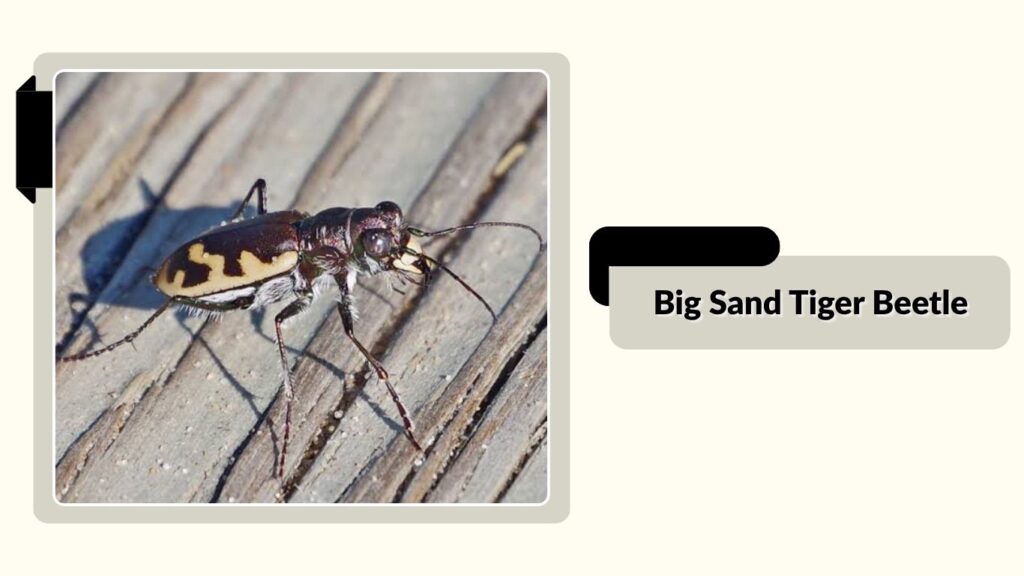
The Big Sand Tiger Beetle is a relatively large tiger beetle adapted to open sandy environments. Its body coloration provides excellent camouflage on pale soil, making it difficult to notice until it starts running or flying. Its size, strong mandibles, and speed make it an efficient predator in dunes, beaches, sandbars, and similar habitats.
Identification
- Relatively large tiger beetle
- Tan, brown, or bronze coloration
- Pale markings on wing covers
- Large eyes
- Strong curved mandibles
- Long legs
- Sandy camouflage
- Broad, powerful body
- Rapid running and short-distance flight
Habitat and Distribution
As its name suggests, this species is strongly associated with sandy habitats. It may occur on dunes, beaches, sandy riverbanks, open sand flats, and other areas with loose exposed soil.
Vegetation is usually sparse in preferred habitats. Open sand provides suitable hunting ground for adults and allows females to select locations where larvae can construct burrows.
Behavior and Diet
Adults are fast terrestrial predators that hunt during warm daylight conditions. They use their excellent eyesight to detect small insects moving over the sand.
Prey may include ants, flies, small beetles, spiders, and other invertebrates. Their powerful mandibles allow them to handle prey quickly.
When disturbed, adults frequently fly ahead of an observer and then land on another patch of sand, where their coloration can make them difficult to relocate.
Lifespan and Life Cycle
Larvae spend most of their development inside vertical burrows dug into sandy soil. They position themselves close to the entrance and wait for insects to pass.
Their large jaws allow them to seize prey rapidly. Larvae eventually seal the burrow and pupate below the surface.
Adults emerge following pupation and become active when temperatures are suitable. Development can take more than one season in areas with cold winters or limited feeding periods.
6. Hairy-Necked Tiger Beetle
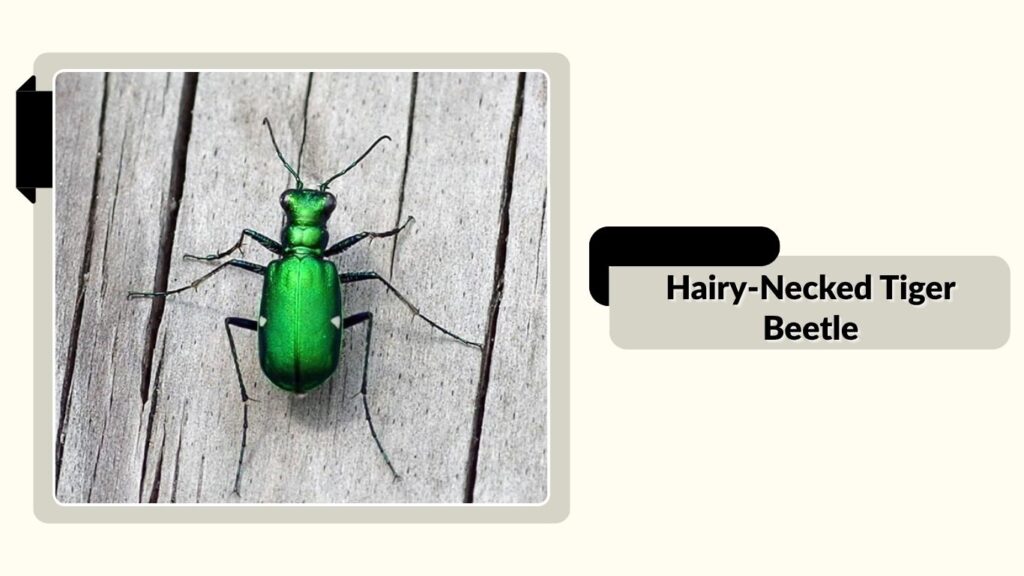
The Hairy-Necked Tiger Beetle is named for the noticeable hairs around parts of its thorax and body. It is often found on sandy shores and open ground where it hunts small insects. Its pale markings, long legs, and alert behavior are typical of tiger beetles, while its body hairs provide an additional identification clue.
Identification
- Noticeable hairs around the thorax
- Brown, bronze, or metallic coloration
- Pale markings on the wing covers
- Large compound eyes
- Long slender legs
- Strong curved mandibles
- Medium-sized body
- Fast-running behavior
- Often well camouflaged on sand
Habitat and Distribution
Hairy-Necked Tiger Beetles commonly occupy sandy habitats such as riverbanks, lake shores, beaches, dunes, and open sandy trails.
They prefer areas with enough exposed ground for hunting and nesting. Moist but not waterlogged sand can provide especially suitable habitat for larvae.
Adults may shift locations as water levels and shoreline conditions change throughout the season.
Behavior and Diet
Adults are daytime predators that actively patrol the surface for small prey. They consume ants, flies, tiny beetles, spiders, and other arthropods.
Their large eyes give them excellent awareness of movement around them. If a person approaches too closely, the beetle typically takes flight before landing a short distance away.
On hot days, individuals may alternate between hunting and resting to regulate body temperature.
Lifespan and Life Cycle
Females lay eggs in sandy soil. The emerging larvae dig burrows and remain inside them for most of their development.
Larvae ambush prey from the burrow entrance and quickly retreat underground if disturbed. They molt several times before entering the pupal stage.
After pupation, adults emerge and begin hunting and mating. The complete life cycle can take one to several years depending on environmental conditions.
7. Twelve-Spotted Tiger Beetle
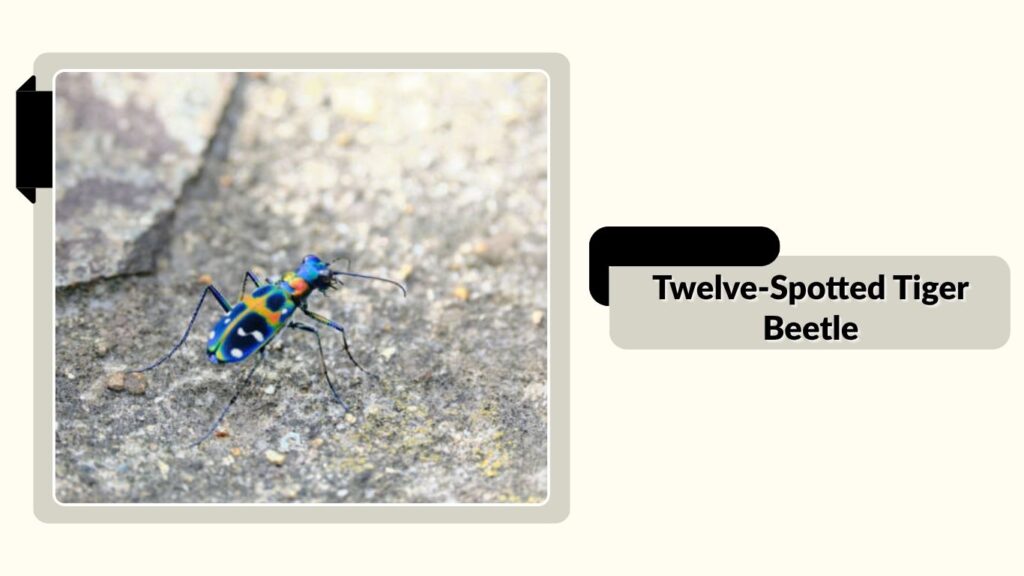
The Twelve-Spotted Tiger Beetle is recognized for the series of pale spots scattered across its dark wing covers. Despite its name, the exact number and size of the markings can vary. This active predator is commonly associated with open, somewhat moist ground and can often be spotted running rapidly along trails and shorelines.
Identification
- Dark brown to blackish body
- Metallic bronze or green reflections
- Numerous pale spots on wing covers
- Usually associated with a twelve-spotted pattern
- Large prominent eyes
- Long legs
- Powerful mandibles
- Approximately medium-sized
- Quick running and flying behavior
Habitat and Distribution
This tiger beetle occurs in various open habitats, particularly those with bare or sparsely vegetated soil. It may inhabit riverbanks, lake margins, damp paths, roadsides, and disturbed areas.
Adults often favor somewhat moist ground rather than extremely dry sand. Suitable hunting areas generally receive direct sunlight for at least part of the day.
Behavior and Diet
Like other tiger beetles, the Twelve-Spotted Tiger Beetle is a visual hunter. It spends daylight hours searching for prey across open ground.
Ants, flies, small caterpillars, spiders, and other insects may be captured. Its speed allows it to chase moving prey, while its large jaws secure the catch.
When alarmed, the beetle often makes a brief flight and lands farther along the trail, sometimes repeating this behavior several times.
Lifespan and Life Cycle
Females lay eggs in the soil, and larvae develop inside vertical burrows. A larva waits at the entrance with its head and jaws positioned to capture prey.
Once an insect comes close enough, the larva lunges forward and drags it underground.
After progressing through its immature stages, the larva pupates inside the burrow. Adults later emerge and continue the cycle, with total development potentially lasting longer than one year.
8. Common Claybank Tiger Beetle
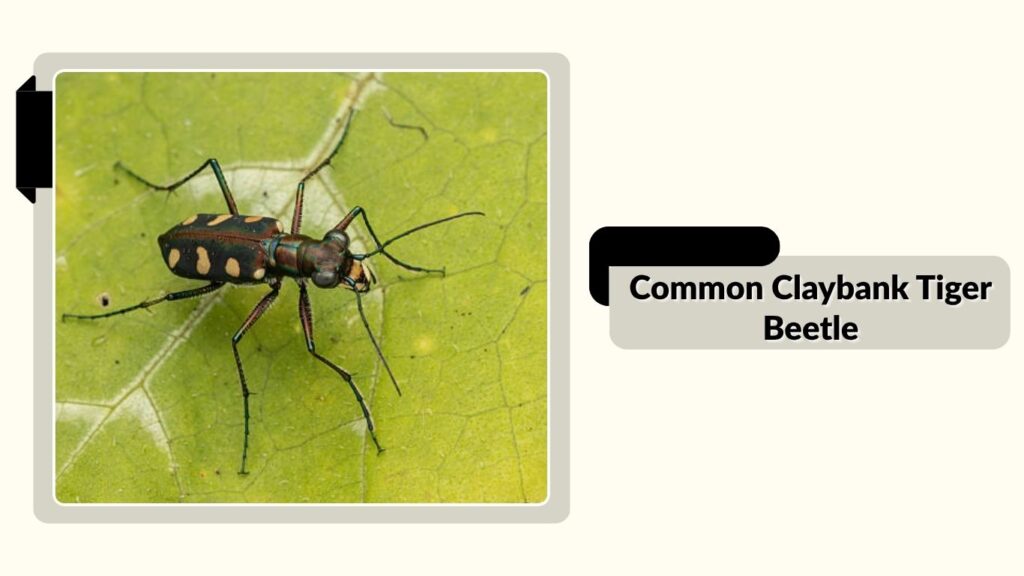
The Common Claybank Tiger Beetle is associated with clay-rich banks, bare soil, and open ground where its coloration provides useful camouflage. It shares the speed and aggressive hunting habits typical of tiger beetles. Although less brightly colored than some metallic green species, its patterned wing covers and active daytime behavior make it an interesting predator to observe.
Identification
- Brown, bronze, or dark metallic body
- Pale curved markings on wing covers
- Large, rounded eyes
- Strong toothed mandibles
- Long legs
- Medium-sized body
- Coloration that blends with clay soil
- Active in bright sunlight
- Flies readily when approached
Habitat and Distribution
Common Claybank Tiger Beetles favor areas with exposed clay or firm soil. They may be found along stream banks, eroded slopes, trails, roadside cuts, and sparsely vegetated open ground.
These habitats provide both hunting surfaces for adults and suitable soil for larval burrows. Individuals often concentrate in areas where sunlight keeps the ground relatively warm.
Behavior and Diet
Adults patrol open clay surfaces and capture small arthropods using a combination of speed and vision. Typical prey includes ants, flies, spiders, small beetles, and other insects.
The beetle often runs several inches or feet before stopping abruptly to reassess its surroundings. This stop-and-go movement is common among tiger beetles.
Predators may include birds, spiders, robber flies, and larger insects, so rapid flight provides an important means of escape.
Lifespan and Life Cycle
Eggs are placed in suitable exposed soil. The larvae that hatch create deep burrows and remain largely stationary while waiting for prey.
Larvae use strong jaws to seize insects and specialized body structures to brace themselves against the burrow walls.
After several molts, they pupate underground. Adults emerge when weather conditions become favorable, usually during warmer parts of the year. Depending on location and climate, the complete development from egg to reproductive adult may take a year or longer.
9. Western Tiger Beetle
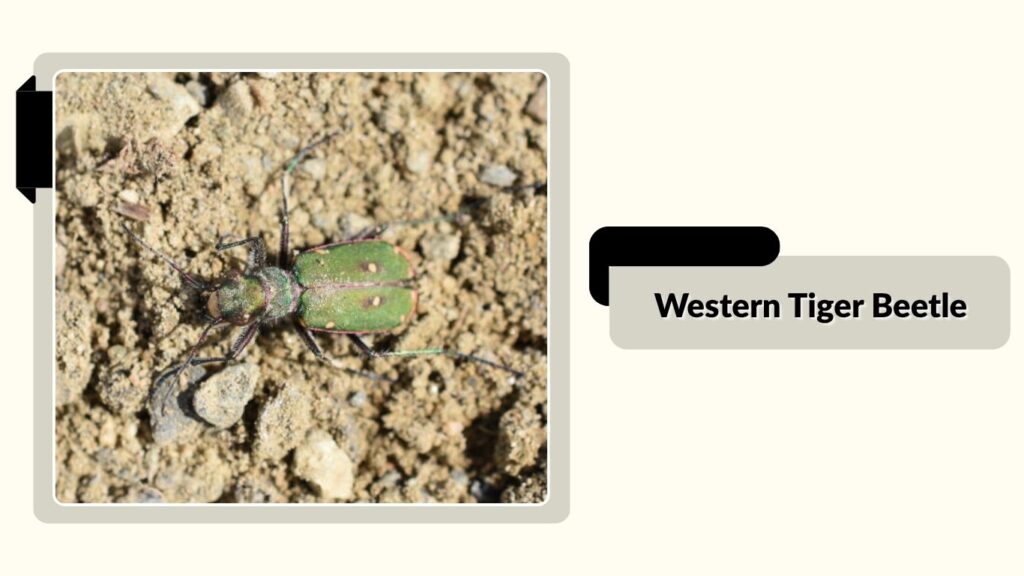
The Western Tiger Beetle is a fast-moving predatory beetle found in open habitats across western parts of North America. Like other tiger beetles, it is built for speed, with long legs, large eyes, and powerful jaws. Its coloration varies from brown and bronze to greenish metallic shades, helping it blend with bare soil, sandy ground, and dry trails while searching for prey.
Identification
- Metallic brown, bronze, or greenish body
- Medium-sized tiger beetle
- Long, slender running legs
- Large, prominent compound eyes
- Strong curved mandibles
- Pale markings may occur on the wing covers
- Narrow thorax and streamlined body
- Fast ground-running behavior
- Short flight when disturbed
Habitat and Distribution
Western Tiger Beetles generally occur in open, sunny environments with exposed soil. They may be found along sandy riverbanks, dry trails, roadsides, grassland openings, and sparsely vegetated areas.
Their exact distribution depends on the species represented by the common name, but they are most strongly associated with western regions of North America. Adults often choose warm ground where they can regulate body temperature and move quickly while hunting.
Behavior and Diet
These beetles are active visual predators. They patrol bare ground and rely on their large eyes to detect small moving prey.
Their diet includes ants, flies, spiders, small beetles, and other arthropods. Once prey is spotted, the beetle runs rapidly toward it and uses its sharp mandibles to capture it.
When approached, Western Tiger Beetles often fly a short distance and land farther ahead.
Lifespan and Life Cycle
Females lay eggs in exposed soil. The larvae remain inside vertical burrows and wait near the surface for prey.
Larvae seize passing insects with strong jaws and retreat deeper into the burrow when threatened. After several growth stages, they pupate underground.
Adults emerge during suitable warm conditions. Development may take one year or more depending on temperature, food availability, and local climate.
10. Ohlone Tiger Beetle
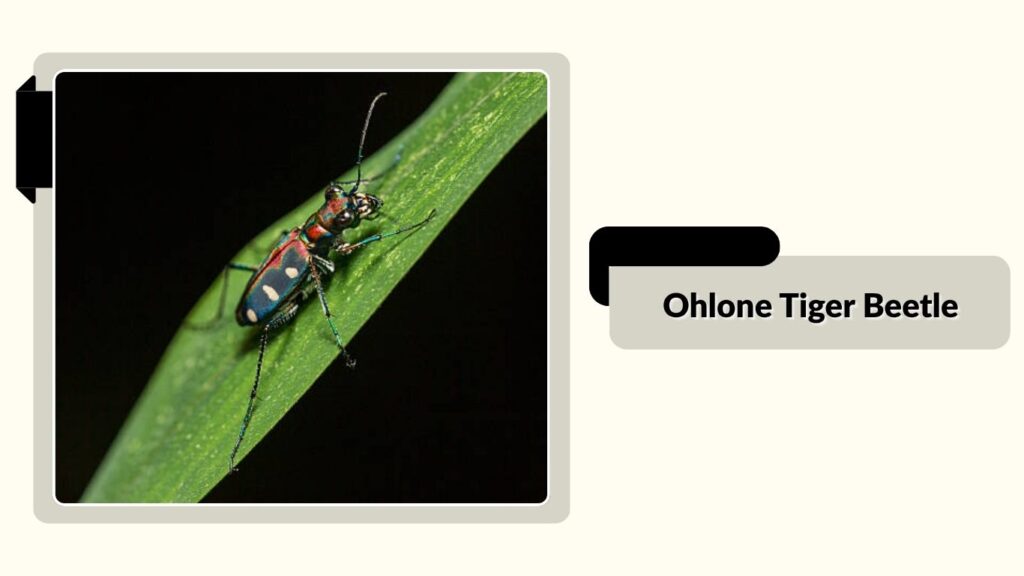
The Ohlone Tiger Beetle is a rare tiger beetle associated with specific grassland habitats in coastal California. Its dark metallic coloration and pale markings help distinguish it from some other species. Because it occupies a very limited habitat range, it is much less commonly encountered than widespread tiger beetles and is closely tied to open ground within native grasslands.
Identification
- Dark metallic green to bronze coloration
- Pale markings along the wing covers
- Large compound eyes
- Strong curved mandibles
- Long running legs
- Medium-sized body
- Shiny surface in sunlight
- Often seen on bare patches of soil
- Quick, alert movements
Habitat and Distribution
The Ohlone Tiger Beetle is associated with coastal grasslands in central California, particularly areas with patches of bare ground among vegetation.
It depends on specialized habitat conditions that provide both hunting surfaces for adults and soil suitable for larval burrows. Habitat loss and disturbance have made the species uncommon and highly localized.
Adults tend to use sunny open patches rather than dense vegetation because their hunting style depends on visibility and speed.
Behavior and Diet
Like other tiger beetles, the Ohlone Tiger Beetle is a daytime predator. It runs rapidly over bare soil and searches for small arthropods.
Ants, flies, spiders, and other small insects may form part of its diet. Its large eyes help it detect prey and approaching threats from a distance.
When disturbed, adults may fly briefly and then land on another exposed patch nearby.
Lifespan and Life Cycle
Females deposit eggs in suitable soil. After hatching, larvae build vertical burrows where they remain for much of their immature development.
Each larva waits at the burrow entrance and attacks passing insects. After growing through multiple stages, it pupates underground.
Adults emerge seasonally and reproduce during suitable weather. Development may extend over more than one year depending on environmental conditions.
11. Appalachian Tiger Beetle
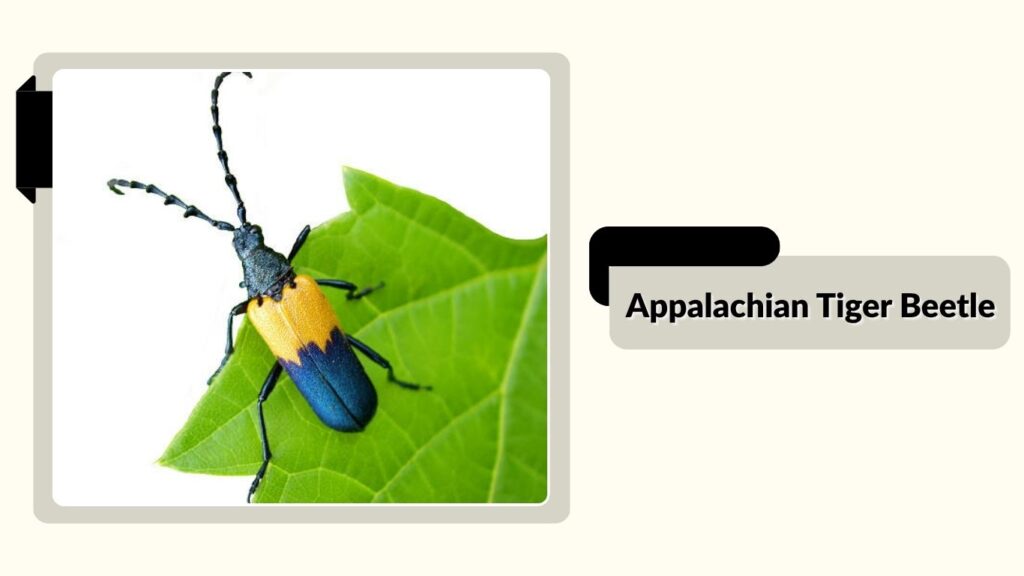
The Appalachian Tiger Beetle is associated with upland and mountainous habitats in the Appalachian region. It shares the classic predatory traits of the tiger beetle group, including speed, excellent vision, and strong mandibles. Its coloration helps it blend with rocky trails, exposed soil, and open woodland surfaces while it searches for small insects and other arthropods.
Identification
- Dark brown, bronze, or metallic coloration
- Pale markings on the wing covers
- Large, rounded eyes
- Long legs for rapid running
- Strong toothed mandibles
- Slender, streamlined body
- Medium-sized appearance
- Often encountered on open trails
- Flies quickly when approached
Habitat and Distribution
This tiger beetle is associated with the Appalachian region and may occur in open woodland trails, mountain paths, rocky clearings, and exposed soil.
It generally favors places that receive enough sunlight to warm the ground. Bare surfaces also give adults a clear view of approaching prey.
Mountain elevation, soil type, and seasonal climate can influence where local populations occur.
Behavior and Diet
Appalachian Tiger Beetles hunt during daylight and are particularly active when the ground is warm.
They prey on ants, small flies, beetles, spiders, and other arthropods. Their hunting strategy involves quick bursts of running followed by brief pauses.
The pause-and-run pattern helps them relocate moving prey while also watching for predators. Birds, spiders, and larger predatory insects may prey on tiger beetles.
Lifespan and Life Cycle
Eggs are laid in soil, where the larvae later construct narrow vertical burrows.
Larvae remain inside these burrows and ambush insects that pass close to the entrance. They anchor themselves in place while striking with powerful jaws.
After several larval stages, they pupate below ground. Adults eventually emerge and begin feeding and mating.
The entire life cycle may take one or more years depending on elevation and seasonal conditions.
12. Pacific Coast Tiger Beetle
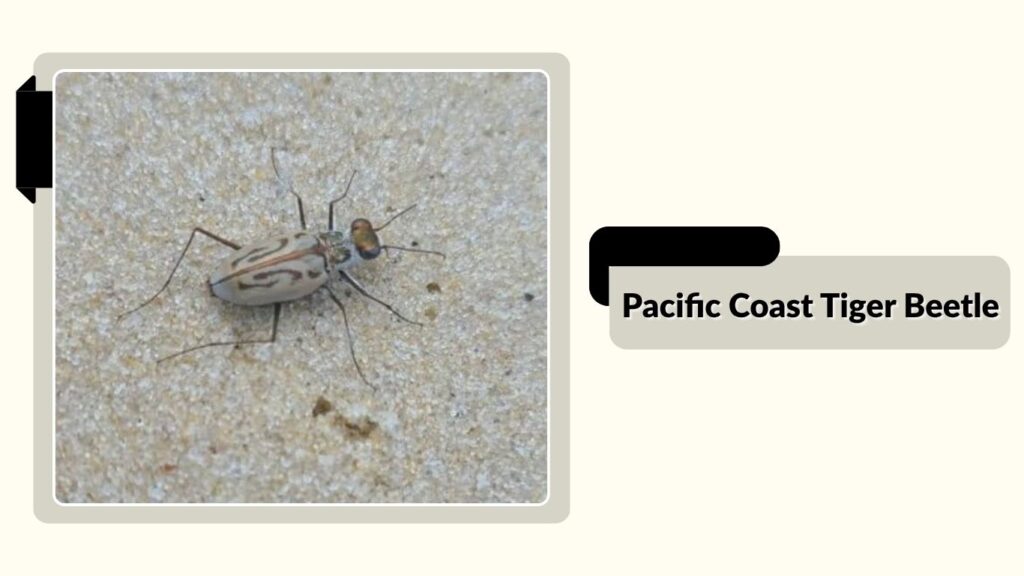
The Pacific Coast Tiger Beetle is adapted to sandy and open environments along the western coast of North America. Its coloration often blends effectively with pale sand and coastal soil, making it difficult to notice until it starts moving. Long legs and excellent eyesight allow it to hunt efficiently across beaches, dunes, coastal flats, and other exposed habitats.
Identification
- Tan, brown, or bronze body
- Pale markings on the wing covers
- Large compound eyes
- Long, slender legs
- Strong mandibles
- Sandy camouflage
- Medium-sized body
- Fast-running behavior
- Frequently flies short distances when disturbed
Habitat and Distribution
Pacific Coast Tiger Beetles are associated with coastal habitats such as sandy beaches, dunes, estuaries, river mouths, and open shoreline flats.
They need exposed ground for hunting and suitable soil for larval burrows. Heavy vegetation can reduce habitat quality because adults rely on open surfaces for visibility and speed.
Some populations may be strongly influenced by tides, shoreline disturbance, and seasonal changes in sand movement.
Behavior and Diet
Adults are active predators that run quickly over sand while searching for prey.
They feed on ants, flies, small beetles, spiders, and other tiny invertebrates. Their excellent vision helps them detect movement across open ground.
When threatened, they often take a short flight and land farther along the shore. Their body coloration then helps them blend into the sand.
Lifespan and Life Cycle
Females lay eggs in appropriate sandy soil. Larvae dig burrows and remain inside while waiting for prey.
The larva sits at the burrow entrance and quickly seizes small insects that pass nearby. Development continues through several larval stages.
Pupation occurs underground, after which adults emerge during favorable seasonal conditions.
The full life cycle may take a year or more depending on temperature and habitat stability.
13. Coral Pink Sand Dune Tiger Beetle
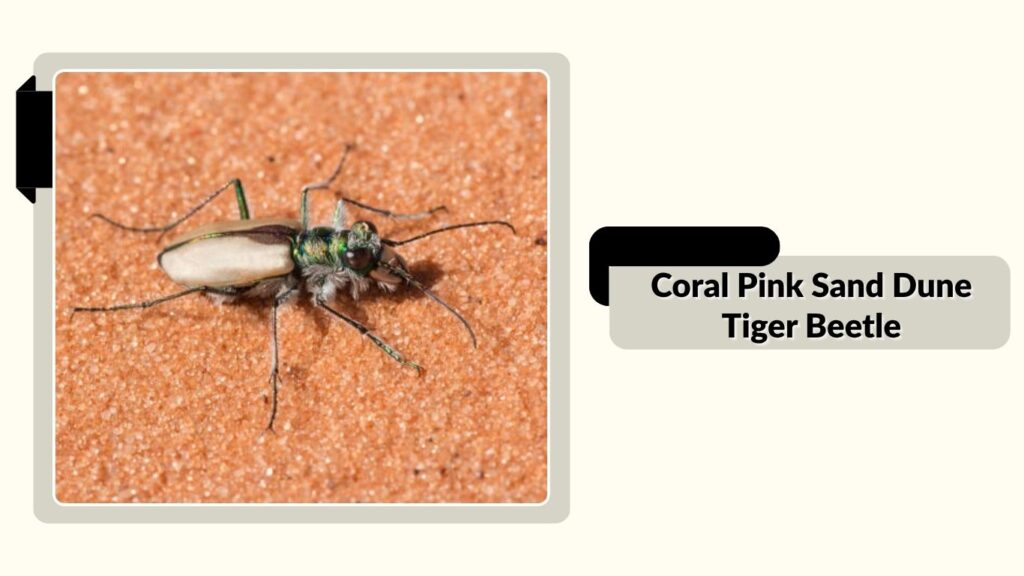
The Coral Pink Sand Dune Tiger Beetle is a highly specialized species associated with the Coral Pink Sand Dunes of southern Utah. Its pale reddish or sandy coloration provides excellent camouflage against the distinctive dune surface. Because its range is extremely limited, it is considered one of the more localized tiger beetles in North America and depends heavily on undisturbed dune habitat.
Identification
- Pale reddish-brown or sandy body
- Coloration closely matching pink dune sand
- Light markings on the wing covers
- Large compound eyes
- Long running legs
- Strong curved mandibles
- Medium-sized body
- Fast movements across open sand
- Highly specialized dune appearance
Habitat and Distribution
This tiger beetle is closely associated with the Coral Pink Sand Dunes area of Utah.
It inhabits open dune surfaces where vegetation is sparse and sand remains exposed. Such habitat provides ideal conditions for adult hunting and larval burrows.
Because the species occupies such a restricted geographic area, changes to dune habitat can have a strong effect on local populations.
Behavior and Diet
Adults hunt during warm daylight periods and run rapidly across loose sand.
Their diet includes ants, flies, small beetles, spiders, and other arthropods found in dune environments.
Their coloration makes them difficult to see when stationary, which may help protect them from predators while also allowing them to approach prey.
Lifespan and Life Cycle
Females lay eggs directly in suitable dune sand. Larvae create vertical burrows and spend much of their development waiting for prey.
They use large jaws to capture insects that pass close to the entrance.
After progressing through several larval stages, the beetle pupates underground. Adults emerge when conditions become favorable.
Development can take more than one season, especially in environments where temperature and food availability vary strongly throughout the year.
14. Green Claybank Tiger Beetle
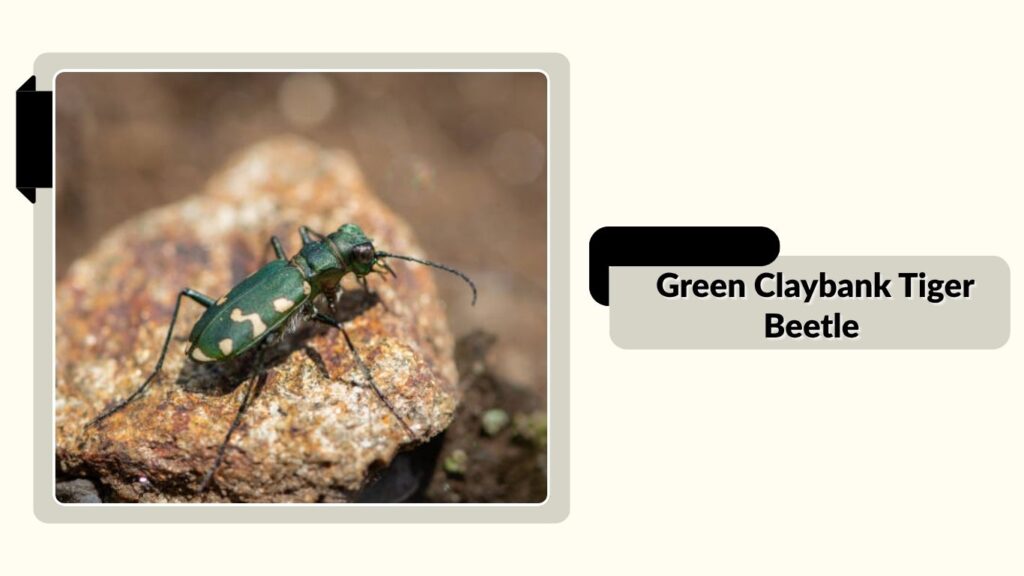
The Green Claybank Tiger Beetle is a striking metallic species associated with exposed clay, damp soil, and open banks. Its green coloration makes it visually distinctive, although shades may vary depending on lighting. Like other tiger beetles, it is an active predator that depends on quick bursts of speed and strong eyesight to hunt small insects across open ground.
Identification
- Metallic green body
- Bronze or blue-green reflections may occur
- Pale markings on the wing covers
- Long running legs
- Large compound eyes
- Strong mandibles
- Medium-sized body
- Shiny appearance in sunlight
- Quick-running behavior
Habitat and Distribution
Green Claybank Tiger Beetles prefer exposed clay banks, moist trails, stream edges, riverbanks, and other areas where bare soil remains available.
They often occur in places with relatively little vegetation, allowing them to see prey clearly and move without obstruction.
Suitable clay or firm soil is also important for larval burrows, so adults may repeatedly return to the same habitat patches.
Behavior and Diet
Adults are highly active daytime hunters. They move rapidly over the soil while searching for ants, flies, spiders, beetles, and other small arthropods.
Their large eyes allow them to detect prey and danger from a distance.
When approached, they often run first and then fly if the threat gets too close. They may land only a few feet away and resume hunting shortly afterward.
Lifespan and Life Cycle
Females lay eggs in exposed soil. The larvae hatch and dig vertical burrows where they live as ambush predators.
Larvae remain close to the entrance, waiting for insects to pass within striking distance.
They develop through several stages before pupating underground.
Adults later emerge, mate, and repeat the cycle. The full development period may take one or more years depending on environmental conditions.
15. Oblique-Lined Tiger Beetle
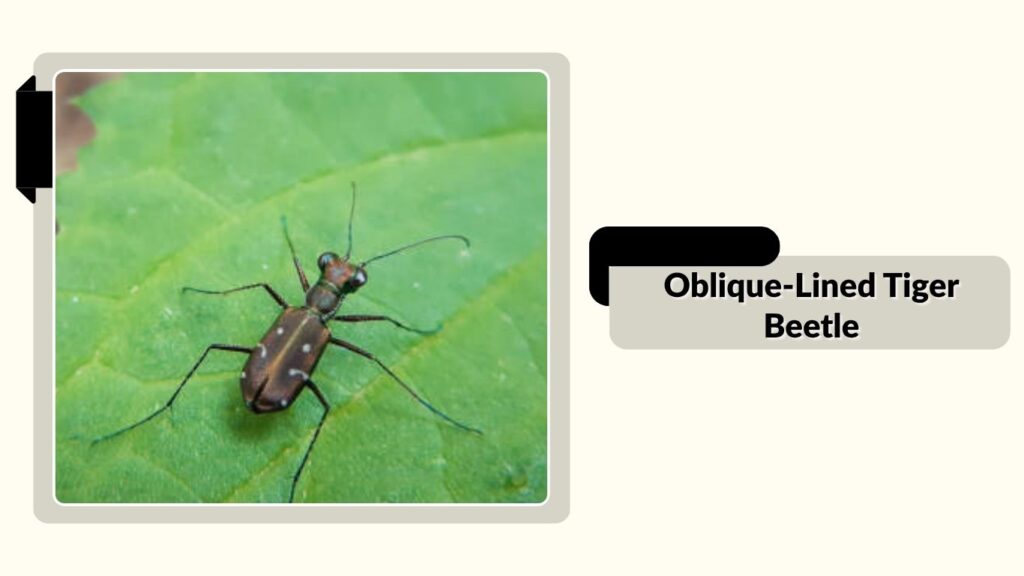
The Oblique-Lined Tiger Beetle is named for the angled pale markings on its wing covers. Its patterned body and active hunting behavior make it relatively distinctive among tiger beetles. It commonly occupies open ground where the surface is warm and sparsely vegetated, allowing it to run quickly while locating ants, flies, and other small prey.
Identification
- Brown, bronze, or greenish metallic body
- Oblique pale lines on wing covers
- Large prominent eyes
- Strong curved mandibles
- Long slender legs
- Medium-sized body
- Shiny surface
- Fast ground-running behavior
- Short defensive flights
Habitat and Distribution
Oblique-Lined Tiger Beetles favor open habitats with exposed soil, including sandy trails, riverbanks, disturbed ground, roadsides, and sparsely vegetated areas.
They generally avoid dense plant cover because thick vegetation interferes with their visual hunting strategy.
Suitable soil also allows females to lay eggs and larvae to construct stable hunting burrows.
Behavior and Diet
These beetles are active predators during daylight. They patrol bare ground and capture small insects and other arthropods.
Common prey includes ants, flies, spiders, tiny beetles, and caterpillars.
The beetle often runs in short bursts, stops briefly, and then continues. This movement pattern is typical of many tiger beetles.
When threatened, adults usually take flight and land nearby before becoming active again.
Lifespan and Life Cycle
Females deposit eggs individually in soil. Larvae hatch and construct narrow vertical burrows.
The larva waits with its head near the entrance and grabs prey using its powerful jaws. It remains largely within the same burrow as it grows.
After several molts, the larva pupates underground. The adult later emerges and begins its active hunting and reproductive stage.
FAQs
1. Are tiger beetles dangerous to humans?
Tiger beetles are not considered dangerous to people. They are predators of small insects and usually run or fly away when disturbed. Although their mandibles look large, they are not aggressive toward humans.
2. Why are tiger beetles so fast?
Tiger beetles use speed to catch prey and escape predators. Their long legs allow them to sprint rapidly across open ground. Some species can run so quickly that they must briefly stop to visually relocate prey before continuing the chase.
3. What do tiger beetles eat?
Adult tiger beetles mainly eat ants, flies, spiders, caterpillars, small beetles, and other arthropods. Their larvae are also predators and capture insects from the entrances of underground burrows.
4. Where do tiger beetle larvae live?
Most tiger beetle larvae live in vertical burrows dug into sand, clay, or other exposed soil. They remain near the burrow opening and ambush small insects that pass nearby.
5. How long do tiger beetles live?
The complete life cycle of a tiger beetle commonly takes one to several years. Much of that time is spent in the larval stage underground. Adult life is usually shorter and focuses mainly on feeding, mating, and egg laying.