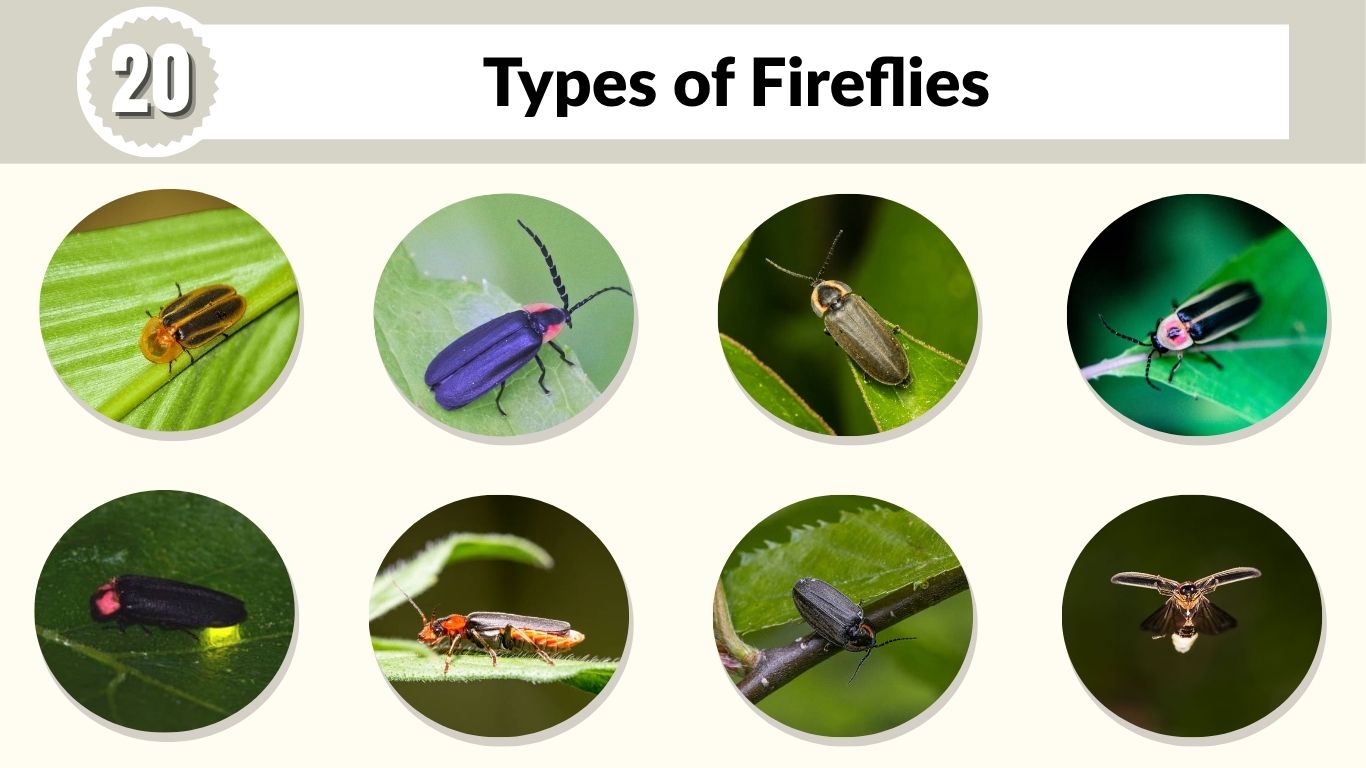
Fireflies are fascinating beetles best known for their glowing courtship displays on warm evenings. Although many species look similar, they can differ greatly in flash pattern, habitat, body shape, range, and behavior. Some live in forests, others prefer wetlands or grasslands, and a few are active during the day without flashing at all. In this guide, we explore 20 types of fireflies, including their identification features, habitat and distribution, behavior and diet, and general lifespan and life cycle.
1. Common Eastern Firefly
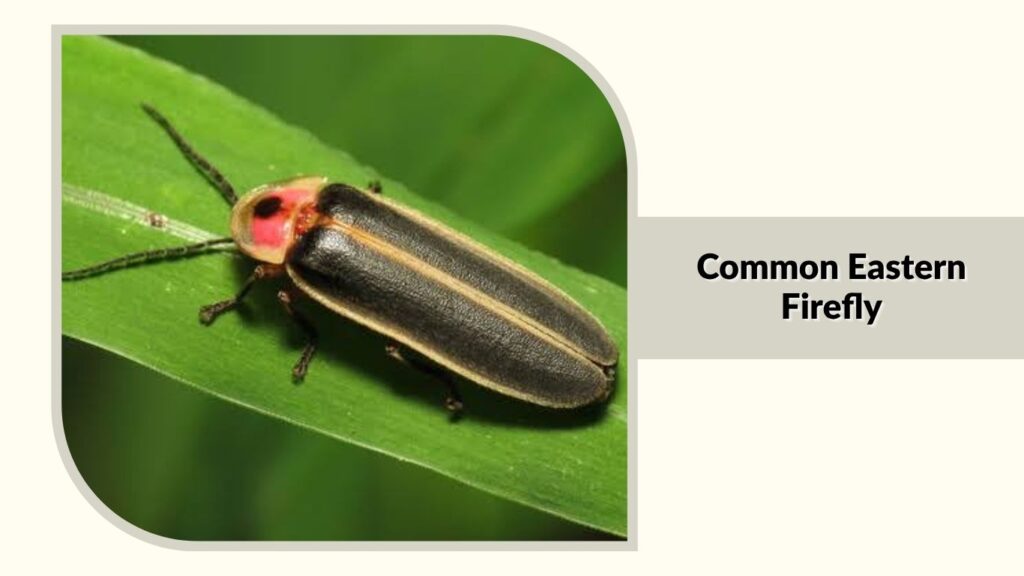
The Common Eastern Firefly is one of the most familiar fireflies in eastern North America. Often seen glowing over lawns, gardens, fields, and woodland edges on warm summer evenings, this species is known for its distinctive flashing courtship signals. Although commonly called a firefly, it is actually a beetle. Adults spend much of their short active season searching for mates, while the larvae live closer to the ground and prey on small invertebrates.
Identification
- Medium-sized firefly beetle
- Dark brown to black wing covers
- Reddish or orange shield-like pronotum
- Dark marking in the center of the pronotum
- Yellowish margins along parts of the body
- Soft-bodied appearance
- Adults have functioning wings
- Males commonly fly while flashing
- Females often respond with their own light signals
- Light-producing organ located near the end of the abdomen
Habitat and Distribution
Common Eastern Fireflies are widely found across the eastern and central parts of North America. They thrive in warm, moderately moist habitats including grassy fields, suburban lawns, gardens, forest edges, meadows, and areas near streams.
They are especially noticeable on humid summer evenings when adults begin flying shortly after sunset. Areas with tall grass, leaf litter, and relatively low pesticide use can provide useful shelter for both larvae and adults.
Behavior and Diet
Adult males fly above vegetation while producing characteristic flashes used to attract females. Females usually remain lower in vegetation and respond when they recognize the appropriate signal.
Adults may feed little during their short reproductive stage, depending on the individual and life stage. Larvae are more active predators and consume soft-bodied organisms such as snails, slugs, worms, and other small invertebrates.
Their glow is produced through a highly efficient chemical reaction called bioluminescence.
Lifespan and Life Cycle
The life cycle begins when females lay eggs in moist soil or leaf litter. The eggs hatch into glowing larvae sometimes called glowworms.
Larvae spend several months feeding and growing before overwintering in the soil or protected litter. They later pupate and emerge as winged adults.
Most of the firefly’s life is spent in the larval stage, while adults generally survive for only a few weeks, focusing mainly on reproduction and producing the familiar evening light displays.
2. Woodland Lucy
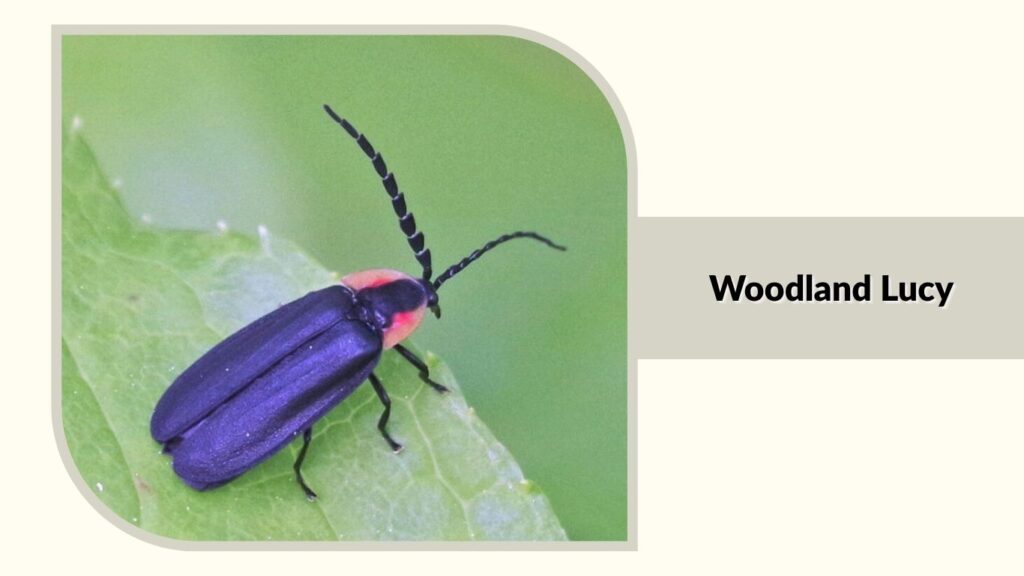
The Woodland Lucy, also called the Black Firefly, is unusual because adults are active during the day rather than producing the familiar nighttime flashes. This species belongs to Lucidota atra and occurs widely across eastern North America. Adults are commonly associated with forests and other shaded habitats, where they rely more heavily on chemical communication than visible light signals.
Identification
- Small to medium-sized firefly
- Usually about 9–11 mm long
- Dark or nearly black wing covers
- Pronotum may have red patches and a dark center
- Long, flattened antennae
- Antennae have a saw-toothed appearance
- Adults are winged
- Active mainly during daylight
- Adults do not produce functional flashes
Habitat and Distribution
Woodland Lucies live primarily in forests, wooded edges, swampy woods, and other relatively shaded habitats. Their range covers much of eastern North America and extends west into parts of the central United States.
Unlike many familiar fireflies that become obvious after sunset, Woodland Lucies can be observed moving through vegetation during daylight, particularly in spring and early summer.
Behavior and Diet
Because adults are day-active and non-flashing, they depend heavily on pheromones for communication rather than glowing courtship displays. Their prominent antennae help detect these chemical signals.
Firefly larvae are predatory, and Woodland Lucy larvae feed on small, soft-bodied invertebrates. Adult feeding is less conspicuous and may be limited compared with the larval stage.
Lifespan and Life Cycle
Like other fireflies, Woodland Lucies develop through egg, larva, pupa, and adult stages. Most of their lives are spent as larvae in or near soil and leaf litter.
Larvae grow while feeding on small invertebrates before pupating. The winged adults emerge seasonally to mate. Adults represent only a relatively short portion of the overall life cycle.
3. Shadow Ghost
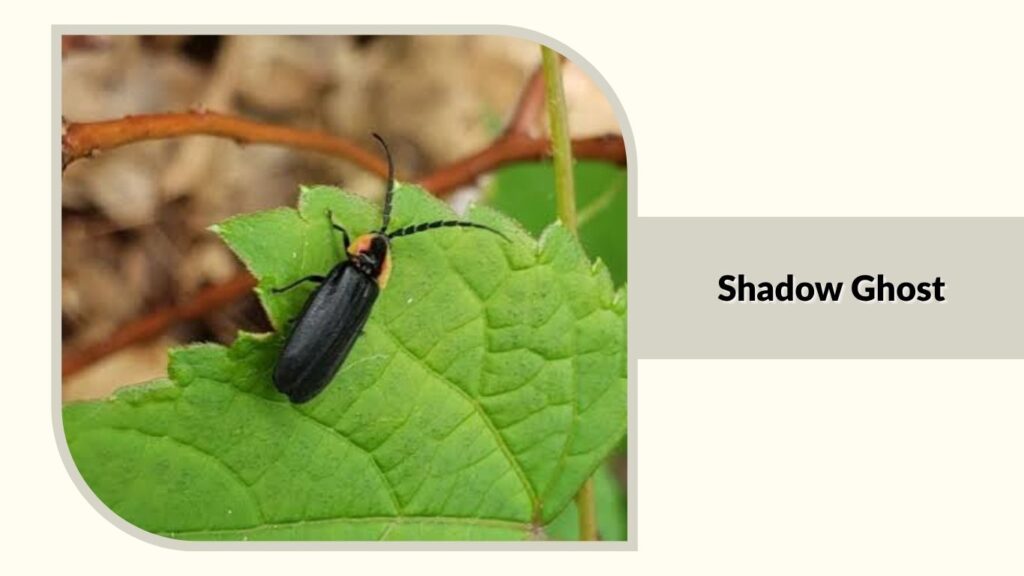
The Shadow Ghost is a tiny and unusual firefly scientifically known as Phausis inaccensa. Unlike typical flashing fireflies, the winged males do not possess functional lanterns, while the flightless females produce a glow. Adults are associated mainly with forested environments, particularly dry woodland and areas near forest streams.
Identification
- Very small firefly, around 4–6 mm long
- Males have wings
- Females are wingless and larva-like
- Dark, textured wing covers on males
- Pale pronotum with dark central marking
- Large eyes in males
- Much smaller eyes in females
- Adult males lack functional lanterns
- Females have glowing areas near the abdomen
Habitat and Distribution
Shadow Ghosts occur in central and eastern portions of the United States. They are associated with dry forests as well as woodland areas near streams.
Because females cannot fly, populations may be closely tied to suitable undisturbed ground habitat where immature stages and adult females can remain protected.
Behavior and Diet
The reproductive behavior differs considerably from conventional flashing fireflies. Males fly through the habitat searching for females, but they do not flash.
Flightless females remain near the ground and produce a steady or visible glow that can help males locate them. The larvae are predators of small invertebrates, as is typical of many fireflies.
Lifespan and Life Cycle
Eggs develop into larvae that live near or within the ground layer. They spend much of the life cycle feeding and growing before pupation.
Adult females retain a larva-like appearance rather than developing fully functional wings. Males become small winged beetles.
In parts of its range, adults can be active during spring, with observations commonly occurring during April through June.
4. Sidewinder Firefly
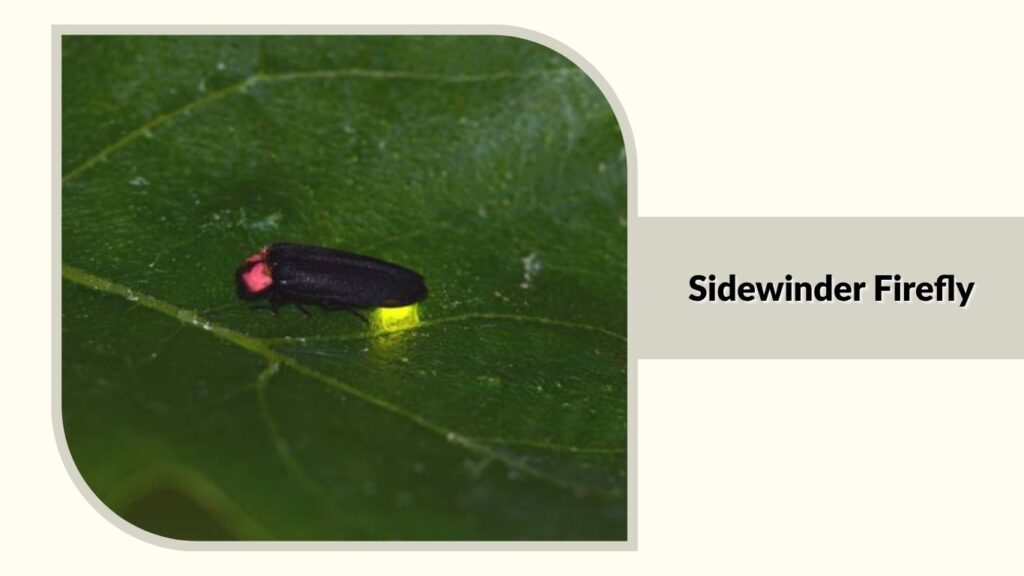
The Sidewinder Firefly in this list refers to Photinus brimleyi, a southeastern North American species known for an unusual difference between males and females. Males are winged fireflies capable of producing mating signals, while females remain flightless and larva-like. It is primarily associated with forested environments and is most often active during summer.
Identification
- Medium-sized firefly
- Dark wing covers
- Broad pale margins along wing covers
- Pale yellow pronotum
- Dark central pronotum marking
- Strongly different male and female appearance
- Males are winged
- Females are flightless
- Females have a pinkish-yellow, larva-like appearance
- Males possess abdominal lanterns
Habitat and Distribution
Sidewinder Fireflies occur primarily in the southeastern United States. Forests and wooded habitats provide the shaded, relatively humid conditions associated with this species.
North Carolina records describe it as a forest-associated species, with adult activity generally occurring from June through August.
Behavior and Diet
Winged males search through forest habitat for females using species-specific courtship signals. Because females cannot fly, they remain relatively close to the ground or surrounding vegetation.
The larvae are predators and feed on small, soft-bodied animals living in soil and leaf litter. This predatory larval stage helps distinguish fireflies ecologically from many other beetles that feed mainly on plants.
Lifespan and Life Cycle
The Sidewinder develops through egg, larval, pupal, and adult stages. Larvae spend much longer developing than adults and remain associated with moist ground habitats.
After pupation, males emerge as fully winged beetles. Females mature while retaining a larva-like body form and limited mobility.
Adults mainly concentrate on reproduction, making the visible adult stage considerably shorter than the immature period.
5. Double Cousin Firefly
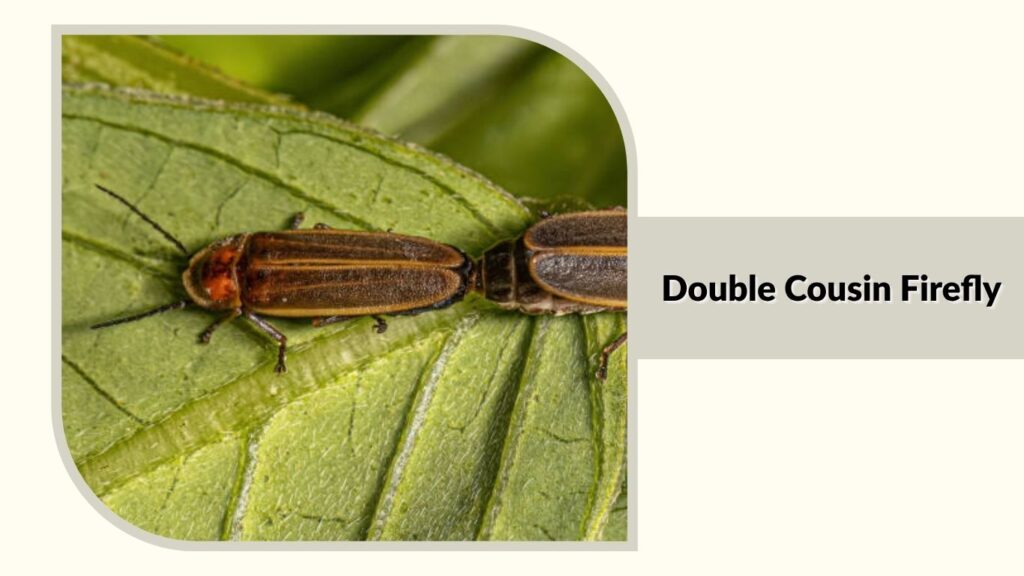
The Double Cousin Firefly, Photinus consanguineus, is a flashing species found across a large part of eastern North America. It can be difficult to identify from appearance alone because it closely resembles several related Photinus species. Its characteristic paired mating flashes therefore provide one of the most useful field clues for recognizing it.
Identification
- Medium-sized firefly
- Dark wing covers
- Clearly defined pale wing margins
- Pale yellow pronotum
- Black rectangular central pronotum marking
- Red or pink coloration beside the dark marking
- Two lantern segments in males
- One lantern segment in females
- Closely resembles several related fireflies
Habitat and Distribution
Double Cousins occur across much of eastern North America, from the southern United States north into parts of Canada. Their broad distribution includes forests, woodland edges, fields, and other habitats suitable for Photinus fireflies.
Adults may be visible over a relatively long seasonal period, with records in some areas extending from late spring into early fall.
Behavior and Diet
The common name reflects its paired flash pattern. Males typically produce two closely spaced flashes followed by a longer dark interval before repeating the signal. They commonly begin flying around dusk and may stay relatively low above the ground.
Females watch from vegetation and respond to suitable male signals.
Larvae are predatory and feed on small soft-bodied invertebrates found around soil and leaf litter.
Lifespan and Life Cycle
Females lay eggs in protected, moist locations. Larvae hatch and spend much of their development feeding near the ground. After multiple larval stages, they pupate and later emerge as adults.
The adults live primarily to reproduce, while most of the species’ overall development occurs during the immature stages.
6. Cattail Flash-Train Firefly
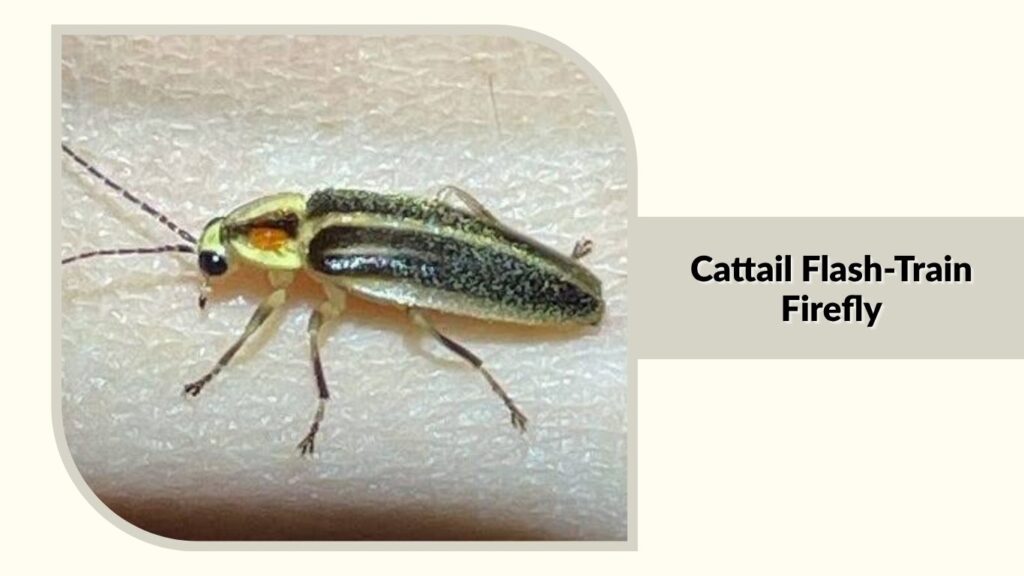
The Cattail Flash-Train Firefly, Photinus consimilis, is a wetland-associated species known for producing a rapid series of flashes rather than one isolated pulse. It occurs across much of eastern North America and is particularly associated with marshes, streams, riverbanks, and other wet habitats.
Identification
- Medium to relatively large firefly
- Approximately 8–15 mm long
- Dark wing covers
- Light yellow margins on wing covers
- Yellow and reddish pronotum
- Dark central bar on pronotum
- Large eyes
- Male has lanterns on two abdominal segments
- Female has one lantern segment
- Known for multi-pulse flash trains
Habitat and Distribution
This species is strongly associated with wetlands. It can be found around marshes, cattail areas, streams, riverbanks, and other wet ground.
Its range stretches across much of the eastern United States, reaching west toward Oklahoma and north toward southern Canada.
Behavior and Diet
Male Cattail Flash-Train Fireflies fly relatively low while displaying a rapid series of several flashes. A typical sequence may contain roughly three to nine pulses before a longer dark interval, although flash speed can change with temperature.
Females usually remain perched on lower vegetation and answer males with their own response signal.
Larvae live around moist soil and wet habitats, where they prey on worms, snails, and other soft-bodied invertebrates.
Lifespan and Life Cycle
The life cycle includes egg, larva, pupa, and adult. Larvae spend most of their development near or below the soil surface.
They feed and grow through multiple stages before pupating. Adults emerge during warmer months, with activity commonly occurring in late spring and summer.
The spectacular flashing stage represents only a short reproductive portion of their overall life.
7. Clipped Single-Flash Firefly
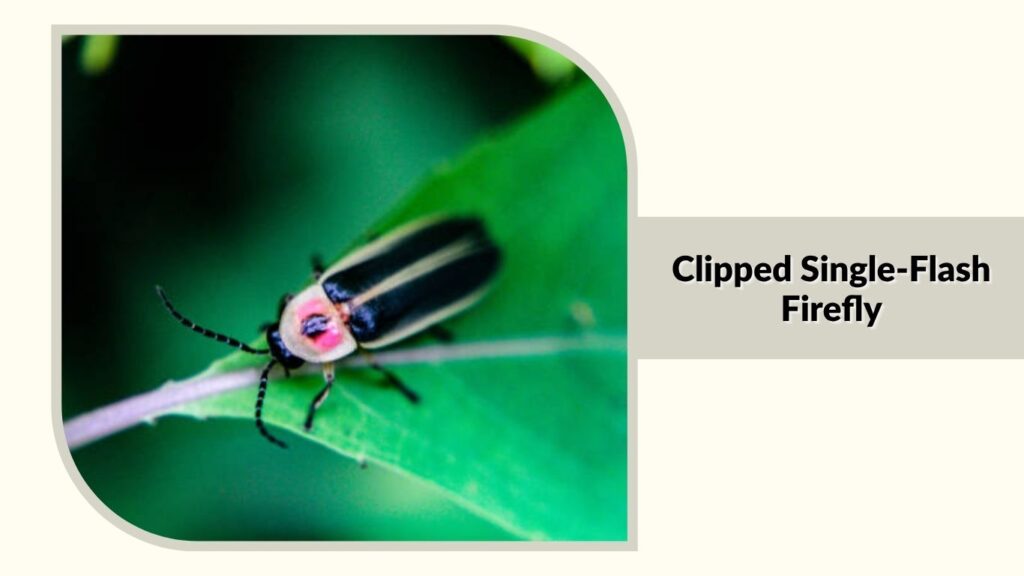
The Clipped Single-Flash Firefly, Photinus curtatus, is a small firefly recognized more easily by its light signal than by body coloration. Males produce a quick, single yellowish-orange flash at repeated intervals. It is primarily associated with brush, woodland understory, and other sheltered habitats across parts of central and eastern North America.
Identification
- Small firefly
- Approximately 5–9 mm long
- Brownish wing covers
- Compact body
- Typical Photinus appearance
- Functional abdominal lantern
- Produces a single brief flash
- Flash usually yellowish to orange
- Often flies around brush and low vegetation
Habitat and Distribution
The Clipped Single-Flash Firefly occurs from portions of the northeastern United States west through parts of the Great Plains, with records extending into southern Canada.
It often inhabits wooded edges, brushy vegetation, undergrowth, roadside hedges, and sheltered open areas.
These habitats provide ground moisture for developing larvae and vegetation that adults use while displaying.
Behavior and Diet
Male courtship behavior is characterized by a quick single flash repeated at intervals of roughly several seconds. Females answer with their own short response after an appropriate male signal.
Adults fly relatively low among brush and undergrowth during the evening.
As larvae, they are predators that consume small soft-bodied invertebrates near the soil surface.
Lifespan and Life Cycle
Females deposit eggs in protected ground habitat where moisture helps prevent drying.
The larvae emerge and spend most of their lives hunting near soil, decaying vegetation, and leaf litter.
After developing through several stages, they pupate and emerge as winged adults. The adult stage is relatively brief and is primarily devoted to courtship and reproduction.
8. Two-Step Flasher Firefly
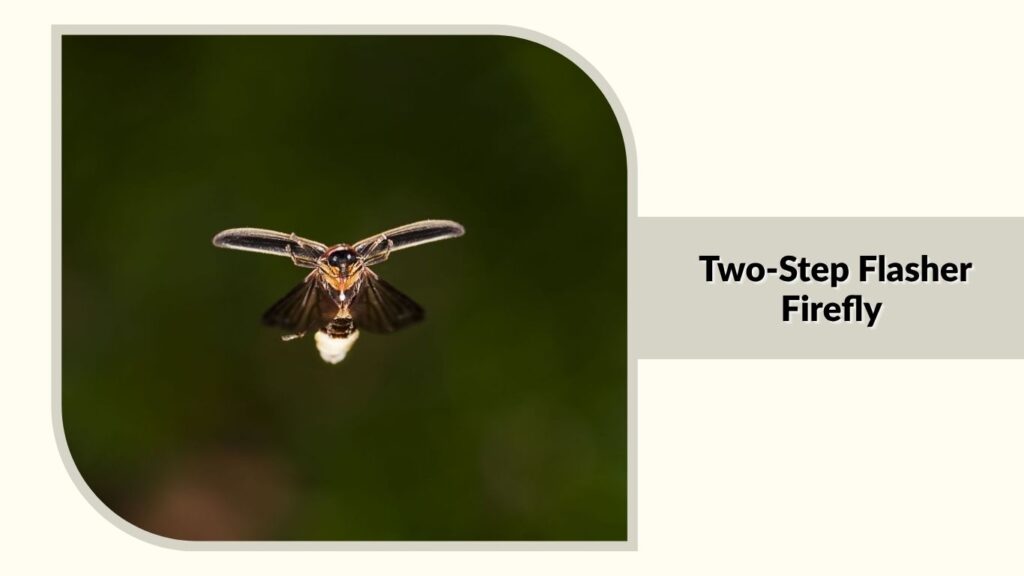
The Two-Step Flasher Firefly, Photinus dimissus, is a small and distinctive firefly of the south-central United States. Its name comes from the rapid paired or two-step appearance of its courtship signal. The species is strongly associated with moist riparian environments and has a more restricted distribution than many widespread eastern fireflies.
Identification
- Small firefly
- Approximately 5–7 mm long
- Dark wing covers
- Pale-edged body
- Distinctive pronotum marking
- Males are winged
- Females are flightless
- Produces rapid two-part flashes
- Small size comparable to a grain of rice
Habitat and Distribution
Two-Step Flashers are mainly associated with Texas, Oklahoma, and nearby parts of the south-central United States. Firefly Atlas currently also records the species from Louisiana.
Preferred habitat includes riparian corridors, creek beds, river edges, moist leaf litter, and shaded areas with relatively low artificial light.
Because females cannot fly, populations can be particularly sensitive to disturbance of ground vegetation and leaf litter.
Behavior and Diet
Males are fast, active fliers that produce distinctive rapid flashes while searching for females. Observers often describe the display as a quick double twinkle repeated approximately once per second. Females respond from low vegetation or the ground.
Larvae are predatory and spend their development in moist ground habitat feeding on other small invertebrates.
Lifespan and Life Cycle
Eggs hatch into ground-dwelling larvae that spend much of the life cycle concealed in moist soil, litter, and vegetation.
After feeding and growing through several stages, larvae pupate. Males emerge with functional wings, while mature females remain flightless.
Adult activity is concentrated during a relatively short seasonal period, often around late spring and early summer, when courtship flashes become visible after dark.
9. Lawn Single-Flash Firefly
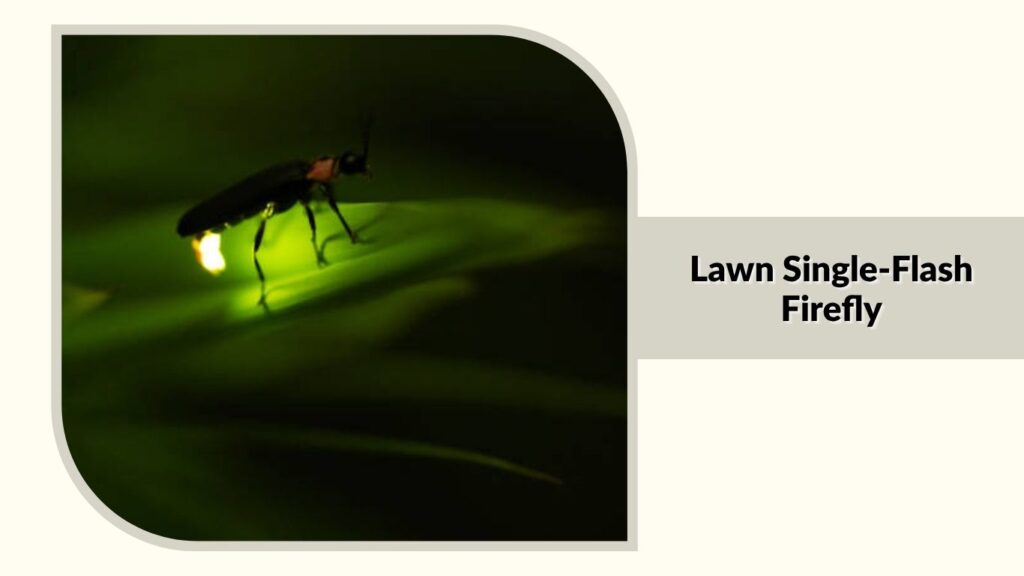
The Lawn Single-Flash Firefly, Photinus granulatus, is a flashing firefly associated mainly with lawns, meadows, and other grassy environments. Its name comes from the simple single flash produced by displaying males. Unlike many familiar fireflies, the females have shortened wings and cannot fly, so courtship generally occurs close to the ground. The species is known from parts of the south-central United States.
Identification
- Small to medium-sized firefly
- Dark wing covers
- Pale margins around the wing covers
- Typical Photinus body shape
- Males have functional wings
- Females are flightless
- Large eyes in males
- Functional abdominal light organs
- Males produce single flashes
- Often observed over lawns and meadows
Habitat and Distribution
Lawn Single-Flash Fireflies inhabit grassy areas such as lawns, meadows, and other open herbaceous habitats. Records are concentrated in Arkansas, Kansas, Oklahoma, and Texas.
Adults benefit from areas where grasses remain relatively undisturbed and artificial nighttime lighting is limited. Females generally remain close to vegetation near ground level, while males patrol slightly higher above the grass.
Behavior and Diet
Displaying males fly roughly a meter above the ground and produce short single flashes at approximately one-second intervals. Their flight movement can make the flash appear slightly doubled even though it is essentially one pulse. Females answer from vegetation near the ground.
Like other Photinus species, larvae are thought to live near or below the soil surface and prey on worms and other soft-bodied invertebrates.
Lifespan and Life Cycle
The life cycle includes egg, larva, pupa, and adult. Larvae spend most of their development in moist ground habitat where they feed and grow.
After pupating below ground, adults emerge during the warm season. Adults live for a relatively short period compared with the larval stage, focusing primarily on mating and reproduction.
10. Mr. Mac Firefly
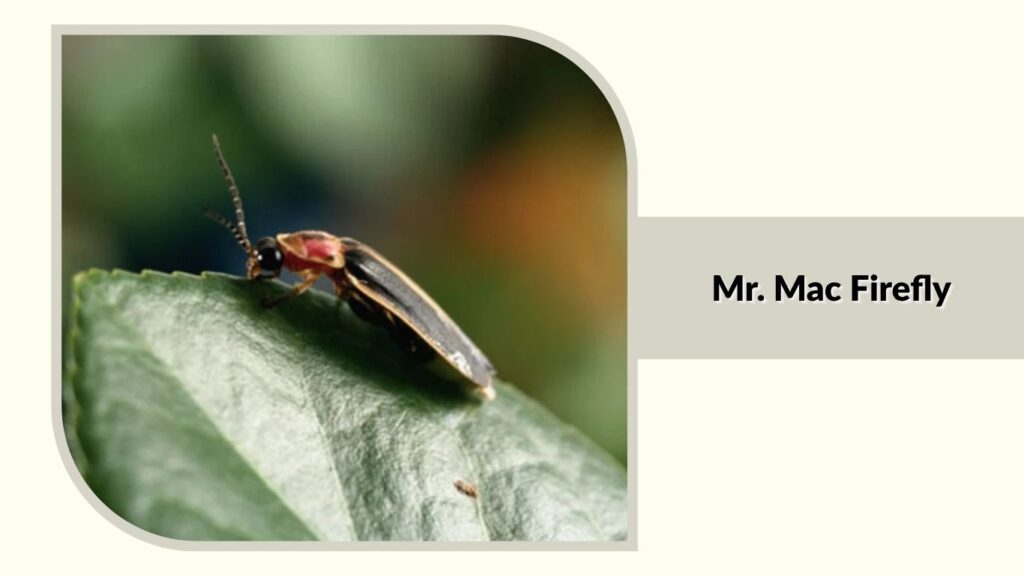
The Mr. Mac Firefly, Photinus macdermotti, is named in honor of firefly specialist Frank McDermott. It is best recognized by its characteristic paired flashes rather than appearance alone because it resembles several related Photinus species. Mr. Mac occurs across much of the eastern United States and is particularly associated with moist forests, open woodland, river valleys, and areas near streams.
Identification
- Usually about 6–10 mm long
- Dark wing covers
- Well-defined pale wing margins
- Yellowish and reddish pronotum
- Dark rectangular mark on pronotum
- Large compound eyes
- Male has two lantern-bearing abdominal segments
- Female generally has one main lantern segment
- Males produce paired flashes
- Difficult to separate visually from related species
Habitat and Distribution
Mr. Mac Fireflies occur in moist montane forests, lowland forests, open woodland near streams, and river valleys. They have a broad eastern North American range, with records extending from the southeastern United States into northern states.
They are often especially visible in open portions of woodland where males have enough flying space for their courtship displays.
Behavior and Diet
Male Mr. Mac Fireflies are known for a two-flash courtship pattern. In the Great Smoky Mountains, males produce two yellow flashes followed by a short dark interval before repeating the pattern. Females respond from vegetation with their own signal.
Larvae are predators and are believed to feed mainly on earthworms and other soft-bodied invertebrates near or below the soil surface.
Lifespan and Life Cycle
Most of the life cycle is spent as a larva. Eggs hatch into glowing larvae that remain in moist terrestrial habitats while feeding and developing.
After passing through several larval stages, they pupate and eventually emerge as adults. Adult activity varies geographically but commonly occurs from spring through summer. Adults devote much of this short period to courtship and reproduction.
11. Punctate Firefly
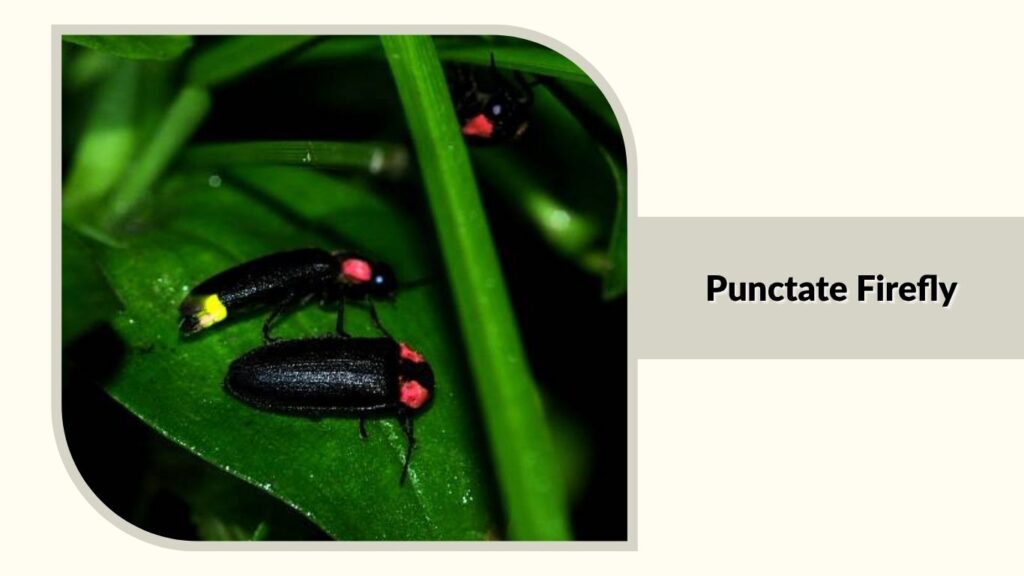
The Punctate Firefly, Photinus punctulatus, is an uncommon flashing species associated with grassy habitats in the central United States. Males produce repeated single yellow-orange flashes while flying above lawns and meadows. Females have shortened wings and cannot fly normally, making undisturbed ground vegetation particularly important to their life cycle. The species is considered poorly understood, with modern population information limited across much of its historical range.
Identification
- Medium-sized Photinus firefly
- Dark wing covers
- Pale edging along wing covers
- Pronotum covering much of the head from above
- Males fully winged
- Females have reduced wings
- Females generally remain near the ground
- Males produce single yellow-orange flashes
- Large eyes adapted for visual signaling
- Similar in appearance to related Photinus species
Habitat and Distribution
Punctate Fireflies have been recorded from Iowa, Illinois, Kansas, Missouri, Oklahoma, Texas, and Arkansas. Their preferred habitats include lawns, meadows, old fields, and other grassy areas.
Because many populations are poorly documented, accurate field identification can be difficult without considering flash behavior, geographic location, and season.
Behavior and Diet
Displaying males fly about one to two meters above the ground and produce single yellow-orange flashes approximately once per second. Activity usually begins around half an hour after sunset. Females remain lower in vegetation and respond with their own flash.
Larvae are believed to live underground or close to the soil surface and feed on earthworms and other soft-bodied invertebrates.
Lifespan and Life Cycle
Eggs hatch into predatory larvae that spend much of their development in moist soil and protected vegetation.
The larval stage lasts far longer than the adult stage. After pupation, winged males and reduced-wing females emerge during the warmer season.
Adults concentrate on mating, while larvae handle most of the feeding and growth required for development.
12. Thinly Girdled Firefly
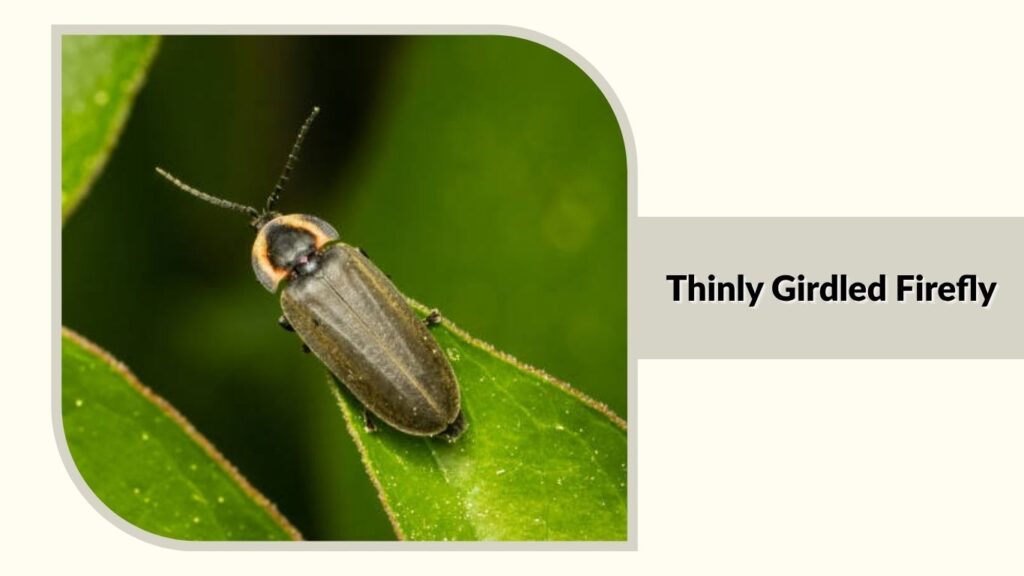
The Thinly Girdled Firefly, Photinus tenuicinctus, is a flashing species associated with forests and shaded lawns in parts of the Ozark region. Males produce sharp single flashes while flying relatively low above the ground. Females have reduced wings and cannot fly, so they remain close to vegetation while responding to displaying males. The species is currently known mainly from Arkansas, Missouri, and Oklahoma.
Identification
- Medium-sized firefly
- Dark wing covers
- Very narrow pale margins
- Pale yellow pronotum
- Dark central pronotum marking
- Large eyes in males
- Males fully winged
- Females have reduced wings
- Produces sharp single flashes
- Typical slender Photinus form
Habitat and Distribution
Thinly Girdled Fireflies occur in wooded landscapes and shaded lawns. Records are concentrated in Arkansas, Missouri, and Oklahoma.
Adults may be observed where woodland borders meet open grassy areas, giving males room to fly while still maintaining the shaded, humid conditions useful to immature stages.
Behavior and Diet
Males begin displaying around 20–25 minutes after sunset and may continue flashing for several hours. They fly roughly one to two meters above the ground, producing brief single flashes while covering short distances between signals.
Females remain in grass or low vegetation and answer males from near ground level.
The larvae are predatory and probably feed on earthworms, snails, and other soft-bodied invertebrates living in or around the soil.
Lifespan and Life Cycle
Females deposit eggs in protected moist ground. The larvae that hatch spend most of their lives concealed among soil and leaf litter.
After feeding and growing through several immature stages, they pupate underground.
Adults eventually emerge during favorable warm and humid conditions. As with most fireflies, the glowing adult stage represents only a relatively brief portion of the full life cycle.
13. Flint Hills Firefly
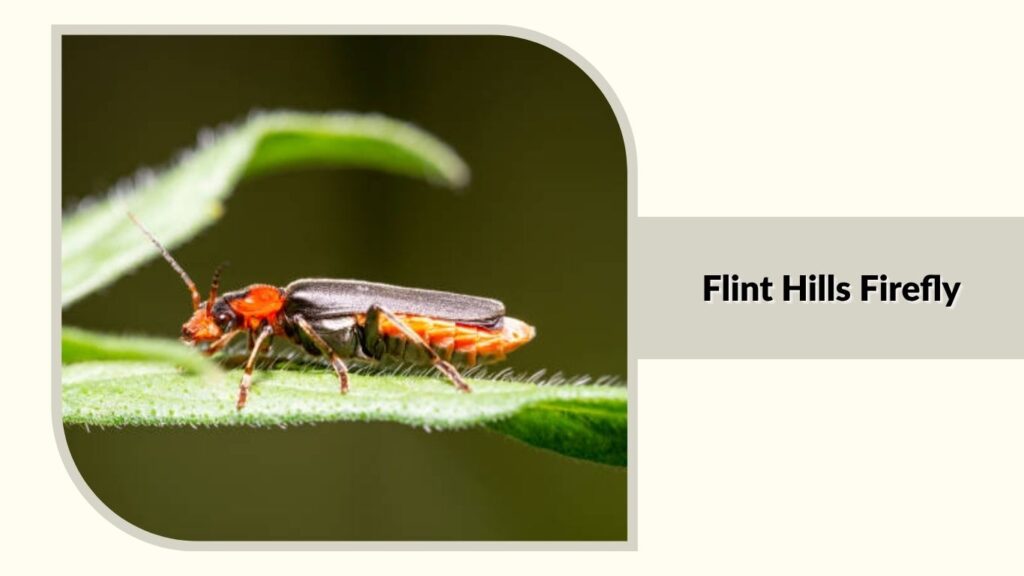
The Flint Hills Firefly, Photuris divisa, is a grassland species named for its association with the Flint Hills and other tallgrass prairie habitats of the central United States. Unlike woodland fireflies, it is well suited to open grassy landscapes. Adults begin displaying relatively soon after sunset, producing one or two pulsed flashes while flying slowly above vegetation.
Identification
- Relatively large Photuris firefly
- Long-legged appearance
- Dark wing covers
- Pale margins along the body
- Large compound eyes
- Functional abdominal lantern
- Produces one- or two-pulse flashes
- Flies slowly above grasses
- Active around tallgrass prairie
- Males and females communicate with flashes
Habitat and Distribution
Flint Hills Fireflies inhabit tallgrass prairie, old fields, roadsides, and other grassy environments with low-growing vegetation. Their documented distribution includes Kansas, Oklahoma, Missouri, and Illinois.
Tallgrass prairie maintained by natural or carefully managed ecological processes provides especially suitable habitat. Excessive conversion of grasslands to intensive development or agriculture can reduce available habitat.
Behavior and Diet
Males usually begin displaying around 15–20 minutes after sunset. They fly slowly over vegetation and produce one or two flashes separated by a short interval, repeating the signal every few seconds. Females answer from vegetation closer to the ground.
Larvae of Photuris fireflies are generalist predators and scavengers. They may consume snails, worms, other soft-bodied invertebrates, and occasionally plant material.
Lifespan and Life Cycle
Eggs hatch into predatory larvae that develop in ground-level habitat. Larvae spend many months feeding before pupation.
The adults are most active during spring and summer, with activity reported from approximately April through August and a peak around June in parts of the range.
Their adult lives are comparatively short and are centered on courtship and reproduction.
14. Spring Four-Flasher Firefly
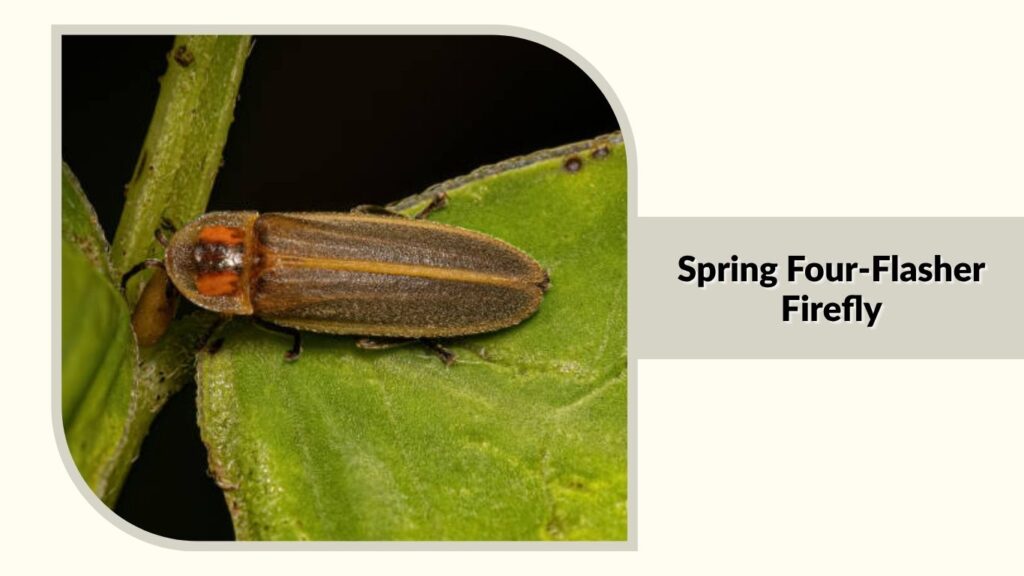
The Spring Four-Flasher, Photuris quadrifulgens, is an early-season firefly known for courtship displays consisting commonly of three or four slow pulses. It occurs primarily in grasslands, fields, pastures, meadows, and large lawns bordered by trees. Adults can appear earlier in the year than many other fireflies, making their slow green flashing displays particularly noticeable during spring evenings.
Identification
- Large firefly, approximately 12–20 mm
- Dark or black wing covers
- Pale yellow wing margins
- Pale pronotum with red coloration
- Dark central pronotum marking
- Long legs
- Large compound eyes
- Bright abdominal lantern
- Usually produces three or four slow flashes
- Greenish courtship light
Habitat and Distribution
Spring Four-Flashers occur mainly in open grassy environments such as hayfields, meadows, pastures, old fields, and large lawns. Trees around the edges of these open spaces are commonly associated with displaying populations.
Males may fly several feet above vegetation and sometimes move around nearby trees while signaling.
Behavior and Diet
The most characteristic courtship display consists of a string of three or four slow flashes, although the exact number can vary. Verified field observations have recorded males producing three to four green pulses while flying above grassland.
Females respond from vegetation after detecting suitable male signals.
The larvae are generalist predators and scavengers, consuming snails, worms, and other soft-bodied animals in damp ground habitats.
Lifespan and Life Cycle
The species develops through egg, larval, pupal, and adult stages. Larvae live at or near ground level and do most of the feeding.
Adults typically appear in spring and early summer, with records concentrated around April, May, and June in portions of the range.
After mating and egg laying, the adult generation disappears while the next generation continues developing as larvae.
15. Bethany Beach Firefly
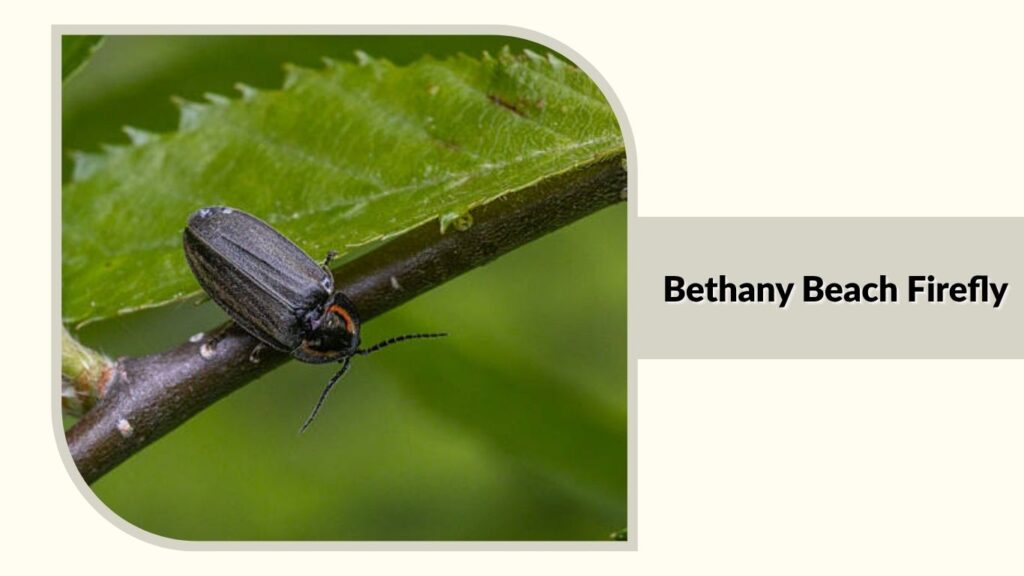
The Bethany Beach Firefly, Photuris bethaniensis, is a rare coastal species associated with freshwater wetlands that form between sand dunes along the Atlantic coast. Adults are relatively small for the genus and produce a distinctive double green flash. Because this firefly depends on a very specialized habitat, it has become an important focus of firefly conservation efforts.
Identification
- Adult males about 9–10.75 mm long
- Tan to light brown body
- Dark brown or black markings
- Dark wing covers
- Pronotum with a central dark marking
- Central marking broadens toward the front
- Large compound eyes
- Long legs typical of Photuris
- Males produce two bright green flashes
- Similar in appearance to several other Photuris species
Habitat and Distribution
Bethany Beach Fireflies live primarily in freshwater interdunal swales—wet depressions located between coastal sand dunes. They are documented from barrier-island habitats along the Atlantic coasts of Delaware, Maryland, and Virginia.
These swales have seasonally wet soils and accumulated organic material that provides important habitat for developing larvae.
Behavior and Diet
Males become active after full darkness during summer. Their characteristic signal consists of two bright green flashes, repeated every few seconds as they fly above wetland habitat searching for females. Females answer with a single flash.
Larvae hunt along the soil surface and feed on snails, worms, and other soft-bodied invertebrates.
Adults in the genus Photuris can also display predatory behavior toward other fireflies.
Lifespan and Life Cycle
Females lay eggs in suitable moist coastal habitat. Larvae develop within organic-rich ground layers and hunt small invertebrates near the soil surface.
When development is complete, larvae pupate in shallow chambers beneath soil or protected beneath woody debris.
Adults are primarily active from late June through July or August. Because this species occupies such specialized coastal habitat, preserving freshwater swales and maintaining dark nighttime conditions are particularly important for its continued life cycle.
16. Belted Firefly
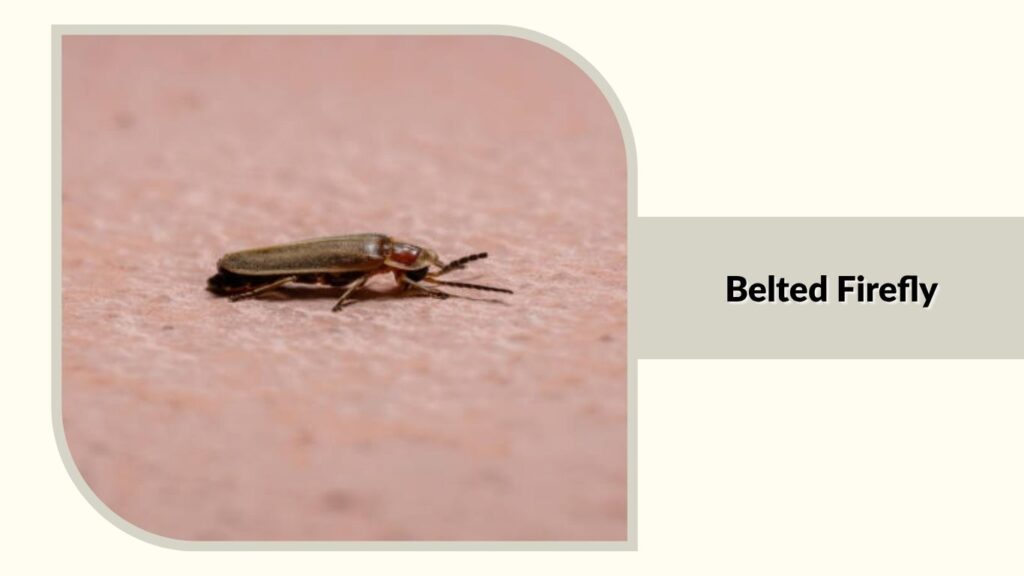
The Belted Firefly, Photuris cinctipennis, is a rare flashing firefly known mainly from Delaware and Maryland. It is associated with moist lowland hardwood forests, forested floodplains, and isolated freshwater wetlands. Adults are active mainly during June and July and produce yellow-green flashes. Because the species has a very restricted known range, suitable wet forest habitat is particularly important to its survival.
Identification
- Medium-sized Photuris firefly
- Long-legged, somewhat humpbacked appearance
- Dark wing covers
- Pale margins along the body
- Red, yellow, and dark markings on the pronotum
- Winged adult males and females
- Yellow-green courtship light
- Produces single flashes
- Difficult to separate visually from related Photuris
- Flash pattern helps with identification
Habitat and Distribution
The Belted Firefly has been documented from only a small portion of the Mid-Atlantic region, primarily Delaware and Maryland. It occurs in moist lowland areas within hardwood forests and isolated freshwater forested wetlands. Floodplain forests, streamside areas, and other humid woodland environments can provide suitable habitat.
Because its distribution is limited, habitat loss and degradation can have significant effects on local populations.
Behavior and Diet
Adults are nocturnal and use yellow-green flashes during courtship. The exact timing and variation of the signal are still being studied.
Larvae of related Photuris species are generalist predators and scavengers. They search damp ground for snails, slugs, earthworms, and other soft-bodied organisms.
Adults in the genus Photuris are also known for complex predatory behavior, although species-specific feeding behavior for the Belted Firefly remains incompletely documented.
Lifespan and Life Cycle
The immature biology of this particular species is not well studied. Based on related Photuris fireflies, eggs hatch after several weeks and larvae may develop through multiple stages over one or two years.
Larvae likely overwinter before eventually pupating in shallow chambers beneath the soil or protected debris. Adults emerge during early summer, with most documented activity occurring in June and July.
17. Dot-Dash Firefly
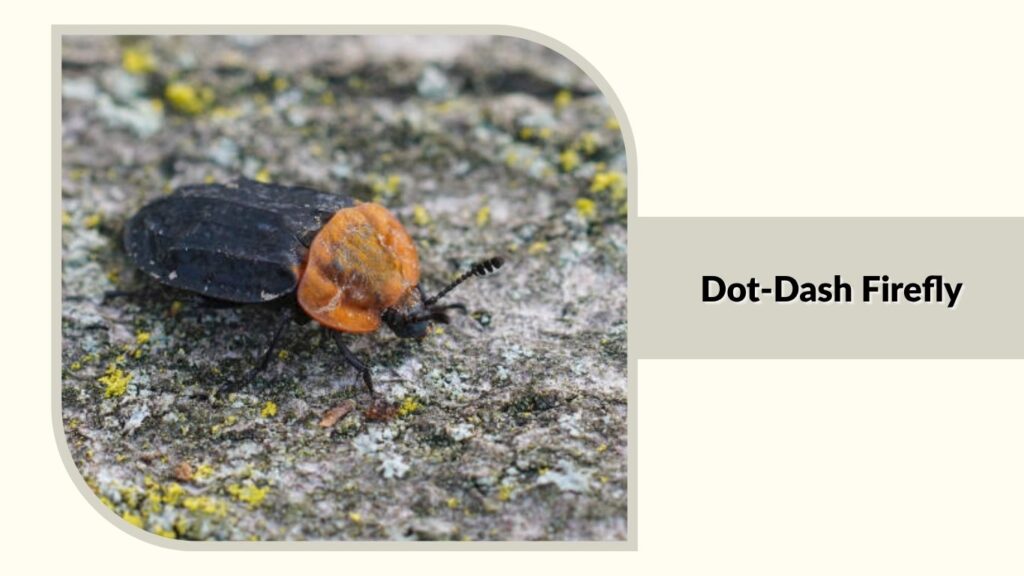
The Dot-Dash Firefly, Photuris pensylvanica, is famous for a distinctive signal consisting of a short flash followed by a much longer one. It is also known as the Pennsylvania Firefly and is Pennsylvania’s state insect. This wetland-associated species occurs in parts of the northeastern United States and is most readily recognized by combining its flash pattern with habitat and seasonal activity.
Identification
- Adult length roughly 8–11 mm
- Dark wing covers
- Long legs
- Typical elongated Photuris body
- Large compound eyes
- Pale body margins
- Winged adults
- Produces greenish light
- Characteristic short “dot” followed by long “dash”
- Best identified through flash pattern and habitat together
Habitat and Distribution
Dot-Dash Fireflies inhabit high-quality freshwater wetlands. Typical locations include freshwater tidal marshes, fens, floodplains, seepage swamps, emergent marshes, and similar wet environments.
Documented populations occur in Delaware, Maryland, New Jersey, New York, Pennsylvania, and Washington, D.C.
Their dependence on healthy wetlands means habitat drainage, development, invasive vegetation, and changes in water conditions can reduce suitable habitat.
Behavior and Diet
Males produce the flash that gives this firefly its name: a quick greenish flash followed by a longer flash that can last several seconds. The pattern is repeated at intervals while males fly through wetland habitat searching for females.
Like other Photuris, the immature stages are predators of small invertebrates. Adults of some Photuris species are also predators and may imitate signals from other fireflies.
Lifespan and Life Cycle
Specific details of the Dot-Dash Firefly’s complete development remain less thoroughly documented than its adult flashing behavior.
Like other fireflies, it passes through egg, larval, pupal, and adult stages. Most of the life cycle is spent as a larva rather than as a flashing adult.
Adults are mainly active during June and July, generally beginning well after sunset and continuing into the night.
18. Florida Sprite Firefly
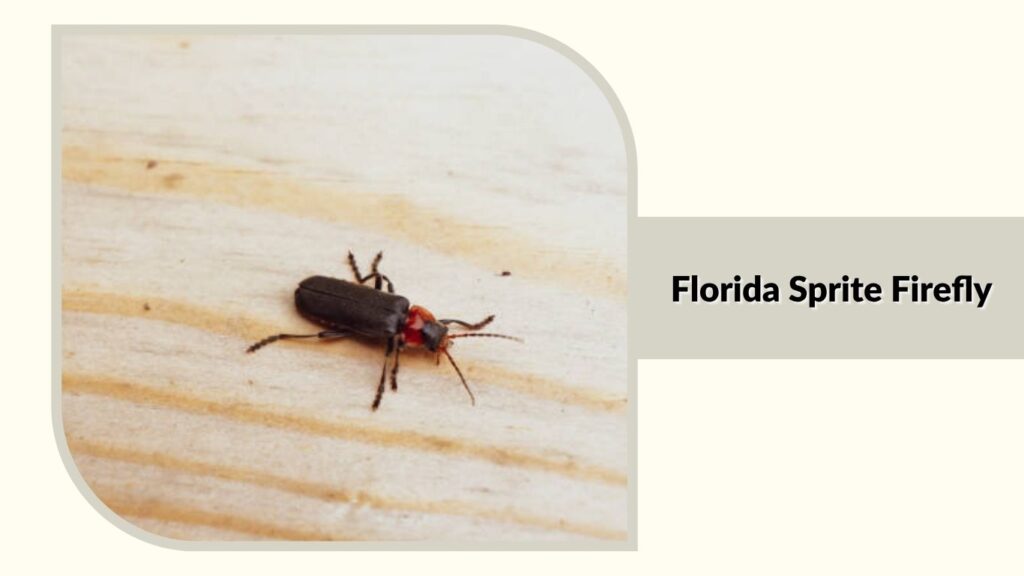
The Florida Sprite, Photinus floridanus, is a small flashing firefly historically associated with moist and moderately moist forest habitats in Florida. Interestingly, it has also been documented far north in Delaware. Males begin their courtship displays very soon after sunset, producing brief flashes while flying in a hopping or hovering pattern above low vegetation.
Identification
- Small Photinus firefly
- Dark wing covers
- Pale-edged body
- Typical shield-like pronotum
- Large eyes in males
- Functional abdominal lantern
- Males are fully winged
- Produces short single flashes
- Low, hovering courtship flight
- Best observed shortly after sunset
Habitat and Distribution
In Florida, this species has historically been recorded in moist and moderately moist hammocks, forest floors, stream margins, woodland edges, palmetto vegetation, and roadside bushes.
A disjunct population has also been reported in peat-bog forest in Delaware. Current distribution is not completely understood, and recent records are limited.
Behavior and Diet
Florida Sprite males can begin displaying less than ten minutes after sunset. They fly in distinctive hopping or hovering movements while producing brief flashes roughly every few seconds.
Females stay much lower, often on weeds or palmetto leaves, and answer males with short flashes.
The larvae are believed to live at or below the soil surface. Like other Photinus larvae, they likely prey primarily on earthworms and other soft-bodied invertebrates.
Lifespan and Life Cycle
Eggs develop into predatory ground-dwelling larvae. The larval stage makes up the majority of the firefly’s life and provides the feeding and growth required before adulthood.
After completing larval development, individuals pupate and later emerge as winged adults.
The Florida Sprite can be particularly noticeable around spring and again later in summer. Its evening display period may be relatively short, sometimes lasting only around half an hour after sunset.
19. Keel-Necked Firefly
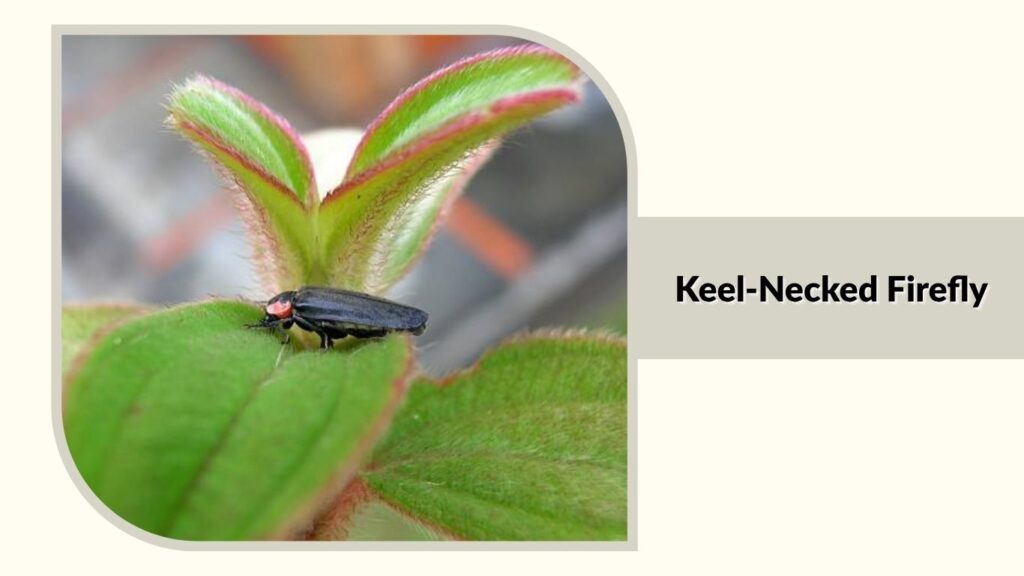
The Keel-Necked Firefly, Pyractomena ecostata, is a distinctive wetland species recognized by its bright, explosive-looking flashes. It has a scattered distribution that includes populations in the southeastern United States and the coastal Mid-Atlantic. This firefly is closely associated with brackish marshes, high marsh vegetation, and wet grassy environments, making habitat an important clue when identifying it.
Identification
- Medium-sized firefly
- Dark wing covers
- Yellow diagonal markings on the wings
- Raised keel-like line on the pronotum
- Relatively short antennae
- Fully winged adults
- Bright greenish-yellow light
- Long, intense single flashes
- Often flies several feet above vegetation
- Distinctive “firecracker-like” signal
Habitat and Distribution
Keel-Necked Fireflies occur in Alabama, Delaware, Florida, Maryland, and New Jersey according to the current Firefly Atlas checklist. They are strongly associated with brackish tidal marshes, wet pastures, high marshes, and other damp grassy environments.
Larval habitat is especially connected to moist marsh ground and vegetation.
Behavior and Diet
Male courtship signals are unusually conspicuous. A male gives a long greenish-yellow flash or short glow lasting roughly half a second to a second, followed by a long dark interval.
These flashes have been described as bright and explosive, sometimes appearing like sparks moving above the marsh.
Larvae are predatory and likely feed on snails and other small soft-bodied animals available in wet habitats.
Lifespan and Life Cycle
The life cycle follows the familiar firefly sequence of egg, larva, pupa, and adult. Much of development takes place in moist ground habitat before the adult flashing season begins.
Activity varies geographically. Depending on location, adults may occur from spring through late summer or early fall.
The narrow habitat requirements of this species make the survival of marsh vegetation and naturally wet ground especially important to successful reproduction.
20. Marsh Imp Firefly
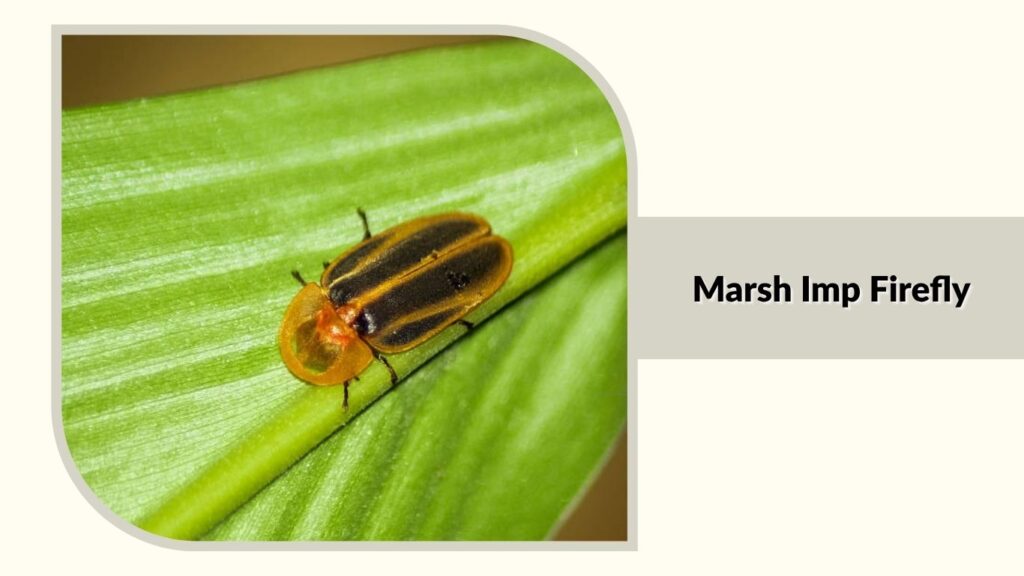
The Marsh Imp, Pyractomena lucifera, is appropriately named because almost every part of its life is tied to freshwater wetlands. Adults fly just above cattails and other emergent vegetation while giving rapid yellow flashes. Its larvae are particularly interesting because they live around wetland plants and can capture prey both above and below the waterline.
Identification
- Adult length around 9–10 mm
- Dark wing covers
- Yellow outer and inner wing margins
- Pale orange or yellowish flashes
- Short, rapid single flash
- Males fly over marsh vegetation
- Females respond with longer flashes
- Associated strongly with cattail marshes
- Typical Pyractomena body structure
- Adults active mainly during summer
Habitat and Distribution
Marsh Imps live in freshwater marshes containing cattails and other emergent aquatic vegetation.
Their broad North American distribution includes parts of the Great Lakes region, the Northeast, Southeast, and south-central United States, with records extending into Canada.
Despite that broad overall range, suitable wetland habitat determines where local populations can survive.
Behavior and Diet
Males fly just above cattails and other marsh vegetation while producing quick yellow flashes every few seconds. Females answer with a noticeably longer flash from vegetation.
Marsh Imp larvae are unusual predators. They climb vegetation near the waterline and capture snails, freshwater limpets, arthropods, and even leeches. They can seize prey below the water surface and drag it upward before feeding.
Lifespan and Life Cycle
Females lay eggs after mating, and laboratory observations have found eggs hatching in roughly 15 days. The developing larvae live among wetland vegetation where they hunt and grow.
Pupation occurs on emergent plants rather than deep underground. Research recorded a pupal period of roughly one week before adults emerged.
Adults are mostly active during summer. In northern portions of their range, observations commonly fall between late June and August.
FAQs
1. Are fireflies actually flies?
No. Fireflies are beetles belonging to the family Lampyridae. The names firefly and lightning bug are common names rather than scientific descriptions of their insect order.
2. Why do fireflies produce light?
Most flashing species use bioluminescence primarily for communication and courtship. Males commonly produce species-specific flash patterns while females respond with signals that help suitable mates locate one another.
3. What do fireflies eat?
Most firefly larvae are predators. Depending on species, they may eat snails, slugs, earthworms, insect larvae, and other soft-bodied invertebrates. Adult diets vary considerably. Some adults eat little, while certain Photuris fireflies can prey on other fireflies.
4. How long do fireflies live?
Most of a firefly’s life is spent as an immature larva, often for many months and sometimes longer than a year. The visible adult stage is generally much shorter and focuses mainly on mating and reproduction.
5. Why are there fewer fireflies in some places?
Fireflies face several pressures, including habitat loss, artificial light at night, pesticide exposure, and climate-related changes to specialized wetlands and other habitats. Different species are affected differently because some can use many habitat types while others depend on very specific marshes, forests, or grasslands.