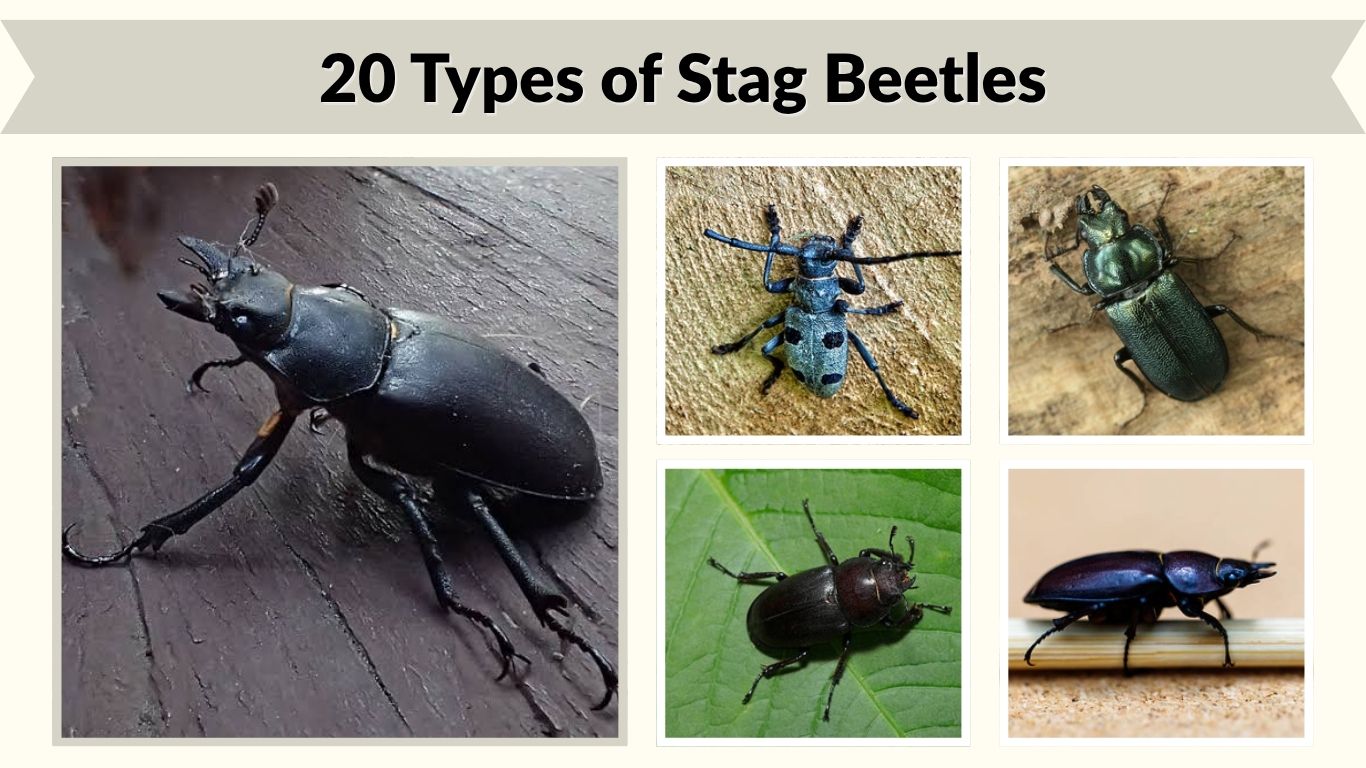
Stag beetles are some of the most fascinating beetles in the world, known especially for the oversized, antler-like mandibles found on many males. With hundreds of species distributed across forests, woodlands, and tropical regions, they vary widely in size, color, behavior, and habitat. In this guide, you’ll discover 20 types of stag beetles, including giant, rainbow, European, Japanese, and Australian species. Each type includes identification features, habitat and distribution, behavior and diet, and an overview of its lifespan and life cycle.
1. Giant Stag Beetle
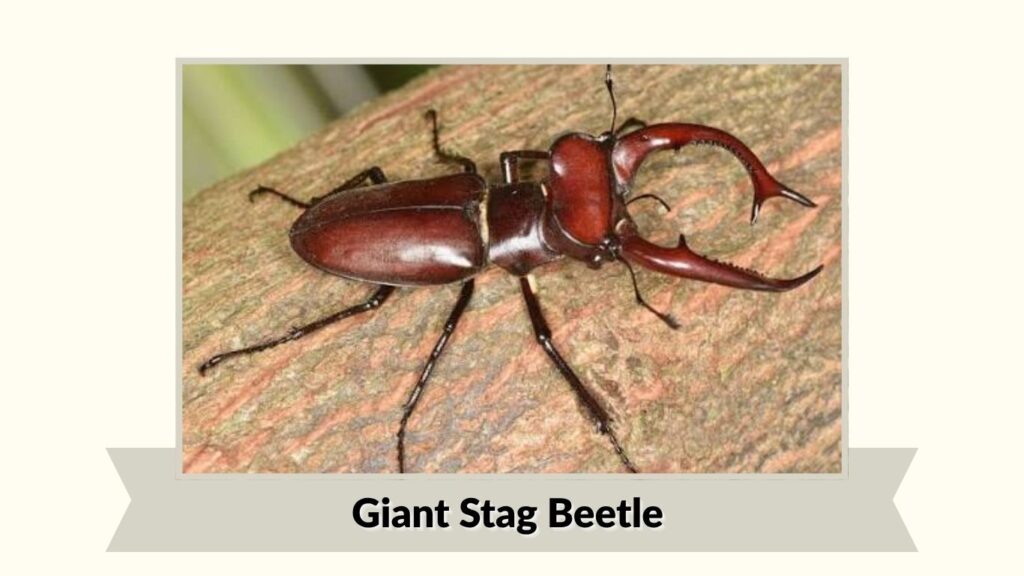
The Giant Stag Beetle (Lucanus elaphus) is one of the largest and most impressive stag beetles found in North America. Males are especially noticeable because of their oversized, antler-like mandibles, which give the species its distinctive appearance. These beetles are closely associated with deciduous forests and decaying wood, where their larvae spend much of their development. Despite their intimidating jaws, giant stag beetles are generally harmless to people.
Identification
- Size: Approximately 30–60 mm long, depending on sex and mandible size.
- Color: Usually shiny reddish-brown to dark brown.
- Mandibles: Males have extremely large, curved, antler-like jaws.
- Head: Males have a broad head adapted to support their large mandibles.
- Legs: Typically dark to black and relatively long.
- Females: Smaller than males with much shorter, stronger-looking jaws.
- Antennae: End in characteristic fan-like clubs typical of stag beetles.
Habitat and Distribution
Giant stag beetles mainly inhabit deciduous woodlands in the eastern United States. They are particularly dependent on moist, decaying logs, dead trees, and old stumps. These materials provide both shelter and food for developing larvae. Adults are most often observed during late spring and summer and may occasionally be attracted to outdoor lights at night.
Behavior and Diet
Adult males use their oversized mandibles primarily when competing with other males for access to females rather than for feeding. Adults consume sugary liquids such as tree sap, juices from soft or rotting fruit, and aphid honeydew. The larvae have a very different diet, feeding within damp, decomposing wood and benefiting from fungi and microorganisms associated with wood decay.
Lifespan and Life Cycle
Females lay their eggs in crevices within moist, decaying wood. After hatching, the white, grub-like larvae live inside rotting logs or stumps and may take several years to develop fully. They eventually pupate before emerging as adults, usually during the warmer months. The adult stage is comparatively short and is mainly devoted to finding mates and reproducing. This long larval period also makes giant stag beetles important contributors to the natural decomposition of dead wood in forests.
2. Reddish-Brown Stag Beetle
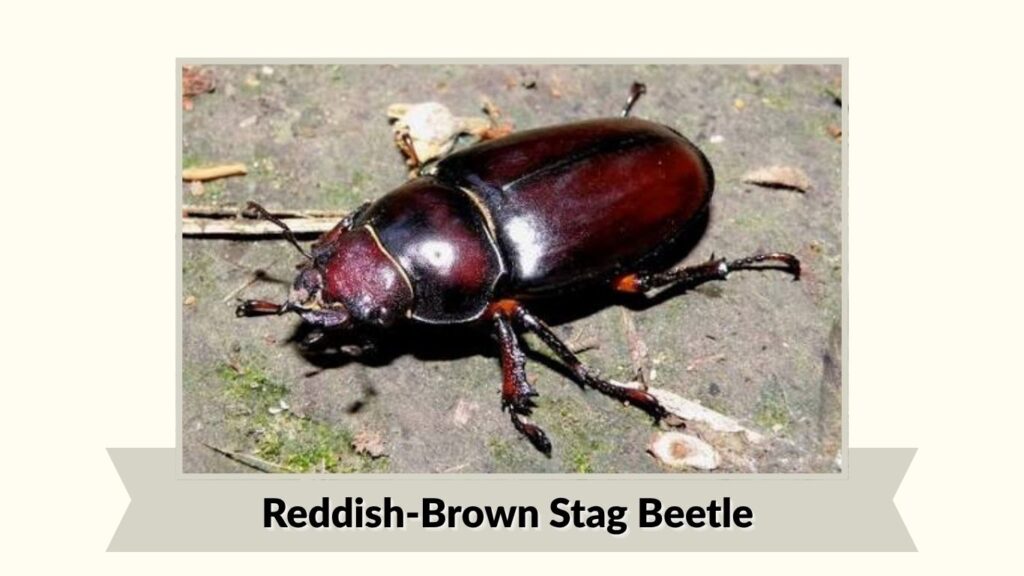
The Reddish-Brown Stag Beetle (Lucanus capreolus) is a large North American stag beetle recognized by its smooth, glossy reddish-brown body. Males possess long, curved mandibles that resemble miniature deer antlers, while females have much shorter jaws. This species is closely associated with deciduous forests, where decomposing logs and stumps provide essential habitat for its developing larvae.
Identification
- Size: Usually about 22–35 mm long.
- Color: Glossy reddish-brown to dark chestnut.
- Mandibles: Males have long, strongly curved jaws.
- Legs: Femora often have a distinctive orange-brown coloration.
- Body: Broad, sturdy, and relatively smooth.
- Females: Smaller mandibles and a less dramatic head shape.
- Antennae: End in fan-like segmented clubs typical of stag beetles.
Habitat and Distribution
Reddish-brown stag beetles occur primarily in eastern North America, including parts of the United States and Canada. They favor deciduous forests and wooded areas containing plenty of dead timber. Adults are often found around old stumps and fallen logs and may also appear around outdoor lights after dark. Decaying hardwood is especially important because it provides the breeding site and larval food source.
Behavior and Diet
Adults are largely nocturnal. Males use their curved mandibles to wrestle rival males, particularly around breeding sites. The oversized jaws look threatening but are mainly adapted for competition rather than feeding. Adult stag beetles commonly obtain energy from tree sap and other sugary plant fluids. Their larvae live inside rotting wood, where they consume decomposing plant material and associated microorganisms.
Lifespan and Life Cycle
Females deposit eggs in or around decaying wood. After hatching, the larvae become large, pale, C-shaped grubs that remain inside rotting timber. Larval development may take about two years before the beetles pupate, often in nearby soil. Adults eventually emerge to reproduce, completing a life cycle that depends heavily on undisturbed deadwood habitat.
3. Rainbow Stag Beetle
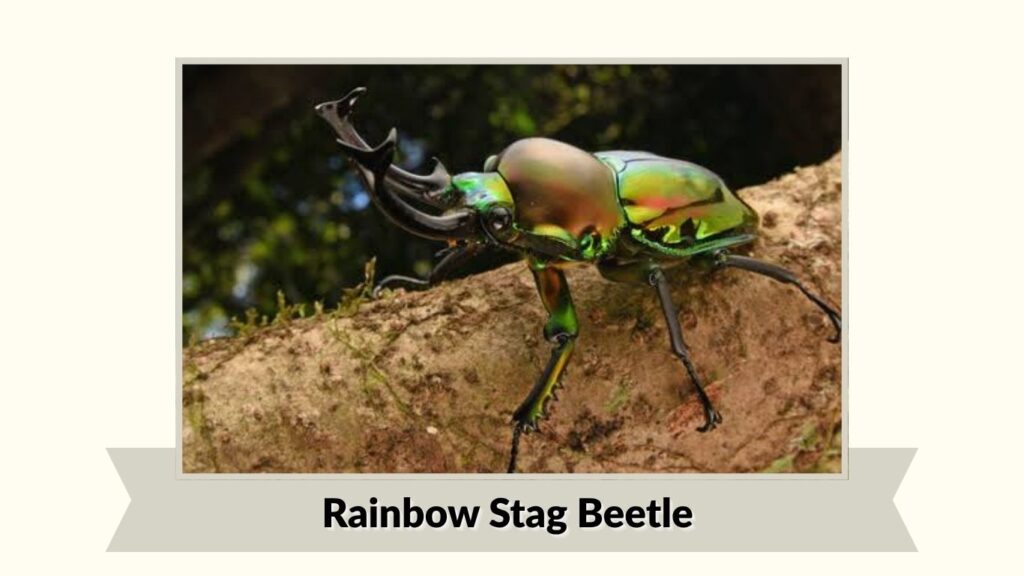
The Rainbow Stag Beetle (Phalacrognathus muelleri) is among the most visually striking members of the stag beetle family. Its polished exoskeleton can display metallic green, gold, copper, red, blue, and purple tones depending on lighting and viewing angle. Native to tropical regions of Australia and New Guinea, this spectacular beetle is particularly recognizable by the long mandibles of adult males.
Identification
- Color: Brilliant metallic green, gold, red, blue, or copper.
- Surface: Exceptionally shiny and reflective.
- Mandibles: Males have long, curved black mandibles.
- Females: Smaller and equipped with much shorter jaws.
- Body: Broad, smooth, and strongly built.
- Legs: Long, dark legs with hooked feet for gripping surfaces.
- Sexual dimorphism: Males are generally larger and more heavily armed than females.
Habitat and Distribution
Rainbow stag beetles occur naturally in northern Queensland, Australia, as well as New Guinea. They are associated with warm, wet tropical forests containing abundant decaying timber. Moist rotting wood affected by white-rot fungi is particularly important for breeding and larval development.
Behavior and Diet
Adult males use their enlarged mandibles during contests with competing males. They may lift, push, or displace rivals while competing for access to females. Like many stag beetles, adults obtain energy from sugary plant materials such as tree sap and soft fruit. The larvae follow a completely different feeding strategy, consuming decomposing wood and material associated with wood-decaying fungi.
Lifespan and Life Cycle
Females may lay dozens of eggs near suitable rotting timber. Eggs can hatch within roughly two weeks under favorable conditions. The larvae then spend an extended period feeding inside moist decomposing wood. Larval development can take up to several years before pupation occurs. Adults emerge after metamorphosis, with reproduction becoming their primary biological role.
4. Giraffe Stag Beetle
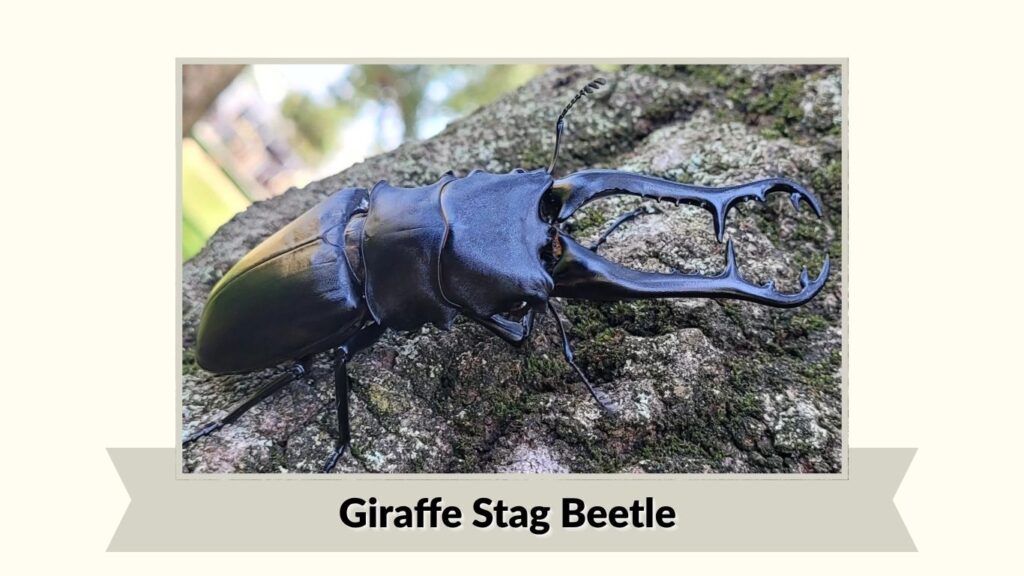
The Giraffe Stag Beetle (Prosopocoilus giraffa) is famous for its extraordinary size and extremely long jaws. Large males can approach 12 centimeters when their mandibles are included, placing this species among the largest stag beetles in the world. Its elongated head and antler-like jaws create a distinctive appearance that makes it easy to separate from many smaller Lucanidae species.
Identification
- Size: Large males may reach around 100–120 mm including the mandibles.
- Color: Usually dark brown to nearly black.
- Mandibles: Extremely long with several teeth along the inner edges.
- Body: Elongated, flattened, and powerful.
- Females: Much smaller with short, functional mandibles.
- Legs: Strong legs adapted for holding bark and branches.
- Head: Large in males to support the oversized jaws.
Habitat and Distribution
Giraffe stag beetles inhabit tropical forest environments across parts of southern and Southeast Asia. Their range extends from India toward Indonesia, with different geographic forms occurring throughout this broad region. Moist forests rich in fallen timber provide ideal conditions because decomposing wood is essential for larval development.
Behavior and Diet
Male giraffe stag beetles can be highly competitive when encountering other males. Their enormous jaws function almost like grappling tools. A male may grip, lift, or throw an opponent from a branch while competing for mates. Despite their powerful appearance, adults mainly feed on sugary liquids such as tree sap and juices from ripe fruit. Larvae consume decaying wood.
Lifespan and Life Cycle
Females search for decomposing timber in which to lay their eggs. Once hatched, the larvae remain hidden inside rotting wood and gradually grow through several developmental stages. This larval period represents the longest portion of the beetle’s life. Mature larvae eventually form pupal chambers, transform into pupae, and later emerge as adults. Adult males then concentrate much of their activity on locating females and competing with rivals.
5. Elephant Stag Beetle
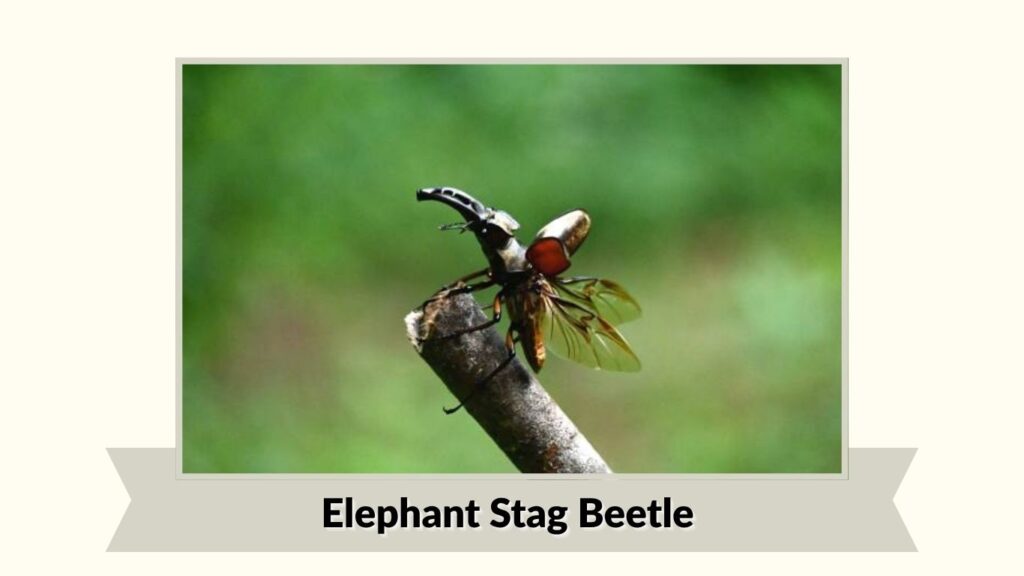
The name Elephant Stag Beetle is sometimes used for Lucanus elaphus. However, this is actually the same species as the Giant Stag Beetle covered in number 1 rather than a separate stag beetle species. “Giant stag beetle,” “elk stag beetle,” and “American stag beetle” are more appropriate names; BugGuide specifically notes that “elephant stag beetle” arose from confusion surrounding the scientific name elaphus.
Identification
- Size: About 30–60 mm including the mandibles.
- Color: Dark reddish-brown to brown.
- Mandibles: Large males have long, branched, antler-like jaws.
- Legs: Typically dark compared with those of the reddish-brown stag beetle.
- Pronotum: Smooth and dark.
- Females: Smaller jaws and a more compact appearance.
- Antennae: Clubbed tips consisting of separated segments.
Habitat and Distribution
This beetle occurs mainly in eastern North America, particularly in deciduous woodland. Fallen trees, old stumps, and other sources of moist decomposing hardwood are especially important. Adults can sometimes be seen near rotting logs or attracted to artificial lights during warm nights.
Behavior and Diet
Adult males use their large mandibles when competing with other males rather than primarily for feeding. Adults are associated with sap-producing trees and other sugary food sources, while the larvae obtain their nutrition from damp, decaying wood. Stag beetles therefore play a useful ecological role by participating in the breakdown and recycling of dead plant material.
Lifespan and Life Cycle
Females place eggs around suitable deadwood. The larvae hatch as pale grubs and spend one or several years developing inside decomposing wood. Once mature, they pupate and eventually emerge as adults, commonly during spring or early summer.
6. European Stag Beetle
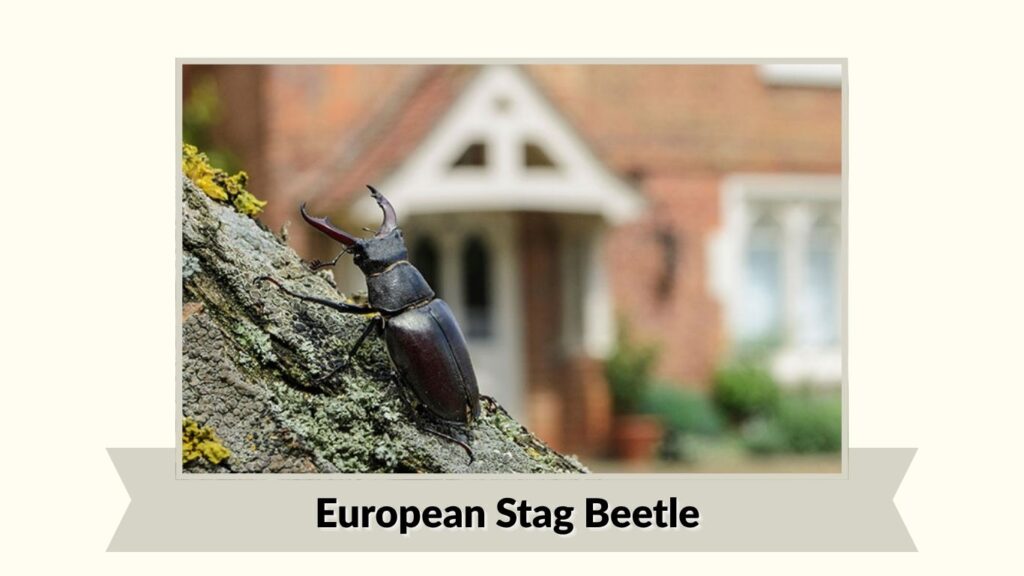
The European Stag Beetle (Lucanus cervus) is one of Europe’s largest and most recognizable beetles. Adult males are famous for their enormous antler-like mandibles, while females are smaller and equipped with shorter, stronger jaws. The species depends heavily on old trees, decaying stumps, and underground deadwood. Most of its life is spent as a larva, with the adult stage lasting only a relatively short period during summer.
Identification
- Size: Males can reach about 75–80 mm in length.
- Color: Black head and thorax with chestnut-brown wing covers.
- Mandibles: Large males have strongly enlarged, antler-like jaws.
- Females: Usually about 30–50 mm long with much smaller mandibles.
- Body: Broad, heavy, and slightly flattened.
- Larvae: Large, creamy-white, C-shaped grubs with orange-brown heads.
- Antennae: End in distinctive clubbed segments.
Habitat and Distribution
European stag beetles occur across central and southern Europe, with important populations also found in southern England. They prefer broad-leaved woodland, especially areas containing old oak trees, but they can also survive in parks, orchards, hedgerows, and gardens where deadwood remains available. Warm locations containing buried stumps and decaying roots provide especially valuable breeding habitat.
Behavior and Diet
Adult males are best known for wrestling one another with their oversized mandibles. They attempt to push, lift, or throw competing males away from females or feeding sites. Adults mainly drink sweet fluids such as tree sap and juices from decomposing fruit. Larvae feed on rotting wood and associated fungi rather than attacking healthy living trees.
Lifespan and Life Cycle
Females lay eggs near decaying wood underground. After hatching, the larvae may spend three to seven years feeding and growing before constructing a pupal chamber. Pupation generally occurs during the final autumn, but newly formed adults remain underground until late spring or early summer. Adult beetles usually survive only several weeks, during which their primary purpose is reproduction.
7. Japanese Small Stag Beetle
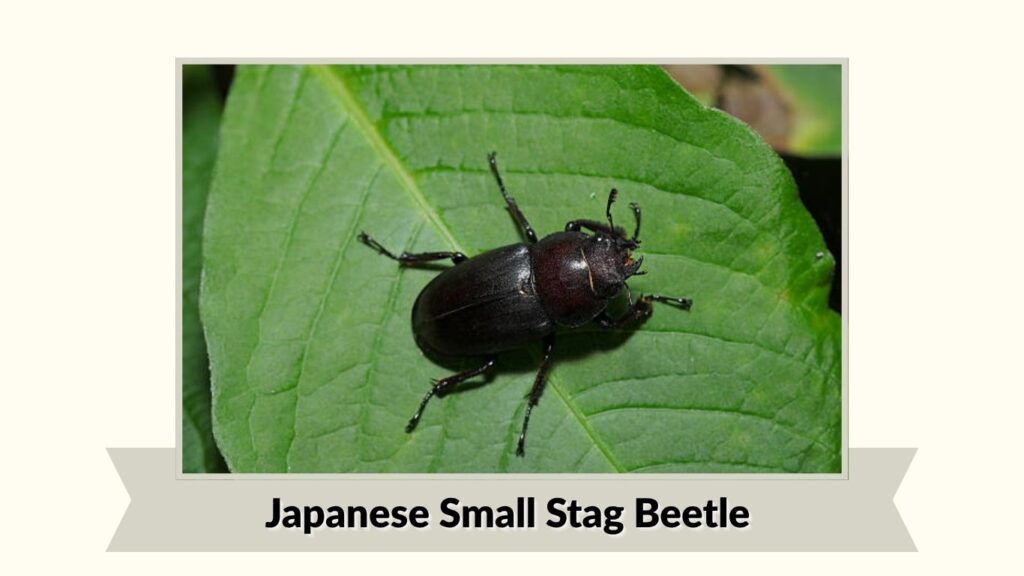
The Japanese Small Stag Beetle (Dorcus rectus) is a compact but impressive stag beetle found across parts of East Asia. Despite its smaller size compared with giant members of the family, males still possess distinctive curved mandibles used during competition. Its dark, glossy body and robust form make it easy to recognize. The species occurs in wooded habitats where adults use trees for feeding and larvae depend on decaying timber.
Identification
- Color: Usually glossy black to very dark reddish-brown.
- Body: Compact, broad, and relatively flattened.
- Mandibles: Males possess curved jaws with internal teeth.
- Females: Have significantly shorter mandibles.
- Surface: Smooth and polished-looking exoskeleton.
- Legs: Strong, dark legs adapted for gripping bark.
- Male variation: Mandible shape and development can vary considerably among males.
Habitat and Distribution
This species occurs in Japan, Korea, parts of China, and the Russian Far East. It is associated mainly with forests and other wooded environments containing mature broad-leaved trees and dead timber. Adults may hide under bark, inside tree cavities, or beneath loose wood during daylight before becoming more active after dark.
Behavior and Diet
Japanese small stag beetles are generally more active during warm evenings and nights. Males use their mandibles as weapons when competing with other males, especially around valuable feeding or mating locations. Adults feed primarily on sugary liquids such as tree sap and juices from ripe or damaged fruit. The larvae live inside decomposing hardwood and consume softened woody material.
Lifespan and Life Cycle
Females place eggs in suitable rotting wood. The young larvae hatch and pass through several grub stages while feeding within the timber. As they increase in size, they eventually prepare a chamber where pupation takes place. After metamorphosis, the adult emerges and searches for feeding sites and mates. As with many Dorcus species, much more time is spent in the hidden larval stage than in active seasonal reproduction.
8. Miyama Stag Beetle
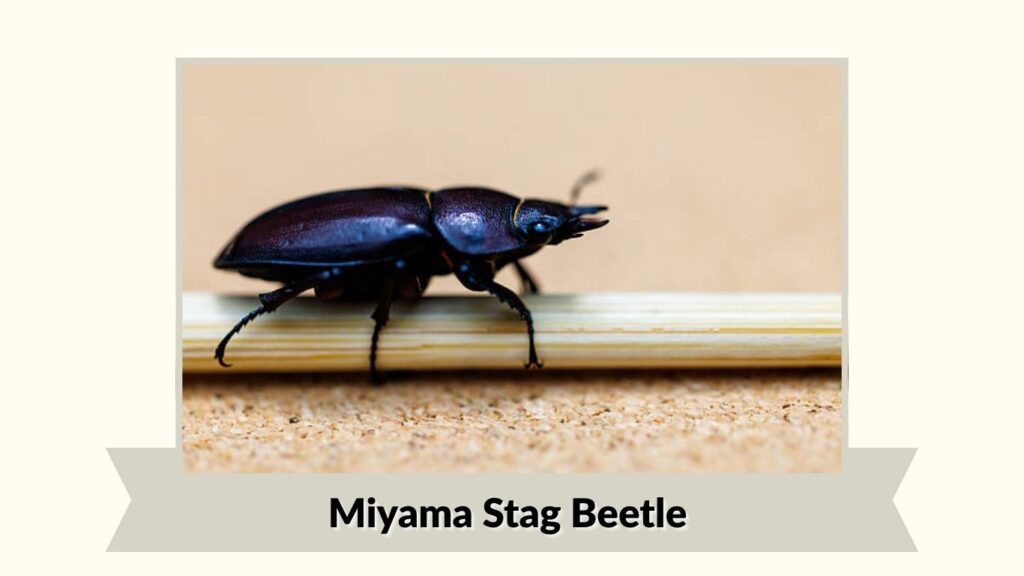
The Miyama Stag Beetle (Lucanus maculifemoratus) is a large and distinctive East Asian stag beetle particularly well known in Japan. Males have broad heads and impressive curved mandibles lined with teeth, giving them a powerful appearance. The species is commonly associated with forested and mountainous environments and often gathers around sap-producing trees during summer.
Identification
- Color: Brown, dark brown, or slightly bronze-brown.
- Mandibles: Long and curved with several prominent inner teeth.
- Head: Broad and heavily developed in mature males.
- Body: Elongated with a sturdy thorax.
- Females: Smaller and equipped with short, powerful jaws.
- Legs: Often partly reddish or brownish, depending on the individual.
- Male size variation: Head and mandible proportions can vary greatly with overall body size.
Habitat and Distribution
Miyama stag beetles occur in Japan and are also recorded from Korea, China, and nearby parts of East Asia. They are frequently associated with forested hills and mountain regions. Suitable habitat contains mature broad-leaved trees, decaying timber, and sap-producing trunks. Records show adults active mainly during the warmer period from approximately June through September.
Behavior and Diet
Adults commonly gather around tree-sap flows, especially on oak trees. These feeding sites can become competitive because several beetle species may use the same resource. Male Miyama stag beetles can wrestle rivals using their long mandibles, attempting to push competitors away from sap or females. Adults mainly consume tree sap and other sugary plant liquids, while larvae feed within decomposing wood.
Lifespan and Life Cycle
Females lay eggs in decaying wood or nearby decomposed woody material. Larvae hatch as pale grubs and remain concealed while feeding and increasing in size. They pass through several larval stages before creating a chamber for pupation. Once metamorphosis is complete, the adults emerge during the warmer months. Environmental temperature and food quality can strongly influence how quickly the developing larvae reach maturity.
9. Sawtooth Stag Beetle
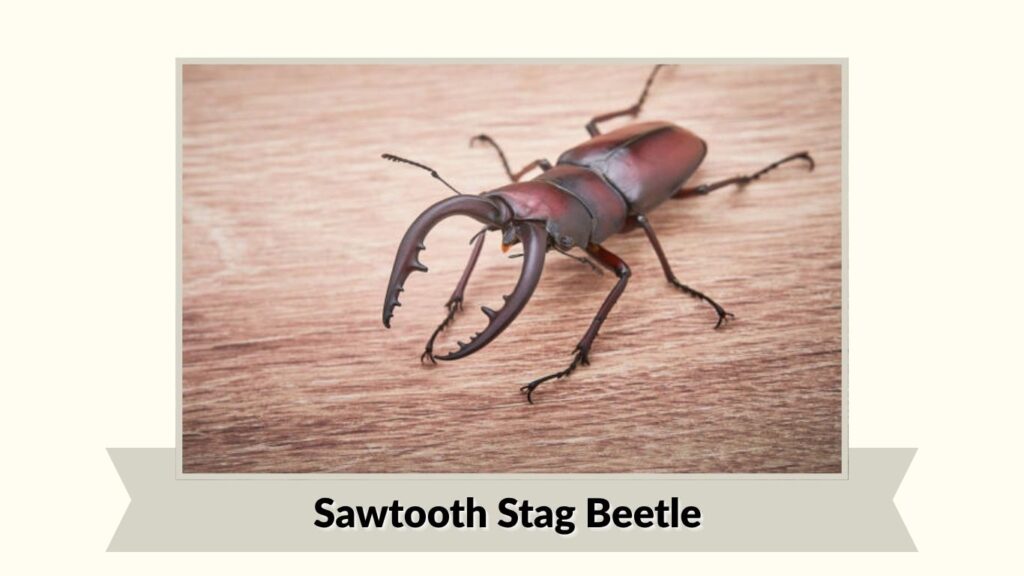
The Sawtooth Stag Beetle (Prosopocoilus inclinatus), also known as the Saw Stag Beetle, is one of Japan’s best-known stag beetles. Large males have remarkably long, curved mandibles lined with uneven teeth, producing the “sawtooth” appearance behind its common name. Adults range widely in size, and the mandibles of small males can look noticeably different from those of large individuals.
Identification
- Size: Approximately 26–75 mm depending on sex and individual development.
- Color: Dark brown, reddish-brown, or chestnut.
- Mandibles: Long, downward-curving jaws with saw-like inner teeth.
- Males: Usually larger than females.
- Females: More compact with much shorter jaws.
- Body: Smooth and elongated.
- Legs: Long and strong for gripping tree bark.
Habitat and Distribution
Sawtooth stag beetles are widespread through Japan, including Hokkaido, Honshu, Shikoku, Kyushu, and several smaller islands. They also occur on the Korean Peninsula. They inhabit broad-leaved forests and wooded landscapes containing sap-producing trees and decaying timber. Warm summer forests provide the best conditions for observing active adults.
Behavior and Diet
Males use their long mandibles in physical contests. During encounters, they may hook beneath an opponent and attempt to lift or throw it from the tree. Adults often congregate at sap flows, where they drink carbohydrate-rich liquids. They may also consume fluids from ripe fruit. Larvae develop inside rotting wood, where they feed on decomposed plant material and microorganisms associated with decay. Research has documented this species competing at oak sap sites with other large Japanese beetles.
Lifespan and Life Cycle
Females search for suitable decomposing timber in which to deposit eggs. Larvae remain inside the wood through successive growth stages. After reaching maturity, they construct a protected chamber and enter the pupal stage. The adult later emerges, usually becoming active during summer. The larval period makes up the majority of its development, while the adult stage centers largely on feeding, competition, mating, and reproduction.
10. Great Stag Beetle
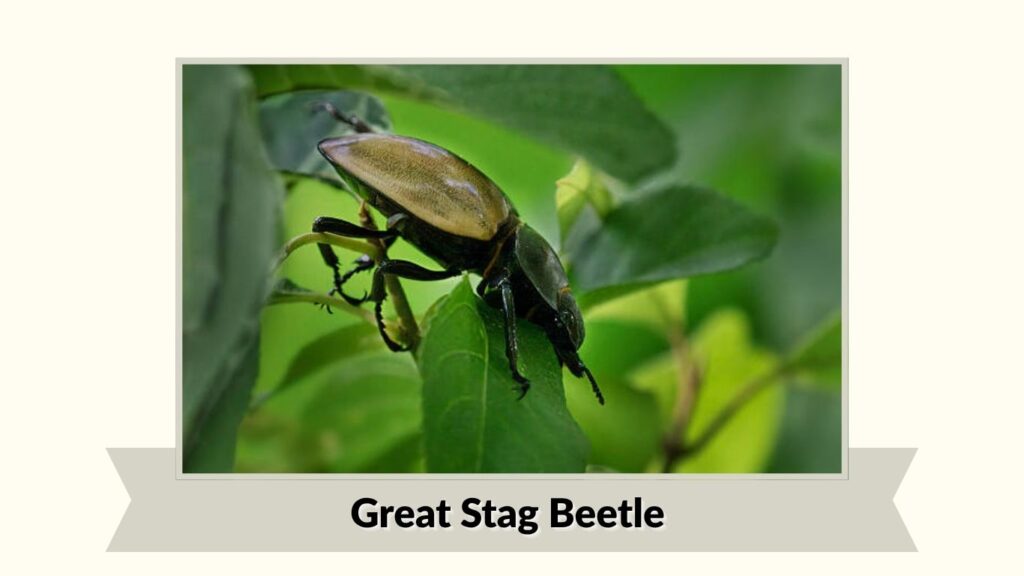
The Great Stag Beetle (Dorcus hopei) is a large, powerful stag beetle native to East Asia. Japanese populations are especially well known and are often referred to as Japanese great stag beetles. Unlike species with extremely elongated jaws, this beetle has thick, robust mandibles suited to powerful gripping. Its glossy black coloration and broad body give it a strong, armored appearance.
Identification
- Color: Deep glossy black.
- Body: Broad, flattened, and heavily built.
- Mandibles: Thick and curved with prominent inner teeth.
- Head: Large and wide in males.
- Females: Smaller with considerably shorter jaws.
- Legs: Strong and adapted for holding onto bark.
- Exoskeleton: Hard, smooth, and highly polished in appearance.
Habitat and Distribution
Great stag beetles occur naturally in Japan, Korea, and China. They prefer broad-leaved forests containing mature trees, cavities, sap flows, and decaying timber. Adults are primarily nocturnal and often occupy hollows or cracks in large trees during daylight. Males may establish positions near sap-producing sites, which provide both food and opportunities to encounter females.
Behavior and Diet
Adults feed mainly on hardwood sap and sweet fluids from fruit. Males can be territorial around productive sap sites and use their mandibles when confronting rival males. Their powerful jaws allow them to grip and push opponents while maintaining a firm hold on the tree. Larvae have a completely different diet, feeding within decomposing wood that has been softened by microorganisms.
Lifespan and Life Cycle
Females lay eggs in decaying broad-leaved wood. The larvae hatch and remain within the dead timber, usually developing for roughly one to two years depending on environmental conditions. They later pupate and transform into adults. Unlike many stag beetles with short-lived adults, Dorcus hopei can survive for several years as an adult under favorable conditions, with reports commonly placing adult longevity around three to five years.
11. Blue Stag Beetle
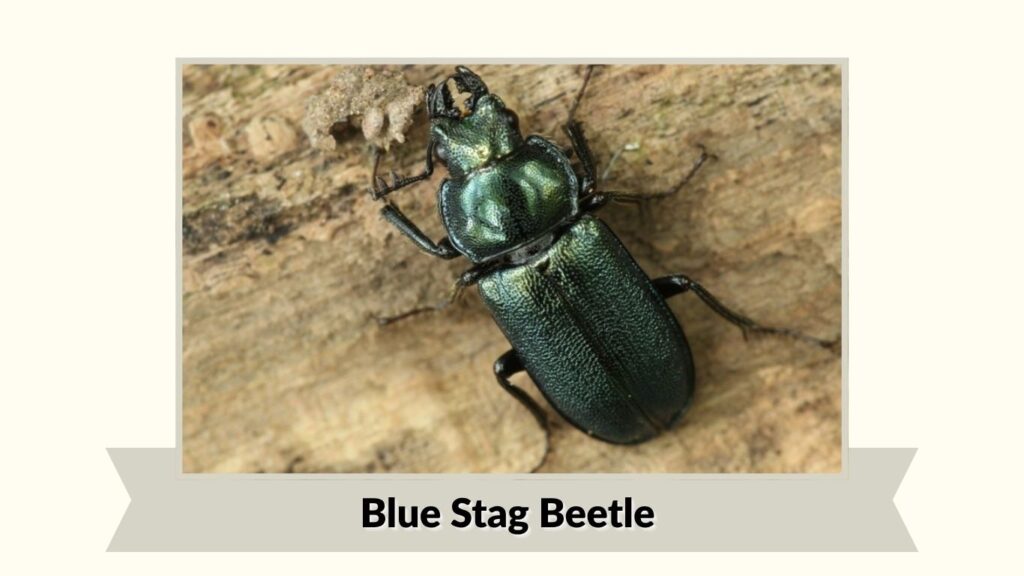
The Blue Stag Beetle (Platycerus caraboides) is a small but striking member of the stag beetle family, known for its metallic blue, blue-green, or nearly black coloration. Unlike the giant stag beetles with enormous antler-like jaws, this species has relatively short mandibles. Its flattened body and brilliant metallic surface make it distinctive among European woodland beetles.
Identification
- Size: Small compared with many other stag beetles.
- Color: Metallic steel-blue, blue-green, greenish, or black.
- Body: Flattened and elongated.
- Mandibles: Short, with toothed inner edges.
- Antennae: Elbowed with a three-segmented club.
- Surface: Often has a glossy metallic appearance.
- Sexes: Males and females are relatively similar, although males have somewhat stronger jaws.
Habitat and Distribution
Blue stag beetles occur across much of continental Europe and extend into parts of western and central Asia and North Africa. They are associated mainly with deciduous woodland, particularly areas containing plenty of fallen branches and decaying timber. The species has historically occurred in Britain but is considered probably extinct there because it has not been reliably recorded since the nineteenth century.
Behavior and Diet
Adults are often active during daylight, especially from late spring through midsummer. They may crawl over fallen branches or fly through woodland while searching for mates and suitable breeding areas. Their relatively small mandibles are not as specialized for dramatic wrestling as those of larger stag beetles. Larvae obtain their food from decomposing hardwood, particularly oak and beech.
Lifespan and Life Cycle
Females place their eggs in suitable dead or heavily decayed wood. After hatching, the larvae remain concealed inside timber, where they feed on softened plant material and microorganisms involved in decomposition. The larval stage lasts much longer than the visible adult stage. Adults are most commonly encountered from May through July, when reproduction and dispersal take place.
12. Golden Stag Beetle
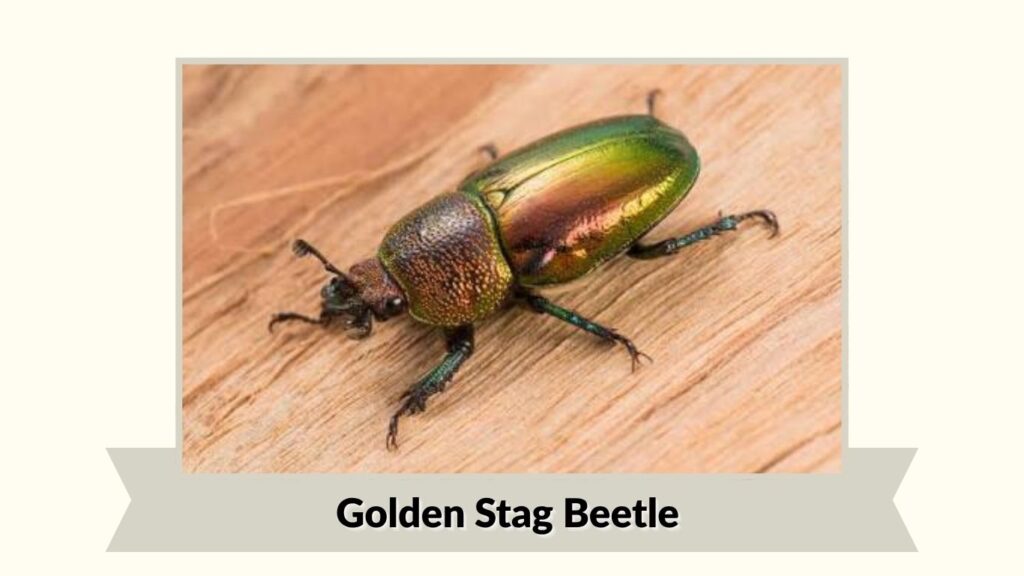
The Golden Stag Beetle (Lamprima aurata) is a brilliantly metallic Australian stag beetle whose colors can range from golden green and yellow to blue, copper, and violet. Males usually have more developed forward-pointing mandibles, while females are smaller and sometimes display especially vivid blue or green coloration. Its polished appearance makes it one of the most colorful stag beetles.
Identification
- Size: Usually around 15–25 mm long.
- Color: Metallic green, gold, yellow, blue, or copper.
- Body: Oval, smooth, and highly reflective.
- Mandibles: Males possess enlarged forward-projecting jaws.
- Females: Generally smaller, often blue, blue-green, or brownish.
- Legs: Frequently display colorful metallic tones.
- Surface: Strong iridescence can make the color change with viewing angle.
Habitat and Distribution
Golden stag beetles are native to Australia. They occur in Tasmania and southeastern mainland Australia, where they are associated particularly with dry sclerophyll forests. Rotten logs and fallen timber are important components of their habitat because these provide food and shelter for the immature stages.
Behavior and Diet
Adults are capable of flight and may move actively over the forest floor or vegetation during the day. They feed on sugary plant resources, including flower nectar, and have been recorded visiting eucalypt flowers. Males can occupy decomposing logs and defend favorable areas against other males. Their enlarged mandibles function primarily during competition rather than for processing solid foods.
Lifespan and Life Cycle
Females select decomposing timber as a breeding location. After the eggs hatch, the larvae live within rotten logs, feeding on decomposed wood. Larval development may last about two years, allowing the grubs to grow gradually before forming pupal chambers. After pupation, adults emerge and become active above ground, where feeding, competition, mating, and egg laying complete the reproductive stage.
13. Black Stag Beetle
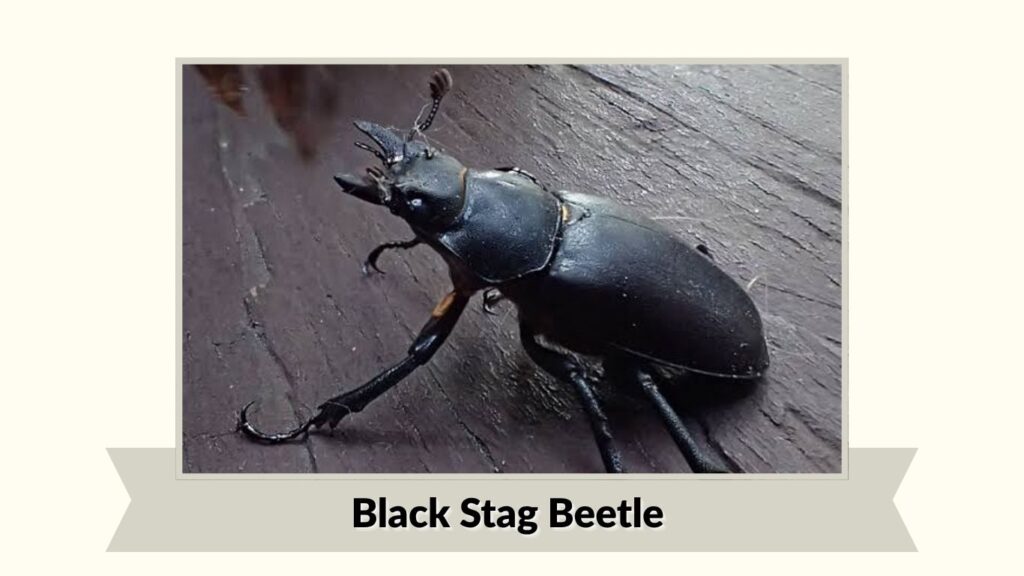
The Black Stag Beetle (Ceruchus piceus) is a relatively small North American stag beetle with a glossy black to dark reddish-brown body. Males have enlarged mandibles with distinctive inner teeth, though their jaws are far shorter than those of giant stag beetles. The species is strongly associated with old forests and large decomposing logs, where much of its development occurs.
Identification
- Size: Approximately 10–15 mm long.
- Color: Glossy black to very dark reddish-brown.
- Body: Compact and robust.
- Mandibles: Males have enlarged jaws with a noticeable inner tooth.
- Antennae: Clubbed in the characteristic stag beetle form.
- Legs: Short, strong, and adapted for moving through wood.
- Appearance: Much smaller and darker than many familiar Lucanus species.
Habitat and Distribution
The black stag beetle occurs in eastern North America. It is closely associated with decomposing hardwood logs, particularly large, well-rotted pieces of beech, oak, and other trees. Red-rotted logs can provide especially suitable habitat. Because larvae depend on dead timber, forests containing abundant old logs and naturally decomposing wood are particularly valuable for the species.
Behavior and Diet
Black stag beetles spend much of their lives in or close to decaying wood. Adults may occasionally come to artificial lights, although they are generally less conspicuous than larger stag beetles. Male mandibles can be used during encounters with other males. The larvae feed directly within deadwood, consuming decomposed woody material and benefiting from the fungi and microorganisms that soften the timber.
Lifespan and Life Cycle
Females lay eggs in suitable decomposing logs. The larvae hatch within this protected environment and remain inside the wood as they pass through their developmental stages. Eventually, mature larvae create chambers where they transform into pupae. Adults emerge after metamorphosis and search for mates and additional deadwood habitat. The species’ dependence on decomposing logs means removal of fallen timber can greatly reduce suitable breeding sites.
14. Lesser Stag Beetle
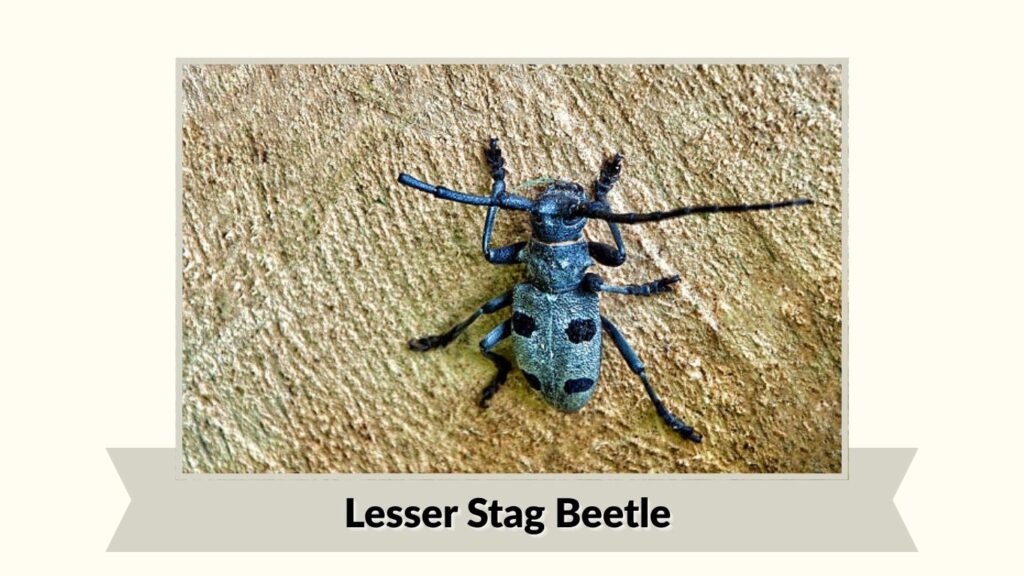
The Lesser Stag Beetle (Dorcus parallelipipedus) is a medium-sized European stag beetle with a broad, matt-black body. Although smaller than the European stag beetle, it can still reach around 3 cm in length. Males have only moderately enlarged jaws, making the sexes more similar in appearance than in species such as Lucanus cervus.
Identification
- Size: Approximately 15–32 mm long.
- Color: Uniformly black or very dark brown.
- Body: Broad, flattened, and somewhat rectangular.
- Mandibles: Slightly larger in males than females.
- Wing Covers: Black rather than chestnut brown.
- Surface: Usually matt to slightly shiny.
- Females: Similar to males but with smaller jaws.
Habitat and Distribution
Lesser stag beetles occur widely across Europe and are particularly familiar in England and Wales. They inhabit woodland, hedgerows, parks, orchards, and gardens where mature trees and deadwood are available. Unlike the larger European stag beetle, which often develops in underground deadwood, lesser stag beetles frequently breed in rotting timber and stumps above ground.
Behavior and Diet
Adults can be active both during the day and at night and are often seen resting on trunks or flying during summer. They can also be attracted to lights. Adults are unable to chew solid food effectively and instead drink tree sap and liquids from damaged or fallen fruit. Larvae feed within soft, decaying broad-leaved wood, including ash, beech, apple, oak, willow, and elm.
Lifespan and Life Cycle
Females place individual eggs inside small depressions or tunnels in decaying wood. Larval development generally lasts around two to three years, depending partly on temperature and when eggs are laid. Unlike many large stag beetles whose adults survive only one breeding season, adult lesser stag beetles can live for more than a year and sometimes several years.
15. Small Stag Beetle
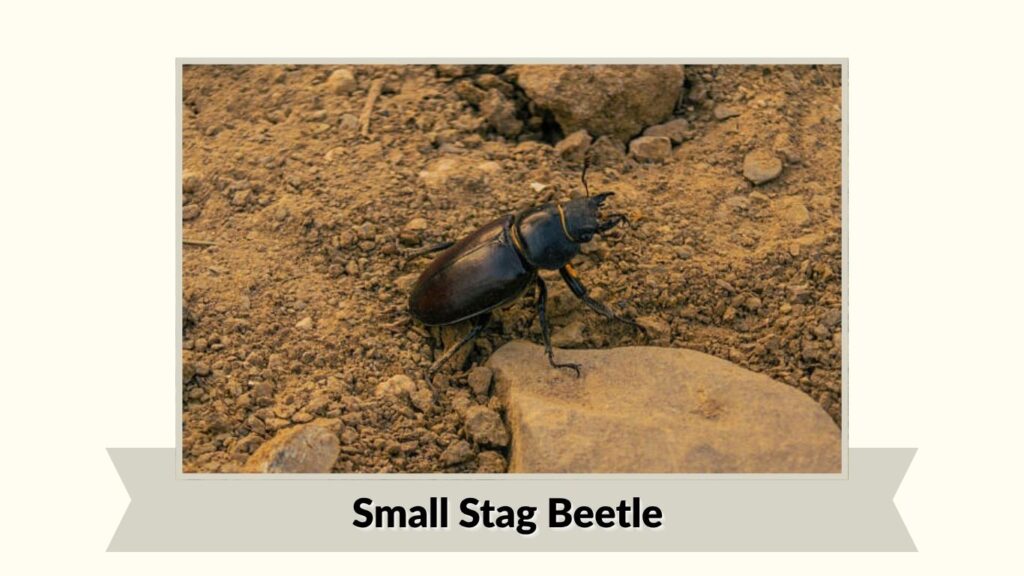
The Small Stag Beetle is another common name used for Dorcus parallelipipedus, meaning it is actually the same species as the Lesser Stag Beetle in number 14 rather than a separate type. It has a dark, sturdy body, modest male mandibles, and a strong association with deadwood. For a 20-species article, this entry should eventually be replaced with a different stag beetle to avoid duplication.
Identification
- Size: Usually around 15–32 mm long.
- Color: Matt black to dark brown-black.
- Body: Broad, compact, and relatively flattened.
- Mandibles: Moderately enlarged in males.
- Females: Similar in general appearance but with smaller jaws.
- Wing Covers: Uniformly dark rather than chestnut colored.
- Antennae: Characteristic clubbed stag beetle antennae.
Habitat and Distribution
Small stag beetles occur through much of Europe, including large areas of England and Wales. They occupy woodland, parkland, old orchards, hedgerows, and gardens containing mature trees. Suitable habitat must provide decomposing wood because both developing larvae and overwintering adults frequently shelter within softened logs or stumps.
Behavior and Diet
Adults are strongest during the warmer months and may disperse by flight. They can be encountered on tree trunks, around old logs, or occasionally near artificial lights. Adult feeding is focused on liquids such as tree sap and juices from damaged fruit. The larvae consume decomposing timber rather than healthy wood, meaning they contribute to nutrient recycling instead of damaging living trees.
Lifespan and Life Cycle
Eggs are deposited in decaying wood, where newly hatched larvae remain protected while feeding. Development commonly takes around two to three years before pupation and adult emergence. Adults are unusually long-lived compared with some larger stag beetles and may survive through winter inside wood, stored logs, plant pots, or other sheltered locations.
16. Broad-Toothed Stag Beetle
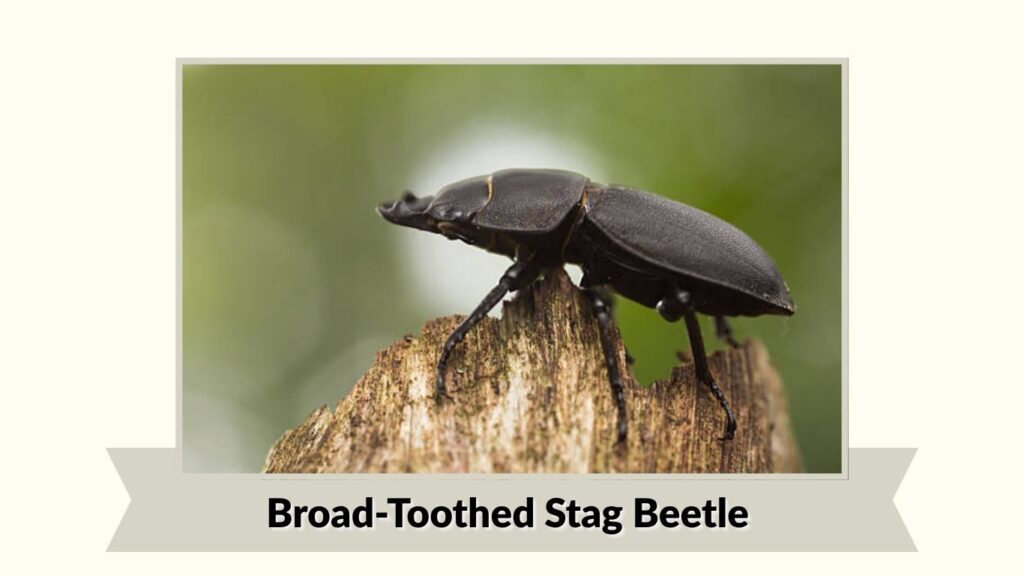
The Broad-Toothed Stag Beetle (Lissotes latidens), also called the Wielangta Stag Beetle, is a rare, flightless species found only in southeastern Tasmania. Unlike many famous stag beetles with extremely long jaws, this species is relatively small, but males still possess distinctive bull-horn-shaped mandibles. Its dependence on moist forest-floor conditions, decaying logs, and surrounding soil makes it particularly vulnerable to habitat disturbance.
Identification
- Size: Generally about 12–18 mm long.
- Color: Dull to dark black.
- Body: Compact with a heavily pitted or pock-marked surface.
- Mandibles: Males have prominent bull-horn-shaped jaws.
- Wings: Adults are flightless.
- Females: Smaller, with much less developed mandibles.
- Larvae: Pale, soft-bodied grubs with brown head capsules.
Habitat and Distribution
This stag beetle is endemic to Tasmania and has a remarkably restricted range. Known populations occur in southeastern Tasmania, including around Wielangta State Forest and Maria Island. It favors wet eucalypt forest dominated by trees such as Eucalyptus obliqua, E. regnans, and E. globulus. Fallen and decomposing timber, moist soil, and a developed forest understory are important habitat components. Because the beetle cannot fly, fragmented populations have limited ability to colonize new areas.
Behavior and Diet
Broad-toothed stag beetles spend much of their time concealed beneath rotting logs and in the upper layers of soil. Both adults and larvae have been found around the soil–decaying wood interface. Larvae appear adapted to tunneling through this moist environment. Their association with decomposing timber also contributes to the broader process of breaking down dead organic matter in forest ecosystems.
Lifespan and Life Cycle
The life cycle is still less thoroughly documented than that of many common stag beetles. Research indicates that larvae can spend up to about two years developing through three larval instars. They remain closely associated with soil beneath decaying timber before entering a pre-pupal and pupal stage. Adults have been recorded as active mainly between September and April.
17. Giant Fijian Stag Beetle
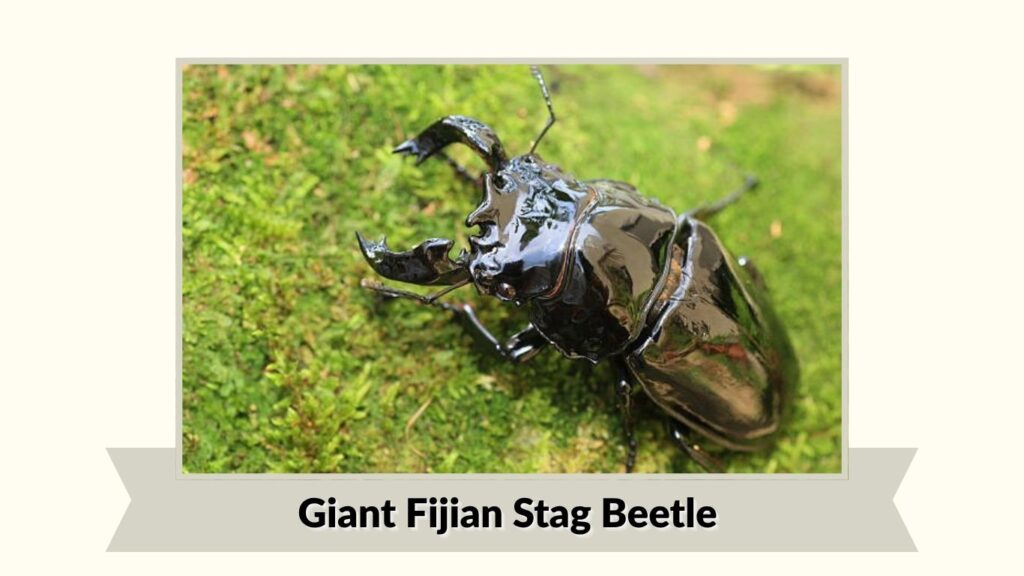
For this list, the Giant Fijian Stag Beetle refers to Aegus grandis, a genuinely Fijian member of the stag beetle family. This distinction matters because the much larger Giant Fijian Long-Horned Beetle belongs to a completely different beetle family. Aegus grandis is one of Fiji’s notable native lucanids and is unusually large compared with many related Aegus from Pacific islands.
Identification
- Size: Large for an Aegus stag beetle; a documented male specimen measured about 38 mm including the mandibles.
- Color: Mainly glossy black to very dark brown.
- Body: Thick, robust, and somewhat flattened.
- Mandibles: Enlarged in males and armed with teeth.
- Females: Have shorter, stronger jaws.
- Legs: Dark and sturdy for moving across or beneath timber.
- Exoskeleton: Heavily hardened, giving adults an armored appearance.
Habitat and Distribution
Aegus grandis is associated with Fiji, with records including Viti Levu and Vanua Levu. Published research describes it as one of the distinctive large Aegus of the Fijian archipelago. Like other members of this genus, it is associated with forest habitats containing decaying wood, stumps, and fungal decomposition—the resources on which many lucanid larvae depend.
Behavior and Diet
Much of the detailed natural history of Aegus grandis remains poorly documented. Aegus stag beetles are primarily saproxylic, meaning that they are strongly associated with dead and decomposing wood. Larvae occur in rotting timber rich in fungal growth. Male mandibles are primarily associated with competition rather than processing food, as is typical among stag beetles.
Lifespan and Life Cycle
Females are expected to select decomposing wood for reproduction, where larvae can remain protected while feeding and developing. The grub stage takes up most of the developmental period before a larva constructs a protected site for pupation. Because biological information about wild A. grandis remains limited, exact development times should not be stated as firmly as they can be for better-studied stag beetles.
18. Australian Stag Beetle
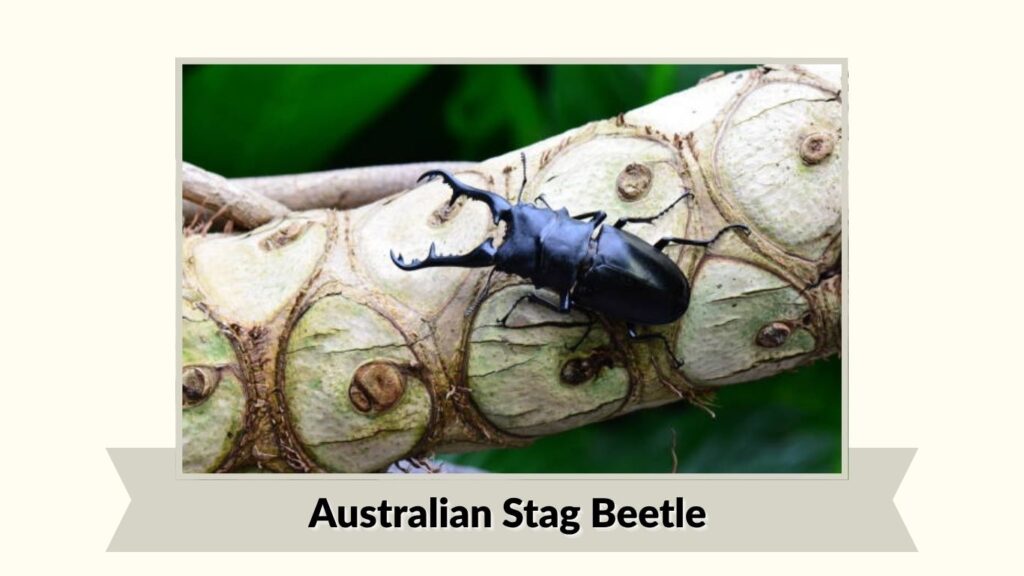
“Australian Stag Beetle” is a broad name rather than one standardized species name because Australia supports dozens of lucanid species. To keep this list from repeating the Golden Stag Beetle already covered, this entry uses Lissapterus obesus as a representative Australian species. It is a stocky, flightless stag beetle associated with upland rainforest environments in eastern Australia.
Identification
- Size: Approximately 28–42 mm.
- Color: Usually dark brown to black.
- Body: Heavy, broad, and robust.
- Mandibles: More strongly developed in males.
- Wings: Adults are flightless.
- Legs: Strong and suited to movement across the forest floor.
- Females: Generally have much shorter mandibles than males.
Habitat and Distribution
Lissapterus obesus inhabits areas of the Great Dividing Range from northern New South Wales into southern Queensland. It is particularly associated with drier rainforest occurring at higher elevations, generally above about 950 meters. Suitable forest floors provide fallen logs and decomposing timber that offer both shelter and developmental habitat.
Behavior and Diet
Because adults cannot fly, they move slowly across or beneath the forest floor and fallen timber. Their limited dispersal makes continuous suitable habitat particularly important. Larvae develop in or beneath decaying logs and depend on decomposing woody material. For many Australian lucanids, fungi play an important role in softening deadwood and making it usable by developing larvae.
Lifespan and Life Cycle
Larvae spend their immature lives closely associated with fallen timber, gradually increasing in size before pupating. Adults of Lissapterus obesus have been reported emerging mainly around December and January. The flightless adults then move over the forest floor in search of mates. This lifestyle makes them quite different from colorful, flying Australian stag beetles such as species of Lamprima.
19. Giant Malaysian Stag Beetle
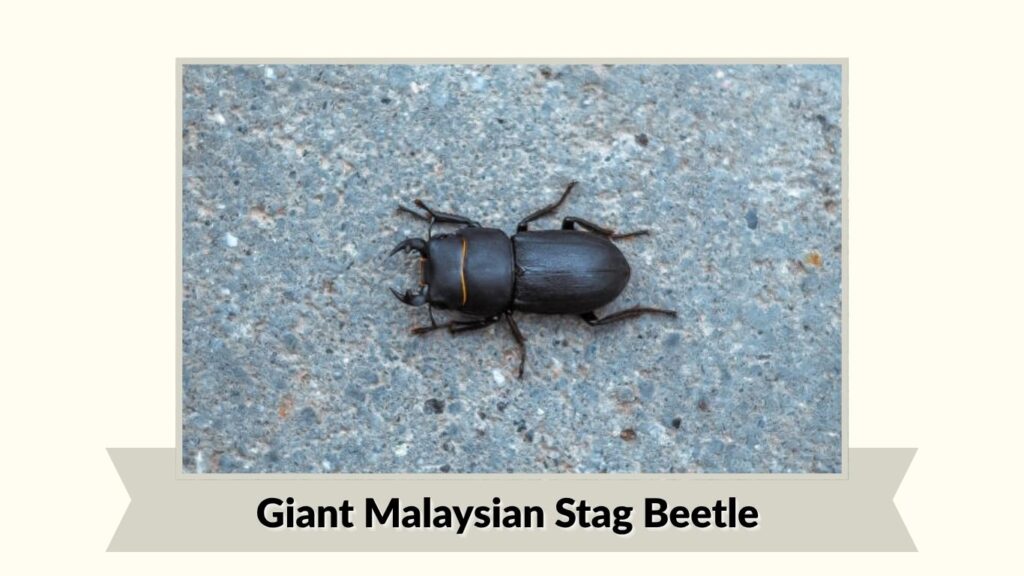
The Giant Malaysian Stag Beetle can be represented by the Fighting Giant Stag Beetle (Hexarthrius parryi), a spectacular Asian lucanid with multiple forms occurring in Malaysia. Males have exceptionally long, strongly curved mandibles, while some forms also display conspicuous yellow-orange areas on their wing covers. Malaysian subspecies include H. p. deyrollei and H. p. elongatus.
Identification
- Size: Males commonly reach roughly 40–90 mm, depending on subspecies and individual development.
- Color: Mainly black to dark brown.
- Mandibles: Extremely long, curved, and forked near their tips.
- Wing Covers: Some forms have large yellow or orange patches.
- Head: Broad and strongly developed in males.
- Females: Usually around 40–54 mm with much shorter jaws.
- Body: Elongated and strongly built.
Habitat and Distribution
The species occurs across parts of South and Southeast Asia. Malaysian populations are represented by several geographic forms, including populations in Peninsular Malaysia and Borneo. These beetles inhabit tropical forests where fallen trees, decomposing hardwood, tree sap, and warm humid conditions provide the resources needed by adults and larvae.
Behavior and Diet
The name “fighting giant stag beetle” reflects the behavior of the males. When two males meet around feeding or mating sites, they may use their long mandibles to grip, lift, and displace one another. Adults consume sugary resources such as tree sap and ripe fruit. Despite the threatening appearance of their jaws, the spectacular mandibles are primarily specialized for competition.
Lifespan and Life Cycle
Females place eggs in decomposing wood, sometimes preparing tunnels before laying. Larvae hatch and feed on rotten timber while passing through their growth stages. Available life-cycle accounts indicate that pupation may follow several months of larval development, while adults can survive for several additional months. Developmental timing varies with temperature, food quality, and geographic form.
20. North American Stag Beetle
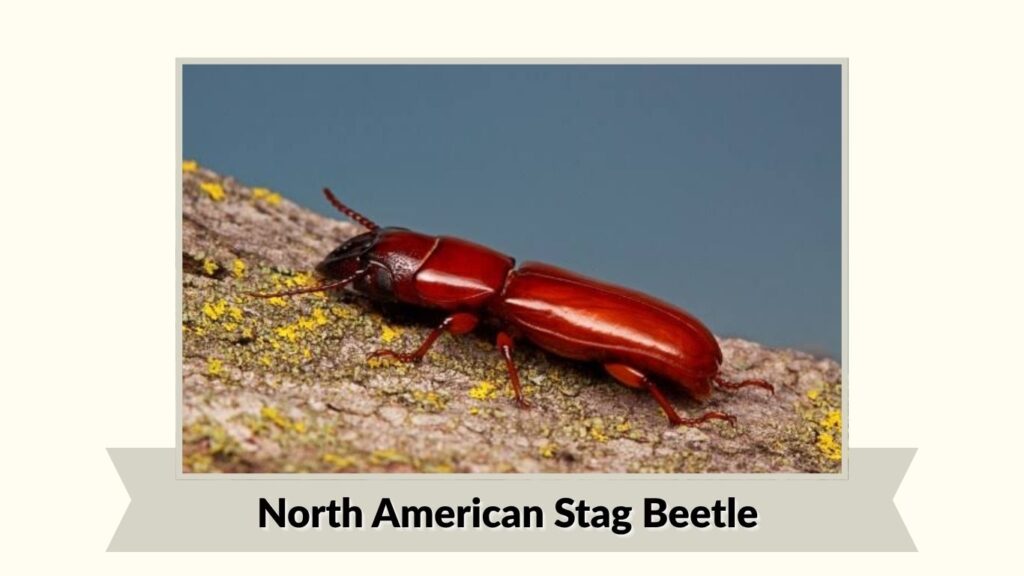
For this entry, the North American Stag Beetle refers to the Smooth Stag Beetle (Lucanus placidus), giving the list a distinct North American species rather than repeating the Giant Stag Beetle or Reddish-Brown Stag Beetle. It is a relatively large brown stag beetle found particularly in central and eastern portions of North America and is often associated with sandy woodland habitats.
Identification
- Size: Approximately 19–32 mm long.
- Color: Reddish-brown to dark brown.
- Body: Smooth, broad, and somewhat elongated.
- Mandibles: Enlarged in males with several small teeth along the inner edges.
- Females: Have noticeably shorter mandibles.
- Legs: Strong and dark-colored.
- Antennae: End in the characteristic stag-beetle club.
Habitat and Distribution
Smooth stag beetles occur in the United States and southern Canada. They are particularly associated with sandy ground in or near woodland, where dead roots, decomposing stumps, and fallen logs provide suitable larval habitat. Adults may also appear in yards and gardens where old stumps remain. They are frequently attracted to artificial lights during warm nights.
Behavior and Diet
Adults become active around dusk and during the early evening. Males may fight one another using their mandibles, sometimes even on open lawns. Adults have been reported feeding on tree sap and flower nectar, while larvae obtain nutrition from decomposing roots, stumps, and other woody material below or near the soil surface. Their wood-recycling activity makes them beneficial components of woodland ecosystems.
Lifespan and Life Cycle
Eggs are deposited near suitable underground or decaying woody material. Larvae spend the long immature portion of their lives feeding on dead plant material before pupating. Adults are seasonal and comparatively short-lived; observations indicate that they may survive only a few weeks. Adult activity is particularly noticeable during late spring and early summer.
FAQs
1. What is the largest type of stag beetle?
Some tropical Asian stag beetles can exceed 10 cm when their mandibles are included. Species such as the Giraffe Stag Beetle and very large Dorcus and Hexarthrius species rank among the biggest members of the family.
2. Do stag beetles bite humans?
Stag beetles are not aggressive toward humans. Females and some males can pinch if handled carelessly, but their jaws are primarily used for defense, feeding-related activities, or competition with other beetles. They are not venomous.
3. Why do male stag beetles have such large mandibles?
Male stag beetles mainly use enlarged mandibles to compete with other males. They may grip, lift, push, or throw rivals away from feeding sites and females. Larger mandibles can therefore provide an advantage during mating competition.
4. What do stag beetles eat?
Adult diets vary by species but commonly include tree sap, flower nectar, juices from ripe fruit, and other sugary liquids. Most stag beetle larvae feed in or around decaying wood, where fungi and microorganisms help break the timber down into usable material.
5. How long does a stag beetle live?
Lifespan varies considerably among species. Larvae often live for one to several years, and this is usually the longest stage of the life cycle. Adults of some species survive only weeks or months, while certain Dorcus stag beetles can live considerably longer under favorable conditions.