Jewel beetles are among the most striking members of the beetle world, known for their metallic green, blue, bronze, copper, and gold coloration. Belonging to the family Buprestidae, these beetles vary widely in size, habitat, host plants, and behavior. Some species are harmless forest insects, while others can seriously damage trees during their larval stage. This guide covers 20 types of jewel beetles, including their identification, habitat and distribution, behavior and diet, and lifespan and life cycle.
1. Emerald Ash Borer
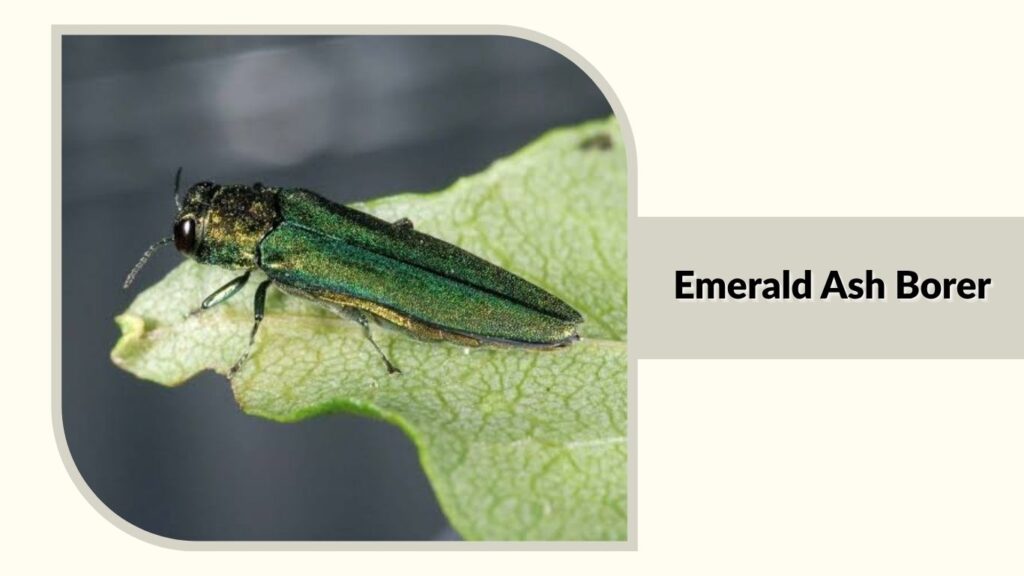
The Emerald Ash Borer is one of the best-known jewel beetles because of its brilliant metallic-green body and destructive relationship with ash trees. Scientifically known as Agrilus planipennis, it belongs to the family Buprestidae. Native to Asia, this beetle has become a serious invasive forest pest in North America, where its larvae feed beneath ash-tree bark and can eventually kill otherwise healthy trees.
Identification
- Common Name: Emerald Ash Borer
- Scientific Name: Agrilus planipennis
- Family: Buprestidae
- Adult Size: About 8–14 mm long
- Color: Bright metallic emerald green
- Body Shape: Narrow, elongated, and slightly flattened
- Abdomen: Coppery-red or purplish beneath the wings
- Larva: Cream-colored, flattened, and segmented
- Exit Hole: Distinctive D-shaped opening in ash bark
The metallic coloration makes adults attractive and relatively distinctive, although several native green beetles can look similar at first glance.
Habitat and Distribution
Emerald Ash Borers are naturally associated with ash trees in parts of Asia. In North America, they were first detected near Detroit, Michigan, in 2002 and have since spread widely through areas containing suitable ash species.
They occur in forests, parks, neighborhoods, roadsides, and other places where ash trees grow. Human movement of infested firewood, logs, and nursery material has contributed to long-distance spread beyond the beetle’s natural flying range.
Behavior and Diet
Adult Emerald Ash Borers are most active during warm, sunny daytime conditions. They spend much of their short adult lives in ash-tree canopies, where they feed on leaves.
The larvae cause serious damage. After hatching, they tunnel beneath the bark and feed on phloem and outer sapwood. Their winding, S-shaped galleries interfere with the tree’s movement of water and nutrients. Heavy infestations eventually cause canopy dieback and tree death.
Lifespan and Life Cycle
The Emerald Ash Borer passes through four stages: egg, larva, pupa, and adult. Females lay eggs in bark cracks and crevices. The eggs usually hatch within several weeks, after which larvae tunnel beneath the bark and pass through four larval stages.
Larvae commonly overwinter beneath the bark before pupating. Adults emerge through characteristic D-shaped holes during spring and summer. The complete life cycle generally takes one or two years, depending on temperature, location, tree condition, and other environmental factors. Adult beetles themselves usually survive for only a few weeks.
2. Goldspotted Oak Borer
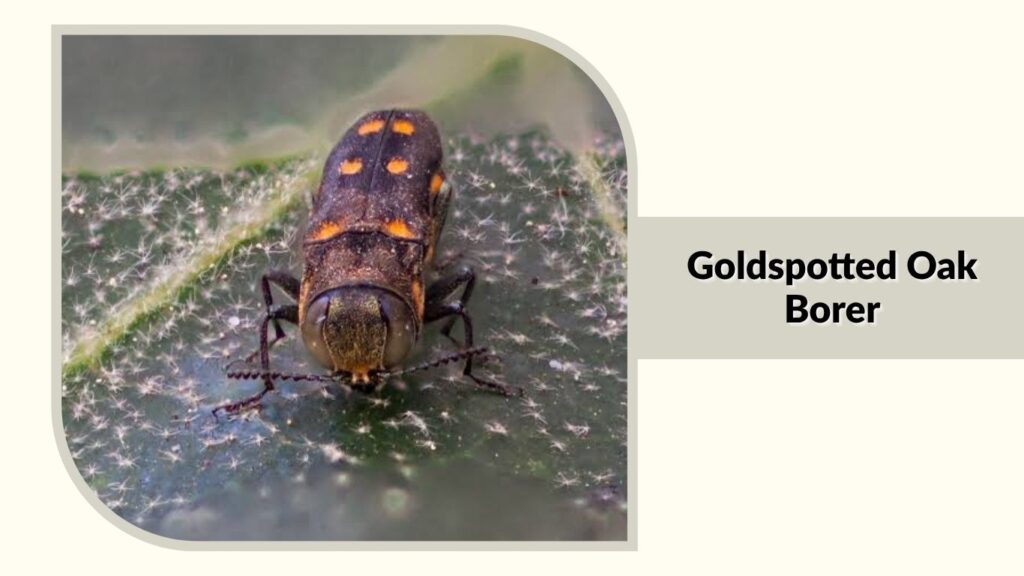
The Goldspotted Oak Borer (Agrilus auroguttatus) is a distinctive jewel beetle named for the golden-yellow spots on its dark wing covers. Native to southeastern Arizona and northern Mexico, it became an important invasive pest in Southern California after being transported outside its native range. Its larvae tunnel beneath oak bark, disrupting tissues responsible for moving nutrients and water through the tree.
Identification
- Common Name: Goldspotted Oak Borer
- Scientific Name: Agrilus auroguttatus
- Family: Buprestidae
- Body Shape: Narrow, elongated, and slightly flattened
- Color: Dark metallic green to black
- Markings: Six prominent golden-yellow spots on the wing covers
- Larva: White, flattened, legless flatheaded borer
- Exit Hole: D-shaped
- Primary Hosts: Oak trees
The combination of a dark body and conspicuous golden spots makes adults relatively distinctive among North American Agrilus species.
Habitat and Distribution
The species is native to oak woodlands of southeastern Arizona and northern Mexico. It was introduced into Southern California, probably through movement of infested oak firewood.
In California, it is particularly damaging to coast live oak and California black oak, with canyon live oak also susceptible. Mature red oaks are generally at greater risk than small trees.
Behavior and Diet
Adults feed on oak foliage after emerging, but this feeding causes relatively little damage. The destructive stage is the larva.
Young larvae tunnel through bark and feed in phloem and outer xylem. Repeated feeding can disrupt the tree’s vascular system, leading to bark staining, canopy thinning, branch dieback, and eventually tree death in serious infestations.
Lifespan and Life Cycle
The Goldspotted Oak Borer generally has one generation per year. Females lay eggs on oak bark from summer into early fall. Eggs hatch in about two weeks, and larvae enter the tree.
Larvae develop through four stages before forming pupal cells near the bark surface. Adults emerge mainly from late spring through summer. Adults usually survive for several weeks, though laboratory individuals have lived for up to about two months.
3. Bronze Birch Borer
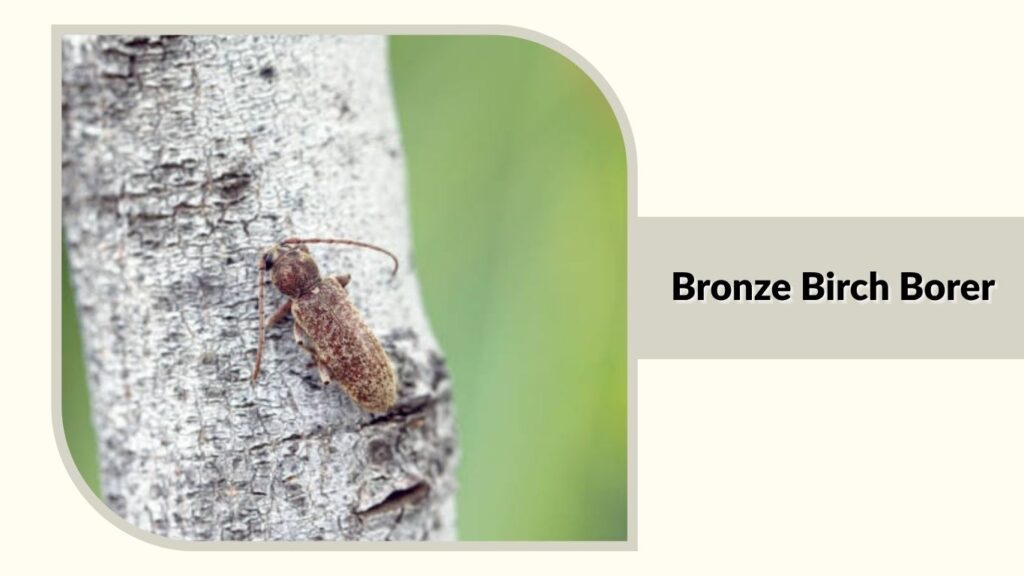
The Bronze Birch Borer (Agrilus anxius) is a native North American jewel beetle specialized for feeding on birch trees. Adults have an attractive olive-bronze metallic appearance, but their larvae can seriously weaken stressed birches. The beetle is especially problematic on drought-stressed, aging, or introduced birch species growing under unfavorable landscape conditions.
Identification
- Common Name: Bronze Birch Borer
- Scientific Name: Agrilus anxius
- Family: Buprestidae
- Adult Size: About 6–12 mm
- Color: Olive, coppery, or bronze
- Body: Slender and elongated
- Larva: Pale, legless, and flattened behind the head
- Exit Hole: D-shaped
- Host: Birch trees
Infested trees can also develop raised ridges over larval galleries and S-shaped tunnels beneath the bark.
Habitat and Distribution
Bronze Birch Borers occur throughout temperate and boreal portions of North America where birch trees grow. Native birches can be attacked, particularly when weakened, while some introduced white-barked birches are especially susceptible.
Urban landscapes can create ideal conditions for infestation when birches experience drought, root stress, high soil temperatures, or unsuitable planting conditions.
Behavior and Diet
Adults spend much of their time in the upper canopy and briefly feed on birch leaves. Adult feeding usually causes little significant harm.
Larvae are responsible for serious injury. They tunnel beneath the bark through phloem and xylem tissues, disrupting water and nutrient movement. Damage often begins with thinning and dieback in the upper crown before progressing downward.
Lifespan and Life Cycle
In warmer parts of its range, the Bronze Birch Borer normally completes one generation each year. Development may require two years in colder regions or vigorous trees.
Adults emerge between May and July, mate, and deposit eggs in bark crevices. Larvae feed beneath the bark through summer before forming pupal cells. They overwinter in the tree and pupate before the next adult emergence period.
4. Twolined Chestnut Borer
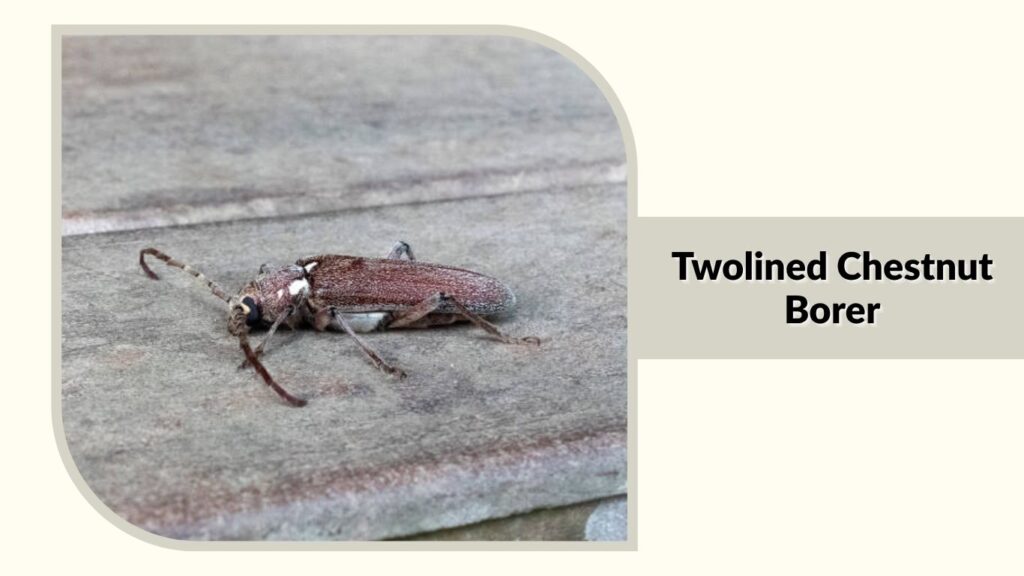
The Twolined Chestnut Borer (Agrilus bilineatus) is a native North American jewel beetle that primarily attacks stressed oaks and historically used American chestnut as an important host. Adults are dark beetles distinguished by two pale longitudinal stripes. Infestations frequently become serious after drought, defoliation, or other stresses have reduced a tree’s natural defenses.
Identification
- Common Name: Twolined Chestnut Borer
- Scientific Name: Agrilus bilineatus
- Family: Buprestidae
- Adult Size: About 5–13 mm
- Color: Black to bluish or greenish black
- Markings: Two pale yellowish stripes along the back
- Larva: White, flattened, and legless
- Larval Size: Up to about 25 mm
- Exit Hole: D-shaped
Its pair of longitudinal lines makes the adult easier to recognize than many plain-colored Agrilus species.
Habitat and Distribution
The Twolined Chestnut Borer occurs across southern Canada and much of the eastern United States, extending westward into portions of the Great Plains.
Today, various oak species are its principal hosts. White oak, red oak, bur oak, black oak, and several other species may be attacked, particularly when trees have experienced drought, repeated defoliation, root disturbance, or other stress.
Behavior and Diet
Adults feed on host foliage after emerging but cause relatively minor damage. Females select weakened trees and deposit eggs in bark cracks.
After hatching, larvae tunnel into phloem and create winding galleries filled with frass. These galleries interfere with water and nutrient movement. Heavy attacks may cause progressive crown dieback and eventually kill severely stressed trees.
Lifespan and Life Cycle
Adults commonly emerge from early summer through July and live about two to five weeks. During this period they feed, mate, and lay eggs.
Larvae develop beneath the bark and usually overwinter there before pupating. Most complete their development within one year, although the life cycle can extend to two years in colder climates or where food resources are limited.
5. Flatheaded Appletree Borer
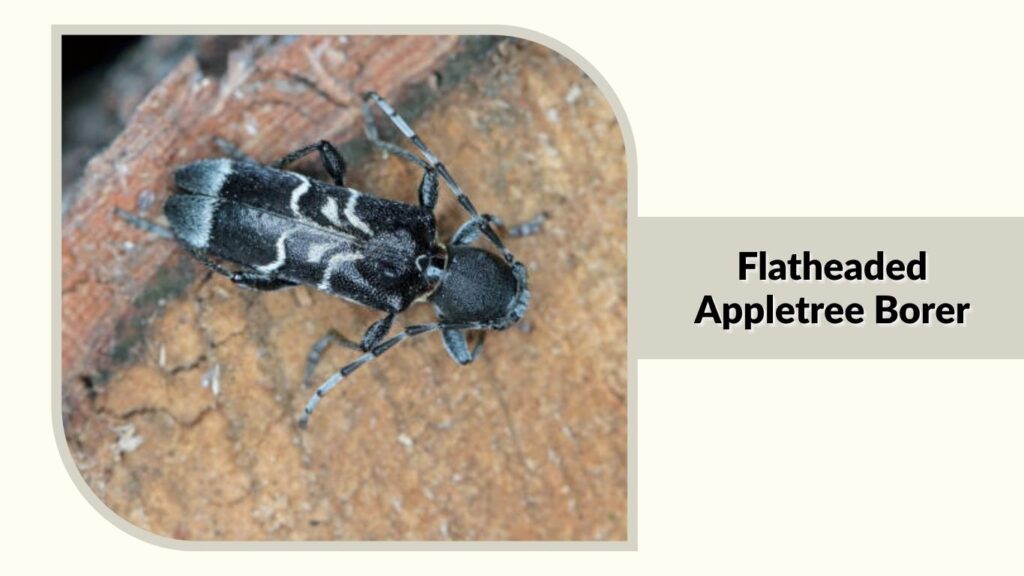
The Flatheaded Appletree Borer (Chrysobothris femorata) is a widespread North American jewel beetle with an exceptionally broad range of host trees. Despite its name, it is not restricted to apple trees. Larvae can attack fruit, nut, shade, ornamental, and forest trees, particularly young or stressed specimens. Severe tunneling may girdle newly planted trees and cause their death.
Identification
- Common Name: Flatheaded Appletree Borer
- Scientific Name: Chrysobothris femorata
- Family: Buprestidae
- Adult Size: Around 11–13 mm on average
- Color: Metallic greenish-bronze
- Body Shape: Flattened and wedge-shaped
- Wing Covers: Pale, irregular zigzag markings
- Larva: Cream-colored and legless
- Larval Feature: Broad flattened segment behind the head
- Exit Hole: D-shaped or oval
Its broad, flattened larval thorax gives this group its familiar “flatheaded borer” name.
Habitat and Distribution
The species occurs throughout much of the United States and Canada. It inhabits orchards, nurseries, forests, landscapes, and other places containing suitable hardwood hosts.
Hosts include apple, pear, maple, elm, walnut, hickory, poplar, sycamore, and numerous other woody plants. Recently transplanted, drought-stressed, sunburned, or mechanically injured trees are particularly vulnerable.
Behavior and Diet
Adults are sun-loving beetles that may feed on tender bark and leaf margins. Females usually choose bark cracks, wounds, or sun-exposed areas for egg laying.
Larvae tunnel through cambium, phloem, and outer sapwood. Their galleries may girdle young trunks, producing cracked bark, wet-looking areas, sap flow, or frass beneath damaged bark.
Lifespan and Life Cycle
Flatheaded Appletree Borers normally produce one generation per year. Adults emerge during spring and summer, mate, and lay eggs in bark crevices.
Eggs hatch after roughly two to three weeks. Larvae immediately bore into the tree and feed beneath the bark for several months. Mature larvae overwinter in sapwood or heartwood, pupate in spring, and later emerge as adults. Under some conditions, larval development can take longer than one year.
6. Pacific Flatheaded Borer
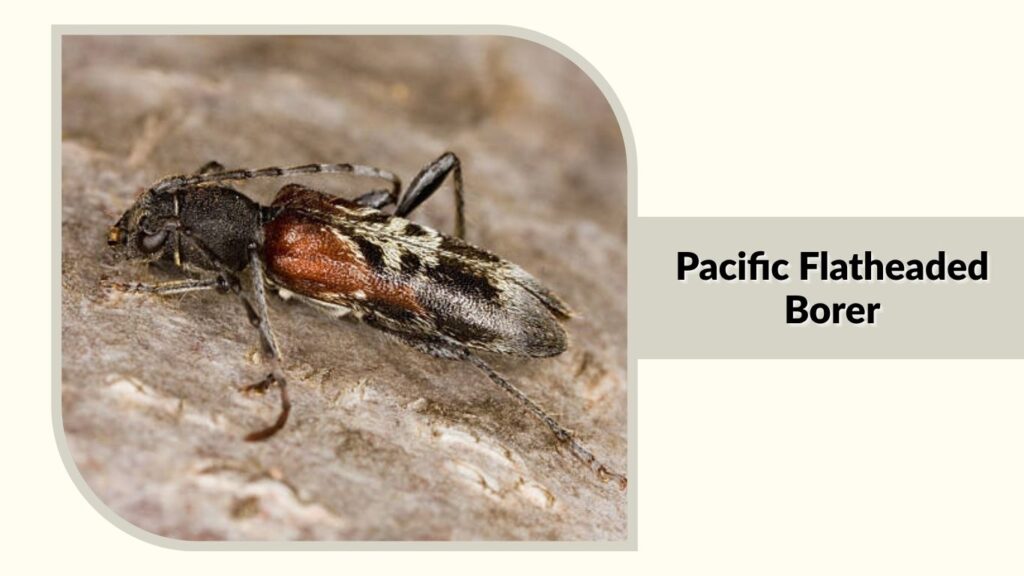
The Pacific Flatheaded Borer (Chrysobothris mali) is a native western North American jewel beetle and an important pest of orchards and nursery trees. Adults have dark bronze bodies marked with copper-colored spots. Larvae attack a wide variety of woody plants, especially young, recently planted, sunburned, drought-stressed, or mechanically injured trees.
Identification
- Common Name: Pacific Flatheaded Borer
- Scientific Name: Chrysobothris mali
- Family: Buprestidae
- Adult Size: Around 8–10 mm on average
- Color: Dark bronze to reddish-brown
- Markings: Copper-colored spots on the wing covers
- Body Shape: Flattened and wedge-shaped
- Larva: Whitish to pale yellow
- Larval Feature: Broad flattened area behind the head
- Primary Sign: Frass-filled galleries beneath bark
Adults are typically smaller than Flatheaded Appletree Borers, though their size ranges overlap enough that size alone is not reliable for identification.
Habitat and Distribution
Pacific Flatheaded Borers occur primarily west of the Rocky Mountains. They are important pests in the Pacific Northwest and other western regions where orchards and commercial nurseries provide abundant host plants.
The species attacks many deciduous trees and shrubs, including fruit trees. Young and newly planted trees are particularly susceptible, especially after drought, sunburn, pruning, or other injuries.
Behavior and Diet
Adults are active, sun-loving beetles that fly during warm conditions and may feed on tender bark and leaf margins.
Females prefer sun-exposed or damaged sections of bark for egg laying. After hatching, larvae immediately tunnel into the cambium. A single larva may sometimes girdle a small tree by destroying tissues responsible for transporting water and nutrients.
Lifespan and Life Cycle
The Pacific Flatheaded Borer generally has one generation per year, although some larvae may require longer to mature.
Adults usually emerge from late spring through summer. Eggs hatch within several weeks, and larvae feed beneath the bark through the growing season. In fall, mature larvae move deeper into the wood and construct overwintering chambers. Pupation occurs the following spring before new adults emerge.
7. Flatheaded Alder Borer
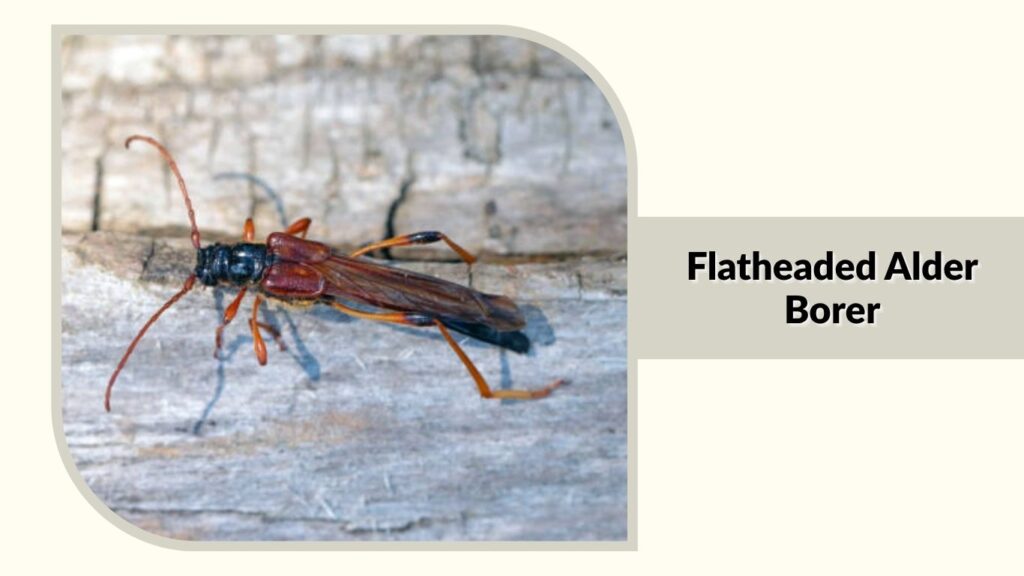
The Flatheaded Alder Borer (Agrilus burkei) is a metallic jewel beetle specialized on alder trees. Adults are small, dark blue-green beetles, while the pale larvae live beneath bark and can damage the tree’s cambium. White alder is particularly susceptible when drought-stressed or declining. Unlike some broadly feeding flatheaded borers, this species is strongly associated with alders.
Identification
- Common Name: Flatheaded Alder Borer
- Scientific Name: Agrilus burkei
- Family: Buprestidae
- Adult Size: About 6–10 mm long
- Color: Shiny metallic blue to green
- Body Shape: Narrow and elongated
- Larva: Pale yellow to whitish and legless
- Larval Size: Up to about 20–25 mm
- Primary Host: Alder trees
- Exit Holes: Small openings left after adult emergence
Adults are widest around the middle of the abdomen and taper toward the rear, giving them the streamlined appearance typical of many Agrilus species.
Habitat and Distribution
Flatheaded Alder Borers occur where suitable alder hosts grow, particularly in western North America. White alder is an important host, especially in landscapes where trees experience drought stress, root damage, or declining health.
The beetles usually concentrate on stressed trees rather than vigorous alders. Larval activity may be indicated by wet-looking bark, dark staining, or irregular growth around damaged areas.
Behavior and Diet
Adults emerge during spring and feed lightly along the outer edges of alder leaves. This feeding is generally minor and rarely causes noticeable damage.
The larvae are much more important. After hatching, they tunnel beneath the bark and feed on cambium and phloem. Heavy feeding can disrupt the movement of water and nutrients, causing branch dieback or further decline in already stressed trees.
Lifespan and Life Cycle
Adults typically emerge from late March through May and may live for around two weeks. Females lay small groups of eggs on the lower trunk or major branches.
After hatching, larvae enter the bark and spend their developmental period feeding internally. They later pupate beneath the bark before emerging as metallic adults and beginning another generation.
8. Oak Twig Girdler
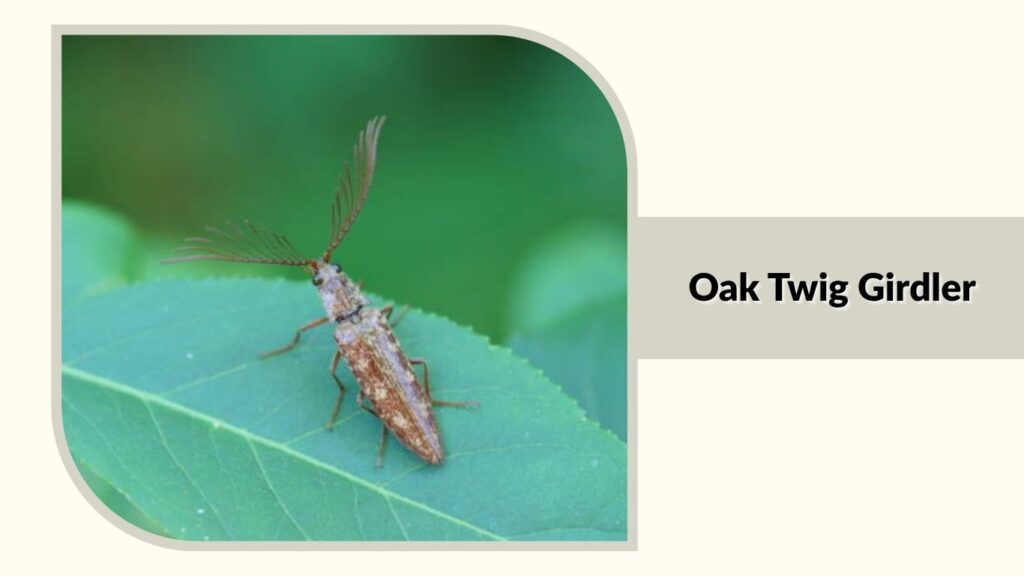
The Oak Twig Girdler (Agrilus angelicus) is a small North American jewel beetle whose larvae tunnel beneath the bark of oak twigs. The tunneling gradually circles or “girdles” the twig, cutting off its supply of water and causing leaves beyond the damaged area to turn brown and die. Coast live oak is an especially common host in California.
Identification
- Common Name: Oak Twig Girdler
- Scientific Name: Agrilus angelicus
- Family: Buprestidae
- Adult Size: About 6 mm long
- Color: Dark coppery brown
- Body Shape: Slender and elongated
- Eggs: Narrow, whitish, and small
- Larvae: White to pale yellow
- Larval Mouthparts: Brown
- Typical Damage: Dead leafy twigs scattered through an oak canopy
The most useful identification clue is often not the adult beetle but the spiral-shaped gallery hidden beneath the bark where living and dead portions of a twig meet.
Habitat and Distribution
Oak Twig Girdlers are widespread in California and have also been reported elsewhere in western and central North America.
Hosts include coast live oak, canyon live oak, interior live oak, California black oak, Engelmann oak, and valley oak. Coast live oak in Southern California may experience particularly noticeable infestations.
Behavior and Diet
Adult beetles spend their active period around host trees. Females lay eggs on suitable oak twigs, allowing newly hatched larvae to enter the bark quickly.
Larvae tunnel beneath the bark in winding galleries. As the tunnel spirals around a twig, it effectively girdles it. The tissue beyond the damaged point dies, leaving clusters of dry brown leaves attached to the tree.
Lifespan and Life Cycle
Eggs hatch into flatheaded larvae that spend the main developmental portion of their lives concealed beneath oak bark.
The larva continues feeding until mature, eventually forming a pupal chamber within the host. After pupation, the adult emerges to mate and lay eggs. Because immature stages remain hidden, visible twig dieback is often the first indication that the beetle is present.
9. Western Cedar Borer
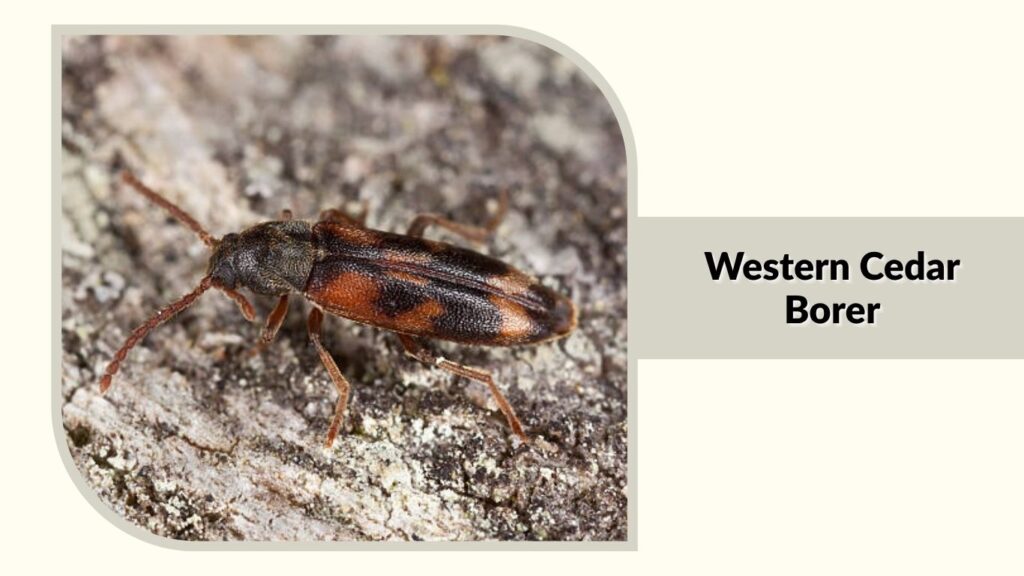
The Western Cedar Borer (Trachykele blondeli) is a colorful jewel beetle associated primarily with western redcedar and related conifers. Its larvae can tunnel deeply into sapwood and heartwood, sometimes lowering the commercial quality of timber even when the tree survives. Adults have an attractive emerald-green and golden appearance that makes them especially representative of the “jewel beetle” name.
Identification
- Common Name: Western Cedar Borer
- Scientific Name: Trachykele blondeli
- Family: Buprestidae
- Adult Size: About 11–17 mm
- Color: Bright emerald green with a golden sheen
- Markings: Several darker spots
- Body Shape: Elongated and somewhat flattened
- Larva: Pale, wood-boring flatheaded larva
- Primary Host: Western redcedar
- Other Hosts: Junipers and some cypress species
The brilliant metallic body contrasts strongly with the duller brown coloration found in many other wood-boring beetles.
Habitat and Distribution
The Western Cedar Borer occurs in western North America wherever appropriate cedar and juniper hosts are present.
Western redcedar is its principal host, but western juniper, Monterey cypress, Sargent cypress, and related trees can also support development. Larval injury is often concentrated in heartwood, particularly in the upper trunk.
Behavior and Diet
Adults emerge during spring and search for host trees on which to mate and lay eggs. Females typically place eggs beneath bark scales or in protected crevices.
After hatching, larvae bore from branches toward the main trunk. Their galleries may extend into sapwood and heartwood. Although feeding does not always kill the tree, tunneling can reduce the value of lumber by creating defects inside otherwise usable wood.
Lifespan and Life Cycle
Development is relatively slow compared with many smaller Agrilus species. Larvae may spend two or more years tunneling inside cedar wood.
Historical studies indicate that development can require at least three years in some conditions. Mature larvae pupate within the wood, transform into adults, overwinter in their chambers, and emerge during the following spring.
10. Rose Stem Girdler
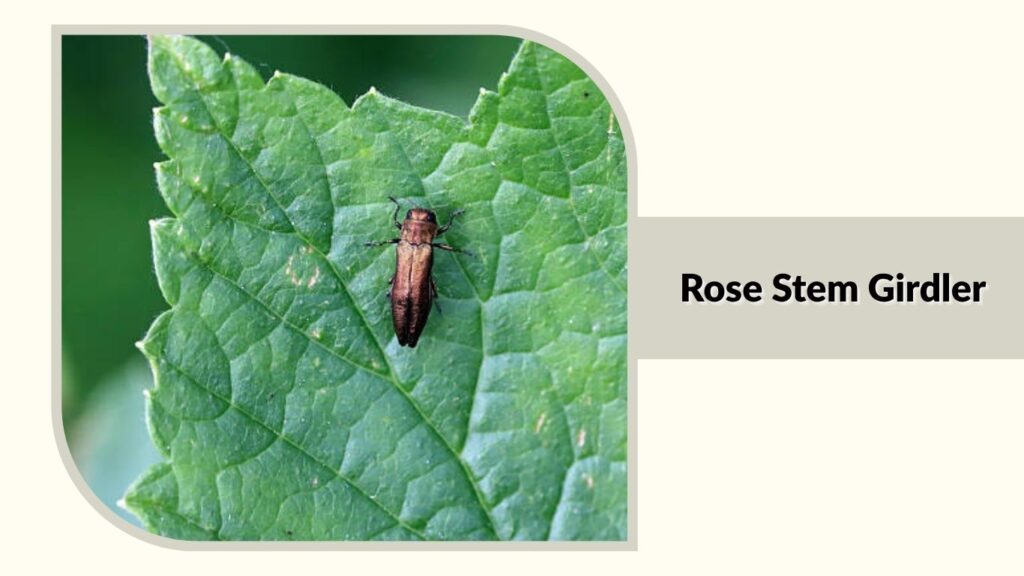
The Rose Stem Girdler (Agrilus cuprescens) is a small metallic-copper jewel beetle whose larvae damage roses, raspberries, blackberries, and related plants. It is native to parts of Europe and Asia but has become established in North America. Larval tunneling can spiral around canes, weaken stems, cause swelling, and occasionally make fruiting canes break at the damaged point.
Identification
- Common Name: Rose Stem Girdler
- Scientific Name: Agrilus cuprescens
- Family: Buprestidae
- Adult Color: Metallic copper to bronze
- Body Shape: Narrow and elongated
- Size: Small compared with many jewel beetles
- Larva: Cream-colored and flattened
- Primary Hosts: Roses and caneberries
- Common Damage: Swollen, weakened, or girdled canes
- Larval Gallery: Often spirals around the stem
Adult feeding may create small irregular areas along the margins of leaves, but larval tunneling produces the most serious symptoms.
Habitat and Distribution
Rose Stem Girdlers occur in areas containing roses, raspberries, blackberries, and related plants. In North America, the beetle has been established for many decades and has been recorded in western and eastern regions.
It can occur in gardens, commercial berry fields, nurseries, and wild areas containing suitable host plants.
Behavior and Diet
Adults feed on host foliage before mating. Females then lay eggs on suitable stems or canes.
After hatching, larvae enter the cane and begin feeding beneath the bark. Their galleries may spiral around the stem and interfere with nutrient movement. Damaged canes can become enlarged, wilt above the feeding site, or snap where extensive girdling has weakened the tissue.
Lifespan and Life Cycle
The species generally produces one generation per year in temperate regions. Eggs hatch during the growing season, and larvae develop inside host stems.
Later-stage larvae overwinter inside the cane, often within the pith or surrounding tissues. Development resumes as temperatures rise, followed by pupation and adult emergence. This hidden larval stage is responsible for most of the plant damage.
11. Bronze Poplar Borer
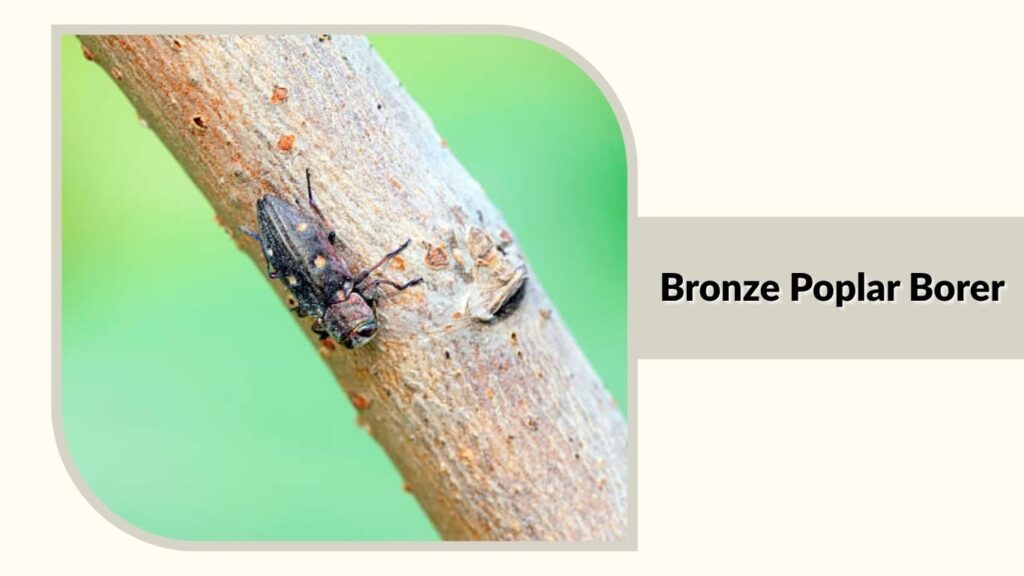
The Bronze Poplar Borer (Agrilus liragus) is a North American jewel beetle specialized on trees in the genus Populus, including poplars, aspens, and cottonwoods. Adults are small and dark with a metallic greenish or bronze tint. Larvae tunnel beneath bark, where heavy feeding can disrupt the tree’s cambium and contribute to dieback, particularly when host trees are already weakened.
Identification
- Common Name: Bronze Poplar Borer
- Scientific Name: Agrilus liragus
- Family: Buprestidae
- Adult Size: About 7–12 mm
- Color: Dark with metallic green or bronze tones
- Body Shape: Slender and elongated
- Larva: Whitish and narrow
- Larval Length: Can exceed the adult’s length
- Hosts: Poplars, aspens, and cottonwoods
- Exit Hole: Typically D-shaped
Adults can resemble the Bronze Birch Borer, but host plant association provides an important clue because Bronze Poplar Borers specialize on Populus species.
Habitat and Distribution
The species has a broad northern North American distribution, extending across Canada and parts of the northern United States.
It occurs wherever suitable poplar hosts grow, including forests, woodland edges, young aspen stands, shelterbelts, and planted landscapes. Trees weakened by defoliation, injury, drought, or previous borer attacks may be particularly vulnerable.
Behavior and Diet
Adults spend their brief above-ground period around host trees, where mating and egg laying occur.
Females deposit eggs in bark crevices. After hatching, larvae enter the cambial region and excavate compact zigzagging galleries beneath the bark. Their feeding damages tissues responsible for water and nutrient movement and can contribute to stem or branch dieback.
Lifespan and Life Cycle
The Bronze Poplar Borer has a relatively long larval development. Larvae commonly feed through two growing seasons before reaching maturity.
After completing larval growth, they pupate beneath the bark or within nearby woody tissues. Adults then emerge, leaving characteristic openings in the bark. Much of the beetle’s total lifespan is therefore spent hidden inside its poplar host rather than in the adult stage.
12. Golden Buprestid
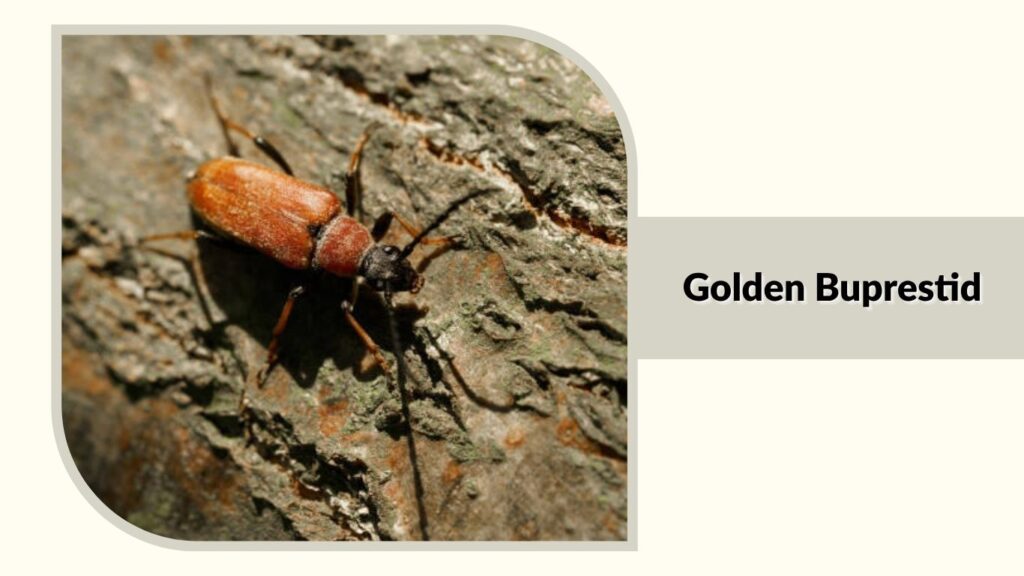
The Golden Buprestid (Buprestis aurulenta) is one of North America’s most striking jewel beetles, displaying brilliant metallic green with coppery, red, or golden margins. It is primarily associated with conifers, particularly Douglas-fir. Although beautiful as an adult, its larvae are remarkable wood borers capable of surviving for unusually long periods when trapped inside dry structural timber.
Identification
- Common Name: Golden Buprestid
- Scientific Name: Buprestis aurulenta
- Family: Buprestidae
- Adult Size: Commonly around 17–21 mm
- Color: Brilliant metallic green
- Markings: Coppery-red to golden margins on the wing covers
- Body Shape: Elongated and slightly flattened
- Larva: Pale, legless flatheaded wood borer
- Exit Hole: Oval
- Main Hosts: Douglas-fir, pine, hemlock, and other conifers
Its intense metallic coloration makes it one of the easiest Buprestis species to recognize.
Habitat and Distribution
Golden Buprestids occur mainly in western North America, from southern British Columbia through the Pacific Northwest and Rocky Mountain regions toward Mexico. They are strongly associated with coniferous forests.
Larvae commonly develop in recently dead, fallen, fire-damaged, or partially seasoned conifer wood. Infested timber can occasionally be incorporated into houses, flooring, poles, or other wooden structures before development is complete.
Behavior and Diet
Adults feed briefly on Douglas-fir foliage before mating, but this feeding generally causes little significant damage.
Larvae bore deeply into sapwood and heartwood, creating long oval galleries packed with fine frass. Important hosts include Douglas-fir, lodgepole pine, ponderosa pine, western hemlock, and western redcedar.
Lifespan and Life Cycle
Females deposit eggs in bark crevices or cracks in exposed wood. Larvae hatch and immediately begin tunneling.
Under normal forest conditions, development generally takes two to four years. However, larvae trapped in dry structural wood may develop extremely slowly; documented cases show development lasting decades, with some larvae potentially surviving for up to about 60 years. Mature larvae pupate near the wood surface before adults emerge.
13. Green Buprestid
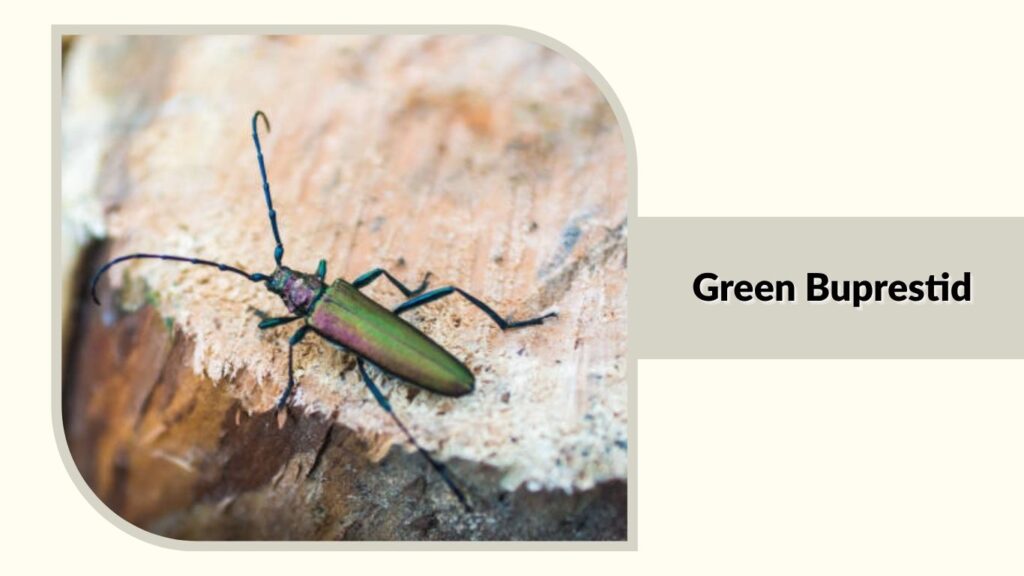
The Green Buprestid (Buprestis langii) is another beautiful metallic wood-boring beetle of western North America. Adults are commonly brilliant green, but some individuals display blue or coppery-bronze coloration. Its biology resembles that of the Golden Buprestid, and both species can develop in Douglas-fir timber and occasionally emerge from structural wood long after trees have been cut.
Identification
- Common Name: Green Buprestid
- Scientific Name: Buprestis langii
- Family: Buprestidae
- Adult Size: Roughly 15–22 mm in documented specimens
- Color: Bright metallic green, blue, or coppery bronze
- Body Shape: Elongated and flattened
- Female Markings: May have 2, 4, or 6 pale spots on the elytra
- Elytral Tips: Two-toothed
- Larva: Flatheaded wood borer
- Primary Host: Douglas-fir
Females can be particularly distinctive when pale spots contrast with their metallic wing covers.
Habitat and Distribution
The Green Buprestid has a broad distribution in northwestern North America. Records extend through western Canada and the western United States, including a documented occurrence as far north as Yukon.
It is especially associated with coniferous forests containing Douglas-fir. Larvae can also persist in cut timber, including poles, piling, siding, and flooring.
Behavior and Diet
Adults are active during warmer weather and are often noticed because of their brilliant metallic coloration.
The larvae bore through Douglas-fir wood, producing flattened galleries typical of buprestid larvae. Damage can resemble that caused by the Golden Buprestid. When infested logs are converted to building materials before larvae have completed development, adults may eventually emerge from finished wood.
Lifespan and Life Cycle
Females lay eggs on suitable conifer wood. After hatching, larvae tunnel beneath the bark and deeper into woody tissue, where most of their development occurs.
Pupation takes place in an oval chamber near the wood surface. Adults then chew their way out, leaving oval emergence holes. Like related timber-inhabiting buprestids, development can become prolonged in dry structural lumber, although exact species-specific maximum development times are not well established.
14. Sculptured Pine Borer
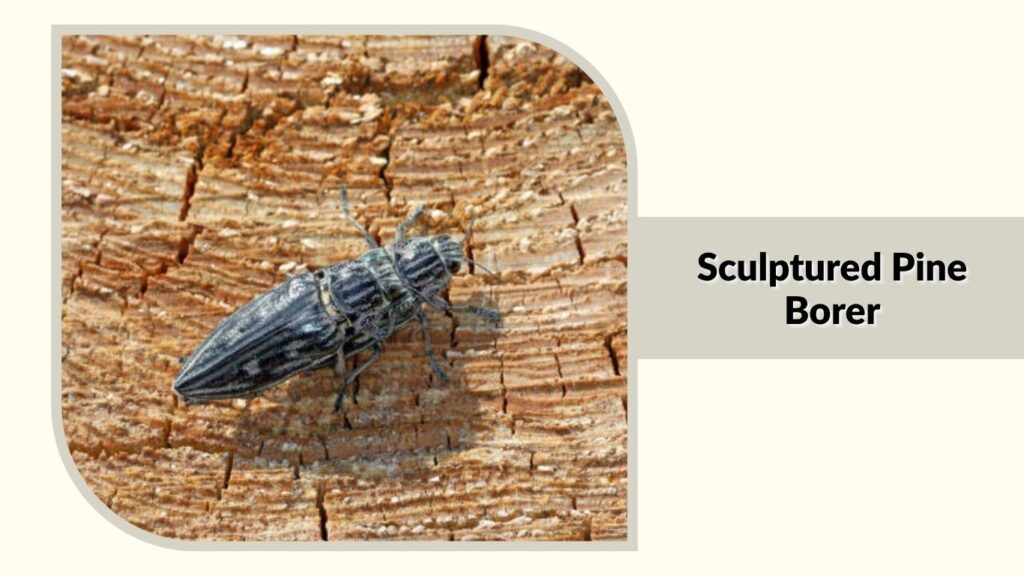
The Sculptured Pine Borer (Chalcophora virginiensis) is one of the largest jewel beetles found in eastern North America. Its rugged, strongly sculptured body has dark copper, bronze, and blackish markings that blend remarkably well with pine bark. Unlike brightly colored jewel beetles, its metallic coloration functions as effective camouflage on dead and dying pine trees.
Identification
- Common Name: Sculptured Pine Borer
- Scientific Name: Chalcophora virginiensis
- Family: Buprestidae
- Adult Size: Often more than 25 mm long
- Color: Dark bronze, coppery brown, and black
- Surface: Deeply ridged and strongly sculptured
- Body Shape: Large, elongated, and flattened
- Larva: Large pale flatheaded wood borer
- Hosts: Primarily pine trees
- Camouflage: Closely resembles rough pine bark
Its large size and heavily textured wing covers distinguish it from smaller, smoother Agrilus jewel beetles.
Habitat and Distribution
The Sculptured Pine Borer is native to forested areas of eastern Canada and the eastern United States.
Recorded hosts include eastern white pine and red pine. Adults are usually encountered around dead, dying, recently damaged, or fallen pine trees where females can find suitable wood for egg laying.
Behavior and Diet
Adults are mainly active during daylight and often remain motionless on pine bark, where their coloration makes them difficult to detect.
Females lay eggs in cracks of dying or recently dead pine. After hatching, larvae bore into trunks and branches and eventually penetrate deeper woody tissues. The larvae, rather than adults, are responsible for most wood feeding.
Lifespan and Life Cycle
Egg development requires roughly two weeks. After hatching, larvae tunnel through pine wood and pass through numerous growth stages.
Larval development generally requires one to three years. Mature larvae form pupal chambers deep inside the tree. Pupation lasts several weeks under favorable temperatures, after which adults develop and eventually emerge from the wood.
15. Turpentine Borer
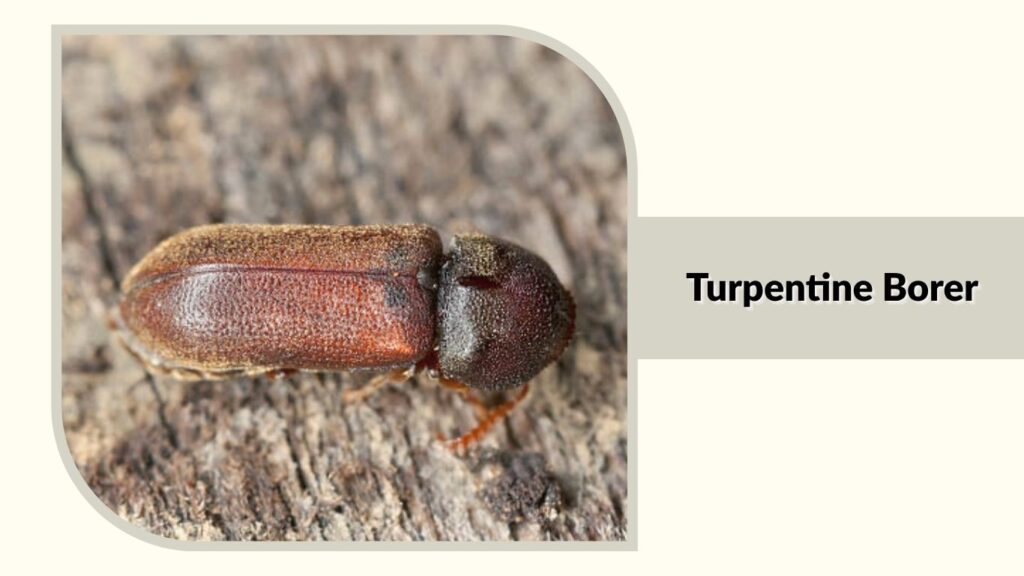
The Turpentine Borer (Buprestis apricans) is a metallic wood-boring beetle historically associated with longleaf pines used for turpentine production. Injured trees provided ideal egg-laying sites, particularly where bark had been removed during resin harvesting. Although its economic importance has declined with changes in turpentine production, it remains a notable North American jewel beetle associated with damaged pine wood.
Identification
- Common Name: Turpentine Borer
- Scientific Name: Buprestis apricans
- Family: Buprestidae
- Body Shape: Elongated and moderately flattened
- Appearance: Metallic buprestid coloration
- Larva: Pale flatheaded wood borer
- Primary Host: Pine
- Favored Trees: Wounded, resin-tapped, burned, or mechanically damaged pines
- Damage Area: Sapwood and resinous heartwood
The species belongs to Buprestis, a genus known for medium-to-large metallic adults and flattened wood-boring larvae.
Habitat and Distribution
The Turpentine Borer occurs in North America and the Caribbean. Historically, it became especially important in southeastern pine forests where longleaf pines were wounded for the naval-stores and turpentine industries.
Today, infestations are more commonly associated with fire scars, damaged trunks, and other wounds.
Behavior and Diet
Females are attracted to exposed, dried, burned, or injured areas of pine trunks and deposit eggs on these damaged surfaces.
Larvae bore into resinous woody tissue and may extend their galleries into solid heartwood. Historically, heavy attacks weakened turpentine-producing trees and could cause trunks to break, while also reducing lumber quality.
Lifespan and Life Cycle
Adults have historically been observed emerging from pine wood during late winter and spring.
Females then select injured pine surfaces for egg laying. Larvae hatch, penetrate the wood, and spend the longest portion of their development tunneling within the trunk before pupating. Detailed modern data on the exact duration of the complete life cycle are limited compared with better-studied jewel beetles.
16. Sinuate Peartree Borer
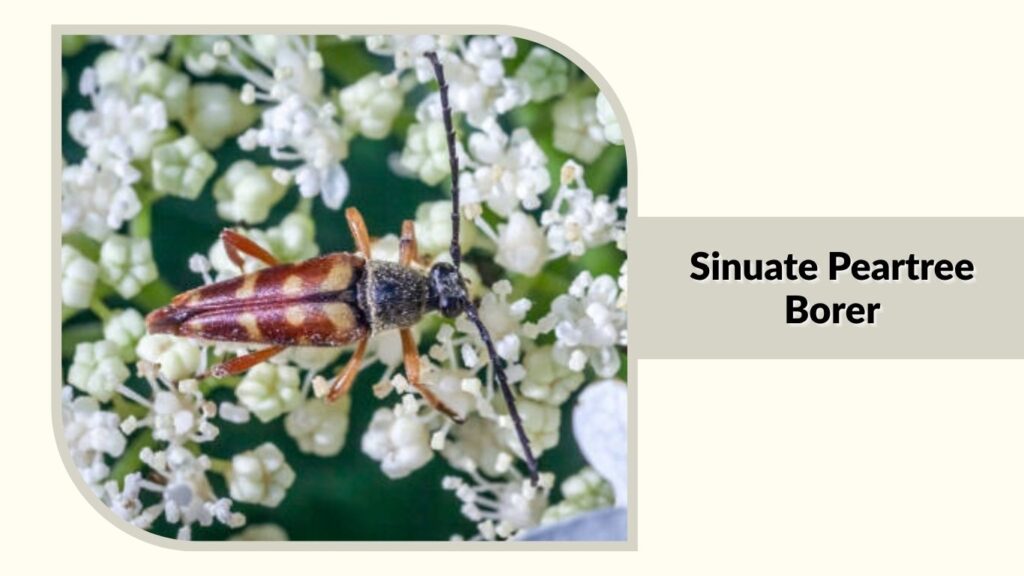
The Sinuate Peartree Borer (Agrilus sinuatus), also called the Sinuate Pear Borer, is a European jewel beetle that became established in North America. Pear is its most important cultivated host, although hawthorn, mountain ash, quince, and related trees may also be attacked. Its larvae create distinctive winding galleries beneath bark that can weaken or kill young trees.
Identification
- Common Name: Sinuate Peartree Borer
- Scientific Name: Agrilus sinuatus
- Family: Buprestidae
- Adult Size: About 12–15 mm
- Color: Dark metallic bronze to burgundy
- Body Shape: Narrow and elongated
- Larva: Pale, flattened, legless borer
- Gallery: Long, winding or sinuous tunnel
- Exit Hole: D-shaped, roughly 3–5 mm wide
- Primary Host: Pear
Its winding larval galleries are among the most characteristic signs of infestation.
Habitat and Distribution
The species is native to Europe but was detected in North America by the late nineteenth century. It has historically been recorded in areas including New Jersey, New York, Ohio, and British Columbia.
Pear orchards and nurseries are particularly vulnerable, although wild and ornamental members of the rose family can also support the beetle.
Behavior and Diet
Adults become active during warm sunny weather and feed on host plant tissues.
Females select sunny areas of trunks and thicker branches for egg laying. Larvae then feed on cambium and outer sapwood, creating long, winding galleries beneath the bark. Severe tunneling can produce canker-like damage and interfere with water and nutrient transport.
Lifespan and Life Cycle
The Sinuate Peartree Borer typically follows a two-year life cycle. Females may lay several dozen eggs on suitable host trees.
Larvae develop beneath the bark over two seasons and can create galleries around 50–60 cm long. By the end of the second autumn, mature larvae construct pupal chambers within the wood. Adults later emerge through characteristic D-shaped exit holes and begin another generation.
17. Hazel Stem Borer
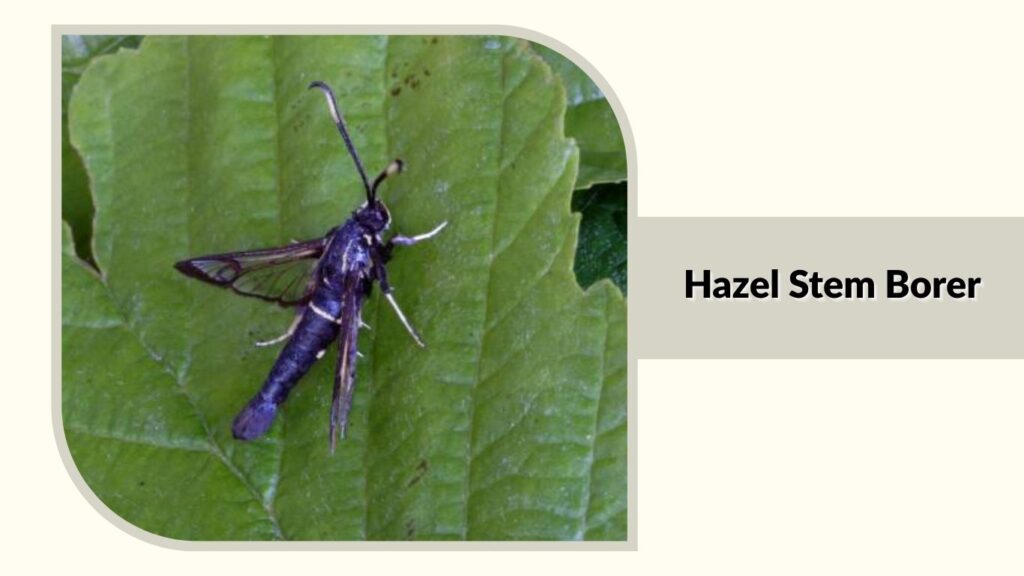
The Hazel Stem Borer (Agrilus pseudocoryli) is a North American jewel beetle associated with hazelnuts and related Corylus plants. Its larvae tunnel beneath the bark of stems, where feeding can cause branch dieback and reduce plant vigor. Research in Minnesota found the species damaging hybrid hazelnuts, particularly plants already affected by environmental stress or disease.
Identification
- Common Name: Hazel Stem Borer
- Scientific Name: Agrilus pseudocoryli
- Family: Buprestidae
- Body Shape: Narrow, elongated, and slightly flattened
- Adult Appearance: Typical metallic Agrilus form
- Larva: Pale, flattened, legless borer
- Primary Hosts: Hazelnuts and filberts
- Damage: Stem dieback and internal galleries
- Adult Activity: Mainly during early to midsummer
Because many Agrilus beetles resemble one another, reliable species identification may require close examination by an entomologist.
Habitat and Distribution
Hazel Stem Borers are native to North America and are associated primarily with areas where wild or cultivated hazels grow.
Recent research documented significant activity in hybrid hazelnut plantings in southeastern Minnesota. In that study, adults were observed from June 8 through July 13. Some plants suffered extensive buprestid-associated stem dieback, and damage tended to be greater on plants showing other forms of stress.
Behavior and Diet
Adult Hazel Stem Borers spend their above-ground period around host plants, where they mate and locate suitable stems for egg laying.
The larvae cause the important damage. After entering the stem, they feed beneath the bark and interfere with the plant’s vascular tissues. Heavy tunneling can weaken or kill portions of a stem. Drought-stressed hazels may be especially vulnerable because stressed plants have reduced ability to resist borer attack.
Lifespan and Life Cycle
The species undergoes complete metamorphosis through egg, larval, pupal, and adult stages.
Most of its development occurs hidden within host stems. Adults emerge during the warm season, reproduce, and begin another generation. Detailed information about the exact duration of each developmental stage remains limited compared with heavily studied invasive jewel beetles.
18. Flatheaded Hackberry Borer
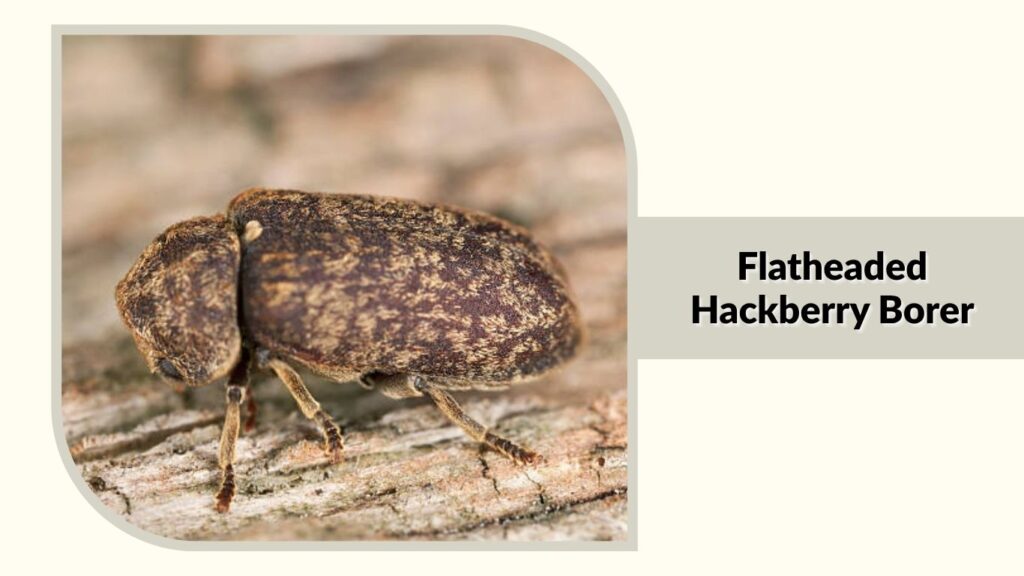
The Flatheaded Hackberry Borer (Agrilus macer) is a native North American jewel beetle associated primarily with hackberry and sugarberry trees. Although it can occur in large numbers on declining trees, research indicates that it generally behaves as a secondary pest rather than attacking healthy trees aggressively. Larval tunneling beneath bark can nevertheless accelerate decline in already weakened hosts.
Identification
- Common Name: Flatheaded Hackberry Borer
- Scientific Name: Agrilus macer
- Family: Buprestidae
- Adult Size: Approximately 8–16 mm
- Color: Metallic dark green, bronze-green, or bluish green
- Body Shape: Slender and bullet-shaped
- Elytra: Noticeable raised ridge
- Larva: Pale, flattened, and legless
- Hosts: Hackberry and sugarberry
- Exit Hole: D-shaped
The raised ridge on each wing cover is a useful characteristic for separating this species from several similar Agrilus beetles.
Habitat and Distribution
Flatheaded Hackberry Borers occur widely across the southern United States, with many historical records from Texas and Louisiana. They have also become conspicuous on declining sugarberry trees in parts of the southeastern United States.
Their principal hosts belong to the genus Celtis, especially sugarberry and common hackberry. Stressed and declining trees are particularly likely to support heavy populations.
Behavior and Diet
Adults are most active during the warmer months, particularly May through July, and may feed on hackberry or sugarberry foliage.
Females deposit clusters averaging about 16 eggs on trunks, branches, and sometimes exposed roots. After hatching, larvae tunnel through phloem, cambium, and outer sapwood. Extensive galleries can interfere with nutrient transport and hasten the decline of weakened trees.
Lifespan and Life Cycle
The life cycle includes egg, larva, pupa, and adult. Adults mate and lay eggs during summer.
Larvae enter the bark soon after hatching and spend the main developmental portion of their lives feeding inside the tree. They eventually pupate and emerge as adults through characteristic D-shaped exit holes. Like many flatheaded borers, the concealed larval stage lasts much longer than the visible adult period.
19. Gambel Oak Borer
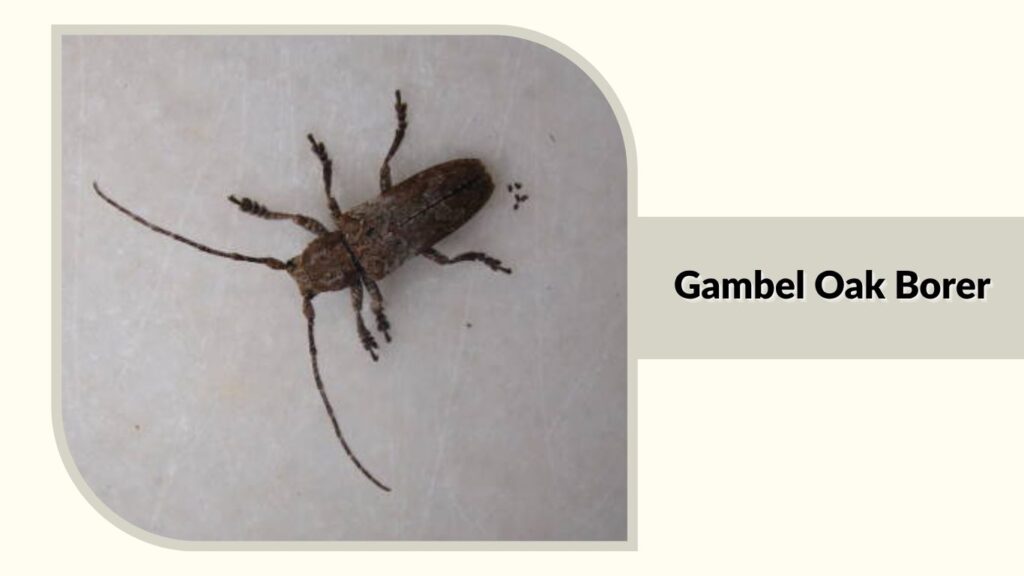
The Gambel Oak Borer (Agrilus quercicola) is a native jewel beetle associated primarily with Gambel oak in western North America. It generally causes little concern in healthy natural oak stands, but populations can increase after drought, freeze damage, transplantation stress, or other conditions that weaken trees. English oak planted in landscapes may also be attacked.
Identification
- Common Name: Gambel Oak Borer
- Scientific Name: Agrilus quercicola
- Family: Buprestidae
- Adult Size: Slightly under 10 mm
- Body Shape: Elongated and oval
- Thorax: Copper or bronze
- Abdomen: Green
- Elytra: Dark to black
- Larva: Pale flatheaded borer
- Exit Hole: D-shaped
- Primary Host: Gambel oak
The coppery or bronze-colored thorax is one of the most useful features for distinguishing this species from similar Colorado Agrilus beetles.
Habitat and Distribution
Gambel Oak Borers occur in western North American oak habitats where Gambel oak grows naturally. They can inhabit mountain foothills, oak woodlands, and urban landscapes.
Gambel oak is the main natural host, but English oak can also suffer infestations. Problems are most likely when trees are recently transplanted, heavily shaded, drought-stressed, frozen, or otherwise weakened.
Behavior and Diet
Adults emerge during late spring and disperse among suitable oak hosts. They feed and mate before females deposit eggs on trees.
Larvae tunnel beneath bark, producing winding galleries that can interrupt water and nutrient transport. Affected branches may develop brown foliage, dieback, thinning crowns, or wet-looking areas of bark. Infestations typically begin in stressed parts of the tree rather than healthy vigorous tissue.
Lifespan and Life Cycle
Larvae spend winter beneath the bark of their host. Adults begin emerging through D-shaped holes around May, with peak flight commonly occurring around mid-June.
After emergence, adults find new hosts, mate, and lay eggs. Newly hatched larvae enter the bark and continue feeding until winter, completing the seasonal cycle. Natural parasitoid wasps can also help keep populations low under normal conditions.
20. Giant Jewel Beetle
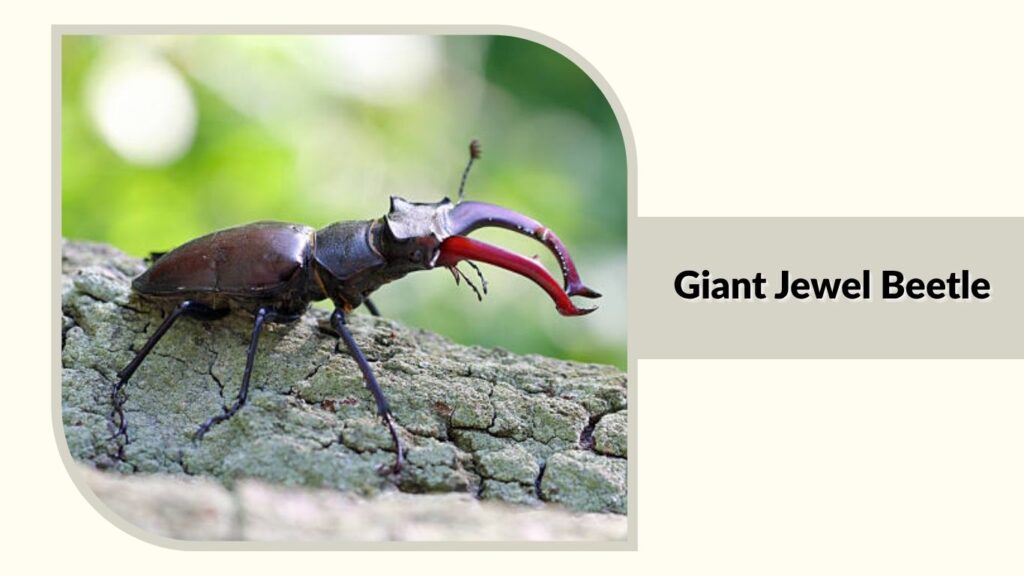
The Giant Jewel Beetle (Julodimorpha saundersii) is a spectacular Australian buprestid and one of the larger members of the jewel beetle family. Unlike many brilliantly green jewel beetles, it has a more subdued golden-brown appearance. The species is endemic to Western Australia and is also famous for the unusual mating behavior of males, which have sometimes mistaken brown glass bottles for oversized females.
Identification
- Common Name: Giant Jewel Beetle
- Scientific Name: Julodimorpha saundersii
- Family: Buprestidae
- Body Size: Large for a jewel beetle
- Color: Golden brown to bronze-brown
- Body Shape: Long, heavy, and robust
- Surface: Strongly textured or punctured
- Female: Larger and essentially flightless
- Male: Smaller and capable of flight
- Larva: Large, soil-dwelling buprestid larva
- Distribution: Western Australia
The Western Australian Museum recognizes J. saundersii as the Giant Jewel Beetle.
Habitat and Distribution
The species is native to Western Australia, where it occurs in dry woodland, shrubland, and other environments suitable for its underground immature stages.
Unlike the larvae of many jewel beetles that develop directly inside trunks or branches, Julodimorpha larvae have a soil-dwelling lifestyle. A mature J. saundersii larva has been documented underground in association with plant roots.
Behavior and Diet
Males fly close to the ground while searching for the much larger females. Their mate-searching behavior is strongly influenced by size, color, and reflected light.
The closely studied behavior that made these beetles famous involved males attempting to mate with discarded brown beer bottles whose color and textured surface resembled unusually large females. Females remain on or near the ground rather than flying.
Lifespan and Life Cycle
The Giant Jewel Beetle passes through egg, larval, pupal, and adult stages, although its complete life cycle is less thoroughly documented than that of major pest buprestids.
Research confirms that its larvae live underground rather than following the typical trunk-boring lifestyle of many jewel beetles. Larval development occurs in soil in association with plant roots before pupation and adult emergence. Because detailed timing for each stage is limited, a precise total lifespan is not well established.
FAQs
1. Why are they called jewel beetles?
Jewel beetles belong to the family Buprestidae. Many adults have brilliant metallic green, blue, copper, gold, or purple bodies that resemble polished metal or gemstones, which explains the name “jewel beetle.”
2. Are jewel beetles harmful to humans?
Jewel beetles are generally harmless to humans. They are not known for biting or stinging people. The main concern involves species whose larvae bore into trees, shrubs, or crops and cause economic or ecological damage.
3. What do jewel beetles eat?
Adult diets vary by species and may include foliage, pollen, nectar, or other plant material. Most larvae feed within woody plants, stems, roots, or beneath bark. Australian jewel beetles commonly have wood- or root-associated larvae.
4. How can you identify a jewel beetle?
Many jewel beetles have an elongated or bullet-shaped body and a hard exoskeleton with metallic coloration. Their larvae are commonly called flatheaded borers because the area directly behind the head is broad and flattened. Exact identification often requires host information and close examination.
5. Are all jewel beetles tree pests?
No. Although species such as the Emerald Ash Borer can cause devastating tree mortality, many jewel beetles mainly develop in dead, dying, injured, or stressed plants and play natural roles in woodland ecosystems. Pest importance varies greatly among species.